


- The nanotechnology toothpaste formulations market size is expected to be valued at USD 520.4 million in 2026 and is projected to reach USD 980.6 million by 2036 growing at a CAGR of 6.5% during the forecast period as advanced oral care products gain wider consumer acceptance.
- Chinese manufacturers have expanded their presence in global nanotechnology toothpaste supply chains due to competitive production costs and continued activity in nano-material research.
- Nano-hydroxyapatite toothpaste remains an important product category, with Chinese suppliers strengthening their position in markets where affordability plays a major role in purchasing decisions.
- Major oral care brands retain a strong position in premium segments, supported by extensive clinical evidence and long-standing consumer confidence.
- The cost benefit of Chinese manufacturers is driving retailers and private label brands to diversify their sourcing strategies.
- Product quality and regulatory documentation remain important considerations for distributors and consumers when assessing toothpaste suppliers and formulations.
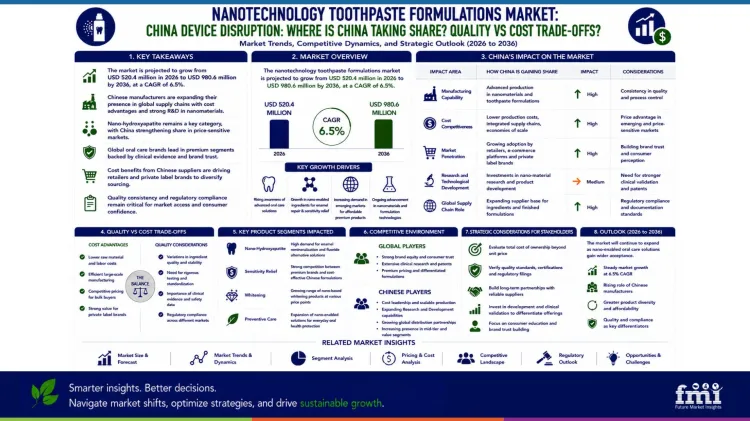
The nanotechnology toothpaste formulations market has experienced a consistent growth as increasing number of consumers are looking for advanced oral care products that can solve tooth sensitivity, enamel repair, whitening, and preventive dental health needs. During the forecast period, the market is anticipated to grow from USD 520.4 million in 2026 to USD 980.6 million by 2036, at a CAGR of 6.5%. The market development is still driven by the increasing awareness of nano-enabled ingredients and the growing demand for science-based oral care solutions.
The commercialization of nanotechnology based oral care products is making the competition among the manufacturers increasingly global. A key trend impacting the market dynamics is the increasing involvement of Chinese manufacturers in manufacturing and supplying nano-enabled toothpaste ingredients and finished formulations.
In the past, premium nanotechnology toothpaste products were predominantly marketed by multinational oral care companies and specialized dental brands from North America, Europe, Japan and South Korea. The firms attained competitive market advantages through rigorous clinical testing, advanced research capabilities and established consumer trust.
But the manufacturing ecosystem in China has evolved a lot in the past decade. Chinese suppliers have been able to move beyond low-cost production and compete more directly in higher-value segments through investments in nanomaterials research, advanced chemical processing, precision manufacturing and oral care product development.
One of the most visible areas of market share expansion is in nano-hydroxyapatite formulations. With the increasing need for fluoride substitutes and remineralization products of enamel, Chinese producers have increased the manufacturing capacity of nano-hydroxyapatite powders and toothpaste formulations. The ability to make these materials at volume has created price advantages that are driving procurement decisions by distributors, retailers and private label brands.
China also has a huge advantage in terms of cost competitiveness. Suppliers benefit from manufacturing efficiencies, integrated supply chains and access to large scale production infrastructure which allows them to manufacture at costs that are often lower than those of established international competitors. This type of pricing flexibility is particularly appealing in emerging markets where affordability is a key purchase driver.
Private label oral care brands have benefitted the most from this trend. Many retailers looking to expand premium oral care ranges without significantly raising product costs are turning to Chinese manufacturing partners. As a result, Chinese-made nanotechnology toothpaste products are becoming more and more visible in online channels, pharmacies and retail outlets across the world.
But quality considerations still play a role in purchase decisions throughout the market.
The international brands are generally better placed in premium consumer segments, with a strong clinical evidence base supporting product performance. Consumers looking for solutions for enamel repair, dentin sensitivity, whitening, and preventative oral health often look to published research, dental recommendations, and established brand names.
Regulatory compliance is also part of competitive dynamics. Each country has different requirements for nano-material disclosure, safety testing, ingredient approval and labeling standards. Regulatory expertise is often important for manufacturers to gain access to the market and to build consumer confidence.
Nano-scale ingredients also need to be controlled with respect to particle size, formulation stability and manufacturing accuracy to achieve the desired performance effects. Variations in ingredient quality can have a direct impact on product efficacy and consumer satisfaction. This is why distributors and oral care brands are putting careful scrutiny on manufacturing standards as they choose suppliers.
This is particularly the case in the sensitivity relief section, where the quality versus cost argument takes hold. Nano-hydroxyapatite based products compete head-to-head with the existing technologies of the leading global oral care brands. Budget-conscious consumers may be attracted to lower-cost options, but premium products often make a case for higher prices with stronger clinical support and documented treatment outcomes.
Whitening formulations are also competitive. Chinese manufacturers have developed a range of nano-calcium carbonate and nano-abrasive technologies that aim to improve whitening performance at affordable price points. Still, Premium brands continue to distinguish themselves on product safety profiles, controlled abrasiveness and more extensive scientific validation.
Technology development is slowly closing the gap in quality between Chinese producers and the established market leaders. Many Chinese companies are investing more in research partnerships, lab testing and intellectual property development. Thus, the improvements in the quality of products are becoming increasingly visible in several categories of nanotechnology toothpaste.
The competitive position of China is also being affected by supply chain resilience. Being able to quickly ramp up production and respond to fluctuations in market demand is a huge advantage in times of supply disruption or changing consumer tastes. Retailers and distributors are demanding more and more suppliers able to provide consistent product availability and cost control.
Further, trends in market segmentation are showing where Chinese manufacturers are gaining ground. Demand for sensitivity relief products is high, as consumers are more aware of enamel protection and treatment for dentin hypersensitivity. Chinese suppliers are also extending their footprint further in one of the key ingredient categories, nano-hydroxyapatite.
The shift is being accelerated by online and direct-to-consumer sales channels. New manufacturers can access international customers via digital platforms rather than through traditional retail distribution channels. Newer brands are growing their customer base by offering competitive pricing, running targeted marketing campaigns, and as consumers become more familiar with nano-enabled oral care products.
From a regional viewpoint, the Asia-Pacific continues to be one of the most influential markets in setting future competitive dynamics. The demand for advanced toothpaste formulations is supported by growing middle-class populations, increasing oral health awareness and adoption of preventive dental care. Chinese manufacturers are especially well positioned to exploit these regional growth opportunities.
The idea that market competition is only about product price is becoming increasingly outdated. Today the quality of ingredient, scientific data, manufacturing practices, regulatory compliance, brand reputation and the long term trust of the consumer are becoming more and more the drivers behind purchasing decisions.
The nanotechnology toothpaste formulations market is maturing and is expected to see more competition between established global brands and emerging Chinese manufacturers. Technological advancement, clinical validation, product safety and customer confidence will remain battle grounds for market leaders, while Chinese suppliers will continue to benefit from their scale, efficiency and improving technological capabilities.
Bottom Line
Growing influence of China in the nanotechnology toothpaste formulations market is altering the competitive environment across the oral care industry. Cost advantages continue to be a driving force for market share gains across a number of product categories; but, quality assurance, clinical evidence and regulatory credibility remain important purchase considerations. With the global demand for nano-enabled oral care products on the rise, manufacturers who can achieve the right balance of affordability, performance and consumer trust are poised to improve their competitive position.

