


- OEM supply accounts for 68.4% of automotive pillar demand, which makes qualification, scale, delivery reliability, and engineering support central to competitive survival.
- Large suppliers such as Gestamp Automoción, Aisin Corporation, GEDIA Automotive Group, Kirchhoff Automotive, Magna, Benteler, DURA, Martinrea, Shiloh, Futaba, and CIE Automotive shape the competitive base.
- Smaller manufacturers face pressure from minimum order volumes, quality certification requirements, regional compliance costs, and long OEM validation timelines.
- Niche opportunities remain in aftermarket repair channels, regional production, specialized tooling, low-volume platforms, customization, and specific pillar subassemblies.
- Supplier consolidation appears likely where OEMs reduce platforms, globalize sourcing, and prefer suppliers with multi-region manufacturing and co-development capability.
- Smaller pillar manufacturers can remain competitive, but only if they avoid competing directly against global Tier 1 suppliers on undifferentiated high-volume programs.
The automotive pillar market has the characteristics of a supplier consolidation category. It is OEM-led, safety-critical, capital-intensive, and tied to platform engineering. That combination naturally favors companies with scale, certifications, tooling capability, crash validation support, and long-standing customer relationships.
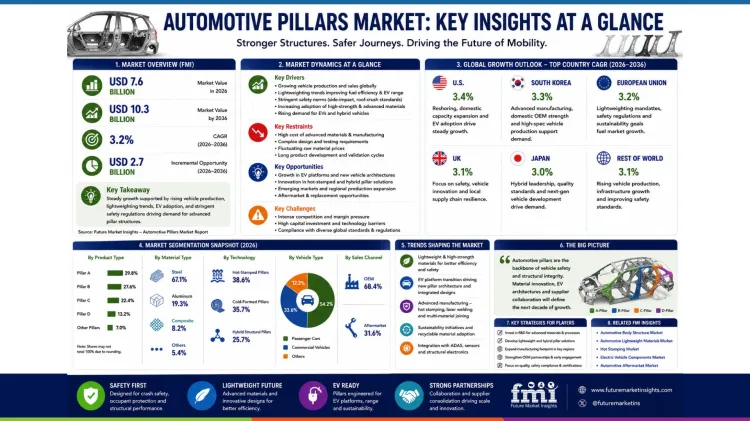
The FMI market structure makes this visible. Original equipment manufacturers account for 68.4% of sales channel demand. Passenger cars account for 54.2% of vehicle-type demand. Pillar A holds 29.8% of product-type demand. The market is therefore concentrated around high-volume passenger car platforms and direct automotive production supply.
That is a difficult environment for small manufacturers. A pillar is not a simple bracket or trim item. It is part of the body-in-white safety structure. OEMs evaluate dimensional consistency, weldability, forming quality, crash performance, coating, joining, logistics, traceability, and warranty exposure. A supplier must deliver parts repeatedly at automotive volumes, often across tight time windows and changing production schedules.
FMI explicitly notes that smaller manufacturers face barriers to entry through minimum order volumes, quality certification requirements, and the cost of maintaining multiple regional compliance standards. It also states that qualified producers serve OEM sourcing requirements and that logistics costs and lead times favor regional sourcing where quality standards permit. These points together show the operating challenge, since customers want both scale and proximity.
Gestamp Automoción is identified by FMI as a leading player, supported by manufacturing scale, technical capabilities, and established customer relationships. Aisin, GEDIA, Kirchhoff, Magna, Benteler, DURA, Martinrea, Shiloh, Futaba, and CIE Automotive are also profiled. The presence of these firms indicates that OEMs prefer suppliers able to combine product breadth, technology capability, customer access, and geographic footprint.
The reason is not only purchasing convenience. Automotive OEMs are reducing complexity across platforms. A global vehicle architecture may serve several regions and body styles. If a pillar supplier can support design, tooling, manufacturing, validation, and launch across multiple plants, the OEM lowers coordination risk. A small supplier serving one region may still win business, and the program must fit its capacity and capability.
Supplier consolidation is also driven by technology. Hot-stamped pillars, cold-formed pillars, and hybrid structural pillars require different production capabilities. Hot stamping needs furnaces, forming lines, die technology, cooling control, and quality systems. Hybrid structures may require joining dissimilar materials, adhesives, laser welding, rivets, or mechanical fasteners. As pillars become more closely tied to crash simulation and EV body architecture, OEMs are likely to favor suppliers that can co-develop rather than only manufacture.
Cost pressure adds to consolidation. FMI mentions margin compression in commodity-grade products where multiple suppliers compete on price. A smaller manufacturer may be vulnerable if it relies on standard stamped parts with little differentiation. Large suppliers can spread tooling, engineering, procurement, and compliance costs over larger volumes. They may also have better negotiating leverage for steel, aluminum, logistics, and equipment.
Certification and compliance also raise fixed costs. Automotive structural components need quality systems, material traceability, process documentation, and customer-specific requirements. Cross-border supply adds more layers. FMI refers to European Union regulations, USA federal standards, and national specifications in the USA and Japan as part of the fragmented compliance environment. Companies with existing certifications across jurisdictions hold an advantage.
Regional production can still create openings for smaller companies. Not every OEM program requires a global supplier. Local commercial vehicles, low-volume passenger variants, repair channels, specialty vehicles, and regional platforms may value local flexibility and lower overhead. In some cases, a smaller manufacturer can respond faster, customize tooling, or support short-run production more economically than a global Tier 1.
Aftermarket and repair channels offer another path. FMI includes aftermarket as a sales channel, and OEM dominates. Pillars are not replaced as frequently as wear parts, and collision repair, restoration, customization, and structural repair can create demand for pillar components or related reinforcements. Smaller companies may serve these channels if they can meet fitment and safety expectations.
Specialization may be the most practical route. A smaller manufacturer should not try to outscale Gestamp or Magna on global passenger car A-pillar programs. It may instead focus on one or two areas such as specialized hot-stamped reinforcements, regional commercial vehicle pillars, EV prototype support, low-volume specialty vehicle structures, aftermarket crash repair parts, or tooling and subassembly partnerships.
Partnerships can also matter. Smaller manufacturers may become sub-suppliers to larger Tier 1s rather than direct OEM suppliers. They can provide stampings, reinforcements, brackets, welded subassemblies, or regional capacity. This reduces direct customer access and may provide steadier volume if the Tier 1 relationship is strong.
The EV transition creates both threat and opportunity. EV platforms raise engineering requirements and can favor large suppliers. New vehicle programs, startup OEMs, regional EV platforms, and specialty electric commercial vehicles may also create entry points. Smaller suppliers with flexible engineering and rapid prototyping can support early-stage programs before volumes scale.
South Korea and the USA are useful examples. FMI identifies the USA as the fastest-growing market at 3.4% CAGR and South Korea at 3.3%. The USA outlook is linked to reshoring, domestic capacity expansion, and supply chain diversification. South Korea demand is supported by advanced manufacturing, domestic OEM relationships, and high-specification requirements. In both markets, smaller suppliers may benefit if they bring certified local capacity or specialized technical support.
A frequent assumption in consolidation discussions is that smaller suppliers simply disappear. The automotive supply base rarely works that cleanly. Some small suppliers exit. Some are acquired. Some move into niches. Some become sub-suppliers. Some invest in one advanced capability and become valuable in a narrow segment. The deciding factor is whether they offer something beyond generic capacity.
For an automotive pillar supplier, something beyond capacity can mean a certified local plant, rapid tooling, hot-stamped expertise, multi-material joining, competitive regional labor cost, specialty vehicle relationships, aftermarket access, or customer engineering support. Without one of these, price becomes the only lever, and price-only competition is hard to sustain.
The most likely market pattern is a two-tier structure. Global Tier 1 and large Tier 2 suppliers will dominate high-volume OEM programs. Smaller manufacturers will remain active in regional, specialty, repair, and subassembly roles. The middle tier that lacks scale and lacks specialization is most exposed.
From a strategic standpoint, smaller suppliers should decide whether they want to scale, specialize, or partner. Trying to do all three without capital can weaken focus. Scaling requires investment in equipment, quality systems, and customer acquisition. Specialization requires technical differentiation. Partnership requires reliability and process discipline.
The market does not close the door on smaller pillar manufacturers. It narrows the door. Competitive survival depends on choosing the right entry point and avoiding direct comparison with global suppliers on the programs where scale, certifications, and platform engineering dominate purchasing decisions.

