


- Animal feed additives are not judged only by active ingredient promise; they must survive mixing, pelleting, storage, transport, and on-farm handling.
- FMI identifies powder as the leading form in the Animal Feed Additives Market, reflecting the importance of industrial premix and dry-blending compatibility.
- Technological additives lead the type segment because feed stability, preservation, and bulk storage quality remain core commercial requirements.
- Pelleting temperature, moisture, shear, and storage conditions can reduce the efficacy of sensitive enzymes, probiotics, vitamins, acids, and natural additives.
- Encapsulation, carrier selection, coating systems, and post-pellet application can convert a strong ingredient into a reliable feed-mill solution.
- The misconception to avoid is that additive performance is proven at purchase. In reality, performance must hold after processing and through the feeding event.
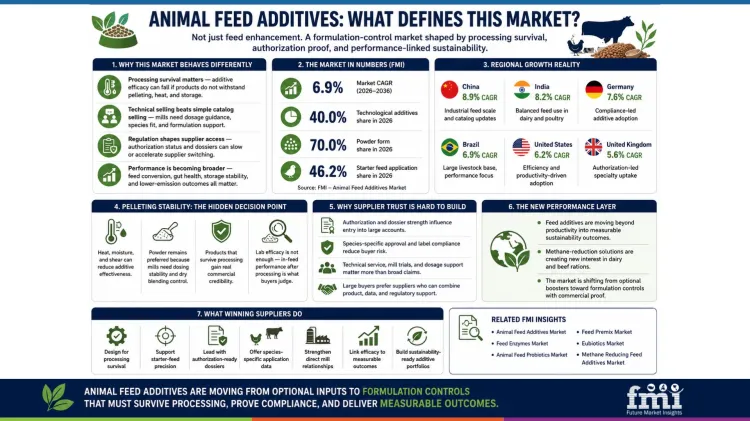
Animal feed additives are often marketed around their functional promise: better digestion, stronger gut health, improved feed conversion, higher palatability, better preservation, or more consistent nutrient delivery. That promise matters, but it is not enough. In the Animal Feed Additives Market, the practical question is whether the additive still works after it passes through the feed mill, premix plant, storage system, and farm-level feeding routine.
This is why a practical pelleting-stability angle fits the market better than a generic growth or brand-share angle. Feed additives are not shelf products purchased for a visible consumer experience. They are technical inputs that must be blended accurately into feed and remain functional under industrial conditions. A probiotic that loses viability during pelleting, an enzyme that deactivates under heat, a vitamin that oxidizes during storage, or an acidifier that creates handling problems may look strong on paper but weak in commercial use.
FMI frames the Animal Feed Additives Market around livestock and aquaculture nutrition programs that are increasingly focused on feed efficiency, health, and stability. FMI also identifies powder as the leading form, which is commercially logical. Powder formats fit existing dry-blending and premix infrastructure, allow controlled dosage, reduce liquid-handling complexity, and suit high-throughput feed mills. For many buyers, a powder additive is not preferred because it is fashionable; it is preferred because the plant is designed around it.
The same FMI view identifies technological additives as the leading type segment. This reinforces the operational nature of the market. Preservatives, stabilizers, and feed-quality protection systems are important because stored feed is exposed to moisture, heat, oxidation, microbial pressure, and handling damage. Feed mills and integrators cannot treat additives as optional extras when the final feed must remain consistent from manufacturing to consumption.
Pelleting is the most important stress point. Feed mills use heat, pressure, moisture, and mechanical shear to produce pellets that are easier to transport, store, and consume. This process improves feed handling and can reduce segregation, but it creates a harsh environment for sensitive additives. Enzymes can lose activity. Probiotics can lose viability. Vitamins can degrade. Organic acids and essential oils can volatilize or interact with carriers. Natural pigments and botanicals can weaken if not protected. The relevant question is not only what the additive does in isolation; it is what remains active after pelleting.
The Feed Enzymes Market is a useful related reference because enzymes show this issue clearly. Enzyme suppliers do not win only by claiming digestibility improvement. They must prove that activity survives processing and produces measurable results in the animal. Phytase, carbohydrase, protease, and multi-enzyme systems are valuable only if they retain sufficient activity at the point of digestion. This is why thermostability, coating quality, activity units, species fit, and substrate availability matter as much as the enzyme name.
The Animal Feed Probiotic Market creates a similar challenge. Probiotics depend on viable organisms or defined microbial performance. If the organism does not survive feed manufacturing, storage, or the gastric environment, the commercial value declines. This is why spore-forming strains, encapsulation, protective carriers, and careful application timing matter. A probiotic claim that does not translate into viable delivery is not a feed-mill solution; it is a formulation risk.
Prebiotics, eubiotics, acidifiers, and palatability enhancers also need process fit. The Animal Feed Prebiotics Market and Eubiotics Market are linked to gut-health strategies, but adoption depends on how these ingredients behave in the complete feed. Some acids can affect palatability. Some botanical blends can have strong odors. Some fiber or prebiotic systems can change flowability. Some natural additives may interact with other premix components. A feed additive must be technically effective and operationally manageable.
Formulation teams should therefore evaluate additives through a processing-survival lens. The checklist should include heat tolerance, moisture sensitivity, particle size, dusting risk, flowability, compatibility with carriers, segregation behavior, storage stability, and dosage uniformity. A high-value micro-ingredient that cannot be mixed evenly creates performance inconsistency across the flock, herd, or pond. In large operations, small dosing errors can create meaningful biological and financial effects.
Encapsulation and delivery technologies are becoming more important for this reason. Coatings can protect sensitive actives during pelleting and release them later in the digestive tract. Carriers can improve flow, reduce dust, and support accurate dosing. Microencapsulation can protect acids, essential oils, vitamins, probiotics, enzymes, and pigments from premature degradation. Post-pellet liquid application can also be useful where heat sensitivity is severe, although it requires capital equipment and process control.
The Feed Premix Market is relevant because many feed additives reach the final ration through premix systems. Premixes help manage trace inclusion rates, but they also create compatibility challenges. Vitamins, minerals, enzymes, acids, probiotics, binders, flavors, and pigments may sit together before being blended into compound feed. The premix must remain stable, free-flowing, and accurately dosed. Supplier support is important because the interaction between ingredients can matter more than the ingredient specification alone.
The strongest suppliers are those that help customers validate performance in real processing conditions. Laboratory activity data is useful, but feed mills need plant-level proof. Can the additive survive the customer's pelleting temperature? Does it remain stable after 60 or 90 days of storage? Does it distribute evenly in the mixer? Does it create dust or handling problems? Does it remain effective in mash, pellet, crumble, or extruded feed? These are the questions that decide repeat contracts.
The misconception to avoid is that animal feed additive performance is fully proven at purchase. It is not. Additives are purchased before they face the most important test: processing and delivery. A lower-cost additive that loses activity in the mill can be more expensive than a premium additive that survives processing and improves field results.
Bottom line: animal feed additive value depends on processing survival. The winners will be suppliers that prove stability through pelleting, premixing, storage, and feeding, rather than suppliers that rely only on ingredient claims.

