


- Fish protein is gaining strategic importance not because fish raw material is scarce, but because food-grade conversion capacity is limited.
- The real bottleneck is the ability to convert fish side streams into low-odor, soluble, stable, and application-ready protein isolate, hydrolysate, and concentrate.
- Powder formats are becoming commercially important because they support shelf-stable distribution, supplement blending, pet food use, aquafeed mixing, and food formulation flexibility.
- Fish protein hydrolysate is the most processing-sensitive category because enzyme control, peptide profile, bitterness management, and drying consistency directly affect end-use performance.
- Suppliers with advanced hydrolysis, deodorization, filtration, drying, and grade-separation capabilities are likely to gain stronger pricing power than basic marine by-product processors.
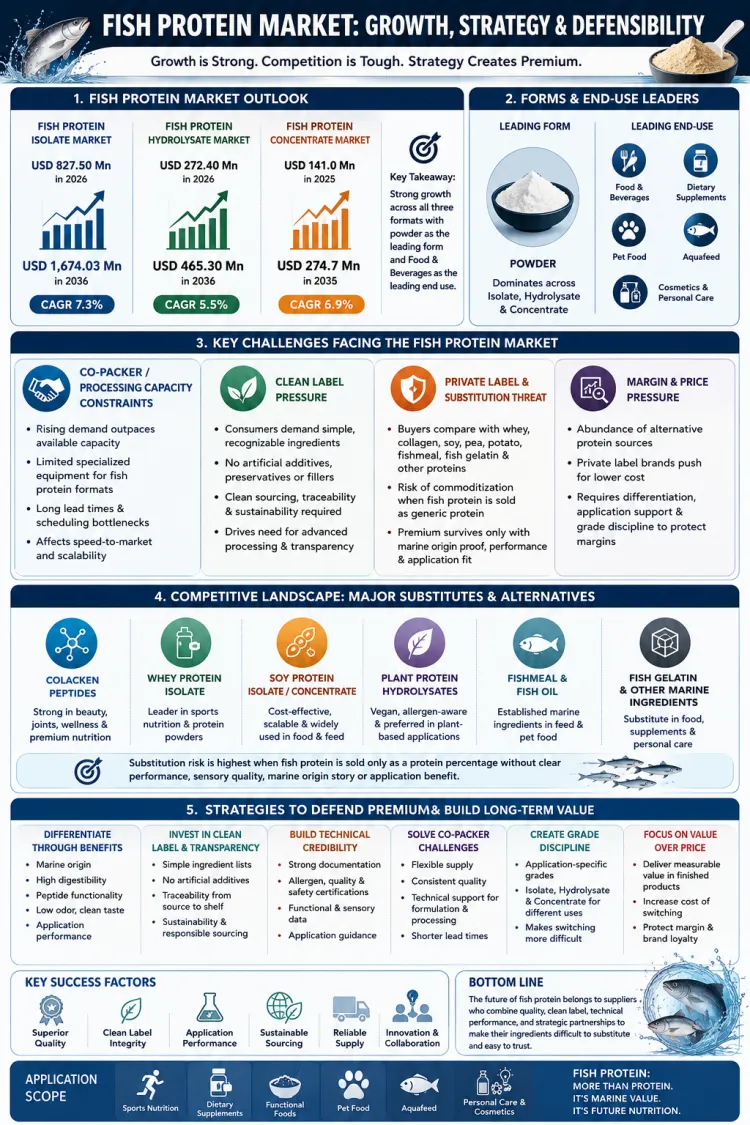
Fish protein is entering a more technically disciplined phase of growth. The market is no longer driven only by the availability of fish raw material or seafood processing by-products. The sharper question is now: which suppliers can convert marine raw material into food-grade, low-odor, soluble, stable, and consistent protein ingredients that brands can use confidently?
This is an important shift. In the earlier stage of marine protein valorization, the focus was largely on recovering value from fish processing side streams. Today, the market is moving toward higher-value conversion. Fish protein isolate, fish protein hydrolysate, and fish protein concentrate are not simple by-product outputs. They are processed ingredient systems. Their value depends on how well they perform in finished applications such as food and beverages, dietary supplements, sports nutrition, pet food, aquafeed, cosmetics, and personal care.
FMI’s Fish Protein Isolate Market shows that this category is already moving into higher-value applications. The market is projected to expand from USD 827.50 million in 2026 to USD 1,674.03 million by 2036. FMI also identifies powder as the leading form and food and beverages as the leading end-use industry. That matters because isolate demand is not only about protein concentration. It is about producing a clean, shelf-stable, formulation-ready powder that can work in consumer-facing products.
The same logic appears in FMI’s Fish Protein Hydrolysate Market. The market is projected to grow from USD 272.40 million in 2026 to USD 465.30 million by 2036. FMI identifies enzymatic hydrolysis as the leading technology and powder as the leading form. This is directly relevant to processing capacity because hydrolysate quality depends on controlled enzyme processing, peptide profile management, bitterness reduction, solubility, and drying stability. A processor cannot create premium hydrolysate simply by increasing throughput. It must control the conversion process.
Fish protein concentrate also supports the same capacity story. FMI’s Fish Protein Concentrate Market is projected to grow from USD 141.0 million in 2025 to USD 274.7 million by 2035, with powder leading the form segment. Concentrate is often positioned between isolate and hydrolysate in terms of processing intensity, but it still requires strong drying, odor control, protein standardization, and grade management. This makes processing depth a key value driver across the full fish protein portfolio.
The central issue is that fish protein demand is becoming more sophisticated than basic processing capacity. Many seafood-producing regions have fish raw material. Many processors can produce fishmeal, fish oil, or lower-grade marine ingredients. But far fewer can produce food-grade fish protein ingredients with consistent sensory quality, solubility, microbial safety, documentation, and batch-to-batch reliability.
This is where the co-packer and processing-capacity constraint becomes important. A brand may want to launch a marine protein powder, pet nutrition product, protein-enriched food, or functional supplement, but it may not own the required fish protein processing infrastructure. It must rely on specialized ingredient processors, marine protein suppliers, or co-packers that can handle fish-based ingredients without creating odor, taste, stability, or safety issues.
Fish protein is more difficult to process than many plant or dairy proteins because it carries stronger sensory risk. Fish odor, oxidation, bitterness, and marine aftertaste can limit use in finished products. A fish protein ingredient may look strong on a specification sheet, but if it performs poorly in a beverage, powder blend, pet food coating, nutritional bar, capsule, or ready meal, the commercial value drops quickly.
This means the real bottleneck is not only production volume. It is usable production volume. The market needs fish protein that is clean enough for premium applications, stable enough for distribution, and consistent enough for industrial formulation. This creates a clear difference between commodity marine ingredient capacity and premium food-grade fish protein capacity.
Hydrolysate capacity is especially constrained because controlled hydrolysis is technically demanding. The processor must manage enzyme type, reaction time, pH, temperature, degree of hydrolysis, peptide size, bitterness, solubility, and drying conditions. Small process variations can change the final ingredient’s taste, digestibility, bioactivity, and formulation behavior. For this reason, fish protein hydrolysate is not a simple scale game. It is a process-control game.
This is why enzymatic hydrolysis becomes a strategic capability. It allows suppliers to create differentiated hydrolysate grades for aquafeed, pet food, supplements, functional food, and personal care. However, each application has different requirements. Aquafeed may prioritize palatability and growth performance. Pet food may prioritize digestibility and hypoallergenic positioning. Supplements may require neutral taste, peptide positioning, and clean-label documentation. Food and beverage applications may require the strictest sensory and solubility profile.
Powder capacity is another hidden constraint. Powder is commercially attractive because it is easier to store, ship, blend, dose, and formulate. It supports dry premixes, capsules, protein powders, pet food applications, aquafeed systems, and functional food formats. But producing stable fish protein powder requires controlled drying. Poor drying can affect odor, color, solubility, flowability, oxidation, shelf life, and protein functionality.
Spray drying and other controlled drying systems therefore become important value-chain assets. A processor that can produce stable, low-odor, shelf-ready powder can serve a much wider customer base than a supplier limited to crude, liquid, paste, or inconsistent dry forms. This explains why powder leadership across fish protein isolate, hydrolysate, and concentrate is commercially meaningful. It reflects the need for scalable, globally distributable ingredient formats.
Odor and taste management decide premium access. In fish protein, nutrition alone is not enough. A finished-product brand will not pay a premium for an ingredient that requires heavy masking, creates marine aftertaste, or destabilizes the product. Premium pricing depends on whether the fish protein can enter a formulation without damaging the consumer experience.
This creates a strong processing requirement. Suppliers must manage raw material freshness, fat removal, oxidation control, deodorization, filtration, hydrolysis conditions, drying parameters, and packaging. The more advanced the application, the stricter the requirement. Sports nutrition and dietary supplements need clean sensory performance. Pet food needs palatability and digestibility. Aquafeed needs functional performance and cost-in-use. Cosmetics and personal care need purity, consistency, and marine-origin positioning.
Food-grade separation is also becoming essential. Fish protein cannot be treated as one uniform output across feed, pet food, supplements, food, and cosmetics. Each end-use requires different documentation, specifications, safety standards, and quality expectations. As the market matures, suppliers will need to define clear product grades: feed-grade, pet food-grade, food-grade, supplement-grade, and personal care-grade fish protein.
This grade separation creates another capacity challenge. A processor may have total production capacity, but only part of that capacity may be suitable for premium food or supplement applications. This means headline capacity numbers can be misleading. What matters is how much controlled, documented, food-grade, application-ready capacity is actually available.
For co-packers, fish protein creates both opportunity and risk. The opportunity is that more brands will need partners capable of handling marine protein ingredients. The risk is that fish protein requires stronger controls than basic dry blending. Co-packers need allergen management, odor containment, cleaning protocols, moisture control, packaging stability, and formulation experience. Not every protein powder co-packer is suitable for fish protein.
This creates pricing power for specialized processors and co-packers. If a supplier can offer hydrolysis expertise, odor control, powder stabilization, application support, and documentation, it becomes more than a raw material vendor. It becomes a formulation partner. This is where margin can improve.
For brands, the capacity constraint changes procurement strategy. They cannot treat fish protein as a simple interchangeable commodity. Supplier qualification becomes critical. Brands need to evaluate the processor’s technology, species sourcing, sensory profile, batch consistency, documentation, food safety systems, and application support. If capacity is limited, brands may need longer-term supply agreements or early supplier engagement before commercial launch.
For fish protein suppliers, the key strategic shift is from volume-led selling to specification-led selling. Selling more tonnes of marine protein is not enough if the ingredient cannot meet premium customer requirements. The stronger opportunity is to build differentiated product grades with clear end-use fit. A hydrolysate for aquafeed should not be positioned the same way as a hydrolysate for supplements. A concentrate for feed should not be treated the same as a food-grade concentrate. An isolate for sports nutrition must meet different requirements from a general industrial protein powder.
Regional dynamics also matter. Seafood-producing regions may have strong access to raw material, but value capture depends on conversion infrastructure. Regions with only primary processing may remain lower-value suppliers. Regions with advanced hydrolysis, filtration, drying, quality control, and export documentation can capture higher-value demand. This creates a two-layer market: raw material regions and advanced conversion hubs.
The connection with fishmeal and fish oil is also important. Fishmeal and fish oil are large established marine ingredient categories, but fish protein isolate, hydrolysate, and concentrate represent a more specialized value route. Instead of only supplying bulk feed markets, processors can upgrade marine protein into more targeted applications. This does not replace fishmeal, but it creates a premium pathway for selected raw materials and side streams.
The pet food opportunity reinforces the capacity constraint. FMI’s Pet Food Ingredients Market shows strong demand for animal-derived ingredients and commercial pet food applications. Fish protein hydrolysate and concentrate can benefit from premium pet food trends because pet owners increasingly look for digestible, recognizable, high-quality animal proteins. However, pet food producers also need consistent palatability, stable supply, and clear specifications. This again favors processors with technical control.
The aquafeed angle is equally important. Fish protein hydrolysate can support palatability, amino acid availability, and functional feed performance. But aquafeed customers are highly cost-sensitive and performance-driven. Suppliers must prove not only that the ingredient is marine-derived, but that it delivers measurable value in feed systems. Processing consistency becomes essential because inconsistent hydrolysate quality can affect feed performance and customer trust.
The misconception to avoid is that fish protein capacity is automatically available wherever fish processing exists. That is not true. Raw material availability does not equal premium ingredient capacity. A seafood processing region may generate large volumes of fish side streams, but without hydrolysis, deodorization, drying, filtration, and food-grade systems, that raw material may not become high-value fish protein.
Another misconception is that capacity expansion means only building larger plants. In this market, capacity expansion also means building better process control. The market needs more controlled enzymatic hydrolysis, better powder drying, stronger odor management, grade separation, traceability, and application testing. A smaller facility with stronger technical capability may capture better margins than a larger facility producing inconsistent commodity-grade material.
Bottom line: the fish protein market’s processing-capacity constraint is becoming one of the most important pricing and growth factors. The market has access to marine raw material, but premium growth depends on the ability to convert that raw material into clean, stable, soluble, low-odor, and application-ready protein ingredients. In fish protein, processing is not a back-end operational function. Processing is the main value-creation step.
The companies that win will not simply be the companies with access to fish. They will be the companies that can control conversion. Hydrolysis capability, powder stability, deodorization, food-grade separation, and application support will decide who captures premium demand. In the fish protein market, the real bottleneck is not fish supply. The real bottleneck is high-quality processing capacity.

