


- The movement of prices is largely affected by biology, economics of production, and supply rather than demand for shrimps in the international market.
- Diseases continue to be the most important cause of unpredictable price changes in the international shrimp market.
- The cost of feed, weather interference, trade policies, and focus on exports can sometimes affect shrimp prices more than the consumption pattern.
- The integrated producer, diverse exporter, and technology-oriented farm will better cope with the price volatility compared to those with single geographical focus.
- The greatest misunderstanding about the market concerns demand, with the assumption being that increased demand for seafood leads to an increase in shrimp prices.
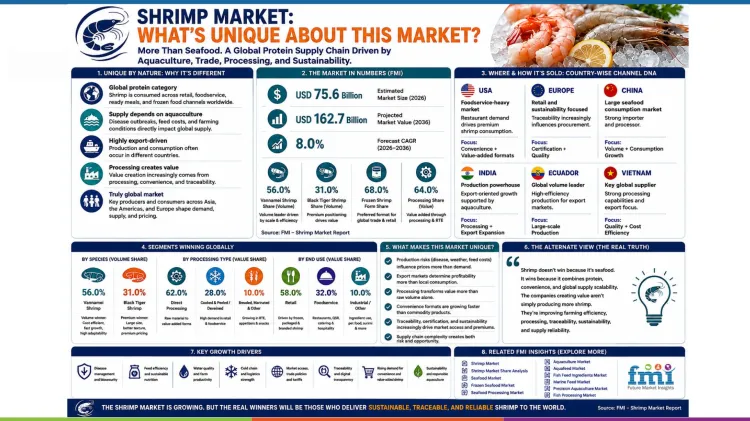
The global Shrimp Market has become one of the most dynamic segments within the broader seafood industry. Demand continues to expand across retail, foodservice, and export channels, supported by growing protein consumption, rising disposable incomes, and increasing consumer interest in seafood-based diets.
Nonetheless, in spite of such positive demand factors, shrimp prices continue to be exceptionally volatile.
This is often not understood by purchasers. Consumers presume that high demand should lead to stability. The producers think the same way due to the increasing world consumption, which, according to them, should translate into consistent conditions on the market. Buyers think that higher demand for fish products should automatically mean good prices.
Unfortunately, it is rarely the case.
In contrast to other segments of packaged goods, prices in the shrimp industry are highly dependent upon biological production cycles. Any unexpected event like an outbreak of diseases, increased costs of feed, weather changes, political shifts, and so forth can create unstable conditions on the market faster than customers change their demands.
Understanding this distinction is becoming increasingly important for participants throughout the broader Seafood Market, where supply-chain resilience is emerging as a competitive advantage.
Disease Outbreaks Are Still the Industry's Biggest Pricing Shock
Disease would probably top the list if there was a single variable capable of driving shrimp prices upwards in a matter of days.
Shrimp production operations are still prone to biological issues which could lead to a quick decline in volumes being produced. Diseases like Early Mortality Syndrome (EMS), White Spot Syndrome Virus (WSSV), Acute Hepatopancreatic Necrosis Disease (AHPND), among others, are still occurring in the shrimp-producing areas of the world.
Whenever a disease outbreak happens, its effects can be felt immediately.
Producers may see reduced mortality rates, slower growth cycles, lesser harvest volumes, and even higher production costs. The same goes for exporters who might have problems meeting up with contractual obligations. The processors will likely run out of raw materials while importers will suddenly be competing for a limited supply.
And all these contribute to increased prices.
It is important to understand here that when dealing with disease, the response capacity of producers is minimal. It simply takes a lot more time before shrimp production levels can be raised.
In comparison to poultry or some other land-based protein producer, the shrimp farmers have little room to act.
This challenge is one reason the Precision Aquaculture Market is attracting increasing investment. Technologies focused on water-quality monitoring, automated feeding, predictive analytics, disease detection, and farm management are becoming critical tools for reducing biological risk.
The ability to detect problems before they become production disasters is increasingly becoming a pricing advantage.
Feed Economics Quietly Shape Global Shrimp Prices
- While disease outbreaks receive most of the attention, feed costs are often the more persistent source of pricing pressure.
- Feed represents one of the largest operating expenses in shrimp aquaculture. Consequently, developments in the Aquafeed Market have direct implications for shrimp production economics.
- When feed costs increase, farmers face difficult decisions.
- They may reduce stocking densities. They may delay expansion projects. They may harvest earlier than planned. Some producers may temporarily exit production altogether if margins become unsustainable.
- Each of these decisions ultimately affects supply.
- Unlike disease outbreaks, which create sudden shocks, feed inflation tends to create slower-moving but equally important disruptions. Production growth becomes constrained, expansion slows, and overall supply becomes less responsive to rising demand.
- The situation becomes even more complex when examining developments in the Fish Feed Ingredients Market. Fishmeal, soy proteins, algae-based ingredients, specialty additives, and other feed components all influence the cost structure of shrimp farming.
- Changes in ingredient availability or pricing can ripple throughout the shrimp value chain.
- The same applies to the Marine Feed Market, where fluctuations in raw materials can significantly affect production costs across major aquaculture regions.
- The result is a market where feed economics quietly shape pricing long before consumers notice changes at retail shelves.
Climate and Weather Are Becoming Structural Risks
- In the past, weather disturbances used to be considered transient occurrences.
- This view is no longer the case.
- Weather has become a key determinant in shrimp farming.
- Factors like flooding, drought, temperatures, cyclones, variations in salinity levels, and poor water quality have become common in shrimp production.
- While diseases tend to affect small sections within the industry, weather disturbances may have wide-reaching effects, affecting large segments in a single region.
- Heavy rainfall and hurricanes may destroy ponds, equipment, transport systems, and processing centers.
- Drought may have adverse effects on productivity in the area.
- Since shrimp is sold globally, weather disturbance in one producing region affects production around the world.
- Producers who cannot get enough from one supplier will turn to other suppliers.
- These dynamics are becoming increasingly relevant across the broader Aquaculture Market, where climate adaptation is moving from a sustainability discussion to a profitability discussion.
Trade Policies Can Reshape Pricing Overnight
- One of the biggest overlooked factors for price fluctuations of shrimp is the trade policies that affect them.
- Shrimps belong to one of the topmost internationally traded sea foods in the world.
- The production and consumption of shrimps are usually geographically different from each other, thus the importance of trade for the functioning of their market becomes paramount.
- There is an inherent danger here.
- Policies on tariffs, restrictions on imports, anti-dumping regulations, policy decisions, etc., can play an important role in the pricing of their markets.
- One particular policy decision affecting just one major exporter can completely alter the global market of trade for these goods.
- Consumption patterns will change. Shrimp producers may change where their produce goes. Manufacturers of shrimps may have to adjust to new competitive pressures.
- Such changes will often lead to temporary supply shocks and hence influence prices.
- However, these events happen completely independent of customer demand.
- While customers in the market may buy shrimps in regular quantity, there might be a lot happening in the rest of the world which will cause pricing problems.
Frozen Shrimp Is Changing How Volatility Is Managed
- The expansion of the Frozen Seafood Market has changed how the industry responds to volatility.
- Inventories that are frozen serve as a very good hedge against sudden interruptions.
- There are many different parties including processors, exporters, distributors, and retailers who can rely on inventory when dealing with any form of instabilities.
- However, inventory should not be viewed as a long-term solution.
- Any prolonged cases of diseases, feed inflation or reduction in production will definitely lead to low inventories, thus prompting changes in prices within a very short while.
- Frozen fish therefore serves both as a stabilizing agent and an early indicator.
- A high level of inventories will mask any issues of supply, while low inventories are usually an indication of future price hikes.
Why Processors Experience Volatility Differently
- Not every participant in the shrimp value chain experiences volatility in the same way.
- Companies operating within the Fish Processing Market and broader Seafood Processing Market often face a different set of challenges than farmers.
- Processors face dual risk factors, supply and demand, at once.
- As prices go up, cost of raw material goes up. As prices drop, value of inventory may come down. Management of margins becomes more challenging.
- This is part of the explanation for why some big processors go for diversification.
- Having access to a variety of production zones can help mitigate local problems. Vertical integration helps with supply chain visibility. Having long term supplier relationship will help mitigate volatility periods.
- Volatility management is becoming an essential competitive advantage for some of the best processors.
The Winners and Losers During Volatility
Volatility does not affect all market participants equally.
The winners are typically:
- Integrated producers with farming, processing, and distribution capabilities.
- Exporters sourcing from multiple production regions.
- Companies investing in disease management and farm technology.
- Businesses with strong cold-chain and inventory management capabilities.
The losers are often:
- Single-country sourcing models.
- Small producers with limited access to capital.
- Companies heavily exposed to spot-market procurement.
- Businesses lacking supply-chain diversification.
As volatility increases, operational resilience becomes more valuable than scale alone.
The Biggest Misconception
- One of the major misconceptions about shrimp prices is that they depend mainly on consumer demand.
- This is because logically speaking, it seems to make sense but does not consider the process through which shrimp is obtained.
- Demand by consumers evolves slowly over time. Supply chains can be disrupted instantaneously.
- The spread of diseases might bring down production instantly. Policies and regulations can affect supplies in just one day. Weather conditions could cause problems within the day itself.
- Such incidents tend to impact prices even before the shift in demand by consumers takes place.
- Demand affects long-term growth in markets.
- Supply impacts short-term price fluctuations.
Bottom Line
- Future shrimp prices will be decided less by what consumers demand than by how well the industry controls supply risks.
- Outbreaks, higher feeds costs, weather events, trade restrictions, and economic considerations will keep shaping market dynamics in the world’s Shrimp Market.
- Firms that focus on diversification, biosecurity, precision farming, feed conversion, and logistics efficiency will be best prepared for future market volatility.
- Low costs do not mean everything.
- Being best able to control uncertainty is what counts.
- Volatility is not an abnormality in the shrimp market.
- It has become the norm.
Related FMI Reports

