


- Textured protein capacity is no longer only about who can supply soy, pea, wheat, or fava protein; it is about who can reliably texturize it at scale.
- Co-packer and extrusion partner selection is becoming a strategic decision because texture, hydration, bite, and cooking stability decide repeat use in plant-based meat, hybrid meat, ready meals, and industrial food formats.
- FMI’s Texturized Vegetable Protein Market shows that industrial end use dominates demand, confirming that B2B processors, not only retail-facing brands, are shaping capacity requirements.
- The strongest partners are those that combine extrusion technology, raw material flexibility, specification control, documentation, and application support.
- The biggest risk is assuming that all textured protein suppliers are interchangeable. In reality, poor extrusion consistency can increase reformulation cycles, production losses, sensory failure, and buyer switching.
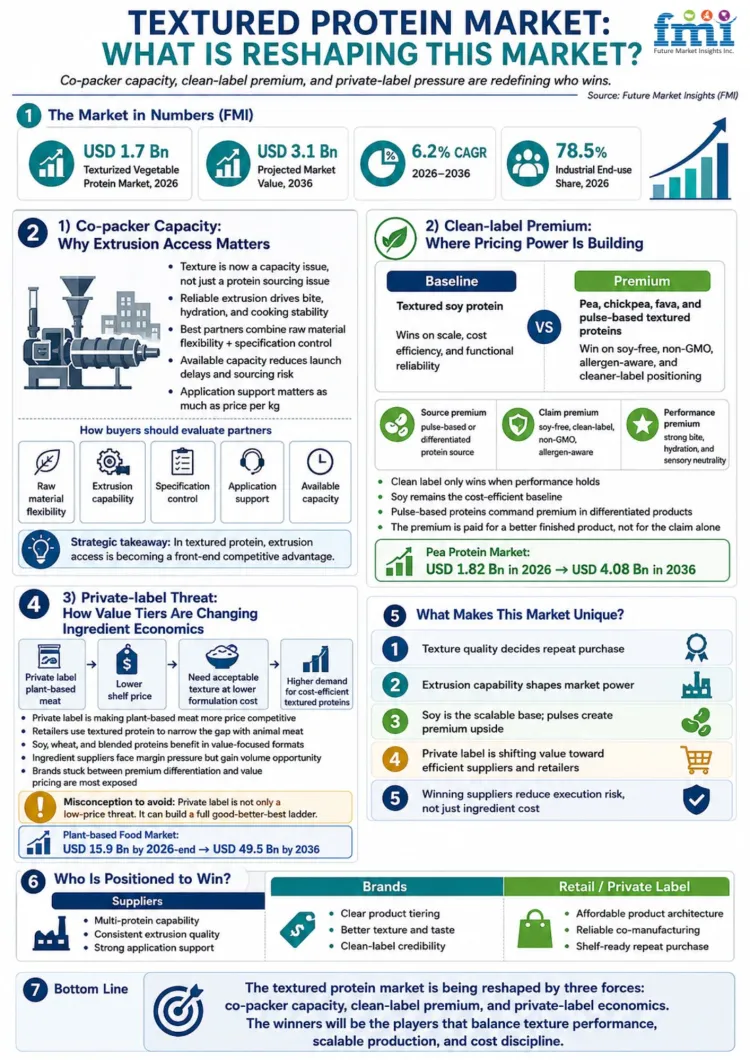
Textured protein is moving from a commodity ingredient decision to a capacity and execution decision. The market is no longer asking only, “Which protein source should we use?” The sharper question is now: which supplier, extrusion partner, or co-packer can deliver the same texture, hydration, bite, and process performance again and again across commercial-scale batches?
This matters because textured protein is not bought like ordinary protein powder. A powder ingredient can be evaluated through protein content, solubility, flavor, and cost. Textured protein has a more demanding job. It must carry structure. It must rehydrate predictably. It must survive cooking. It must create chew, bite, and fibrous mouthfeel. It must perform in patties, nuggets, mince, fillings, ready meals, dry mixes, and hybrid meat systems. That is why co-packer capacity is becoming one of the most important competitive questions in the textured protein market.
FMI’s Texturized Vegetable Protein Market confirms the scale and direction of the opportunity. The market is expected to move from USD 1.7 billion in 2026 to USD 3.1 billion by 2036, expanding at a 6.2% CAGR. More importantly, FMI identifies industrial end use as the leading demand area, with 78.5% share in 2026. This shows that the market is heavily shaped by food processors, ingredient buyers, and B2B manufacturers that need dependable production systems, not only brand-level plant-based positioning.
The co-packer capacity issue becomes even clearer when textured protein is placed inside the wider plant-based protein ecosystem. FMI’s Plant-Based Protein Market includes textured protein as a defined form, along with isolates, concentrates, hydrolysates, and blends. It also identifies texturizing as a functional role, which means textured protein is not just a nutrition input; it is a structure-building ingredient. In practical terms, brands and food manufacturers are not buying only protein grams. They are buying processing reliability.
This is why extrusion access is becoming a strategic advantage. Extrusion decides whether soy, pea, wheat, fava, chickpea, rice, or blended proteins can be converted into usable textured formats. The same raw material can perform differently depending on extrusion conditions, moisture control, particle size, protein concentration, thermal history, and post-extrusion drying. A weak extrusion partner can turn a promising protein source into an inconsistent ingredient. A strong partner can make a difficult formulation commercially usable.
For plant-based meat companies, this is especially important. FMI’s Plant-Based Meat Market shows that the category continues to expand across retail shelves, foodservice menus, and QSR-style applications. Plant-based meat products are expected to replicate the taste, texture, and nutritional profile of animal-based meat, which raises the pressure on textured protein inputs. If the texture is poor, the brand cannot hide behind a sustainability or vegan claim. The product fails at the eating experience.
For hybrid meat processors, textured protein capacity is also valuable. FMI notes that food processors use texturized vegetable protein to manage animal protein cost exposure across value food formats. This creates demand beyond pure vegan and vegetarian products. Processors can combine plant protein with conventional meat systems to improve yield, manage cost, and create more affordable protein products. In this use case, the co-packer must deliver predictable bulk functionality rather than only clean-label storytelling.
The first decision criterion is raw material flexibility. A strong textured protein partner should not be limited to one protein source unless the buyer specifically needs that source. Soy remains important because it is familiar, scalable, and widely used. However, buyers are increasingly evaluating pea, wheat, fava, chickpea, and blended proteins depending on claim requirements, allergen positioning, cost, and regional availability. A co-packer with broader raw material handling capability gives the buyer more room to adjust formulation strategy.
The second decision criterion is extrusion capability. Not all extrusion capacity is equal. Basic dry extrusion may be suitable for granules, chunks, mince, and crumbles. More advanced systems may be needed for fibrous structures, higher-moisture formats, and meat-like bite. For food manufacturers, the practical question is not simply whether a supplier has an extruder. The question is whether the supplier can produce the right texture for the intended application and repeat it across batches.
The third decision criterion is specification control. Textured protein buyers need consistency in bulk density, hydration ratio, particle size, moisture, protein level, color, flavor neutrality, and cooking behavior. If one batch absorbs water differently from the next, downstream production becomes unstable. If the particle size changes, a nugget, patty, or filling can lose its expected bite. If color varies, the finished product may require reformulation. Co-packers with strong quality systems reduce these risks.
The fourth decision criterion is application support. FMI’s broader plant-based protein analysis highlights that suppliers with stronger application support and dependable raw material access are expected to strengthen their position. This is directly relevant to textured protein. Buyers do not only need a product list; they need help translating textured protein into finished product performance. A supplier that can support hydration trials, seasoning interaction, binding systems, cooking loss, shelf-life behavior, and sensory adjustment is more valuable than a supplier that only offers price competitiveness.
The fifth decision criterion is available capacity. High utilization can give a co-packer pricing power, but it can also create lead-time pressure. Low utilization may create pricing flexibility, but it may also indicate weak technical demand or inconsistent customer retention. For textured protein buyers, the ideal partner is not always the lowest-cost partner. It is the partner with enough available capacity to support scale-up without forcing the brand into constant rescheduling, reformulation, or emergency sourcing.
This is where capacity metrics become useful. Buyers should track utilization rate, available capacity, contract length trend, technology adoption, and single-source dependency. A textured protein co-packer operating near full utilization may prioritize larger contracts and charge stronger premiums. A partner with meaningful open capacity may be more flexible, but buyers must check whether the available capacity is attached to the right technology, protein source, and quality system. Capacity is useful only when it matches the product requirement.
Single-source dependency is another risk. If a brand relies on one extrusion partner for a critical textured protein input, supply disruption can immediately affect finished product availability. This is especially risky when the product depends on a unique particle size, custom blend, or proprietary texture. Multi-source qualification can reduce risk, but it also requires tighter specification management. The brand must ensure that two partners can produce similar performance, not just similar ingredient labels.
Contract length is becoming more important as well. Short contracts give buyers flexibility but may weaken priority access when capacity tightens. Long contracts improve supply security but can lock buyers into a technology or formulation before the market has matured. The best approach is often a staged model: pilot agreement, scale-up agreement, and then a longer commercial supply arrangement once performance is proven.
Co-packer capacity also affects cost structure. In textured protein, cost is not only raw material cost. It includes preprocessing, extrusion, drying, milling or sizing, blending, quality testing, packaging, documentation, freight, and technical service. A low raw material price can be offset by poor yield, high reformulation cost, or weak functionality. Buyers should therefore evaluate total delivered performance cost, not only price per kilogram.
The capacity question also differs by application. Meat alternatives need stronger sensory performance and more precise structure. Ready meals need cooking stability and sauce compatibility. Snacks may need crispness, density, and seasoning adhesion. Industrial meat extenders need cost efficiency and hydration reliability. Foodservice formats need heat-hold performance and consistent bite after reheating. A co-packer that performs well in one application may not automatically be the best partner for another.
This is why the market should not treat textured protein as one uniform category. Granules, flakes, chunks, strips, mince, crumbles, and fibrous formats each require different performance expectations. Soy-based textured protein may remain the volume workhorse, but pulse-based and blended proteins can gain where brands need soy-free, allergen-aware, or premium positioning. Co-packers that can manage both baseline and differentiated formats will be better positioned than those limited to commodity output.
For suppliers, the strategic opportunity is to move beyond ingredient selling. The winners will behave more like formulation partners and capacity platforms. They will offer multiple protein bases, controlled textures, application guidance, documentation, and reliable scale-up. They will help buyers reduce trial time and avoid failed launches. In a market where product developers are under pressure to improve taste, texture, and cost, this service layer can become a major competitive advantage.
For brands, the strategic mistake is to evaluate co-packers too late. Many plant-based and hybrid meat developers finalize the product concept before checking whether commercial-scale texturization capacity exists. This can create a gap between lab success and manufacturing reality. A formulation may work in pilot batches but fail when scaled through available extrusion lines. The right approach is to involve extrusion partners earlier, before the final product architecture is locked.
For food processors, the opportunity is different. Processors using textured protein for meat extension, ready meals, or industrial formulations should treat co-packer selection as a procurement resilience issue. The key question is whether the partner can provide consistent material under commercial timelines and changing cost conditions. Since industrial end use dominates the market, the buyers that manage capacity relationships best will be better positioned to protect margins.
For investors and suppliers, available capacity can also indicate where the market may consolidate. Regions with strong plant protein demand but limited advanced texturization capacity may attract investment in extrusion lines, toll manufacturing, and ingredient-processing partnerships. However, capacity investment should follow application demand, not just category enthusiasm. Adding extrusion equipment without application support may create underutilized assets.
The misconception to avoid is that textured protein growth automatically benefits every supplier with an extruder. It does not. Growth benefits suppliers that can connect raw material access, extrusion capability, quality control, application support, and commercial reliability. Buyers are not only purchasing protein texture; they are purchasing lower execution risk.
Bottom line: co-packer capacity is becoming one of the most important control points in the textured protein market. The winners will not simply be the companies with the cheapest protein or the largest ingredient catalog. They will be the suppliers and co-manufacturing partners that can turn protein sources into repeatable, scalable, application-ready texture. In textured protein, extrusion access is no longer a back-end production detail. It is becoming a front-end strategic advantage.

