


The Common Narrative
The conventional interpretation of the Packaging and Packaging Waste Regulation is that it will accelerate a shift towards recyclable packaging, higher recycled content, reduced material use, and reusable formats.
In this narrative, compliance is largely a packaging design exercise. Brands identify formats that may struggle under the new requirements, converters develop alternative structures, procurement teams qualify new substrates, and sustainability teams update corporate packaging commitments.
The commercial assumption is equally straightforward. Packaging designed for recycling should attract more favourable regulatory treatment, while formats with poor recyclability will become more expensive or disappear. Companies with strong innovation pipelines are expected to adapt, while slower competitors will eventually follow.
This view positions PPWR as a race to redesign packaging. It also implies that compliance costs can be managed through material substitution, supplier negotiation, and gradual portfolio conversion. Once a recyclable structure has been developed, the remaining challenge appears to be implementation.
That interpretation underestimates where the real economic pressure will emerge.
Why That Narrative Is Incomplete
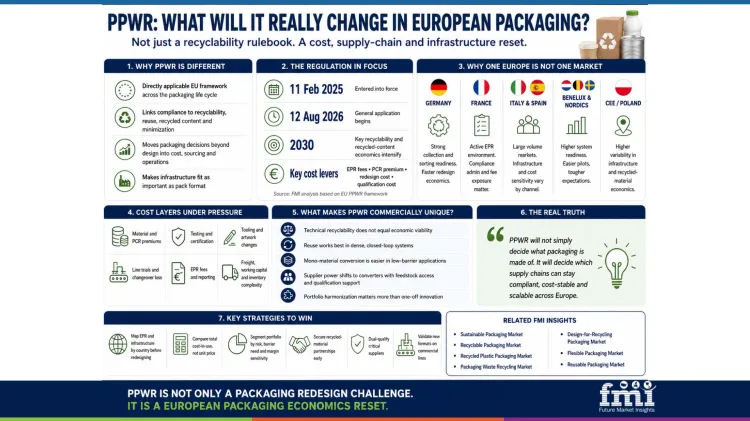
PPWR is not only changing the technical requirements placed on packaging. It is changing how packaging cost is calculated, who carries compliance risk, and which suppliers have the leverage to preserve margins.
A technically compliant structure is not automatically a commercially viable replacement. A mono-material film may improve recyclability but require more expensive resin, modified coatings, longer qualification cycles, or slower production speeds. A lighter pack may reduce material use but increase damage, leakage, or rejection rates. Recycled content may support compliance but expose buyers to a narrower pool of qualified feedstock.
The relevant comparison is not the price of the old package against the price of the redesigned package. It is the total cost of placing, filling, transporting, documenting, recovering, and managing that packaging across several European markets.
Compliance expenditure will also extend beyond the packaging component itself. Companies may incur redesign, testing, certification, data-management, labelling, tooling, line-trial, supplier-qualification, and inventory-conversion costs. Some of these expenses will appear before compliant packaging reaches commercial scale, while others will recur at SKU, supplier, or country level.
PPWR seeks greater harmonisation across the European Union, but harmonised product requirements do not create uniform packaging economics. Collection systems, EPR structures, deposit-return arrangements, sorting infrastructure, recycler access, and administrative readiness still differ by country. The same packaging design can therefore carry different practical and economic consequences across Europe.
How the Market Actually Behaves
Packaging conversion will not occur evenly across materials, applications, or company types.
Adoption will move fastest where redesign requires limited changes to product protection and existing filling assets. Secondary packaging, transport packaging, selected rigid formats, and lower-barrier applications are more likely to offer manageable conversion pathways.
Progress will be slower in applications where packaging performs several functions simultaneously. High-barrier food packaging, contamination-sensitive products, pharmaceutical formats, and products requiring long shelf life cannot be redesigned around recyclability alone. Seal performance, oxygen and moisture protection, migration, sterilisation, machinability, and product safety remain commercially non-negotiable.
Large brand owners are likely to rationalise portfolios rather than redesign every SKU independently. They may reduce the number of packaging structures, concentrate volume among fewer approved suppliers, and favour solutions that can be deployed across several markets. This can improve purchasing scale but also transfer more volume and bargaining power to converters capable of supporting multinational qualification and reporting requirements.
Smaller brands and converters face a different reality. They may lack the volume required to negotiate long-term recycled-material contracts, absorb repeated testing costs, or finance equipment modifications. Their compliance cost per unit can remain high even when the technical redesign is relatively simple.
Supplier power will increasingly depend on more than converting capacity. Access to qualified recycled feedstock, evidence supporting recyclability, technical-service capability, data accuracy, multi-country support, and the ability to maintain performance during redesign will become commercial differentiators.
The result is likely to be a more selective supplier market. Packaging buyers may have many potential vendors, but far fewer suppliers able to satisfy technical, regulatory, data, volume, and regional requirements at the same time.
Structural Constraints or Breakpoints
Recycled-material availability is a major economic breakpoint. Mandatory recycled-content requirements for covered plastic packaging begin from 2030, but procurement consequences arise earlier because companies must qualify sources, establish traceability, test performance, and secure supply. High-quality recycled resin suitable for demanding or contact-sensitive applications is not interchangeable with general recycled material.
When demand for qualified PCR rises faster than dependable supply, the impact appears through premiums, contractual commitments, minimum-volume requirements, and reduced buyer flexibility. Larger buyers may secure multi-year agreements or develop direct relationships with recyclers. Smaller buyers may remain dependent on distributors or spot availability, weakening their ability to predict packaging cost.
EPR fee modulation creates another pressure point. As recyclability performance becomes more closely connected to producer responsibility fees, packaging design decisions will influence recurring portfolio economics rather than only one-time development cost. A poorly performing structure may carry a higher continuing burden. A redesigned format may reduce that exposure but require tooling, testing, line adjustment, and material premiums.
Qualification complexity is another hidden cost. Every material or structural change can trigger packaging trials, compatibility testing, shelf-life validation, migration testing, quality approvals, artwork changes, supplier audits, and production scheduling. These requirements become especially expensive when a company manages hundreds or thousands of SKUs.
Converter margin pressure will not be evenly distributed. Converters face their own compliance, material, energy, equipment, scrap, and working-capital exposure. Customers may expect converters to absorb redesign and trial costs as part of normal service, while substrate suppliers seek to pass through higher input prices. Converters with differentiated technical capability, secure feedstock access, and strong customer relationships may protect margins. Commodity converters with limited purchasing power are more likely to be squeezed between upstream material suppliers and downstream brand owners.
Where Decisions Commonly Break
A recurring failure is treating the lowest compliant unit price as the best economic option. A packaging structure may appear competitive in an RFQ but create slower line speeds, higher scrap, longer changeovers, greater storage requirements, or more product damage. These costs are often measured by operations, logistics, or quality teams rather than procurement, so they may not be included in the original supplier comparison.
Another failure occurs when companies redesign packaging before mapping country-level infrastructure and EPR exposure. A structure developed around theoretical recyclability may not receive the expected economic treatment if collection, sorting, or recycling pathways remain limited in an important market.
Pilot success can also conceal commercial weakness. Trials usually operate under controlled conditions, with dedicated technical support, selected production lines, and carefully managed material batches. Commercial rollout introduces multiple plants, operators, suppliers, climates, line speeds, and product variants. Small performance losses become material when repeated across high-volume portfolios.
Companies may underestimate the cost of running old and new packaging systems simultaneously. Existing inventory, contractual commitments, tooling, artwork, and supplier agreements cannot always be retired at once. Parallel systems create working-capital pressure, planning complexity, and temporary loss of purchasing scale.
A further mistake is assuming that regulatory responsibility can be delegated to the packaging function. PPWR affects procurement contracts, supplier data, manufacturing assets, product economics, logistics, EPR reporting, portfolio strategy, and retailer relationships. Decisions made within one function frequently shift costs into another.
What Decision-Makers Should Do Differently
Companies should establish a packaging cost baseline that extends beyond the purchased component. The baseline should capture material, conversion, tooling, testing, line performance, scrap, changeover losses, freight, storage, product damage, EPR fees, compliance administration, and working capital. This makes it possible to compare redesign options on total cost-in-use rather than supplier price alone.
Portfolio segmentation should precede portfolio-wide conversion. Packaging should be grouped by regulatory exposure, technical difficulty, margin sensitivity, volume, country coverage, supplier concentration, and infrastructure fit. High-volume formats with manageable technical requirements may justify early conversion. Safety-critical, low-margin, or technically demanding formats may require longer qualification and alternative pathways.
Supplier evaluation should also change. Buyers need to assess access to qualified recycled feedstock, available capacity, technical-service depth, evidence quality, reporting capability, geographic reach, and financial ability to support repeated development cycles.
Long-term material and converter partnerships may become more valuable than frequent transactional sourcing. This does not eliminate the need for competition. It changes the basis of competition from quoted unit price to supply continuity, qualification reliability, and compliant performance at scale.
Margin stress-testing should be completed by product tier and market. A packaging change that is manageable for a premium product may be commercially damaging for a value-tier SKU. A solution that works in a highly developed recycling market may not offer the same economics elsewhere.
Management should define decision thresholds before approving conversion. These should cover acceptable cost increase, minimum line efficiency, maximum scrap, required supplier capacity, material availability, expected EPR treatment, and the number of countries in which the format can be deployed without further redesign.
The Misconception to Avoid
The misconception is that a technically compliant package is automatically an economically superior package.
Compliance can reduce regulatory exposure while still increasing material cost, qualification expenditure, operational losses, or supplier dependence. The commercially stronger solution is the one that delivers compliance, performance, supply continuity, and acceptable total cost at scale.
Bottom Line
PPWR will reward companies that manage packaging as an integrated economic system. The competitive advantage will not come from redesign alone, but from controlling material access, qualification risk, supplier capability, operational performance, and recurring compliance cost.
Related Future Market Insights Reports
- Sustainable Packaging Market: Primary related report. Covers sustainable materials, packaging formats, end-use adoption, supplier activity, and regional transition dynamics.
- Design-for-Recycling Packaging Market: Directly supports the PPWR discussion on recyclability criteria, packaging redesign, technical feasibility, and compliance-led innovation.
- Packaging Waste Recycling Market: Supports analysis of collection, sorting, recovery infrastructure, recycler capacity, and regulated packaging-waste systems.
- Recycled Plastic Packaging Market: Relevant to recycled-content mandates, PCR availability, quality consistency, sourcing risk, and supplier positioning.
- Post-Consumer Recycled Plastic Packaging Market: Provides focused context on PCR supply, application qualification, feedstock quality, and brand adoption.
- Recyclable Packaging Market: Supports material and format comparisons around technical recyclability and commercial adoption.
- Flexible Packaging Market: Relevant to mono-material conversion, barrier-performance trade-offs, converter economics, and qualification complexity.
- Reusable Packing Market: Supports analysis of reuse targets, reverse logistics, wash infrastructure, asset tracking, return rates, and cost per use.
- Paper Packaging Market: Relevant to paperisation, fibre substitution, performance trade-offs, and format-level cost implications.
- Barrier Packaging Industry Analysis in Europe: Useful for the European application-level discussion on high-barrier formats, food safety, pharmaceutical integrity, and conversion limits.
Sources
Regulatory references should be checked against the official text of Regulation (EU) 2025/40 and current European Commission guidance before publication. The regulation entered into force on 11 February 2025 and generally applies from 12 August 2026. Recyclability and recycled-content provisions have staged implementation dates and category-specific requirements.
- Official regulation: Regulation (EU) 2025/40
- European Commission overview: Packaging and Packaging Waste Regulation

