


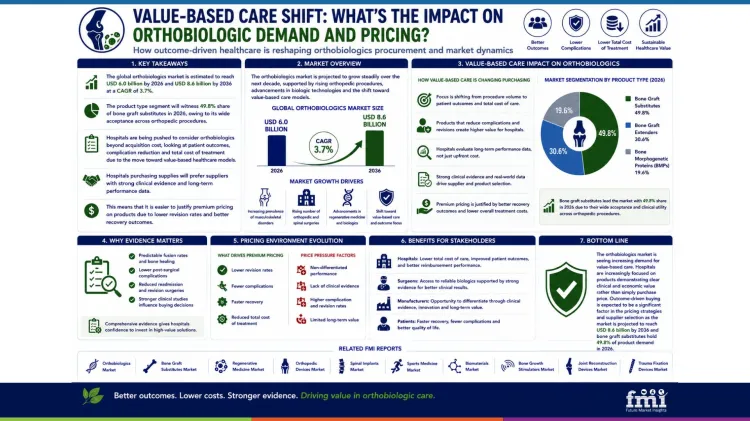
- The global orthobiologics market is estimated to reach USD 6.0 billion by 2026 and USD 8.6 billion by 2036 at a CAGR of 3.7%.
- The product type segment will witness 49.8% share of bone graft substitutes in 2026, owing to its wide acceptance across orthopedic procedures.
- Hospitals are being pushed to consider orthobiologics beyond acquisition cost, looking at patient outcomes, complication reduction and total cost of treatment due to the move toward value-based healthcare models.
- Hospitals purchasing supplies will prefer suppliers with strong clinical evidence and long-term performance data.
- This means that it is easier to justify premium pricing on products due to lower revision rates and better recovery outcomes.
- Increasing adoption of bone graft substitutes is supporting long-term market expansion as hospitals prioritize clinically validated regenerative solutions
The Shift Toward Outcome-Based Purchasing Is Changing Orthobiologics Demand
Healthcare systems globally are increasingly moving towards value-based care, where providers are rewarded based on clinical outcomes rather than volumes of procedures. The change is affecting purchasing decisions in orthopedic departments, including the selection of orthobiologic products used in spinal fusion, trauma repair, sports medicine and reconstructive surgery.
Future Market Insights states that the orthobiologics market will be worth USD 6.0 billion in 2026 and USD 8.6 billion by 2036, with a CAGR of 3.7%. Market Segmentation Based on Product Type, the market is segmented into Bone Graft Substitutes, Bone Graft Extenders and Bone Morphogenetic Proteins (BMPs).
Hospitals are increasingly looking at whether a biologic product reduces complications, shortens recovery time and minimizes need for revision procedures under value-based reimbursement models. Procurement teams are now looking not just at the upfront pricing but also the total cost of patient care across the treatment pathway.
This trend is especially good for those products that have good clinical studies behind them. Surgeons and hospital administrators want technologies that show predictable fusion rates, effective bone healing and a lower rate of complications post-surgery. Evidence that is complete is often a winning factor in purchase decisions.
The pricing environment is also shifting. Premium orthobiologics still command a premium price when supported by measurable clinical benefit. Products that help to reduce readmission rates, or expensive follow-up procedures, may be worth higher acquisition costs to hospitals. In contrast, products with non-differentiated performance are increasingly subject to price competition.
Bone graft substitutes are an excellent example of this dynamic. The increasing market share shows that the products are gaining acceptance as hospitals look for alternatives that simplify procedures but remain clinically effective. In assessing these products, facilities often rely on long-term economic models, and not just unit cost comparisons, to strike a balance between financial targets and patient outcomes.
Manufacturers are also putting more money into generating evidence because of value-based care. Clinical registries, post-market studies and health economic analyses have gained importance as commercial tools as purchasing committees now demand documented proof of value before approving premium biologic technologies.
This is changing the competitive environment for suppliers from product features alone to measurable healthcare outcomes. As hospitals continue to modernize their orthopedic treatment pathways, those companies that can combine scientific validation with reliable manufacturing quality and dependable supply continuity are likely to be in a stronger position.
Bottom Line
The orthobiologics market is seeing increasing demand for value-based care. Hospitals are increasingly focused on products demonstrating clear clinical and economic value rather than simply purchase price. Outcome-driven buying is expected to be a significant factor in the pricing strategies and supplier selection as the market is projected to reach USD 8.6 billion by 2036 and bone graft substitutes hold 49.8% of product demand in 2026.
Related FMI Reports
- Orthobiologics Market
- Bone Graft Substitutes Market
- Regenerative Medicine Market
- Spinal Implants and Devices Market
- Orthotic Devices, Orthotic Splints, and Orthopedic Braces and Support Market
- Sports Medicine Market
- Joint Reconstruction Devices Market
- Biomaterials Market
- Bone Growth Stimulators Market
- Surgical Navigation Systems Market

