

- Market Size (2026)
- USD 5.8 Bn
- Forecast (2036)
- USD 13.4 Bn
- CAGR (2026 to 2036)
- 8.7%
How big is Toxicity Testing Outsourcing Market in 2026?
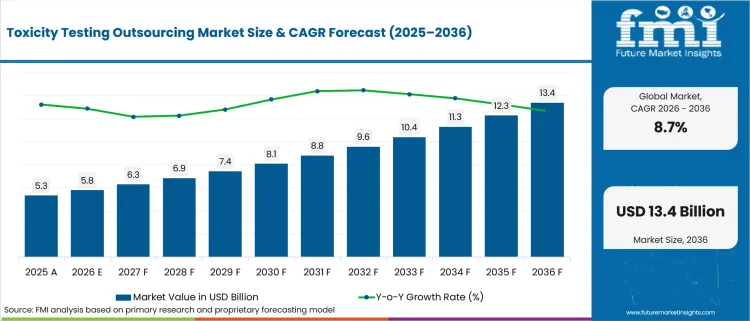
USD 5.8 billion in 2026 and USD 13.4 billion by 2036 at an 8.7% CAGR.
Demand for toxicity testing outsourcing is projected to expand at an 8.7% CAGR between 2026 and 2036, increasing valuation from USD 5.8 billion in 2026 to USD 13.4 billion by 2036. Large chemical safety programs need scalable screening methods that preserve traceable results across many regulated substances. Health Canada reported in November 2025 that its 2024-2025 program assessed more than 800 chemicals through a high-throughput in vitro thyroid toxicity assay. External laboratories therefore need validated platforms that manage volume without weakening documentation quality or scientific review.
Sponsors compare model access and reporting control as they assign complete packages to preclinical CRO services. Integrated bioanalytical testing services connect exposure measurements with pathology findings under one quality system and reduce interpretation risk.
Key Takeaways of Toxicity Testing Outsourcing Market
- Sponsors assign complete safety packages to laboratories preserving study controls from protocol design through final reporting.
- Based on service type, in vivo toxicity testing is projected to account for 41.0% in 2026 due to integrated systemic evidence.
- By application, drug development is estimated to hold 48.0% in 2026 owing to safety decisions across asset progression.
- In 2026, direct contract research services are expected to lead distribution activity with 52.0% share through single-provider accountability.
- Limited study slots and unstable method transfers can disrupt dosing schedules across linked regulatory development programs.
- Labcorp and Charles River Laboratories cover broad toxicology programs, while Eurofins, SGS, WuXi AppTec, NAMSA, Evotec and Inotiv serve specialized routes.
Analyst Perspective
"Outsourced toxicity testing earns its premium through exposure data, pathology interpretation and archive records that withstand regulatory review. A delayed pivotal study erases apparent laboratory savings, making study-slot certainty and method-transfer readiness decisive commercial tests."
- Anurag Sharma, Principal Consultant, Future Market Insights
How is the Toxicity Testing Outsourcing Market segmented?
The toxicity testing outsourcing industry is segmented by service type, application, end user, distribution channel, testing method and region.
The market is segmented by service type, application, end user, distribution channel, testing method and region. Service type covers in vivo, in vitro, bioanalysis, safety pharmacology and specialized toxicology, while applications include drug development, device testing, chemical safety, cosmetics and environmental testing. End users include pharmaceutical companies, biotechnology developers, device manufacturers, chemical producers and research institutes, while distribution spans direct contracts, CRO networks, laboratories, public programs and digital platforms. Testing methods cover GLP studies, exploratory work, alternative methods, computational models and integrated strategies for submissions.
What supports in vivo toxicity testing within the service type category?
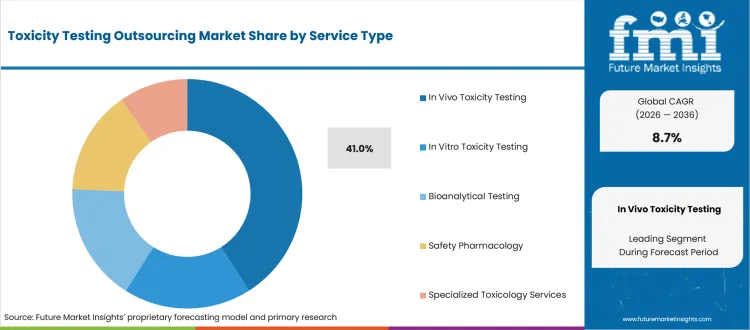
In vivo studies connect systemic exposure with organ-level findings across repeated dosing and recovery periods. External laboratories combine veterinary oversight with toxicokinetic sampling and pathology review within one controlled quality and archive system.
- In vivo toxicity testing is likely to capture 41.0% share in 2026 attributable to regulator needs for integrated organism-level evidence.
- Chemical safety teams use in vitro human models to screen hazards and prioritize organism-level follow-up. EPA reported in March 2025 that ToxCast covers almost 10,000 substances from twenty assay sources. The larger evidence base helps external laboratories reserve confirmatory studies for unresolved endpoints and define clearer priorities.
How does drug development shape demand within the application category?
Drug programs require safety evidence ahead of first-in-human dosing and following significant formulation or delivery changes. Unlike preclinical device testing built around contact-specific plans, pharmaceutical packages connect systemic toxicity with exposure and pathology.
- Drug development is set to lead the application category with 48.0% share in 2026 due to safety decisions across asset progression.
- Development teams expand outsourced packages as formulations and delivery routes change across clinical planning and regulatory submissions. Laboratories with qualified biocompatible materials expertise address device programs separately, preventing unrelated endpoints from entering pharmaceutical study packages and protecting each program's regulatory scope.
What makes direct contract research services central to the distribution channel category?
Direct contracts assign protocol execution and final reporting to one accountable laboratory across regulated programs. Named study directors coordinate dosing with bioanalysis and pathology review through agreed change controls across sites.
- By distribution channel, direct contract research services are forecast to represent 52.0% in 2026 driven by single-provider accountability across each study stage.
- Programs with several endpoints depend on outsourced testing services that maintain consistent data ownership across laboratories. Long-term service agreements improve capacity visibility and define escalation responsibilities throughout pivotal study execution across sites. Project contracts remain practical for isolated endpoints that use stable methods and carry limited cross-study dependencies.
How does GLP-compliant testing influence selection within the testing method category?
GLP systems document how regulated studies are planned and reported across the complete evidence chain. Regulatory acceptance of organ-on-chip drug testing depends on evidence that matches the intended decision for each program. FDA reported in April 2026 that it launched a searchable database clarifying acceptable alternatives and established a permanent qualification pathway.
- The testing method category is forecast to be led by GLP-compliant testing at 45.0% share in 2026 due to auditable conduct and archive controls.
- Laboratories pair validated alternative methods with established studies to bridge new evidence without dividing quality responsibility across separate providers.
What are the drivers, restraints and opportunities in the Toxicity Testing Outsourcing Market?
External capacity supports uneven safety workloads, but unfinished methods or scarce study slots disrupt dosing plans and coordinated alternative methods improve evidence continuity.
- Driver: External laboratories spread specialized facility costs across programs with uneven sponsor workloads and changing endpoint needs.
- Restraint: Incomplete test-item characterization and unfinished bioanalytical methods can leave reserved study slots unusable for planned dosing.
- Opportunity: Coordinated alternative methods and structured records can reduce interpretation handoffs across complete regulatory safety programs.
External laboratories spread the cost of specialized rooms, trained study directors and quality systems across programs with uneven workloads. Smaller developers therefore access regulated models and experienced oversight without carrying underused facilities between active studies.
Reserved study capacity loses value if test-item characterization or bioanalytical methods remain incomplete at dosing initiation. Sponsors therefore evaluate readiness gates and escalation rules as protections for clinical milestones that depend on timely nonclinical evidence.
Validated alternative methods gain commercial value under common governance that connects assay qualification with established toxicology records. Laboratories that coordinate analytical testing services with pathology review can reduce interpretation handoffs and deliver a clearer regulator-facing conclusion.
Which country CAGRs are profiled in the Toxicity Testing Outsourcing Market?
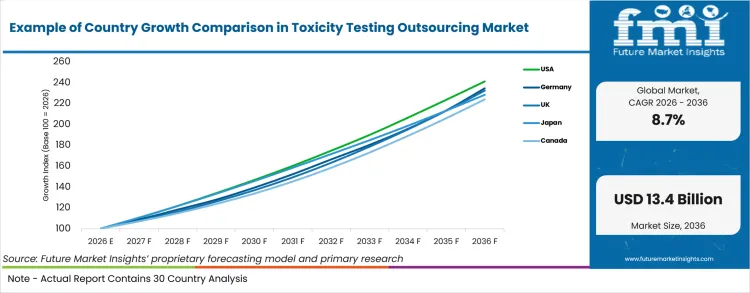
| Country | CAGR |
|---|---|
| United States | 9.2% |
| Germany | 8.9% |
| United Kingdom | 8.8% |
| Japan | 8.6% |
| Canada | 8.4% |
How do country-level CAGRs compare in the Toxicity Testing Outsourcing Market?
The displayed range spans 0.8 percentage point and forms one close cluster across regulated laboratory systems. CAGR spacing reflects differences in method acceptance and specialist service access rather than current market size.
- Federal qualification pathways give the United States a method-validation workload compared with Germany’s established GLP monitoring route.
- Germany’s OECD-aligned monitoring system supports internationally accepted study packages across pharmaceutical and chemical safety programs.
- The United Kingdom’s similar outlook reflects national compliance monitoring that retains GLP expectations during the transition toward qualified alternative methods.
- Japan’s rate reflects structured facility inspections and context-specific weight-of-evidence practices across regulated pharmaceutical safety programs.
- Canada’s federal chemical programs integrate validated alternatives into established risk-assessment workflows despite a smaller specialist laboratory base.
Comparable CAGRs can produce different market entry conditions. The full report provides country-level CAGR analysis across North America, Latin America, Europe, East Asia, South Asia and Pacific, and the Middle East and Africa.
Country-wise Analysis
- USA drug developers can access broad GLP capacity and specialized pathology services across several operating regions, yet alternative methods require acceptance for a defined regulatory context and product decision. The United States is estimated to post 9.2% CAGR over the forecast period, supported by integrated laboratory networks that coordinate advanced assays with pathology review while evidence justification can extend pivotal scheduling across modalities and filing routes. FDA’s March 2026 draft guidance established four validation principles and directed sponsors toward method-specific consultation, so early regulatory alignment remains necessary ahead of pivotal study schedules and archive plans under documented quality governance.
- Germany’s OECD-aligned GLP system supports international acceptance through federal and state monitoring, although external laboratories must maintain facility-specific inspection records and archive procedures across decentralized authorities. BfR reported in July 2026 that regulatory use of animal-free methods remains limited without validation and OECD Test Guideline endorsement across accepted safety decisions and formal sponsor audits. Adoption of toxicity testing outsourcing in Germany is estimated to expand at 8.9% CAGR through 2036, owing to experienced study directors and established laboratory infrastructure that support pharmaceutical and chemical programs requiring validated alternatives alongside conventional studies and detailed local compliance records across monitored facilities.
- United Kingdom medicine developers can combine conventional studies with qualified non-animal methods under one compliance system, but product-specific expectations require aligned documentation across domestic and European regulatory routes. The United Kingdom’s toxicity testing outsourcing outlook is anticipated to advance at 8.8% CAGR over the assessment period, reinforced by concentrated life-science research and accessible specialist laboratories that coordinate method validation with regulator-facing packages. MHRA’s March 2026 approach retained GLP expectations for applicable regulatory safety studies while accepting qualified non-animal evidence, so providers need early agency engagement ahead of pivotal program definition and final submission packages across therapeutic classes and testing sites.
- Japanese pharmaceutical programs use structured facility inspections and formal GLP certificates for nonclinical safety studies supporting marketing applications, although overseas laboratories face translation review and context-specific method acceptance. PMDA published weight-of-evidence considerations in October 2025 that explain how separate nonclinical findings can support one regulatory safety conclusion across pharmaceutical development decisions. In Japan, toxicity testing outsourcing demand is predicted to advance at 8.6% CAGR through 2036, driven by experienced domestic laboratories that coordinate pathology and study documentation while overseas providers manage additional language review across complex development dossiers and scheduled agency meetings under local quality procedures and submission timelines.
- Canadian chemical programs recognize GLP principles and use federal risk-assessment routes across existing and newly notified substances, but a smaller domestic specialist base increases service distance and sample-transfer coordination for complex studies. Toxicity testing outsourcing demand in Canada is forecast to rise at 8.4% CAGR over the forecast period, aided by cross-border development programs that support assay qualification and integrated chemical testing across analytical endpoints requiring specialized pathology. Health Canada’s July 2025 guidance explained how federal programs use new approach methods under CEPA and assess regulatory fitness, so laboratories must preserve documented custody across provincial service routes and several analytical networks.
Who are the notable companies in the Toxicity Testing Outsourcing Market?
Companies include Labcorp, Charles River Laboratories, Eurofins Scientific, SGS, WuXi AppTec, NAMSA, Evotec and Inotiv.
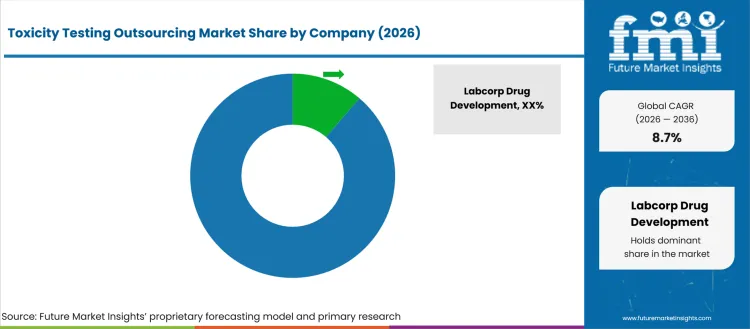
Broad GLP capacity is concentrated among global CROs and specialized laboratory networks serving regulated safety programs. The wider clinical research organization market includes groups without nonclinical specialization, so entry requires verified study governance.
- Labcorp, Charles River Laboratories and WuXi AppTec cover general toxicology and specialist endpoints through broad nonclinical testing platforms.
- Eurofins Scientific and SGS combine toxicology with chemical testing services, while Inotiv provides preclinical safety and model support.
- NAMSA and Evotec focus on medical-device biological safety or integrated drug-development programs requiring detailed scientific interpretation.
Competitive Benchmarking: Toxicity Testing Outsourcing Market
| Company | Regulated toxicology breadth | Alternative method capability | Bioanalysis and pathology integration | Geographic reach |
|---|---|---|---|---|
| Labcorp | High | Medium | High | Global |
| Charles River Laboratories | High | High | High | Global |
| Eurofins Scientific | High | High | Medium | Global |
| SGS | Low | High | Low | Global |
| WuXi AppTec | High | Medium | High | Asia, Europe and North America |
| NAMSA | Medium | Medium | Medium | North America, Europe and Asia |
| Evotec | Medium | Medium | High | Europe and United States |
| Inotiv | High | High | High | North America and Europe |
Scoring basis: High requires three verified study families, while Medium requires two and Low confirms one for breadth or alternative-method capability. Integration is High with bioanalysis plus pathology and Medium with one function, while Low confirms narrower verified support and geographic reach remains descriptive.
Key Developments in the Toxicity Testing Outsourcing Market
- In April 2026, Charles River reported 100% no-observed-adverse-effect-level concordance across twenty virtual control group toxicology studies and animal-use reductions of up to 25%.
- In January 2026, NAMSA completed its acquisition of selected Labcorp medical-device testing assets covering biocompatibility and microbiology alongside analytical testing and preclinical research.
- In October 2025, Charles River and Toxys began validating a human stem-cell assay for developmental toxicity screening across pharmaceutical and chemical programs.
- In March 2025, NAMSA completed its acquisition of WuXi AppTec medical-device testing operations in the United States and expanded biological safety laboratory capacity.
Toxicity Testing Outsourcing Market - Report Scope
| Coverage field | Report scope |
|---|---|
| Market breakdown | By service type, application, end user, distribution channel, testing method and region. |
| Quantitative Units | Revenue in USD billion and CAGR in %. |
| Market Definition | The market covers external laboratory and CRO services that perform regulated toxicity studies for pharmaceutical, biotechnology, medical-device, chemical, cosmetic, food and environmental programs. |
| Regions Covered | North America, Latin America, Europe, East Asia, South Asia and Pacific and Middle East and Africa. |
| Countries Covered | United States, Germany, United Kingdom, Japan, Canada, and 20+ countries included in the full report. |
| Key Companies Profiled | Labcorp, Charles River Laboratories, Eurofins Scientific, SGS, WuXi AppTec, NAMSA, Evotec and Inotiv. |
| Forecast Period | 2026 to 2036. |
| Approach | Primary and secondary research with market triangulation. |
Toxicity Testing Outsourcing Market - Research Methodology
| Method | Approach |
|---|---|
| Primary Research | FMI analysts gathered input from manufacturers, service providers, technology developers, distributors, end users, procurement teams, and subject-matter experts. Interviews examined purchasing decisions, product or service evaluation, adoption barriers, approval requirements, pricing considerations, and expectations for technical or commercial support. Respondents were also asked what evidence is required before a trial, pilot, or initial order develops into regular purchasing. |
| Desk Research | Desk research covered government statistics, regulatory publications, trade data, industry associations, technical literature, standards, company filings, product information, and official corporate announcements. Sources were reviewed for relevance, publication date, geographic coverage, and consistency with the defined market scope. Claims relating to performance, applications, approvals, capacity, investment, and commercial activity were retained only when supported by credible public evidence. |
| Market Sizing and Forecasting | The market model combined the baseline value with historical performance, segment structure, pricing and volume indicators, adoption levels, company participation, and country-level demand conditions. Forecast assumptions considered economic activity, investment trends, regulatory developments, technology adoption, purchasing cycles, supply availability, and barriers to wider market use. Segment and regional estimates were reconciled before the final market total was calculated. |
| Data Validation | Estimates were checked against multiple independent indicators, including public data, company activity, trade patterns, industry developments, and findings from primary interviews. Validation also tested whether products, services, applications, and company revenues fell within the defined market boundaries. Adjacent categories, unsupported claims, overlapping revenues, and activities without direct market relevance were excluded to reduce double counting and maintain consistency across segments and countries. |
Toxicity Testing Outsourcing Market by Segments
Toxicity Testing Outsourcing Market by Service Type
- In Vivo Toxicity Testing
- Acute Toxicity Testing
- Repeated Dose Toxicity Testing
- In Vitro Toxicity Testing
- Cytotoxicity Testing
- Genotoxicity Testing
- Bioanalytical Testing
- Pharmacokinetic Analysis
- Biomarker Testing
- Safety Pharmacology
- Cardiovascular Safety Studies
- Respiratory Safety Studies
- Specialized Toxicology Services
- Reproductive Toxicity Testing
- Carcinogenicity Studies
Toxicity Testing Outsourcing Market by Application
- Drug Development
- Preclinical Drug Development
- Biologics Development
- Medical Device Testing
- Implant Safety Testing
- Biocompatibility Testing
- Chemical Safety Assessment
- Industrial Chemicals
- Specialty Chemicals
- Cosmetic Safety Testing
- Skin Irritation Testing
- Ocular Toxicity Testing
- Food and Environmental Testing
- Food Additive Testing
- Environmental Toxicology
Toxicity Testing Outsourcing Market by End User
- Pharmaceutical Companies
- Innovator Pharmaceutical Companies
- Generic Drug Manufacturers
- Biotechnology Companies
- Cell Therapy Developers
- Gene Therapy Developers
- Medical Device Manufacturers
- Class II Device Manufacturers
- Class III Device Manufacturers
- Chemical Manufacturers
- Agrochemical Companies
- Industrial Chemical Producers
- Academic and Research Institutes
- Universities
- Government Research Institutes
Toxicity Testing Outsourcing Market by Distribution Channel
- Direct Contract Research Services
- Long-Term Service Agreements
- Project-Based Contracts
- Contract Research Organizations (CROs)
- Global CRO Networks
- Regional CROs
- Laboratory Service Providers
- Central Laboratories
- Specialty Toxicology Laboratories
- Government Procurement
- Public Research Contracts
- Regulatory Testing Programs
- Online Service Platforms
- Digital CRO Platforms
- Research Procurement Portals
Toxicity Testing Outsourcing Market by Testing Method
- GLP-Compliant Testing
- OECD Guideline Studies
- FDA-Compliant Studies
- Non-GLP Testing
- Exploratory Toxicology
- Screening Studies
- Alternative Testing Methods
- 3D Cell Culture Models
- Organ-on-a-Chip Testing
- Computational Toxicology
- In Silico Toxicity Prediction
- AI-Based Toxicity Modeling
- Integrated Testing Strategies
- Weight of Evidence Assessment
- Next Generation Risk Assessment
Toxicity Testing Outsourcing Market by Region:
- North America
- United States
- Canada
- Latin America
- Brazil
- Chile
- Mexico
- Rest of Latin America
- Western Europe
- Germany
- United Kingdom
- Italy
- Spain
- France
- Nordics
- Benelux
- Rest of Western Europe
- Eastern Europe
- Russia
- Poland
- Hungary
- Balkan and Baltic States
- Rest of Eastern Europe
- East Asia
- China
- Japan
- South Korea
- South Asia and Pacific
- India
- ASEAN
- Australia and New Zealand
- Rest of South Asia and Pacific
- Middle East and Africa
- Kingdom of Saudi Arabia
- Other GCC Countries
- Türkiye
- South Africa
- Other African Union Countries
- Rest of Middle East and Africa
Research Sources and Bibliography
- Health Canada. (2025, November 7). Chemicals management plan (Horizontal initiative).
- USA Environmental Protection Agency. (2025, March 10). Improvements to ToxCast Make Screening Assay Data for Thousands of Chemicals Easier to Interpret.
- USA Food and Drug Administration. (2026, April 20). FDA Achieves Year 1 Goals in Reducing Animal Testing in Drug Development.
- USA Food and Drug Administration. (2026, March 18). FDA Releases Draft Guidance on Alternatives to Animal Testing in Drug Development.
- German Federal Institute for Risk Assessment. (2026, July 24). From lab to life: Qualification as a bridge to fast-track the use of animal-free methods in risk assessment.
- Medicines and Healthcare products Regulatory Agency. (2026, March 25). MHRA approach to medicines using non-animal methods.
- Pharmaceuticals and Medical Devices Agency. (2025, October 24). Thoughts on the Use of Weight of Evidence Approach in Nonclinical Safety Evaluation (Early Consideration).
- Health Canada. (2025, July 18). Use of new approach methods (NAMs) in risk assessment.
- Charles River Laboratories International, Inc. (2026, April 21). Charles River Highlights Effectiveness of VCGs in Toxicology.
- NAMSA. (2026, January 8). NAMSA Announces Strategic Acquisition of Select Assets of the Early Development Medical Device Testing Business of Labcorp.
- Charles River Laboratories International, Inc. (2025, October 8). Charles River and Toxys Announce Collaboration to Validate the Use of NAMs for Developmental Toxicity Testing.
- NAMSA. (2025, March 3). NAMSA Completes Acquisition of WuXi AppTec US Medical Device Testing Business.
- Labcorp Holdings Inc. (2026, February 24). Annual report on Form 10-K for the fiscal year ended December 31, 2025.
- Charles River Laboratories International, Inc. (2026, March 31). 2025 Annual Report.
- Eurofins Scientific SE. (2026, January 29). Annual Report 2025.
- SGS SA. (2026, February 11). 2025 Integrated Report.
- WuXi AppTec Co., Ltd. (2026, March 23). WuXi AppTec Beat Full-Year Guidance and Achieved Record Performance in 2025.
- Evotec SE. (2026, April 8). Integrated Annual Report 2025.
- Inotiv, Inc. (2025, December 3). Inotiv Reports Fourth Quarter and Full Year Financial Results for Fiscal 2025 and Provides Business Update.
This bibliography is provided for reader reference and is not exhaustive. The full report contains the complete reference list and detailed citations
This Report Answers
- How large is the toxicity testing outsourcing market in 2026 and 2036?
- Which operating conditions support demand for outsourced toxicity testing services?
- How does in vivo toxicity testing shape service demand during 2026?
- Why does drug development account for the dominant application share?
- How do direct contracts change accountability across regulated testing programs?
- Which national conditions influence country-level toxicity outsourcing growth through 2036?
- How should sponsors compare outsourced toxicity testing companies and capabilities?
- Which constraints can delay outsourced safety studies and regulatory submissions?
- How should development teams compare laboratory methods and governance controls?
Frequently Asked Questions
How big is the Toxicity Testing Outsourcing Market in 2026?
The toxicity testing outsourcing market is valued at USD 5.8 billion in 2026 and is forecast to reach USD 13.4 billion by 2036, growing at an 8.7% CAGR as sponsors assign complete safety packages to laboratories that preserve study controls from protocol design through final reporting.
What is the CAGR of the Toxicity Testing Outsourcing Market from 2026 to 2036?
The toxicity testing outsourcing market grows at a CAGR of 8.7% between 2026 and 2036, rising from USD 5.8 billion to USD 13.4 billion as external laboratories scale validated platforms that manage rising study volume without weakening documentation quality or scientific review.
Which service type leads the Toxicity Testing Outsourcing Market?
In vivo toxicity testing leads the toxicity testing outsourcing market by service type with a 41.0% share in 2026, as regulators require integrated organism-level evidence connecting systemic exposure with organ-level findings across repeated dosing and recovery periods.
How much will the Toxicity Testing Outsourcing Market add between 2026 and 2036?
The toxicity testing outsourcing market is set to add USD 7.6 billion between 2026 and 2036, growing from USD 5.8 billion to USD 13.4 billion as sponsors expand outsourced safety packages across drug development, chemical safety and device testing programs worldwide.
Who are the leading companies in the Toxicity Testing Outsourcing Market?
Eight companies lead the toxicity testing outsourcing market, including Labcorp, Charles River Laboratories, Eurofins Scientific, SGS and WuXi AppTec, competing through broad nonclinical testing platforms, alternative-method capability and integrated bioanalysis and pathology services across regulated pharmaceutical, device and chemical safety programs.
Preview the report firsthand - request a free sample
Get SampleGet the brochure for pricing and purchase details.
Get PDFTable of Content
- Key Takeaways
- Market Size and CAGR
- Top Growth Driver
- Fastest Growing Segment
- Leading Region
- Key Companies
- Emerging Opportunities
- Executive Summary
- Global Market Outlook
- Demand-side Trends
- Supply-side Trends
- Technology Roadmap Analysis
- Analysis and Recommendations
- Analyst Perspective (What is happening? Why now? What should investors know?)
- Key Questions Answered
- How large is the market?
- What is the CAGR?
- What are key trends?
- Which region dominates?
- Who are the leaders?
- Market Overview
- Market Coverage / Taxonomy
- Market Definition / Scope / Limitations
- Research Methodology
- Chapter Orientation
- Analytical Lens and Working Hypotheses
- Market Structure, Signals, and Trend Drivers
- Benchmarking and Cross-market Comparability
- Market Sizing, Forecasting, and Opportunity Mapping
- Research Design and Evidence Framework
- Desk Research Programme (Secondary Evidence)
- Expert Input and Fieldwork (Primary Evidence)
- Tooling, Models, and Reference Databases
- Data Engineering and Model Build
- Quality Assurance and Audit Trail
- Market Background
- Market Dynamics (Drivers, Restraints, Opportunity, Trends)
- Scenario Forecast (Optimistic, Likely, Conservative)
- Impact Analysis
- AI Impact
- Sustainability Impact
- Regulatory Impact
- Technology Impact
- Consumer / Buyer Analysis
- Purchase Drivers
- Adoption Barriers
- Buyer Journey
- Opportunity Map Analysis
- Product Life Cycle Analysis
- Supply Chain Analysis
- Investment Feasibility Matrix
- Value Chain Analysis
- PESTLE and Porter's Analysis
- Regulatory Landscape
- Regional Parent Market Outlook
- Production and Consumption Statistics
- Import and Export Statistics
- Global Market Analysis and Forecast, 2021 to 2036
- Historical Market Size Value (USD Billion) Analysis, 2021 to 2025
- Current and Future Market Size Value (USD Billion) Projections, 2026 to 2036
- Y-o-Y Growth Trend Analysis
- Absolute $ Opportunity Analysis
- Global Market Pricing Analysis, 2021 to 2036
- Global Market Analysis and Forecast, By Service Type, 2021 to 2036
- Introduction / Key Findings
- Historical Market Size Value (USD Billion) Analysis By Service Type, 2021 to 2025
- Current and Future Market Size Value (USD Billion) Analysis and Forecast By Service Type, 2026 to 2036
- In Vivo Toxicity Testing
- Acute Toxicity Testing
- Repeated Dose Toxicity Testing
- In Vitro Toxicity Testing
- Cytotoxicity Testing
- Genotoxicity Testing
- Bioanalytical Testing
- Pharmacokinetic Analysis
- Biomarker Testing
- Safety Pharmacology
- Cardiovascular Safety Studies
- Respiratory Safety Studies
- Specialized Toxicology Services
- Reproductive Toxicity Testing
- Carcinogenicity Studies
- In Vivo Toxicity Testing
- Y-o-Y Growth Trend Analysis By Service Type, 2021 to 2025
- Absolute $ Opportunity Analysis By Service Type, 2026 to 2036
- Global Market Analysis and Forecast, By Application, 2021 to 2036
- Introduction / Key Findings
- Historical Market Size Value (USD Billion) Analysis By Application, 2021 to 2025
- Current and Future Market Size Value (USD Billion) Analysis and Forecast By Application, 2026 to 2036
- Drug Development
- Preclinical Drug Development
- Biologics Development
- Medical Device Testing
- Implant Safety Testing
- Biocompatibility Testing
- Chemical Safety Assessment
- Industrial Chemicals
- Specialty Chemicals
- Cosmetic Safety Testing
- Skin Irritation Testing
- Ocular Toxicity Testing
- Food and Environmental Testing
- Food Additive Testing
- Environmental Toxicology
- Drug Development
- Y-o-Y Growth Trend Analysis By Application, 2021 to 2025
- Absolute $ Opportunity Analysis By Application, 2026 to 2036
- Global Market Analysis and Forecast, By End User, 2021 to 2036
- Introduction / Key Findings
- Historical Market Size Value (USD Billion) Analysis By End User, 2021 to 2025
- Current and Future Market Size Value (USD Billion) Analysis and Forecast By End User, 2026 to 2036
- Pharmaceutical Companies
- Innovator Pharmaceutical Companies
- Generic Drug Manufacturers
- Biotechnology Companies
- Cell Therapy Developers
- Gene Therapy Developers
- Medical Device Manufacturers
- Class II Device Manufacturers
- Class III Device Manufacturers
- Chemical Manufacturers
- Agrochemical Companies
- Industrial Chemical Producers
- Academic and Research Institutes
- Universities
- Government Research Institutes
- Pharmaceutical Companies
- Y-o-Y Growth Trend Analysis By End User, 2021 to 2025
- Absolute $ Opportunity Analysis By End User, 2026 to 2036
- Global Market Analysis and Forecast, By Distribution Channel, 2021 to 2036
- Introduction / Key Findings
- Historical Market Size Value (USD Billion) Analysis By Distribution Channel, 2021 to 2025
- Current and Future Market Size Value (USD Billion) Analysis and Forecast By Distribution Channel, 2026 to 2036
- Direct Contract Research Services
- Long-Term Service Agreements
- Project-Based Contracts
- Contract Research Organizations
- Global CRO Networks
- Regional CROs
- Laboratory Service Providers
- Central Laboratories
- Specialty Toxicology Laboratories
- Government Procurement
- Public Research Contracts
- Regulatory Testing Programs
- Online Service Platforms
- Digital CRO Platforms
- Research Procurement Portals
- Direct Contract Research Services
- Y-o-Y Growth Trend Analysis By Distribution Channel, 2021 to 2025
- Absolute $ Opportunity Analysis By Distribution Channel, 2026 to 2036
- Global Market Analysis and Forecast, By Testing Method, 2021 to 2036
- Introduction / Key Findings
- Historical Market Size Value (USD Billion) Analysis By Testing Method, 2021 to 2025
- Current and Future Market Size Value (USD Billion) Analysis and Forecast By Testing Method, 2026 to 2036
- GLP-Compliant Testing
- OECD Guideline Studies
- FDA-Compliant Studies
- Non-GLP Testing
- Exploratory Toxicology
- Screening Studies
- Alternative Testing Methods
- 3D Cell Culture Models
- Organ-on-a-Chip Testing
- Computational Toxicology
- In Silico Toxicity Prediction
- AI-Based Toxicity Modeling
- Integrated Testing Strategies
- Weight of Evidence Assessment
- Next Generation Risk Assessment
- GLP-Compliant Testing
- Y-o-Y Growth Trend Analysis By Testing Method, 2021 to 2025
- Absolute $ Opportunity Analysis By Testing Method, 2026 to 2036
- Global Market Analysis and Forecast, By Region, 2021 to 2036
- Introduction
- Historical Market Size Value (USD Billion) Analysis By Region, 2021 to 2025
- Current Market Size Value (USD Billion) Analysis and Forecast By Region, 2026 to 2036
- North America
- Latin America
- Western Europe
- Eastern Europe
- East Asia
- South Asia and Pacific
- Middle East & Africa
- Market Attractiveness Analysis By Region
- North America Market Analysis and Forecast, By Country, 2021 to 2036
- Historical Market Size Value (USD Billion) Trend Analysis By Market Taxonomy, 2021 to 2025
- Market Size Value (USD Billion) Forecast By Market Taxonomy, 2026 to 2036
- By Country
- USA
- Canada
- By Service Type
- By Application
- By End User
- By Distribution Channel
- By Testing Method
- By Country
- Market Attractiveness Analysis
- By Country
- By Service Type
- By Application
- By End User
- By Distribution Channel
- By Testing Method
- Key Takeaways
- Latin America Market Analysis and Forecast, By Country
- Historical Market Size Value (USD Billion) Trend Analysis By Market Taxonomy, 2021 to 2025
- Market Size Value (USD Billion) Forecast By Market Taxonomy, 2026 to 2036
- By Country
- Brazil
- Mexico
- Chile
- Rest of Latin America
- By Service Type
- By Application
- By End User
- By Distribution Channel
- By Testing Method
- By Country
- Market Attractiveness Analysis
- By Country
- By Service Type
- By Application
- By End User
- By Distribution Channel
- By Testing Method
- Key Takeaways
- Western Europe Market Analysis and Forecast, By Country
- Historical Market Size Value (USD Billion) Trend Analysis By Market Taxonomy, 2021 to 2025
- Market Size Value (USD Billion) Forecast By Market Taxonomy, 2026 to 2036
- By Country
- Germany
- UK
- Italy
- Spain
- France
- Nordic
- BENELUX
- Rest of Western Europe
- By Service Type
- By Application
- By End User
- By Distribution Channel
- By Testing Method
- By Country
- Market Attractiveness Analysis
- By Country
- By Service Type
- By Application
- By End User
- By Distribution Channel
- By Testing Method
- Key Takeaways
- Eastern Europe Market Analysis and Forecast, By Country
- Historical Market Size Value (USD Billion) Trend Analysis By Market Taxonomy, 2021 to 2025
- Market Size Value (USD Billion) Forecast By Market Taxonomy, 2026 to 2036
- By Country
- Russia
- Poland
- Hungary
- Balkan & Baltic
- Rest of Eastern Europe
- By Service Type
- By Application
- By End User
- By Distribution Channel
- By Testing Method
- By Country
- Market Attractiveness Analysis
- By Country
- By Service Type
- By Application
- By End User
- By Distribution Channel
- By Testing Method
- Key Takeaways
- East Asia Market Analysis and Forecast, By Country
- Historical Market Size Value (USD Billion) Trend Analysis By Market Taxonomy, 2021 to 2025
- Market Size Value (USD Billion) Forecast By Market Taxonomy, 2026 to 2036
- By Country
- China
- Japan
- South Korea
- By Service Type
- By Application
- By End User
- By Distribution Channel
- By Testing Method
- By Country
- Market Attractiveness Analysis
- By Country
- By Service Type
- By Application
- By End User
- By Distribution Channel
- By Testing Method
- Key Takeaways
- South Asia and Pacific Market Analysis and Forecast, By Country
- Historical Market Size Value (USD Billion) Trend Analysis By Market Taxonomy, 2021 to 2025
- Market Size Value (USD Billion) Forecast By Market Taxonomy, 2026 to 2036
- By Country
- India
- ASEAN
- Australia & New Zealand
- Rest of South Asia and Pacific
- By Service Type
- By Application
- By End User
- By Distribution Channel
- By Testing Method
- By Country
- Market Attractiveness Analysis
- By Country
- By Service Type
- By Application
- By End User
- By Distribution Channel
- By Testing Method
- Key Takeaways
- Middle East & Africa Market Analysis and Forecast, By Country
- Historical Market Size Value (USD Billion) Trend Analysis By Market Taxonomy, 2021 to 2025
- Market Size Value (USD Billion) Forecast By Market Taxonomy, 2026 to 2036
- By Country
- Kingdom of Saudi Arabia
- Other GCC Countries
- Türkiye
- South Africa
- Other African Union
- Rest of Middle East & Africa
- By Service Type
- By Application
- By End User
- By Distribution Channel
- By Testing Method
- By Country
- Market Attractiveness Analysis
- By Country
- By Service Type
- By Application
- By End User
- By Distribution Channel
- By Testing Method
- Key Takeaways
- Key Countries Market Analysis
- USA
- Pricing Analysis
- Market Share Analysis, 2025
- By Service Type
- By Application
- By End User
- By Distribution Channel
- By Testing Method
- Canada
- Pricing Analysis
- Market Share Analysis, 2025
- By Service Type
- By Application
- By End User
- By Distribution Channel
- By Testing Method
- Mexico
- Pricing Analysis
- Market Share Analysis, 2025
- By Service Type
- By Application
- By End User
- By Distribution Channel
- By Testing Method
- Brazil
- Pricing Analysis
- Market Share Analysis, 2025
- By Service Type
- By Application
- By End User
- By Distribution Channel
- By Testing Method
- Chile
- Pricing Analysis
- Market Share Analysis, 2025
- By Service Type
- By Application
- By End User
- By Distribution Channel
- By Testing Method
- Germany
- Pricing Analysis
- Market Share Analysis, 2025
- By Service Type
- By Application
- By End User
- By Distribution Channel
- By Testing Method
- UK
- Pricing Analysis
- Market Share Analysis, 2025
- By Service Type
- By Application
- By End User
- By Distribution Channel
- By Testing Method
- Italy
- Pricing Analysis
- Market Share Analysis, 2025
- By Service Type
- By Application
- By End User
- By Distribution Channel
- By Testing Method
- Spain
- Pricing Analysis
- Market Share Analysis, 2025
- By Service Type
- By Application
- By End User
- By Distribution Channel
- By Testing Method
- France
- Pricing Analysis
- Market Share Analysis, 2025
- By Service Type
- By Application
- By End User
- By Distribution Channel
- By Testing Method
- India
- Pricing Analysis
- Market Share Analysis, 2025
- By Service Type
- By Application
- By End User
- By Distribution Channel
- By Testing Method
- ASEAN
- Pricing Analysis
- Market Share Analysis, 2025
- By Service Type
- By Application
- By End User
- By Distribution Channel
- By Testing Method
- Australia & New Zealand
- Pricing Analysis
- Market Share Analysis, 2025
- By Service Type
- By Application
- By End User
- By Distribution Channel
- By Testing Method
- China
- Pricing Analysis
- Market Share Analysis, 2025
- By Service Type
- By Application
- By End User
- By Distribution Channel
- By Testing Method
- Japan
- Pricing Analysis
- Market Share Analysis, 2025
- By Service Type
- By Application
- By End User
- By Distribution Channel
- By Testing Method
- South Korea
- Pricing Analysis
- Market Share Analysis, 2025
- By Service Type
- By Application
- By End User
- By Distribution Channel
- By Testing Method
- Russia
- Pricing Analysis
- Market Share Analysis, 2025
- By Service Type
- By Application
- By End User
- By Distribution Channel
- By Testing Method
- Poland
- Pricing Analysis
- Market Share Analysis, 2025
- By Service Type
- By Application
- By End User
- By Distribution Channel
- By Testing Method
- Hungary
- Pricing Analysis
- Market Share Analysis, 2025
- By Service Type
- By Application
- By End User
- By Distribution Channel
- By Testing Method
- Kingdom of Saudi Arabia
- Pricing Analysis
- Market Share Analysis, 2025
- By Service Type
- By Application
- By End User
- By Distribution Channel
- By Testing Method
- Türkiye
- Pricing Analysis
- Market Share Analysis, 2025
- By Service Type
- By Application
- By End User
- By Distribution Channel
- By Testing Method
- South Africa
- Pricing Analysis
- Market Share Analysis, 2025
- By Service Type
- By Application
- By End User
- By Distribution Channel
- By Testing Method
- USA
- Market Structure Analysis
- Competition Dashboard
- Competition Benchmarking
- Market Share Analysis of Top Players
- By Regional
- By Service Type
- By Application
- By End User
- By Distribution Channel
- By Testing Method
- Emerging Startups
- Innovation Benchmarking
- Competition Analysis
- Competition Deep Dive
- Labcorp Drug Development
- Overview
- Product Portfolio
- Profitability by Market Segments
- Sales Footprint
- Strategy Overview
- Marketing Strategy
- Product Strategy
- Channel Strategy
- Charles River Laboratories
- Eurofins Scientific
- SGS SA
- WuXi AppTec
- NAMSA
- ICON plc
- Evotec SE
- Thermo Fisher Scientific
- Syneos Health
- Labcorp Drug Development
- Case Studies
- Success Stories
- Recent Developments
- Competition Deep Dive
- Assumptions & Acronyms Used


