

- Industry Size (2026)
- USD 653.5 Mn
- Forecast (2036)
- USD 1544.5 Mn
- CAGR (2026 to 2036)
- 9.0%
3D Ground Penetrating Radar Market Forecast and Outlook 2026 to 2036
The 3D ground penetrating radar market is expected to grow from USD 653.5 million in 2026 to USD 1,544.5 million by 2036, reflecting a CAGR of 9.0% over the forecast period. Between 2026 and 2036, value creation within the 3D ground penetrating radar market is shaped by cost structures linked to system complexity and control over data workflows rather than shipment volumes. Hardware represents the highest cost component, as multichannel antennas, positioning modules, and rugged platforms establish a high entry barrier and reinforce pricing discipline for established suppliers.
Margin concentration increasingly favors vendors that integrate proprietary software, calibration, and service contracts into system offerings. Software capabilities extend system utility across multiple projects, improving lifetime value and repeat revenue. Buyers prioritize accuracy, productivity, and defensible documentation, enabling suppliers with validated performance to protect margins. Firms that control interpretation tools, system interoperability, and long-term support capture more value than those competing primarily on equipment volume.
Quick Stats for 3D Ground Penetrating Radar Market
- 3D Ground Penetrating Radar Market Value (2026): USD 653.5 Million
- 3D Ground Penetrating Radar Market Forecast Value (2036): USD 1,544.5 Million
- 3D Ground Penetrating Radar Market Forecast CAGR 2026 to 2036: 9.0%
- Leading Product Type in 3D Ground Penetrating Radar Market: Hardware
- Leading Application in 3D Ground Penetrating Radar Market: Utility Detection
- Key Growth Regions in 3D Ground Penetrating Radar Market: Asia Pacific, North America, Latin America, Middle East & Africa
- Top Key Players in 3D Ground Penetrating Radar Market: Geophysical Survey Systems, Inc.; IDS GeoRadar s.r.l.; Sensors & Software Inc.; Guideline Geo AB; Chemring Group PLC
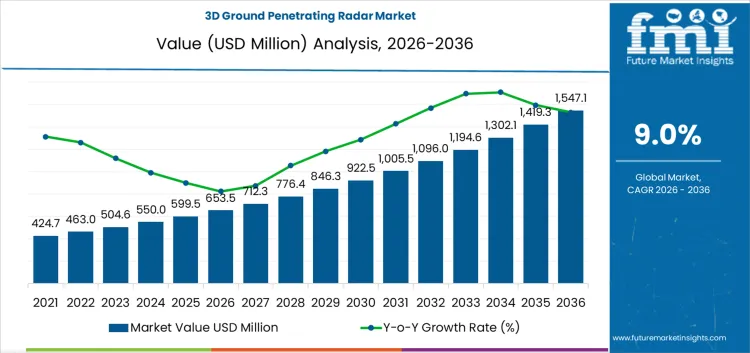
3D Ground Penetrating Radar Market Key Takeaways
| Metric | Value |
|---|---|
| 3D Ground Penetrating Radar Market Value (2026) | USD 653.5 Million |
| 3D Ground Penetrating Radar Market Forecast Value (2036) | USD 1,544.5 Million |
| 3D Ground Penetrating Radar Market Forecast CAGR 2026 to 2036 | 9.0% |
Why is the 3D Ground Penetrating Radar Market Growing at a Steady Pace?
The 3D ground penetrating radar market is expanding due to rising demand for non-destructive subsurface investigation across infrastructure, construction, and urban development projects. Governments and private developers are prioritizing accurate underground mapping to reduce excavation risks, cost overruns, and project delays. Aging utility networks and increasingly complex underground layouts are pushing project owners to adopt advanced detection solutions that deliver reliable three-dimensional subsurface visualization.
Technological progress is accelerating adoption within the 3D ground penetrating radar market. Advancements in multi-channel antenna configurations, real-time 3D data processing, and higher-resolution imaging are improving survey accuracy and operational efficiency. Software-driven improvements, including automated data interpretation and cloud-enabled analysis, are reducing dependency on highly specialized operators. These developments are broadening usage across civil engineering, environmental assessment, and commercial surveying applications.
Expanding use cases across transportation infrastructure, utility mapping, archaeology, and defense continue to strengthen growth prospects for the 3D ground penetrating radar market. Highway agencies and airport operators deploy these systems for pavement evaluation and subsurface integrity assessment. Utility operators rely on them to minimize accidental line strikes during excavation. Defense and security agencies apply advanced radar platforms for detection and assessment activities, reinforcing steady market demand over the forecast period.
What does the segment overview indicate about the 3D ground penetrating radar market?
The 3D ground penetrating radar market shows clear segmentation patterns shaped by deployment intensity and end-use needs. Hardware leads with about 40.0% share, reflecting its role in delivering accurate depth penetration and wide-area coverage. Software and services support data interpretation and workflow efficiency. On the application side, utility detection accounts for nearly 25.8% share, driven by underground asset mapping requirements. Transportation infrastructure and concrete investigation form stable mid-tier segments, while archaeology, environmental studies, and defense contribute specialized demand variations across regions.
Why does hardware account for the leading share in the 3D ground penetrating radar market?
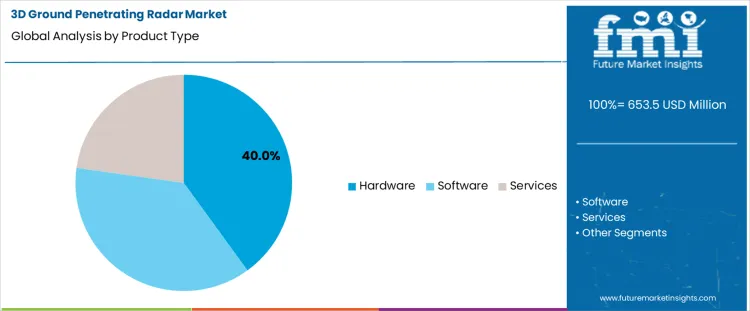
Hardware holds the leading position in the 3D ground penetrating radar market with an estimated 40.0% share, as it directly determines scanning accuracy, depth penetration, and coverage efficiency. Multi-channel antenna arrays and high-frequency systems enable reliable 3D imaging for utilities, roads, and large civil engineering projects. Demand is stronger for integrated cart-based and vehicle-mounted hardware that supports faster data acquisition and reduced survey time. Segment variation is visible, with compact hardware favored in dense urban environments and heavy-duty platforms deployed for highways and rail corridors. Ongoing upgrades, calibration needs, and replacement cycles further sustain hardware’s dominant contribution compared to software and service segments.
How does utility detection maintain its leading application share in the 3D ground penetrating radar market?
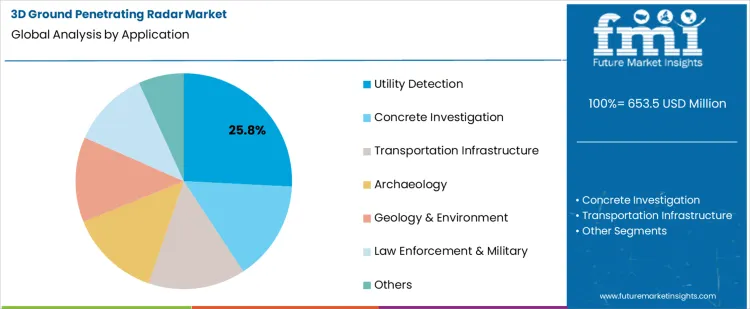
Utility detection remains the leading application in the 3D ground penetrating radar market, accounting for approximately 25.8% share, due to rising excavation risks in urban and infrastructure projects. Accurate identification of buried cables, pipelines, and conduits reduces service disruptions and safety incidents. Contractors increasingly rely on 3D imaging to visualize overlapping utility networks, improving planning accuracy over conventional methods. Demand varies by region, with mature markets focusing on verification and replacement mapping, while developing regions emphasize initial underground surveys. Infrastructure investment cycles and regulatory emphasis on damage prevention continue to reinforce utility detection as the most consistent application segment.
What’s Shaping Growth in the 3D Ground Penetrating Radar Market?
The 3D ground penetrating radar market is expanding as infrastructure owners and contractors seek accurate subsurface visibility before excavation and rehabilitation. Compared with 2D surveys, 3D imaging delivers volumetric data that improves target positioning and interpretation accuracy, helping reduce utility strikes, rework costs, and project delays. Rising refurbishment activity in urban infrastructure, where underground congestion is high, is supporting adoption. Digital as-built documentation requirements and non-destructive testing practices are increasingly specified in project scopes. Acceptance of geophysical data within planning and asset evaluation workflows is strengthening demand, although adoption levels vary depending on soil conditions, operator capability, and upfront investment requirements.
Why Are Utility and Infrastructure Projects Driving the 3D Ground Penetrating Radar Market?
Utility mapping is a primary growth driver for the 3D ground penetrating radar market as buried networks become denser and more interconnected. Accurate detection of power cables, telecom lines, water pipelines, and gas infrastructure reduces service disruptions and safety risks during excavation. Transportation authority’s apply 3D ground penetrating radar systems for pavement structure analysis, bridge-deck condition assessment, and rebar mapping to support maintenance planning without destructive testing. Three-dimensional visualization improves confidence in decision-making on large-scale projects. Increasing demand for GIS-ready and digitally shareable subsurface data in tenders is encouraging contractors to favor 3D survey approaches over conventional 2D scanning.
What is Limiting Wider Adoption of 3D Ground Penetrating Radar Systems?
High acquisition costs remain a key restraint for the 3D ground penetrating radar market, as full 3D systems require multiple antennas, accurate positioning hardware, and advanced data processing software. Smaller service providers often face longer payback periods, slowing investment decisions. Survey performance is sensitive to soil conductivity, moisture, and clay content, which can limit penetration depth and data clarity. Interpretation requires skilled personnel, increasing training and labor costs. Dense 3D grids also generate large datasets, extending processing time. For lower-complexity projects, some clients continue to accept 2D surveys, reducing immediate demand for 3D upgrades.
What is the country-wise growth outlook for the 3D ground penetrating radar market?
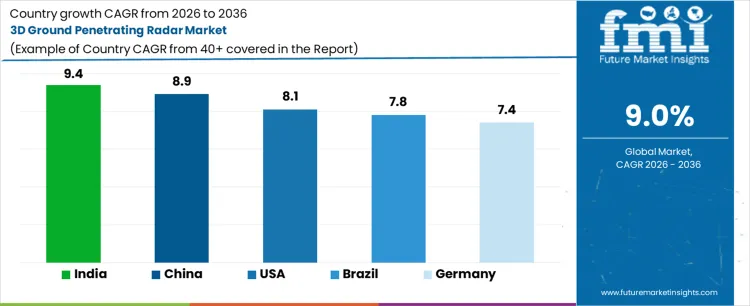
The 3D ground penetrating radar market reflects balanced growth across emerging and mature infrastructure economies, supported by steady adoption of non-destructive subsurface inspection. India leads the outlook with a 9.4% CAGR, driven by expanding urban excavation and transport corridor activity. China follows at an 8.9% CAGR as municipal authorities and contractors integrate GPR into routine utility and pavement assessments. The USA records an 8.1% CAGR, supported by compliance-driven demand and high-value inspection use cases. Brazil grows at a 7.8% CAGR through utility replacement and road rehabilitation programs, while Germany advances at a 7.4% CAGR, backed by engineering-focused inspection and maintenance practices.
| Country | CAGR |
|---|---|
| India | 9.4% |
| China | 8.9% |
| USA | 8.1% |
| Brazil | 7.8% |
| Germany | 7.4% |
Why does India represent the strongest growth engine for the 3D ground penetrating radar market?
Demand across India continues to rise as large-scale infrastructure execution intensifies across urban centers and transport corridors. The 3D ground penetrating radar market in India is projected to grow at a CAGR of 9.4%, supported by frequent excavation activity where unidentified subsurface utilities create schedule and safety risks. Sales are driven by EPC contractors, metro rail developers, and utility detection service providers seeking faster surveys and higher confidence before trenching. Highway widening, metro expansion, and pipeline replacement programs generate recurring requirements for cart-based and modular 3D GPR systems. Adoption is reinforced by increasing inclusion of subsurface investigation clauses in public tenders. Contractors value systems that deliver clear depth slices and corridor-level coverage in congested environments. Growth is further supported by improving operator training, expanding rental availability, and stronger local service networks, allowing firms to scale deployments across multiple project sites and maintain consistent equipment utilization.
What factors are shaping China’s demand outlook for the 3D ground penetrating radar market?
Sales momentum in China reflects steady expansion as subsurface scanning becomes embedded in municipal and transportation infrastructure workflows. The 3D ground penetrating radar market in China is expected to expand at a CAGR of 8.9%, supported by extensive road maintenance, airport upgrades, and underground utility construction. Contractors rely on 3D GPR to verify asset locations and assess pavement and structural conditions before rehabilitation. Demand favors wide-coverage cart systems and multichannel arrays that reduce survey time across large sites. Concrete investigation for bridges, tunnels, and station structures adds to system utilization. Buyers prioritize integrated software that supports rapid visualization and standardized reporting across large project portfolios. Strong domestic manufacturing capacity and accessible after-sales support reduce downtime, enabling contractors to deploy multiple systems across provinces and sustain long-term demand growth.
Why does the USA remain a stable and high-value market for 3D ground penetrating radar?
Sales activity in the USA continues to expand steadily as damage prevention and compliance remain central to excavation and infrastructure maintenance practices. The 3D ground penetrating radar market in the USA grows at a forecast CAGR of 8.1%, driven by utility locating firms, transportation agencies, and engineering consultancies. Demand is anchored in highway rehabilitation, bridge inspection, and urban utility replacement rather than large-scale new construction. Buyers emphasize data reliability, positioning accuracy, and documentation quality to support permitting and liability management. Advanced multichannel and cart-based systems gain preference for their ability to reduce field time and improve survey consistency. Software compatibility with CAD and GIS platforms plays a key role in purchasing decisions. Strong service contracts, calibration support, and operator training programs encourage repeat purchases and upgrade cycles, sustaining steady sales volumes.
How is Brazil strengthening its adoption of 3D ground penetrating radar solutions?
Demand in Brazil is expanding as municipalities and utilities increase preventive subsurface inspection efforts. The 3D ground penetrating radar market in Brazil is projected to grow at a CAGR of 7.8%, supported by water distribution upgrades, sewer rehabilitation, and telecom network expansion. Contractors increasingly rely on 3D GPR to reduce excavation uncertainty and control rework costs. Road rehabilitation programs also contribute to demand, with scanning used for pavement layer analysis and void detection prior to resurfacing. Sales favor versatile systems that address both utility detection and concrete investigation, improving return on equipment investment. Adoption improves as local service providers enhance interpretation quality and deliver clearer visual outputs to project owners. Training initiatives and rising awareness of non-destructive inspection benefits further support penetration across urban and regional infrastructure projects.
What supports Germany’s steady demand growth for 3D ground penetrating radar?
Demand in Germany continues to rise as infrastructure owners prioritize precision-led inspection and asset lifecycle management. The 3D ground penetrating radar market in Germany is expected to grow at a CAGR of 7.4%, supported by rail network maintenance, roadway assessment, and inspection of public structures. Engineering consultancies and contractors use 3D GPR for concrete investigation, rebar mapping, and void identification ahead of rehabilitation work. Buyers place strong emphasis on repeatable survey methodologies, high-resolution data, and traceable documentation suitable for technical decision-making. Urban utility mapping also contributes to adoption in regulated environments where excavation accuracy is critical. Sales favor proven systems supported by robust technical validation and professional training, sustaining consistent demand across long-term maintenance and rehabilitation programs.
How is Competitive Ground Being Shaped across leading 3D GPR Manufacturers?
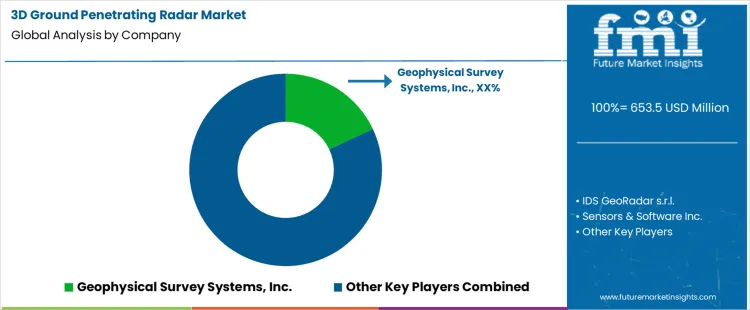
Competition is being defined by how efficiently three-dimensional subsurface images are captured and converted into decisions. Geophysical Survey Systems, Inc. is being positioned around integrated 3D workflows designed for utilities, concrete scanning, and transportation assets. Emphasis is being placed on compact control units, real-time depth slicing, and intuitive visualization promoted through product brochures. Ease of deployment and rapid operator training are being highlighted to secure adoption among service providers handling repeat urban projects. Sensors & Software Inc. is being differentiated through platform flexibility. Modular antennas, configurable carts, and software-driven upgrades are being promoted to support multiple survey objectives without full system replacement. Versatility is being presented as the core value proposition.
Array-based 3D mapping is being used as a scale advantage. IDS GeoRadar s.r.l. is being marketed on wide-coverage acquisition, where vehicle-towed arrays are used to generate dense 3D datasets in a single pass. Productivity per kilometer is being emphasized in brochures aimed at road agencies and infrastructure owners. Guideline Geo AB is being positioned similarly, though differentiation is being driven by channel density, signal clarity, and repeatability at speed. High-resolution output and reduced post-processing time are being framed as cost-saving features for large-area surveys where downtime is expensive.
A different competitive logic is being applied by Chemring Group PLC. GPR capability is being embedded within security and defense platforms rather than sold as a standalone survey tool. Product materials focus on detection reliability, sensor fusion, and deployment in hostile environments. Autonomous platforms and handheld systems are being promoted for route clearance and threat detection scenarios. Across all players, competition is being shaped less by raw penetration depth and more by workflow ownership, data confidence, and how convincingly each product brochure links technical performance to operational outcomes.
Key Players in 3D Ground Penetrating Radar Market
- Geophysical Survey Systems, Inc.
- IDS GeoRadar s.r.l.
- Sensors & Software Inc.
- Guideline Geo AB
- Chemring Group PLC
Scope of Report
| Attributes | Description |
|---|---|
| Quantitative Unit | USD Million |
| Base Year | 2026 |
| Forecast Period | 2026 to 2036 |
| Product Type | Hardware, Software, Services |
| Application | Utility Detection, Concrete Investigation, Transportation Infrastructure, Archaeology, Geology & Environment, Law Enforcement & Military, Others |
| Regions Covered | Asia Pacific, Europe, North America, Latin America, Middle East & Africa |
| Countries Covered | China, Japan, South Korea, India, Australia & New Zealand, ASEAN, Rest of Asia Pacific, Germany, United Kingdom, France, Italy, Spain, Nordic, BENELUX, Rest of Europe, United States, Canada, Mexico, Brazil, Chile, Rest of Latin America, Kingdom of Saudi Arabia, Other GCC Countries, Turkey, South Africa, Other African Union, Rest of Middle East & Africa |
| Key Companies Profiled | Geophysical Survey Systems, Inc., IDS GeoRadar s.r.l., Sensors & Software Inc., Guideline Geo AB, Chemring Group PLC |
| Additional Attributes | Dollar sales by product type and application; regional market sizing and 2026–2036 forecast analysis; deployment trends across civil infrastructure, subsurface inspection, and public safety use cases; assessment of hardware–software integration trends; analysis of procurement patterns across government, infrastructure contractors, and geophysical service providers. |
3D Ground Penetrating Radar Market by Key Segments
Product Type
- Hardware
- Software
- Services
Application
- Utility Detection
- Concrete Investigation
- Transportation Infrastructure
- Archaeology
- Geology & Environment
- Law Enforcement & Military
- Others
Region:
- Asia Pacific
- China
- Japan
- South Korea
- India
- Australia & New Zealand
- ASEAN
- Rest of Asia Pacific
- Europe
- Germany
- United Kingdom
- France
- Italy
- Spain
- Nordic
- BENELUX
- Rest of Europe
- North America
- United States
- Canada
- Mexico
- Latin America
- Brazil
- Chile
- Rest of Latin America
- Middle East & Africa
- Kingdom of Saudi Arabia
- Other GCC Countries
- Turkey
- South Africa
- Other African Union
- Rest of Middle East & Africa
Bibliography
- U.S. Environmental Protection Agency. (2025, April 18). Ground penetrating radar (GPR). U.S. Environmental Protection Agency.
- Federal Highway Administration. (2024, August). Validating a density-profiling system for asphalt compaction assessment (Publication No. FHWA-HRT-24-143). U.S. Department of Transportation.
- Florida Department of Transportation. (2024). Soil and foundations handbook (2024 ed.). Florida Department of Transportation.
Frequently Asked Questions
How big is the 3d ground penetrating radar market in 2026?
The global 3d ground penetrating radar market is estimated to be valued at USD 653.5 million in 2026.
What will be the size of 3d ground penetrating radar market in 2036?
The market size for the 3d ground penetrating radar market is projected to reach USD 1,547.1 million by 2036.
How much will be the 3d ground penetrating radar market growth between 2026 and 2036?
The 3d ground penetrating radar market is expected to grow at a 9.0% CAGR between 2026 and 2036.
What are the key product types in the 3d ground penetrating radar market?
The key product types in 3d ground penetrating radar market are hardware, software and services.
Which application segment to contribute significant share in the 3d ground penetrating radar market in 2026?
In terms of application, utility detection segment to command 25.8% share in the 3d ground penetrating radar market in 2026.
Preview the report firsthand - request a free sample
Get SampleGet the brochure for pricing and purchase details.
Get PDFTable of Content
- Executive Summary
- Global Market Outlook
- Demand-side Trends
- Supply-side Trends
- Technology Roadmap Analysis
- Analysis and Recommendations
- Market Overview
- Market Coverage / Taxonomy
- Market Definition / Scope / Limitations
- Market Background
- Market Dynamics
- Drivers
- Restraints
- Opportunity
- Trends
- Scenario Forecast
- Demand in Optimistic Scenario
- Demand in Likely Scenario
- Demand in Conservative Scenario
- Opportunity Map Analysis
- Product Life Cycle Analysis
- Supply Chain Analysis
- Investment Feasibility Matrix
- Value Chain Analysis
- PESTLE and Porter’s Analysis
- Regulatory Landscape
- Regional Parent Market Outlook
- Production and Consumption Statistics
- Import and Export Statistics
- Market Dynamics
- Global Market Analysis 2021 to 2025 and Forecast, 2026 to 2036
- Historical Market Size Value (USD Million) Analysis, 2021 to 2025
- Current and Future Market Size Value (USD Million) Projections, 2026 to 2036
- Y-o-Y Growth Trend Analysis
- Absolute $ Opportunity Analysis
- Global Market Pricing Analysis 2021 to 2025 and Forecast 2026 to 2036
- Global Market Analysis 2021 to 2025 and Forecast 2026 to 2036, By Product Type
- Introduction / Key Findings
- Historical Market Size Value (USD Million) Analysis By Product Type , 2021 to 2025
- Current and Future Market Size Value (USD Million) Analysis and Forecast By Product Type , 2026 to 2036
- Hardware
- Software
- Services
- Hardware
- Y-o-Y Growth Trend Analysis By Product Type , 2021 to 2025
- Absolute $ Opportunity Analysis By Product Type , 2026 to 2036
- Global Market Analysis 2021 to 2025 and Forecast 2026 to 2036, By Application
- Introduction / Key Findings
- Historical Market Size Value (USD Million) Analysis By Application, 2021 to 2025
- Current and Future Market Size Value (USD Million) Analysis and Forecast By Application, 2026 to 2036
- Utility Detection
- Concrete Investigation
- Transportation Infrastructure
- Archaeology
- Geology & Environment
- Law Enforcement & Military
- Others
- Utility Detection
- Y-o-Y Growth Trend Analysis By Application, 2021 to 2025
- Absolute $ Opportunity Analysis By Application, 2026 to 2036
- Global Market Analysis 2021 to 2025 and Forecast 2026 to 2036, By Region
- Introduction
- Historical Market Size Value (USD Million) Analysis By Region, 2021 to 2025
- Current Market Size Value (USD Million) Analysis and Forecast By Region, 2026 to 2036
- North America
- Latin America
- Western Europe
- Eastern Europe
- East Asia
- South Asia and Pacific
- Middle East & Africa
- Market Attractiveness Analysis By Region
- North America Market Analysis 2021 to 2025 and Forecast 2026 to 2036, By Country
- Historical Market Size Value (USD Million) Trend Analysis By Market Taxonomy, 2021 to 2025
- Market Size Value (USD Million) Forecast By Market Taxonomy, 2026 to 2036
- By Country
- USA
- Canada
- Mexico
- By Product Type
- By Application
- By Country
- Market Attractiveness Analysis
- By Country
- By Product Type
- By Application
- Key Takeaways
- Latin America Market Analysis 2021 to 2025 and Forecast 2026 to 2036, By Country
- Historical Market Size Value (USD Million) Trend Analysis By Market Taxonomy, 2021 to 2025
- Market Size Value (USD Million) Forecast By Market Taxonomy, 2026 to 2036
- By Country
- Brazil
- Chile
- Rest of Latin America
- By Product Type
- By Application
- By Country
- Market Attractiveness Analysis
- By Country
- By Product Type
- By Application
- Key Takeaways
- Western Europe Market Analysis 2021 to 2025 and Forecast 2026 to 2036, By Country
- Historical Market Size Value (USD Million) Trend Analysis By Market Taxonomy, 2021 to 2025
- Market Size Value (USD Million) Forecast By Market Taxonomy, 2026 to 2036
- By Country
- Germany
- UK
- Italy
- Spain
- France
- Nordic
- BENELUX
- Rest of Western Europe
- By Product Type
- By Application
- By Country
- Market Attractiveness Analysis
- By Country
- By Product Type
- By Application
- Key Takeaways
- Eastern Europe Market Analysis 2021 to 2025 and Forecast 2026 to 2036, By Country
- Historical Market Size Value (USD Million) Trend Analysis By Market Taxonomy, 2021 to 2025
- Market Size Value (USD Million) Forecast By Market Taxonomy, 2026 to 2036
- By Country
- Russia
- Poland
- Hungary
- Balkan & Baltic
- Rest of Eastern Europe
- By Product Type
- By Application
- By Country
- Market Attractiveness Analysis
- By Country
- By Product Type
- By Application
- Key Takeaways
- East Asia Market Analysis 2021 to 2025 and Forecast 2026 to 2036, By Country
- Historical Market Size Value (USD Million) Trend Analysis By Market Taxonomy, 2021 to 2025
- Market Size Value (USD Million) Forecast By Market Taxonomy, 2026 to 2036
- By Country
- China
- Japan
- South Korea
- By Product Type
- By Application
- By Country
- Market Attractiveness Analysis
- By Country
- By Product Type
- By Application
- Key Takeaways
- South Asia and Pacific Market Analysis 2021 to 2025 and Forecast 2026 to 2036, By Country
- Historical Market Size Value (USD Million) Trend Analysis By Market Taxonomy, 2021 to 2025
- Market Size Value (USD Million) Forecast By Market Taxonomy, 2026 to 2036
- By Country
- India
- ASEAN
- Australia & New Zealand
- Rest of South Asia and Pacific
- By Product Type
- By Application
- By Country
- Market Attractiveness Analysis
- By Country
- By Product Type
- By Application
- Key Takeaways
- Middle East & Africa Market Analysis 2021 to 2025 and Forecast 2026 to 2036, By Country
- Historical Market Size Value (USD Million) Trend Analysis By Market Taxonomy, 2021 to 2025
- Market Size Value (USD Million) Forecast By Market Taxonomy, 2026 to 2036
- By Country
- Kingdom of Saudi Arabia
- Other GCC Countries
- Turkiye
- South Africa
- Other African Union
- Rest of Middle East & Africa
- By Product Type
- By Application
- By Country
- Market Attractiveness Analysis
- By Country
- By Product Type
- By Application
- Key Takeaways
- Key Countries Market Analysis
- USA
- Pricing Analysis
- Market Share Analysis, 2025
- By Product Type
- By Application
- Canada
- Pricing Analysis
- Market Share Analysis, 2025
- By Product Type
- By Application
- Mexico
- Pricing Analysis
- Market Share Analysis, 2025
- By Product Type
- By Application
- Brazil
- Pricing Analysis
- Market Share Analysis, 2025
- By Product Type
- By Application
- Chile
- Pricing Analysis
- Market Share Analysis, 2025
- By Product Type
- By Application
- Germany
- Pricing Analysis
- Market Share Analysis, 2025
- By Product Type
- By Application
- UK
- Pricing Analysis
- Market Share Analysis, 2025
- By Product Type
- By Application
- Italy
- Pricing Analysis
- Market Share Analysis, 2025
- By Product Type
- By Application
- Spain
- Pricing Analysis
- Market Share Analysis, 2025
- By Product Type
- By Application
- France
- Pricing Analysis
- Market Share Analysis, 2025
- By Product Type
- By Application
- India
- Pricing Analysis
- Market Share Analysis, 2025
- By Product Type
- By Application
- ASEAN
- Pricing Analysis
- Market Share Analysis, 2025
- By Product Type
- By Application
- Australia & New Zealand
- Pricing Analysis
- Market Share Analysis, 2025
- By Product Type
- By Application
- China
- Pricing Analysis
- Market Share Analysis, 2025
- By Product Type
- By Application
- Japan
- Pricing Analysis
- Market Share Analysis, 2025
- By Product Type
- By Application
- South Korea
- Pricing Analysis
- Market Share Analysis, 2025
- By Product Type
- By Application
- Russia
- Pricing Analysis
- Market Share Analysis, 2025
- By Product Type
- By Application
- Poland
- Pricing Analysis
- Market Share Analysis, 2025
- By Product Type
- By Application
- Hungary
- Pricing Analysis
- Market Share Analysis, 2025
- By Product Type
- By Application
- Kingdom of Saudi Arabia
- Pricing Analysis
- Market Share Analysis, 2025
- By Product Type
- By Application
- Turkiye
- Pricing Analysis
- Market Share Analysis, 2025
- By Product Type
- By Application
- South Africa
- Pricing Analysis
- Market Share Analysis, 2025
- By Product Type
- By Application
- USA
- Market Structure Analysis
- Competition Dashboard
- Competition Benchmarking
- Market Share Analysis of Top Players
- By Regional
- By Product Type
- By Application
- Competition Analysis
- Competition Deep Dive
- Geophysical Survey Systems, Inc.
- Overview
- Product Portfolio
- Profitability by Market Segments (Product/Age /Sales Channel/Region)
- Sales Footprint
- Strategy Overview
- Marketing Strategy
- Product Strategy
- Channel Strategy
- IDS GeoRadar s.r.l.
- Sensors & Software Inc.
- Guideline Geo AB
- Chemring Group PLC
- Geophysical Survey Systems, Inc.
- Competition Deep Dive
- Assumptions & Acronyms Used
- Research Methodology


