

- Market Size (2026)
- USD 304.9 Mn
- Forecast (2036)
- USD 1160.6 Mn
- CAGR (2026 to 2036)
- 14.3%
How big is 800VDC Rack Power Interface Test Equipment Market in 2026?
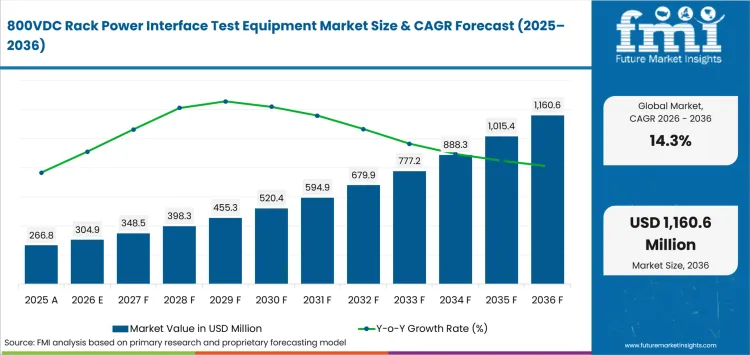
USD 304.9 million in 2026 and USD 1,160.6 million by 2036 at a 14.3% CAGR.
Sales of 800VDC rack power interface test equipment are projected to expand at a 14.3% CAGR between 2026 and 2036, increasing market valuation from USD 304.9 million to USD 1,160.6 million. Higher rack-power densities are driving adoption of 800VDC architectures as data centers seek more efficient power distribution for AI and high-performance computing workloads. NVIDIA said in August 2026 that more than 80 equipment manufacturers and infrastructure companies were developing products for defined 800 VDC specifications. That change shifts automated test equipment selection earlier in qualification programs for AI projects before procurement closes. Data center power design decisions then define which electrical states test systems must reproduce at the rack boundary.
Country growth differs because new AI capacity reaches electrical design freeze through different site-development and grid-connection routes. France's economy ministry identified 63 sites suitable for data centers in January 2026. The figure shows a national pipeline with power access being prepared before final facility design. That pipeline changes which party owns insulation checks and protection-response records before rack energization begins at each site. Test vendors therefore need commissioning support that fits power management workflows after rack energization. Data center infrastructure management records also need compatible fault data so maintenance teams can reuse acceptance evidence.
Key Takeaways
- Open 800 VDC rack architectures are turning interface validation into a repeatable factory and site acceptance requirement for high-density AI infrastructure.
- By product configuration, rack-integrated assembly is estimated to hold 31.0% in 2026 owing to test access moving closer to row-level power conversion.
- The 750-850 VDC segment is likely to capture 49.0% share in 2026 attributable to open designs centered on nominal 800 VDC distribution.
- The 250-500 kW segment is set to lead rack power density with 36.0% share in 2026 due to dedicated high-voltage qualification at this transition band.
- Evolving arc-flash guidance and protection coordination can lengthen qualification because converter-fed 800 VDC systems need architecture-specific fault analysis before common procedures stabilize.
- Some of the key players in this market include Chroma ATE Inc., Keysight Technologies, Inc., Tektronix, Inc., KIKUSUI Electronics Corp., Bender GmbH & Co. KG, Eaton, Delta Electronics, Inc., and Schneider Electric.
Analyst Perspective
"800 VDC test platforms earn their place by shortening repeat qualification without weakening electrical safety evidence at the rack boundary. Commercial value concentrates in equipment that preserves comparable records from factory acceptance through commissioning and later service work."
- Nikhil Kaitwade, Principal Consultant, Future Market Insights
How is the USA accelerates acceptance as hyperscalers adopt 800VDC architectures alongside AI data center deployments. segmented?
The market is segmented by product configuration, nominal DC voltage, rack power density, data center type, route to market and region.
Product configuration separates rack-integrated assemblies from standalone modules, busway-integrated formats and prefabricated cabinets. Nominal DC voltage covers 750-850 VDC and adjacent voltage bands. Rack power density spans below 250 kW through above 750 kW. Data center type covers hyperscale AI, colocation AI, enterprise or sovereign AI and HPC research centers. Route to market includes power OEM direct, electrical EPC or system integrator, authorized distributor and retrofit or service channels.
What supports Hyperscale AI data centers in the Data center type category?
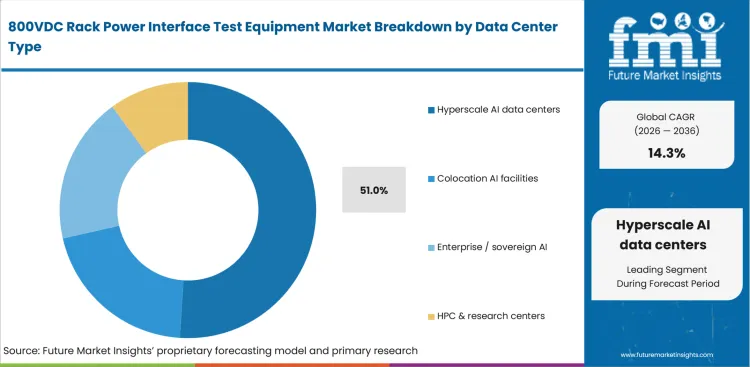
Hyperscale AI sites generate repeated rack acceptance work as operators deploy the same electrical architecture in large batches. NVIDIA disclosed in October 2025 that more than 20 partners were supporting 800 VDC data centers for future gigawatt AI factories. More than 20 partners let an AI server chassis program enter qualification before every site-specific power detail is finalized.
- Hyperscale AI data centers are projected to hold 51.0% share in 2026 owing to deployment volumes that justify repeatable rack-interface qualification procedures.
- Large operators also need test records that can move between factory acceptance and site commissioning without losing traceability after equipment configuration changes.
What makes Rack-integrated assembly central to the Product configuration category?
Rack-integrated assemblies place sensing and acceptance access beside the power rack instead of forcing every verification step upstream. NVIDIA said in August 2026 that its MGX-compatible 800 VDC power rack was scheduled for the second half of 2026 and designed for existing AC facilities. The row-level conversion point therefore makes power quality monitoring useful during commissioning without reopening building-level distribution.
- Based on product configuration, rack-integrated assembly is projected to account for 31.0% in 2026 due to repeat validation beside high-density compute racks.
- Operators can retain one documented test sequence after rack replacement or reconfiguration because accessible measurement points stay with the row-level power package.
Why does 750-850 VDC lead the nominal DC voltage category?
The 750-850 VDC band matches the nominal architecture now used for open high-density rack power work. Schneider Electric stated in October 2025 that its 800 VDC program covered conversion and protection together with metering and testing for high-density AI rack systems. That system-level work gives test engineers a direct electrical window to reproduce without relying on lower-voltage transitional equipment.
- By nominal DC voltage, the 750-850 VDC segment is estimated to hold 49.0% in 2026 owing to qualification converging on nominal 800 VDC distribution.
- Direct source-and-load emulation gives laboratory teams a practical route to reproduce rack power states before field commissioning begins at the final installation.
How does 250-500 kW define the Rack Power density category?
The 250-500 kW band marks the point where lower current and controlled fault behavior become material rack-design concerns. Chroma documented in September 2025 that its synchronized DC load architecture scales to 1.44 MW for AI server power validation. The same scalable test logic supports the digital power conversion transition from individual power shelves toward larger rack assemblies.
- By rack power density, the 250-500 kW segment is forecast to represent 36.0% in 2026 driven by dedicated high-voltage testing becoming economical before megawatt racks dominate.
- Commissioning teams in this band need transient testing and current-slew verification that ordinary voltage-presence checks cannot provide during realistic operating states.
What are the drivers, restraints and opportunities in the 800VDC Rack Power Interface Test Equipment Market?
Standardized 800 VDC interfaces increase qualification demand, evolving safety evidence slows common test packages, and retrofit power racks broaden row-level validation requirements.
- Driver: Common 800 VDC electrical interfaces let manufacturers reuse qualification procedures for larger batches of rack-power equipment.
- Restraint: Converter-fed fault behavior requires architecture-specific safety analysis before one acceptance method can cover every 800 VDC implementation.
- Opportunity: Existing AC facilities need row-level verification as new 800 VDC power racks are introduced without rebuilding upstream electrical distribution.
Open 800 VDC interfaces make repeat qualification more valuable
Power-equipment manufacturers spend less engineering time rewriting test limits once voltage windows and interface behavior converge. Open Compute Project documented in August 2026 that published 800 VDC requirements let equipment manufacturers build interoperable products without maintaining conflicting customer specifications. Repeatable source and load profiles therefore become easier to standardize inside AI rack power budgeting workflows before site construction is complete.
Safety evidence keeps qualification architecture-specific
Capacitor discharge and protection timing alter fault exposure, so high-voltage DC acceptance cannot rely on nominal voltage alone. Schneider Electric published an August 2026 analysis covering two representative 800 VDC architectures and found that arc-flash outcomes depended strongly on configuration. Test specifications therefore need fault-response evidence that matches the installed topology instead of a generic DC checklist.
Retrofit power racks shift testing toward the row
Existing facilities can adopt high-voltage rack power without replacing every upstream electrical stage, which places more acceptance work beside compute rows. Bender announced a March 2025 partnership with speedikon to integrate electrical safety data into a data-center infrastructure management platform. That pairing gives data center transformation programs a route to carry fault-monitoring records into operating workflows after commissioning.
Which country CAGRs are profiled in the 800VDC Rack Power Interface Test Equipment Market?
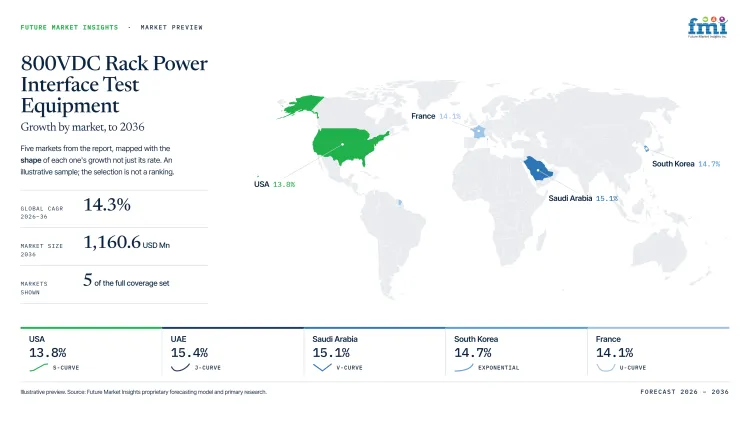
| Country | CAGR |
|---|---|
| UAE | 15.4% |
| Saudi Arabia | 15.1% |
| South Korea | 14.7% |
| France | 14.1% |
| USA | 13.8% |
How do country-level CAGRs compare in the 800VDC Rack Power Interface Test Equipment Market?
The five profiled CAGRs span 1.3 percentage points from UAE at 15.4% to France at 14.1%. Gulf markets form the upper group because greenfield AI campuses assign electrical acceptance early in construction. South Korea and Japan rely on phased infrastructure planning. France pairs AI projects with grid sites and power-equipment manufacturing.
- UAE project concentration favors standardized factory records during tightly scheduled campus commissioning.
- Saudi greenfield halls increase the value of mobile commissioning on separate energization schedules.
- South Korea rewards redeployable test fleets as regional projects enter service in phases.
- France shifts acceptance upstream as domestic power-module production expands beside AI projects.
- USA accelerates acceptance as hyperscalers adopt 800VDC architectures alongside AI data center deployments.
Comparable CAGRs can therefore produce different test ownership and service requirements in each national market. The full report provides country-level CAGR analysis across North America, Latin America, Europe, East Asia, South Asia, Oceania and the Middle East and Africa.
Country-wise Analysis
- Large Abu Dhabi programs increasingly specify sovereign infrastructure and rack-power acceptance within one deployment plan, giving power integrators early access to defined commissioning requirements before equipment reaches the data hall. The UAE 800VDC rack power interface test equipment outlook is anticipated to advance at 15.4% CAGR over the assessment period, aided by campus-scale AI infrastructure that concentrates test ownership among power OEMs and site integrators with local engineering teams. In October 2025 the Department of Government Enablement said its unified government data center would provide 19 MW of AI-ready capacity, but high ambient temperatures and strict efficiency targets raise repeat-testing costs after late design changes or incomplete interface documentation.
- As Riyadh greenfield projects tie electrical acceptance closely to construction schedules, power OEMs can define rack-interface test points before field teams mobilize at large campuses outside mature service corridors. Saudi Press Agency stated in January 2026 that the SDAIA Hexagon government data center was designed for 480 MW, giving equipment makers a clear national scale signal for factory acceptance planning and local commissioning support. Saudi Arabia is estimated to post 15.1% CAGR over the forecast period, propelled by sovereign AI programs despite calibration and specialist service capacity that must expand with construction beyond established technical hubs during each major project phase.
- Outside Seoul, regional AI projects pair new compute halls with utility planning and require test providers to follow phased construction into locations with thinner specialist service coverage. Adoption of 800VDC rack power interface test equipment in South Korea is estimated to expand at 14.7% CAGR through 2036, tied to high-capacity commissioning that rewards portable systems and repeatable factory records before each site phase energizes. The Ministry of Science and ICT said in June 2025 that the Ulsan AI data center was planned as a 100 MW-class facility, although power-system reviews and site sequencing can delay acceptance after rack equipment arrives.
- French AI projects increasingly pair large compute commitments with domestic power-equipment manufacturing and pre-identified grid connection sites, giving test vendors earlier contact with power-module manufacturers and EPC partners. In June 2026 the Élysée disclosed that SoftBank planned at least 3 GW of AI-dedicated data-center capacity in France, establishing a visible pipeline for power modules and commissioning equipment. The France 800VDC rack power interface test equipment sector is projected to record 14.1% CAGR over the assessment period, reflecting a pipeline that favors IEC-oriented records reusable between factory and site acceptance even though grid connection timing can postpone instrument deployment after specifications are selected.
- USA AI projects increasingly pair large compute commitments with expanding power-equipment ecosystems and pre-identified grid connection sites, giving test vendors earlier contact with power-module manufacturers and EPC partners. In March 2026 Texas Instruments unveiled a complete 800 VDC power architecture with NVIDIA for future-generation AI data centers, establishing a visible pipeline for power modules and commissioning equipment. The USA 800VDC rack power interface test equipment sector is projected to record 13.8% CAGR over the assessment period, reflecting a pipeline that favors standardized test records reusable between factory and site acceptance even though grid connection timing can postpone instrument deployment after specifications are selected.
Who are the notable companies in the 800VDC Rack Power Interface Test Equipment Market?
Chroma ATE Inc., Keysight Technologies, Inc., Tektronix, Inc., Megger, Bender GmbH & Co. KG, Eaton, Delta Electronics, Inc., and Schneider Electric are notable companies serving this market.
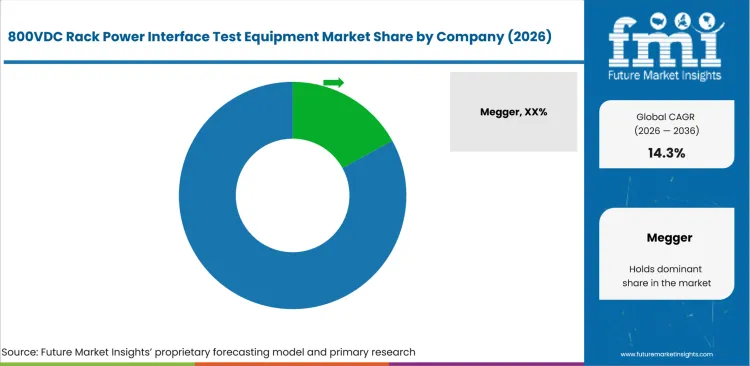
The competitive field separates programmable source-load systems from electrical monitoring and rack-power integration. Chroma, Keysight and KIKUSUI offer high-power source or load platforms for electrical validation. Tektronix extends power and signal analysis into dense AI infrastructure workflows. Bender addresses residual-current and insulation monitoring. Eaton, Delta and Schneider Electric define conversion, protection and distribution choices at the rack interface. Higher rack density places electrical acceptance in the same commissioning window as data center liquid cooling projects.
- High-power validation platforms: Chroma ATE Inc., Keysight Technologies, Inc. and KIKUSUI Electronics Corp. supply programmable source-load systems for high-voltage electrical qualification.
- Measurement and monitoring specialists: Tektronix, Inc. covers power-distribution analysis and Bender GmbH & Co. KG focuses on residual-current and insulation monitoring.
- Rack-power integration companies: Eaton, Delta Electronics, Inc. and Schneider Electric define conversion, protection and distribution choices that determine the test boundary.
Competitive Benchmarking: 800VDC Rack Power Interface Test Equipment Market
| Company | High-voltage DC test depth | Source/load emulation | Rack/facility integration | Geographic Reach |
|---|---|---|---|---|
| Chroma ATE Inc. | High | High | Medium | Global |
| Keysight Technologies, Inc. | High | High | Medium | Global |
| Tektronix, Inc. | Medium | Low | Medium | Global |
| KIKUSUI Electronics Corp. | High | High | Low | Global |
| Bender GmbH & Co. KG | Medium | Low | High | Europe, North America and Asia |
| Eaton | Low | Low | High | Global |
| Delta Electronics, Inc. | Low | Low | High | Global |
| Schneider Electric | Medium | Low | High | Global |
Scoring basis: High high-voltage DC test depth requires documented operation at or above 800 VDC plus multiple relevant test modes. Medium identifies a directly relevant DC route with narrower coverage. Low records a documented diagnostic or architecture role without a dedicated 800 VDC test platform. High source-load emulation requires programmable bidirectional or regenerative operation at rack scale. Medium covers one programmable source or load route. Low records a documented role without source-load emulation. High rack-facility integration requires embedded or in-row participation in the data-center power path. Medium covers rack-level test systems. Low is primarily portable or offline.
Key Developments in the 800VDC Rack Power Interface Test Equipment Market
- In December 2025, Chroma ATE Inc. introduced a 1.8 MW bidirectional platform that sources 800 VDC and accepts 800 VDC as a regenerative rack load.
- In November 2025, Keysight Technologies, Inc. launched the RP5900, EL4900 and DP5700 high-power ATE families for automated regenerative power validation.
- In May 2025, Bender GmbH & Co. KG introduced LINETRAXX SmartDetect RCMS425 residual-current monitoring devices for multi-channel industrial electrical monitoring.
Key Players in the 800VDC Rack Power Interface Test Equipment Market
High-power source and load test platforms
- Chroma ATE Inc.
- Keysight Technologies, Inc.
- KIKUSUI Electronics Corp.
Measurement and electrical monitoring specialists
- Tektronix, Inc.
- Bender GmbH & Co. KG
Rack-power and facility integration platforms
- Eaton
- Delta Electronics, Inc.
- Schneider Electric
800VDC Rack Power Interface Test Equipment Market - Report Scope
| Coverage field | Report scope |
|---|---|
| Market breakdown | By product configuration, nominal DC voltage, rack power density, data center type, route to market and region. |
| Quantitative Units | USD Million. |
| Market Definition | Electrical test, measurement and monitoring equipment used to qualify 800 VDC rack-power interfaces during factory acceptance, site commissioning and service. |
| Regions Covered | North America, Latin America, Europe, East Asia, South Asia and Pacific, and Middle East and Africa. |
| Countries Covered | UAE, Saudi Arabia, South Korea, Japan, France, and 20+ countries included in the full report. |
| Key Companies Profiled | Chroma ATE Inc., Keysight Technologies, Inc., Tektronix, Inc., KIKUSUI Electronics Corp., Bender GmbH & Co. KG, Eaton, Delta Electronics, Inc., Schneider Electric. |
| Forecast Period | 2026 to 2036. |
| Approach | Primary and secondary research with market triangulation. |
800VDC Rack Power Interface Test Equipment Market - Research Methodology
| Method | Approach |
|---|---|
| Primary Research | FMI analysts gathered input from manufacturers, service providers, technology developers, distributors, end users, procurement teams, and subject-matter experts. Interviews examined purchasing decisions, product or service evaluation, adoption barriers, approval requirements, pricing considerations, and expectations for technical or commercial support. Respondents were also asked what evidence is required before a trial, pilot, or initial order develops into regular purchasing. |
| Desk Research | Desk research covered government statistics, regulatory publications, trade data, industry associations, technical literature, standards, company filings, product information, and official corporate announcements. Sources were reviewed for relevance, publication date, geographic coverage, and consistency with the defined market scope. Claims relating to performance, applications, approvals, capacity, investment, and commercial activity were retained only when supported by credible public evidence. |
| Market Sizing and Forecasting | The market model combined the baseline value with historical performance, segment structure, pricing and volume indicators, adoption levels, company participation, and country-level demand conditions. Forecast assumptions considered economic activity, investment trends, regulatory developments, technology adoption, purchasing cycles, supply availability, and barriers to wider market use. Segment and regional estimates were reconciled before the final market total was calculated. |
| Data Validation | Estimates were checked against multiple independent indicators, including public data, company activity, trade patterns, industry developments, and findings from primary interviews. Validation also tested whether products, services, applications, and company revenues fell within the defined market boundaries. Adjacent categories, unsupported claims, overlapping revenues, and activities without direct market relevance were excluded to reduce double counting and maintain consistency across segments and countries. |
800VDC Rack Power Interface Test Equipment Market by Segments
800VDC Rack Power Interface Test Equipment Market segmented by product configuration:
- rack-integrated assembly
- standalone device/module
- busway/distribution-integrated
- prefabricated power cabinet
800VDC Rack Power Interface Test Equipment Market segmented by nominal DC voltage:
- 750-850 VDC
- 600-749 VDC
- 851-1,000 VDC
- above 1,000 VDC
800VDC Rack Power Interface Test Equipment Market segmented by rack power density:
- 250-500 kW
- below 250 kW
- 501-750 kW
- above 750 kW
800VDC Rack Power Interface Test Equipment Market segmented by data center type:
- hyperscale AI data centers
- colocation AI facilities
- enterprise/sovereign AI
- HPC and research centers
800VDC Rack Power Interface Test Equipment Market segmented by route to market:
- power OEM direct
- electrical EPC/system integrator
- authorized distributor
- retrofit/service channel
800VDC Rack Power Interface Test Equipment Market by Region:
- North America
- United States
- Canada
- Latin America
- Brazil
- Mexico
- Argentina
- Chile
- Western Europe
- Germany
- France
- United Kingdom
- Italy
- Spain
- Benelux
- Nordics
- Eastern Europe
- Poland
- Czech Republic
- Romania
- Hungary
- East Asia
- China
- Japan
- South Korea
- South Asia and Pacific
- India
- ASEAN
- Australia and New Zealand
- Middle East and Africa
- GCC Countries
- South Africa
- Türkiye
- Israel
Research Sources and Bibliography
- NVIDIA. (2026, August 11). Why Scaling AI Compute Performance Requires a New Power Architecture.
- Ministère de l’Économie, des Finances et de la Souveraineté industrielle et numérique. (2026, January 30). Rencontres des centres de données : la dynamique des projets d’infrastructures numériques se confirme.
- Schneider Electric. (2025, October 13). Schneider Electric Highlights Innovation in 800 VDC Power Systems in support of NVIDIA’s next generation GPUs.
- Chroma ATE Inc. (2025, September 19). HVDC AI Server Power Testing: Chroma DC Load Enables 1.44MW-Level Verification.
- NVIDIA. (2025, October 13). NVIDIA, Partners Drive Next-Gen Efficient Gigawatt AI Factories in Buildup for Vera Rubin.
- Open Compute Project Foundation. (2026, August 11). Powering the Next Era of AI: How Google, Microsoft and Nvidia Are Standardizing and Accelerating the Industry Transition to LVDC.
- Schneider Electric. (2026, August 3). Schneider Electric releases pioneering study assessing arc flash risk in 800 VDC data centers aligning with world’s leading hyperscalers.
- Bender GmbH & Co. KG. (2025, March 18). Bender reveal new DCIM solution and partnership with speedikon at Data Centre World 2025.
- Department of Government Enablement - Abu Dhabi. (2025, October 17). Department of Government Enablement and e& Partner to Launch Abu Dhabi Unified Government Data Centre to Power 40+ Government Entities.
- Saudi Press Agency. (2026, January 1). Foundation Stone Laid for World’s Largest Government Data Center in Riyadh.
- Ministry of Science and ICT, Republic of Korea. (2025, June 20). Ulsan AI Data Center Launch Sparks Dialogue on Advancing Korea into a Top-Three Global AI Power.
- Ministry of Economy, Trade and Industry, Japan. (2025, June 12). Report 1.0 of the Public-Private Advisory Council on Watt-Bit Collaboration Published.
- The Élysée. (2026, June 1). Meeting with Masayoshi Son, CEO of SoftBank.
- Chroma ATE Inc. (2025, December 18). Chroma 1.8MW Bidirectional Power Supply Accelerates the HVDC Era.
- Keysight Technologies, Inc. (2025, November 5). Keysight Launches Next-Gen High-Power Test Solutions to Tackle Growing Power Validation Challenges.
- Bender GmbH & Co. KG. (2025, May 26). Introducing the new LINETRAXX SmartDetect RCMS425 residual current monitoring devices.
- Keysight Technologies, Inc. (2026, March). RP5900 Series Operating and Service Guide.
- Eaton. (2025, October 13). Eaton unveils next-generation architecture to advance 800 VDC power infrastructure for AI factories.
- Delta Electronics, Inc. (2026, May 28). Delta Bolsters 800 VDC Architecture for Next-gen AI Factories with Power, Cooling and Microgrid Solutions.
- Schneider Electric. (2026, June 15). Schneider Electric and Hon Hai Technology Group (Foxconn) announce strategic collaboration to accelerate next-generation AI data centers.
- Tektronix, Inc. (2026, July 9). Tektronix Unifies Power and Signal Integrity Analysis for Modern Power Distribution Networks.
- Chroma ATE Inc. (2026, January 13). Ready for HVDC ±400V and 800V: Chroma Delivers Test Solutions for Solid-State Transformer Modules.
- Bender GmbH & Co. KG. (2026, March 27). Bender introduces new modular residual current devices (MRCD).
- KIKUSUI Electronics Corp. (2025, October 9).
- Keysight Technologies, Inc. (2026, February 18). Keysight Introduces Scale-Up Validation Solutions for AI Data Centers.
- Fluke Corporation. (2026, May 12). New Fluke FEV500 Redefines Testing for Fast DC Electric Vehicle Chargers, Eliminating Costly Downtime.
This bibliography is provided for reader reference and is not exhaustive. The full report contains the complete reference list and detailed citations.
This Report Answers
- What is the 2026 market size for 800VDC rack power interface test equipment market and 2036 forecast?
- Which operating changes increase repeated 800 VDC qualification?
- Why does rack-integrated assembly lead product configuration?
- Why does 750-850 VDC lead nominal DC voltage?
- How does the 250-500 kW band alter test requirements?
- How do the profiled country CAGRs differ?
- Which companies cover source-load validation and electrical diagnostics?
- Which safety conditions delay common 800 VDC acceptance procedures?
- What should engineering teams compare before selecting test platforms?
Frequently Asked Questions
How big is the 800VDC rack power interface test equipment market in 2026?
The 800VDC rack power interface test equipment market is valued at USD 304.9 million in 2026 and is projected to reach USD 1,160.6 million by 2036. Standardized rack interfaces increase repeat factory and site qualification work before energization.
What is the CAGR of the 800VDC rack power interface test equipment market from 2026 to 2036?
The 800VDC rack power interface test equipment market is projected to grow at a CAGR of 14.3% between 2026 and 2036. Higher rack power densities require more repeatable electrical acceptance work at factory and site stages.
Which nominal DC voltage segment leads the 800VDC rack power interface test equipment market?
The 750-850 VDC segment is expected to hold 49.0% of the 800VDC rack power interface test equipment market in 2026, driven by open architectures centered on nominal 800 VDC distribution. Test teams reproduce this voltage window during laboratory qualification and site acceptance.
Which countries are projected to record the highest growth in the 800VDC rack power interface test equipment market?
UAE is projected to grow at 15.4% CAGR, followed by Saudi Arabia at 15.0% and South Korea at 14.7% through 2036. Large AI infrastructure programs keep these countries in the upper growth range.
Which companies are active in the 800VDC rack power interface test equipment market?
Key companies operating in the market include Chroma ATE Inc., Keysight Technologies, Inc., Tektronix, Inc., KIKUSUI Electronics Corp., Bender GmbH & Co. KG, Eaton, Delta Electronics, Inc., and Schneider Electric. Their documented roles cover source-load testing alongside measurement, monitoring and rack-power integration for 800 VDC qualification.
Preview the report firsthand - request a free sample
Get SampleGet the brochure for pricing and purchase details.
Get PDFTable of Content
- Key Takeaways
- Market Size and CAGR
- Top Growth Driver
- Fastest Growing Segment
- Leading Region
- Key Companies
- Emerging Opportunities
- Executive Summary
- Global Market Outlook
- Demand-side Trends
- Supply-side Trends
- Technology Roadmap Analysis
- Analysis and Recommendations
- Analyst Perspective (What is happening? Why now? What should investors know?)
- Key Questions Answered
- How large is the market?
- What is the CAGR?
- What are key trends?
- Which region dominates?
- Who are the leaders?
- Market Overview
- Market Coverage / Taxonomy
- Market Definition / Scope / Limitations
- Research Methodology
- Chapter Orientation
- Analytical Lens and Working Hypotheses
- Market Structure, Signals, and Trend Drivers
- Benchmarking and Cross-market Comparability
- Market Sizing, Forecasting, and Opportunity Mapping
- Research Design and Evidence Framework
- Desk Research Programme (Secondary Evidence)
- Expert Input and Fieldwork (Primary Evidence)
- Tooling, Models, and Reference Databases
- Data Engineering and Model Build
- Quality Assurance and Audit Trail
- Market Background
- Market Dynamics (Drivers, Restraints, Opportunity, Trends)
- Scenario Forecast (Optimistic, Likely, Conservative)
- Impact Analysis
- AI Impact
- Sustainability Impact
- Regulatory Impact
- Technology Impact
- Consumer / Buyer Analysis
- Purchase Drivers
- Adoption Barriers
- Buyer Journey
- Opportunity Map Analysis
- Product Life Cycle Analysis
- Supply Chain Analysis
- Investment Feasibility Matrix
- Value Chain Analysis
- PESTLE and Porter's Analysis
- Regulatory Landscape
- Regional Parent Market Outlook
- Production and Consumption Statistics
- Import and Export Statistics
- Global Market Analysis and Forecast, 2021 to 2036
- Historical Market Size Value (USD Million) Analysis, 2021 to 2025
- Current and Future Market Size Value (USD Million) Projections, 2026 to 2036
- Y-o-Y Growth Trend Analysis
- Absolute $ Opportunity Analysis
- Global Market Pricing Analysis, 2021 to 2036
- Global Market Analysis and Forecast, By Product Configuration, 2021 to 2036
- Introduction / Key Findings
- Historical Market Size Value (USD Million) Analysis By Product Configuration, 2021 to 2025
- Current and Future Market Size Value (USD Million) Analysis and Forecast By Product Configuration, 2026 to 2036
- Rack-integrated assembly
- Standalone device/module
- Busway / distribution-integrated
- Prefabricated power cabinet
- Rack-integrated assembly
- Y-o-Y Growth Trend Analysis By Product Configuration, 2021 to 2025
- Absolute $ Opportunity Analysis By Product Configuration, 2026 to 2036
- Global Market Analysis and Forecast, By Nominal DC Voltage, 2021 to 2036
- Introduction / Key Findings
- Historical Market Size Value (USD Million) Analysis By Nominal DC Voltage, 2021 to 2025
- Current and Future Market Size Value (USD Million) Analysis and Forecast By Nominal DC Voltage, 2026 to 2036
- 750-850 VDC
- 600-749 VDC
- 851-1,000 VDC
- Above 1,000 VDC
- 750-850 VDC
- Y-o-Y Growth Trend Analysis By Nominal DC Voltage, 2021 to 2025
- Absolute $ Opportunity Analysis By Nominal DC Voltage, 2026 to 2036
- Global Market Analysis and Forecast, By Rack Power Density, 2021 to 2036
- Introduction / Key Findings
- Historical Market Size Value (USD Million) Analysis By Rack Power Density, 2021 to 2025
- Current and Future Market Size Value (USD Million) Analysis and Forecast By Rack Power Density, 2026 to 2036
- 250-500 kW
- Below 250 kW
- 501-750 kW
- Above 750 kW
- 250-500 kW
- Y-o-Y Growth Trend Analysis By Rack Power Density, 2021 to 2025
- Absolute $ Opportunity Analysis By Rack Power Density, 2026 to 2036
- Global Market Analysis and Forecast, By Data Center Type, 2021 to 2036
- Introduction / Key Findings
- Historical Market Size Value (USD Million) Analysis By Data Center Type, 2021 to 2025
- Current and Future Market Size Value (USD Million) Analysis and Forecast By Data Center Type, 2026 to 2036
- Hyperscale AI data centers
- Colocation AI facilities
- Enterprise / sovereign AI
- HPC & research centers
- Hyperscale AI data centers
- Y-o-Y Growth Trend Analysis By Data Center Type, 2021 to 2025
- Absolute $ Opportunity Analysis By Data Center Type, 2026 to 2036
- Global Market Analysis and Forecast, By Route to Market, 2021 to 2036
- Introduction / Key Findings
- Historical Market Size Value (USD Million) Analysis By Route to Market, 2021 to 2025
- Current and Future Market Size Value (USD Million) Analysis and Forecast By Route to Market, 2026 to 2036
- Power OEM direct
- Electrical EPC / system integrator
- Authorized distributor
- Retrofit / service channel
- Power OEM direct
- Y-o-Y Growth Trend Analysis By Route to Market, 2021 to 2025
- Absolute $ Opportunity Analysis By Route to Market, 2026 to 2036
- Global Market Analysis and Forecast, By Region, 2021 to 2036
- Introduction
- Historical Market Size Value (USD Million) Analysis By Region, 2021 to 2025
- Current Market Size Value (USD Million) Analysis and Forecast By Region, 2026 to 2036
- North America
- Latin America
- Western Europe
- Eastern Europe
- East Asia
- South Asia and Pacific
- Middle East & Africa
- Market Attractiveness Analysis By Region
- North America Market Analysis and Forecast, By Country, 2021 to 2036
- Historical Market Size Value (USD Million) Trend Analysis By Market Taxonomy, 2021 to 2025
- Market Size Value (USD Million) Forecast By Market Taxonomy, 2026 to 2036
- By Country
- USA
- Canada
- By Product Configuration
- By Nominal DC Voltage
- By Rack Power Density
- By Data Center Type
- By Route to Market
- By Country
- Market Attractiveness Analysis
- By Country
- By Product Configuration
- By Nominal DC Voltage
- By Rack Power Density
- By Data Center Type
- By Route to Market
- Key Takeaways
- Latin America Market Analysis and Forecast, By Country
- Historical Market Size Value (USD Million) Trend Analysis By Market Taxonomy, 2021 to 2025
- Market Size Value (USD Million) Forecast By Market Taxonomy, 2026 to 2036
- By Country
- Brazil
- Mexico
- Chile
- Rest of Latin America
- By Product Configuration
- By Nominal DC Voltage
- By Rack Power Density
- By Data Center Type
- By Route to Market
- By Country
- Market Attractiveness Analysis
- By Country
- By Product Configuration
- By Nominal DC Voltage
- By Rack Power Density
- By Data Center Type
- By Route to Market
- Key Takeaways
- Western Europe Market Analysis and Forecast, By Country
- Historical Market Size Value (USD Million) Trend Analysis By Market Taxonomy, 2021 to 2025
- Market Size Value (USD Million) Forecast By Market Taxonomy, 2026 to 2036
- By Country
- Germany
- UK
- Italy
- Spain
- France
- Nordic
- BENELUX
- Rest of Western Europe
- By Product Configuration
- By Nominal DC Voltage
- By Rack Power Density
- By Data Center Type
- By Route to Market
- By Country
- Market Attractiveness Analysis
- By Country
- By Product Configuration
- By Nominal DC Voltage
- By Rack Power Density
- By Data Center Type
- By Route to Market
- Key Takeaways
- Eastern Europe Market Analysis and Forecast, By Country
- Historical Market Size Value (USD Million) Trend Analysis By Market Taxonomy, 2021 to 2025
- Market Size Value (USD Million) Forecast By Market Taxonomy, 2026 to 2036
- By Country
- Russia
- Poland
- Hungary
- Balkan & Baltic
- Rest of Eastern Europe
- By Product Configuration
- By Nominal DC Voltage
- By Rack Power Density
- By Data Center Type
- By Route to Market
- By Country
- Market Attractiveness Analysis
- By Country
- By Product Configuration
- By Nominal DC Voltage
- By Rack Power Density
- By Data Center Type
- By Route to Market
- Key Takeaways
- East Asia Market Analysis and Forecast, By Country
- Historical Market Size Value (USD Million) Trend Analysis By Market Taxonomy, 2021 to 2025
- Market Size Value (USD Million) Forecast By Market Taxonomy, 2026 to 2036
- By Country
- China
- Japan
- South Korea
- By Product Configuration
- By Nominal DC Voltage
- By Rack Power Density
- By Data Center Type
- By Route to Market
- By Country
- Market Attractiveness Analysis
- By Country
- By Product Configuration
- By Nominal DC Voltage
- By Rack Power Density
- By Data Center Type
- By Route to Market
- Key Takeaways
- South Asia and Pacific Market Analysis and Forecast, By Country
- Historical Market Size Value (USD Million) Trend Analysis By Market Taxonomy, 2021 to 2025
- Market Size Value (USD Million) Forecast By Market Taxonomy, 2026 to 2036
- By Country
- India
- ASEAN
- Australia & New Zealand
- Rest of South Asia and Pacific
- By Product Configuration
- By Nominal DC Voltage
- By Rack Power Density
- By Data Center Type
- By Route to Market
- By Country
- Market Attractiveness Analysis
- By Country
- By Product Configuration
- By Nominal DC Voltage
- By Rack Power Density
- By Data Center Type
- By Route to Market
- Key Takeaways
- Middle East & Africa Market Analysis and Forecast, By Country
- Historical Market Size Value (USD Million) Trend Analysis By Market Taxonomy, 2021 to 2025
- Market Size Value (USD Million) Forecast By Market Taxonomy, 2026 to 2036
- By Country
- Kingdom of Saudi Arabia
- Other GCC Countries
- Türkiye
- South Africa
- Other African Union
- Rest of Middle East & Africa
- By Product Configuration
- By Nominal DC Voltage
- By Rack Power Density
- By Data Center Type
- By Route to Market
- By Country
- Market Attractiveness Analysis
- By Country
- By Product Configuration
- By Nominal DC Voltage
- By Rack Power Density
- By Data Center Type
- By Route to Market
- Key Takeaways
- Key Countries Market Analysis
- USA
- Pricing Analysis
- Market Share Analysis, 2025
- By Product Configuration
- By Nominal DC Voltage
- By Rack Power Density
- By Data Center Type
- By Route to Market
- Canada
- Pricing Analysis
- Market Share Analysis, 2025
- By Product Configuration
- By Nominal DC Voltage
- By Rack Power Density
- By Data Center Type
- By Route to Market
- Mexico
- Pricing Analysis
- Market Share Analysis, 2025
- By Product Configuration
- By Nominal DC Voltage
- By Rack Power Density
- By Data Center Type
- By Route to Market
- Brazil
- Pricing Analysis
- Market Share Analysis, 2025
- By Product Configuration
- By Nominal DC Voltage
- By Rack Power Density
- By Data Center Type
- By Route to Market
- Chile
- Pricing Analysis
- Market Share Analysis, 2025
- By Product Configuration
- By Nominal DC Voltage
- By Rack Power Density
- By Data Center Type
- By Route to Market
- Germany
- Pricing Analysis
- Market Share Analysis, 2025
- By Product Configuration
- By Nominal DC Voltage
- By Rack Power Density
- By Data Center Type
- By Route to Market
- UK
- Pricing Analysis
- Market Share Analysis, 2025
- By Product Configuration
- By Nominal DC Voltage
- By Rack Power Density
- By Data Center Type
- By Route to Market
- Italy
- Pricing Analysis
- Market Share Analysis, 2025
- By Product Configuration
- By Nominal DC Voltage
- By Rack Power Density
- By Data Center Type
- By Route to Market
- Spain
- Pricing Analysis
- Market Share Analysis, 2025
- By Product Configuration
- By Nominal DC Voltage
- By Rack Power Density
- By Data Center Type
- By Route to Market
- France
- Pricing Analysis
- Market Share Analysis, 2025
- By Product Configuration
- By Nominal DC Voltage
- By Rack Power Density
- By Data Center Type
- By Route to Market
- India
- Pricing Analysis
- Market Share Analysis, 2025
- By Product Configuration
- By Nominal DC Voltage
- By Rack Power Density
- By Data Center Type
- By Route to Market
- ASEAN
- Pricing Analysis
- Market Share Analysis, 2025
- By Product Configuration
- By Nominal DC Voltage
- By Rack Power Density
- By Data Center Type
- By Route to Market
- Australia & New Zealand
- Pricing Analysis
- Market Share Analysis, 2025
- By Product Configuration
- By Nominal DC Voltage
- By Rack Power Density
- By Data Center Type
- By Route to Market
- China
- Pricing Analysis
- Market Share Analysis, 2025
- By Product Configuration
- By Nominal DC Voltage
- By Rack Power Density
- By Data Center Type
- By Route to Market
- Japan
- Pricing Analysis
- Market Share Analysis, 2025
- By Product Configuration
- By Nominal DC Voltage
- By Rack Power Density
- By Data Center Type
- By Route to Market
- South Korea
- Pricing Analysis
- Market Share Analysis, 2025
- By Product Configuration
- By Nominal DC Voltage
- By Rack Power Density
- By Data Center Type
- By Route to Market
- Russia
- Pricing Analysis
- Market Share Analysis, 2025
- By Product Configuration
- By Nominal DC Voltage
- By Rack Power Density
- By Data Center Type
- By Route to Market
- Poland
- Pricing Analysis
- Market Share Analysis, 2025
- By Product Configuration
- By Nominal DC Voltage
- By Rack Power Density
- By Data Center Type
- By Route to Market
- Hungary
- Pricing Analysis
- Market Share Analysis, 2025
- By Product Configuration
- By Nominal DC Voltage
- By Rack Power Density
- By Data Center Type
- By Route to Market
- Kingdom of Saudi Arabia
- Pricing Analysis
- Market Share Analysis, 2025
- By Product Configuration
- By Nominal DC Voltage
- By Rack Power Density
- By Data Center Type
- By Route to Market
- Türkiye
- Pricing Analysis
- Market Share Analysis, 2025
- By Product Configuration
- By Nominal DC Voltage
- By Rack Power Density
- By Data Center Type
- By Route to Market
- South Africa
- Pricing Analysis
- Market Share Analysis, 2025
- By Product Configuration
- By Nominal DC Voltage
- By Rack Power Density
- By Data Center Type
- By Route to Market
- USA
- Market Structure Analysis
- Competition Dashboard
- Competition Benchmarking
- Market Share Analysis of Top Players
- By Regional
- By Product Configuration
- By Nominal DC Voltage
- By Rack Power Density
- By Data Center Type
- By Route to Market
- Emerging Startups
- Innovation Benchmarking
- Competition Analysis
- Competition Deep Dive
- Megger
- Overview
- Product Portfolio
- Profitability by Market Segments
- Sales Footprint
- Strategy Overview
- Marketing Strategy
- Product Strategy
- Channel Strategy
- Fluke
- Bender
- Eaton
- Megger
- Case Studies
- Success Stories
- Recent Developments
- Competition Deep Dive
- Assumptions & Acronyms Used


