

- Industry Size (2025)
- USD 1.5 Bn
- Forecast (2035)
- USD 2.5 Bn
- CAGR (2025 to 2035)
- 5.4%
Chromatography Resin Market Size and Share Forecast Outlook 2025 to 2035
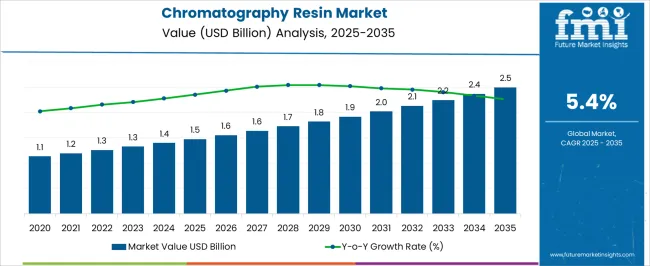
The Chromatography Resin Market is estimated to be valued at USD 1.5 billion in 2025 and is projected to reach USD 2.5 billion by 2035, registering a compound annual growth rate (CAGR) of 5.4% over the forecast period.
The Chromatography Resin market is experiencing robust growth, driven by the increasing demand for high-purity biomolecules and efficient separation processes across the biopharmaceutical and life sciences sectors. Rising adoption of protein purification, antibody production, and vaccine manufacturing is contributing to the expanding need for advanced resin technologies. Continuous innovations in resin chemistry, surface functionalization, and binding specificity are enhancing separation efficiency, process yield, and operational scalability.
The integration of affinity and ion-exchange chromatography methods has further strengthened application versatility. Growing investments in research and development, coupled with regulatory emphasis on product quality and consistency, are accelerating market adoption. Manufacturers are increasingly focusing on customizable resin solutions to meet diverse purification requirements, ensuring compatibility with automated and continuous processing systems.
As biopharmaceutical production scales up globally and downstream processing demands become more complex, the Chromatography Resin market is expected to sustain growth Increasing emphasis on cost-effective production, reduced cycle times, and high recovery rates is shaping the adoption of innovative resin solutions, positioning the market for long-term expansion.
Quick Stats for Chromatography Resin Market
- Chromatography Resin Market Industry Value (2025): USD 1.5 billion
- Chromatography Resin Market Forecast Value (2035): USD 2.5 billion
- Chromatography Resin Market Forecast CAGR: 5.4%
- Leading Segment in Chromatography Resin Market in 2025: Synthetic (73.3%)
- Key Growth Region in Chromatography Resin Market: North America, Asia-Pacific, Europe
- Top Key Players in Chromatography Resin Market: GE Healthcare, Thermo Fisher Scientific Inc., Waters Corporation, Merck KGaA, Agilent Technologies, Bio-Rad Laboratories, Pall Corporation, Perkin Elmer Inc., Shimadzu Corporation, Avantor Performance Materials Inc., Mitsubishi Chemical Corporation, W.R. Grace & Co., Kaneka Corporation, Tosoh Bioscience, Expedeon Ltd, Life Technology Corporation, JSR Micro Inc., Knauer GmbH
| Metric | Value |
|---|---|
| Chromatography Resin Market Estimated Value in (2025 E) | USD 1.5 billion |
| Chromatography Resin Market Forecast Value in (2035 F) | USD 2.5 billion |
| Forecast CAGR (2025 to 2035) | 5.4% |
Segmental Analysis
The market is segmented by Product Type, Technology Type, and End User Type and region. By Product Type, the market is divided into Synthetic and Native. In terms of Technology Type, the market is classified into Affinity Chromatography, Anion Exchange Chromatography, Cation Exchange Chromatography, Size Exclusion, and Hydrophobic Interaction. Based on End User Type, the market is segmented into Biopharmaceutical Companies, Clinical Research Organizations, and Academic Institutes. Regionally, the market is classified into North America, Latin America, Western Europe, Eastern Europe, Balkan & Baltic Countries, Russia & Belarus, Central Asia, East Asia, South Asia & Pacific, and the Middle East & Africa.
Insights into the Synthetic Product Type Segment
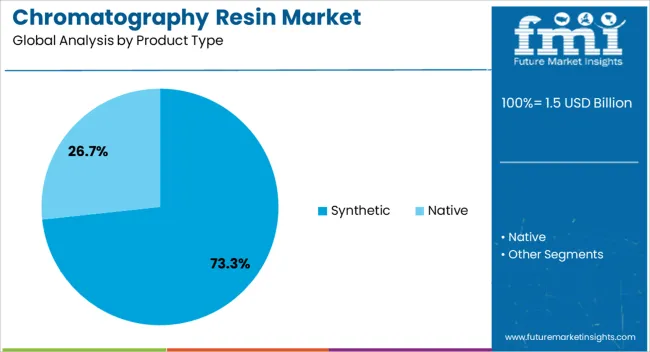
The synthetic product type segment is projected to hold 73.3% of the market revenue in 2025, establishing it as the leading product type. Its dominance is driven by superior chemical stability, consistent performance, and high reproducibility, which are critical for biopharmaceutical and research applications. Synthetic resins enable precise control over binding capacities, selectivity, and elution profiles, enhancing purification efficiency and product quality.
The ability to withstand harsh operating conditions, repeated cleaning cycles, and long-term storage contributes to reliability and operational cost savings. Continuous improvements in resin chemistry, including tailored surface functionalities and improved mechanical strength, have strengthened adoption across diverse chromatography platforms. Organizations are increasingly leveraging synthetic resins to optimize downstream processing and meet stringent regulatory standards.
The scalability and adaptability of synthetic resins for both large-scale manufacturing and research applications further reinforce market leadership As demand for high-purity biomolecules rises and process efficiency becomes a priority, the synthetic product type segment is expected to maintain its dominant position, supported by ongoing technological advancements and operational advantages.
Insights into the Affinity Chromatography Technology Type Segment
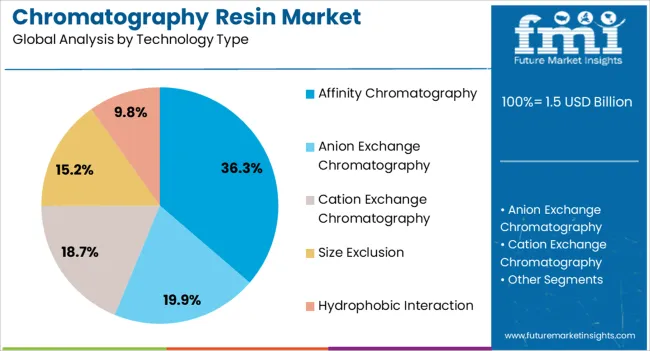
The affinity chromatography segment is anticipated to account for 36.3% of the market revenue in 2025, making it the leading technology type. Its growth is being driven by its high specificity and efficiency in isolating target biomolecules such as proteins, antibodies, and enzymes. Affinity chromatography enables selective binding and elution, which improves yield, purity, and process reproducibility.
The technology is widely adopted in biopharmaceutical production and research settings due to its compatibility with advanced resin chemistries and automated processing systems. Advancements in ligand development, immobilization techniques, and surface modification have enhanced performance and operational reliability. Integration with continuous processing and high-throughput purification workflows further accelerates adoption.
Regulatory focus on product quality, reproducibility, and process validation reinforces the importance of affinity chromatography in critical applications As demand for biologics, vaccines, and therapeutic proteins grows globally, affinity chromatography is expected to remain the primary technology driving the Chromatography Resin market, supported by innovations in resin design and process efficiency.
Insights into the Biopharmaceutical Companies End-User Type Segment
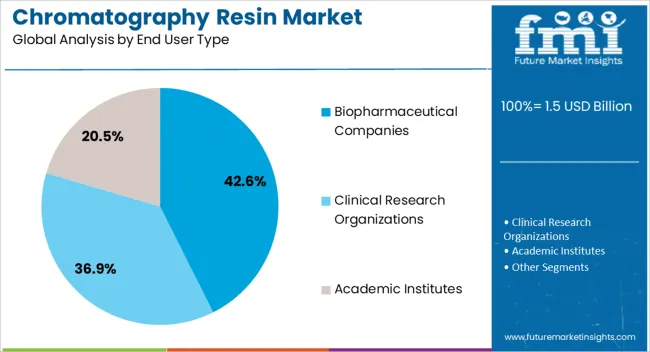
The biopharmaceutical companies segment is projected to hold 42.6% of the market revenue in 2025, establishing it as the leading end-user type. Growth in this segment is driven by the expanding global production of therapeutic proteins, monoclonal antibodies, and vaccines. High demand for consistent, high-quality purification processes has made chromatography resins essential in large-scale biopharmaceutical manufacturing.
Companies are increasingly adopting advanced resin technologies and automated systems to improve process efficiency, reduce downtime, and ensure regulatory compliance. Focus on reducing production costs while maintaining high yield and purity further supports adoption. Collaborative initiatives with resin manufacturers for custom solutions tailored to specific biologics have strengthened market engagement.
The ongoing shift toward continuous processing and high-throughput purification has reinforced the reliance of biopharmaceutical companies on high-performance resins As the global biologics market continues to grow and production demands become more complex, biopharmaceutical companies are expected to remain the primary end-users, driving the market through increased adoption of innovative chromatography resin technologies.
Market Trends and Highlights
- Surging adoption of chromatography techniques in food and beverage industry is a factor that will pave the way for market during the forecast period.
- Continually increasing demand in pharmaceutical and biotechnology industries across the globe, is pacing up the market prospects.
- Technological advancements in chromatography resins, is among the factors that is advancing swiftly towards market expansion.
- Expanding applications in environmental testing, is also gaining momentum to propel the market.
2020 to 2025 Historical Analysis vs. 2025 to 2035 Market Forecast Projections
The scope for chromatography resin rose at a 7.7% CAGR between 2020 and 2025. The global market is achieving heights to grow at a moderate CAGR of 5.4% over the forecast period 2025 to 2035.
Pharmaceutical, biotechnology industries being the major players in chromatography, utilize chromatography resins for purification as well as separation processes in development and manufacture of drugs. The utilization accelerated the market growth during the historical period.
Chromatography techniques are essential in ensuring food and beverage safety and quality, which had stimulated the demand for chromatography resins in this sector. Chromatography resins are themselves a result of rapid advancement in the technology and this is one of the reasons that propelled the market growth.
The pharmaceutical and biotechnology industries will forecast remarkable growth in the near future, attributed to aging populations, increase in incidences of chronic diseases as well as advances in technology.
The development of novel therapies, including gene therapies, cell based therapies, and personalized medicine, will drive the demand for chromatography resins tailored for the purification and analysis of complex biomolecules. Integration of chromatography with other analytical techniques, such as mass spectrometry and spectroscopy, will continue to expand, fueling demand for compatible chromatography resins and systems.
Chromatography Resin Market Key Drivers
- Increasing investments in healthcare infrastructure will create the lucrative opportunities for the chromatography resin market.
- Continually growing focus on drug development as well as research, scales up the demand for chromatography resin.
- Expansion of biopharmaceutical production is accelerating the demand for chromatography resin.
- Rising awareness regarding chromatography techniques is a major factor that is paving the way for market growth.
Challenges in the Chromatography Resin Market
- Limited adoption of chromatography resins in small scale industries is resulting in the downfall of the market.
- High initial investment costs of these resins, is another factor that is causing a reduction in the viability of the market.
- A market restraining factor includes the competition from alternative technologies.
- Technological complexity as well as skill requirements, can be the major challenges, showing red signs to the market.
Country-wise Insights
The below table showcases revenues in terms of the top 5 leading countries, spearheaded by India and Thailand. The countries will lead the market through 2035.
| Countries | Forecast CAGRs from 2025 to 2035 |
|---|---|
| The United States | 2.1% |
| The United Kingdom | 3.6% |
| Germany | 3.9% |
| Thailand | 5.8% |
| India | 7.6% |
Technological Advancements and Innovation Paving the Way for the Market in the United States
The chromatography resin market in the United States will expand at a CAGR of 2.1% through 2035. The country is a hub for technological advancements and innovation in chromatography techniques, resin manufacturing, and chromatography system development.
Ongoing research and development efforts focus on improving resin performance, enhancing chromatography system efficiency, as well as developing novel chromatography applications, augmenting the market growth.
The country is home to a robust biopharmaceutical industry, with numerous biotechnology companies, pharmaceutical manufacturers, and research institutions. The increasing investment in biopharmaceutical research and development, coupled with the increasing demand for biologics and biosimilars, is stimulating the demand for chromatography resins.
Stringent Regulatory Standards to Ride the Waves in the United Kingdom
The chromatography resin market in the United Kingdom to expand at a CAGR of 3.6% through 2035. The pharmaceutical and biotechnology industries in the country are subject to stringent regulatory standards enforced by agencies.
Chromatography techniques and resins are essential for meeting regulatory requirements for drug quality, safety, and efficacy, thus propelling the market growth. The United Kingdom has a well-established pharmaceutical and biotechnology industry, with numerous research institutions, pharmaceutical companies, and biotech start-ups.
The increasing investment in drug discovery, development, and manufacturing activities is increasing the demand for chromatography resins used in purification, separation, and analysis of pharmaceutical compounds and biomolecules.
Increasing Demand for Personalized Medicine Heads towards Success in Germany
Chromatography resin trends in Germany are taking a turn for the better. A 3.9% CAGR is forecast for the country from 2025 to 2035. There is a growing demand for personalized medicine and targeted therapies in Germany, driven by advancements in genomics, proteomics, and precision medicine.
Chromatography resins enable the purification and separation of biomolecules for personalized medicine applications, contributing to market growth. The strategic location of Germany in Europe positions it as a key hub for pharmaceutical and biotechnology companies, research institutions, and academic centers.
The central location of the country facilitates easy access to European markets and fosters collaborations, trade partnerships, and investments, fueling the demand for chromatography resins.
Expansion of Food and Beverage Industry Raises the Market Expansion in Thailand
The chromatography resin market in Thailand is poised to expand at a CAGR of 5.8% through 2035. Food and beverage industry in Thailand is experiencing growth due to changing consumer preferences, urbanization, and tourism.
Chromatography techniques and resins are used for quality control testing, flavor analysis, and contaminant detection in the food and beverage industry, propelling market growth. Academic and research institutions in Thailand are actively engaged in scientific research and development across various disciplines, including chemistry, biochemistry, and biotechnology.
Chromatography techniques and resins are widely used in research laboratories for analytical testing, protein purification, and sample preparation, contributing to market prospects.
Growing Nutraceutical and Herbal Medicine Industry to Enhance Prospects in India
The chromatography resin market in India will expand at a CAGR of 7.6% through 2035. India has a rich tradition of herbal medicine and Ayurveda, and there is a growing demand for nutraceuticals and herbal supplements globally.
Chromatography techniques are used for quality control and standardization of herbal products, accelerating the demand for chromatography resins in the nutraceutical and herbal medicine industry.
India has stringent environmental regulations governing air, water, and soil quality to protect public health and the environment. Chromatography techniques, such as gas chromatography and liquid chromatography, are essential for environmental testing and pollutant analysis, stimulating the demand for chromatography resins.
Category-wise Insights
The below table highlights how synthetic segment is leading the market in terms of product type, and will account for a share of 73.3% in 2025.
Based on technology type, the affinity chromatography segment is gaining heights and will to account for a share of 36.3% in 2025.
| Category | Shares in 2025 |
|---|---|
| Synthetic | 73.3% |
| Affinity Chromatography | 36.3% |
Synthetic Segment Witnesses High Demand for Chromatography Resin
Based on product type, the synthetic segment will dominate the chromatography resin market. Synthetic chromatography resins offer greater control over material properties, enabling manufacturers to tailor resins with specific pore sizes, surface chemistries, and particle sizes to meet diverse application requirements.
The customizability ensures consistent performance and reproducibility, driving their adoption in various chromatography processes. Synthetic chromatography resins find applications across a broad spectrum of industries, including pharmaceuticals, biotechnology, food and beverages, environmental testing, and research laboratories.
Their versatility allows for purification, separation, and analysis of various biomolecules, proteins, nucleic acids, and small molecules, driving their demand in diverse applications.
Affinity Chromatography Segment to Hold High Demand for Chromatography Resin
In terms of technology, the affinity chromatography segment will dominate the chromatography resin market. Affinity chromatography finds widespread applications in various fields, including pharmaceuticals, biotechnology, healthcare, and research.
It is used for protein purification, antibody isolation, enzyme purification, drug-target interactions, and biomolecular interactions studies, fueling demand for affinity chromatography resins across diverse industries.
Affinity chromatography offers high specificity in capturing target molecules based on reversible interactions between the target molecule and a ligand immobilized on the chromatography resin. The specificity enables efficient purification of biomolecules, such as proteins, antibodies, enzymes, and nucleic acids, from complex biological mixtures.
Competitive Landscape
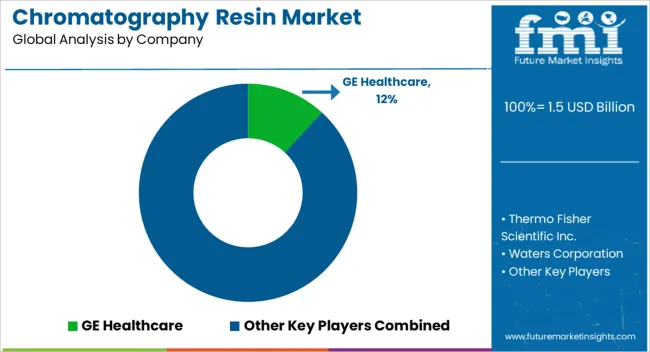
The chromatography resin market is characterized by intense competition among key players striving to maintain or enhance their market share through strategic initiatives, product innovation, and differentiation strategies.
Company Portfolio
- Agilent Technologies is a global leader in life sciences, diagnostics, and applied chemical markets, providing solutions for analytical instrumentation and laboratory workflow optimization. The company offers a range of chromatography resins for analytical and preparative chromatography applications.
- Their portfolio includes ion exchange resins, affinity chromatography resins, and size exclusion chromatography resins designed for protein purification, nucleic acid separation, and sample analysis.
- Bio-Rad Laboratories is a multinational manufacturer and distributor of life science research and clinical diagnostic products. The company provides chromatography resins for protein purification, affinity chromatography, and ion exchange chromatography applications.
- Their chromatography resin portfolio includes pre packed columns, resins for chromatography system integration, and specialty resins for research and bioprocessing.
Key Coverage in the Chromatography Resin Industry Report
- Chromatography resin types
- Chromatography resin applications
- Emerging chromatography resin technologies
- Analytical Instruments Market
- Chromatography Columns Market
- Chromatography Systems Market
- Liquid Chromatography Market
- Gas Chromatography Market
- Ion Exchange Resins Market
- Bioprocessing Market
- Separation Sciences Market
- Chemicals and Petrochemicals Market
Report Scope
| Attribute | Details |
|---|---|
| Estimated Market Size in 2025 | USD 1.5 billion |
| Projected Market Valuation in 2035 | USD 2.5 billion |
| Value-based CAGR 2025 to 2035 | 5.4% |
| Forecast Period | 2025 to 2035 |
| Historical Data Available for | 2020 to 2025 |
| Market Analysis | Value in USD Billion |
| Key Regions Covered | North America; Latin America; Western Europe; Eastern Europe; South Asia and Pacific; East Asia; The Middle East & Africa |
| Key Market Segments Covered | Product Type, Technology Type, End User Type, Region |
| Key Countries Profiled | The United States, Canada, Brazil, Mexico, Germany, France, France, Spain, Italy, Russia, Poland, Czech Republic, Romania, India, Bangladesh, Australia, New Zealand, China, Japan, South Korea, GCC countries, South Africa, Israel |
| Key Companies Profiled | Agilent Technologies; Bio-Rad Laboratories; GE Healthcare; Waters Corporation; Expedeon Ltd; Thermo Fisher Scientific Inc.; Pall Corporation; Merck KGaA; Perkin Elmer Inc.; Kaneka Corporation; Shimadzu Corporation; Knauer GmbH; Tosoh Bioscience; Avantor Performance Materials Inc.; Mitsubishi Chemical Corporation; W.R. Grace & Co.; JSR Micro Inc.; Life Technology Corporation |
Segmentation Analysis of the Chromatography Resin Market
By Product Type:
- Native
- Synthetic
By Technology Type:
- Affinity Chromatography
- Anion Exchange Chromatography
- Cation Exchange Chromatography
- Size Exclusion
- Hydrophobic Interaction
By End User Type:
- Biopharmaceutical Companies
- Clinical Research Organizations
- Academic Institutes
By Region:
- North America
- Latin America
- Western Europe
- Eastern Europe
- South Asia and Pacific
- East Asia
- The Middle East and Africa
Frequently Asked Questions
How big is the chromatography resin market in 2025?
The global chromatography resin market is estimated to be valued at USD 1.5 billion in 2025.
What will be the size of chromatography resin market in 2035?
The market size for the chromatography resin market is projected to reach USD 2.5 billion by 2035.
How much will be the chromatography resin market growth between 2025 and 2035?
The chromatography resin market is expected to grow at a 5.4% CAGR between 2025 and 2035.
What are the key product types in the chromatography resin market?
The key product types in chromatography resin market are synthetic and native.
Which technology type segment to contribute significant share in the chromatography resin market in 2025?
In terms of technology type, affinity chromatography segment to command 36.3% share in the chromatography resin market in 2025.
Preview the report firsthand - request a free sample
Get SampleGet the brochure for pricing and purchase details.
Get PDFTable of Content
- Executive Summary
- Global Market Outlook
- Demand-side Trends
- Supply-side Trends
- Technology Roadmap Analysis
- Analysis and Recommendations
- Market Overview
- Market Coverage / Taxonomy
- Market Definition / Scope / Limitations
- Market Background
- Market Dynamics
- Drivers
- Restraints
- Opportunity
- Trends
- Scenario Forecast
- Demand in Optimistic Scenario
- Demand in Likely Scenario
- Demand in Conservative Scenario
- Opportunity Map Analysis
- Product Life Cycle Analysis
- Supply Chain Analysis
- Investment Feasibility Matrix
- Value Chain Analysis
- PESTLE and Porter’s Analysis
- Regulatory Landscape
- Regional Parent Market Outlook
- Production and Consumption Statistics
- Import and Export Statistics
- Market Dynamics
- Global Market Analysis 2020 to 2024 and Forecast, 2025 to 2035
- Historical Market Size Value (USD Million) Analysis, 2020 to 2024
- Current and Future Market Size Value (USD Million) Projections, 2025 to 2035
- Y-o-Y Growth Trend Analysis
- Absolute $ Opportunity Analysis
- Global Market Pricing Analysis 2020 to 2024 and Forecast 2025 to 2035
- Global Market Analysis 2020 to 2024 and Forecast 2025 to 2035, By Product Type
- Introduction / Key Findings
- Historical Market Size Value (USD Million) Analysis By Product Type , 2020 to 2024
- Current and Future Market Size Value (USD Million) Analysis and Forecast By Product Type , 2025 to 2035
- Synthetic
- Native
- Y-o-Y Growth Trend Analysis By Product Type , 2020 to 2024
- Absolute $ Opportunity Analysis By Product Type , 2025 to 2035
- Global Market Analysis 2020 to 2024 and Forecast 2025 to 2035, By Technology Type
- Introduction / Key Findings
- Historical Market Size Value (USD Million) Analysis By Technology Type, 2020 to 2024
- Current and Future Market Size Value (USD Million) Analysis and Forecast By Technology Type, 2025 to 2035
- Affinity Chromatography
- Anion Exchange Chromatography
- Cation Exchange Chromatography
- Size Exclusion
- Hydrophobic Interaction
- Y-o-Y Growth Trend Analysis By Technology Type, 2020 to 2024
- Absolute $ Opportunity Analysis By Technology Type, 2025 to 2035
- Global Market Analysis 2020 to 2024 and Forecast 2025 to 2035, By End User Type
- Introduction / Key Findings
- Historical Market Size Value (USD Million) Analysis By End User Type, 2020 to 2024
- Current and Future Market Size Value (USD Million) Analysis and Forecast By End User Type, 2025 to 2035
- Biopharmaceutical Companies
- Clinical Research Organizations
- Academic Institutes
- Y-o-Y Growth Trend Analysis By End User Type, 2020 to 2024
- Absolute $ Opportunity Analysis By End User Type, 2025 to 2035
- Global Market Analysis 2020 to 2024 and Forecast 2025 to 2035, By Region
- Introduction
- Historical Market Size Value (USD Million) Analysis By Region, 2020 to 2024
- Current Market Size Value (USD Million) Analysis and Forecast By Region, 2025 to 2035
- North America
- Latin America
- Western Europe
- Eastern Europe
- East Asia
- South Asia and Pacific
- Middle East & Africa
- Market Attractiveness Analysis By Region
- North America Market Analysis 2020 to 2024 and Forecast 2025 to 2035, By Country
- Historical Market Size Value (USD Million) Trend Analysis By Market Taxonomy, 2020 to 2024
- Market Size Value (USD Million) Forecast By Market Taxonomy, 2025 to 2035
- By Country
- USA
- Canada
- Mexico
- By Product Type
- By Technology Type
- By End User Type
- By Country
- Market Attractiveness Analysis
- By Country
- By Product Type
- By Technology Type
- By End User Type
- Key Takeaways
- Latin America Market Analysis 2020 to 2024 and Forecast 2025 to 2035, By Country
- Historical Market Size Value (USD Million) Trend Analysis By Market Taxonomy, 2020 to 2024
- Market Size Value (USD Million) Forecast By Market Taxonomy, 2025 to 2035
- By Country
- Brazil
- Chile
- Rest of Latin America
- By Product Type
- By Technology Type
- By End User Type
- By Country
- Market Attractiveness Analysis
- By Country
- By Product Type
- By Technology Type
- By End User Type
- Key Takeaways
- Western Europe Market Analysis 2020 to 2024 and Forecast 2025 to 2035, By Country
- Historical Market Size Value (USD Million) Trend Analysis By Market Taxonomy, 2020 to 2024
- Market Size Value (USD Million) Forecast By Market Taxonomy, 2025 to 2035
- By Country
- Germany
- UK
- Italy
- Spain
- France
- Nordic
- BENELUX
- Rest of Western Europe
- By Product Type
- By Technology Type
- By End User Type
- By Country
- Market Attractiveness Analysis
- By Country
- By Product Type
- By Technology Type
- By End User Type
- Key Takeaways
- Eastern Europe Market Analysis 2020 to 2024 and Forecast 2025 to 2035, By Country
- Historical Market Size Value (USD Million) Trend Analysis By Market Taxonomy, 2020 to 2024
- Market Size Value (USD Million) Forecast By Market Taxonomy, 2025 to 2035
- By Country
- Russia
- Poland
- Hungary
- Balkan & Baltic
- Rest of Eastern Europe
- By Product Type
- By Technology Type
- By End User Type
- By Country
- Market Attractiveness Analysis
- By Country
- By Product Type
- By Technology Type
- By End User Type
- Key Takeaways
- East Asia Market Analysis 2020 to 2024 and Forecast 2025 to 2035, By Country
- Historical Market Size Value (USD Million) Trend Analysis By Market Taxonomy, 2020 to 2024
- Market Size Value (USD Million) Forecast By Market Taxonomy, 2025 to 2035
- By Country
- China
- Japan
- South Korea
- By Product Type
- By Technology Type
- By End User Type
- By Country
- Market Attractiveness Analysis
- By Country
- By Product Type
- By Technology Type
- By End User Type
- Key Takeaways
- South Asia and Pacific Market Analysis 2020 to 2024 and Forecast 2025 to 2035, By Country
- Historical Market Size Value (USD Million) Trend Analysis By Market Taxonomy, 2020 to 2024
- Market Size Value (USD Million) Forecast By Market Taxonomy, 2025 to 2035
- By Country
- India
- ASEAN
- Australia & New Zealand
- Rest of South Asia and Pacific
- By Product Type
- By Technology Type
- By End User Type
- By Country
- Market Attractiveness Analysis
- By Country
- By Product Type
- By Technology Type
- By End User Type
- Key Takeaways
- Middle East & Africa Market Analysis 2020 to 2024 and Forecast 2025 to 2035, By Country
- Historical Market Size Value (USD Million) Trend Analysis By Market Taxonomy, 2020 to 2024
- Market Size Value (USD Million) Forecast By Market Taxonomy, 2025 to 2035
- By Country
- Kingdom of Saudi Arabia
- Other GCC Countries
- Turkiye
- South Africa
- Other African Union
- Rest of Middle East & Africa
- By Product Type
- By Technology Type
- By End User Type
- By Country
- Market Attractiveness Analysis
- By Country
- By Product Type
- By Technology Type
- By End User Type
- Key Takeaways
- Key Countries Market Analysis
- USA
- Pricing Analysis
- Market Share Analysis, 2024
- By Product Type
- By Technology Type
- By End User Type
- Canada
- Pricing Analysis
- Market Share Analysis, 2024
- By Product Type
- By Technology Type
- By End User Type
- Mexico
- Pricing Analysis
- Market Share Analysis, 2024
- By Product Type
- By Technology Type
- By End User Type
- Brazil
- Pricing Analysis
- Market Share Analysis, 2024
- By Product Type
- By Technology Type
- By End User Type
- Chile
- Pricing Analysis
- Market Share Analysis, 2024
- By Product Type
- By Technology Type
- By End User Type
- Germany
- Pricing Analysis
- Market Share Analysis, 2024
- By Product Type
- By Technology Type
- By End User Type
- UK
- Pricing Analysis
- Market Share Analysis, 2024
- By Product Type
- By Technology Type
- By End User Type
- Italy
- Pricing Analysis
- Market Share Analysis, 2024
- By Product Type
- By Technology Type
- By End User Type
- Spain
- Pricing Analysis
- Market Share Analysis, 2024
- By Product Type
- By Technology Type
- By End User Type
- France
- Pricing Analysis
- Market Share Analysis, 2024
- By Product Type
- By Technology Type
- By End User Type
- India
- Pricing Analysis
- Market Share Analysis, 2024
- By Product Type
- By Technology Type
- By End User Type
- ASEAN
- Pricing Analysis
- Market Share Analysis, 2024
- By Product Type
- By Technology Type
- By End User Type
- Australia & New Zealand
- Pricing Analysis
- Market Share Analysis, 2024
- By Product Type
- By Technology Type
- By End User Type
- China
- Pricing Analysis
- Market Share Analysis, 2024
- By Product Type
- By Technology Type
- By End User Type
- Japan
- Pricing Analysis
- Market Share Analysis, 2024
- By Product Type
- By Technology Type
- By End User Type
- South Korea
- Pricing Analysis
- Market Share Analysis, 2024
- By Product Type
- By Technology Type
- By End User Type
- Russia
- Pricing Analysis
- Market Share Analysis, 2024
- By Product Type
- By Technology Type
- By End User Type
- Poland
- Pricing Analysis
- Market Share Analysis, 2024
- By Product Type
- By Technology Type
- By End User Type
- Hungary
- Pricing Analysis
- Market Share Analysis, 2024
- By Product Type
- By Technology Type
- By End User Type
- Kingdom of Saudi Arabia
- Pricing Analysis
- Market Share Analysis, 2024
- By Product Type
- By Technology Type
- By End User Type
- Turkiye
- Pricing Analysis
- Market Share Analysis, 2024
- By Product Type
- By Technology Type
- By End User Type
- South Africa
- Pricing Analysis
- Market Share Analysis, 2024
- By Product Type
- By Technology Type
- By End User Type
- USA
- Market Structure Analysis
- Competition Dashboard
- Competition Benchmarking
- Market Share Analysis of Top Players
- By Regional
- By Product Type
- By Technology Type
- By End User Type
- Competition Analysis
- Competition Deep Dive
- GE Healthcare
- Overview
- Product Portfolio
- Profitability by Market Segments (Product/Age /Sales Channel/Region)
- Sales Footprint
- Strategy Overview
- Marketing Strategy
- Product Strategy
- Channel Strategy
- Thermo Fisher Scientific Inc.
- Waters Corporation
- Merck KGaA
- Agilent Technologies
- Bio-Rad Laboratories
- Pall Corporation
- Perkin Elmer Inc.
- Shimadzu Corporation
- Avantor Performance Materials Inc.
- Mitsubishi Chemical Corporation
- W.R. Grace & Co.
- Kaneka Corporation
- Tosoh Bioscience
- Expedeon Ltd
- Life Technology Corporation
- JSR Micro Inc.
- Knauer GmbH
- GE Healthcare
- Competition Deep Dive
- Assumptions & Acronyms Used
- Research Methodology


