

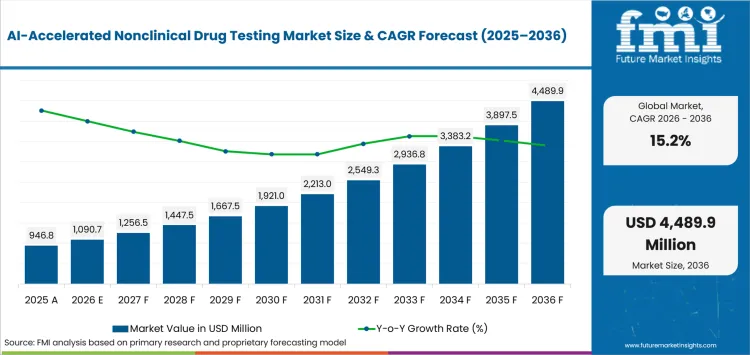
- Market Size (2026)
- USD 1090.7 million
- Forecast (2036)
- USD 4489.9 million
- CAGR (2026 to 2036)
- 15.2%
How big is AI-Accelerated Nonclinical Drug Testing Market in 2026?
USD 1,090.7 million in 2026 and USD 4,489.9 million by 2036 at a 15.2% CAGR.
Demand for AI-accelerated nonclinical drug testing is projected at 15.2% CAGR from 2026 to 2036 with the forecast supported by regulatory acceptance of validated computational and human-relevant evidence. The industry is estimated at USD 1,090.7 million in 2026 and is forecast to reach USD 4,489.9 million by 2036, supported by expanding validated workflows across development programs. Pharmaceutical developers purchase computational models and laboratory services that reject weak candidates earlier and preserve auditable evidence for regulatory discussions. FDA reported in April 2026 that more than 90% of drugs clearing animal studies do not receive approval, highlighting the translation problem these tools address. Integrated AI-enabled drug discovery workflows combine prediction with experimental confirmation so toxicologists can separate model confidence from biological uncertainty during program review. Commercial value therefore depends on validated contexts of use and documented exception handling rather than faster scoring alone.
United States sponsors can discuss alternative nonclinical evidence within an active FDA consultation pathway that increasingly recognizes computational and human-relevant methods. British programs operate within a national replacement strategy that links regulatory confidence with shared infrastructure and workforce development. Japanese developers face a consultation-led route that requires evidence packages suited to PMDA review and local scientific expectations. External preclinical CRO services matter across every route by pairing experimental confirmation with regulatory documentation beside model outputs. Human-derived organoid systems can strengthen translation yet each jurisdiction evaluates validation scope and submission relevance through different procedures. Commercial entry therefore depends on local regulatory support and service access rather than software availability alone during implementation.
Key Takeaways of AI-Accelerated Nonclinical Drug Testing Market
- Demand for AI-accelerated nonclinical drug testing is driven by drug developers seeking to reduce late-stage failure risk, with earlier prediction helping toxicologists remove weak compounds before expensive laboratory packages consume scarce specialist capacity.
- By technology, machine learning platforms hold the leading share at 30.5% in 2026, supported by reusable models that serve several compound programs across regulated portfolios.
- Toxicity prediction is the dominant application segment, holding 31.4% share in 2026, attributable to its direct influence on candidate selection and study design.
- Pharmaceutical companies lead end-user demand at 33.5% share in 2026, shaped by sponsor control over compound data and submission strategy.
- In silico testing captures 39.0% test-type share in 2026, enabled by broad compound coverage and comparatively low marginal screening cost, though experimental confirmation remains necessary for uncertain biological responses.
- South Korea, the USA, and Japan record CAGRs of 17.0%, 16.3%, and 11.6% respectively through 2036, while Germany and the UK maintain distinct regulatory routes placing comparable value on validation quality and reproducible documentation.
- Competition centers on Certara, Simulations Plus, Lhasa Limited, Instem, Charles River Laboratories, Evotec, XtalPi, and VeriSIM Life, with vendors differentiating through biosimulation platforms, transparent toxicology models, integrated computational-laboratory execution, and AI-experimental feedback loops.
Analyst Perspective
Machine learning's share depends less on predictive accuracy than on whether platforms preserve versioned datasets and defined contexts of use, since FDA's risk-based credibility framework means an unauditable model, however accurate, carries limited regulatory value compared to one with documented boundaries and traceable retraining history. Toxicity prediction's commercial pull comes from directing scarce laboratory resources toward defensible candidates rather than replacing biological testing outright, so tools like unified genotoxicity workflows earn adoption by explaining which structural alerts need confirmation, not by claiming certainty the underlying chemistry can't support. Pharmaceutical companies' dominant end-user position reflects a data-ownership calculation as much as scale, since sponsors piloting external platforms are really testing whether a vendor's model transfers across therapeutic programs without forcing a separate validation procedure for every new study, which is the real bottleneck standing between a promising pilot and routine institutional use.
-Anurag Sharma, Principal Analyst at Future Market Insights
Source: FMI's proprietary forecasting model and primary research
How is the AI-Accelerated Nonclinical Drug Testing Market segmented?
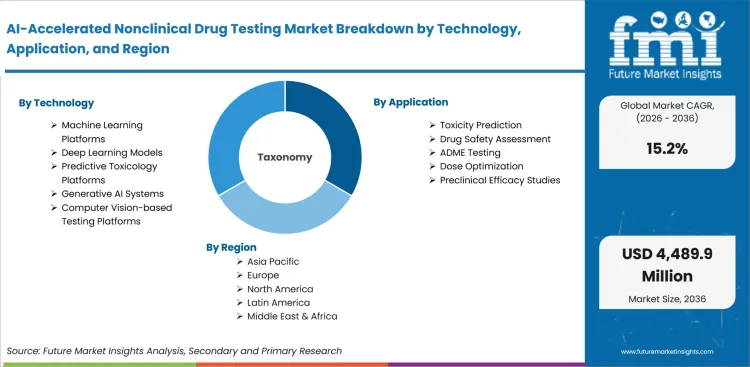
The AI-accelerated nonclinical drug testing industry is segmented by technology, application, end user, test type, and region.
Technology separates machine learning and deep learning platforms from predictive toxicology and computer vision systems used during nonclinical evaluation. Application categories distinguish toxicity prediction from broader safety assessment together with ADME work and dose optimization. End-user analysis compares pharmaceutical and biotechnology companies with contract research organizations and academic research institutes. Test type separates in silico approaches from in vitro platforms and integrated methods that combine computational and experimental evidence.
How do machine learning platforms support nonclinical study decisions?
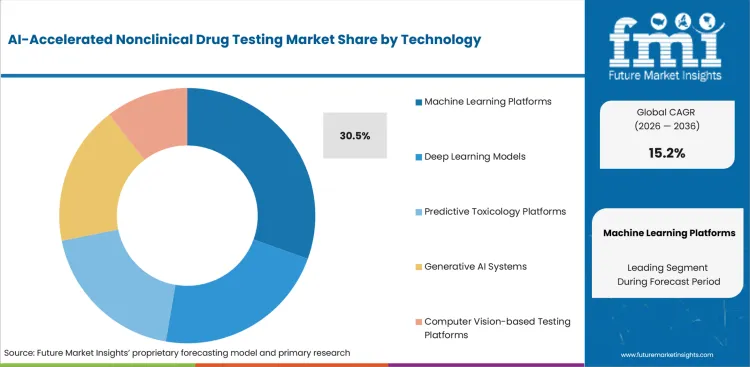
Machine learning platforms help toxicologists rank compounds across several safety endpoints before each program commits to costly laboratory studies. FDA's January 2025 draft guidance established a risk-based credibility framework for AI models used to support drug regulatory decisions. Platform teams therefore need versioned datasets and defined contexts of use that connect predictions with auditable model limitations. Biosimulation software can preserve that connection across compound selection and later experimental review within regulated development programs.
- Machine learning platforms are estimated to account for 30.5% share within technology in 2026, supported by reusable models that serve several compound programs. Their position reflects scalable screening economics and documented model governance during formal program review across regulated portfolios.
- Pharmaceutical toxicology teams select machine learning platforms to prioritize experiments and investigate conflicting safety signals across candidate portfolios. Adoption depends on data governance and expert review procedures that identify predictions requiring additional laboratory confirmation. Laboratory informatics must preserve model versions and retraining controls across regulated development records and submissions.
What supports demand for toxicity prediction within the application category?
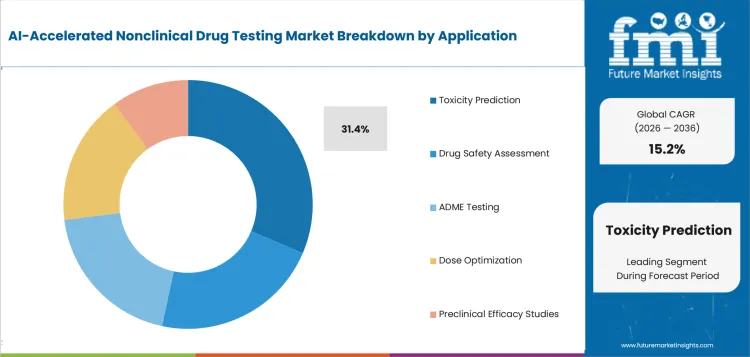
Toxicity prediction gives development teams an earlier view of safety liabilities that can eliminate unsuitable compounds before full nonclinical packages begin. Transparent structural alerts help specialists distinguish a reproducible concern from a model result that needs additional investigation. Lhasa Limited introduced unified genotoxicity prediction across Derek Nexus and Sarah Nexus in October 2025 through one transparent assessment workflow. ADME-Tox assays remain complementary through biological confirmation for modeled responses that exceed validated chemical coverage across important safety endpoints.
- Toxicity prediction is projected to represent 31.4% of application revenue in 2026, attributable to its direct influence on candidate selection. The segment reduces avoidable study spending by directing laboratory resources toward compounds with defensible safety profiles and clearer dose priorities.
- Medicinal chemistry and toxicology groups use toxicity prediction to compare structural alerts with exposure expectations during lead optimization. Commercial adoption strengthens through interpretable outputs that explain uncertainty and support expert decisions across regulated development programs and submission planning across product classes.
How do pharmaceutical companies evaluate AI-accelerated testing services?
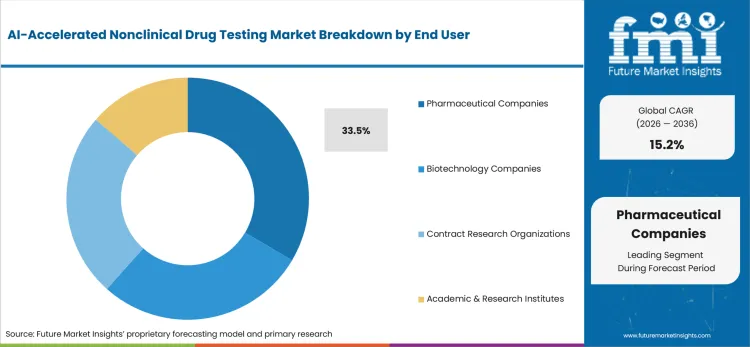
Pharmaceutical companies need AI-accelerated testing services that fit internal governance and preserve evidence across discovery and nonclinical development. Program leaders compare data ownership and endpoint coverage together with the experimental work required for uncertain model outputs. Pilot compounds reveal whether external methods transfer across therapeutic programs without creating separate review procedures for every study. A March 2025 Drug Discovery Today survey of pharmaceutical companies reported broad NAM use yet continuing concerns about regulatory harmonization and translation.
- Pharmaceutical companies are forecast to hold 33.5% share within end user for 2026, shaped by sponsor control over compound data and submission strategy. Internal portfolio scale also supports repeated use across several therapeutic programs and distinct safety questions across global programs.
- Large drug developers assess external platforms through pilot compounds that expose data quality and model transfer limitations during routine review. Purchasing expands through contracts that define validation responsibilities and secure technical specialists across the complete development program and local regulatory questions.
How is in silico testing positioned within the test type category?
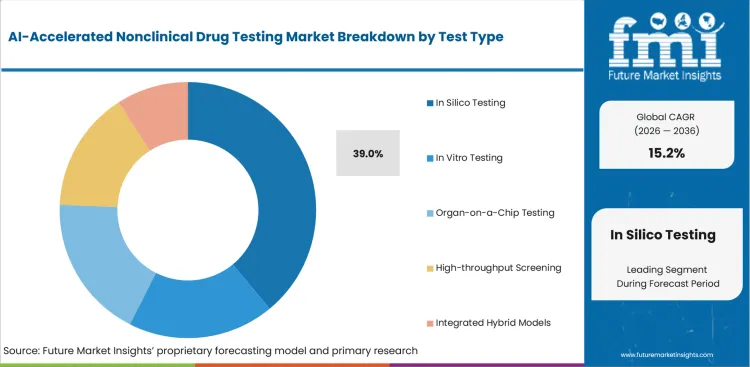
In silico testing supports rapid evidence generation across candidate libraries that cannot receive equal laboratory attention during early nonclinical planning. FDA issued draft guidance in March 2026 that provides a validation framework and reporting recommendations for new approach methodologies. The guidance encourages regulatory use of validated methods that improve the predictivity of nonclinical studies. Organ-on-chip testing can provide complementary human-relevant evidence for predictions that require mechanistic confirmation across complex biological endpoints.
- In silico testing is likely to capture 39.0% share within test type in 2026, enabled by broad compound coverage and comparatively low marginal screening cost. Its commercial position depends on directing experiments and documenting uncertainty rather than replacing every biological assessment.
- Drug safety teams use in silico testing to examine chemical structure and exposure scenarios across several endpoints during study planning. Adoption rises through documented applicability domains that clarify which compounds need in vitro confirmation or specialist interpretation during review across complex programs.
What are the drivers, restraints, and opportunities in the AI-Accelerated Nonclinical Drug Testing Market?
Regulatory support for human-relevant methods strengthens demand yet validation burdens slow routine use across nonclinical programs. Standardized evidence repositories create a practical route for wider implementation across sponsors and service providers.
- Driver: Drug developers need human-relevant safety evidence that can improve candidate selection without expanding every animal study program.
- Restraint: Model credibility remains difficult to establish across endpoints that lack reproducible validation and clearly defined applicability limits.
- Opportunity: Shared method records can reduce repeated qualification work and help sponsors compare evidence across regulatory contexts.
Regulatory acceptance of human-relevant evidence creates a clear driver for AI-accelerated testing across nonclinical development programs. FDA announced in April 2025 that investigational applications could immediately include computational toxicity models and laboratory organoid evidence. The policy gives sponsors a defined reason to combine prediction with targeted confirmation during study planning. High‑throughput screening can expand the tested evidence base without assigning equal experimental resources to every compound. Technology providers gain purchasing relevance through workflows that document which modeled results influence each nonclinical decision.
Validation uncertainty creates a material restraint whenever one model is expected to support several toxicology endpoints across different chemical classes. Commercial teams cannot rely on average accuracy if the underlying applicability domain excludes compounds within an active development program. BfR explained in January 2025 that alternative toxicology methods require scientific validation and reproducible results across independent laboratories. Sponsors therefore need endpoint-specific evidence and transparent limits before replacing established study components within regulated development programs. Adoption remains restricted until platform providers can document performance across representative compounds and routine operating conditions.
Standardized method records create an opportunity to reduce repeated qualification work across sponsors and regulatory discussions. NIEHS expanded the CAMERA repository in March 2026 with additional reproducibility definitions and method comparison features. The resource gives development teams a structured basis for locating validated approaches and associated regulatory guidance. Drug discovery services can package those records with study design and specialist interpretation across several programs. Service providers must maintain current method status and explain how each record applies to the sponsor's exact context of use.
Which country CAGRs are profiled in the AI-Accelerated Nonclinical Drug Testing Market?
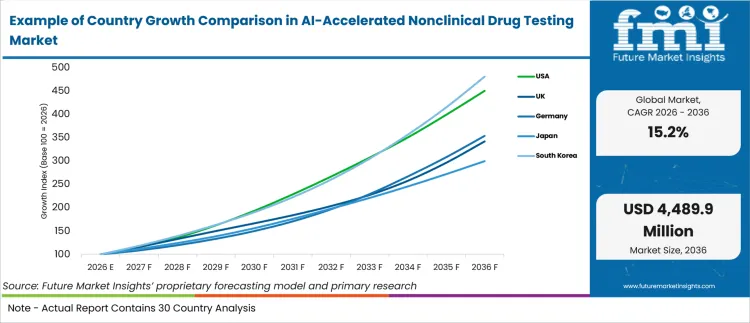
| Country | CAGR |
|---|---|
| USA | 16.3% |
| UK | 13.1% |
| Germany | 13.5% |
| Japan | 11.6% |
| South Korea | 17.0% |
How do country-level CAGRs compare in the AI-Accelerated Nonclinical Drug Testing Market?
The country outlook spans 5.4 percentage points from South Korea at 17.0% to Japan at 11.6% during the assessment period, reflecting measured forecast spacing across national routes. South Korea and the USA form a close upper cluster with a separation of 0.7 percentage point. Germany and the UK create another closely compressed pair that differs by 0.4 percentage point. Japan sits 1.5 percentage points below the UK and remains positioned outside both main clusters. The measured spacing reflects different regulatory pathways and service capacity rather than a direct comparison of current market size.
- South Korea combines public AI development programs with expanding technical skills that can support faster integration across domestic pharmaceutical research teams.
- The USA benefits from active federal guidance and a broad nonclinical service base although sponsors face demanding context-of-use documentation.
- Germany's position reflects strong toxicology expertise and validation discipline that can extend review timelines for unfamiliar computational methods.
- The UK combines a national animal-replacement strategy with infrastructure ambitions yet commercial projects must navigate evolving implementation responsibilities.
- Japan's measured outlook reflects consultation-led regulatory practice and careful evidence review across programs using new approach methodologies.
Similar CAGRs can produce different entry conditions through consultation access and local validation expertise together with specialist service coverage. Commercial planning should therefore separate forecast pace from the practical cost of producing acceptable evidence in each location. The full report provides country-level CAGR analysis across North America, Latin America, Europe, East Asia, South Asia, Oceania and the Middle East and Africa.
Country-wise Analysis
- United States sponsors can source predictive software and integrated nonclinical services through a broad domestic commercial network. Demand for AI-accelerated nonclinical drug testing in the USA is projected to grow at 16.3% CAGR through 2036, supported by active regulatory modernization. FDA released draft guidance in December 2025 describing circumstances that can reduce or eliminate nonhuman primate testing for monoclonal antibodies. Federal consultation access supports adoption yet context-of-use validation creates substantial documentation and specialist review burdens. Commercial contracts should separate software performance from experimental confirmation and assign responsibility for every disputed safety conclusion.
- British drug developers can combine globally available modeling platforms with domestic research organizations and public scientific infrastructure. National policy increasingly links animal replacement with regulatory confidence and workforce development across biomedical research programs. The UK outlook is anticipated to advance at 13.1% CAGR over the assessment period, attributable to coordinated replacement priorities. The government published its replacing animals in science strategy in November 2025 with six objectives covering validation and infrastructure. Public coordination supports adoption yet sponsors need clearer implementation routes and sufficient specialist capacity for program-level evidence packages.
- German toxicology programs operate inside a validation-intensive environment supported by experienced pharmaceutical and contract research organizations. The German sector is estimated to post 13.5% CAGR from 2026 to 2036, enabled by strong scientific and laboratory capabilities. BfR reported in June 2025 that an international workshop examined combined in silico and in vitro workflows for next-generation risk assessment. Interlaboratory expertise supports adoption yet rigorous reproducibility expectations can extend qualification timelines for unfamiliar model architectures. Market entry requires local scientific support and documentation that connects each prediction with a defensible experimental or regulatory decision.
- Japanese sponsors typically introduce new nonclinical methods through careful consultation and evidence packages adapted to domestic review expectations. Local pharmaceutical expertise supports method evaluation although limited regulatory precedent can slow broad program standardization. Demand in Japan is forecast to rise at 11.6% CAGR during the forecast period, shaped by consultation-led adoption. PMDA confirmed in October 2025 that its cross-functional NAM working group addresses regulatory acceptance and international coordination challenges. Commercial providers need Japanese technical support and transparent validation records that reduce interpretation burdens during sponsor consultations.
- South Korean pharmaceutical teams operate within a technology-focused development environment that supports rapid experimentation and domestic AI capability building. The national outlook is predicted to advance at 17.0% CAGR through 2036, reinforced by organized workforce development. KHIDI opened a July 2025 call for an operator to deliver AI-enabled drug development education and promotion. Training programs provide a direct enabler yet smaller developers can face limited validation resources and specialist regulatory support. Platform providers should pair local training with accessible technical service and evidence plans suited to domestic development programs.
Who are the notable companies in the AI-Accelerated Nonclinical Drug Testing Market?
Certara; Simulations Plus; Lhasa Limited; Instem; Charles River Laboratories; Evotec; XtalPi; and VeriSIM Life are notable companies shaping this market.
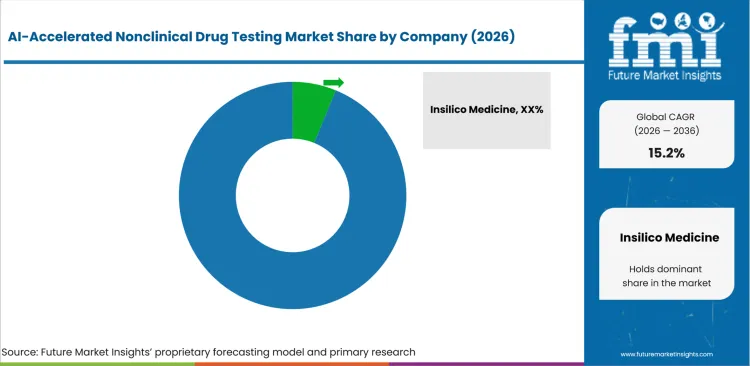
Competition separates software-centered providers from integrated research organizations that can generate experimental evidence beside computational predictions. Instem's Predict platform supports computational toxicology and regulator-ready assessments across extensive study and chemical records. Evotec's Cyprotex operation combines predictive toxicology with in vitro laboratory services and regulated safety support. Software specialists compete through model transparency and workflow integration while service organizations compete through study execution and scientific interpretation. Selection therefore depends on the sponsor's need for internal software control or accountable delivery across a broader nonclinical package.
- Certara and Simulations Plus provide biosimulation and property-prediction software that connects modeled exposure with candidate selection and development planning. Lhasa Limited and Instem emphasize interpretable toxicology outputs and structured reports suited to expert safety review. Program selection turns on endpoint coverage and the documentation needed for internal governance across multiple development teams.
- Charles River Laboratories and Evotec combine computational screening with laboratory toxicology and broader nonclinical study execution. Their commercial advantage depends on coordinating model outputs with experimental protocols and regulatory documentation across one managed program. Sponsors use these providers to reduce handoffs between prediction and formal safety assessment during regulated submission planning.
- XtalPi connects AI design with automated wet-laboratory feedback while VeriSIM Life combines mechanistic modeling with machine learning for translational prediction. Both companies compete through iterative evidence generation that can refine candidate decisions across successive experimental cycles. Adoption depends on transparent validation and dependable access to specialist scientific support across active development programs.
Competitive Benchmarking: AI-Accelerated Nonclinical Drug Testing Market
| Company | Predictive Safety Modeling | Experimental Validation | Regulatory Workflow Support | Geographic Reach |
|---|---|---|---|---|
| Certara | High | Medium | High | Global |
| Simulations Plus | High | Low | High | Global |
| Lhasa Limited | High | Low | High | Global |
| Instem | High | Low | High | Global |
| Charles River Laboratories | Medium | High | High | Global |
| Evotec | Medium | High | High | Europe and North America |
| XtalPi | High | High | Medium | China and United States |
| VeriSIM Life | High | Medium | Medium | United States |
Key Developments in the AI-Accelerated Nonclinical Drug Testing Market
- In April 2025, Certara launched Non-Animal Navigator to combine regulatory strategy with integrated preclinical planning and AI-enabled biosimulation. The service uses Simcyp and quantitative systems pharmacology models beside toxicology expertise to help sponsors design evidence packages aligned with FDA's animal-testing roadmap. The launch extends competition from standalone modeling toward accountable program design and regulatory support across complex nonclinical programs.
- In June 2025, Simulations Plus released ADMET Predictor 13 with expanded machine learning models and high-throughput PBPK simulation capabilities. The version also added automation through APIs and Python scripting for data-centered research teams across several development workflows. The release strengthens enterprise use across molecule design and ADMET evaluation without requiring every prediction to remain inside a separate desktop workflow.
- In June 2026, XtalPi entered a strategic partnership to develop oral small-molecule therapeutics for a GPCR target. Its closed-loop workflow combines AI design and robotic synthesis with wet-laboratory validation and iterative ADMET optimization. The agreement demonstrates a commercial model that links prediction directly with experimental evidence across successive design cycles and safety reviews.
- In June 2026, VeriSIM Life formalized a material transfer agreement with FDA's National Center for Toxicological Research. The collaboration evaluates mechanistic AI approaches through the BIOiSIM platform across preclinical and regulatory use cases. The agreement gives the provider a formal research route for testing translational models against public-sector scientific requirements and validation priorities.
Key Players in the AI-Accelerated Nonclinical Drug Testing Market
Predictive Modeling and Regulatory Software
- Certara
- Simulations Plus
- Lhasa Limited
- Instem
Integrated Nonclinical Services
- Charles River Laboratories
- Evotec
AI and Translational Platform Developers
- XtalPi
- VeriSIM Life
AI-Accelerated Nonclinical Drug Testing Market - Report Scope
| Coverage field | Report scope |
|---|---|
| Market breakdown | Technology, application, end user, test type, and region. |
| Quantitative Units | Revenue in USD Million, CAGR in %. |
| Market Definition | AI-enabled software, modeling services, and integrated experimental support used to predict or evaluate drug safety, pharmacokinetics, efficacy, and toxicity during nonclinical development. |
| Regions Covered | North America, Latin America, Western Europe, Eastern Europe, East Asia, South Asia and Pacific, and Middle East and Africa. |
| Countries Covered | USA, UK, Germany, Japan, and South Korea. |
| Key Companies Profiled | Certara; Simulations Plus; Lhasa Limited; Instem; Charles River Laboratories; Evotec; XtalPi; and VeriSIM Life |
| Forecast Period | 2026 to 2036. |
| Approach | Hybrid bottom-up and top-down market sizing supported by primary interviews and official desk research. |
AI-Accelerated Nonclinical Drug Testing Market - Research Methodology
| Method | Approach |
|---|---|
| Primary Research | FMI analysts gathered input from manufacturers, service providers, technology developers, distributors, end users, procurement teams, and subject-matter experts. Interviews examined purchasing decisions, product or service evaluation, adoption barriers, approval requirements, pricing considerations, and expectations for technical or commercial support. Respondents were also asked what evidence is required before a trial, pilot, or initial order develops into regular purchasing. |
| Desk Research | Desk research covered government statistics, regulatory publications, trade data, industry associations, technical literature, standards, company filings, product information, and official corporate announcements. Sources were reviewed for relevance, publication date, geographic coverage, and consistency with the defined market scope. Claims relating to performance; applications; approvals; capacity; investment; and commercial activity were retained upon support by credible public evidence. |
| Market Sizing and Forecasting | The market model combined the baseline value with historical performance, segment structure, pricing and volume indicators, adoption levels, company participation, and country-level demand conditions. Forecast assumptions considered economic activity, investment trends, regulatory developments, technology adoption, purchasing cycles, supply availability, and barriers to wider market use. Segment and regional estimates were reconciled before the final market total was calculated. |
| Data Validation | Estimates were checked against multiple independent indicators, including public data, company activity, trade patterns, industry developments, and findings from primary interviews. Validation also tested whether products, services, applications, and company revenues fell within the defined market boundaries. Adjacent categories, unsupported claims, overlapping revenues, and activities without direct market relevance were excluded to reduce double counting and maintain consistency across segments and countries. |
AI-Accelerated Nonclinical Drug Testing Market by Segments
AI-Accelerated Nonclinical Drug Testing Market segmented by Technology:
- Machine Learning Platforms
- Deep Learning Models
- Predictive Toxicology Platforms
- Generative AI Systems
- Computer Vision-based Testing Platforms
AI-Accelerated Nonclinical Drug Testing Market segmented by Application:
- Toxicity Prediction
- Drug Safety Assessment
- ADME Testing
- Dose Optimization
- Preclinical Efficacy Studies
AI-Accelerated Nonclinical Drug Testing Market segmented by End User:
- Pharmaceutical Companies
- Biotechnology Companies
- Contract Research Organizations
- Academic & Research Institutes
AI-Accelerated Nonclinical Drug Testing Market segmented by Test Type:
- In Silico Testing
- In Vitro Testing
- Organ-on-a-Chip Testing
- High-throughput Screening
- Integrated Hybrid Models
AI-Accelerated Nonclinical Drug Testing Market by Region:
- North America
- United States
- Canada
- Latin America
- Brazil
- Mexico
- Argentina
- Chile
- Western Europe
- Germany
- France
- United Kingdom
- Italy
- Spain
- Benelux
- Nordics
- Eastern Europe
- Poland
- Czech Republic
- Romania
- Hungary
- East Asia
- China
- Japan
- South Korea
- South Asia and Pacific
- India
- ASEAN
- Australia and New Zealand
- Middle East and Africa
- GCC Countries
- South Africa
- Türkiye
- Israel
Research Sources and Bibliography
- USA Food and Drug Administration. (2025, January 6). Considerations for the Use of Artificial Intelligence To Support Regulatory Decision-Making for Drug and Biological Products.
- USA Food and Drug Administration. (2026, April 20). FDA Achieves Year 1 Goals in Reducing Animal Testing in Drug Development.
- USA Food and Drug Administration. (2025, April 10). FDA Announces Plan to Phase Out Animal Testing Requirement for Monoclonal Antibodies and Other Drugs.
- USA Food and Drug Administration. (2025, December 2). FDA Releases Draft Guidance on Reducing Testing on Non-Human Primates for Monoclonal Antibodies.
- USA Food and Drug Administration. (2026, March 18). General Considerations for the Use of New Approach Methodologies in Drug Development.
- Department for Science, Innovation and Technology, Home Office, & Department for Environment, Food & Rural Affairs. (2025, November 11). Replacing animals in science strategy.
- German Federal Institute for Risk Assessment. (2025, January 21). Questions and answers on animal experiments, alternative methods and animal experiment numbers.
- German Federal Institute for Risk Assessment. (2025, June 6). International expert workshop on next-generation risk assessment.
- Pharmaceuticals and Medical Devices Agency. (2025, October 10). New Approach Methodologies: NAMs.
- Korea Health Industry Development Institute. (2025, July 28).[Call for an operator for AI-enabled drug development education and promotion].
- National Institute of Environmental Health Sciences. (2026, March). CAMERA release notes.
- Shenton, J., Bousnina, I., Oropallo, M., David, R., Weir, L., Baker, T. K., Dunmore, H.-M., Villenave, R., McElroy, M., Pettersen, B., Kokate, T., Fuller, C. L., Homan, K. A., Hudry, E., Wood, C., & Gunter, S. (2025). Opportunities and insights from pharmaceutical companies on the current use of new approach methodologies in nonclinical safety assessment. Drug Discovery Today, 30(4), 104328.
- Lhasa Limited. (2025, October 9). Lhasa Limited introduces unified, single-click genotoxicity prediction across Derek Nexus and Sarah Nexus.
- Certara, Inc. (2025, April 14). Certara launches Non-Animal Navigator™ solution to help drug developers reduce reliance on animal testing.
- Simulations Plus. (2025, June 5). Simulations Plus releases ADMET Predictor® 13.
- XtalPi. (2026, June 10). XtalPi announces strategic partnership with a leading biopharma to develop oral small molecule therapeutics for a GPCR target.
- VeriSIM Life. (2026, June 29). VeriSIM Life formalizes research collaboration with FDA/NCTR, advancing the next generation of mechanistic AI for drug development.
- Certara. (n.d.). Regulatory adoption in drug development.
- Simulations Plus. (n.d.). ADMET Predictor®.
- Simulations Plus. (n.d.). Modeling & simulation software and consulting support.
- Lhasa Limited. (n.d.). In silico mutagenicity assessment.
This bibliography is provided for reader reference and is not exhaustive. The full report contains the complete reference list and detailed citations.
This Report Answers
- How large is the AI-accelerated nonclinical drug testing market in 2026 and 2036?
- Which regulatory and scientific pressures support spending on AI-accelerated nonclinical testing?
- Why do machine learning platforms hold the principal technology share during 2026?
- How does toxicity prediction influence candidate selection and experimental study planning?
- Why do pharmaceutical companies represent the principal end-user group during 2026?
- How do country growth rates differ across the USA, UK, Germany, Japan, and South Korea?
- Which companies provide predictive software, integrated laboratory services, or translational AI platforms?
- What validation and regulatory constraints limit routine use across nonclinical development programs?
- How should sponsors evaluate model credibility and service responsibility before commercial adoption?
Frequently Asked Questions
How big is the AI-Accelerated Nonclinical Drug Testing Market in 2026?
The AI-accelerated nonclinical drug testing market is valued at USD 1090.7 million in 2026 and is forecast to reach USD 4489.9 million by 2036. Growth reflects pharmaceutical developers purchasing computational models and laboratory services that reject weak candidates earlier while preserving auditable evidence for regulatory discussions.
What is the CAGR of the AI-Accelerated Nonclinical Drug Testing Market from 2026 to 2036?
The AI-accelerated nonclinical drug testing market grows at a CAGR of 15.2% between 2026 and 2036, supported by drug developers needing human-relevant safety evidence that can improve candidate selection without expanding every animal study program.
Which test type leads the AI-Accelerated Nonclinical Drug Testing Market?
In silico testing accounts for 39.0% of the AI-accelerated nonclinical drug testing market by test type in 2026, enabled by broad compound coverage and comparatively low marginal screening cost across candidate libraries during early nonclinical planning.
How much will the AI-Accelerated Nonclinical Drug Testing Market add between 2026 and 2036?
The AI-accelerated nonclinical drug testing market is set to add USD 3399.2 million between 2026 and 2036, growing from USD 1090.7 million to USD 4489.9 million as validated computational and human-relevant testing platforms extend across a widening base of pharmaceutical development programs.
Who are the leading companies in the AI-Accelerated Nonclinical Drug Testing Market?
Five companies lead the AI-accelerated nonclinical drug testing market, including Certara, Simulations Plus, Lhasa Limited, Instem, and Charles River Laboratories, competing through biosimulation platforms, transparent toxicology models, and integrated computational-laboratory execution.
Preview the report firsthand - request a free sample
Get SampleGet the brochure for pricing and purchase details.
Get PDFTable of Content
- Key Takeaways
- Market Size and CAGR
- Top Growth Driver
- Fastest Growing Segment
- Leading Region
- Key Companies
- Emerging Opportunities
- Executive Summary
- Global Market Outlook
- Demand-side Trends
- Supply-side Trends
- Technology Roadmap Analysis
- Analysis and Recommendations
- Analyst Perspective (What is happening? Why now? What should investors know?)
- Key Questions Answered
- How large is the market?
- What is the CAGR?
- What are key trends?
- Which region dominates?
- Who are the leaders?
- Market Overview
- Market Coverage / Taxonomy
- Market Definition / Scope / Limitations
- Research Methodology
- Chapter Orientation
- Analytical Lens and Working Hypotheses
- Market Structure, Signals, and Trend Drivers
- Benchmarking and Cross-market Comparability
- Market Sizing, Forecasting, and Opportunity Mapping
- Research Design and Evidence Framework
- Desk Research Programme (Secondary Evidence)
- Expert Input and Fieldwork (Primary Evidence)
- Tooling, Models, and Reference Databases
- Data Engineering and Model Build
- Quality Assurance and Audit Trail
- Market Background
- Market Dynamics (Drivers, Restraints, Opportunity, Trends)
- Scenario Forecast (Optimistic, Likely, Conservative)
- Impact Analysis
- AI Impact
- Sustainability Impact
- Regulatory Impact
- Technology Impact
- Consumer / Buyer Analysis
- Purchase Drivers
- Adoption Barriers
- Buyer Journey
- Opportunity Map Analysis
- Product Life Cycle Analysis
- Supply Chain Analysis
- Investment Feasibility Matrix
- Value Chain Analysis
- PESTLE and Porter's Analysis
- Regulatory Landscape
- Regional Parent Market Outlook
- Production and Consumption Statistics
- Import and Export Statistics
- Global Market Analysis and Forecast, 2021 to 2036
- Historical Market Size Value (USD Million) Analysis, 2021 to 2025
- Current and Future Market Size Value (USD Million) Projections, 2026 to 2036
- Y-o-Y Growth Trend Analysis
- Absolute $ Opportunity Analysis
- Global Market Pricing Analysis, 2021 to 2036
- Global Market Analysis and Forecast, By Technology, 2021 to 2036
- Introduction / Key Findings
- Historical Market Size Value (USD Million) Analysis By Technology, 2021 to 2025
- Current and Future Market Size Value (USD Million) Analysis and Forecast By Technology, 2026 to 2036
- Machine Learning Platforms
- Deep Learning Models
- Predictive Toxicology Platforms
- Generative AI Systems
- Computer Vision-based Testing Platforms
- Machine Learning Platforms
- Y-o-Y Growth Trend Analysis By Technology, 2021 to 2025
- Absolute $ Opportunity Analysis By Technology, 2026 to 2036
- Global Market Analysis and Forecast, By Application, 2021 to 2036
- Introduction / Key Findings
- Historical Market Size Value (USD Million) Analysis By Application, 2021 to 2025
- Current and Future Market Size Value (USD Million) Analysis and Forecast By Application, 2026 to 2036
- Toxicity Prediction
- Drug Safety Assessment
- ADME Testing
- Dose Optimization
- Preclinical Efficacy Studies
- Toxicity Prediction
- Y-o-Y Growth Trend Analysis By Application, 2021 to 2025
- Absolute $ Opportunity Analysis By Application, 2026 to 2036
- Global Market Analysis and Forecast, By End User, 2021 to 2036
- Introduction / Key Findings
- Historical Market Size Value (USD Million) Analysis By End User, 2021 to 2025
- Current and Future Market Size Value (USD Million) Analysis and Forecast By End User, 2026 to 2036
- Pharmaceutical Companies
- Biotechnology Companies
- Contract Research Organizations
- Academic & Research Institutes
- Pharmaceutical Companies
- Y-o-Y Growth Trend Analysis By End User, 2021 to 2025
- Absolute $ Opportunity Analysis By End User, 2026 to 2036
- Global Market Analysis and Forecast, By Test Type, 2021 to 2036
- Introduction / Key Findings
- Historical Market Size Value (USD Million) Analysis By Test Type, 2021 to 2025
- Current and Future Market Size Value (USD Million) Analysis and Forecast By Test Type, 2026 to 2036
- In Silico Testing
- In Vitro Testing
- Organ-on-a-Chip Testing
- High-throughput Screening
- Integrated Hybrid Models
- In Silico Testing
- Y-o-Y Growth Trend Analysis By Test Type, 2021 to 2025
- Absolute $ Opportunity Analysis By Test Type, 2026 to 2036
- Global Market Analysis and Forecast, By Region, 2021 to 2036
- Introduction
- Historical Market Size Value (USD Million) Analysis By Region, 2021 to 2025
- Current Market Size Value (USD Million) Analysis and Forecast By Region, 2026 to 2036
- North America
- Latin America
- Western Europe
- Eastern Europe
- East Asia
- South Asia and Pacific
- Middle East & Africa
- Market Attractiveness Analysis By Region
- North America Market Analysis and Forecast, By Country, 2021 to 2036
- Historical Market Size Value (USD Million) Trend Analysis By Market Taxonomy, 2021 to 2025
- Market Size Value (USD Million) Forecast By Market Taxonomy, 2026 to 2036
- By Country
- USA
- Canada
- By Technology
- By Application
- By End User
- By Test Type
- By Country
- Market Attractiveness Analysis
- By Country
- By Technology
- By Application
- By End User
- By Test Type
- Key Takeaways
- Latin America Market Analysis and Forecast, By Country
- Historical Market Size Value (USD Million) Trend Analysis By Market Taxonomy, 2021 to 2025
- Market Size Value (USD Million) Forecast By Market Taxonomy, 2026 to 2036
- By Country
- Brazil
- Mexico
- Chile
- Rest of Latin America
- By Technology
- By Application
- By End User
- By Test Type
- By Country
- Market Attractiveness Analysis
- By Country
- By Technology
- By Application
- By End User
- By Test Type
- Key Takeaways
- Western Europe Market Analysis and Forecast, By Country
- Historical Market Size Value (USD Million) Trend Analysis By Market Taxonomy, 2021 to 2025
- Market Size Value (USD Million) Forecast By Market Taxonomy, 2026 to 2036
- By Country
- Germany
- UK
- Italy
- Spain
- France
- Nordic
- BENELUX
- Rest of Western Europe
- By Technology
- By Application
- By End User
- By Test Type
- By Country
- Market Attractiveness Analysis
- By Country
- By Technology
- By Application
- By End User
- By Test Type
- Key Takeaways
- Eastern Europe Market Analysis and Forecast, By Country
- Historical Market Size Value (USD Million) Trend Analysis By Market Taxonomy, 2021 to 2025
- Market Size Value (USD Million) Forecast By Market Taxonomy, 2026 to 2036
- By Country
- Russia
- Poland
- Hungary
- Balkan & Baltic
- Rest of Eastern Europe
- By Technology
- By Application
- By End User
- By Test Type
- By Country
- Market Attractiveness Analysis
- By Country
- By Technology
- By Application
- By End User
- By Test Type
- Key Takeaways
- East Asia Market Analysis and Forecast, By Country
- Historical Market Size Value (USD Million) Trend Analysis By Market Taxonomy, 2021 to 2025
- Market Size Value (USD Million) Forecast By Market Taxonomy, 2026 to 2036
- By Country
- China
- Japan
- South Korea
- By Technology
- By Application
- By End User
- By Test Type
- By Country
- Market Attractiveness Analysis
- By Country
- By Technology
- By Application
- By End User
- By Test Type
- Key Takeaways
- South Asia and Pacific Market Analysis and Forecast, By Country
- Historical Market Size Value (USD Million) Trend Analysis By Market Taxonomy, 2021 to 2025
- Market Size Value (USD Million) Forecast By Market Taxonomy, 2026 to 2036
- By Country
- India
- ASEAN
- Australia & New Zealand
- Rest of South Asia and Pacific
- By Technology
- By Application
- By End User
- By Test Type
- By Country
- Market Attractiveness Analysis
- By Country
- By Technology
- By Application
- By End User
- By Test Type
- Key Takeaways
- Middle East & Africa Market Analysis and Forecast, By Country
- Historical Market Size Value (USD Million) Trend Analysis By Market Taxonomy, 2021 to 2025
- Market Size Value (USD Million) Forecast By Market Taxonomy, 2026 to 2036
- By Country
- Kingdom of Saudi Arabia
- Other GCC Countries
- Türkiye
- South Africa
- Other African Union
- Rest of Middle East & Africa
- By Technology
- By Application
- By End User
- By Test Type
- By Country
- Market Attractiveness Analysis
- By Country
- By Technology
- By Application
- By End User
- By Test Type
- Key Takeaways
- Key Countries Market Analysis
- USA
- Pricing Analysis
- Market Share Analysis, 2025
- By Technology
- By Application
- By End User
- By Test Type
- Canada
- Pricing Analysis
- Market Share Analysis, 2025
- By Technology
- By Application
- By End User
- By Test Type
- Mexico
- Pricing Analysis
- Market Share Analysis, 2025
- By Technology
- By Application
- By End User
- By Test Type
- Brazil
- Pricing Analysis
- Market Share Analysis, 2025
- By Technology
- By Application
- By End User
- By Test Type
- Chile
- Pricing Analysis
- Market Share Analysis, 2025
- By Technology
- By Application
- By End User
- By Test Type
- Germany
- Pricing Analysis
- Market Share Analysis, 2025
- By Technology
- By Application
- By End User
- By Test Type
- UK
- Pricing Analysis
- Market Share Analysis, 2025
- By Technology
- By Application
- By End User
- By Test Type
- Italy
- Pricing Analysis
- Market Share Analysis, 2025
- By Technology
- By Application
- By End User
- By Test Type
- Spain
- Pricing Analysis
- Market Share Analysis, 2025
- By Technology
- By Application
- By End User
- By Test Type
- France
- Pricing Analysis
- Market Share Analysis, 2025
- By Technology
- By Application
- By End User
- By Test Type
- India
- Pricing Analysis
- Market Share Analysis, 2025
- By Technology
- By Application
- By End User
- By Test Type
- ASEAN
- Pricing Analysis
- Market Share Analysis, 2025
- By Technology
- By Application
- By End User
- By Test Type
- Australia & New Zealand
- Pricing Analysis
- Market Share Analysis, 2025
- By Technology
- By Application
- By End User
- By Test Type
- China
- Pricing Analysis
- Market Share Analysis, 2025
- By Technology
- By Application
- By End User
- By Test Type
- Japan
- Pricing Analysis
- Market Share Analysis, 2025
- By Technology
- By Application
- By End User
- By Test Type
- South Korea
- Pricing Analysis
- Market Share Analysis, 2025
- By Technology
- By Application
- By End User
- By Test Type
- Russia
- Pricing Analysis
- Market Share Analysis, 2025
- By Technology
- By Application
- By End User
- By Test Type
- Poland
- Pricing Analysis
- Market Share Analysis, 2025
- By Technology
- By Application
- By End User
- By Test Type
- Hungary
- Pricing Analysis
- Market Share Analysis, 2025
- By Technology
- By Application
- By End User
- By Test Type
- Kingdom of Saudi Arabia
- Pricing Analysis
- Market Share Analysis, 2025
- By Technology
- By Application
- By End User
- By Test Type
- Türkiye
- Pricing Analysis
- Market Share Analysis, 2025
- By Technology
- By Application
- By End User
- By Test Type
- South Africa
- Pricing Analysis
- Market Share Analysis, 2025
- By Technology
- By Application
- By End User
- By Test Type
- USA
- Market Structure Analysis
- Competition Dashboard
- Competition Benchmarking
- Market Share Analysis of Top Players
- By Regional
- By Technology
- By Application
- By End User
- By Test Type
- Emerging Startups
- Innovation Benchmarking
- Competition Analysis
- Competition Deep Dive
- Insilico Medicine
- Overview
- Product Portfolio
- Profitability by Market Segments
- Sales Footprint
- Strategy Overview
- Marketing Strategy
- Product Strategy
- Channel Strategy
- Exscientia
- BenevolentAI
- Recursion Pharmaceuticals
- Atomwise
- Valo Health
- Schrödinger
- BioSymetrics
- Certara
- Simulations Plus
- Insilico Medicine
- Case Studies
- Success Stories
- Recent Developments
- Competition Deep Dive
- Assumptions & Acronyms Used


