

- Market Size (2026)
- USD 392.9 Mn
- Forecast (2036)
- USD 896.6 Mn
- CAGR (2026 to 2036)
- 8.6%
How big is AI Data Center Onsite Generation Load-Following Controls Market in 2026?
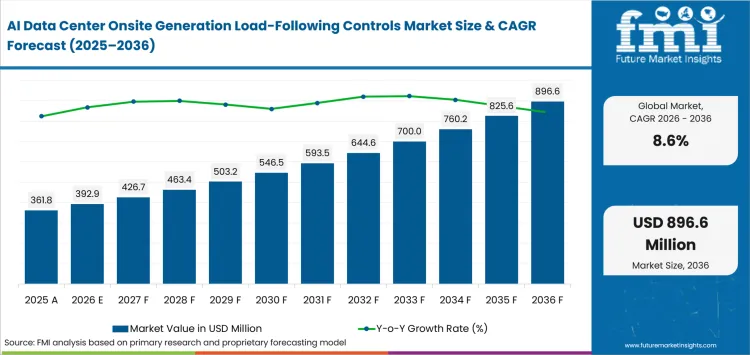
USD 392.9 million in 2026 and USD 896.6 million by 2036 at an 8.6% CAGR.
Sales in the AI data center onsite generation load-following controls market are projected to grow at 8.6% CAGR through 2036, driving valuation to USD 896.6 million by 2036 from USD 392.9 million in 2026. Power availability is becoming a larger operational concern as AI facilities add higher-density compute and electrical infrastructure. Lawrence Berkeley National Laboratory estimated in June 2026 that data centers could account for 11.8% of USA electricity use by 2030. The projected electricity load increases the value of data center power management that coordinates storage, generation, conversion equipment, and protection before compute halls are energized.
Country conversion depends on whether high-voltage capacity reaches the site before planned compute load is energized. France's economy ministry identified 28 additional candidate data-center sites with grid-ready development potential in May 2025. The 28-site pipeline makes connection timing a site-sequencing issue, so projects awaiting full grid capacity place more engineering weight on microgrid systems, transfer logic, and staged source synchronization.
Key Takeaways
- AI load volatility and grid-connection timing are increasing purchases of controls that synchronize onsite sources with sensitive data-center loads.
- By solution type, power conversion equipment is estimated to hold 27.0% in 2026 owing to its role between storage, generation buses, and downstream AI loads.
- Medium-voltage distribution is projected to account for 31.0% of the electrical layer in 2026 because campus protection and source isolation are concentrated at this boundary.
- In 2026, 51-150 MW is expected to lead power capacity with 31.0% share as modular electrical blocks remain repeatable at this campus scale.
- Interconnection models, fault studies, and commissioning dependencies can postpone energization even after onsite generation capacity is available.
- Some of the key players in this market include Cummins, Caterpillar, Siemens Energy, Rolls-Royce Power Systems, Schneider Electric, Eaton, ABB, and Vertiv.
Analyst Perspective
"The commercial test is whether an AI campus can turn available onsite megawatts into stable compute power without redesigning protection at every expansion phase. Controls earn their place when generator ramp limits, battery response, transfer sequences, and utility ride-through models are resolved before the first hall is energized."
- Sudip saha, Principal Consultant, Future Market Insights
How is the AI data center onsite generation load-following controls market segmented?
The market is segmented by solution type, electrical layer, power capacity, facility type, route to market, and region.
Six axes define the market. Solution type covers power conversion equipment, switchgear and distribution assemblies, prefabricated power modules, protection and transfer systems, and monitoring and control hardware. Electrical layer covers medium-voltage, low-voltage, UPS/storage interface, and rack-side distribution. Power capacity spans up to 50 MW, 51-150 MW, 151-300 MW, and above 300 MW. Facility type includes hyperscale AI, colocation, enterprise/private cloud, and HPC/research. Route to market includes OEM direct, EPC/electrical contractor, systems integrator, and service/channel partner. Region follows the fixed taxonomy.
What supports hyperscale AI leadership in the facility type category?
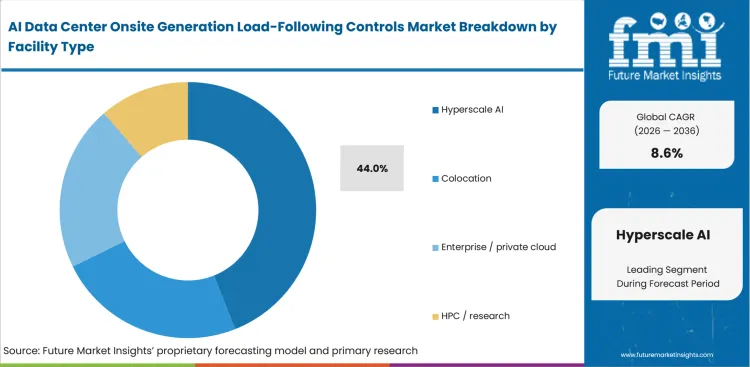
Hyperscale AI campuses concentrate enough compute load for electrical transients to affect the whole campus instead of a room-level UPS. In July 2026, Schneider Electric and AMD released a validated Helios reference design supporting 246 kW racks and clusters up to 10.4 MW of IT load.
- Hyperscale AI is set to lead facility type with 44.0% share in 2026 because repeated high-density halls justify common source coordination.
- Operators use power distribution units in repeatable electrical blocks that can be factory-tested, limiting late commissioning changes as new AI halls come online.
What makes power conversion equipment central to the solution type category?
AI workloads can change power demand faster than mechanical generators can ramp, so conversion equipment bridges the interval while holding voltage and frequency. In August 2026, Cummins was selected to supply battery energy storage systems for a USA data-center project requiring fast response to AI load fluctuations.
- Based on solution type, power conversion equipment is projected to account for 27.0% in 2026 owing to placement between onsite sources and AI loads.
- Engineering teams specify conversion equipment early because storage dispatch, UPS behavior, and generator-following logic must use common source and load models.
Why does medium-voltage distribution lead the electrical layer category?
Campus generation is aggregated before feeders step down toward low-voltage rooms and racks, making medium voltage the main boundary for fault clearing and source isolation. Eaton announced in April 2026 that its new Nebraska plant will expand USA medium-voltage switchgear production for data-center and power-generation systems.
- By electrical layer, medium-voltage distribution is estimated to hold 31.0% in 2026 because source coordination and feeder protection are concentrated before downstream voltage conversion.
- Data-center electrical teams use medium-voltage equipment to isolate a faulted block without dropping unaffected generation or storage-supported sections during routine operation and fault events.
How does 51-150 MW shape selection within the power capacity category?
At 51-150 MW, onsite power requires plant-level coordination without forcing every feeder and control block to be custom-engineered. South Korea's Ministry of Science and ICT said in June 2025 that the Ulsan AI Data Center is a 100 MW-class project scheduled to reach 103 MW.
- The 51-150 MW segment is forecast to represent 31.0% in 2026, attributable to project sizes that justify coordinated onsite controls without forcing one-off plant architecture.
- Developers can repeat tested modular data-center electrical blocks at this scale, reducing field redesign as each successive capacity phase is commissioned in sequence.
What are the drivers, restraints and opportunities in the AI Data Center Onsite Generation Load-Following Controls Market?
Fast AI load swings require coordinated dispatch, interconnection studies delay energization, and pre-engineered onsite-power packages reduce late field integration.
- Driver: Rapid compute-load changes make coordinated dispatch, storage response, and transfer logic part of the initial AI campus power design.
- Restraint: Large-load ride-through and fault-study requirements can extend design approval and commissioning before a campus is allowed to energize.
- Opportunity: Pre-engineered source, switchgear, conversion, and control packages can reduce site integration work for bridge-to-grid and prime-power projects.
Fast AI-campus buildouts are raising the amount of power that must be balanced locally before utilities can expand grid service. The USA Energy Information Administration reported in March 2026 that electricity demand grew about 1.7% annually from 2020 to 2025, with data centers a major source of the increase. Onsite generation and power management systems must absorb short demand changes without exposing IT loads to unstable transfers.
Large electronic loads face stricter utility review once a transmission fault can trigger a simultaneous campus trip. ERCOT requested voltage ride-through information in June 2025 for data-center and other electronic loads of 75 MW or more. Approval depends on dynamic models, protection settings, and source-control behavior that utilities can test for each planned operating mode before commissioning.
Pre-engineered electrical and generation packages can shorten site integration by fixing major interfaces before field construction. Eaton and Siemens Energy announced a fast-track design in June 2025 that develops the electrical facility and onsite generation plant in parallel. Factory-tested switchgear systems, conversion equipment, and control interfaces reduce late reconciliation during commissioning and clarify the handoff to permanent service.
Which country CAGRs are profiled in the AI Data Center Onsite Generation Load-Following Controls Market?
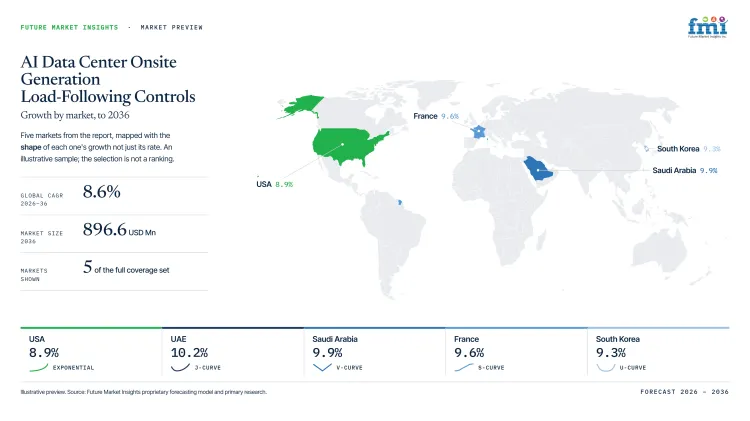
| Country | CAGR |
|---|---|
| UAE | 10.2% |
| Saudi Arabia | 9.9% |
| France | 9.6% |
| South Korea | 9.3% |
| USA | 8.9% |
| Japan | 8.6% |
How do country-level CAGRs compare in the AI Data Center Onsite Generation Load-Following Controls Market?
The six profiled markets span 1.6 percentage points from the UAE at 10.2% CAGR to Japan at 8.6% from 2026 to 2036. The UAE and Saudi Arabia form the top band because both are pairing AI infrastructure programs with large new data-center capacity. France and South Korea sit in a second growth band where public policy is accelerating sites and computing infrastructure.
- UAE projects bundle campus power procurement before later compute phases.
- Saudi Arabia makes commissioning capacity valuable for new generation sites.
- France brings protection reviews into design earlier through utility planning.
- South Korea’s public AI pipeline gives suppliers visibility into staged additions.
- USA projects support service revenue across a deep installed base.
- Japan operators face a planning environment where electricity infrastructure and telecommunications capacity are being coordinated at policy level.
Procurement paths still differ by utility access and commissioning scope. The full report provides country-level CAGR analysis across North America, Latin America, Europe, East Asia, South Asia, Oceania and the Middle East and Africa.
Country-wise Analysis
- Abu Dhabi developers lock source architecture early because Stargate UAE concentrates several compute phases inside one coordinated campus program, with its May 2025 announcement setting a 1 GW cluster and an initial 200 MW phase for 2026. The UAE onsite generation load-following controls outlook is projected to grow at 10.2% CAGR over the assessment period, owing to greenfield sites that can standardize source, conversion, and protection blocks before later halls are energized. Power-system integrators still face a sequencing risk because each new block must preserve approved protection settings, so control interfaces and commissioning support need to scale without reopening the design at every phase.
- Saudi developers are pairing new AI campuses with dedicated generation because grid readiness does not advance at the same pace in every location, making controllable local power part of early site planning. The Saudi Press Agency documented more than 440 MW of operating data-center capacity in 2025 and nearly sixfold growth since 2021, while rapid additions put pressure on commissioning engineers to repeat transfer and dispatch settings without slowing energization. Demand for onsite generation load-following controls in Saudi Arabia is forecast to rise at 9.9% CAGR during the forecast period, tied to projects that need repeatable controls before every planned grid connection reaches full capacity.
- French developers increasingly treat high-voltage readiness as part of site selection because bridge power has commercial value only if the final utility handoff is engineered before construction reaches commissioning. The French market is positioned to record 9.6% CAGR through 2036, given a pipeline that needs temporary generation and permanent grid service to use compatible protection settings without late redesign. In January 2026, the economy ministry reported five fast-track sites with more than 700 MW of connection potential each within three to four years, which makes transfer sequences and commissioning evidence a qualification issue for switchgear and controls manufacturers seeking early specification.
- South Korea is expanding AI capacity through staged public and private programs, and the Ministry of Science and ICT said in August 2026 that the National AI Computing Center in Haenam targets 15,000 AI chips by 2028. Phased projects favor medium-voltage blocks that can reuse protection and commissioning settings, though power availability is less consistent outside the strongest clusters and prevents one electrical design from fitting every site. South Korea is estimated to post 9.3% CAGR over the forecast period because integrators that standardize controls for repeatable expansion can convert announced compute capacity into equipment orders without assuming identical interconnection conditions.
- USA data-center operators increasingly treat large-load behavior as a utility-facing design condition because compute schedules are moving ahead of grid upgrades in several high-growth regions. By 2036, USA is projected to grow at 8.9% CAGR, attributable to a deep construction pipeline and wider use of behind-the-meter generation where connection schedules lag planned compute loads. ERCOT's June 3, 2025 workshop notice cited simultaneous loss of multiple large loads after transmission faults, so control packages with testable dynamic models, documented ride-through settings, service support, and clear field responsibility have a stronger path through utility review and final utility site acceptance.
- Operators face a planning environment where electricity infrastructure and telecommunications capacity are being coordinated at policy level. Demand for AI data center onsite generation load-following controls in Japan is forecast to expand at 8.6% CAGR from 2026 to 2036. METI and MIC published Watt-Bit Collaboration Report 1.0 in June 2025 to support coordinated development of data-center power and communications infrastructure. The main constraint is mismatched lead times and location constraints for large electrical loads. Suppliers need modular controls and distribution systems that can fit region-specific power availability and phased compute deployment.
Who are the notable companies in the AI Data Center Onsite Generation Load-Following Controls Market?
Cummins, Caterpillar, Siemens Energy, Rolls-Royce Power Systems, Schneider Electric, Eaton, ABB, and Vertiv are notable companies serving this market.
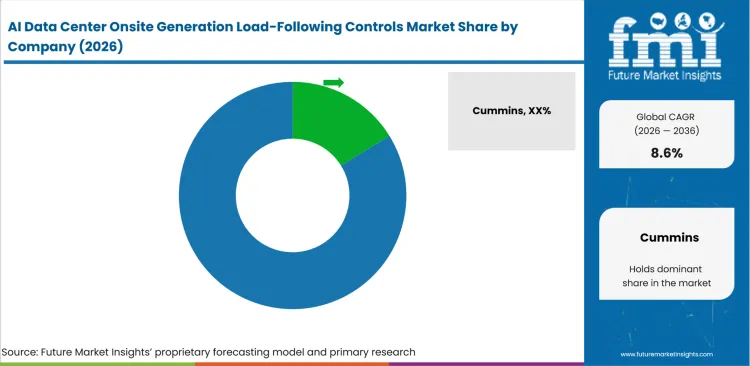
Competition separates into onsite generation specialists, protection and distribution firms, and data-center infrastructure integrators that package power into repeatable modules. A qualifying offer must coordinate generation with protection, conversion, transfer logic, and commissioning evidence under clear responsibility. Installed equipment fleets provide service reach, but the decisive distinction is whether the company can own the energized interface during testing and handover.
- Generation and source-control platforms: Cummins, Caterpillar, Siemens Energy, and Rolls-Royce Power Systems provide prime or standby generation with controls suited to data-center source coordination.
- Protection and electrical architecture: Schneider Electric, Eaton, and ABB cover medium-voltage distribution, transfer, protection, and modular electrical assemblies.
- Critical-infrastructure integration: Vertiv links power distribution, monitoring, storage interfaces, and prefabricated infrastructure to high-density data-center deployment.
Competitive Benchmarking: AI Data Center Onsite Generation Load-Following Controls Market
| Company | Onsite Source Coordination | Protection & Distribution Engineering | Prefabricated AI Power | Geographic Reach |
|---|---|---|---|---|
| Cummins | High | Medium | Medium | Global power-systems footprint; current North American data-center projects |
| Caterpillar | High | Medium | Medium | Global power-systems and dealer network |
| Siemens Energy | High | Medium | High | Global energy-technology reach |
| Rolls-Royce Power Systems | High | Medium | Medium | Global mtu power-systems reach; strong North American data-center focus |
| Schneider Electric | Medium | High | High | Global |
| Eaton | High | High | High | Global; major North American data-center manufacturing expansion |
| ABB | High | High | High | Global; current USA and international AI power projects |
| Vertiv | High | Medium | High | Global data-center infrastructure and service network |
Scoring basis: High requires broad current official evidence for the stated capability in data-center or onsite-power projects. Medium reflects a credible but narrower documented route, and Low applies only to an explicitly limited current offer. Geographic reach records active coverage, and company size does not influence any capability score.
Key Developments in the AI Data Center Onsite Generation Load-Following Controls Market
- In April 2026, Vertiv and CPower announced a collaboration to use grid-interactive battery systems and behind-the-meter assets to support data-center power flexibility and utility participation.
- In March 2026, ABB extended its VoltaGrid collaboration with orders for 35 additional synchronous condensers and prefabricated eHouses for data-center power projects supporting hyperscale AI loads.
- In March 2026, Caterpillar, OnePWR Solutions, and Vero3 announced an integrated data-center power collaboration covering natural-gas prime generation, battery storage, controls, and related engineering.
Key Players in the AI Data Center Onsite Generation Load-Following Controls Market
Onsite Generation and Source-Control Platforms
- Cummins
- Caterpillar
- Siemens Energy
- Rolls-Royce Power Systems
AI Power Architecture and Protection
- Schneider Electric
- Eaton
- ABB
Critical Infrastructure Integration
- Vertiv
AI Data Center Onsite Generation Load-Following Controls Market - Report Scope
| Coverage field | Report scope |
|---|---|
| Market breakdown | By solution type, electrical layer, power capacity, facility type, route to market, and region. |
| Quantitative Units | USD million. |
| Market Definition | Revenue includes power conversion equipment, distribution assemblies, prefabricated power modules, protection and transfer systems, and monitoring or control hardware sold for onsite-generation load-following architectures in AI data centers. Generation prime movers, fuel, IT equipment, cooling systems, utility energy sales, and unrelated substitute categories are excluded. |
| Regions Covered | North America, Latin America, Western Europe, Eastern Europe, East Asia, South Asia and Pacific, and Middle East and Africa. |
| Countries Covered | UAE, Saudi Arabia, France, South Korea, USA, and 20+ countries included in the full report. |
| Key Companies Profiled | Cummins, Caterpillar, Siemens Energy, Rolls-Royce Power Systems, Schneider Electric, Eaton, ABB, and Vertiv. |
| Forecast Period | 2026 to 2036. |
| Approach | Primary and secondary research with market triangulation. |
AI Data Center Onsite Generation Load-Following Controls Market - Research Methodology
| Method | Approach |
|---|---|
| Primary Research | FMI analysts gathered input from manufacturers, service providers, technology developers, distributors, end users, procurement teams, and subject-matter experts. Interviews examined purchasing decisions, product or service evaluation, adoption barriers, approval requirements, pricing considerations, and expectations for technical or commercial support. Respondents were also asked what evidence is required before a trial, pilot, or initial order develops into regular purchasing. |
| Desk Research | Desk research covered government statistics, regulatory publications, trade data, industry associations, technical literature, standards, company filings, product information, and official corporate announcements. Sources were reviewed for relevance, publication date, geographic coverage, and consistency with the defined market scope. Claims relating to performance, applications, approvals, capacity, investment, and commercial activity were retained only when supported by credible public evidence. |
| Market Sizing and Forecasting | The market model combined the baseline value with historical performance, segment structure, pricing and volume indicators, adoption levels, company participation, and country-level demand conditions. Forecast assumptions considered economic activity, investment trends, regulatory developments, technology adoption, purchasing cycles, supply availability, and barriers to wider market use. Segment and regional estimates were reconciled before the final market total was calculated. |
| Data Validation | Estimates were checked against multiple independent indicators, including public data, company activity, trade patterns, industry developments, and findings from primary interviews. Validation also tested whether products, services, applications, and company revenues fell within the defined market boundaries. Adjacent categories, unsupported claims, overlapping revenues, and activities without direct market relevance were excluded to reduce double counting and maintain consistency across segments and countries. |
AI Data Center Onsite Generation Load-Following Controls Market by Segments
AI Data Center Onsite Generation Load-Following Controls Market segmented by Solution Type:
- Power Conversion Equipment
- Switchgear and Distribution Assemblies
- Prefabricated Power Modules
- Protection and Transfer Systems
- Monitoring and Control Hardware
AI Data Center Onsite Generation Load-Following Controls Market segmented by Electrical Layer:
- Medium-Voltage Distribution
- Low-Voltage Distribution
- UPS / Storage Interface
- Rack-Side Distribution
AI Data Center Onsite Generation Load-Following Controls Market segmented by Power Capacity:
- Up to 50 MW
- 51-150 MW
- 151-300 MW
- Above 300 MW
AI Data Center Onsite Generation Load-Following Controls Market segmented by Facility Type:
- Hyperscale AI
- Colocation
- Enterprise / Private Cloud
- HPC / Research
AI Data Center Onsite Generation Load-Following Controls Market segmented by Route to Market:
- OEM Direct
- EPC / Electrical Contractor
- Systems Integrator
- Service / Channel Partner
AI Data Center Onsite Generation Load-Following Controls Market by Region:
- North America
- USA
- Canada
- Latin America
- Brazil
- Mexico
- Chile
- Rest of Latin America
- Western Europe
- Germany
- United Kingdom
- Italy
- Spain
- France
- Nordics
- Benelux
- Rest of Western Europe
- Eastern Europe
- Russia
- Poland
- Hungary
- Balkan and Baltic States
- Rest of Eastern Europe
- East Asia
- China
- Japan
- South Korea
- South Asia and Pacific
- India
- ASEAN
- Australia and New Zealand
- Rest of South Asia and Pacific
- Middle East and Africa
- Kingdom of Saudi Arabia
- Other GCC Countries
- Türkiye
- South Africa
- Other African Union Countries
- Rest of Middle East and Africa
Research Sources and Bibliography
- Lawrence Berkeley National Laboratory. (2026, June). United States Data Center Energy Usage Report: 2025 Update
- Ministère de l’Économie, des Finances et de la Souveraineté industrielle et numérique. (2025, May 20). Sommet Choose France 2025
- Cummins Inc. (2026, August 18). Cummins selected to supply battery energy storage systems for large USA data center project
- Eaton. (2026, April 8). Eaton expands operations in Nebraska with new manufacturing facility to meet increasing switchgear demand driven by AI data center boom
- Ministry of Science and ICT, Republic of Korea. (2025, June 20). Ulsan AI Data Center Launch Sparks Dialogue on Advancing Korea into a Top-Three Global AI Power
- Schneider Electric. (2026, July 23). Schneider Electric and AMD release first Helios platform reference design to accelerate AI Factory deployment
- USA Energy Information Administration. (2026, March 12). Fossil generation could rise with faster-than-expected growth in data center power demand
- ERCOT. (2025, June 23). Large Load Survey and Request for Information of Voltage Ride-Through Capabilities to Ensure Reliable Interconnection and Operation of Large Electronic Loads
- Siemens Energy. (2025, June 3). Eaton and Siemens Energy join forces to provide power and technology to accelerate the delivery of new data center capacity
- Abu Dhabi Media Office. (2025, May 22). Global tech alliance launches Stargate UAE
- Saudi Press Agency. (2026, April 27). Saudi Arabia Strengthens Its Global Position in Artificial Intelligence Through Data Center Growth and Accelerated Smart Manufacturing
- Ministère de l’Économie, des Finances et de la Souveraineté industrielle et numérique. (2026, January 30). Rencontres des centres de données : la dynamique des projets d’infrastructures numériques se confirme
- Ministry of Science and ICT, Republic of Korea. (2026, August 18). National AI Computing Center, a Key Infrastructure for Korea’s AI Highway, Breaks Ground in Haenam
- ERCOT. (2025, June 3). June 13th ERCOT Technical Workshop Regarding Measures to Facilitate Continued Reliable Integration of Data Center and Cryptomining Large Loads in the ERCOT Region
- Vertiv. (2026, April 14). Vertiv and CPower collaborate to help data centers accelerate interconnection and unlock value from energy assets
- ABB. (2026, March 26). ABB and VoltaGrid extend collaboration on data center power infrastructure
- Caterpillar Inc. (2026, March 1). Caterpillar, OnePWR Solutions, and Vero3 Announce Strategic Collaboration to Deliver Sustainable Solutions and Infrastructure for Data Centers
- Schneider Electric. (2025, September 3). AVAIO Digital and Schneider Electric Partner to build new AI-optimized data centers in USA
- Eaton. (2026, January 28). Eaton expands modular data center offering for rapid deployment of AI factories from grid to chip
- Schneider Electric. (2025, June 11). Schneider Electric Accelerates the Development and Deployment of AI Factories at Scale With NVIDIA
- Eaton. (2025, April 1). Eaton completes acquisition of Fibrebond
- Rolls-Royce. (2025, December 11). Rolls-Royce delivers first emergency power generators for data centres with Environmental Product Declarations
- Bloom Energy. (2026, April 13). Bloom Energy and Oracle Expand Strategic Partnership to Deploy up to 2.8 GW to Accelerate AI Infrastructure Build-Out
- Babcock & Wilcox. (2026, March 4). Babcock & Wilcox Receives Full Notice to Proceed on $2.4 Billion Power Generation Project for Base Electron to Supply Power to Applied Digital AI Factory Campuses
- Cummins Inc. (2026, June 16). Cummins Natural Gas Generators to Power Large Scale Data Centers in West Texas
- Schneider Electric. (2026, June 15). Schneider Electric and Hon Hai Technology Group (Foxconn) announce strategic collaboration to accelerate next-generation AI data centers
- Vertiv. (2025, November 18). Vertiv and Caterpillar announce energy optimization collaboration to expand end-to-end power and cooling offerings for AI data centers
- Eaton. (2025, December 10). Eaton invests $50M+ in new Virginia facility to advance grid-to-chip AI data center solutions
- Babcock & Wilcox. (2026, August 11). Babcock & Wilcox Signs Agreement with Siemens Energy to Commence Work on 20 Steam Turbines for Data Center Power Generation
- ABB. (2025, November 13). ABB expands power technology partnership with Applied Digital for AI-ready data centers
- Vertiv. (2025, July 22). Oklo and Vertiv announce collaboration to advance power and cooling solutions for hyperscale and colocation data centers in the United States
- Rolls-Royce. (2026, July 9). Rolls-Royce cuts ribbon on new $24m expansion in Mankato, Minnesota
This bibliography is provided for reader reference and is not exhaustive. The full report contains the complete reference list and detailed citations
This Report Answers
- How large is the AI data center onsite generation load-following controls market in 2026 and what valuation is projected for 2036?
- Which electrical conditions are increasing demand for onsite source coordination at AI campuses?
- Why does power conversion equipment hold the leading solution-type share?
- Why is medium-voltage distribution the leading electrical layer?
- How does the 51-150 MW power band affect control architecture and commissioning?
- Which country markets show the strongest projected growth through 2036?
- What limits faster deployment of load-following controls even when onsite generation is available?
- Which companies are positioned for source coordination, protection, and modular AI power infrastructure?
- How do prefabricated power systems change the route from design to energization?
Frequently Asked Questions
How big is the AI data center onsite generation load-following controls market in 2026?
The AI data center onsite generation load-following controls market is valued at USD 392.9 million in 2026 and is projected to reach USD 896.6 million by 2036. Growth follows rising AI power demand and tighter coordination between onsite sources and sensitive compute loads.
What is the CAGR of the AI data center onsite generation load-following controls market from 2026 to 2036?
The AI data center onsite generation load-following controls market is projected to grow at a CAGR of 8.6% between 2026 and 2036. Grid-connection pressure, fast compute-load changes, and wider use of onsite generation raise the need for coordinated load-following controls.
Which solution type leads the AI data center onsite generation load-following controls market?
The power conversion equipment segment is expected to hold 27.0% of the AI data center onsite generation load-following controls market in 2026, attributable to its position between storage and transient AI loads. It supplies fast electrical response immediately before slower generation can change output.
Which electrical layer leads the AI data center onsite generation load-following controls market?
The medium-voltage distribution segment is projected to hold 31.0% of the AI data center onsite generation load-following controls market in 2026, supported by campus-level source isolation and feeder protection. Medium voltage also carries transfer and staged-energization duties for large electrical blocks.
Which countries are projected to record the highest growth in the AI data center onsite generation load-following controls market?
UAE is projected to grow at 10.2% CAGR, followed by Saudi Arabia at 9.9% and France at 9.6% through 2036. The upper group is concentrated in markets pairing large AI capacity programs with new power infrastructure and faster site-development routes.
Which companies are active in the AI data center onsite generation load-following controls market?
Key companies operating in the market include Cummins, Caterpillar, Siemens Energy, Rolls-Royce Power Systems, Schneider Electric, Eaton, ABB, and Vertiv. Current offers differ in source-control depth, protection engineering, modular electrical infrastructure, and field-service responsibility.
Preview the report firsthand - request a free sample
Get SampleGet the brochure for pricing and purchase details.
Get PDFTable of Content
- Key Takeaways
- Market Size and CAGR
- Top Growth Driver
- Fastest Growing Segment
- Leading Region
- Key Companies
- Emerging Opportunities
- Executive Summary
- Global Market Outlook
- Demand-side Trends
- Supply-side Trends
- Technology Roadmap Analysis
- Analysis and Recommendations
- Analyst Perspective (What is happening? Why now? What should investors know?)
- Key Questions Answered
- How large is the market?
- What is the CAGR?
- What are key trends?
- Which region dominates?
- Who are the leaders?
- Market Overview
- Market Coverage / Taxonomy
- Market Definition / Scope / Limitations
- Research Methodology
- Chapter Orientation
- Analytical Lens and Working Hypotheses
- Market Structure, Signals, and Trend Drivers
- Benchmarking and Cross-market Comparability
- Market Sizing, Forecasting, and Opportunity Mapping
- Research Design and Evidence Framework
- Desk Research Programme (Secondary Evidence)
- Expert Input and Fieldwork (Primary Evidence)
- Tooling, Models, and Reference Databases
- Data Engineering and Model Build
- Quality Assurance and Audit Trail
- Market Background
- Market Dynamics (Drivers, Restraints, Opportunity, Trends)
- Scenario Forecast (Optimistic, Likely, Conservative)
- Impact Analysis
- AI Impact
- Sustainability Impact
- Regulatory Impact
- Technology Impact
- Consumer / Buyer Analysis
- Purchase Drivers
- Adoption Barriers
- Buyer Journey
- Opportunity Map Analysis
- Product Life Cycle Analysis
- Supply Chain Analysis
- Investment Feasibility Matrix
- Value Chain Analysis
- PESTLE and Porter's Analysis
- Regulatory Landscape
- Regional Parent Market Outlook
- Production and Consumption Statistics
- Import and Export Statistics
- Global Market Analysis and Forecast, 2021 to 2036
- Historical Market Size Value (USD Million) Analysis, 2021 to 2025
- Current and Future Market Size Value (USD Million) Projections, 2026 to 2036
- Y-o-Y Growth Trend Analysis
- Absolute $ Opportunity Analysis
- Global Market Pricing Analysis, 2021 to 2036
- Global Market Analysis and Forecast, By Solution Type, 2021 to 2036
- Introduction / Key Findings
- Historical Market Size Value (USD Million) Analysis By Solution Type, 2021 to 2025
- Current and Future Market Size Value (USD Million) Analysis and Forecast By Solution Type, 2026 to 2036
- Power conversion equipment
- Distribution assemblies
- Prefabricated power modules
- Protection & transfer systems
- Monitoring / control hardware
- Power conversion equipment
- Y-o-Y Growth Trend Analysis By Solution Type, 2021 to 2025
- Absolute $ Opportunity Analysis By Solution Type, 2026 to 2036
- Global Market Analysis and Forecast, By Electrical Layer, 2021 to 2036
- Introduction / Key Findings
- Historical Market Size Value (USD Million) Analysis By Electrical Layer, 2021 to 2025
- Current and Future Market Size Value (USD Million) Analysis and Forecast By Electrical Layer, 2026 to 2036
- Medium-voltage distribution
- Low-voltage distribution
- Rack / row-level
- Substation / grid interface
- Medium-voltage distribution
- Y-o-Y Growth Trend Analysis By Electrical Layer, 2021 to 2025
- Absolute $ Opportunity Analysis By Electrical Layer, 2026 to 2036
- Global Market Analysis and Forecast, By Power Capacity, 2021 to 2036
- Introduction / Key Findings
- Historical Market Size Value (USD Million) Analysis By Power Capacity, 2021 to 2025
- Current and Future Market Size Value (USD Million) Analysis and Forecast By Power Capacity, 2026 to 2036
- 51-150 MW
- 10-50 MW
- Below 10 MW
- Above 150 MW
- 51-150 MW
- Y-o-Y Growth Trend Analysis By Power Capacity, 2021 to 2025
- Absolute $ Opportunity Analysis By Power Capacity, 2026 to 2036
- Global Market Analysis and Forecast, By Facility Type, 2021 to 2036
- Introduction / Key Findings
- Historical Market Size Value (USD Million) Analysis By Facility Type, 2021 to 2025
- Current and Future Market Size Value (USD Million) Analysis and Forecast By Facility Type, 2026 to 2036
- Hyperscale AI
- Colocation
- Enterprise / private cloud
- HPC / research
- Hyperscale AI
- Y-o-Y Growth Trend Analysis By Facility Type, 2021 to 2025
- Absolute $ Opportunity Analysis By Facility Type, 2026 to 2036
- Global Market Analysis and Forecast, By Route to Market, 2021 to 2036
- Introduction / Key Findings
- Historical Market Size Value (USD Million) Analysis By Route to Market, 2021 to 2025
- Current and Future Market Size Value (USD Million) Analysis and Forecast By Route to Market, 2026 to 2036
- OEM direct
- Electrical EPC / contractor
- System integrator
- Distributor / service partner
- OEM direct
- Y-o-Y Growth Trend Analysis By Route to Market, 2021 to 2025
- Absolute $ Opportunity Analysis By Route to Market, 2026 to 2036
- Global Market Analysis and Forecast, By Region, 2021 to 2036
- Introduction
- Historical Market Size Value (USD Million) Analysis By Region, 2021 to 2025
- Current Market Size Value (USD Million) Analysis and Forecast By Region, 2026 to 2036
- North America
- Latin America
- Western Europe
- Eastern Europe
- East Asia
- South Asia and Pacific
- Middle East & Africa
- Market Attractiveness Analysis By Region
- North America Market Analysis and Forecast, By Country, 2021 to 2036
- Historical Market Size Value (USD Million) Trend Analysis By Market Taxonomy, 2021 to 2025
- Market Size Value (USD Million) Forecast By Market Taxonomy, 2026 to 2036
- By Country
- USA
- Canada
- By Solution Type
- By Electrical Layer
- By Power Capacity
- By Facility Type
- By Route to Market
- By Country
- Market Attractiveness Analysis
- By Country
- By Solution Type
- By Electrical Layer
- By Power Capacity
- By Facility Type
- By Route to Market
- Key Takeaways
- Latin America Market Analysis and Forecast, By Country
- Historical Market Size Value (USD Million) Trend Analysis By Market Taxonomy, 2021 to 2025
- Market Size Value (USD Million) Forecast By Market Taxonomy, 2026 to 2036
- By Country
- Brazil
- Mexico
- Chile
- Rest of Latin America
- By Solution Type
- By Electrical Layer
- By Power Capacity
- By Facility Type
- By Route to Market
- By Country
- Market Attractiveness Analysis
- By Country
- By Solution Type
- By Electrical Layer
- By Power Capacity
- By Facility Type
- By Route to Market
- Key Takeaways
- Western Europe Market Analysis and Forecast, By Country
- Historical Market Size Value (USD Million) Trend Analysis By Market Taxonomy, 2021 to 2025
- Market Size Value (USD Million) Forecast By Market Taxonomy, 2026 to 2036
- By Country
- Germany
- UK
- Italy
- Spain
- France
- Nordic
- BENELUX
- Rest of Western Europe
- By Solution Type
- By Electrical Layer
- By Power Capacity
- By Facility Type
- By Route to Market
- By Country
- Market Attractiveness Analysis
- By Country
- By Solution Type
- By Electrical Layer
- By Power Capacity
- By Facility Type
- By Route to Market
- Key Takeaways
- Eastern Europe Market Analysis and Forecast, By Country
- Historical Market Size Value (USD Million) Trend Analysis By Market Taxonomy, 2021 to 2025
- Market Size Value (USD Million) Forecast By Market Taxonomy, 2026 to 2036
- By Country
- Russia
- Poland
- Hungary
- Balkan & Baltic
- Rest of Eastern Europe
- By Solution Type
- By Electrical Layer
- By Power Capacity
- By Facility Type
- By Route to Market
- By Country
- Market Attractiveness Analysis
- By Country
- By Solution Type
- By Electrical Layer
- By Power Capacity
- By Facility Type
- By Route to Market
- Key Takeaways
- East Asia Market Analysis and Forecast, By Country
- Historical Market Size Value (USD Million) Trend Analysis By Market Taxonomy, 2021 to 2025
- Market Size Value (USD Million) Forecast By Market Taxonomy, 2026 to 2036
- By Country
- China
- Japan
- South Korea
- By Solution Type
- By Electrical Layer
- By Power Capacity
- By Facility Type
- By Route to Market
- By Country
- Market Attractiveness Analysis
- By Country
- By Solution Type
- By Electrical Layer
- By Power Capacity
- By Facility Type
- By Route to Market
- Key Takeaways
- South Asia and Pacific Market Analysis and Forecast, By Country
- Historical Market Size Value (USD Million) Trend Analysis By Market Taxonomy, 2021 to 2025
- Market Size Value (USD Million) Forecast By Market Taxonomy, 2026 to 2036
- By Country
- India
- ASEAN
- Australia & New Zealand
- Rest of South Asia and Pacific
- By Solution Type
- By Electrical Layer
- By Power Capacity
- By Facility Type
- By Route to Market
- By Country
- Market Attractiveness Analysis
- By Country
- By Solution Type
- By Electrical Layer
- By Power Capacity
- By Facility Type
- By Route to Market
- Key Takeaways
- Middle East & Africa Market Analysis and Forecast, By Country
- Historical Market Size Value (USD Million) Trend Analysis By Market Taxonomy, 2021 to 2025
- Market Size Value (USD Million) Forecast By Market Taxonomy, 2026 to 2036
- By Country
- Kingdom of Saudi Arabia
- Other GCC Countries
- Türkiye
- South Africa
- Other African Union
- Rest of Middle East & Africa
- By Solution Type
- By Electrical Layer
- By Power Capacity
- By Facility Type
- By Route to Market
- By Country
- Market Attractiveness Analysis
- By Country
- By Solution Type
- By Electrical Layer
- By Power Capacity
- By Facility Type
- By Route to Market
- Key Takeaways
- Key Countries Market Analysis
- USA
- Pricing Analysis
- Market Share Analysis, 2025
- By Solution Type
- By Electrical Layer
- By Power Capacity
- By Facility Type
- By Route to Market
- Canada
- Pricing Analysis
- Market Share Analysis, 2025
- By Solution Type
- By Electrical Layer
- By Power Capacity
- By Facility Type
- By Route to Market
- Mexico
- Pricing Analysis
- Market Share Analysis, 2025
- By Solution Type
- By Electrical Layer
- By Power Capacity
- By Facility Type
- By Route to Market
- Brazil
- Pricing Analysis
- Market Share Analysis, 2025
- By Solution Type
- By Electrical Layer
- By Power Capacity
- By Facility Type
- By Route to Market
- Chile
- Pricing Analysis
- Market Share Analysis, 2025
- By Solution Type
- By Electrical Layer
- By Power Capacity
- By Facility Type
- By Route to Market
- Germany
- Pricing Analysis
- Market Share Analysis, 2025
- By Solution Type
- By Electrical Layer
- By Power Capacity
- By Facility Type
- By Route to Market
- UK
- Pricing Analysis
- Market Share Analysis, 2025
- By Solution Type
- By Electrical Layer
- By Power Capacity
- By Facility Type
- By Route to Market
- Italy
- Pricing Analysis
- Market Share Analysis, 2025
- By Solution Type
- By Electrical Layer
- By Power Capacity
- By Facility Type
- By Route to Market
- Spain
- Pricing Analysis
- Market Share Analysis, 2025
- By Solution Type
- By Electrical Layer
- By Power Capacity
- By Facility Type
- By Route to Market
- France
- Pricing Analysis
- Market Share Analysis, 2025
- By Solution Type
- By Electrical Layer
- By Power Capacity
- By Facility Type
- By Route to Market
- India
- Pricing Analysis
- Market Share Analysis, 2025
- By Solution Type
- By Electrical Layer
- By Power Capacity
- By Facility Type
- By Route to Market
- ASEAN
- Pricing Analysis
- Market Share Analysis, 2025
- By Solution Type
- By Electrical Layer
- By Power Capacity
- By Facility Type
- By Route to Market
- Australia & New Zealand
- Pricing Analysis
- Market Share Analysis, 2025
- By Solution Type
- By Electrical Layer
- By Power Capacity
- By Facility Type
- By Route to Market
- China
- Pricing Analysis
- Market Share Analysis, 2025
- By Solution Type
- By Electrical Layer
- By Power Capacity
- By Facility Type
- By Route to Market
- Japan
- Pricing Analysis
- Market Share Analysis, 2025
- By Solution Type
- By Electrical Layer
- By Power Capacity
- By Facility Type
- By Route to Market
- South Korea
- Pricing Analysis
- Market Share Analysis, 2025
- By Solution Type
- By Electrical Layer
- By Power Capacity
- By Facility Type
- By Route to Market
- Russia
- Pricing Analysis
- Market Share Analysis, 2025
- By Solution Type
- By Electrical Layer
- By Power Capacity
- By Facility Type
- By Route to Market
- Poland
- Pricing Analysis
- Market Share Analysis, 2025
- By Solution Type
- By Electrical Layer
- By Power Capacity
- By Facility Type
- By Route to Market
- Hungary
- Pricing Analysis
- Market Share Analysis, 2025
- By Solution Type
- By Electrical Layer
- By Power Capacity
- By Facility Type
- By Route to Market
- Kingdom of Saudi Arabia
- Pricing Analysis
- Market Share Analysis, 2025
- By Solution Type
- By Electrical Layer
- By Power Capacity
- By Facility Type
- By Route to Market
- Türkiye
- Pricing Analysis
- Market Share Analysis, 2025
- By Solution Type
- By Electrical Layer
- By Power Capacity
- By Facility Type
- By Route to Market
- South Africa
- Pricing Analysis
- Market Share Analysis, 2025
- By Solution Type
- By Electrical Layer
- By Power Capacity
- By Facility Type
- By Route to Market
- USA
- Market Structure Analysis
- Competition Dashboard
- Competition Benchmarking
- Market Share Analysis of Top Players
- By Regional
- By Solution Type
- By Electrical Layer
- By Power Capacity
- By Facility Type
- By Route to Market
- Emerging Startups
- Innovation Benchmarking
- Competition Analysis
- Competition Deep Dive
- Cummins
- Overview
- Product Portfolio
- Profitability by Market Segments
- Sales Footprint
- Strategy Overview
- Marketing Strategy
- Product Strategy
- Channel Strategy
- Schneider Electric
- Caterpillar
- Eaton
- Cummins
- Case Studies
- Success Stories
- Recent Developments
- Competition Deep Dive
- Assumptions & Acronyms Used


