

- Market Size (2026)
- USD 514.1 Mn
- Forecast (2036)
- USD 1297.4 Mn
- CAGR (2026 to 2036)
- 9.7%
How big is AI Rack Golden-Image Compliance Platforms Market in 2026?
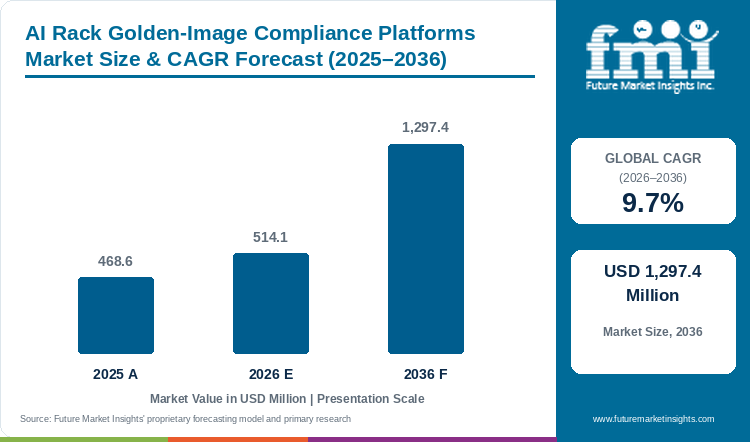
Demand for ai rack golden-image compliance platforms is projected to grow at 9.7% CAGR from 2026 to 2036. The 2025 market estimate is USD 468.6 million and the market is estimated at USD 514.1 million in 2026 before reaching USD 1,297.4 million by 2036.
AI rack golden-image compliance platforms market was valued at USD 468.6 million in 2025 and FMI estimates the market at USD 514.1 million in 2026. The market is projected to reach USD 1,297.4 million by 2036 and is anticipated to grow at 9.7% CAGR. AI rack golden-image platforms are used for comparing approved rack images with live configuration and telemetry. In April 2026, the International Energy Agency reported that data center electricity demand increased by 17% in 2025, whereas AI-focused centers increased by 50%.[1] Increasing electricity use and higher concentration of GPU systems is making configuration faults more expensive. Due to which, requirement for live rack monitoring and safe recovery is expected to support the market revenue growth.
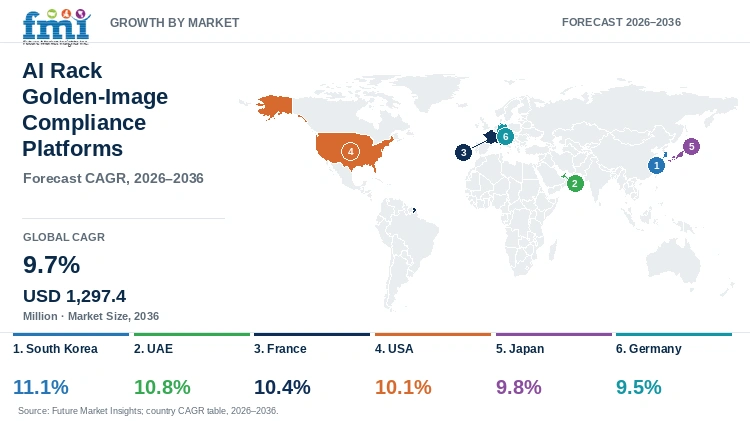
Regional demand patterns differ because infrastructure programs and operating requirements affect the purchase of AI infrastructure management platforms. South Korea market is projected to grow at 11.1% CAGR, whereas the UAE is expected to grow at 10.8% CAGR through 2036. In February 2025, South Korea announced procurement of 18,000 high-performance GPUs by the first half of 2026.[2] Apart from that, the UAE announced a 1 GW Stargate cluster within a planned 5 GW campus in May 2025.[10] South Korea is expanding shared computing capacity, whereas the UAE can include image and telemetry controls during commissioning of new campuses. Compatibility with selected servers and rollback requirement will remain a final factor before automated recovery is used.
Key Takeaways
- High-density AI infrastructure raises the operational cost of configuration drift, weak telemetry and slow recovery. This makes repeatable desired state plus continuous evidence a direct operations purchase.
- Monitoring & telemetry leads Platform Function with a 27.0% share in 2026 owing to compliance must be checked against the live rack state rather than a reference image alone.
- SaaS / public cloud leads Deployment Model with a 38.0% share in 2026 owing to centralized reporting and policy updates can be managed across distributed fleets without deploying a separate console at every site.
- 251 to 500 kW leads AI Rack Density with a 32.0% share in 2026 owing to this density band creates material power and thermal exposure while remaining broader than the most specialized frontier racks.
- South Korea AI rack golden-image compliance platforms market is projected to grow at 11.1% CAGR through 2036 owing to expansion of public AI computing capacity. In 2026, South Korea proposed securing another 15,000 advanced GPUs, taking the cumulative total to 37,000 units.[9] The program also includes the National AI Computing Center and sixth national supercomputer. Shared GPU systems are used by different users and workloads, due to which repeatable node images and scheduler information is required before restoring a node. Compatibility with domestic and imported hardware will remain a market restraint. Increasing public computing capacity is expected to support demand for image provenance, telemetry and controlled rollback in South Korea.
- Notable companies in the AI Rack Golden-Image Compliance Platforms market include Red Hat, HPE, NVIDIA and SchedMD.
Analyst Perspective
“FMI analysis expects rack operators to pay for a verified live state and safe recovery together. A platform that detects drift but cannot protect running GPU workloads will face a narrower buying case.”
- Sudip Saha, Principal Consultant, Future Market Insights.
How is the ai rack golden-image compliance platforms market segmented?
The ai rack golden-image compliance platforms market is segmented by Platform Function, Deployment Model, AI Rack Density, Data Center Type and Commercial Model, plus region. In 2026, the leading subsegments are monitoring & telemetry at 27.0% of platform function demand, saas / public cloud at 38.0% of deployment model demand, 251-500 kw at 32.0% of ai rack density demand, hyperscale ai data centers at 46.0% of data center type demand and direct enterprise contract at 42.0% of commercial model demand.
Platform Function covers Monitoring & telemetry, Planning & simulation, Optimization & control, Fault / reliability analytics and Reporting & governance.
Deployment Model includes SaaS / public cloud, Private cloud, On-premise and Hybrid deployment.
AI Rack Density comprises 251 to 500 kW, 100 to 250 kW, Below 100 kW and Above 500 kW.
Data Center Type includes Hyperscale AI data centers, Colocation AI facilities, Enterprise private AI and HPC & research centers.
Commercial Model covers Direct enterprise contract, System integrator / EPC-led, Subscription / license and Managed-service contract.
Why does Monitoring & telemetry lead the Platform Function category?
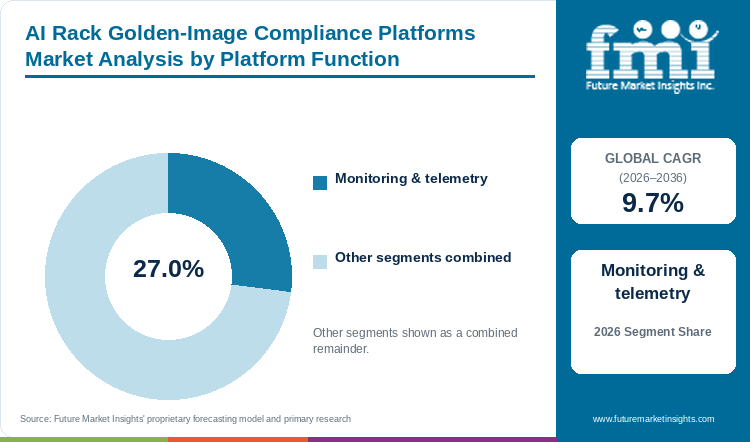
In 2026, monitoring & telemetry is expected to account for 27.0% of platform function demand in the global market.
Monitoring and telemetry is increasingly used for comparing the approved rack image with the running rack. NVIDIA Mission Control collects infrastructure telemetry, whereas HPE Performance Cluster Manager checks cluster health and software consistency. Live information supports operators in finding unhealthy nodes, image differences and cooling alerts before recovery is started. Increasing requirement for finding rack exceptions before recovery is expected to support monitoring and telemetry segment growth.
- Monitoring & telemetry is expected to hold a 27.0% share in 2026 owing to buyers requires live evidence of configuration, health and environmental state before they can trust policy enforcement.
- In March 2025, NVIDIA introduced Mission Control with continuous monitoring, health checks and telemetry across AI-factory infrastructure.[3] The development illustrates why observability is increasingly becoming part of the compliance control plane.
What makes SaaS / public cloud central to the Deployment Model category?
In 2026, SaaS / public cloud is forecast to represent 38.0% of deployment model demand in the global market.
SaaS and public cloud deployment provides one hosted view for policy status of distributed AI infrastructure. Red Hat cloud services assesses and reports compliance for registered RHEL systems, whereas local infrastructure continues to operate the workloads. Companies having AI racks at different sites can use the same reporting view without installing separate management system at every location. Availability of centralized reporting is expected to increase adoption, however data handling and access control may limiting its use in isolated sites.
- SaaS / public cloud is expected to hold a 38.0% share in 2026 owing to hosted policy analytics and reporting reduce the need to deploy a separate management stack at every location.
- Red Hat documents centralized cloud services for RHEL operations and compliance reporting. The model shows how a hosted console can aggregate policy evidence while local systems continue to execute workloads.
Why does 251 to 500 kW lead the AI Rack Density category?
In 2026, 251-500 kW is projected to hold 32.0% of ai rack density demand in the global market.
AI racks in the 251 to 500 kW range contains higher power and cooling load in a smaller area. A 2025 U.S. Department of Energy presentation stated that data center load could double or triple by 2028 and reach 12% of total electricity demand.[5] A configuration error in these racks can affect cooling alarms, fabric health and recovery of running jobs. Due to which, rack operators requires combined image, health and recovery controls. Increasing deployment of dense AI racks is expected to boost the 251 to 500 kW segment growth.
- 251 to 500 kW is expected to hold a 32.0% share in 2026 owing to concentrated thermal and power exposure increases the value of integrated image, health and remediation controls.
- The IEA documented rapid AI power-density escalation in April 2026.[1] That change raises the operational penalty for a node or rack configuration that drifts away from a validated baseline.
What supports Hyperscale AI data centers in the Data Center Type category?
In 2026, hyperscale AI data centers are estimated to make up 46.0% of data center type demand in the global market.
Hyperscale AI data centers operates large number of GPU racks and a wrong image can affect provisioning, fabric operation and long running jobs. In November 2025, the European Commission reported that data centers used about 415 TWh globally and consumption could reach 945 TWh by 2030.[6] Large AI facilities requires controls that identify the affected rack before recovery and maintain similar operating image across the cluster. Expansion of large AI clusters is anticipated to support hyperscale AI data center segment growth.
- Hyperscale AI data centers hold a 46.0% share in 2026 owing to fleet scale multiplies the cost of manual provisioning, inconsistent images and delayed fault isolation.
- In March 2025, NVIDIA described Mission Control as an end-to-end AI-factory operations platform with provisioning, telemetry and autonomous recovery.[3] This illustrates the control depth required at hyperscale.
Why does Direct enterprise contract lead the Commercial Model category?
In 2026, direct enterprise contract is anticipated to capture 42.0% of commercial model demand in the global market.
Golden-image compliance platforms can receive privileged access for checking and restoring production AI racks. In April 2026, NVIDIA Mission Control 2.3 added support for air-gapped deployment in controlled AI environments.[7] Enterprises therefore requires hardware compatibility, rollback handling, security controls and responsible technical support before the platform is used. Direct enterprise contracts are increasingly preferred where integration and support responsibility needs to be agreed with the supplier.
- Direct enterprise contract is expected to hold a 42.0% share in 2026 owing to qualification, support accountability and integration depth are central to adoption for production AI racks.
- NVIDIA Mission Control 2.3 reached general availability in April 2026 with air-gapped deployment support. The capability illustrates why direct commercial engagement matters in controlled AI environments.
What are the drivers, restraints and opportunities in the ai rack golden-image compliance platforms market?
Demand rises as denser AI racks increase the cost of configuration drift and opaque failures, while heterogeneous infrastructure and strict change control slow qualification and image-based policy plus telemetry-aware remediation creates a path to broader automation.
- Driver: Higher rack power density and larger GPU estates make continuous state visibility and repeatable images operational requirements.
- Restraint: Cross-vendor validation across firmware, operating systems, fabrics and schedulers can delay enterprise approval.
- Opportunity: Platforms that join policy-as-code with rack telemetry and workload-aware remediation can expand into sovereign and managed AI estates.
Rack Density Raises Control Demand
Increasing power density of AI racks is boosting demand for continuous configuration monitoring. In September 2026, the European Commission proposed a common rating scheme for comparing energy and water use of data centers.[8] Higher power in smaller rack space increases the effect of cooling alarms, unhealthy nodes and incorrect rack settings. Due to which, operators are increasingly adopting controls that compares approved image with live rack information. Increasing requirement for continuous rack evidence is expected to drive the market growth.
Mixed Systems Complicate Safe Changes
AI racks includes firmware, operating-system images, fabric controls and workload managers supplied by different companies. In August 2025, NIST released a concept paper for SP 800-53 control overlays covering generative AI, predictive AI, AI agents and controls for AI developers.[19] The proposed overlays also ties AI security with the IT infrastructure on which the system is operating. Each rack combination therefore requires security review, rollback testing and a suitable change window. High testing requirement and difficulty in changing active GPU racks may limiting platforms to reporting, which in turn may hamper automated remediation adoption.
Connected Telemetry Opens Automation Routes
Versioned rack images, live telemetry and scheduler information are creating new opportunities for controlled remediation. In August 2026, Red Hat introduced image builder guidance for creating bootable RHEL images for public cloud and virtualization environments.[20] The image blueprint includes package content, system customizations and first-boot instructions, due to which the approved system state can be repeated before deployment. Rack telemetry and scheduler information can then check the running condition before changing the image. Increasing use of shared and isolated AI infrastructure is expected to create growth opportunities for rack-aware remediation platforms.
Which country CAGRs are profiled in the ai rack golden-image compliance platforms market?
| Country | CAGR |
|---|---|
| South Korea | 11.1% |
| UAE | 10.8% |
| France | 10.4% |
| USA | 10.1% |
| Japan | 9.8% |
| Germany | 9.5% |
How do country-level CAGRs compare in the ai rack golden-image compliance platforms market?
Country outlook in AI rack golden-image compliance platforms market differs owing to national AI capacity programs, data center construction and operating requirements. New AI campuses can include image controls during commissioning, whereas existing data centers requires testing with different rack and software systems.
- South Korea: National GPU procurement and the planned computing center favor repeatable provisioning across large shared clusters.
- UAE: Greenfield giga-scale campuses can embed image validation and security controls during commissioning rather than retrofit them later.
- France: Low-carbon site development creates a greenfield opening for standardized AI rack operations as new capacity is commissioned.
- USA: Large installed and planned data-center loads raise pressure to connect rack health with facility-level power planning.
- Japan: Watt-bit coordination makes power and network readiness part of the platform qualification discussion.
- Germany: Energy-management and measurement duties increase the value of auditable telemetry and reporting.
The full report provides country-wise CAGR outlooks across North America, Latin America, Western Europe, Eastern Europe, East Asia, South Asia and Pacific, and the Middle East and Africa.
Country-wise Analysis
- South Korea AI rack golden-image compliance platforms market is projected to grow at 11.1% CAGR through 2036 owing to expansion of public AI computing capacity. In 2026, South Korea proposed securing another 15,000 advanced GPUs, taking the cumulative total to 37,000 units. The program also includes the National AI Computing Center and sixth national supercomputer. Shared GPU systems are used by different users and workloads, due to which repeatable node images and scheduler information is required before restoring a node. Compatibility with domestic and imported hardware will remain a market restraint. Increasing public computing capacity is expected to support demand for image provenance, telemetry and controlled rollback in South Korea.
- The UAE market is anticipated to advance at 10.8% CAGR between 2026 and 2036 owing to construction of large AI campuses. In May 2025, the Abu Dhabi Media Office announced a 1 GW Stargate UAE cluster inside a planned 5 GW UAE-US AI Campus. The first 200 MW cluster was expected to start in 2026.[10] New campuses can include security, image provenance and telemetry controls before servers enters production. However, isolated deployment and change control needs to match the selected rack systems. Increasing commissioning of greenfield AI campuses is anticipated to create growth opportunities for AI rack golden-image compliance platforms in the UAE.
- In February 2025, the Elysee reported more than USD 113 billion in announced infrastructure investment for AI development in France.[11] In February 2025, the Élysée reported more than USD 113 billion in announced infrastructure investment and identified low-carbon sites and high-voltage grid capacity for AI data centers. The investment amount is not considered as market revenue, but it shows the projects moving towards site development. New racks requires a defined software image and operating record during commissioning. Different server and network designs may increase the integration requirement. Expansion of low-carbon AI data center sites is expected to support adoption of rack image and telemetry controls in France.
- Demand in the USA is forecast to rise at 10.1% CAGR over the forecast period owing to increasing electricity requirement of data centers. Lawrence Berkeley National Laboratory estimated in June 2026 that data centers could account for 11.8% of total U.S. electricity use by 2030, with a scenario range of 9.5% to 15.3%.[12] Higher electricity use is increasing requirement for rack-level power and health information. The country also has different firmware and operating-system patterns in its installed data center base. This increases the number of racks that can use compliance platforms, but also increases testing requirement. Growing data center load is expected to support the USA market where image policy and rollback are connected with the running rack.
- AI rack golden-image compliance platform adoption in Japan is estimated to expand at 9.8% CAGR through 2036. In May 2026, Japan introduced new data center efficiency measures and added electricity use and PUE values to annual reporting requirements.[13] The program connects electricity, telecommunications and data center planning with increasing AI traffic. Power and network readiness can affect the stage at which rack software controls are selected. Deployment records and telemetry also needs to match the site power and communication design. Delay in grid or communication planning may limiting early platform adoption. Increasing coordination of power, network and data center development is expected to support demand for connected rack configuration records in Japan.
- Germany is estimated to post 9.5% CAGR through 2036 owing to energy management and reporting requirement for data centers. In 2025, the European Commission Joint Research Centre published updated data center energy-efficiency practices covering IT, cooling and monitoring controls.[14] The regulation does not require one particular software category, however it increases demand for auditable operating information. AI rack compliance platforms can connect energy records with the live rack state and approved image. Integration with formal management systems may increase the adoption time. Increasing requirement for traceable data center records is anticipated to support the Germany market over the forecast period.
Who are the notable companies in the ai rack golden-image compliance platforms market?
Red Hat, HPE, NVIDIA, SchedMD are the notable companies profiled in this market.
AI rack golden-image compliance platforms market is moderately concentrated with companies operating at different software and rack control layers. Red Hat is engaged in operating-system images and compliance reporting, whereas HPE offers cluster image, provisioning and monitoring functions. NVIDIA combines AI factory provisioning, validation, telemetry and recovery, while SchedMD provides workload scheduling through Slurm. Presence of companies offering separate and integrated controls is expected to increase competition in the market. Some of the prominent companies are focusing on image lifecycle, rack monitoring and workload information in order to increase its customer base.
- Operating-system image and policy control: Red Hat provides image-based RHEL deployment, security hardening and compliance reporting that can anchor the node baseline.
- Rack and cluster lifecycle control: HPE and NVIDIA connect provisioning with infrastructure telemetry and recovery across high-performance or AI rack environments.
- Workload scheduling and topology integration: SchedMD provides Slurm for resource allocation and topology-aware scheduling. Its role is complementary to image and rack compliance controls.
Competitive Benchmarking: AI Rack Golden-Image Compliance Platforms Market
| Company | Reference-image and node-state control | Health, telemetry and automated remediation | AI-rack and workload-stack integration | Geographic Reach |
|---|---|---|---|---|
| Red Hat | High | Medium | Medium | Low |
| HPE | High | High | High | Low |
| NVIDIA | Medium | High | High | Low |
| SchedMD | Low | Low | High | Low |
High rating indicates wider documented capability for the stated function, whereas Medium represents a comparatively limited role. Low indicates limited direct coverage in available company information. These ratings does not represent product quality, company revenue or global market share.
Key Developments in the AI Rack Golden-Image Compliance Platforms Market
- In March 2025, NVIDIA introduced Mission Control for AI-factory operations and orchestration.[3] The software combines deployment configuration, infrastructure validation, telemetry and autonomous recovery. Its rack-scale scope shows how AI infrastructure management is moving toward one control plane that can compare desired state with live operating conditions.
- In May 2025, Red Hat made image mode for Red Hat Enterprise Linux generally available for versioned operating-system deployment and rollback.[4] It enables operating systems to be built and managed as container images. Red Hat also documented baseline hardening profiles and machine-readable compliance reports. The release gives platform teams a versioned operating-system artifact that can serve as part of a golden-image policy.
- In April 2026, HPE released a recommended monitoring update for HPE Performance Cluster Manager 1.15.[17] The patch addressed dashboard, flow-metric and fabric-health issues. The update is commercially relevant owing to telemetry quality directly affects whether operators can trust rack-state evidence before acting on a compliance exception.
Key Players in the AI Rack Golden-Image Compliance Platforms Market
Image Policy and Operating-System Compliance
- Red Hat
Rack and Cluster Lifecycle Control
- HPE
- NVIDIA
Workload Orchestration and Topology Scheduling
- SchedMD
AI Rack Golden-Image Compliance Platforms Market - Report Scope
| Coverage field | Report scope |
|---|---|
| Market breakdown | Platform Function; Deployment Model; AI Rack Density; Data Center Type; Commercial Model |
| Quantitative Units | USD Million |
| Market Definition | Includes software licenses, subscriptions, hosted services and managed-service fees where AI rack golden-image or desired-state compliance is the contracted deliverable. Scope can include image build and provisioning, configuration validation, compliance reporting, rack or cluster telemetry and remediation tied to the platform. Bundled systems count only the attributable platform, software or service revenue. AI servers, racks, GPUs, power and cooling hardware, downstream AI compute services, generic EPC work, generic workload scheduling sold without a compliance function and adjacent configuration tools outside AI rack compliance are excluded. |
| Regions Covered | North America; Latin America; Western Europe; Eastern Europe; East Asia; South Asia and Pacific; Middle East and Africa |
| Countries Covered | USA, South Korea, Japan, France, Germany, UAE |
| Key Companies Profiled | Red Hat, HPE, NVIDIA, SchedMD |
| Forecast Period | 2026 to 2036 |
| Approach | Primary and secondary research with market triangulation. |
AI Rack Golden-Image Compliance Platforms Market - Research Methodology
| Method | Approach |
|---|---|
| Market inputs | Market inputs are reviewed according to the defined product and service boundary. Public company information and official industry data are used for checking market relevance. |
| Desk Research | Desk research includes government statistics, standards, association information, company product pages and dated announcements. Sources are reviewed on the basis of date, geography and relevance to the market. |
| Market Sizing and Forecasting | Market sizing includes baseline value, segment structure, company participation and country-level demand. Forecast assumptions considers product adoption, investment, regulation and purchasing cycle affecting the market. |
| Data Validation | Market estimates are validated through public data, company activities and industry developments. Adjacent products, overlapping revenue and activities outside the market are excluded in order to reduce double counting. |
AI Rack Golden-Image Compliance Platforms Market by Segments
AI Rack Golden-Image Compliance Platforms Market segmented by Platform Function:
- Monitoring & telemetry
- Planning & simulation
- Optimization & control
- Fault / reliability analytics
- Reporting & governance
AI Rack Golden-Image Compliance Platforms Market segmented by Deployment Model:
- SaaS / public cloud
- Private cloud
- On-premise
- Hybrid deployment
AI Rack Golden-Image Compliance Platforms Market segmented by AI Rack Density:
- 251 to 500 kW
- 100 to 250 kW
- Below 100 kW
- Above 500 kW
AI Rack Golden-Image Compliance Platforms Market segmented by Data Center Type:
- Hyperscale AI data centers
- Colocation AI facilities
- Enterprise private AI
- HPC & research centers
AI Rack Golden-Image Compliance Platforms Market segmented by Commercial Model:
- Direct enterprise contract
- System integrator / EPC-led
- Subscription / license
- Managed-service contract
AI Rack Golden-Image Compliance Platforms Market by Region:
- North America
- United States
- Canada
- Latin America
- Brazil
- Mexico
- Argentina
- Chile
- Western Europe
- Germany
- France
- United Kingdom
- Italy
- Spain
- Benelux
- Nordics
- Eastern Europe
- Poland
- Czech Republic
- Romania
- Hungary
- East Asia
- China
- Japan
- South Korea
- South Asia and Pacific
- India
- ASEAN
- Australia and New Zealand
- Middle East and Africa
- GCC Countries
- South Africa
- Türkiye
- Israel
Research Sources and Bibliography
- [1] International Energy Agency. (2026, April 16). Data centre electricity use surged in 2025, even with tightening bottlenecks driving a scramble for solutions.
- [2] Ministry of Science and ICT, Republic of Korea. (2025, February 20). Korea to expand AI computing infrastructure to strengthen national AI capabilities and achieve global leadership.
- [3] NVIDIA. (2025, March 18). New NVIDIA software for Blackwell infrastructure runs AI factories at light speed.
- [4] Red Hat. (2025, May 20). Image mode for Red Hat Enterprise Linux is generally available.
- [5] U.S. Department of Energy, Better Buildings Solution Center. (2025, May 1). Powering the future: How data centers can overcome emerging energy challenges.
- [6] European Commission, Directorate-General for Energy. (2025, November 17). In focus: Data centres, an energy-hungry challenge.
- [7] NVIDIA. (2026, April 14). Release: NVIDIA Mission Control 2.3.
- [8] European Commission, Directorate-General for Energy. (2026, September 21). Energy performance of data centres.
- [9] Ministry of Science and ICT, Republic of Korea. (2026). Driving future growth with the twin engines of AI and science and technology.
- [10] Abu Dhabi Media Office. (2025, May 22). Global tech alliance launches Stargate UAE.
- [11] Elysee. (2025, February 11). Make France an AI powerhouse.
- [12] Lawrence Berkeley National Laboratory. (2026, June). United States Data Center Energy Usage Report: 2025 Update.
- [13] Agency for Natural Resources and Energy, Japan. (2026, May 20). New measures for improving data center energy efficiency.
- [14] European Commission, Joint Research Centre. (2025, March 21). 2025 Best Practice Guidelines for the EU Code of Conduct on Data Centre Energy Efficiency.
- [15] Red Hat Developer. (2026, August 6). Provisioning image mode for Red Hat Enterprise Linux using Red Hat Satellite.
- [16] SchedMD. (2026, May 26). Slurm version 26.05 is now available.
- [17] Hewlett Packard Enterprise. (2026, March). HPE Performance Cluster Manager Software Installation Guide for Clusters With ICE Leader Nodes.
- [18] NVIDIA. (2025, December 15). NVIDIA acquires open-source workload management provider SchedMD.
- [19] National Institute of Standards and Technology. (2025, August 14). NIST releases Control Overlays for Securing AI Systems concept paper.
- [20] Red Hat Developer. (2026, August 17). Build bootable image mode for Red Hat Enterprise Linux with image builder.
This bibliography is provided for reader reference. The full report contains the complete reference list and detailed citations.
This Report Answers
- How big is the AI Rack Golden-Image Compliance Platforms market in 2026?
- What value is the AI Rack Golden-Image Compliance Platforms market projected to reach by 2036?
- Which segment leads the AI Rack Golden-Image Compliance Platforms market in 2026?
- Which sales channel is prominent in the AI Rack Golden-Image Compliance Platforms market?
- Which countries show notable AI Rack Golden-Image Compliance Platforms market growth through 2036?
- Who are notable companies in the AI Rack Golden-Image Compliance Platforms market?
Frequently Asked Questions
How big is the ai rack golden-image compliance platforms market in 2026?
Future Market Insights estimates the ai rack golden-image compliance platforms market at USD 514.1 million in 2026 and projects USD 1,297.4 million by 2036.
What is the ai rack golden-image compliance platforms market CAGR from 2026 to 2036?
FMI projects a 9.7% CAGR for the ai rack golden-image compliance platforms market from 2026 to 2036.
Why is monitoring & telemetry prominent in the ai rack golden-image compliance platforms market?
Monitoring & telemetry is expected to lead its parent segment in 2026 because buyers need live evidence of configuration, health and environmental state before they can trust policy enforcement.
Why does saas / public cloud matter in the ai rack golden-image compliance platforms market?
Saas / public cloud is projected to retain a notable parent-segment share because hosted policy analytics and reporting reduce the need to deploy a separate management stack at every location.
Which country has notable ai rack golden-image compliance platforms market growth?
South Korea AI rack golden-image compliance platforms market is projected to grow at 11.1% CAGR through 2036 owing to expansion of public AI computing capacity. In 2026, South Korea proposed securing another 15,000 advanced GPUs, taking the cumulative total to 37,000 units. The program also includes the National AI Computing Center and sixth national supercomputer. Shared GPU systems are used by different users and workloads, due to which repeatable node images and scheduler information is required before restoring a node. Compatibility with domestic and imported hardware will remain a market restraint. Increasing public computing capacity is expected to support demand for image provenance, telemetry and controlled rollback in South Korea.
Who are notable companies in the ai rack golden-image compliance platforms market?
Notable companies include Red Hat, HPE, NVIDIA, SchedMD and other companies named in the competitive assessment.
Preview the report firsthand - request a free sample
Get SampleGet the brochure for pricing and purchase details.
Get PDFTable of Content
- Key Takeaways
- Market Size and CAGR
- Top Growth Driver
- Fastest Growing Segment
- Leading Region
- Key Companies
- Emerging Opportunities
- Executive Summary
- Global Market Outlook
- Demand-side Trends
- Supply-side Trends
- Technology Roadmap Analysis
- Analysis and Recommendations
- Analyst Perspective (What is happening? Why now? What should investors know?)
- Key Questions Answered
- How large is the market?
- What is the CAGR?
- What are key trends?
- Which region dominates?
- Who are the leaders?
- Market Overview
- Market Coverage / Taxonomy
- Market Definition / Scope / Limitations
- Research Methodology
- Chapter Orientation
- Analytical Lens and Working Hypotheses
- Market Structure, Signals, and Trend Drivers
- Benchmarking and Cross-market Comparability
- Market Sizing, Forecasting, and Opportunity Mapping
- Research Design and Evidence Framework
- Desk Research Programme (Secondary Evidence)
- Expert Input and Fieldwork (Primary Evidence)
- Tooling, Models, and Reference Databases
- Data Engineering and Model Build
- Quality Assurance and Audit Trail
- Market Background
- Market Dynamics (Drivers, Restraints, Opportunity, Trends)
- Scenario Forecast (Optimistic, Likely, Conservative)
- Impact Analysis
- AI Impact
- Sustainability Impact
- Regulatory Impact
- Technology Impact
- Consumer / Buyer Analysis
- Purchase Drivers
- Adoption Barriers
- Buyer Journey
- Opportunity Map Analysis
- Product Life Cycle Analysis
- Supply Chain Analysis
- Investment Feasibility Matrix
- Value Chain Analysis
- PESTLE and Porter's Analysis
- Regulatory Landscape
- Regional Parent Market Outlook
- Production and Consumption Statistics
- Import and Export Statistics
- Global Market Analysis and Forecast, 2021 to 2036
- Historical Market Size Value (USD Million) Analysis, 2021 to 2025
- Current and Future Market Size Value (USD Million) Projections, 2026 to 2036
- Y-o-Y Growth Trend Analysis
- Absolute $ Opportunity Analysis
- Global Market Pricing Analysis, 2021 to 2036
- Global Market Analysis and Forecast, By Platform Function, 2021 to 2036
- Introduction / Key Findings
- Historical Market Size Value (USD Million) Analysis By Platform Function, 2021 to 2025
- Current and Future Market Size Value (USD Million) Analysis and Forecast By Platform Function, 2026 to 2036
- Monitoring & telemetry
- Planning & simulation
- Optimization & control
- Fault / reliability analytics
- Reporting & governance
- Y-o-Y Growth Trend Analysis By Platform Function, 2021 to 2025
- Absolute $ Opportunity Analysis By Platform Function, 2026 to 2036
- Global Market Analysis and Forecast, By Deployment Model, 2021 to 2036
- Introduction / Key Findings
- Historical Market Size Value (USD Million) Analysis By Deployment Model, 2021 to 2025
- Current and Future Market Size Value (USD Million) Analysis and Forecast By Deployment Model, 2026 to 2036
- SaaS / public cloud
- Private cloud
- On-premise
- Hybrid deployment
- Y-o-Y Growth Trend Analysis By Deployment Model, 2021 to 2025
- Absolute $ Opportunity Analysis By Deployment Model, 2026 to 2036
- Global Market Analysis and Forecast, By AI Rack Density, 2021 to 2036
- Introduction / Key Findings
- Historical Market Size Value (USD Million) Analysis By AI Rack Density, 2021 to 2025
- Current and Future Market Size Value (USD Million) Analysis and Forecast By AI Rack Density, 2026 to 2036
- 251 to 500 kW
- 100 to 250 kW
- Below 100 kW
- Above 500 kW
- Y-o-Y Growth Trend Analysis By AI Rack Density, 2021 to 2025
- Absolute $ Opportunity Analysis By AI Rack Density, 2026 to 2036
- Global Market Analysis and Forecast, By Data Center Type, 2021 to 2036
- Introduction / Key Findings
- Historical Market Size Value (USD Million) Analysis By Data Center Type, 2021 to 2025
- Current and Future Market Size Value (USD Million) Analysis and Forecast By Data Center Type, 2026 to 2036
- Hyperscale AI data centers
- Colocation AI facilities
- Enterprise private AI
- HPC & research centers
- Y-o-Y Growth Trend Analysis By Data Center Type, 2021 to 2025
- Absolute $ Opportunity Analysis By Data Center Type, 2026 to 2036
- Global Market Analysis and Forecast, By Commercial Model, 2021 to 2036
- Introduction / Key Findings
- Historical Market Size Value (USD Million) Analysis By Commercial Model, 2021 to 2025
- Current and Future Market Size Value (USD Million) Analysis and Forecast By Commercial Model, 2026 to 2036
- Direct enterprise contract
- System integrator / EPC-led
- Subscription / license
- Managed-service contract
- Y-o-Y Growth Trend Analysis By Commercial Model, 2021 to 2025
- Absolute $ Opportunity Analysis By Commercial Model, 2026 to 2036
- Global Market Analysis and Forecast, By Region, 2021 to 2036
- Introduction
- Historical Market Size Value (USD Million) Analysis By Region, 2021 to 2025
- Current Market Size Value (USD Million) Analysis and Forecast By Region, 2026 to 2036
- North America
- Latin America
- Western Europe
- Eastern Europe
- East Asia
- South Asia and Pacific
- Middle East and Africa
- Market Attractiveness Analysis By Region
- North America Market Analysis and Forecast, By Country, 2021 to 2036
- Historical Market Size Value (USD Million) Trend Analysis By Market Taxonomy, 2021 to 2025
- Market Size Value (USD Million) Forecast By Market Taxonomy, 2026 to 2036
- By Country
- United States
- Canada
- By Platform Function
- By Deployment Model
- By AI Rack Density
- By Data Center Type
- By Commercial Model
- By Country
- Market Attractiveness Analysis
- By Country
- By Platform Function
- By Deployment Model
- By AI Rack Density
- By Data Center Type
- By Commercial Model
- Key Takeaways
- Latin America Market Analysis and Forecast, By Country
- Historical Market Size Value (USD Million) Trend Analysis By Market Taxonomy, 2021 to 2025
- Market Size Value (USD Million) Forecast By Market Taxonomy, 2026 to 2036
- By Country
- Brazil
- Mexico
- Argentina
- Chile
- By Platform Function
- By Deployment Model
- By AI Rack Density
- By Data Center Type
- By Commercial Model
- By Country
- Market Attractiveness Analysis
- By Country
- By Platform Function
- By Deployment Model
- By AI Rack Density
- By Data Center Type
- By Commercial Model
- Key Takeaways
- Western Europe Market Analysis and Forecast, By Country
- Historical Market Size Value (USD Million) Trend Analysis By Market Taxonomy, 2021 to 2025
- Market Size Value (USD Million) Forecast By Market Taxonomy, 2026 to 2036
- By Country
- Germany
- France
- United Kingdom
- Italy
- Spain
- Benelux
- Nordics
- By Platform Function
- By Deployment Model
- By AI Rack Density
- By Data Center Type
- By Commercial Model
- By Country
- Market Attractiveness Analysis
- By Country
- By Platform Function
- By Deployment Model
- By AI Rack Density
- By Data Center Type
- By Commercial Model
- Key Takeaways
- Eastern Europe Market Analysis and Forecast, By Country
- Historical Market Size Value (USD Million) Trend Analysis By Market Taxonomy, 2021 to 2025
- Market Size Value (USD Million) Forecast By Market Taxonomy, 2026 to 2036
- By Country
- Poland
- Czech Republic
- Romania
- Hungary
- By Platform Function
- By Deployment Model
- By AI Rack Density
- By Data Center Type
- By Commercial Model
- By Country
- Market Attractiveness Analysis
- By Country
- By Platform Function
- By Deployment Model
- By AI Rack Density
- By Data Center Type
- By Commercial Model
- Key Takeaways
- East Asia Market Analysis and Forecast, By Country
- Historical Market Size Value (USD Million) Trend Analysis By Market Taxonomy, 2021 to 2025
- Market Size Value (USD Million) Forecast By Market Taxonomy, 2026 to 2036
- By Country
- China
- Japan
- South Korea
- By Platform Function
- By Deployment Model
- By AI Rack Density
- By Data Center Type
- By Commercial Model
- By Country
- Market Attractiveness Analysis
- By Country
- By Platform Function
- By Deployment Model
- By AI Rack Density
- By Data Center Type
- By Commercial Model
- Key Takeaways
- South Asia and Pacific Market Analysis and Forecast, By Country
- Historical Market Size Value (USD Million) Trend Analysis By Market Taxonomy, 2021 to 2025
- Market Size Value (USD Million) Forecast By Market Taxonomy, 2026 to 2036
- By Country
- India
- ASEAN
- Australia and New Zealand
- By Platform Function
- By Deployment Model
- By AI Rack Density
- By Data Center Type
- By Commercial Model
- By Country
- Market Attractiveness Analysis
- By Country
- By Platform Function
- By Deployment Model
- By AI Rack Density
- By Data Center Type
- By Commercial Model
- Key Takeaways
- Middle East and Africa Market Analysis and Forecast, By Country
- Historical Market Size Value (USD Million) Trend Analysis By Market Taxonomy, 2021 to 2025
- Market Size Value (USD Million) Forecast By Market Taxonomy, 2026 to 2036
- By Country
- GCC Countries
- South Africa
- Türkiye
- Israel
- By Platform Function
- By Deployment Model
- By AI Rack Density
- By Data Center Type
- By Commercial Model
- By Country
- Market Attractiveness Analysis
- By Country
- By Platform Function
- By Deployment Model
- By AI Rack Density
- By Data Center Type
- By Commercial Model
- Key Takeaways
- Key Countries Market Analysis
- United States
- Pricing Analysis
- Market Share Analysis, 2025
- By Platform Function
- By Deployment Model
- By AI Rack Density
- By Data Center Type
- By Commercial Model
- Canada
- Pricing Analysis
- Market Share Analysis, 2025
- By Platform Function
- By Deployment Model
- By AI Rack Density
- By Data Center Type
- By Commercial Model
- Mexico
- Pricing Analysis
- Market Share Analysis, 2025
- By Platform Function
- By Deployment Model
- By AI Rack Density
- By Data Center Type
- By Commercial Model
- Brazil
- Pricing Analysis
- Market Share Analysis, 2025
- By Platform Function
- By Deployment Model
- By AI Rack Density
- By Data Center Type
- By Commercial Model
- Chile
- Pricing Analysis
- Market Share Analysis, 2025
- By Platform Function
- By Deployment Model
- By AI Rack Density
- By Data Center Type
- By Commercial Model
- Germany
- Pricing Analysis
- Market Share Analysis, 2025
- By Platform Function
- By Deployment Model
- By AI Rack Density
- By Data Center Type
- By Commercial Model
- United Kingdom
- Pricing Analysis
- Market Share Analysis, 2025
- By Platform Function
- By Deployment Model
- By AI Rack Density
- By Data Center Type
- By Commercial Model
- Italy
- Pricing Analysis
- Market Share Analysis, 2025
- By Platform Function
- By Deployment Model
- By AI Rack Density
- By Data Center Type
- By Commercial Model
- Spain
- Pricing Analysis
- Market Share Analysis, 2025
- By Platform Function
- By Deployment Model
- By AI Rack Density
- By Data Center Type
- By Commercial Model
- France
- Pricing Analysis
- Market Share Analysis, 2025
- By Platform Function
- By Deployment Model
- By AI Rack Density
- By Data Center Type
- By Commercial Model
- India
- Pricing Analysis
- Market Share Analysis, 2025
- By Platform Function
- By Deployment Model
- By AI Rack Density
- By Data Center Type
- By Commercial Model
- ASEAN
- Pricing Analysis
- Market Share Analysis, 2025
- By Platform Function
- By Deployment Model
- By AI Rack Density
- By Data Center Type
- By Commercial Model
- Australia and New Zealand
- Pricing Analysis
- Market Share Analysis, 2025
- By Platform Function
- By Deployment Model
- By AI Rack Density
- By Data Center Type
- By Commercial Model
- China
- Pricing Analysis
- Market Share Analysis, 2025
- By Platform Function
- By Deployment Model
- By AI Rack Density
- By Data Center Type
- By Commercial Model
- Japan
- Pricing Analysis
- Market Share Analysis, 2025
- By Platform Function
- By Deployment Model
- By AI Rack Density
- By Data Center Type
- By Commercial Model
- South Korea
- Pricing Analysis
- Market Share Analysis, 2025
- By Platform Function
- By Deployment Model
- By AI Rack Density
- By Data Center Type
- By Commercial Model
- Poland
- Pricing Analysis
- Market Share Analysis, 2025
- By Platform Function
- By Deployment Model
- By AI Rack Density
- By Data Center Type
- By Commercial Model
- Hungary
- Pricing Analysis
- Market Share Analysis, 2025
- By Platform Function
- By Deployment Model
- By AI Rack Density
- By Data Center Type
- By Commercial Model
- Türkiye
- Pricing Analysis
- Market Share Analysis, 2025
- By Platform Function
- By Deployment Model
- By AI Rack Density
- By Data Center Type
- By Commercial Model
- South Africa
- Pricing Analysis
- Market Share Analysis, 2025
- By Platform Function
- By Deployment Model
- By AI Rack Density
- By Data Center Type
- By Commercial Model
- UAE
- Pricing Analysis
- Market Share Analysis, 2025
- By Platform Function
- By Deployment Model
- By AI Rack Density
- By Data Center Type
- By Commercial Model
- United States
- Market Structure Analysis
- Competition Dashboard
- Competition Benchmarking
- Market Share Analysis of Top Players
- By Regional
- By Platform Function
- By Deployment Model
- By AI Rack Density
- By Data Center Type
- By Commercial Model
- Emerging Startups
- Innovation Benchmarking
- Competition Analysis
- Competition Deep Dive
- Red Hat
- Overview
- Product Portfolio
- Profitability by Market Segments
- Sales Footprint
- Strategy Overview
- Marketing Strategy
- Product Strategy
- Channel Strategy
- HPE
- NVIDIA
- SchedMD
- Red Hat
- Case Studies
- Success Stories
- Recent Developments
- Competition Deep Dive
- Assumptions & Acronyms Used


