

- Industry Size (2025)
- USD 410.6 Mn
- Forecast (2035)
- USD 668.9 Mn
- CAGR (2025 to 2035)
- 5.0%
Ammunition Belt Market Size and Share Forecast Outlook 2025 to 2035
The Ammunition Belt Market is estimated to be valued at USD 410.6 million in 2025 and is projected to reach USD 668.9 million by 2035, registering a compound annual growth rate (CAGR) of 5.0% over the forecast period.
Quick Stats for Ammunition Belt Market
- Ammunition Belt Market Value (2025): USD 410.6 million
- Ammunition Belt Market Forecast Value (2035): USD 668.9 million
- Ammunition Belt Market Forecast CAGR: 5.0%
- Leading Segment in Ammunition Belt Market in 2025: Continuous Belt (56.3%)
- Key Growth Regions in Ammunition Belt Market: North America, Asia-Pacific, Europe
- Top Key Players in Ammunition Belt Market: FN Herstal, General Dynamics, BAE Systems, Rheinmetall AG, Meggitt PLC, Oerlikon Contraves, Curtiss-Wright Corporation
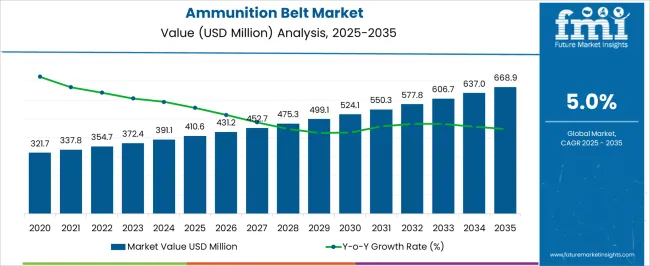
Ammunition Belt Market Key Takeaways
| Metric | Value |
|---|---|
| Ammunition Belt Market Estimated Value in (2025 E) | USD 410.6 million |
| Ammunition Belt Market Forecast Value in (2035 F) | USD 668.9 million |
| Forecast CAGR (2025 to 2035) | 5.0% |
Why is the Ammunition Belt Market Growing?
The Ammunition Belt market is witnessing steady growth, driven by increasing demand from defense forces, law enforcement agencies, and security organizations for reliable and efficient ammunition feeding systems. Rising investments in modernization of military macine hardware and tactical equipment are accelerating the adoption of advanced ammunition belt solutions. The market is further supported by the need for consistent performance and operational efficiency in heavy weapon systems, where continuous ammunition feed is critical for mission success.
Advancements in materials, manufacturing techniques, and modular designs are enhancing durability, reliability, and compatibility with a wide range of firearms. The growing emphasis on mechanized warfare, tactical readiness, and rapid deployment capabilities has also reinforced the adoption of high-performance ammunition belts.
Furthermore, procurement strategies of defense agencies increasingly prioritize scalable, reusable, and easy-to-maintain solutions, creating additional opportunities As global defense spending rises and military modernization programs expand, the Ammunition Belt market is positioned for sustained growth, with innovations in materials and design driving operational effectiveness and user preference.
Segmental Analysis
The ammunition belt market is segmented by type, application, and geographic regions. By type, ammunition belt market is divided into Continuous Belt and Disintegrated Links Belt. In terms of application, ammunition belt market is classified into Heavy Machine Guns, Light Infantry Machine Guns, Armored Vehicles, and Anti Air Weapons. Regionally, the ammunition belt industry is classified into North America, Latin America, Western Europe, Eastern Europe, Balkan & Baltic Countries, Russia & Belarus, Central Asia, East Asia, South Asia & Pacific, and the Middle East & Africa.
Insights into the Continuous Belt Type Segment
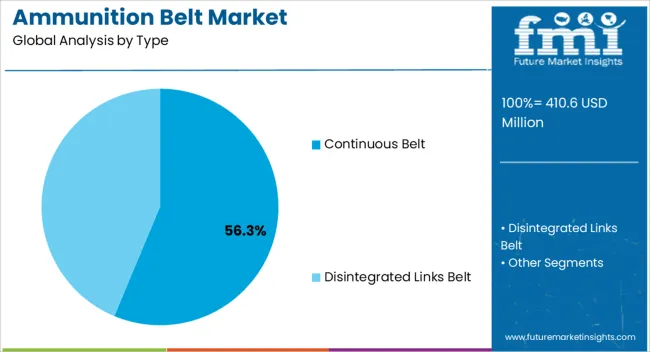
The continuous belt type segment is projected to hold 56.3% of the Ammunition Belt market revenue in 2025, establishing it as the leading product type. Its dominance is being driven by the ability to provide uninterrupted ammunition feeding, which is essential for high-intensity combat operations and sustained firing sequences. Continuous belts allow for higher firing rates and reduce the frequency of reloading, improving operational efficiency and tactical performance.
Advanced materials and precision engineering enhance durability, tensile strength, and resistance to environmental factors, ensuring consistent functionality in extreme conditions. The segment’s modular design allows compatibility with a variety of heavy and medium-caliber firearms, increasing adoption across military and law enforcement agencies.
Continuous belts also reduce the risk of jamming or misfeed, ensuring mission-critical reliability As defense forces increasingly adopt automated and rapid-firing weapon systems, the continuous belt segment is expected to maintain market leadership, supported by improvements in design, materials, and operational efficiency.
Insights into the Heavy Machine Guns Application Segment
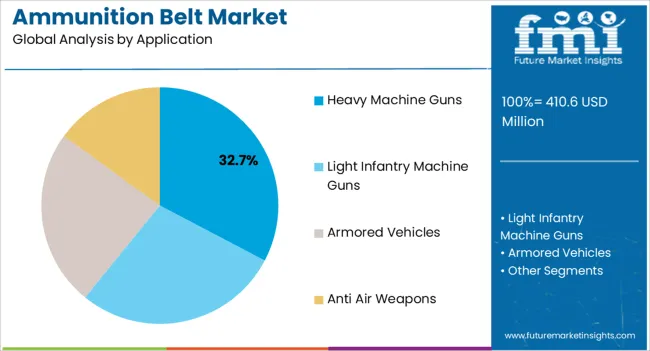
The heavy machine guns application segment is expected to account for 32.7% of the Ammunition Belt market revenue in 2025, making it the leading application area. Growth in this segment is being driven by the increasing deployment of heavy machine guns in modern defense and tactical operations, where sustained firepower is critical. Ammunition belts enhance operational efficiency by enabling continuous feeding, reducing reload times, and supporting high rates of fire.
Military automation modernization programs and procurement initiatives emphasize reliability, durability, and ease of handling, which further support adoption in this application. Integration with automated and mounted heavy weapon systems has increased the strategic importance of ammunition belts in operational planning.
Advanced materials and precision engineering allow belts to perform reliably under extreme temperatures, high stress, and challenging environmental conditions As armed forces globally continue to focus on improving combat readiness and mechanized firepower, the heavy machine guns segment is expected to remain the primary driver of market growth, supported by technological innovations and operational requirements.
Market Overview
Ammunition Belt Market Overview
The fear of terrorism is spreading all over the world, especially in regions such as Europe, Russia, Africa, and Middle East. Terrorist activities have reached its extreme limits and the governments of various countries are trying their level best to fight against such activities prevailing in their respective regions. Countries such as India, China, Pakistan, and South Korea are increasing their expenditure on ammunition belts owing to the troubles faced from neighbouring countries.
Ammunition belts were once limited to its use in machine guns, but that is no longer the case. Ammunition belt or belt is a device used to hold and feed cartridges into a firearm.
Ammunition belts are usually manufactured in various sizes. Earlier, ammunition belts were prepared by cloth, with evenly spaced pockets to allow the belt to be mechanically fed into the gun. These were used in machine guns such as Vickers machine gun, Maxim gun, etc. But, nowadays ammunition belts are manufactured using disintegrated metal links.
There are two versions of ammunition belt which include continuous belt and those with disintegrating links. Continuous belts remain wholly intact as they pass through the receiver of the firearm. Linked belts break apart into individual links or into short sections when fired through the firearm, which depends on how the belt was designed. Metal links ammunition belts have advantage over other belts owing to the reason that metal links are not affected by cleaning solvents or oil.
Analysis of Ammunition Belt Market By Key Countries
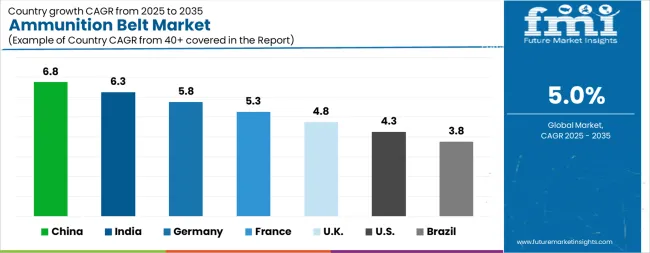
| Country | CAGR |
|---|---|
| China | 6.8% |
| India | 6.3% |
| Germany | 5.8% |
| France | 5.3% |
| UK | 4.8% |
| USA | 4.3% |
| Brazil | 3.8% |
Country-wise Analysis
The Ammunition Belt Market is expected to register a CAGR of 5.0% during the forecast period, exhibiting varied country level momentum. China leads with the highest CAGR of 6.8%, followed by India at 6.3%. Developed markets such as Germany, France, and the UK continue to expand steadily, while the USA is likely to grow at consistent rates. Brazil posts the lowest CAGR at 3.8%, yet still underscores a broadly positive trajectory for the global Ammunition Belt Market. In 2024, Germany held a dominant revenue in the Western Europe market and is expected to grow with a CAGR of 5.8%. The USA Ammunition Belt Market is estimated to be valued at USD 154.8 million in 2025 and is anticipated to reach a valuation of USD 234.7 million by 2035. Sales are projected to rise at a CAGR of 4.3% over the forecast period between 2025 and 2035. While Japan and South Korea markets are estimated to be valued at USD 20.6 million and USD 13.5 million respectively in 2025.
Key Players in the Ammunition Belt Market
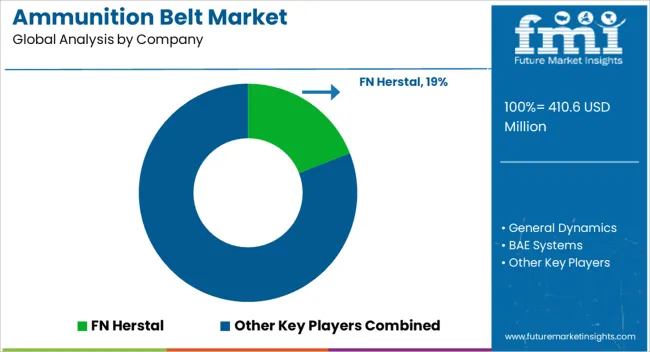
- FN Herstal
- General Dynamics
- BAE Systems
- Rheinmetall AG
- Meggitt PLC
- Oerlikon Contraves
- Curtiss-Wright Corporation
Scope of the Report
| Item | Value |
|---|---|
| Quantitative Units | USD 410.6 Million |
| Type | Continuous Belt and Disintegrated Links Belt |
| Application | Heavy Machine Guns, Light Infantry Machine Guns, Armored Vehicles, and Anti Air Weapons |
| Regions Covered | North America, Europe, Asia-Pacific, Latin America, Middle East & Africa |
| Country Covered | United States, Canada, Germany, France, United Kingdom, China, Japan, India, Brazil, South Africa |
| Key Companies Profiled | FN Herstal, General Dynamics, BAE Systems, Rheinmetall AG, Meggitt PLC, Oerlikon Contraves, and Curtiss-Wright Corporation |
Ammunition Belt Market by Segments
Type:
- Continuous Belt
- Disintegrated Links Belt
Application:
- Heavy Machine Guns
- Light Infantry Machine Guns
- Armored Vehicles
- Anti Air Weapons
Region:
- North America
- USA
- Canada
- Mexico
- Latin America
- Brazil
- Chile
- Rest of Latin America
- Western Europe
- Germany
- UK
- Italy
- Spain
- France
- Nordic
- BENELUX
- Rest of Western Europe
- Eastern Europe
- Russia
- Poland
- Hungary
- Balkan & Baltic
- Rest of Eastern Europe
- East Asia
- China
- Japan
- South Korea
- South Asia and Pacific
- India
- ASEAN
- Australia & New Zealand
- Rest of South Asia and Pacific
- Middle East & Africa
- Kingdom of Saudi Arabia
- Other GCC Countries
- Turkiye
- South Africa
- Other African Union
- Rest of Middle East & Africa
Frequently Asked Questions
How big is the ammunition belt market in 2025?
The global ammunition belt market is estimated to be valued at USD 410.6 million in 2025.
What will be the size of ammunition belt market in 2035?
The market size for the ammunition belt market is projected to reach USD 668.9 million by 2035.
How much will be the ammunition belt market growth between 2025 and 2035?
The ammunition belt market is expected to grow at a 5.0% CAGR between 2025 and 2035.
What are the key product types in the ammunition belt market?
The key product types in ammunition belt market are continuous belt and disintegrated links belt.
Which application segment to contribute significant share in the ammunition belt market in 2025?
In terms of application, heavy machine guns segment to command 32.7% share in the ammunition belt market in 2025.
Preview the report firsthand - request a free sample
Get SampleGet the brochure for pricing and purchase details.
Get PDFTable of Content
- Executive Summary
- Global Market Outlook
- Demand-side Trends
- Supply-side Trends
- Technology Roadmap Analysis
- Analysis and Recommendations
- Market Overview
- Market Coverage / Taxonomy
- Market Definition / Scope / Limitations
- Market Background
- Market Dynamics
- Drivers
- Restraints
- Opportunity
- Trends
- Scenario Forecast
- Demand in Optimistic Scenario
- Demand in Likely Scenario
- Demand in Conservative Scenario
- Opportunity Map Analysis
- Product Life Cycle Analysis
- Supply Chain Analysis
- Investment Feasibility Matrix
- Value Chain Analysis
- PESTLE and Porter’s Analysis
- Regulatory Landscape
- Regional Parent Market Outlook
- Production and Consumption Statistics
- Import and Export Statistics
- Market Dynamics
- Global Market Analysis 2020 to 2024 and Forecast, 2025 to 2035
- Historical Market Size Value (USD Million) Analysis, 2020 to 2024
- Current and Future Market Size Value (USD Million) Projections, 2025 to 2035
- Y-o-Y Growth Trend Analysis
- Absolute $ Opportunity Analysis
- Global Market Pricing Analysis 2020 to 2024 and Forecast 2025 to 2035
- Global Market Analysis 2020 to 2024 and Forecast 2025 to 2035, By Type
- Introduction / Key Findings
- Historical Market Size Value (USD Million) Analysis By Type , 2020 to 2024
- Current and Future Market Size Value (USD Million) Analysis and Forecast By Type , 2025 to 2035
- Continuous Belt
- Disintegrated Links Belt
- Y-o-Y Growth Trend Analysis By Type , 2020 to 2024
- Absolute $ Opportunity Analysis By Type , 2025 to 2035
- Global Market Analysis 2020 to 2024 and Forecast 2025 to 2035, By Application
- Introduction / Key Findings
- Historical Market Size Value (USD Million) Analysis By Application, 2020 to 2024
- Current and Future Market Size Value (USD Million) Analysis and Forecast By Application, 2025 to 2035
- Heavy Machine Guns
- Light Infantry Machine Guns
- Armored Vehicles
- Anti Air Weapons
- Y-o-Y Growth Trend Analysis By Application, 2020 to 2024
- Absolute $ Opportunity Analysis By Application, 2025 to 2035
- Global Market Analysis 2020 to 2024 and Forecast 2025 to 2035, By Region
- Introduction
- Historical Market Size Value (USD Million) Analysis By Region, 2020 to 2024
- Current Market Size Value (USD Million) Analysis and Forecast By Region, 2025 to 2035
- North America
- Latin America
- Western Europe
- Eastern Europe
- East Asia
- South Asia and Pacific
- Middle East & Africa
- Market Attractiveness Analysis By Region
- North America Market Analysis 2020 to 2024 and Forecast 2025 to 2035, By Country
- Historical Market Size Value (USD Million) Trend Analysis By Market Taxonomy, 2020 to 2024
- Market Size Value (USD Million) Forecast By Market Taxonomy, 2025 to 2035
- By Country
- USA
- Canada
- Mexico
- By Type
- By Application
- By Country
- Market Attractiveness Analysis
- By Country
- By Type
- By Application
- Key Takeaways
- Latin America Market Analysis 2020 to 2024 and Forecast 2025 to 2035, By Country
- Historical Market Size Value (USD Million) Trend Analysis By Market Taxonomy, 2020 to 2024
- Market Size Value (USD Million) Forecast By Market Taxonomy, 2025 to 2035
- By Country
- Brazil
- Chile
- Rest of Latin America
- By Type
- By Application
- By Country
- Market Attractiveness Analysis
- By Country
- By Type
- By Application
- Key Takeaways
- Western Europe Market Analysis 2020 to 2024 and Forecast 2025 to 2035, By Country
- Historical Market Size Value (USD Million) Trend Analysis By Market Taxonomy, 2020 to 2024
- Market Size Value (USD Million) Forecast By Market Taxonomy, 2025 to 2035
- By Country
- Germany
- UK
- Italy
- Spain
- France
- Nordic
- BENELUX
- Rest of Western Europe
- By Type
- By Application
- By Country
- Market Attractiveness Analysis
- By Country
- By Type
- By Application
- Key Takeaways
- Eastern Europe Market Analysis 2020 to 2024 and Forecast 2025 to 2035, By Country
- Historical Market Size Value (USD Million) Trend Analysis By Market Taxonomy, 2020 to 2024
- Market Size Value (USD Million) Forecast By Market Taxonomy, 2025 to 2035
- By Country
- Russia
- Poland
- Hungary
- Balkan & Baltic
- Rest of Eastern Europe
- By Type
- By Application
- By Country
- Market Attractiveness Analysis
- By Country
- By Type
- By Application
- Key Takeaways
- East Asia Market Analysis 2020 to 2024 and Forecast 2025 to 2035, By Country
- Historical Market Size Value (USD Million) Trend Analysis By Market Taxonomy, 2020 to 2024
- Market Size Value (USD Million) Forecast By Market Taxonomy, 2025 to 2035
- By Country
- China
- Japan
- South Korea
- By Type
- By Application
- By Country
- Market Attractiveness Analysis
- By Country
- By Type
- By Application
- Key Takeaways
- South Asia and Pacific Market Analysis 2020 to 2024 and Forecast 2025 to 2035, By Country
- Historical Market Size Value (USD Million) Trend Analysis By Market Taxonomy, 2020 to 2024
- Market Size Value (USD Million) Forecast By Market Taxonomy, 2025 to 2035
- By Country
- India
- ASEAN
- Australia & New Zealand
- Rest of South Asia and Pacific
- By Type
- By Application
- By Country
- Market Attractiveness Analysis
- By Country
- By Type
- By Application
- Key Takeaways
- Middle East & Africa Market Analysis 2020 to 2024 and Forecast 2025 to 2035, By Country
- Historical Market Size Value (USD Million) Trend Analysis By Market Taxonomy, 2020 to 2024
- Market Size Value (USD Million) Forecast By Market Taxonomy, 2025 to 2035
- By Country
- Kingdom of Saudi Arabia
- Other GCC Countries
- Turkiye
- South Africa
- Other African Union
- Rest of Middle East & Africa
- By Type
- By Application
- By Country
- Market Attractiveness Analysis
- By Country
- By Type
- By Application
- Key Takeaways
- Key Countries Market Analysis
- USA
- Pricing Analysis
- Market Share Analysis, 2024
- By Type
- By Application
- Canada
- Pricing Analysis
- Market Share Analysis, 2024
- By Type
- By Application
- Mexico
- Pricing Analysis
- Market Share Analysis, 2024
- By Type
- By Application
- Brazil
- Pricing Analysis
- Market Share Analysis, 2024
- By Type
- By Application
- Chile
- Pricing Analysis
- Market Share Analysis, 2024
- By Type
- By Application
- Germany
- Pricing Analysis
- Market Share Analysis, 2024
- By Type
- By Application
- UK
- Pricing Analysis
- Market Share Analysis, 2024
- By Type
- By Application
- Italy
- Pricing Analysis
- Market Share Analysis, 2024
- By Type
- By Application
- Spain
- Pricing Analysis
- Market Share Analysis, 2024
- By Type
- By Application
- France
- Pricing Analysis
- Market Share Analysis, 2024
- By Type
- By Application
- India
- Pricing Analysis
- Market Share Analysis, 2024
- By Type
- By Application
- ASEAN
- Pricing Analysis
- Market Share Analysis, 2024
- By Type
- By Application
- Australia & New Zealand
- Pricing Analysis
- Market Share Analysis, 2024
- By Type
- By Application
- China
- Pricing Analysis
- Market Share Analysis, 2024
- By Type
- By Application
- Japan
- Pricing Analysis
- Market Share Analysis, 2024
- By Type
- By Application
- South Korea
- Pricing Analysis
- Market Share Analysis, 2024
- By Type
- By Application
- Russia
- Pricing Analysis
- Market Share Analysis, 2024
- By Type
- By Application
- Poland
- Pricing Analysis
- Market Share Analysis, 2024
- By Type
- By Application
- Hungary
- Pricing Analysis
- Market Share Analysis, 2024
- By Type
- By Application
- Kingdom of Saudi Arabia
- Pricing Analysis
- Market Share Analysis, 2024
- By Type
- By Application
- Turkiye
- Pricing Analysis
- Market Share Analysis, 2024
- By Type
- By Application
- South Africa
- Pricing Analysis
- Market Share Analysis, 2024
- By Type
- By Application
- USA
- Market Structure Analysis
- Competition Dashboard
- Competition Benchmarking
- Market Share Analysis of Top Players
- By Regional
- By Type
- By Application
- Competition Analysis
- Competition Deep Dive
- FN Herstal
- Overview
- Product Portfolio
- Profitability by Market Segments (Product/Age /Sales Channel/Region)
- Sales Footprint
- Strategy Overview
- Marketing Strategy
- Product Strategy
- Channel Strategy
- General Dynamics
- BAE Systems
- Rheinmetall AG
- Meggitt PLC
- Oerlikon Contraves
- Curtiss-Wright Corporation
- FN Herstal
- Competition Deep Dive
- Assumptions & Acronyms Used
- Research Methodology


