

- Market Size (2026)
- USD 280.0 Mn
- Forecast (2036)
- USD 8099.0 Mn
- CAGR (2026 to 2036)
- 40.0%
How big is Autonomous Rail Freight & Intermodal Market in 2026?
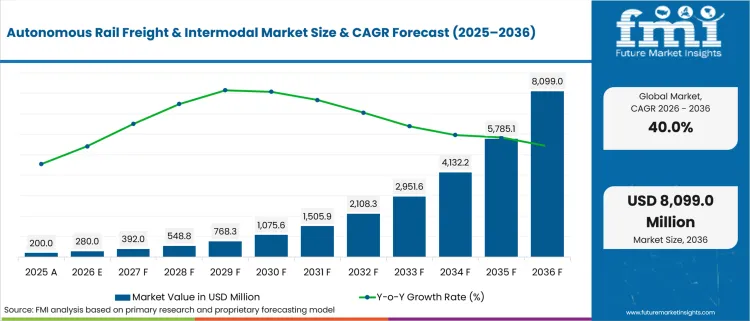
USD 280.0 million in 2026 and USD 8,099.0 million by 2036 at a 40.0% CAGR.
Sales in autonomous rail freight & intermodal market is projected to rise from USD 280.0 million in 2026 to USD 8,099.0 million by 2036 at a 40.0% CAGR. Growth is being supported by continued investment in freight rail modernization and efforts to improve transportation efficiency across major logistics networks. In this context, large freight volumes on established rail corridors provide a foundation for the gradual deployment of autonomous rail solutions. According to China’s National Bureau of Statistics, railways transported 5.17 billion tonnes of freight in 2024, an increase of 2.8% from the previous year. This volume highlights the scale of rail-based cargo movements and the potential applicability of autonomous freight operations on selected corridors. terminals with dependable container flow and freight rail infrastructure that supports safe digital control.
Commercial adoption is expected to differ across national networks and private industrial track used by mines and manufacturing sites. China offers dense corridor volumes and large terminal systems that can support repeated automated movements. The United States offers short-line routes with contained operating boundaries and direct access to inland distribution sites. Each route needs compatible signals and practical terminal handoffs plus a written recovery plan for communication loss. Projects that lower dwell without disrupting established trains can compete with road haulage services on short container lanes.
Key Takeaways of Autonomous Rail Freight & Intermodal Market
- Demand for autonomous rail freight and intermodal solutions is driven by short freight movements that conventional train formation serves inefficiently, with smaller powered groups reducing terminal dwell on fixed lanes.
- Self-propelled railcars are the leading vehicle type for smaller container groups traveling between fixed terminals under planned movement authority and predictable loading windows.
- Automated shunting locomotives fit repeated yard work under established supervision, remaining well suited to familiar maintenance practices within controlled operating areas.
- Battery-electric propulsion is estimated to suit bounded routes best, supported by planned charging and workshop access close to the operating area and daily timetable.
- Recurring budgets create durable revenue as time-limited trials convert into scheduled freight service with continuing vehicle support and remote intervention, while safe recovery during signal or communication faults remains a core commercial requirement.
- The United States, Europe, and Russia are expected to follow distinct adoption paths, shaped by short-line testing conditions, cross-border infrastructure approval, and communications/maintenance demands across longer, weather-exposed routes.
- Competition centers on Parallel Systems, Intramotev, DB Cargo, Watco, ÖBB Rail Cargo Group, R.J. Corman Railroad Company, Bosch Engineering, and ITK Engineering, with vendors differentiating through battery-electric vehicle development, yard automation testing, and shunting control systems under defined staff supervision.
Analyst Perspective
"The autonomous rail shunting market is progressing as rail operators evaluate automation through operational resilience rather than locomotive autonomy alone. Commercial deployment depends on whether autonomous movements can coexist with existing freight operations, maintain compatibility with signaling infrastructure, and recover safely from routine disruptions without affecting network efficiency. The next phase of adoption will favor suppliers that reduce integration complexity, demonstrate dependable performance across mixed operating environments, and provide the engineering expertise required for safe, scalable implementation."
- Ronak Shah, Principal Analyst at Future Market Insights
Source: FMI's proprietary forecasting model and primary research
How is the Autonomous Rail Freight & Intermodal Market segmented?
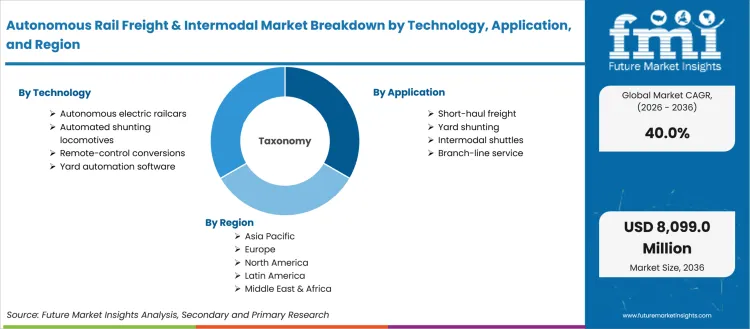
The autonomous rail freight & intermodal market is segmented by Technology, Application, Component, End-use, Business Model, and Region.
The market is segmented by technology, application, component, end-use, business model, and region. Technology covers self-propelled electric railcars and automated shunting locomotives plus remote-control conversions and yard-control software. Application distinguishes short-haul freight from yard shunting and intermodal shuttle work across fixed freight corridors. Component analysis separates vehicles from autonomy software and continuing operating services used throughout scheduled operations. End-use identifies the organization controlling the route and business model explains whether equipment is purchased or supported through a service contract.
How do autonomous electric railcars shape demand within the technology category?
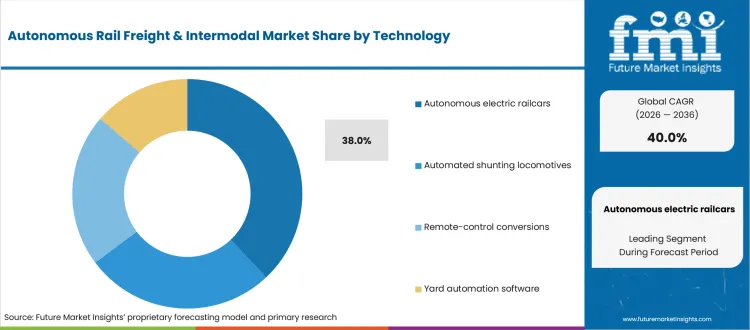
Autonomous electric railcars place propulsion and control beneath a smaller freight load instead of relying on a full locomotive formation. The Federal Railroad Administration described a 160-mile Georgia test corridor in January 2024 for self-propelled battery-electric rail vehicles. That route provides a direct test of braking and dispatch integration across working freight lines with existing schedules. The design suits manufacturing logistics that need earlier departures between plants and nearby terminals under a planned service pattern.
- By technology, autonomous electric railcars are forecast to represent 38.0% of revenue in 2026 through integrated propulsion and onboard control. The share reflects the engineering value inside a railworthy unit that can form smaller train groups. Route economics improve through earlier departures and lower terminal waiting rather than higher vehicle speed alone.
- Freight operators compare new powered railcars with automated shunting locomotives and remote-control conversions during route planning. A new railcar suits container groups that travel between fixed terminals under planned movement authority. A conversion can retain familiar locomotives and workshop practices inside yards with repeated low-speed movements and direct staff supervision.
What supports demand for short-haul freight within the application category?
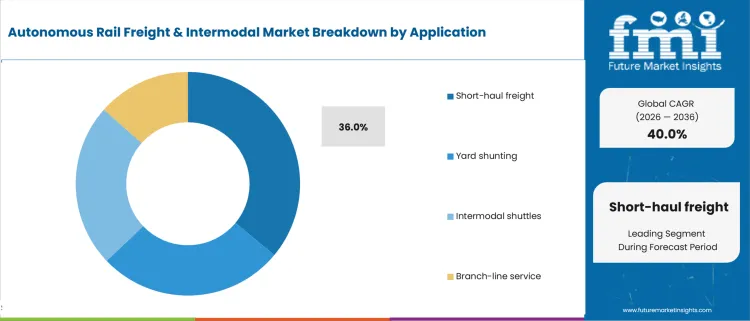
Short-haul freight is constrained by the time containers spend waiting for a conventional train to reach economic length. The Association of American Railroads reported in January 2025 that intermodal volume across United States railroads increased by about 9% during 2024, which supports more frequent terminal departures on lanes with steady container flow and dependable loading windows. Autonomous rail can improve middle-mile delivery if loading and dispatch remain coordinated across both ends of the route.
- In the 2026 application view, short-haul freight is estimated to account for 36.0% of revenue as moderate-volume lanes need more frequent departures. Commercial returns depend on total terminal dwell and access to train paths across the complete corridor. The service gains value by releasing containers earlier under a dependable timetable that protects established freight movements and avoids extra storage at the terminal.
- Yard shunting and branch-line service follow different commercial paths even though both involve relatively short operating distances. Bounded yards support direct supervision through established procedures and clear movement authority across a defined work area.
How are vehicles positioned within the component category?
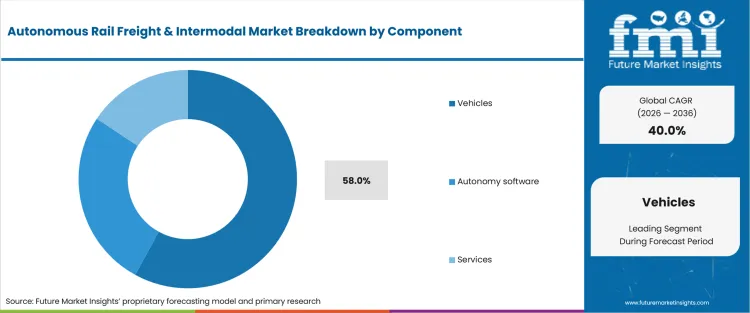
Railworthy structures and safe propulsion place vehicles at the center of early program spending across autonomous freight projects. Deutsche Bahn announced in March 2025 that DB Cargo and two Bosch subsidiaries were developing a fully automated hump locomotive for approval at the end of 2027. The planned 2028 rollout shows how vehicle readiness sets the commercial schedule for yard automation. Later revenue shifts toward transport management systems and remote support across each approved operating site.
- Vehicles are projected to hold 58.0% of component revenue in 2026 through railworthy frames and propulsion systems that require route testing. Fleet plans need firm production and workshop schedules that align with each approved operating site. A delayed vehicle delivery can postpone an approved service even if software and terminal preparations are complete.
- Autonomy software and operating services are anticipated to gain value as commercial hours increase across approved routes. Map updates and remote support become recurring needs across terminals operating several vehicles under scheduled dispatch. Service revenue grows as control software becomes part of routine movement authority and documented incident recovery across every operating shift.
What are the drivers, restraints, and opportunities in the autonomous Rail Freight & Intermodal Market?
Short-route economics support demand through smaller departures. Route approval slows commercial schedules through safety evidence and recovery duties.
- Driver: Smaller freight groups are expected to improve route economics on lanes that cannot support the fixed cost and delay of conventional train formation.
- Restraint: Route approval is anticipated to extend project schedules through braking tests and documented recovery duties under local signaling rules.
- Opportunity: Service agreements are projected to widen commercial use by combining vehicle support and daily operating responsibility within one contract.
Short container lanes become expensive as terminal dwell exceeds the journey between nearby freight sites. Parallel Systems announced in April 2025 that it had raised USD 38 million and was starting its first commercial pilot. The financing shows that capital is moving toward rail vehicles designed for smaller departure groups rather than conventional long trains. Commercial demand is expected to concentrate on corridors with steady freight flow and direct terminal access at both ends, which drives market growth. These routes place autonomous rail inside outbound logistics as a scheduled service with measurable dwell reduction.
Rail approval can delay revenue even after a vehicle performs reliably during a controlled private-track test. The Federal Railroad Administration stated in January 2024 that the Georgia program involved two host railroads and required several waivers from existing equipment rules. That filing illustrates the interfaces that a new freight vehicle must resolve before routine service. Each project needs accepted braking and recovery procedures plus clear control authority during faults across the approved route. Commercial schedules remain exposed until the safety case covers routine work and credible abnormal operating events.
Service agreements create a practical path from pilot equipment to recurring freight operations with defined technical support. A managed contract can connect autonomous railcars with port-to-door container journeys and assign support duties across terminal handoffs. Recurring revenue expands as vehicle maintenance and remote intervention become part of a daily timetable.
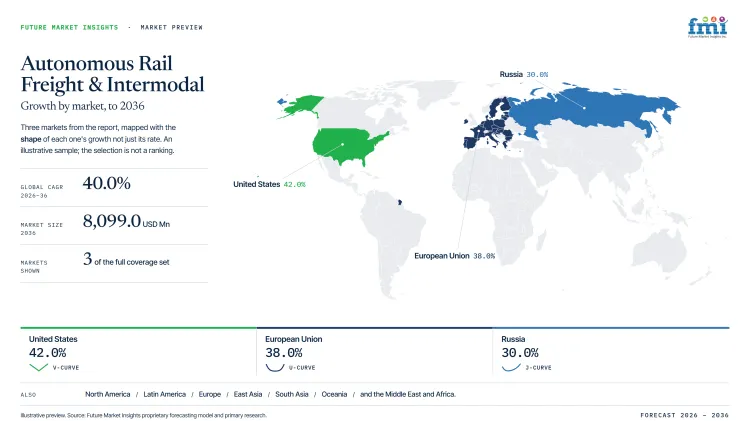
Which country CAGRs are profiled in the Autonomous Rail Freight & Intermodal Market?
| Country | CAGR |
|---|---|
| United States | 42.0% |
| European Union | 38.0% |
| Russia | 30.0% |
Source: FMI's proprietary forecasting model and primary research.
How do country-level CAGRs compare in the Autonomous Rail Freight & Intermodal Market?
The comparison spans 12.0 percentage points and separates the profiled markets into three distinct growth levels across the autonomous rail freight & intermodal market. The United States holds a clear lead at 42.0% CAGR, followed by the European Union at 38.0%, while Russia stands at 30.0%. The wide spread reflects different stages of rail network modernization, freight automation investment and digital rail infrastructure development.
- The United States leads the comparison with a CAGR of 42.0%. Freight rail operators are accelerating investment in autonomous train technologies, AI-enabled traffic management and digitally connected intermodal operations to improve network efficiency, strengthen safety and optimize long-distance freight movement across large rail corridors.
- The European Union follows at 38.0%, remaining 4.0 percentage points behind the United States. Railway infrastructure managers and freight operators are expanding the use of automation, digital signaling and intelligent traffic coordination to improve cross-border rail operations and increase intermodal freight efficiency. Progress differs among member states because rail modernization programs, network complexity and investment schedules are not uniform across the region.
- Russia records a CAGR of 30.0%, placing it 8.0 percentage points below the European Union. Market activity reflects continued interest in autonomous freight operations across extensive rail corridors, where automation technologies are being evaluated to improve operational efficiency, reduce manual intervention and strengthen long-distance cargo transport.
Comparable CAGRs do not necessarily produce identical commercial opportunities. Differences in rail infrastructure, signaling systems, freight volumes, regulatory frameworks and automation investment priorities influence deployment strategies and long-term supplier positioning. The full report provides country-level CAGR analysis across North America, Latin America, Europe, East Asia, South Asia, Oceania and the Middle East and Africa.
Country-wise Analysis
National growth differs according to route density and the operating boundary available for early commercial service. The United States offers short-line settings that reduce the number of outside interfaces during testing. European projects must fit several infrastructure managers and cross-border technical rules throughout scheduled commercial operation. Russia presents long routes and distant maintenance points that raise support costs for autonomous equipment. These differences determine whether rail freight operations begin with self-propelled railcars or contained yard automation.
- Short-line railroads give the United States contained commercial routes that connect ports and inland distribution sites. Autonomous rail freight demand is forecast to expand at 42.0% CAGR from 2026 to 2036 as these operators test smaller train groups under existing dispatch rules. As of July 2026, the Association of American Railroads Data Center listed six United States Class I railroads in its detailed annual traffic dataset. The figure shows how a small group of national networks operates alongside a broad short-line system with different approval needs. New vehicles must fit written movement authority and protect established train schedules across the route.
- European freight automation is likely to begin inside formation yards and terminal zones with defined supervision. The European Union outlook is estimated to record 38.0% CAGR by 2036 due to operators’ need for repeatable automation within dense rail networks. Eurostat reported in October 2025 that European Union rail freight performance totaled 375 billion tonne-kilometres during 2024. That scale supports investment but creates complex interfaces across infrastructure managers and national operating rules. Formation yards offer a contained setting for automated locomotive work under established procedures and direct staff oversight.
- Russia’s long bulk routes create a different automation case from compact terminal corridors in other profiled countries. The sector is projected to record 30.0% CAGR from 2026 to 2036 as selected industrial sites assess remote control and supervised freight movement. Russian Railways reported in January 2025 that the network carried 1.18 billion tonnes during 2024 and volume declined by 4.1%. That fall strengthens the need to justify each automation program through measurable operating savings. Severe weather and distant maintenance bases require reserve equipment and local repair capability across each route.
Who are the notable companies in the Autonomous Rail Freight & Intermodal Market?
Parallel Systems, Intramotev, DB Cargo, Watco, ÖBB Rail Cargo Group, R.J. Corman Railroad Company, Bosch Engineering, and ITK Engineering are verified participants in this market.
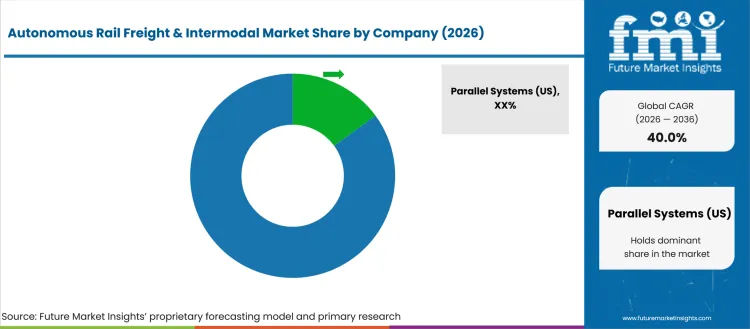
Competition includes vehicle developers and freight operators plus control engineers with different responsibilities across each route. Parallel Systems and Intramotev develop self-propelled battery-electric rail vehicles for short freight movements under supervised control. DB Cargo and Watco provide operating settings that test automation against established yard procedures and daily terminal schedules. ÖBB Rail Cargo Group and R.J. Corman Railroad Company add network experience across European freight and North American switching work. Bosch Engineering and ITK Engineering support control integration for automated shunting under defined staff supervision. Commercial structures increasingly resemble logistics outsourcing as one contract combines equipment support and route responsibility.
- Parallel Systems and Intramotev focus on self-propelled battery-electric rail vehicles for short freight routes and terminal work. Their commercial position depends on reliable braking and controlled recovery during communication loss under routine operating conditions. Route evidence must show that smaller train groups improve terminal dwell without reducing network reliability or disrupting existing freight schedules.
- DB Cargo and Watco bring established operating procedures to automation projects inside yards and terminal routes. ÖBB Rail Cargo Group and R.J. Corman Railroad Company add working freight settings with different signaling and maintenance practices. These operators determine whether a technical system fits routine schedules and supports practical recovery across each operating shift.
- Bosch Engineering develops sensing and control equipment for automated shunting and ITK Engineering provides the line-side workstation. Their involvement shows that vehicle software must follow local movement authority and defined staff supervision across every operating state. Integration work becomes commercially valuable by reducing uncertainty during route approval and daily recovery planning.
Competitive Benchmarking: Autonomous Rail Freight & Intermodal Market
| Company | Vehicle Scope | Autonomous-Control Integration | Operations Support | Geographic Reach |
|---|---|---|---|---|
| Parallel Systems | High | High | Medium | North America, commercial pilot |
| Intramotev | High | High | Medium | North America and Europe, commercial use |
| DB Cargo | Low | High | High | Europe, formation yards |
| Watco | Low | Medium | High | North America, terminal operations |
| ÖBB Rail Cargo Group | Low | Medium | High | Europe, freight network |
| R.J. Corman Railroad Company | Low | Medium | High | North America, industrial switching |
| Bosch Engineering | Low | High | Medium | Europe, project engineering |
| ITK Engineering | Low | High | Medium | Europe, control engineering |
Scoring basis: High indicates direct verified capability in the stated dimension and evidence of market-specific activity. Medium reflects documented capability that depends partly on a technology or operating partner within an active freight program. Low indicates that direct evidence within the Autonomous Rail Freight & Intermodal Market remains limited across the stated capability dimension.
Source: Future Market Insights competitive analysis, 2026. Ratings reflect official company announcements and documented operating roles within the defined market.
Key Developments in the Autonomous Rail Freight & Intermodal Market
- In September 2025, Parallel Systems reported that its Georgia commercial pilot had entered a second testing phase on a Genesee & Wyoming short line. The program advances autonomous battery-electric rail vehicles from initial authorization into operating evidence under working freight conditions.
- In March 2026, R.J. Corman Railroad Company agreed to introduce Intramotev TugVolt railcars for industrial switching on its Memphis Line. The agreement places self-propelled freight vehicles inside an established switching operation with existing schedules and maintenance routines.
- In September 2025, Watco entered an agreement to use Intramotev TugVolt technology at its Wood River transload terminal. The deployment places autonomous battery-electric railcars inside routine terminal work instead of a separate demonstration.
- In April 2026, ÖBB Rail Cargo Group reached an agreement for the first European use of Intramotev autonomous railcars. The project introduces self-propelled freight wagons to a European operating environment with established network rules and terminal procedures.
Key Players in the Autonomous Rail Freight & Intermodal Market
Autonomous rail vehicle developers
- Parallel Systems
- Intramotev
Freight operators and route partners
- DB Cargo
- Watco
- ÖBB Rail Cargo Group
- R.J. Corman Railroad Company
- Georgia Central Railway and Heart of Georgia Railroad
Control and systems engineering partners
- Bosch Engineering
- ITK Engineering
Autonomous Rail Freight & Intermodal Market - Report Scope
| Coverage field | Report scope |
|---|---|
| Market breakdown | Technology, application, component, end-use, business model, and region. |
| Quantitative units | Revenue in USD Million, CAGR in %. |
| Market definition | Autonomous or remotely supervised rail vehicles that move freight containers and wagons plus automated shunting and terminal control systems. |
| Regions covered | North America, Latin America, Europe, East Asia, South Asia, Oceania, and the Middle East and Africa. |
| Countries covered | United States, China, India, Russia, major European countries, and more than 20 additional country views. |
| Key companies profiled | Parallel Systems, Intramotev, DB Cargo, Watco, ÖBB Rail Cargo Group, R.J. Corman Railroad Company, Bosch Engineering, and ITK Engineering. |
| Forecast period | 2026 to 2036. |
| Approach | Supplier-level and demand-level sizing supported by primary interviews and official desk research. |
Source: Future Market Insights analysis based on proprietary forecasting models and primary research
Autonomous Rail Freight & Intermodal Market - Research Methodology
| Method | Approach |
|---|---|
| Primary Research | FMI analysts gathered input from manufacturers, service providers, technology developers, distributors, end users, procurement teams, and subject-matter experts. Interviews examined purchasing decisions, product or service evaluation, adoption barriers, approval requirements, pricing considerations, and expectations for technical or commercial support. Respondents were also asked what evidence is required before a trial, pilot, or initial order develops into regular purchasing. |
| Desk Research | Desk research covered government statistics, regulatory publications, trade data, industry associations, technical literature, standards, company filings, product information, and official corporate announcements. Sources were reviewed for relevance, publication date, geographic coverage, and consistency with the defined market scope. Claims relating to performance, applications, approvals, capacity, investment, and commercial activity were retained only when supported by credible public evidence. |
| Market Sizing and Forecasting | The market model combined the baseline value with historical performance, segment structure, pricing and volume indicators, adoption levels, company participation, and country-level demand conditions. Forecast assumptions considered economic activity, investment trends, regulatory developments, technology adoption, purchasing cycles, supply availability, and barriers to wider market use. Segment and regional estimates were reconciled before the final market total was calculated. |
| Data Validation | Estimates were checked against multiple independent indicators, including public data, company activity, trade patterns, industry developments, and findings from primary interviews. Validation also tested whether products, services, applications, and company revenues fell within the defined market boundaries. Adjacent categories, unsupported claims, overlapping revenues, and activities without direct market relevance were excluded to reduce double counting and maintain consistency across segments and countries. |
Source: Future Market Insights analysis based on proprietary forecasting models and primary research
Autonomous Rail Freight & Intermodal Market by Segments
Autonomous Rail Freight & Intermodal Market segmented by Technology:
- Autonomous Electric Railcars
- Automated Shunting Locomotives
- Remote-Control Conversions
- Yard Automation Software
Autonomous Rail Freight & Intermodal Market segmented by Application:
- Short-Haul Freight
- Yard Shunting
- Intermodal Shuttles
- Branch-Line Service
Autonomous Rail Freight & Intermodal Market segmented by Component:
- Vehicles
- Autonomy Software
- Operations Services
Autonomous Rail Freight & Intermodal Market segmented by End-use:
- Rail Operators
- Intermodal and Ports
- Industrial Spurs
- Mining and Bulk Sites
Autonomous Rail Freight & Intermodal Market segmented by Business Model:
- Direct Sales
- Service Contracts
- Pilot Programs
- Lease Arrangements
Autonomous Rail Freight & Intermodal Market by Region:
- North America
- United States
- Canada
- Latin America
- Brazil
- Mexico
- Argentina
- Europe
- Germany
- United Kingdom
- France
- Italy
- Spain
- Russia
- East Asia
- China
- Japan
- South Korea
- South Asia
- India
- Thailand
- Indonesia
- Oceania
- Australia
- New Zealand
- Middle East and Africa
- GCC Countries
- South Africa
- Türkiye
Research Sources and Bibliography
- National Bureau of Statistics of China. "Statistical Communiqué of the People’s Republic of China on the 2024 National Economic and Social Development." National Bureau of Statistics of China, 28 February 2025.
- Association of American Railroads. "Rail Traffic Data." Association of American Railroads, January 2025.
- Association of American Railroads. "Data Center." Association of American Railroads
- Federal Railroad Administration. "Petition for Waivers of Compliance for the Georgia Rail Vehicle Test Program." Federal Register, 16 January 2024.
- Deutsche Bahn. "DB Cargo and Bosch subsidiaries develop fully automated shunting locomotive for series production." Deutsche Bahn, 30 March 2025.
- Parallel Systems. "Parallel Systems to Launch First Commercial Pilot in April Following Federal Railroad Administration Approval as Company Closes 38 Million Series B Funding Round." Parallel Systems Newsroom, 15 April 2025.
- Parallel Systems. "Parallel Systems shifts into second phase of testing on G&W in Georgia." Parallel Systems Newsroom, 22 September 2025.
- Eurostat. "Railway freight transport statistics." European Commission, October 2025.
- Indian Railways. "Indian Railways Year Book 2023-24." Ministry of Railways, March 2025.
- Russian Railways. "Freight loading results for 2024." Russian Railways, January 2025.
- Intramotev. "R.J. Corman to begin using Intramotev autonomous railcars." Intramotev Newsroom, 30 March 2026.
- Intramotev. "Intramotev announces commercial agreement with Watco to deploy TugVolt technology." Intramotev Newsroom, 16 September 2025.
- Intramotev. "Intramotev reaches deal with Austria’s ÖBB for first foreign use of its autonomous railcars." Intramotev Newsroom, 27 April 2026.
This bibliography is provided for reader reference and uses primary government, standards-body, official trade body, and company sources.
This Report Answers
- What market value is estimated for 2026 and 2036?
- What CAGR is projected from 2026 to 2036?
- Which technology and application segments shape commercial demand?
- Why do vehicles account for dominant share in 2026?
- Which route economics support autonomous freight rail use?
- How do CAGRs differ among the three profiled markets?
- Which companies develop vehicles, operate freight programs, or provide control engineering?
- How should rail operators evaluate a pilot before expanding commercial service?
- How do approval evidence and recovery planning affect system selection?
Frequently Asked Questions
What is driving growth in the Autonomous Rail Freight & Intermodal Market?
Smaller self-propelled rail units can reduce container dwell on short routes with steady freight flow. Commercial growth depends on turning route trials into scheduled services with defined support duties.
Who are the key players in the Autonomous Rail Freight & Intermodal Market?
Parallel Systems and Intramotev develop self-propelled rail vehicles for short freight routes. DB Cargo and Watco provide operating settings and engineering partners support automated control integration.
What is a notable restraint in the Autonomous Rail Freight & Intermodal Market?
Route approval can extend schedules beyond the technical trial period. Each program needs braking evidence and a practical recovery plan that fits local signals and operating authority.
Why should executives track the Autonomous Rail Freight & Intermodal Market?
Autonomous rail changes the shipment size needed for practical short-route service. It can create recurring vehicle and support revenue on lanes that conventional train formation serves poorly.
What business problem does the Autonomous Rail Freight & Intermodal Market address?
The market addresses freight movements that are necessary but costly to staff or schedule. Smaller powered units can depart earlier without waiting for a long conventional train.
What should procurement teams evaluate before selecting a system?
Procurement teams should compare route fit and braking evidence with the recovery plan behind each design. Contracts must assign vehicle support and remote intervention from the first commercial service day.
What limits return on investment for fleet owners?
Weak freight density can leave specialized vehicles underused after a pilot. Charging access and distant maintenance can reduce returns if the operating plan lacks reserve equipment or local support.
What supports long-term commercial confidence in the Autonomous Rail Freight & Intermodal Market?
Reliable performance during signal faults and communication loss supports confidence in wider fleet use. Documented maintenance and incident roles give operators a practical basis for approving another route.
Preview the report firsthand - request a free sample
Get SampleGet the brochure for pricing and purchase details.
Get PDFTable of Content
- Key Takeaways
- Market Size and CAGR
- Top Growth Driver
- Fastest Growing Segment
- Leading Region
- Key Companies
- Emerging Opportunities
- Executive Summary
- Global Market Outlook
- Demand-side Trends
- Supply-side Trends
- Technology Roadmap Analysis
- Analysis and Recommendations
- Analyst Perspective (What is happening? Why now? What should investors know?)
- Key Questions Answered
- How large is the market?
- What is the CAGR?
- What are key trends?
- Which region dominates?
- Who are the leaders?
- Market Overview
- Market Coverage / Taxonomy
- Market Definition / Scope / Limitations
- Research Methodology
- Chapter Orientation
- Analytical Lens and Working Hypotheses
- Market Structure, Signals, and Trend Drivers
- Benchmarking and Cross-market Comparability
- Market Sizing, Forecasting, and Opportunity Mapping
- Research Design and Evidence Framework
- Desk Research Programme (Secondary Evidence)
- Expert Input and Fieldwork (Primary Evidence)
- Tooling, Models, and Reference Databases
- Data Engineering and Model Build
- Quality Assurance and Audit Trail
- Market Background
- Market Dynamics (Drivers, Restraints, Opportunity, Trends)
- Scenario Forecast (Optimistic, Likely, Conservative)
- Impact Analysis
- AI Impact
- Sustainability Impact
- Regulatory Impact
- Technology Impact
- Consumer / Buyer Analysis
- Purchase Drivers
- Adoption Barriers
- Buyer Journey
- Opportunity Map Analysis
- Product Life Cycle Analysis
- Supply Chain Analysis
- Investment Feasibility Matrix
- Value Chain Analysis
- PESTLE and Porter's Analysis
- Regulatory Landscape
- Regional Parent Market Outlook
- Production and Consumption Statistics
- Import and Export Statistics
- Global Market Analysis and Forecast, 2021 to 2036
- Historical Market Size Value (USD Million) Analysis, 2021 to 2025
- Current and Future Market Size Value (USD Million) Projections, 2026 to 2036
- Y-o-Y Growth Trend Analysis
- Absolute $ Opportunity Analysis
- Global Market Pricing Analysis, 2021 to 2036
- Global Market Analysis and Forecast, By Technology, 2021 to 2036
- Introduction / Key Findings
- Historical Market Size Value (USD Million) Analysis By Technology, 2021 to 2025
- Current and Future Market Size Value (USD Million) Analysis and Forecast By Technology, 2026 to 2036
- Autonomous electric railcars
- Automated shunting locomotives
- Remote-control conversions
- Yard automation software
- Autonomous electric railcars
- Y-o-Y Growth Trend Analysis By Technology, 2021 to 2025
- Absolute $ Opportunity Analysis By Technology, 2026 to 2036
- Global Market Analysis and Forecast, By Application, 2021 to 2036
- Introduction / Key Findings
- Historical Market Size Value (USD Million) Analysis By Application, 2021 to 2025
- Current and Future Market Size Value (USD Million) Analysis and Forecast By Application, 2026 to 2036
- Short-haul freight
- Yard shunting
- Intermodal shuttles
- Branch-line service
- Short-haul freight
- Y-o-Y Growth Trend Analysis By Application, 2021 to 2025
- Absolute $ Opportunity Analysis By Application, 2026 to 2036
- Global Market Analysis and Forecast, By Component, 2021 to 2036
- Introduction / Key Findings
- Historical Market Size Value (USD Million) Analysis By Component, 2021 to 2025
- Current and Future Market Size Value (USD Million) Analysis and Forecast By Component, 2026 to 2036
- Vehicles
- Autonomy software
- Services
- Vehicles
- Y-o-Y Growth Trend Analysis By Component, 2021 to 2025
- Absolute $ Opportunity Analysis By Component, 2026 to 2036
- Global Market Analysis and Forecast, By End-use, 2021 to 2036
- Introduction / Key Findings
- Historical Market Size Value (USD Million) Analysis By End-use, 2021 to 2025
- Current and Future Market Size Value (USD Million) Analysis and Forecast By End-use, 2026 to 2036
- Rail operators
- Intermodal & ports
- Industrial spurs
- Mining & bulk
- Rail operators
- Y-o-Y Growth Trend Analysis By End-use, 2021 to 2025
- Absolute $ Opportunity Analysis By End-use, 2026 to 2036
- Global Market Analysis and Forecast, By Business Model, 2021 to 2036
- Introduction / Key Findings
- Historical Market Size Value (USD Million) Analysis By Business Model, 2021 to 2025
- Current and Future Market Size Value (USD Million) Analysis and Forecast By Business Model, 2026 to 2036
- Direct
- Service contracts
- Pilot programs
- Lease
- Direct
- Y-o-Y Growth Trend Analysis By Business Model, 2021 to 2025
- Absolute $ Opportunity Analysis By Business Model, 2026 to 2036
- Global Market Analysis and Forecast, By Region, 2021 to 2036
- Introduction
- Historical Market Size Value (USD Million) Analysis By Region, 2021 to 2025
- Current Market Size Value (USD Million) Analysis and Forecast By Region, 2026 to 2036
- North America
- Latin America
- Western Europe
- Eastern Europe
- East Asia
- South Asia and Pacific
- Middle East & Africa
- Market Attractiveness Analysis By Region
- North America Market Analysis and Forecast, By Country, 2021 to 2036
- Historical Market Size Value (USD Million) Trend Analysis By Market Taxonomy, 2021 to 2025
- Market Size Value (USD Million) Forecast By Market Taxonomy, 2026 to 2036
- By Country
- USA
- Canada
- By Technology
- By Application
- By Component
- By End-use
- By Business Model
- By Country
- Market Attractiveness Analysis
- By Country
- By Technology
- By Application
- By Component
- By End-use
- By Business Model
- Key Takeaways
- Latin America Market Analysis and Forecast, By Country
- Historical Market Size Value (USD Million) Trend Analysis By Market Taxonomy, 2021 to 2025
- Market Size Value (USD Million) Forecast By Market Taxonomy, 2026 to 2036
- By Country
- Brazil
- Mexico
- Chile
- Rest of Latin America
- By Technology
- By Application
- By Component
- By End-use
- By Business Model
- By Country
- Market Attractiveness Analysis
- By Country
- By Technology
- By Application
- By Component
- By End-use
- By Business Model
- Key Takeaways
- Western Europe Market Analysis and Forecast, By Country
- Historical Market Size Value (USD Million) Trend Analysis By Market Taxonomy, 2021 to 2025
- Market Size Value (USD Million) Forecast By Market Taxonomy, 2026 to 2036
- By Country
- Germany
- UK
- Italy
- Spain
- France
- Nordic
- BENELUX
- Rest of Western Europe
- By Technology
- By Application
- By Component
- By End-use
- By Business Model
- By Country
- Market Attractiveness Analysis
- By Country
- By Technology
- By Application
- By Component
- By End-use
- By Business Model
- Key Takeaways
- Eastern Europe Market Analysis and Forecast, By Country
- Historical Market Size Value (USD Million) Trend Analysis By Market Taxonomy, 2021 to 2025
- Market Size Value (USD Million) Forecast By Market Taxonomy, 2026 to 2036
- By Country
- Russia
- Poland
- Hungary
- Balkan & Baltic
- Rest of Eastern Europe
- By Technology
- By Application
- By Component
- By End-use
- By Business Model
- By Country
- Market Attractiveness Analysis
- By Country
- By Technology
- By Application
- By Component
- By End-use
- By Business Model
- Key Takeaways
- East Asia Market Analysis and Forecast, By Country
- Historical Market Size Value (USD Million) Trend Analysis By Market Taxonomy, 2021 to 2025
- Market Size Value (USD Million) Forecast By Market Taxonomy, 2026 to 2036
- By Country
- China
- Japan
- South Korea
- By Technology
- By Application
- By Component
- By End-use
- By Business Model
- By Country
- Market Attractiveness Analysis
- By Country
- By Technology
- By Application
- By Component
- By End-use
- By Business Model
- Key Takeaways
- South Asia and Pacific Market Analysis and Forecast, By Country
- Historical Market Size Value (USD Million) Trend Analysis By Market Taxonomy, 2021 to 2025
- Market Size Value (USD Million) Forecast By Market Taxonomy, 2026 to 2036
- By Country
- India
- ASEAN
- Australia & New Zealand
- Rest of South Asia and Pacific
- By Technology
- By Application
- By Component
- By End-use
- By Business Model
- By Country
- Market Attractiveness Analysis
- By Country
- By Technology
- By Application
- By Component
- By End-use
- By Business Model
- Key Takeaways
- Middle East & Africa Market Analysis and Forecast, By Country
- Historical Market Size Value (USD Million) Trend Analysis By Market Taxonomy, 2021 to 2025
- Market Size Value (USD Million) Forecast By Market Taxonomy, 2026 to 2036
- By Country
- Kingdom of Saudi Arabia
- Other GCC Countries
- Türkiye
- South Africa
- Other African Union
- Rest of Middle East & Africa
- By Technology
- By Application
- By Component
- By End-use
- By Business Model
- By Country
- Market Attractiveness Analysis
- By Country
- By Technology
- By Application
- By Component
- By End-use
- By Business Model
- Key Takeaways
- Key Countries Market Analysis
- USA
- Pricing Analysis
- Market Share Analysis, 2025
- By Technology
- By Application
- By Component
- By End-use
- By Business Model
- Canada
- Pricing Analysis
- Market Share Analysis, 2025
- By Technology
- By Application
- By Component
- By End-use
- By Business Model
- Mexico
- Pricing Analysis
- Market Share Analysis, 2025
- By Technology
- By Application
- By Component
- By End-use
- By Business Model
- Brazil
- Pricing Analysis
- Market Share Analysis, 2025
- By Technology
- By Application
- By Component
- By End-use
- By Business Model
- Chile
- Pricing Analysis
- Market Share Analysis, 2025
- By Technology
- By Application
- By Component
- By End-use
- By Business Model
- Germany
- Pricing Analysis
- Market Share Analysis, 2025
- By Technology
- By Application
- By Component
- By End-use
- By Business Model
- UK
- Pricing Analysis
- Market Share Analysis, 2025
- By Technology
- By Application
- By Component
- By End-use
- By Business Model
- Italy
- Pricing Analysis
- Market Share Analysis, 2025
- By Technology
- By Application
- By Component
- By End-use
- By Business Model
- Spain
- Pricing Analysis
- Market Share Analysis, 2025
- By Technology
- By Application
- By Component
- By End-use
- By Business Model
- France
- Pricing Analysis
- Market Share Analysis, 2025
- By Technology
- By Application
- By Component
- By End-use
- By Business Model
- India
- Pricing Analysis
- Market Share Analysis, 2025
- By Technology
- By Application
- By Component
- By End-use
- By Business Model
- ASEAN
- Pricing Analysis
- Market Share Analysis, 2025
- By Technology
- By Application
- By Component
- By End-use
- By Business Model
- Australia & New Zealand
- Pricing Analysis
- Market Share Analysis, 2025
- By Technology
- By Application
- By Component
- By End-use
- By Business Model
- China
- Pricing Analysis
- Market Share Analysis, 2025
- By Technology
- By Application
- By Component
- By End-use
- By Business Model
- Japan
- Pricing Analysis
- Market Share Analysis, 2025
- By Technology
- By Application
- By Component
- By End-use
- By Business Model
- South Korea
- Pricing Analysis
- Market Share Analysis, 2025
- By Technology
- By Application
- By Component
- By End-use
- By Business Model
- Russia
- Pricing Analysis
- Market Share Analysis, 2025
- By Technology
- By Application
- By Component
- By End-use
- By Business Model
- Poland
- Pricing Analysis
- Market Share Analysis, 2025
- By Technology
- By Application
- By Component
- By End-use
- By Business Model
- Hungary
- Pricing Analysis
- Market Share Analysis, 2025
- By Technology
- By Application
- By Component
- By End-use
- By Business Model
- Kingdom of Saudi Arabia
- Pricing Analysis
- Market Share Analysis, 2025
- By Technology
- By Application
- By Component
- By End-use
- By Business Model
- Türkiye
- Pricing Analysis
- Market Share Analysis, 2025
- By Technology
- By Application
- By Component
- By End-use
- By Business Model
- South Africa
- Pricing Analysis
- Market Share Analysis, 2025
- By Technology
- By Application
- By Component
- By End-use
- By Business Model
- USA
- Market Structure Analysis
- Competition Dashboard
- Competition Benchmarking
- Market Share Analysis of Top Players
- By Regional
- By Technology
- By Application
- By Component
- By End-use
- By Business Model
- Emerging Startups
- Innovation Benchmarking
- Competition Analysis
- Competition Deep Dive
- Parallel Systems (US)
- Overview
- Product Portfolio
- Profitability by Market Segments
- Sales Footprint
- Strategy Overview
- Marketing Strategy
- Product Strategy
- Channel Strategy
- DB Cargo automation (DE)
- Alstom shunting (FR)
- Parallel Systems (US)
- Case Studies
- Success Stories
- Recent Developments
- Competition Deep Dive
- Assumptions & Acronyms Used


