

- Market Size (2026)
- USD 309.7 Mn
- Forecast (2036)
- USD 1023.7 Mn
- CAGR (2026 to 2036)
- 12.7%
How big is Bakery Protein Fortification Systems Market in 2026?
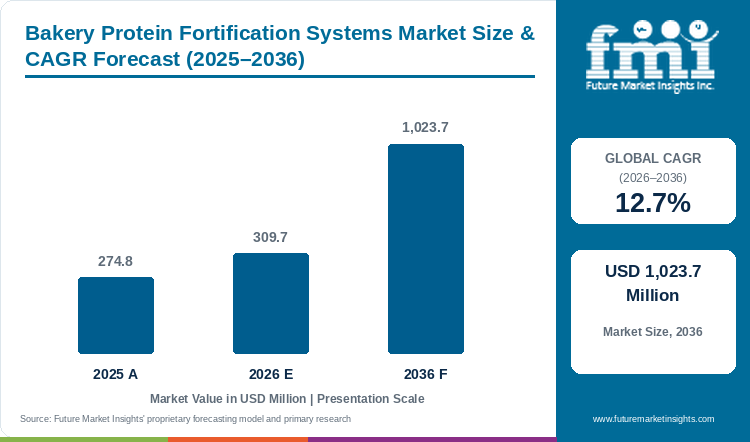
Assessed at USD 274.8 million in 2025 and progressing to USD 309.7 million in 2026, the bakery protein fortification systems market valuation is on course to reach USD 1,023.7 million by 2036, supported by a forecast-period CAGR of 12.7%.
In September 2025, IFF debuted high-protein tortillas and nutrition bars fortified with SOLAE SUPRO soy protein at IBIE, showing commercial bakers that protein loading and crumb texture can ship on one platform [3]. The global bakery protein fortification systems market was valued at USD 274.8 million in 2025 and is estimated to reach USD 309.7 million in 2026. The market is projected to reach USD 1,023.7 million by 2036, expanding at a compound annual growth rate (CAGR) of 12.7% between 2026 and 2036. Isolates are projected to account for 34.0% of 2026 type demand, since 80% to 90% protein purity minimizes dough viscosity distortion. Demand for fortification systems is supported by GLP-1 companion eating and satiety marketing, which moved protein from sports aisles into grocery bread, yet every gram added stresses gluten networks that bakers must re-engineer with hydrolysis and crosslinking chemistry [6]. That systems requirement separates the category from the plant-based protein market at 9.5% CAGR, because protein ingredients sell on supplement demand while bakery systems sell on formulation services. Testing infrastructure is arriving, as Puratos opened its Flour Competence Center in Belgium in June 2026 [5] and AB Enzymes opened a Curitiba plant-protein laboratory the same month [20]. Retail buyers pay for bread holding a protein claim without a chalky crumb, and suppliers passing both tests own those contracts through 2036.
Key Market Trends & Insights
- By type: Isolates are projected to account for 34.0% of the type segment in 2026 because 80% to 90% protein purity minimizes dough viscosity distortion.
- By form: Powder / Dry formats are estimated to hold 48.0% of the form segment in 2026 due to compatibility with pneumatic flour-blending hoppers.
- By application: Bread & Rolls are expected to represent 38.0% of the application segment in 2026 because daily staple loaves anchor retail protein-claim launches.
- By claim: Conventional formulations are forecast to capture 57.0% of the claim segment in 2026 owing to flexible enzyme and wheat-gluten co-formulation tolerances.
- By sales channel: Direct to Industrial Bakeries is anticipated to command 51.0% of the sales channel segment in 2026 through pilot-line rheology qualification.
Regional Highlights
- Top national expansion: The UAE is projected to lead evaluated national markets at a 14.1% CAGR through 2036 under national food-security and modern bakery investments.
- Broader country progression: Saudi Arabia is expected to expand at a 13.7% CAGR ahead of South Korea at a 13.4% CAGR and the USA at a 13.1% CAGR, while Japan is forecast to advance at an 11.8% CAGR.
Market Size & Forecast
Table 1: Market Size and Forecast for the Bakery Protein Fortification Systems Market (USD million and CAGR percentage), 2025 to 2036
| Metric | Value |
|---|---|
| 2025 Market Size | USD 274.8 million |
| Estimated Market Size in 2026 | USD 309.7 million |
| Projected Market Size by 2036 | USD 1,023.7 million |
| CAGR, 2026 to 2036 | 12.7% |
| Added Value Opportunity, 2026 to 2036 | USD 714.0 million |
Widespread adoption of GLP-1 weight-management regimens and active-nutrition diets has shifted supermarket bakery demand toward portion-controlled protein buns and artisan loaves. Direct replacement of wheat flour with unconditioned legume powders weakens the gluten network and reduces loaf height during oven spring. In July 2025, a University of Manitoba study published in the Journal of Food Science evaluated 80% to 90% soy and pea protein isolates at 5% to 15% inclusion in wholegrain bread and confirmed that 5% soy protein isolate achieved the highest loaf volume of 342 mL and 94.21% emulsion stability [2]. Commercial bakeries therefore procure bundled functional proteins pre-blended with xylanases and hydrocolloids to maintain loaf volume.
Production-Volume and Batch-Formulation Sizing
Table 2: Production-Volume and Batch-Formulation Sizing for the Bakery Protein Fortification Systems Market (USD million and operational ranges), 2025 to 2036
| Metric | 2025 | 2026 | 2036 |
|---|---|---|---|
| Market size (USD million) | 274.8 | 309.7 | 1,023.7 |
| Fortified bakery output (million metric tons) | 2.8 to 3.3 | 3.1 to 3.7 | 9.4 to 11.2 |
| Active protein system dosage (% flour weight) | 5.0% to 15.0% | 5.0% to 15.0% | 6.0% to 18.0% |
| Average system spend per ton of dough (USD) | 82.0 to 96.0 | 84.0 to 99.0 | 92.0 to 108.0 |
Operational note: Batch-formulation ranges reflect 5.0% to 18.0% flour-weight substitution required to deliver 10 to 20 grams of protein per 100-gram baked serving or at least 20% of total caloric energy from protein.
Complete amino-acid digestibility scores in baked goods require combining lysine-rich pulse isolates with sulfur-amino-acid-rich cereal fractions. Industrial formulators routinely pair protein powder concentrates with transglutaminase or wheat gluten to prevent dough tearing during high-speed sheeting.
Per Capita & Commercial Bakery Facility Sizing
Table 3: Per Capita and Facility Spending Indicators for the Bakery Protein Fortification Systems Market (USD), 2025 to 2036
| Metric | 2025 | 2026 | 2036 |
|---|---|---|---|
| World population (million) | 8,200 | 8,300 | 9,000 |
| Spend per 1,000 people (USD) | 33.5 | 37.3 | 113.7 |
| Annual spend per fortified bakery line (USD) | 22,500 to 26,800 | 25,200 to 29,500 | 68,000 to 79,500 |
| Direct industrial contract share (%) | 49.0% to 52.0% | 50.0% to 53.0% | 55.0% to 59.0% |
Table 4: Facility & Industrial Bakery Spending Indicators for the Bakery Protein Fortification Systems Market (USD and percentages), 2026
| Metric | Value | Institutional Reference Basis |
|---|---|---|
| Market size, 2026 | USD 309.7 million | 2026 global market value baseline |
| Commercial bakery establishments | 185,000 | Global industrial and craft bakery plant registry |
| Market spend per bakery establishment | USD 1,674.1 | Annualized protein-fortification system expenditure |
| Direct industrial bakery allocation, 2026 | USD 157.9 million | 51.0% sales-channel segment allocation |
High-protein batters and doughs absorb 5% to 12% more water in the mixer yet release bound moisture rapidly during baking if starch-protein matrices are uncalibrated. Commercial plants integrate high protein powders with enzymatic dough strengtheners to preserve cell-wall elasticity across pan bread and tortilla lines.
Analyst Perspective
"Protein percentage on a raw ingredient certificate never guarantees a commercial bakery contract. Suppliers win recurring plant volume only when their protein system preserves farinograph mixing stability and neutralizes volatile legume off-notes during baking."
- Nandini Roy Choudhury, Principal Consultant, Future Market Insights.
How is the bakery protein fortification systems market segmented?
The bakery protein fortification systems market is segmented by type, form, application, claim, and sales channel. In 2026, Isolates are projected at 34.0%, Powder / Dry at 48.0%, Bread & Rolls at 38.0%, Conventional at 57.0%, and Direct to Industrial Bakeries at 51.0%.
By type: Isolates, Concentrates, Hydrolysates, and Textured Protein Crisps.
By form: Powder / Dry, Liquid, Semi-Solid Paste, and Granular Pieces.
By application: Bread & Rolls, Cakes & Muffins, Biscuits & Cookies, Viennoiserie & Pastry, and Specialty Bakery Snacks.
By claim: Conventional, Clean Label, Organic, and Identity-Preserved Non-GMO.
By sales channel: Direct to Industrial Bakeries, Ingredient Distributors, Foodservice & Artisan, and Online B2B.
Why do Isolates lead the type segment?
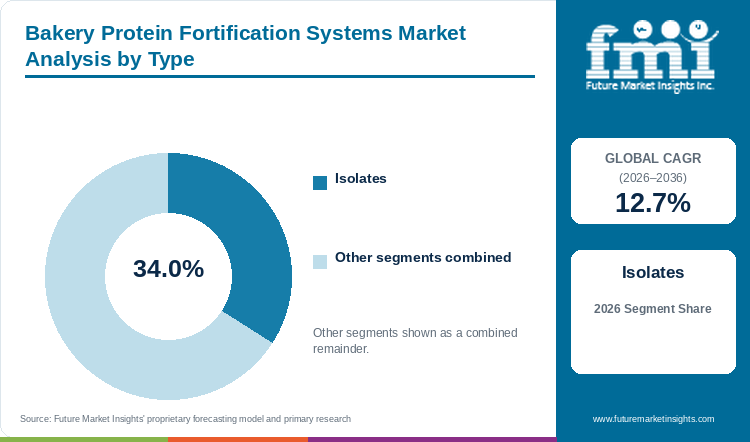
Isolates are projected to capture 34.0% of the type segment in 2026, supported by 80% to 90% protein purity that limits gluten dilution.
Table 5: Type Share for the Bakery Protein Fortification Systems Market (percentage share), 2026
| Type | Share (2026) |
|---|---|
| Isolates | 34.0% |
| Other Segments Combined | 66.0%* |
| Total | 100.0% |
*Note: Remaining type subsegments sum to 100.0% of 2026 bakery protein fortification systems volume.
Table 6: Type Leadership and Market Growth for the Bakery Protein Fortification Systems Market (segment and CAGR percentage), 2026 to 2036
| Metric | Value |
|---|---|
| Global CAGR (2026 to 2036) | 12.7% |
| Leading Segment | Isolates |
Formulators specify soy and pea or wheat protein isolates because 80% to 90% protein purity crosses front-of-pack gram targets at lower total flour replacement than 55%-protein concentrates. Lower non-protein starch and insoluble fiber carry-over preserves gas-cell expansion while complementing vegan protein powder blends in high-speed bread and tortilla lines.
- Isolates are projected to secure 34.0% of the type segment in 2026 by delivering maximum protein density per kilogram of dry mix.
- In September 2025, IFF introduced high-protein tortilla and nutrition-bar prototypes fortified with SOLAE SUPRO soy protein isolate and LITESSE ULTRA fiber at IBIE in Las Vegas [3].
What keeps Powder / Dry ahead in the form segment?
Powder / Dry formats are estimated to secure 48.0% of the form segment in 2026, driven by dry flour-silo and premix integration.
Dry protein isolates and co-milled enzyme-protein bases meter directly through automated dry feeders into wheat flour without requiring wet slurry tanks or sanitation loops. Ambient shelf stability across 12-month warehouse storage also makes dry blends the preferred format for dough-based premixes distributed to regional bakeries.
- Powder / Dry options are estimated to command 48.0% of the form segment in 2026 because dry handling avoids microbial spoilage prior to dough hydration.
- Thermal rheology trials published in Food Chemistry in October 2025 showed that microwave-treated dry corn-starch and pea-protein-isolate (7:3) composites cut retrogradation enthalpy by up to 45% and lowered 3-day muffin hardness by 40% to 50% [4].
Why do Bread & Rolls anchor the application segment?
Bread & Rolls are expected to command 38.0% of the application segment in 2026, reflecting recurring household consumption of protein-enriched loaves.
Sliced pan breads and burger buns represent the largest volume vehicle for daily dietary protein enrichment across retail grocery channels. Because non-gluten proteins lack gliadin extensibility, bread formulators pair protein inputs with bakery improvers to prevent dense crumb porosity and crust darkening.
- Bread & Rolls are expected to hold 38.0% of the application segment in 2026 as mainstream bakeries expand high-protein sandwich loaf and bun SKUs.
- In June 2026, Puratos opened its Flour Competence Center in Groot-Bijgaarden, Belgium to model crop protein fluctuations and water absorption across bread improver and sourdough systems [5].
Why does Conventional lead the claim segment?
Conventional formulations are forecast to generate 57.0% of the claim segment in 2026, owing to cost efficiency and broad processing-aid latitude.
Target crumb softness at 12% to 20% protein content frequently requires wheat gluten and microbial enzymes that fall outside strict organic or clean-label lists. Conventional positioning allows industrial bakers to hit retail price points while maintaining slice cohesion across multi-day distribution.
- Conventional claims are forecast to account for 57.0% of the claim segment in 2026 because unrestricted enzyme and emulsifier pairing lowers batch reformulation risk.
- A December 2025 Journal of Food Science study evaluating alkaline-extracted sacha inchi protein in wheat bread demonstrated a 26.4% protein increase and 10% PDCAAS improvement without altering Mixolab dough rheology [6].
What gives Direct to Industrial Bakeries the leading position in the sales channel segment?
Direct to Industrial Bakeries is anticipated to account for 51.0% of the sales channel segment in 2026, reinforced by co-development pilot trials.
Enterprise baking groups contract directly with protein and biosolution producers because each 5% increment in non-gluten protein requires custom adjustments to farinograph development time and proof-box humidity. Direct supplier partner de-risks industrial scale-up from benchtop prototypes to continuous 6,000-loaf-per-hour tunnel ovens.
- Direct to Industrial Bakeries is anticipated to capture 51.0% of the sales channel segment in 2026 through multi-plant technical service agreements.
- In May 2025, dsm-firmenich inaugurated its Princeton Baking Innovation Center in New Jersey to co-create protein-fortified breads and snack bars with commercial bakery accounts [7].
What are the drivers, restraints, and opportunities in the bakery protein fortification systems market?
In the bakery protein fortification systems market, consumer demand for satiety-enhancing staple foods drives system procurement whereas gluten-network dilution and pulse off-notes restrain inclusion levels and fermented or conjugated plant proteins create formulation opportunities.
- Driver: Mainstream adoption of high-protein diets and GLP-1 portion compression pushes bakeries to fortify everyday breads and wraps.
- Restraint: Gluten-network dilution and lipoxygenase-derived beany volatiles cap unassisted plant-protein inclusion rates.
- Opportunity: Co-fermenting or wet-heat conjugating pulse proteins with lactic acid bacteria and arabinoxylan-degrading enzymes eliminates off-flavors and restores loaf volume.
Growth Analysis and Future Potential: Qualitative Demand Catalysts
Retail grocery buyers and institutional dietitians are expanding shelf allocations for protein-fortified pan breads and soft baked snacks that support lean muscle maintenance in aging and weight-conscious cohorts. Because shoppers resist switching from familiar baked staples to clinical shakes, bakery brands reformulate core bread and roll SKUs to carry source-of-protein front-of-pack seals. Demand for turnkey fortification blends is rising in tandem with vegan protein bars and functional snacking categories. In November 2025, an International Journal of Food Sciences and Nutrition study from the University of Milan and University of Udine showed that replacing 5% of wheat flour with high-pressure-homogenized pea protein concentrate qualified loaves for source-of-protein claims while earning higher hedonic liking scores among older adults [8]. Bakers consequently lock in pre-stabilized protein systems to capture health-oriented retail premiums.
Risk Assessment of the Bakery Protein Fortification Systems Market: Operational and Formulation Friction
Disruption of wheat gluten cross-linking and volatile aldehyde off-flavors from pulse lipoxygenase activity remain the primary technical bottlenecks restricting higher protein dosages. When non-gluten legume isolates replace wheat flour above 10%, water competition reduces dough stability and compresses specific loaf volume. In September 2026, a University College Cork and Teagasc study published in Foods demonstrated that substituting faba bean flour with faba bean protein concentrate or isolate cut gluten-free bread specific volume from 3.29 mL/g down to 2.13 mL/g and 1.85 mL/g while increasing crumb hardness [9]. Similarly, a December 2025 Journal of Food Science flavoromics study across 14 yellow-pea ingredients identified 15 volatile organic compounds driving strong pea off-flavors in pan breads made with unconditioned isolates [10]. Bakeries therefore require food enzymes and flavor modulators before approving supplier switches.
Commercial Opportunity Analysis: Formulation Differentiation and Value-Add Formats
Ingredient suppliers unlock high-margin specification wins by pairing plant protein isolates with cooperative lactic fermentation and transglutaminase cross-linkers. Lactic bioprocessing of pulse proteins prior to baking increases beta-sheet protein conformations while stripping hexanal and nonenal beany odors. Formulators integrating fermented protein bases with clean-label bread conditioners eliminate the need for synthetic dough strengtheners. In December 2025, a Journal of the Science of Food and Agriculture study confirmed that co-fermenting pea protein dough with Lactiplantibacillus plantarum Lp90 raised gluten beta-sheet structure to 57.22% and reduced beany (E)-2-nonenal and 1-octen-3-ol volatiles [11]. Supply of odor-neutralized, rheology-balanced protein systems enables vendors to capture premium reformulation tenders.
Bakery Protein Fortification Systems Market by Country (2026 to 2036)
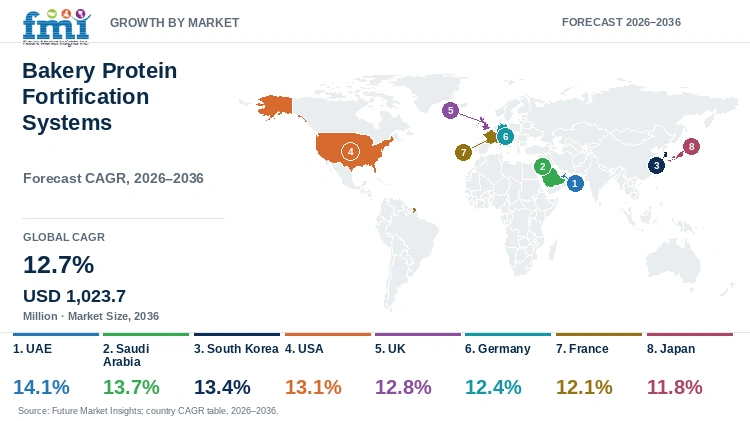
As per FMI, the UAE is projected to lead bakery protein fortification systems expansion across evaluated countries at a 14.1% CAGR through 2036, whereas Japan is forecast to progress at an 11.8% CAGR. National demand outlooks depend on statutory nutrition-claim energy thresholds and mandatory protein panel audits across industrial bakeries.
Table 7: Country CAGR and Primary Growth Levers for the Bakery Protein Fortification Systems Market (CAGR percentage and operational drivers), 2026 to 2036
| Country | CAGR (2026 to 2036) | Primary Growth Lever |
|---|---|---|
| UAE | 14.1% | Local date-fiber and plant-protein flatbread co-formulation in modern bakeries |
| Saudi Arabia | 13.7% | Hermetic wheat-protein preservation and Vision 2030 sandwich-bread enrichment |
| South Korea | 13.4% | Upcycled fiber-and-soy-isolate bakery R&D and MFDS protein label audits |
| USA | 13.1% | Hard red spring wheat glutenin modeling and GLP-1 high-protein tortilla launches |
| UK | 12.8% | Great Britain NHC register protein-claim compliance and retail private-label enrichment |
| Germany | 12.4% | EU 20%-energy high-protein claim standards and protein-seeded Eiweissbrot rolls |
| France | 12.1% | INRAE-Arvalis glutenin/gliadin characterization and domestic pulse-protein baking |
| Japan | 11.8% | Clinical functional wheat-bread trials and seniorconvenience protein rolls |
Source: Future Market Insights analysis
UAE Bakery Protein Fortification Systems Market Outlook (2026 to 2036)
The UAE bakery protein fortification systems market is projected to expand at a leading 14.1% CAGR from 2026 to 2036 across commercial flatbread and hospitality commissary plants. Supermarket grocers and fitness-oriented cafe chains in Dubai and Abu Dhabi actively merchandise high-protein wraps and keto-styled loaves tailored to expatriate and local wellness shoppers. In August 2025, researchers at United Arab Emirates University in Al Ain and New York University Abu Dhabi reported in Scientific Reports that fractionating four domestic date cultivars yielded 3.2 to 7.4 g/100 g dietary fiber with branched arabinogalactan pectins that bind water in baked matrices [12]. While pairing local date-fiber binders with imported pea and soy isolates prevents dry flatbread crumb, summer warehouse heat requires antioxidant-stabilized protein premixes.
Key takeaway: In the UAE, functional flatbread innovation and date-fiber co-formulation are projected to anchor high-growth procurement of dry protein systems.
Saudi Arabia Bakery Protein Fortification Systems Market Outlook (2026 to 2036)
Commercial bakeries across Saudi Arabia are diversifying beyond subsidized standard pan loaves into protein-enriched sandwich breads and tortilla wraps aligned with Vision 2030 wellness goals. Sales of bakery protein fortification systems in Saudi Arabia are forecast to advance at a 13.7% CAGR over the 2026 to 2036 forecast window. In October 2025, a King Saud University partner study in Scientific Reports demonstrated that hermetic grain storage limited wheat protein loss to 0.71% over six months and improved dough stability and bread chewiness [13]. Even so, strict SFDA nutrition-claim verification across retail chains in Riyadh and Jeddah requires analytical amino-acid and protein-percentage dossiers before shelf placement.
Key takeaway: In Saudi Arabia, preventive community nutrition policies and flour-quality preservation initiatives are forecast to drive industrial adoption of verified protein blends.
South Korea Bakery Protein Fortification Systems Market Outlook (2026 to 2036)
South Korea's convenience-store and franchise bakery sector rapidly commercializes high-protein bagels and steamed buns targeted at urban fitness consumers. In March 2026, food scientists at Dongguk University in Seoul reported in Food Chemistry: X that fortifying bread with soy protein isolate and upcycled dietary fiber lifted crude protein by 7.1% while requiring microstructure control to prevent dense crumb cells [14]. Demand for bakery protein fortification systems in South Korea is anticipated to rise at a 13.4% CAGR between 2026 and 2036 across commercial baking groups and retail chains. Mandatory Ministry of Food and Drug Safety protein-labeling tolerances compel bakers in South Korea to buy pre-standardized isolate-enzyme systems.
Key takeaway: In South Korea, rapid convenience-bakery innovation and strict MFDS nutrition-panel audits are anticipated to sustain demand for soy and pea isolate systems.
USA Bakery Protein Fortification Systems Market Outlook (2026 to 2036)
Widespread household adoption of GLP-1 receptor agonists and low-carbohydrate diets across the USA has transformed high-protein tortillas and artisan loaves into core supermarket growth categories. In February 2026, researchers at North Dakota State University and the North Dakota Wheat Commission reported in Foods across 755 hard red spring wheat field samples that combining high-molecular-weight glutenin Bx and Ax subunit ratios with starch metrics predicted loaf volume with an R-squared above 0.860 [15]. IFF debuted SUPRO high-protein tortilla prototypes at IBIE in September 2025 to support dough extensibility [3]. Market value in the USA is estimated to progress at a 13.1% CAGR through 2036, moderated by FDA Protein Digestibility-Corrected Amino Acid Score labeling rules.
Key takeaway: In the USA, GLP-1 dietary shifts and large-scale tortilla and pan-bread reformulation are estimated to drive direct contracting for soy and pea protein systems.
UK Bakery Protein Fortification Systems Market Outlook (2026 to 2036)
The UK is projected to record a 12.8% CAGR in the bakery protein fortification systems market from 2026 to 2036 across supermarket plant-based and active-nutrition bakery bays. Major retail grocery chains in the UK aggressively promote protein-enriched seeded loaves and sliced morning rolls under private-label active health tiers. In May 2026, the Department of Health and Social Care updated the Great Britain nutrition and health claims register governing authorized source-of-protein (12% energy) and high-protein (20% energy) commercial declarations [16]. While non-HFSS store-entrance merchandising rules across grocery chains reward combined protein-and-fiber enrichment, tight private-label margin caps across UK supermarkets compel commercial plant bakeries to scrutinize cost-in-use per loaf.
Key takeaway: In the UK, Great Britain NHC register thresholds and supermarket non-HFSS merchandising are projected to sustain demand for cost-calibrated protein premixes.
Germany Bakery Protein Fortification Systems Market Outlook (2026 to 2036)
Germany represents Europe's largest market for whole-grain and seed-enriched Eiweissbrot (protein bread) served during traditional evening bread meals across households. Bakery protein fortification systems market value in Germany is expected to grow at a 12.4% CAGR between 2026 and 2036 across industrial wholesale bakeries and multi-branch artisan plants. In August 2025, a Journal of Food Science rheology study confirmed that incorporating 5% soy or leaf protein isolates raised wheat dough water absorption from 52.6% to 57.6% while hydrophobic gluten interactions stabilized mixing tolerance [17]. Because Germany's 8,912 craft bakeries face skilled-labor shortages, centralized premix suppliers provide pre-dosed lupin and wheat-protein concentrates that run on standard spiral mixers.
Key takeaway: In Germany, established consumer demand for Eiweissbrot and craft-bakery labor constraints are expected to favor ready-to-mix multi-source plant protein systems.
France Bakery Protein Fortification Systems Market Outlook (2026 to 2036)
National agricultural sovereignty initiatives in France encourage domestic yellow-pea and faba-bean fractionation, yet boulangerie and industrial viennoiserie buyers enforce strict crumb and crust standards. In February 2025, a research consortium led by INRAE and Arvalis with Limagrain Ingredients in France published a multi-environment dataset in Data in Brief covering 31 glutenin and gliadin protein compositional analyses and 37 baguette baking sensory tests [18]. Demand for bakery protein fortification systems in France is slated to advance at a 12.1% CAGR from 2026 to 2036 across packaged industrial sandwich-bread plants and regional commercial bakeries. To avoid bitter saponin notes in brioche crumb, formulators in France pair domestic pulse isolates with mild sourdough fermentation.
Key takeaway: In France, domestic pulse-protein valorization paired with strict sensory thresholds is slated to drive adoption of sourdough-buffered protein systems.
Japan Bakery Protein Fortification Systems Market Outlook (2026 to 2036)
Super-aging demographics and convenience-store meal replacement habits in Japan create steady demand for soft, protein-enriched table rolls and steamed buns that require minimal chewing effort. In June 2025, researchers at Nisshin Seifun Group and Chiyoda Paramedical Care Clinic in Tokyo published a randomized crossover clinical trial validating daily consumption of functional wheat bread enriched with 3.26 g/day resistant starch and tailored protein matrices among 46 adults in Japan [19]. To preserve ultra-soft crumb elasticity with elevated protein density, commercial bakers in Japan blend soy protein-polysaccharide conjugates with proteolytic and maltogenic enzymes. Commercial bakery protein fortification systems market value in Japan is predicted to expand at an 11.8% CAGR through 2036 across national wholesale bakeries.
Key takeaway: In Japan, geriatric nutrition goals and clinical functional-bread validation are predicted to support adoption of soft-texture soy and wheat protein systems.
Full report country CAGRs cover: North America; Latin America; Western Europe; Eastern Europe; East Asia; South Asia and Pacific; Middle East and Africa.
Who are the notable companies in the bakery protein fortification systems market?
Novonesis, IFF, Kerry Group, AB Enzymes, Amano Enzyme, Palsgaard, Corbion, BASF, Puratos, and DSM-Firmenich are the notable companies evaluated in this market.
FMI's competitive evaluation separates primary plant-protein and integrated bakery-system formulators from enzymatic gluten-network modifiers and emulsifier/preservation specialists. Corporate portfolio realignment occurred on September 30, 2025 when BASF completed the sale of its Food and Health Performance Ingredients business in Illertissen to Louis Dreyfus Company while retaining micronutrient flour fortification.
- Direct Protein Input & Integrated System Formulators: IFF and Kerry Group along with Puratos and DSM-Firmenich supply soy or pea protein isolates and taste-masking bakery systems.
- Enzymatic Rheology & Pulse-Bread Performance Specialists: Novonesis and AB Enzymes along with Amano Enzyme engineer xylanases and Valena Pulse biosolutions that restore loaf volume in high-protein doughs.
- Batter Aeration, Preservation & Micronutrient Participants: Palsgaard and Corbion supply cake-premix emulsifiers and clean-label mold/freshness systems, while BASF focuses on vitamin/mineral flour fortification after divesting its food-performance unit to Louis Dreyfus Company in September 2025.
Competitive Benchmarking: Bakery Protein Fortification Systems Market
Table 8: Competitive Benchmarking for the Bakery Protein Fortification Systems Market (qualitative capability ratings), 2026
| Company | Protein Input Breadth | Bakery Functionality | Application Co-development | Geographic Reach |
|---|---|---|---|---|
| Novonesis | Medium | High | High | High |
| IFF | High | High | High | High |
| Kerry Group | High | High | High | High |
| AB Enzymes | Medium | High | High | Medium |
| Amano Enzyme | Medium | High | Medium | Medium |
| Palsgaard | Medium | Medium | High | High |
| Corbion | Medium | High | High | High |
| BASF | Medium | Medium | Medium | High |
| Puratos | High | High | High | High |
| DSM-Firmenich | High | High | High | High |
Scoring basis: Capability ratings assess documented plant/dairy protein isolate supply and enzymatic dough-strengthening or off-note masking in 10%-to-20% protein recipes. Scores also reflect pilot bakery co-development centers and multi-region commercial distribution.
Key Developments in the Bakery Protein Fortification Systems Market
- IFF debuted high-protein tortillas and nutrition bars fortified with SOLAE SUPRO soy protein with POWERFRESH ACE 2000 at IBIE in September 2025 [3].
- Puratos inaugurated its Flour Competence Center in Groot-Bijgaarden, Belgium in June 2026 to analyze crop protein variability and optimize bread improver and protein-fortified recipes [5].
- AB Enzymes opened its new regional office and hands-on baking laboratory in Curitiba, Brazil in June 2026 to accelerate customer trials for dough-conditioning and plant-protein hydrolysate enzymes [20].
Key Players in the Bakery Protein Fortification Systems Market
Direct Protein Input and Integrated System Formulators
- IFF
- Kerry Group
- Puratos
- DSM-Firmenich
Enzymatic Rheology and Pulse-Bread Performance Specialists
- Novonesis
- AB Enzymes
- Amano Enzyme
Batter Aeration, Preservation and Micronutrient Participants
- Palsgaard
- Corbion
- BASF
Bakery Protein Fortification Systems Market - Report Scope
Table 9: Report Scope for the Bakery Protein Fortification Systems Market (coverage fields and definitions), 2026 to 2036
| Coverage field | Report scope |
|---|---|
| Market breakdown | Type; Form; Application; Claim; Sales Channel |
| Quantitative Units | USD Million |
| Market Definition | Includes commercial supplier sales of bakery-grade protein isolates, concentrates, hydrolysates, textured protein crisps, and bundled protein-enzyme-hydrocolloid fortification systems sold to commercial bakeries. Category Scope Note: Excludes finished retail baked-goods value, standalone enzymes sold for unfortified bread, and vitamin-only flour premixes. |
| Regions Covered | North America; Latin America; Western Europe; Eastern Europe; East Asia; South Asia and Pacific; Middle East and Africa |
| Countries Covered | UAE, Saudi Arabia, South Korea, USA, UK, Germany, France, Japan, and additional countries in the full report |
| Key Companies Covered | Novonesis, IFF, Kerry Group, AB Enzymes, Amano Enzyme, Palsgaard, Corbion, BASF, Puratos, DSM-Firmenich |
| Forecast Period | 2026 to 2036 |
| Approach | Primary and secondary research with top-down and bottom-up market triangulation. |
Bakery Protein Fortification Systems Market - Research Methodology
Table 10: Research Methodology for the Bakery Protein Fortification Systems Market (research methods and approach), 2026 edition
| Method | Approach |
|---|---|
| Primary Research | Structured interviews with commercial bakery R&D directors, pulse/soy protein fractionators, and farinograph rheology specialists to verify 5.0% to 18.0% flour-weight protein inclusion bands. |
| Secondary Research | Analysis of EU Regulation 1924/2006 (12% and 20% protein energy thresholds), Great Britain NHC register updates, FDA PDCAAS labeling rules, and Annual Review of Food Science and Technology audits. |
| Market Sizing and Forecasting | Bottom-up mass-balance reconciliation of protein-enriched bread, tortilla, muffin, and biscuit tonnage multiplied by verified isolate/concentrate dosage and bundled system pricing from 2025 to 2036. |
| Country Forecasting Model | Econometric country projections weight GLP-1 and active-nutrition adoption, statutory protein-claim audits, domestic pulse fractionation capacity, and industrial bakery automation across eight nations. |
| Operational Benchmark Traceability | Batch inclusion and per-line spending metrics in Tables 2, 3, and 4 trace to commercial bakery establishment registries, University of Manitoba wholegrain isolate trials, and ZDH bakery registries in Germany. |
| Data Triangulation and Validation | Supplier allocations are cross-validated against food-grade soy, pea, faba, and wheat protein shipments into bakery channels, strictly excluding retail sports-nutrition shakes and unfortified commodity flour. |
Bakery Protein Fortification Systems Market by Segments
Bakery Protein Fortification Systems Market segmented by Type:
- Isolates
- Concentrates
- Hydrolysates
- Textured Protein Crisps
Bakery Protein Fortification Systems Market segmented by Form:
- Powder / Dry
- Liquid
- Semi-Solid Paste
- Granular Pieces
Bakery Protein Fortification Systems Market segmented by Application:
- Bread & Rolls
- Cakes & Muffins
- Biscuits & Cookies
- Viennoiserie & Pastry
- Specialty Bakery Snacks
Bakery Protein Fortification Systems Market segmented by Claim:
- Conventional
- Clean Label
- Organic
- Identity-Preserved Non-GMO
Bakery Protein Fortification Systems Market segmented by Sales Channel:
- Direct to Industrial Bakeries
- Ingredient Distributors
- Foodservice & Artisan
- Online B2B
Bakery Protein Fortification Systems Market by Region
- North America
- United States
- Canada
- Latin America
- Brazil
- Mexico
- Argentina
- Chile
- Western Europe
- Germany
- France
- United Kingdom
- Italy
- Spain
- Benelux
- Nordics
- Eastern Europe
- Poland
- Czech Republic
- Romania
- Hungary
- East Asia
- China
- Japan
- South Korea
- South Asia and Pacific
- India
- ASEAN
- Australia and New Zealand
- Middle East and Africa
- GCC Countries
- South Africa
- Türkiye
- Israel
Research Sources and Bibliography
- [1] Parle, F., Martinez, M. M., & Roman, L. (2026, February 5). Plant-Protein Fortification of Cereal Foods: Market Insights and Nutritional Implications for the Dietary Exposome. Annual Review of Food Science and Technology, 17, 51-77.
- [2] Malalgoda, M., Stefanson, R., Senarathna, S., Valsalan, A., Swaminathan, I., Laplaud, P., Liu, M., & Carlin, J. (2025, July 1). Developing Protein-Enriched Wholegrain Bread With Different Plant Protein Isolates. Journal of Food Science, 90(7), e70362 (PubMed PMID 40610202).
- [3] International Flavors & Fragrances Inc. (2025, September 2). IFF tackles top challenges in baking at IBIE 2025. IFF Media Center.
- [4] Ha, M., Firdhausa, A. S., & Chung, H.-J. (2025, October 30). Microwave treatment modifies the physicochemical properties of starch-protein composite for improved gluten-free muffin quality. Food Chemistry, 490, 145046 (PubMed PMID 40516344).
- [5] Puratos NV. (2026, June 15). Puratos opens new research center to tackle flour variability. Puratos Newsroom.
- [6] Cordero-Clavijo, L. M., Espinosa-Ramírez, J., Antunes-Ricado, M., Chuck-Hernandez, C., Serna-Saldívar, S. O., & Lazo-Vélez, M. A. (2025, December 1). Sacha Inchi (Plukenetia volubilis) Protein-Enriched Bread: Protein Quality, Breadmaking Properties, Textural Profile, and Bioactivity. Journal of Food Science, 90(12), e70743 (PubMed PMID 41346313).
- [7] dsm-firmenich AG. (2025, May 20). On the rise: dsm-firmenich opens state-of-the-art Princeton Baking Innovation Center in Princeton, NJ. dsm-firmenich Press Releases.
- [8] Moretton, M., Cattaneo, C., Pellegrini, N., Pagliarini, E., & Anese, M. (2025, November 3). Tailor-made protein-rich bread for the elderly: integrating sensory preferences with nutritional and technological goals. International Journal of Food Sciences and Nutrition, 76(8), 888-898 (PubMed PMID 41178731).
- [9] Keyes, P., Nyhan, L., Gallagher, E., Zannini, E., & Arendt, E. K. (2026, September 26). Comparative Effects of Faba Bean Flour, Protein Concentrate and Protein Isolate on Gluten-Free Bread Quality: Insights from Techno-Functional Properties. Foods, 15(19), 3440 (PubMed PMID 42883547).
- [10] Goertzen, A. D., Ryland, D., Shariati-Ievari, S., Pitura, K., Bourré, L., Asavajaru, P., Rajagopalan, N., Samaranayaka, A. G. P., Polley, B., Bhowmik, P., & Aliani, M. (2025, December 1). Investigation of Flavor and Functional Properties of Diverse Yellow Pea Ingredients for Pan Bread Applications. Journal of Food Science, 90(12), e70724 (PubMed PMID 41383032).
- [11] Ren, M., Li, Y., Sun, Y., Yin, J., Jin, Y., Li, C., Zhang, G., & Wu, T. (2025, December 3). The chemical rheological properties of pea protein dough and the storage stability of pea steamed bread were improved and the beany flavor was reduced by cooperative fermentation. Journal of the Science of Food and Agriculture, 106(4), 2542-2552 (PubMed PMID 41334699).
- [12] Okonkwo, C. E., Samad, N., Mohamed, H., O'Connor, M. J., Varghese, S., Al-Marzouqi, A. H., Ayyash, M., Boldor, D., & Kamal-Eldin, A. (2025, August 27). Characterization of dietary fiber and soluble carbohydrates in date fruits (Phoenix dactylifera L.). Scientific Reports, 15(1), 31616 (PubMed PMID 40866453).
- [13] Yousuf, H. M. B., Yasin, M., Rebouh, N. Y., Aldawood, A. S., Ali, U., & Rosentrater, K. A. (2025, October 6). Comparative assessment of conventional and hermetic storage facilities on wheat grain quality, pest infestation, and bread development. Scientific Reports, 15(1), 34725 (PubMed PMID 41053191).
- [14] Jo, D., Na, W., Wang, Y., & Lee, K.-G. (2026, March 27). Effect of spent coffee grounds addition on the microstructure and quality characteristics of protein-fortified bread. Food Chemistry: X, 35, 103796 (PubMed PMID 41971404).
- [15] Zhao, Y., Karrar, E., Peterson, J., & Islam, S. (2026, February 11). Contribution of Protein, Starch, and Fiber Composition to the Prediction of Dough Rheology and Baking Quality in U.S. Hard Red Spring Wheat. Foods, 15(4), 650 (PubMed PMID 41750842).
- [16] UK Department of Health and Social Care. (2026, May 19). Great Britain nutrition and health claims (NHC) register. GOV.UK Official Guidance.
- [17] Šekuljica, N., Jakovetić Tanasković, S., Mijalković, J., Luković, N., Gazikalović, I., Antov, M., & Knežević-Jugović, Z. (2025, August 1). Unlocking the Potential Use of Protein From Pumpkin and Spinach Leaves for Dough Fortification: A Comprehensive Investigation Into Dough Rheology and Nutritional Benefits. Journal of Food Science, 90(8), e70455 (PubMed PMID 40785487).
- [18] Munch, M., Rezette, L., Buche, P., Chambrey, B., Deborde, C., Dervaux, S., Geoffroy, S., Kansou, K., Le Gall, S., Linossier, L., Meleard, B., Menut, L., Morel, M.-H., Weber, M., & Saulnier, L. (2025, February 7). Dataset for common wheat (Triticum aestivum L.) grain and flour characterization using classical and advanced analyses. Data in Brief, 59, 111375 (PubMed PMID 40034728).
- [19] Kikuchi, Y., Otomo, Y., Toyota, K., Noma, S., & Ebihara, S. (2025, June 23). Effects of the bread containing resistant starch from wheat (Triticum aestivum) on the improvement in bowel movements: a randomized, double-blind, placebo-controlled, crossover study. Bioscience, Biotechnology, and Biochemistry, 89(7), 1015-1023 (PubMed PMID 40156576).
- [20] AB Enzymes GmbH. (2026, June 1). AB Enzymes Opens New Office and Baking Lab in Curitiba, Brazil. AB Enzymes Newsroom.
- [21] BASF SE & Louis Dreyfus Company. (2025, September 30). Joint News Release: BASF and Louis Dreyfus Company Complete Sale and Purchase Transaction for BASF's Food and Health Performance Ingredients Business. BASF Corporate Media.
- [22] Corbion N.V. (2025, September 2). Corbion leads clean-label reformulation forward at IBIE 2025. Corbion Press Releases.
- [23] Palsgaard A/S. (2025, July 8). Palsgaard Inaugurates State-of-the-Art Application Centre in Navi Mumbai to Strengthen Regional Customer Support. Palsgaard Newsroom.
This bibliography is provided for reader reference and is not exhaustive. The full report contains the complete reference list and detailed citations.
This Report Answers
- How large is the bakery protein fortification systems market in 2026 and what is forecast for 2036?
- Which dietary and retail nutrition pressures support demand for fortified bakery systems?
- Why do Isolates lead the type segment?
- Why does Powder / Dry lead the form segment globally?
- How do growth rates differ across the UAE and Saudi Arabia versus the USA?
- Which leading companies supply plant-protein isolates and dough-strengthening systems today?
- What limits adoption or supplier switching in the bakery protein fortification systems market?
- What should buyers evaluate before purchasing a bakery protein fortification system?
Frequently Asked Questions
How big is the bakery protein fortification systems market in 2026, and what is forecast for 2036?
FMI estimates indicate that the global bakery protein fortification systems market size will reach USD 309.7 million in 2026 from USD 274.8 million in 2025. The market valuation is forecast to hit USD 1,023.7 million by 2036 as commercial bakers scale protein-enriched breads and wraps.
What is the CAGR for the bakery protein fortification systems market from 2026 to 2036?
Future Market Insights projects a 12.7% compound annual growth rate between 2026 and 2036, generating an anticipated USD 714.0 million in incremental market value across industrial and foodservice bakery accounts.
Which type segment leads the bakery protein fortification systems market?
Isolates are projected to capture 34.0% of the type segment in 2026 because 80% to 90% protein concentration crosses nutrition-claim thresholds with minimal gluten dilution.
Which form segment leads the bakery protein fortification systems market?
Powder / Dry formats are estimated to secure 48.0% of the form segment in 2026 as dry blending fits automated flour-silo dosing and premix distribution.
Which country has the fastest growth outlook during the assessment period?
The UAE is projected to lead national growth at a 14.1% CAGR through 2036, supported by functional flatbread launches and local date-fiber co-formulation.
Who are the key players in the market?
Novonesis, IFF, Kerry Group, AB Enzymes, Amano Enzyme, Palsgaard, Corbion, BASF, Puratos, and DSM-Firmenich operate across direct protein inputs and enzymatic dough modifiers.
Preview the report firsthand - request a free sample
Get SampleGet the brochure for pricing and purchase details.
Get PDFTable of Content
- Key Takeaways
- Market Size and CAGR
- Top Growth Driver
- Fastest Growing Segment
- Leading Region
- Key Companies
- Emerging Opportunities
- Executive Summary
- Global Market Outlook
- Demand-side Trends
- Supply-side Trends
- Technology Roadmap Analysis
- Analysis and Recommendations
- Analyst Perspective (What is happening? Why now? What should investors know?)
- Key Questions Answered
- How large is the market?
- What is the CAGR?
- What are key trends?
- Which region dominates?
- Who are the leaders?
- Market Overview
- Market Coverage / Taxonomy
- Market Definition / Scope / Limitations
- Research Methodology
- Chapter Orientation
- Analytical Lens and Working Hypotheses
- Market Structure, Signals, and Trend Drivers
- Benchmarking and Cross-market Comparability
- Market Sizing, Forecasting, and Opportunity Mapping
- Research Design and Evidence Framework
- Desk Research Programme (Secondary Evidence)
- Expert Input and Fieldwork (Primary Evidence)
- Tooling, Models, and Reference Databases
- Data Engineering and Model Build
- Quality Assurance and Audit Trail
- Market Background
- Market Dynamics (Drivers, Restraints, Opportunity, Trends)
- Scenario Forecast (Optimistic, Likely, Conservative)
- Impact Analysis
- AI Impact
- Sustainability Impact
- Regulatory Impact
- Technology Impact
- Consumer / Buyer Analysis
- Purchase Drivers
- Adoption Barriers
- Buyer Journey
- Opportunity Map Analysis
- Product Life Cycle Analysis
- Supply Chain Analysis
- Investment Feasibility Matrix
- Value Chain Analysis
- PESTLE and Porter's Analysis
- Regulatory Landscape
- Regional Parent Market Outlook
- Production and Consumption Statistics
- Import and Export Statistics
- Global Market Analysis and Forecast, 2021 to 2036
- Historical Market Size Value (USD Million) Analysis, 2021 to 2025
- Current and Future Market Size Value (USD Million) Projections, 2026 to 2036
- Y-o-Y Growth Trend Analysis
- Absolute $ Opportunity Analysis
- Global Market Pricing Analysis, 2021 to 2036
- Global Market Analysis and Forecast, By Type, 2021 to 2036
- Introduction / Key Findings
- Historical Market Size Value (USD Million) Analysis By Type, 2021 to 2025
- Current and Future Market Size Value (USD Million) Analysis and Forecast By Type, 2026 to 2036
- Isolates
- Concentrates
- Hydrolysates
- Textured Protein Crisps
- Y-o-Y Growth Trend Analysis By Type, 2021 to 2025
- Absolute $ Opportunity Analysis By Type, 2026 to 2036
- Global Market Analysis and Forecast, By Form, 2021 to 2036
- Introduction / Key Findings
- Historical Market Size Value (USD Million) Analysis By Form, 2021 to 2025
- Current and Future Market Size Value (USD Million) Analysis and Forecast By Form, 2026 to 2036
- Powder / Dry
- Liquid
- Semi-Solid Paste
- Granular Pieces
- Y-o-Y Growth Trend Analysis By Form, 2021 to 2025
- Absolute $ Opportunity Analysis By Form, 2026 to 2036
- Global Market Analysis and Forecast, By Application, 2021 to 2036
- Introduction / Key Findings
- Historical Market Size Value (USD Million) Analysis By Application, 2021 to 2025
- Current and Future Market Size Value (USD Million) Analysis and Forecast By Application, 2026 to 2036
- Bread & Rolls
- Cakes & Muffins
- Biscuits & Cookies
- Viennoiserie & Pastry
- Specialty Bakery Snacks
- Y-o-Y Growth Trend Analysis By Application, 2021 to 2025
- Absolute $ Opportunity Analysis By Application, 2026 to 2036
- Global Market Analysis and Forecast, By Claim, 2021 to 2036
- Introduction / Key Findings
- Historical Market Size Value (USD Million) Analysis By Claim, 2021 to 2025
- Current and Future Market Size Value (USD Million) Analysis and Forecast By Claim, 2026 to 2036
- Conventional
- Clean Label
- Organic
- Identity-Preserved Non-GMO
- Y-o-Y Growth Trend Analysis By Claim, 2021 to 2025
- Absolute $ Opportunity Analysis By Claim, 2026 to 2036
- Global Market Analysis and Forecast, By Sales Channel, 2021 to 2036
- Introduction / Key Findings
- Historical Market Size Value (USD Million) Analysis By Sales Channel, 2021 to 2025
- Current and Future Market Size Value (USD Million) Analysis and Forecast By Sales Channel, 2026 to 2036
- Direct to Industrial Bakeries
- Ingredient Distributors
- Foodservice & Artisan
- Online B2B
- Y-o-Y Growth Trend Analysis By Sales Channel, 2021 to 2025
- Absolute $ Opportunity Analysis By Sales Channel, 2026 to 2036
- Global Market Analysis and Forecast, By Region, 2021 to 2036
- Introduction
- Historical Market Size Value (USD Million) Analysis By Region, 2021 to 2025
- Current Market Size Value (USD Million) Analysis and Forecast By Region, 2026 to 2036
- North America
- Latin America
- Western Europe
- Eastern Europe
- East Asia
- South Asia and Pacific
- Middle East and Africa
- Market Attractiveness Analysis By Region
- North America Market Analysis and Forecast, By Country, 2021 to 2036
- Historical Market Size Value (USD Million) Trend Analysis By Market Taxonomy, 2021 to 2025
- Market Size Value (USD Million) Forecast By Market Taxonomy, 2026 to 2036
- By Country
- United States
- Canada
- By Type
- By Form
- By Application
- By Claim
- By Sales Channel
- By Country
- Market Attractiveness Analysis
- By Country
- By Type
- By Form
- By Application
- By Claim
- By Sales Channel
- Key Takeaways
- Latin America Market Analysis and Forecast, By Country
- Historical Market Size Value (USD Million) Trend Analysis By Market Taxonomy, 2021 to 2025
- Market Size Value (USD Million) Forecast By Market Taxonomy, 2026 to 2036
- By Country
- Brazil
- Mexico
- Argentina
- Chile
- By Type
- By Form
- By Application
- By Claim
- By Sales Channel
- By Country
- Market Attractiveness Analysis
- By Country
- By Type
- By Form
- By Application
- By Claim
- By Sales Channel
- Key Takeaways
- Western Europe Market Analysis and Forecast, By Country
- Historical Market Size Value (USD Million) Trend Analysis By Market Taxonomy, 2021 to 2025
- Market Size Value (USD Million) Forecast By Market Taxonomy, 2026 to 2036
- By Country
- Germany
- France
- United Kingdom
- Italy
- Spain
- Benelux
- Nordics
- By Type
- By Form
- By Application
- By Claim
- By Sales Channel
- By Country
- Market Attractiveness Analysis
- By Country
- By Type
- By Form
- By Application
- By Claim
- By Sales Channel
- Key Takeaways
- Eastern Europe Market Analysis and Forecast, By Country
- Historical Market Size Value (USD Million) Trend Analysis By Market Taxonomy, 2021 to 2025
- Market Size Value (USD Million) Forecast By Market Taxonomy, 2026 to 2036
- By Country
- Poland
- Czech Republic
- Romania
- Hungary
- By Type
- By Form
- By Application
- By Claim
- By Sales Channel
- By Country
- Market Attractiveness Analysis
- By Country
- By Type
- By Form
- By Application
- By Claim
- By Sales Channel
- Key Takeaways
- East Asia Market Analysis and Forecast, By Country
- Historical Market Size Value (USD Million) Trend Analysis By Market Taxonomy, 2021 to 2025
- Market Size Value (USD Million) Forecast By Market Taxonomy, 2026 to 2036
- By Country
- China
- Japan
- South Korea
- By Type
- By Form
- By Application
- By Claim
- By Sales Channel
- By Country
- Market Attractiveness Analysis
- By Country
- By Type
- By Form
- By Application
- By Claim
- By Sales Channel
- Key Takeaways
- South Asia and Pacific Market Analysis and Forecast, By Country
- Historical Market Size Value (USD Million) Trend Analysis By Market Taxonomy, 2021 to 2025
- Market Size Value (USD Million) Forecast By Market Taxonomy, 2026 to 2036
- By Country
- India
- ASEAN
- Australia and New Zealand
- By Type
- By Form
- By Application
- By Claim
- By Sales Channel
- By Country
- Market Attractiveness Analysis
- By Country
- By Type
- By Form
- By Application
- By Claim
- By Sales Channel
- Key Takeaways
- Middle East and Africa Market Analysis and Forecast, By Country
- Historical Market Size Value (USD Million) Trend Analysis By Market Taxonomy, 2021 to 2025
- Market Size Value (USD Million) Forecast By Market Taxonomy, 2026 to 2036
- By Country
- GCC Countries
- South Africa
- Türkiye
- Israel
- By Type
- By Form
- By Application
- By Claim
- By Sales Channel
- By Country
- Market Attractiveness Analysis
- By Country
- By Type
- By Form
- By Application
- By Claim
- By Sales Channel
- Key Takeaways
- Key Countries Market Analysis
- United States
- Pricing Analysis
- Market Share Analysis, 2025
- By Type
- By Form
- By Application
- By Claim
- By Sales Channel
- Canada
- Pricing Analysis
- Market Share Analysis, 2025
- By Type
- By Form
- By Application
- By Claim
- By Sales Channel
- Mexico
- Pricing Analysis
- Market Share Analysis, 2025
- By Type
- By Form
- By Application
- By Claim
- By Sales Channel
- Brazil
- Pricing Analysis
- Market Share Analysis, 2025
- By Type
- By Form
- By Application
- By Claim
- By Sales Channel
- Chile
- Pricing Analysis
- Market Share Analysis, 2025
- By Type
- By Form
- By Application
- By Claim
- By Sales Channel
- Germany
- Pricing Analysis
- Market Share Analysis, 2025
- By Type
- By Form
- By Application
- By Claim
- By Sales Channel
- United Kingdom
- Pricing Analysis
- Market Share Analysis, 2025
- By Type
- By Form
- By Application
- By Claim
- By Sales Channel
- Italy
- Pricing Analysis
- Market Share Analysis, 2025
- By Type
- By Form
- By Application
- By Claim
- By Sales Channel
- Spain
- Pricing Analysis
- Market Share Analysis, 2025
- By Type
- By Form
- By Application
- By Claim
- By Sales Channel
- France
- Pricing Analysis
- Market Share Analysis, 2025
- By Type
- By Form
- By Application
- By Claim
- By Sales Channel
- India
- Pricing Analysis
- Market Share Analysis, 2025
- By Type
- By Form
- By Application
- By Claim
- By Sales Channel
- ASEAN
- Pricing Analysis
- Market Share Analysis, 2025
- By Type
- By Form
- By Application
- By Claim
- By Sales Channel
- Australia and New Zealand
- Pricing Analysis
- Market Share Analysis, 2025
- By Type
- By Form
- By Application
- By Claim
- By Sales Channel
- China
- Pricing Analysis
- Market Share Analysis, 2025
- By Type
- By Form
- By Application
- By Claim
- By Sales Channel
- Japan
- Pricing Analysis
- Market Share Analysis, 2025
- By Type
- By Form
- By Application
- By Claim
- By Sales Channel
- South Korea
- Pricing Analysis
- Market Share Analysis, 2025
- By Type
- By Form
- By Application
- By Claim
- By Sales Channel
- Poland
- Pricing Analysis
- Market Share Analysis, 2025
- By Type
- By Form
- By Application
- By Claim
- By Sales Channel
- Hungary
- Pricing Analysis
- Market Share Analysis, 2025
- By Type
- By Form
- By Application
- By Claim
- By Sales Channel
- Türkiye
- Pricing Analysis
- Market Share Analysis, 2025
- By Type
- By Form
- By Application
- By Claim
- By Sales Channel
- South Africa
- Pricing Analysis
- Market Share Analysis, 2025
- By Type
- By Form
- By Application
- By Claim
- By Sales Channel
- UAE
- Pricing Analysis
- Market Share Analysis, 2025
- By Type
- By Form
- By Application
- By Claim
- By Sales Channel
- Saudi Arabia
- Pricing Analysis
- Market Share Analysis, 2025
- By Type
- By Form
- By Application
- By Claim
- By Sales Channel
- United States
- Market Structure Analysis
- Competition Dashboard
- Competition Benchmarking
- Market Share Analysis of Top Players
- By Regional
- By Type
- By Form
- By Application
- By Claim
- By Sales Channel
- Emerging Startups
- Innovation Benchmarking
- Competition Analysis
- Competition Deep Dive
- Novonesis
- Overview
- Product Portfolio
- Profitability by Market Segments
- Sales Footprint
- Strategy Overview
- Marketing Strategy
- Product Strategy
- Channel Strategy
- IFF
- Kerry Group
- AB Enzymes
- Amano Enzyme
- Palsgaard
- Corbion
- BASF
- Puratos
- DSM-Firmenich
- Novonesis
- Case Studies
- Success Stories
- Recent Developments
- Competition Deep Dive
- Assumptions & Acronyms Used


