

- Market Size (2026)
- USD 137.3 Mn
- Forecast (2036)
- USD 352.8 Mn
- CAGR (2026 to 2036)
- 9.9%
How big is Banana Shelf-Life Additives Market in 2026?
Demand for banana shelf-life additives is projected to expand at 9.9% CAGR between 2026 and 2036. Industry value grows from USD 125.0 million in 2025 to USD 137.3 million in 2026 and is projected to reach USD 352.8 million by 2036.
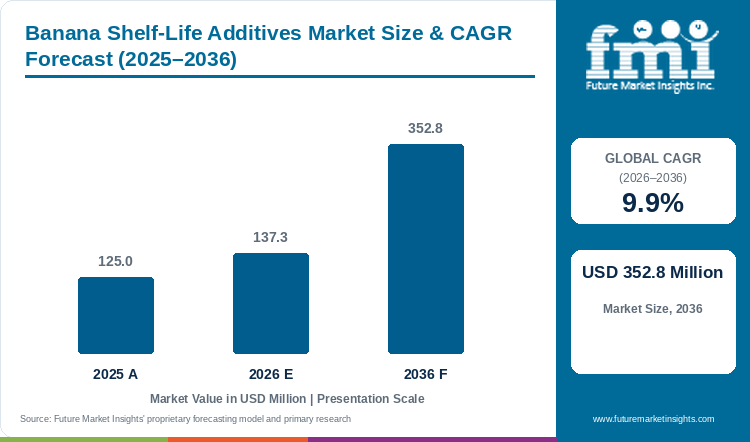
Banana shelf-life additives market has been gaining demand owing to high losses of fresh produce during storage and transportation. The market was valued at USD 125.0 million in 2025 and is projected to grow from USD 137.3 million in 2026 to USD 352.8 million by 2036, at 9.9% CAGR. Edible coatings accounted for 43.7% share in 2026, as coatings can be applied after washing through existing packhouse equipment. According to FAO, 13.3% of food production, equal to 1.31 billion tonnes, was lost between harvest and retail, while fruit and vegetables recorded 25.4% loss in 2025.[1] Apart from that, USDA recorded 9.2 billion pounds of fresh banana imports in the USA during 2024.[2] Such large movement of banana through ports and ripening rooms creates regular need for retaining firmness and saleable condition. In January 2025, Hazel Technologies reported two to six additional days of cucumber shelf life and up to 5% weight loss under other packaging options.[7] These factors are expected to support banana shelf-life additives market growth.
Key Market Trends & Insights
- By product type, edible coatings led with 43.7% share in 2026, owing to easy application after fruit washing.
- By commodity, pome and stone fruit accounted for 45.2% share in 2026, attributed to established coating and cold-storage programs.
- By application point, packhouse use held 37.4% share in 2026, due to washing, dosing and packing being available at one place.
- By technology base, biological or microbial treatments represented 45.0% share in 2026, aided by lower-residue positioning.
- By sales channel, packhouse suppliers generated 45.1% of sales in 2026. In March 2026, StePacPPC stated that its Hermosillo office enables same-day shipment within Sonora and one-day delivery to Sinaloa.[11]
Regional Highlights
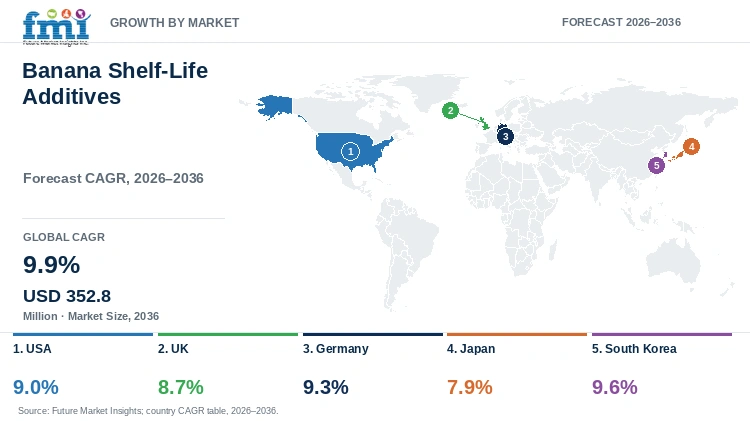
- Fastest-growing profiled country: South Korea (9.6% CAGR, 2026 to 2036).
- Germany (9.3%) and the USA (9.0%) follow, while Japan records the lowest profiled CAGR at 7.9%.
Market Size & Forecast
Table 1: Market Size and Forecast for the Banana Shelf-Life Additives Market (USD million), 2025 to 2036
| Metric | Value |
|---|---|
| 2025 Market Size | USD 125.0 million |
| Estimated Market Size in 2026 | USD 137.3 million |
| Projected Market Size by 2036 | USD 352.8 million |
| CAGR, 2026 to 2036 | 9.9% |
| Added Revenue, 2026 to 2036 | USD 215.5 million |
| Market Expansion Multiple | 2.57x |
Bananas continue ripening after harvest, so treatment demand depends on storage duration, transport route and later color development. The USA import base of 9.2 billion pounds in 2024 represents a large quantity passing through ports, ripening rooms and retail distribution. StePacPPC reported that inventory in Hermosillo can support same-day shipment within Sonora and one-day delivery to Sinaloa.[11] Nearby supply is useful during seasonal packing programs when coatings, liners and post-harvest treatments require fast replenishment. Hazel Technologies also reported two to six additional days of cucumber shelf life from membrane packaging.[7] Additional handling time has value only when fruit reaches required color and eating quality after release. Therefore, route trial, dosage record and destination residue requirement are expected to decide regular purchasing.
Post-Harvest Loss and Treatment Demand Indicators
Table 2: Post-Harvest Loss and Treatment Demand Indicators for the Banana Shelf-Life Additives Market (percent, pounds, days, delivery time, and USD million), mixed reporting years from 2024 to 2036
| Indicator | Data Point | Why It Matters | Source |
|---|---|---|---|
| Fruit and vegetable food loss | 25.4% in 2025 | Shows the fresh-produce base exposed to post-harvest quality loss | [1] |
| USA fresh banana imports | 9.2 billion pounds in 2024 | Creates recurring treatment opportunity across ports, ripening rooms and retail distribution | [2] |
| Membrane-packaging shelf-life result | 2 to 6 additional days in 2025 | Shows the distribution time that controlled-atmosphere formats can add | [7] |
| Weight-loss exposure | Up to 5% for other packaging options in 2025 | Connects moisture control with saleable product retained | [7] |
| Regional packaging delivery | Same day in Sonora; one day to Sinaloa in 2026 | Shows how local inventory can support seasonal replenishment | [11] |
| Added market revenue | USD 215.5 million, 2026 to 2036 | Measures the absolute revenue expected to be added during the forecast period | Calculated from report values |
Basis: Added revenue equals USD 352.8 million less USD 137.3 million. Market expansion multiple equals USD 352.8 million divided by USD 137.3 million. Source years differ by indicator and are stated in the table.
Analyst Perspective
“Packers will prefer treatments which protects firmness and allows banana to reach expected color after release. Route evidence and dosage records will decide whether product trials develops into regular purchasing.”
- Nandini Roy Choudhury, Principal Consultant, Future Market Insights.
How is the banana shelf-life additives market segmented?
banana shelf-life additives market is segmented on the basis of product type, commodity, application point, technology base, sales channel and region. Edible coatings are projected to account for 43.7% share in 2026, while pome and stone fruit are estimated to hold 45.2% share. Packhouse application, biological or microbial technology and packhouse suppliers are projected to account for 37.4%, 45.0% and 45.1% share, respectively. Higher shares of these segments are attributed to established treatment practices, lower-residue preference and availability of line-level application support.
By product type: edible coatings, active sachets and liners, wash and drench treatments, storage-room treatments, and others.
By commodity: pome and stone fruit, citrus, berries and grapes, tropical fruit, vegetables, and others.
By application point: packhouse, storage facility, transit and retail, and others.
By technology base: biological or microbial, plant-extract-based, mineral and wax-based, and others.
By sales channel: packhouse suppliers, post-harvest service providers, direct sales, and others.
By region: North America, Latin America, Western Europe, Eastern Europe, East Asia, South Asia and Pacific, and Middle East and Africa.
Why do edible coatings retain a notable product type share?
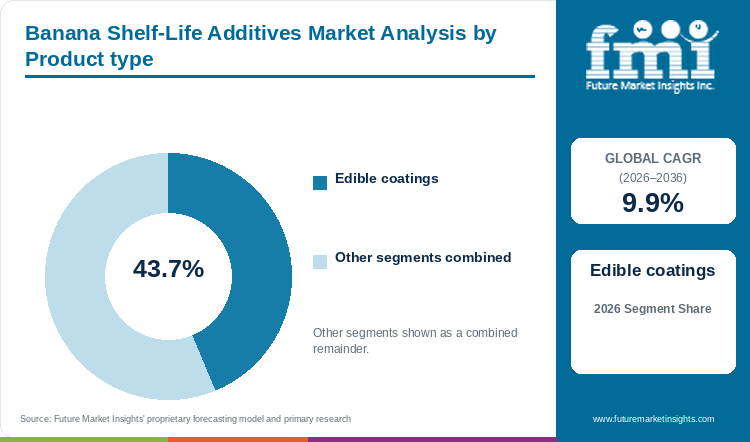
Based on product type, edible coatings are projected to hold 43.7% share in 2026, supported by familiar packhouse application after washing.
Table 3: Product Type Share for the Banana Shelf-Life Additives Market (percentage share), 2026
| Product Type | Share (2026) |
|---|---|
| Edible Coatings | 43.7% |
| Other Segments Combined | 56.3%* |
| Total | 100.0% |
*Calculated as the balance remaining after deducting the leading segment's reported share from 100.0%.
Table 4: Product Type Leadership and Market Growth for the Banana Shelf-Life Additives Market (segment and CAGR percentage), 2026 to 2036
| Metric | Value |
|---|---|
| Global CAGR (2026 to 2036) | 9.9% |
| Leading Segment | Edible Coatings |
Edible coatings forms a thin layer on the fruit surface and reduces exchange of moisture after washing. These coatings are applied by waxing and dosing equipment which are already available across several packhouses. Due to this, packers can include edible coatings in existing fruit handling lines without developing a separate storage-room treatment process. In January 2025, Hazel Technologies reported that membrane packaging extended cucumber shelf life and reduced weight loss.[7] Increasing use of surface and atmosphere control for maintaining fresh-produce condition is expected to support edible coatings segment growth.
- Edible coatings are projected to hold 43.7% of product type demand in 2026 owing to familiar packhouse application after washing.
- Application of coatings after washing through available packhouse equipment is expected to increase repeat demand.
What supports pome and stone fruit within commodity demand?
Pome and stone fruit are estimated to account for 45.2% of commodity demand in 2026, attributed to established coating and cold-storage programs.
Pome and stone fruit are handled under defined harvest, coating and cold-storage programs. Packers can apply shelf-life additives at a fixed treatment stage and can check decay, firmness and weight loss before fruit enters retail distribution. In September 2025, DECCO opened a new post-harvest plant in Valencia for increasing regional availability of fruit treatments.[8] Presence of treatment supply near seasonal fruit-producing locations is likely to increase regular use among pome and stone fruit packers. These factors are expected to maintain 45.2% share of pome and stone fruit segment in 2026.
- Pome and stone fruit are estimated to hold 45.2% of commodity demand in 2026 as storage programs support repeat treatment.
- Defined harvest and storage schedules supports comparison of firmness, decay and weight outcomes before repeat purchasing.
How does packhouse use meet application-point requirements?
Packhouse application is expected to hold 37.4% of application-point demand in 2026, enabled by centralized washing, dosing, and packing infrastructure.
Packhouses brings sorting, washing, dosing and packing activities at one place before fruit enters storage and transportation. Availability of these operations allows packers to check dosage and coating coverage during the same handling process. In September 2025, Citrosol completed reconstruction and expansion of its manufacturing plant for supporting treatment chemistry and application control.[10] Expansion of centralized fruit treatment locations along with availability of dosing equipment is expected to support packhouse application. Owing to these factors, packhouse use is projected to account for 37.4% share in 2026.
- Packhouse use is expected to account for 37.4% of application-point demand in 2026 because dosage can be checked before shipping.
- Centralized dosing allows packers to check concentration and coverage before fruit is supplied for transportation.
Why are biological technologies relevant to shelf-life treatment?
Biological or microbial technologies are projected to capture 45.0% of technology base revenue in 2026, aided by compliant lower-residue positioning.
Biological or microbial treatments are increasingly used where packers requires lower-residue methods for extending fresh-produce life. These products are also used according to crop, dosage and treatment conditions stated under the approval. In July 2026, ANSES Ephy listed Xeda International BIOXEDA for defined post-harvest pome-fruit uses.[9] Availability of biological treatment under formal conditions is increasing confidence among packers looking for residue-controlled products. Rising preference for bio-based post-harvest treatment is anticipated to support 45.0% share of biological or microbial technologies in 2026.
- Biological or microbial technologies are projected at 45.0% in 2026 because buyers seek defined low-residue treatment routes.
- Biological positioning continues to require compliance with crop use, dosage and destination residue requirement.
Which conditions keep packhouse suppliers important in sales channels?
Packhouse suppliers are set to lead the sales channel category with 45.1% share in 2026, underpinned by direct line-level service access.
Packhouse suppliers provides formulations, seasonal inventory and dosing support to fresh-produce operators. Fruit maturity, destination and treatment condition can differ between one shipment and another, due to which technical support is required during application. In March 2026, StePacPPC opened a Hermosillo office with local inventory, technical support and logistics coordination.[11] Nearby inventory can reduce delay in treatment replenishment during seasonal programs. Availability of product and application support together is expected to maintain 45.1% share of packhouse suppliers in 2026.
- Packhouse suppliers are projected to hold 45.1% of sales in 2026 because treatment and line support are purchased together.
- Local inventory and technical support reduces time required between treatment trial, dosage correction and regular purchasing.
What are the drivers, restraints, and opportunities in the banana shelf-life additives market?
Post-harvest loss control is the primary driver for banana shelf-life additives market. Treatment qualification is a major restraint, whereas sachets, liners and simple delivery systems are creating growth opportunities.
- Driver: Rising requirement to reduce weight loss, decay and rejected fruit is increasing demand for shelf-life treatments.
- Restraint: Difference in crop maturity, residue limits and destination rules may limiting regular adoption.
- Opportunity: Sachets, liners and active packaging can widen treatment application without sealed rooms or major line changes.
Post-Harvest Loss Supports Treatment
Fruit and vegetables faces weight loss, decay and quality reduction after harvesting. Bananas continues ripening during storage and transportation, which in turn reduces firmness before retail sale. In May 2025, a USDA Forest Service research study demonstrated that plant-based barrier coatings delayed banana peel browning by two days and reduced fruit weight loss by up to 33%.[19] Shelf-life additives are applied for slowing moisture loss and retaining saleable fruit condition across present handling steps. Rejection of overripe and damaged fruit creates losses for packers and distributors, elevating demand for structured food waste management. An FMI analyst notes that protecting saleable fruit volume is expected to drive banana shelf-life additives market growth.
Qualification Narrows Commercial Adoption
Residue requirement and approved treatment conditions differs according to crop and destination country. The European Commission maintained maximum residue levels for food and agricultural products under its 2025 pesticide-residue framework.[15] As a result, suppliers needs crop-use, dosage and residue information before produce packaging treatments are adopted for imported fruit. Packers also tests treatment timing, maturity and later color development before regular use. Longer qualification process and difference in destination requirement may hamper the growth of banana shelf-life additives market.
Simple Delivery Opens New Routes
Sachets, liners and active packaging are placed along with produce and does not always requires a sealed storage room or major modification in the packhouse line. In May 2026, StePacPPC transitioned its flexible-packaging manufacturing system to FSSC 22000 Version 6.[12] The certification provides a food-safety reference for fresh-produce packaging buyers. Simple treatment formats can be used by packers having limited dosing and storage infrastructure. Introduction of crop-specific sachets and liners is expected to create new growth opportunities in banana shelf-life additives market.
Which country CAGRs are profiled in the banana shelf-life additives market?
Table 5: Competitive Benchmarking for the Banana Shelf-Life Additives Market (qualitative capability ratings), 2026
| Country | CAGR |
|---|---|
| USA | 9.0% |
| UK | 8.7% |
| Germany | 9.3% |
| Japan | 7.9% |
| South Korea | 9.6% |
How do country-level CAGRs compare in the banana shelf-life additives market?
FMI data suggests that country demand differs through 2036 owing to import volume, food-loss reduction and residue requirement. South Korea banana shelf-life additives market is projected to grow at 9.6% CAGR, whereas Germany market is anticipated to expand at 9.3% CAGR. The USA and UK markets are estimated to rise at 9.0% and 8.7% CAGR, respectively, while Japan is projected to grow at 7.9% CAGR. Higher growth of South Korea is attributed to preference for low-residue treatment formats, whereas food-waste reduction activities are expected to support Germany market demand.
Large banana imports increases treatment opportunities, whereas residue and conformity requirement decides regular use of the product.
- USA demand is connected with large recurring banana imports and treatment opportunities along long inbound routes.
- The UK links arrival quality with import notification, inspection, and conformity requirements for specified fresh produce.
- Germany combines food-waste reduction policy with European residue and marketing controls.
- Japan’s food-loss targets support usable-life extension when ripening remains predictable at sale.
- South Korea’s Positive List System makes residue documentation central to imported tropical-fruit treatment.
Full report country CAGRs cover: North America; Latin America; Western Europe; Eastern Europe; East Asia; South Asia and Pacific; Middle East and Africa.
Country-wise Analysis
- Banana shelf-life additive sales in the USA are forecast to expand at 9.0% CAGR through 2036. USDA reported that fresh banana imports reached 9.2 billion pounds during 2024, which was the highest volume since 2018.[2] Large quantity of banana passes through ocean transport, ports, ripening rooms and distribution centers before reaching retail stores. This increases the time during which banana firmness and color has to be maintained. Rising use of route-tested coatings, sachets and liners across higher import volume is expected to support the USA banana shelf-life additives market growth.
- The UK banana shelf-life additives market is projected to grow at 8.7% CAGR between 2026 and 2036. Government guidance updated in September 2026 moved planned EU fruit, vegetable and green-banana controls to February 2027, whereas existing marketing-standard procedures continued for non-EU produce.[3] Shelf-life additives can retain fruit condition during import; however, treatment does not replace notification, inspection and conformity requirement. Increasing preference for products having traceable application records and predictable ripening is anticipated to propel market demand in the UK.
- Germany banana shelf-life additives demand is anticipated to advance at 9.3% CAGR through 2036. A federal update published in June 2025 reported nearly 10.8 million tonnes of food waste in Germany for 2022.[4] Fresh fruit is supplied through retail networks which are increasingly focusing on reduction of avoidable food losses. Shelf-life additives can provide more handling time and retain saleable quality when products meets European residue requirement. Growing focus on food-waste reduction along with stable fruit ripening is expected to fuel market growth in Germany.
- Demand for banana shelf-life additives in Japan is predicted to expand at 7.9% CAGR through 2036. The Ministry of Agriculture, Forestry and Fisheries reported food loss of 4.64 million tonnes during fiscal 2023 and established a new 2030 target for business-related food loss in October 2025.[5] Imported bananas requires controlled storage time and needs to obtain suitable color and eating quality after release. Treatments which provides additional distribution time without affecting later ripening are expected to support Japan banana shelf-life additives market growth.
- South Korea banana shelf-life additives market is estimated to grow at 9.6% CAGR during the forecast period. The Positive List System applies a default level of 0.01 mg/kg where a pesticide residue limit is not established, and official guidance uses banana residue as an example of unestablished crop use.[6] Due to this, importers requires clear treatment status, dosage and destination documents before using shelf-life additives. Increasing preference for low-residue and non-contact formats is likely to support higher market revenue growth in South Korea.
Who are the notable companies in the banana shelf-life additives market?
Hazel Technologies, DECCO, Pace International, Xeda International, Citrosol, Fomesa Fruitech, JBT Marel, and StePacPPC are notable companies profiled in this market.
According to FMI, banana shelf-life additives market is moderately fragmented with presence of post-harvest treatment suppliers, active-packaging companies and packhouse equipment manufacturers. Hazel Technologies and StePacPPC offers atmosphere-control and fresh food packaging formats. DECCO, Pace International, Xeda International, Citrosol and Fomesa Fruitech supplies coatings and post-harvest treatments, whereas JBT Marel offers formulations together with dosing and packhouse equipment. Some of the prominent players are expanding crop coverage, regional inventory and technical support in order to cater the growing demand. Expansion of product portfolio and local supply is expected to increase customer base and market share.
- Atmosphere and active-packaging specialists: Hazel Technologies and StePacPPC manage gas conditions or ethylene exposure after packing.
- Post-harvest formulation specialists: DECCO, Pace International, Xeda International, Citrosol, and Fomesa Fruitech supply coatings or decay-control treatments.
- Integrated packhouse systems: JBT Marel links treatment formulations with washing, dosing, and coating equipment.
Competitive Benchmarking: Banana Shelf-Life Additives Market
Table 6: Research Methodology for the Banana Shelf-Life Additives Market (research methods and approach), 2026 edition
| Company | Atmosphere control | Surface treatment | Application fit | Reach |
|---|---|---|---|---|
| Hazel Technologies | High | Medium | Medium | High |
| DECCO | Medium | High | High | High |
| Pace International | Medium | High | High | High |
| Xeda International | Low | High | Medium | Medium |
| Citrosol | Low | High | High | High |
| Fomesa Fruitech | Low | Medium | Medium | Medium |
| JBT Marel | Low | High | High | High |
| StePacPPC | High | Low | Medium | High |
High represents wider documented capability, Medium represents specific capability and Low represents lower documented breadth. These ratings presents public capability and does not indicate product quality, company revenue or market ranking.
Key Developments in the Banana Shelf-Life Additives Market
- In May 2026, StePacPPC transitioned its flexible-packaging manufacturing system to FSSC 22000 Version 6. This development provides a current food-safety certification reference for active produce packaging.
- In March 2026, StePacPPC opened a regional office in Hermosillo with local inventory, technical support and logistics coordination. Expansion of local availability is expected to reduce replenishment time for nearby fresh-produce customers.
- In September 2025, DECCO announced a new post-harvest plant in Valencia. The new plant is expected to increase regional availability of post-harvest treatments.
- In September 2025, Citrosol completed reconstruction and expansion of its manufacturing plant. The expansion supports increasing production and international supply of treatment products.
Key Players in the Banana Shelf-Life Additives Market
Atmosphere and active-packaging specialists
- Hazel Technologies
- StePacPPC
Post-harvest chemistry and coating specialists
- DECCO
- Pace International
- Xeda International
- Citrosol
- Fomesa Fruitech
Integrated packhouse systems
- JBT Marel
Banana Shelf-Life Additives Market - Report Scope
Table 7: Report Scope for the Banana Shelf-Life Additives Market (coverage fields and definitions), 2026 to 2036
| Coverage field | Report scope |
|---|---|
| Market breakdown | Product type; commodity; application point; technology base; sales channel; region. |
| Quantitative units | USD million. |
| Market definition | Supplier revenue from post-harvest additives, coatings, active sachets, and qualifying liners used to extend saleable fresh-produce life. Generic passive packaging and unrelated logistics services are excluded. |
| Regions covered | North America; Latin America; Western Europe; Eastern Europe; East Asia; South Asia and Pacific; Middle East and Africa. |
| Countries covered | USA, UK, Germany, Japan, South Korea, and additional countries in the full report. |
| Key companies profiled | Hazel Technologies, DECCO, Pace International, Xeda International, Citrosol, Fomesa Fruitech, JBT Marel, StePacPPC. |
| Forecast period | 2026 to 2036. |
| Approach | The report covers product type, commodity, application point, technology base, sales channel and regional demand within the defined banana shelf-life additives market. |
Banana Shelf-Life Additives Market - Research Methodology
| Method | Approach |
|---|---|
| Primary Research | The research study includes primary interviews with manufacturers, service providers, technology developers, distributors, end users, procurement teams and industry experts. The interviews covers purchasing decision, product evaluation, pricing, adoption barriers, approval requirement and technical support. Respondents are also asked regarding the evidence required before a product trial develops into regular purchasing. |
| Desk Research | Desk research includes government statistics, regulatory publications, trade data, industry association material, technical literature, company filings, product pages and official company announcements. Every source is checked according to its date, geographic coverage and relevance to banana shelf-life additives market. |
| Market Sizing and Forecasting | Market sizing combines baseline market value, historical performance, segment share, price and volume indicators, adoption level, company participation and country demand. The forecast considers economic activity, regulation, technology adoption, purchasing cycle and availability of treatment products. Segment and regional estimates are reconciled with the final banana shelf-life additives market value. |
| Data Validation | Market estimates are checked with public statistics, company developments, trade movement and primary interview findings. Validation also checks whether product, application and supplier revenue falls within the stated market definition. Generic passive packaging, unrelated services, unsupported claims and overlapping revenue are excluded for reducing double counting. |
Banana Shelf-Life Additives Market by Segments
Product type
- Edible coatings
- Active sachets and liners
- Wash and drench treatments
- Storage-room treatments
- Others
Commodity
- Pome and stone fruit
- Citrus
- Berries and grapes
- Tropical fruit
- Vegetables
- Others
Application point
- Packhouse
- Storage facility
- Transit and retail
- Others
Technology base
- Biological or microbial
- Plant-extract-based
- Mineral and wax-based
- Others
Sales channel
- Packhouse suppliers
- Post-harvest service providers
- Direct sales
- Others
Banana Shelf-Life Additives Market by Region
- North America
- United States
- Canada
- Latin America
- Brazil
- Mexico
- Argentina
- Chile
- Western Europe
- Germany
- France
- United Kingdom
- Italy
- Spain
- Benelux
- Nordics
- Eastern Europe
- Poland
- Czech Republic
- Romania
- Hungary
- East Asia
- Japan
- South Korea
- Taiwan
- South Asia and Pacific
- ASEAN
- Australia and New Zealand
- Bangladesh
- Middle East and Africa
- GCC Countries
- South Africa
- Türkiye
- Israel
Research Sources and Bibliography
- [1] Food and Agriculture Organization of the United Nations. (2025, September 29). On the International Day of Awareness of Food Loss and Waste, learn how FAO is leveraging data to save food and advance the 2030 Agenda. https://www.fao.org/statistics/highlights-archive/highlights-detail/on-the-international-day-of-awareness-of-food-loss-and-waste--learn-how-fao-is-leveraging-data-to-save-food-and-advance-the-2030-agenda/en
- [2] U.S. Department of Agriculture, Economic Research Service. (2025, July 24). Fruit and Tree Nuts Outlook: July 2025. https://ers.usda.gov/sites/default/files/_laserfiche/outlooks/113001/FTS-382.pdf
- [3] Department for Environment, Food & Rural Affairs. (2026, September 17). Importing and exporting fresh fruit and vegetables. https://www.gov.uk/guidance/importing-and-exporting-fresh-fruit-and-vegetables
- [4] Federal Ministry of Agriculture, Food and Regional Identity. (2025, June 6). Food waste in Germany: Current figures by sector. https://www.bmleh.de/EN/topics/food-and-nutrition/food-waste/food-waste-latest-figures.html
- [5] Ministry of Agriculture, Forestry and Fisheries of Japan. (2025, October). Current status of food loss reduction.
- [6] Ministry of Food and Drug Safety, Republic of Korea. (2026). Positive List System for agricultural products.
- [7] Hazel Technologies. (2025, January 8). Membrane packaging extends shelf life of cucumbers and reduces weight loss.
- [8] DECCO. (2025, September 23). DECCO expands global footprint with new plant in Valencia, Spain.
- [9] ANSES Ephy. (2026, July 6). BIOXEDA XEDA INTERNATIONAL.
- [10] Citrosol. (2025, September 25). Citrosol expands its global footprint.
- [11] StePacPPC. (2026, March 6). StePacPPC opens new regional office in Hermosillo, Mexico.
- [12] StePacPPC. (2026, May 24). Transition to FSSC 22000 certification.
- [13] DECCO. (2025, January 21). DECCO Ibérica receives registration for DECCO Zox.
- [14] Hazel Technologies. (2025, February 3). Modified atmosphere packaging solution helps improve melon quality.
- [15] European Commission. (2025). Maximum residue levels.
- [16] StePacPPC. (2026, September 29). StePacPPC resealable pouches boost shelf appeal and prolong freshness of moisture-sensitive produce.
- [17] StePacPPC. (2026, January 19). StePacPPC advanced packaging extends global access of dragon fruit.
- [18] StePacPPC. (2025, July 2). Recyclable lidding film as an alternative to traditional clamshells.
- [19] U.S. Department of Agriculture, Forest Service. (2025, May). Barrier coating of bananas using plant cellulose and edible lemon peel fibrils to extend shelf life.https://research.fs.usda.gov/treesearch/81130
This bibliography is provided for reader reference. The full report contains the complete reference list and detailed citations.
This Report Answers
- How large is Banana Shelf-Life Additives Market during 2026?
- What value is Banana Shelf-Life Additives Market projected by 2036?
- Which product type holds notable Banana Shelf-Life Additives Market share?
- Which commodity holds notable Banana Shelf-Life Additives Market share?
- Which countries have notable Banana Shelf-Life Additives Market growth?
- Which companies are notable in Banana Shelf-Life Additives Market today?
Frequently Asked Questions
How large is the Banana Shelf-Life Additives Market expected in 2026?
As per the analysis from FMI, the banana shelf-life additives market is valued at USD 137.3 million in 2026 and is projected to reach USD 352.8 million by 2036.
What CAGR is forecast for Banana Shelf-Life Additives through 2036?
FMI research indicates that the banana shelf-life additives market will grow at 9.9% CAGR between 2026 and 2036.
Which product type holds notable market share during 2026?
Edible coatings are projected to hold 43.7% of product type demand in 2026 owing to familiar packhouse application after washing.
Which commodity segment holds notable share during 2026?
Pome and stone fruit are estimated to account for 45.2% of commodity demand in 2026 owing to defined harvest, coating and cold-storage schedules.
Which country has a notable expansion outlook through 2036?
South Korea banana shelf-life additives demand is projected to expand at 9.6% CAGR between 2026 and 2036.
Which companies are active in this market during 2026?
Notable companies include Hazel Technologies, DECCO, Pace International, Xeda International, Citrosol, Fomesa Fruitech, JBT Marel and StePacPPC.
Preview the report firsthand - request a free sample
Get SampleGet the brochure for pricing and purchase details.
Get PDFTable of Content
- Key Takeaways
- Market Size and CAGR
- Top Growth Driver
- Fastest Growing Segment
- Leading Region
- Key Companies
- Emerging Opportunities
- Executive Summary
- Global Market Outlook
- Demand-side Trends
- Supply-side Trends
- Technology Roadmap Analysis
- Analysis and Recommendations
- Analyst Perspective (What is happening? Why now? What should investors know?)
- Key Questions Answered
- How large is the market?
- What is the CAGR?
- What are key trends?
- Which region dominates?
- Who are the leaders?
- Market Overview
- Market Coverage / Taxonomy
- Market Definition / Scope / Limitations
- Research Methodology
- Chapter Orientation
- Analytical Lens and Working Hypotheses
- Market Structure, Signals, and Trend Drivers
- Benchmarking and Cross-market Comparability
- Market Sizing, Forecasting, and Opportunity Mapping
- Research Design and Evidence Framework
- Desk Research Programme (Secondary Evidence)
- Expert Input and Fieldwork (Primary Evidence)
- Tooling, Models, and Reference Databases
- Data Engineering and Model Build
- Quality Assurance and Audit Trail
- Market Background
- Market Dynamics (Drivers, Restraints, Opportunity, Trends)
- Scenario Forecast (Optimistic, Likely, Conservative)
- Impact Analysis
- AI Impact
- Sustainability Impact
- Regulatory Impact
- Technology Impact
- Consumer / Buyer Analysis
- Purchase Drivers
- Adoption Barriers
- Buyer Journey
- Opportunity Map Analysis
- Product Life Cycle Analysis
- Supply Chain Analysis
- Investment Feasibility Matrix
- Value Chain Analysis
- PESTLE and Porter's Analysis
- Regulatory Landscape
- Regional Parent Market Outlook
- Production and Consumption Statistics
- Import and Export Statistics
- Global Market Analysis and Forecast, 2021 to 2036
- Historical Market Size Value (USD Million) Analysis, 2021 to 2025
- Current and Future Market Size Value (USD Million) Projections, 2026 to 2036
- Y-o-Y Growth Trend Analysis
- Absolute $ Opportunity Analysis
- Global Market Pricing Analysis, 2021 to 2036
- Global Market Analysis and Forecast, By Product type, 2021 to 2036
- Introduction / Key Findings
- Historical Market Size Value (USD Million) Analysis By Product type, 2021 to 2025
- Current and Future Market Size Value (USD Million) Analysis and Forecast By Product type, 2026 to 2036
- Edible coatings
- Active sachets and liners
- Wash and drench treatments
- Storage-room treatments
- Others
- Y-o-Y Growth Trend Analysis By Product type, 2021 to 2025
- Absolute $ Opportunity Analysis By Product type, 2026 to 2036
- Global Market Analysis and Forecast, By Commodity, 2021 to 2036
- Introduction / Key Findings
- Historical Market Size Value (USD Million) Analysis By Commodity, 2021 to 2025
- Current and Future Market Size Value (USD Million) Analysis and Forecast By Commodity, 2026 to 2036
- Pome and stone fruit
- Citrus
- Berries and grapes
- Tropical fruit
- Vegetables
- Others
- Y-o-Y Growth Trend Analysis By Commodity, 2021 to 2025
- Absolute $ Opportunity Analysis By Commodity, 2026 to 2036
- Global Market Analysis and Forecast, By Application point, 2021 to 2036
- Introduction / Key Findings
- Historical Market Size Value (USD Million) Analysis By Application point, 2021 to 2025
- Current and Future Market Size Value (USD Million) Analysis and Forecast By Application point, 2026 to 2036
- Packhouse
- Storage facility
- Transit and retail
- Others
- Y-o-Y Growth Trend Analysis By Application point, 2021 to 2025
- Absolute $ Opportunity Analysis By Application point, 2026 to 2036
- Global Market Analysis and Forecast, By Technology base, 2021 to 2036
- Introduction / Key Findings
- Historical Market Size Value (USD Million) Analysis By Technology base, 2021 to 2025
- Current and Future Market Size Value (USD Million) Analysis and Forecast By Technology base, 2026 to 2036
- Biological or microbial
- Plant-extract-based
- Mineral and wax-based
- Others
- Y-o-Y Growth Trend Analysis By Technology base, 2021 to 2025
- Absolute $ Opportunity Analysis By Technology base, 2026 to 2036
- Global Market Analysis and Forecast, By Sales channel, 2021 to 2036
- Introduction / Key Findings
- Historical Market Size Value (USD Million) Analysis By Sales channel, 2021 to 2025
- Current and Future Market Size Value (USD Million) Analysis and Forecast By Sales channel, 2026 to 2036
- Packhouse suppliers
- Post-harvest service providers
- Direct sales
- Others
- Y-o-Y Growth Trend Analysis By Sales channel, 2021 to 2025
- Absolute $ Opportunity Analysis By Sales channel, 2026 to 2036
- Global Market Analysis and Forecast, By Region, 2021 to 2036
- Introduction
- Historical Market Size Value (USD Million) Analysis By Region, 2021 to 2025
- Current Market Size Value (USD Million) Analysis and Forecast By Region, 2026 to 2036
- North America
- Latin America
- Western Europe
- Eastern Europe
- East Asia
- South Asia and Pacific
- Middle East and Africa
- Market Attractiveness Analysis By Region
- North America Market Analysis and Forecast, By Country, 2021 to 2036
- Historical Market Size Value (USD Million) Trend Analysis By Market Taxonomy, 2021 to 2025
- Market Size Value (USD Million) Forecast By Market Taxonomy, 2026 to 2036
- By Country
- United States
- Canada
- By Product type
- By Commodity
- By Application point
- By Technology base
- By Sales channel
- By Country
- Market Attractiveness Analysis
- By Country
- By Product type
- By Commodity
- By Application point
- By Technology base
- By Sales channel
- Key Takeaways
- Latin America Market Analysis and Forecast, By Country
- Historical Market Size Value (USD Million) Trend Analysis By Market Taxonomy, 2021 to 2025
- Market Size Value (USD Million) Forecast By Market Taxonomy, 2026 to 2036
- By Country
- Brazil
- Mexico
- Argentina
- Chile
- By Product type
- By Commodity
- By Application point
- By Technology base
- By Sales channel
- By Country
- Market Attractiveness Analysis
- By Country
- By Product type
- By Commodity
- By Application point
- By Technology base
- By Sales channel
- Key Takeaways
- Western Europe Market Analysis and Forecast, By Country
- Historical Market Size Value (USD Million) Trend Analysis By Market Taxonomy, 2021 to 2025
- Market Size Value (USD Million) Forecast By Market Taxonomy, 2026 to 2036
- By Country
- Germany
- France
- United Kingdom
- Italy
- Spain
- Benelux
- Nordics
- By Product type
- By Commodity
- By Application point
- By Technology base
- By Sales channel
- By Country
- Market Attractiveness Analysis
- By Country
- By Product type
- By Commodity
- By Application point
- By Technology base
- By Sales channel
- Key Takeaways
- Eastern Europe Market Analysis and Forecast, By Country
- Historical Market Size Value (USD Million) Trend Analysis By Market Taxonomy, 2021 to 2025
- Market Size Value (USD Million) Forecast By Market Taxonomy, 2026 to 2036
- By Country
- Poland
- Czech Republic
- Romania
- Hungary
- By Product type
- By Commodity
- By Application point
- By Technology base
- By Sales channel
- By Country
- Market Attractiveness Analysis
- By Country
- By Product type
- By Commodity
- By Application point
- By Technology base
- By Sales channel
- Key Takeaways
- East Asia Market Analysis and Forecast, By Country
- Historical Market Size Value (USD Million) Trend Analysis By Market Taxonomy, 2021 to 2025
- Market Size Value (USD Million) Forecast By Market Taxonomy, 2026 to 2036
- By Country
- Japan
- South Korea
- Taiwan
- By Product type
- By Commodity
- By Application point
- By Technology base
- By Sales channel
- By Country
- Market Attractiveness Analysis
- By Country
- By Product type
- By Commodity
- By Application point
- By Technology base
- By Sales channel
- Key Takeaways
- South Asia and Pacific Market Analysis and Forecast, By Country
- Historical Market Size Value (USD Million) Trend Analysis By Market Taxonomy, 2021 to 2025
- Market Size Value (USD Million) Forecast By Market Taxonomy, 2026 to 2036
- By Country
- ASEAN
- Australia and New Zealand
- Bangladesh
- By Product type
- By Commodity
- By Application point
- By Technology base
- By Sales channel
- By Country
- Market Attractiveness Analysis
- By Country
- By Product type
- By Commodity
- By Application point
- By Technology base
- By Sales channel
- Key Takeaways
- Middle East and Africa Market Analysis and Forecast, By Country
- Historical Market Size Value (USD Million) Trend Analysis By Market Taxonomy, 2021 to 2025
- Market Size Value (USD Million) Forecast By Market Taxonomy, 2026 to 2036
- By Country
- GCC Countries
- South Africa
- Türkiye
- Israel
- By Product type
- By Commodity
- By Application point
- By Technology base
- By Sales channel
- By Country
- Market Attractiveness Analysis
- By Country
- By Product type
- By Commodity
- By Application point
- By Technology base
- By Sales channel
- Key Takeaways
- Key Countries Market Analysis
- United States
- Pricing Analysis
- Market Share Analysis, 2025
- By Product type
- By Commodity
- By Application point
- By Technology base
- By Sales channel
- Canada
- Pricing Analysis
- Market Share Analysis, 2025
- By Product type
- By Commodity
- By Application point
- By Technology base
- By Sales channel
- Mexico
- Pricing Analysis
- Market Share Analysis, 2025
- By Product type
- By Commodity
- By Application point
- By Technology base
- By Sales channel
- Brazil
- Pricing Analysis
- Market Share Analysis, 2025
- By Product type
- By Commodity
- By Application point
- By Technology base
- By Sales channel
- Chile
- Pricing Analysis
- Market Share Analysis, 2025
- By Product type
- By Commodity
- By Application point
- By Technology base
- By Sales channel
- Germany
- Pricing Analysis
- Market Share Analysis, 2025
- By Product type
- By Commodity
- By Application point
- By Technology base
- By Sales channel
- United Kingdom
- Pricing Analysis
- Market Share Analysis, 2025
- By Product type
- By Commodity
- By Application point
- By Technology base
- By Sales channel
- Italy
- Pricing Analysis
- Market Share Analysis, 2025
- By Product type
- By Commodity
- By Application point
- By Technology base
- By Sales channel
- Spain
- Pricing Analysis
- Market Share Analysis, 2025
- By Product type
- By Commodity
- By Application point
- By Technology base
- By Sales channel
- France
- Pricing Analysis
- Market Share Analysis, 2025
- By Product type
- By Commodity
- By Application point
- By Technology base
- By Sales channel
- ASEAN
- Pricing Analysis
- Market Share Analysis, 2025
- By Product type
- By Commodity
- By Application point
- By Technology base
- By Sales channel
- Australia and New Zealand
- Pricing Analysis
- Market Share Analysis, 2025
- By Product type
- By Commodity
- By Application point
- By Technology base
- By Sales channel
- Japan
- Pricing Analysis
- Market Share Analysis, 2025
- By Product type
- By Commodity
- By Application point
- By Technology base
- By Sales channel
- South Korea
- Pricing Analysis
- Market Share Analysis, 2025
- By Product type
- By Commodity
- By Application point
- By Technology base
- By Sales channel
- Poland
- Pricing Analysis
- Market Share Analysis, 2025
- By Product type
- By Commodity
- By Application point
- By Technology base
- By Sales channel
- Hungary
- Pricing Analysis
- Market Share Analysis, 2025
- By Product type
- By Commodity
- By Application point
- By Technology base
- By Sales channel
- Türkiye
- Pricing Analysis
- Market Share Analysis, 2025
- By Product type
- By Commodity
- By Application point
- By Technology base
- By Sales channel
- South Africa
- Pricing Analysis
- Market Share Analysis, 2025
- By Product type
- By Commodity
- By Application point
- By Technology base
- By Sales channel
- United States
- Market Structure Analysis
- Competition Dashboard
- Competition Benchmarking
- Market Share Analysis of Top Players
- By Regional
- By Product type
- By Commodity
- By Application point
- By Technology base
- By Sales channel
- Emerging Startups
- Innovation Benchmarking
- Competition Analysis
- Competition Deep Dive
- Hazel Technologies
- Overview
- Product Portfolio
- Profitability by Market Segments
- Sales Footprint
- Strategy Overview
- Marketing Strategy
- Product Strategy
- Channel Strategy
- DECCO
- Pace International
- Xeda International
- Citrosol
- Fomesa Fruitech
- JBT Marel
- StePacPPC
- Hazel Technologies
- Case Studies
- Success Stories
- Recent Developments
- Competition Deep Dive
- Assumptions & Acronyms Used


