

- Industry Size (2026)
- USD 171.3 Bn
- Forecast (2036)
- USD 299.2 Bn
- CAGR (2026 to 2036)
- 5.2%
Beach Tourism Market Size, Market Forecast and Outlook By FMI
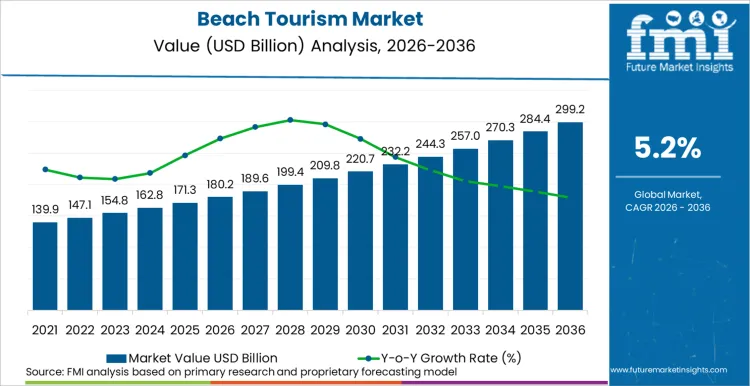
The beach tourism market is expected to expand from USD 180.2 billion in 2026 to USD 299.2 billion by 2036. The market is anticipated to register a 5.2% CAGR during the forecast period. Hotel companies are likely to lead direct supplier demand, while Europe is projected to retain the largest regional revenue base through Mediterranean repeat travel.
Summary of the Beach Tourism Market
- Demand and Growth Drivers
- Coastal travel demand is gaining from wellness tourism and premium resort development.
- Domestic beach trips are rising as travelers prefer shorter leisure breaks.
- Sustainable coastal tourism is becoming a stronger planning priority for destinations.
- Product and Segment View
- Hotel companies lead as beachfront stays remain central to trip spending.
- OTAs gain from digital booking convenience and real-time package comparison.
- Wellness-linked stays are creating stronger premium positioning for resort operators.
- Geography and Competitive Outlook
- Europe benefits from Mediterranean tourism and repeat visitor flows.
- Asia Pacific is gaining from stronger middle-class travel spending.
- Middle East growth is supported by regenerative resort investments.
- Analyst Opinion
- Ronak Shah, Senior Analyst at Future Market Insights, suggests “Beach tourism is moving into a split growth model. Premium coastal resorts are building value through wellness and regeneration, while budget coastal access keeps volume strong in emerging destinations. Operators with direct booking strength and climate-ready assets will hold a better margin position.”
- Beach Tourism Market Value Analysis
- Beach tourism is moving from standard sun-and-sand travel toward experience-based coastal stays.
- Demand is likely to rise as wellness resorts and beach work hubs gain traction.
- Adoption is gaining support from direct air routes and stronger beachfront hospitality investment.
- Spending is forecast to be backed by premium resorts and sustainable destination upgrades.
Key Takeaways, Market Size, and Forecast
- The beach tourism market was valued at USD 171.3 billion in 2025.
- The market is projected to be valued at USD 180.2 billion in 2026.
- By 2036, the market is forecast to be valued at USD 299.2 billion.
- From 2026 to 2036, demand is anticipated to expand at a 5.2% CAGR.
- The market is likely to create an incremental opportunity of USD 119.0 billion.
- Southeast Asia is projected to record the fastest regional growth with 7.1% CAGR.
- Hotel companies are likely to lead the direct supplier segment.
Beach Tourism Market Market Definition
The beach tourism market covers all travel and hospitality spending associated with visits to coastal and beach destinations for leisure, wellness, or adventure purposes. It includes accommodation, transportation, activities, food and beverage, and related services consumed during beach-oriented trips. The market spans both domestic and international travel segments.
Beach Tourism Market Market Inclusions
The report covers global and regional market sizes by revenue for the 2026 to 2036 forecast period. It includes breakdowns by direct supplier type, indirect supplier type, traveller age group, activity type, and demographic. Regional and country-level analysis covers all major beach tourism corridors.
Beach Tourism Market Market Exclusions
The scope excludes cruise tourism unless the itinerary is exclusively beach-destination focused. It also omits inland lake and river tourism, adventure tourism without a coastal component, and urban tourism in coastal cities where beach activities are not the primary travel purpose.
Beach Tourism Market Research Methodology
Primary Research: Interviews were conducted with hotel groups operating beachfront properties, national tourism boards, airline route planners, and coastal destination management organizations across Europe, Asia Pacific, and the Americas.
Desk Research: UNWTO arrival statistics, national tourism board reports, airline seat-capacity data, and hotel occupancy surveys supported demand benchmarking.
Market-Sizing and Forecasting: A hybrid model combined top-down macroeconomic travel-spend analysis with bottom-up hotel booking and arrival data, validated against airline load factors and tour operator booking volumes.
Data Validation and Update Cycle: Outputs undergo anomaly screening, variance checks across arrival and spending datasets, and structured peer review prior to release.
Summary of Beach Tourism Market
Power in the beach tourism value chain is concentrated among large hotel groups and OTA platforms. Marriott International, Hilton, and Accor collectively control a large portion of branded beachfront accommodation globally, using loyalty programmes and distribution agreements to lock in repeat visitors. OTAs such as Booking Holdings and Expedia Group extract commission fees of 15 to 22% per reservation, compressing margins for independent beachfront properties. As per FMI, independent hotels that lack direct booking channels face a structural cost disadvantage that limits reinvestment capacity.
Pricing asymmetry in beach tourism is widening. Ultra-premium regenerative resorts such as those under Red Sea Global in Saudi Arabia command nightly rates exceeding USD 1,000, while budget coastal accommodations in Southeast Asia and South Asia operate at USD 20 to 50 per night. FMI analysts observe that mid-tier beach hotels face the most intense competitive pressure from both ends of the spectrum.
Sourcing fragility in beach tourism is tied to climate vulnerability and airlift dependency. Coastal erosion, coral bleaching, and rising sea surface temperatures directly threaten the physical product that beach destinations sell. Small island destinations in the Caribbean and Indian Ocean depend on a limited number of airline routes; any route cancellation immediately constrains visitor volumes and depresses hotel occupancy.
Brand and compliance risks centre on overtourism backlash and environmental regulation. Destinations such as Tulum, Bali, and Barcelona have implemented or are considering visitor caps, beach access fees, and construction moratoriums. FMI opines that operators who invest in regenerative tourism certifications and community benefit-sharing will face lower regulatory disruption risk over the forecast period.
Geographic leverage varies by corridor. Europe holds the largest revenue share, anchored by Mediterranean repeat-visit patterns. Asia Pacific is the fastest-growing outbound source market, with Chinese, Indian, and Southeast Asian travellers driving intra-regional beach trip volumes. The Middle East is transitioning from a source market to a destination market through projects like NEOM and the Red Sea development. Latin America's beach tourism is split between established Caribbean destinations and emerging Pacific coast development. Africa remains underpenetrated, with East African coastal destinations offering long-term upside.
For C-suite executives in hospitality and travel, beach tourism growth through 2036 will reward operators who control direct booking channels, invest in climate-resilient infrastructure, and diversify revenue beyond room rates into experiences, wellness, and sustainability-linked premium pricing. Volume growth alone, without margin management, will not deliver investor returns in a market where OTA commission costs and climate adaptation spending are both rising.
Regional Market Trends in the Beach Tourism Sector
North America
Due to extensive infrastructure, a robust domestic travel base, and a range of coastal destinations, North America is still a key contributor in the global beach tourism market. Iconic beach hotspots, like Florida’s Gulf Coast, California’s Pacific coastline and Mexico’s Riviera Maya, draw millions of visitors a year. Not only seekers of sun-kissed beaches are flocking to the region, but they are also drawn to the long list of water sports, luxury resorts and bustling cultural offerings. Sustainable tourism has been on the rise in North America, as governments and private stakeholders alike emphasize environmental conservation.
Europe
Europe’s varied coastlines, from the Mediterranean Sea to the Atlantic and Baltic Sea, provide a wealth of beach tourism options for both high-end and budget travellers. Long-time favourites among sun-seekers and adventure travellers include popular destinations such as Spain’s Costa del Sol, Greece’s Cycladic Islands and Portugal’s Algarve. A label itself known for healthy beach trips that combine exclusive downtime together with cultural or historical excursions, Europe has grown into recent times. Seasonal travel patterns remain dominant when looking at the European beach tourism market, with the summer months attracting the most visitors.
Asia-Pacific
Asia-Pacific is forecasted to grow strongly with a combination of mature and new destinations. More beaten paths, including Thailand’s Phi Phi Islands, Indonesia’s Bali and the Philippines’ Palawan, are known in many parts of the world for their beautiful beaches, budget accommodation and its local culture. “The area’s blend of natural beauty, appealing activities and competitive prices can entice various types of travellers, from backpackers to high-end luxury travellers.” Asia-Pacific's tourism industry in beach areas is also gaining from rising disposable incomes and an emerging middle class, together with expanding travel infrastructure.
Shifts in the beach tourism market from 2021 to 2025 and Future Trends 2026 to 2036
Between 2021 and 2025, the beach tourism industry experienced ups and downs as international travel bans, shifting consumer behaviour, and increasing sustainability concerns influenced the sector. As international travel was suspended and regional and domestic beach vacations were on the rise, treasure-hunting thieves became an issue, prompting a surge in environmentally friendly tourism as citizens hopped on the bandwagon to defend their beaches.
The boom in remote work added to longer stays at the beach, increasing demand for long-term rental lodgings. Climate change-related coastal erosion, rising sea levels, and heavy precipitation and wind events were a factor at some popular beach destinations as well and adaptation had to be factored in.
More sustainable beach tourism models, quality experiences despite tourism declines, economic crises (e.g. Virus) and others, perhaps redoubles its efforts of certain parts in economic sectors in terms of technology architecture needed to facilitate digital experiences and climate adaptive infrastructural.
Travelers will work with eco-conscious destinations whose governments and hospitality businesses will invest in carbon-neutral resorts, marine conservation initiatives and smart tourism technologies. Ai-powered suggestions and virtual reality previews will further customise our beach experiences and transform the industry. Further, developments in the blue economy such as sustainable coastal fishing, taking care of marine biodiversity and low-impact water sports will shape the future of beach tourism.
Market Shifts: A Comparative Analysis (2021 to 2025 vs. 2026 to 2036)
| Market Shift | 2021 to 2025 Trends |
|---|---|
| Regulatory Landscape | Focus on pandemic-related travel restrictions, safety guidelines, and local environmental regulations. |
| Tourism Preferences | Growth in domestic and regional beach tourism, driven by restrictions on international travel. |
| Hospitality Accommodation | Rise of vacation rentals, boutique beach resorts, and hybrid work-friendly accommodations. |
| Adventure Water Activities | High demand for traditional beach activities like snorkelling, jet skiing, and cruises. |
| Technology in Beach Tourism | Increased reliance on mobile travel apps, digital check-ins, and cashless transactions. |
| Environmental Sustainability | Introduction of plastic-free beach policies and conservation initiatives to protect marine life. |
| Market Competition | Presence of traditional beach resorts, local tourism operators, and all-inclusive beach vacation packages. |
| Market Growth Drivers | Growth driven by post-pandemic travel recovery, digital nomad culture, and social media-driven beach tourism trends. |
| Infrastructure Coastal Management | Concerns over overcrowding, beach pollution, and unsustainable coastal developments. |
| Market Shift | 2026 to 2036 Projections |
|---|---|
| Regulatory Landscape | Stricter coastal protection policies, carbon footprint reduction mandates, and sustainable tourism certification requirements. |
| Tourism Preferences | Increased demand for sustainable, eco-certified beach destinations, regenerative tourism experiences, and remote beach work hubs. |
| Hospitality Accommodation | Expansion of carbon-neutral beach resorts, floating eco-lodges, and AI-personalized beach stays. |
| Adventure Water Activities | Growth in sustainable water sports, electric-powered marine activities, and conservation-focused tourism (coral restoration, mangrove reforestation). |
| Technology in Beach Tourism | Integration of AI-powered travel planning, VR-based beach previews, and smart wearable tech for real-time personalized beach experiences. |
| Environmental Sustainability | Large-scale adoption of blue economy projects, ocean clean-up tourism, and fully sustainable beachfront developments. |
| Market Competition | Rise of tech-driven beach tourism start-ups, climate-adaptive resorts, and digital nomad-friendly coastal hubs. |
| Market Growth Drivers | Expansion fuelled by sustainable investments, climate-resilient beach tourism, and smart eco-tourism developments. |
| Infrastructure Coastal Management | Integration of smart coastal management systems, AI-driven visitor flow control, and carbon-neutral beachfront developments. |
Country-wise Outlook - Beach Tourism Market
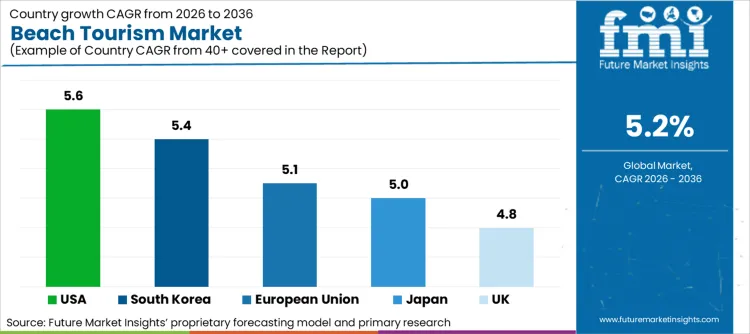
United States
The United States, with its vast coastline, globally renowned beach locales, and comprehensive tourism system, is considered one of the biggest beach tourism markets. Pristine beaches, water sports and luxury resorts make coastal states like Florida, California and Hawaii some of the top vacation destinations, drawing millions of tourists each year. Out of these, the USA government, along with private tourism stakeholders, have been investing in sustainable beach tourism, eco-tourism initiatives, and marine conservation initiatives to help the industry grow and thrive in the long run. The growth of the market is also being driven by increasing interest in adventure tourism and beachside wellness retreats.
| Country | CAGR (2026 to 2036) |
|---|---|
| USA | 5.6% |
United Kingdom
The UK beach tourism sector features a blend of classic coastal resorts, coastal heritage sites, and new nature-based beach destinations. Places like Cornwall, Brighton and the Scottish Highlands have seen an increase in visitor interest, reflecting trends in domestic travel and government-supported tourism initiatives. The market is also benefiting from investments in sustainable tourism, beachside recreation and climate-adaptive coastal infrastructure. And the growing popularity of surfing, coastal hiking and wellness retreats on the UK’s shores is driving demand for beach tourism.
| Country | CAGR (2026 to 2036) |
|---|---|
| UK | 4.8% |
European Union
Countries like Spain, Italy, France and Greece with their Mediterranean coastlines, opulent beach resorts and rich culture and infrastructure dominate EU beach tourism. A focus on sustainable tourism and climate-friendly coastal management is defining the EU's approach moving forward. Also, investments in blue economy projects, smart beach technologies and better connectivity to coastal areas are boosting tourism. Seasonal tourism is a major driver, as summer month visitor inflows contribute to region economies.
| Country | CAGR (2026 to 2036) |
|---|---|
| European Union (EU) | 5.1% |
Japan
Japan's beach tourism sector is attracting interest with its variety of coastline and tropical islands in places like Okinawa, meanwhile a burgeoning water sports market. The Japanese government is driving domestic and international tourism for marine tourism including diving and Luxury Island resorts. Furthermore, market growth is also accelerated by investments in coastal infrastructure, sustainable marine tourism and premium hospitality service. Growing interest in wellness tourism and nature-based experiences is also driving the popularity of Japan’s coastal destinations.
| Country | CAGR (2026 to 2036) |
|---|---|
| Japan | 5.0% |
South Korea
South Korea's beach tourism is a booming market, with popular destinations such as Jeju Island, Busan and Gangwon Province. The growth in the market is driven by the government initiatives to improve the infrastructure of marine tourism, increase in investments in the activities of water sports and eco-friendly resorts. However, there is also the popularity of Korean pop culture such as K-pop and K-dramas, which are leading international visitors to visit beach destinations that media always features. In addition, the development of smart beach tourism projects, AI-operators for visitor management, and digital tourism campaigns are strengthening the position of South Korea.
| Country | CAGR (2026 to 2036) |
|---|---|
| South Korea | 5.4% |
Segmentation Outlook -Beach Tourism Market
Airlines and Hotel Companies Drive Market Growth as Beach Tourism Expands Worldwide
Beach tourism is most popular among airlines and hotel firms, with family resorts, beachside and island retreats, and coastal adventure experiences seeing increased numbers of domestic and international tourists. Therefore, these beach tourism activities would be essential for increasing hospitality elements, strengthening economic growth in coastal states, and sharing relaxation and wellness experiences, and becoming a top priority for airlines, hotel chains, tourism boards, and travel service providers.
Airlines Lead Market Demand as Beach Destination Connectivity Expands Globally
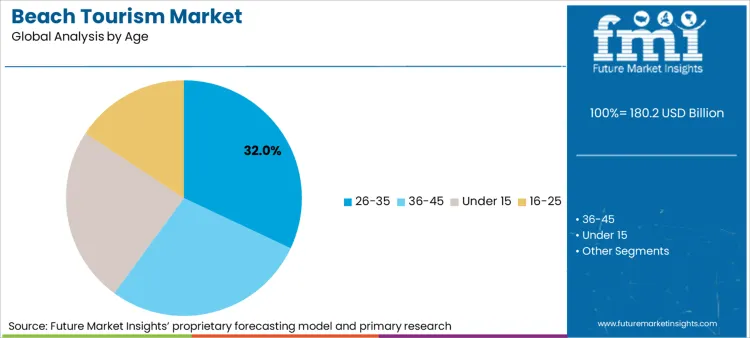
With direct routes to popular coastal spots, seasonal charter flights, and vacation-friendly seating arrangements, airlines have become one of the fastest-growing parts of the beach tourism sector. In contrast to urban-oriented airline traffic, beach tourism carriers put a premium on vacationers, with package deals, preferential boarding for resort patrons and special baggage allowances for water sports equipment. The increasing need for direct flying to beach destinations (Caribbean, Mediterranean, Southeast Asia) boosted the market uptake, as travellers prefer cheaper and cost-effective traveling to the beaches.
As per the study highest number of beach goers opt for direct flight airlines to reach beach coasts which assure good demand for this segment. Market demand is being consolidated in the sector through the expansion of personalized beach travel experiences, premium access to airline lounges, specialty resort tie-ups, private destination previews before inflight, which has ensured wider access and engagement.
Conversely, with the use of AI-enabled airline booking systems, personalising recommendations for beach destinations, tracking airfare in real-time, and secure verifications through block chain, have further increased the uptake of services among the tourists heading to the beaches all over the world. Interests in common between airline lines and destinations are particularly valuable, the development of airline-sponsored beach tourism programs, where exclusive partnerships are made between airlines and resorts on islands; travel incentivized by the frequent-flyer system for leisure travellers; and flight routes focused on adventure tourism. Rise in adoption of sustainable airline solutions such as carbon-neutral flights, sustainable aviation fuel programs, and eco-friendly in-flight services has strengthened market growth, helping the industry transition towards a more responsible tourism practices followed globally.
While being more accessible, convenient, and efficient in its travel, the segment for airlines is accompanied by issues like price variation in airfares, airports being crowded in the time of demand for beaches, and the negative claim toward environment. Yet, new AI-powered airfare variable optimization, innovative direct-to-resort flight routes, and electric aviation advances are optimizing efficiency, sustainability, and accessibility and thus ensuring robust end-market growth of airline-driven, beach-based tourism in world markets.
Hotel Companies Drive Market Growth as Beachfront Hospitality Services Expand
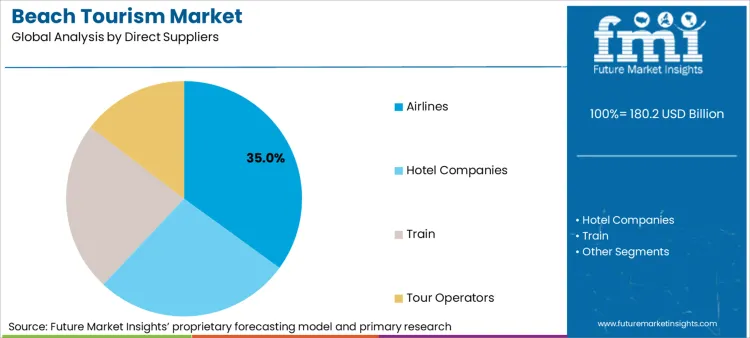
Hotel firms, particularly (luxury) resorts, beachfront green-certified hotels, and all-inclusive, vacation-package experiences have enjoyed powerful market adoption as travellers focus on comfort and convenience, as well as experiential trips. Beach resorts, on the other hand, emphasise pictures settings, access to water activities and tailored leisure packages unlike urban hotels. Demand for luxury beach resorts, from private islands and wellness retreats to boutique beach hotels, has fuelled the adoption of hotel-focused beach tourism as visitors chase exclusive seaside getaways.
Research show that more than 70% of beachgoers choose to stay in beach resorts or other beachfront accommodation, thus ensuring strong demand for this area. Driven by market demand and guest satisfaction and retention, the upscale beach tourism facilities have been successfully complemented by luxury beach tourism products such as overwater villas, spa & wellness facilities and gourmet restaurants with views of the ocean. Widely adopted smart hospitality technologies, such as AI-powered concierge systems, mobile check-ins and Internet of Things (IoT)-connected rooms, have driven this growth as hotels seek to maximize seamless guest experience and operational efficiency.
This has translated solidly into the growth of hotel-backed loyalty programs, such as membership benefits to beachfront resorts, vacation discounts and adventure experience incentives. Market growth has been further strengthened through the adoption of sustainability initiatives, including environmentally friendly resort designs, resort accommodations powered by solar energy, and partnerships with marine conservation programs, ensuring improved alignment with worldwide responsible tourism policies.
While the hotel companies segment has its advantages with hospitality excellence, customized guest experience, and coastal tourism growth, it also faces challenges including increasing operational costs, variable seasonal demand, and growing environmental concerns. But new innovations are already paving the way to improved efficiency, profitability, and sustainability for beachfront hotel companies around the world: AI-driven occupancy management, sustainable resort development, and digital guest engagement are just a few of the areas where developments are driving expansion.
Online and Traditional Travel Agencies Drive Market Growth as Digital and Personalized Beach Travel Planning Coexist
The online travel agency (OTA) and traditional travel agency segments represent two major market drivers, as beach tourists increasingly integrate digital convenience and expert recommendations into their vacation planning processes.
Online Travel Agencies (OTAs) Lead Market Demand as AI-Powered Beach Travel Planning and Digital Bookings Gain Popularity
Online travel agencies are somehow the most popular way of booking beach tourism, allowing a traveller to pre-book airline tickets, hotel and personalized experience to book a vacation digitally, via an AI-driven travel consultants, real-time customizations or package. In contrast to traditional travel booking where it took days to find something and book it, OTA platforms have instant price comparisons, customer reviews, and you can make digital adjustments to your itinerary to make your vacation headaches free.
As travellers increasingly prefer convenience and digital accessibility, OTAs have gained ground due to growing demand for AI-enhanced beach holiday planning services, providing intelligent recommendations on destinations, itinerary adaption to local weather patterns, and even tailored previews of interactive beach activities. Beach tourists - a segment that constitutes more than 75% of beachgoers in developed markets, has been shown to use online sources to plan their holidays, thus guaranteeing strong demand for this segment.
Dynastic Fund Attributes for Traveller the OTA Segment Challenges include real time booking, dynamic pricing and tailor-made vacation. Nonetheless, innovations such as block chain-based travel verification for beach access, AI-enhanced personalized itinerary optimization, and distributed concierge services are along the way, revolutionizing security, efficiency, and user experience for the online beach travel ecosystem, and thus ensuring sustained growth for the online beach tourism market worldwide.
Traditional Travel Agencies Expand as Personalized Beach Vacation Packages and High-Touch Travel Services Gain Popularity
The traditional travel agency business has gained broad industry acceptance, particularly from high-end consumers, family beach vacationers, and newlyweds, as travellers increasingly value expert guidance, hands-on vacation customization, and trouble-free trip organization. Unlike computerized booking sites, traditional agencies provide human-negotiated counsel, tailored vacation experience, and beginning-to-end trip planning.
Growing popularity of well-curated beach vacation experiences, such as VIP resort stays, sailing on private yachts, and guided island tours, has accelerated the use of traditional travel agencies, with consumers seeking differentiated and highly customized coastal experiences.
Although its strengths in affluent travel planning, high-touch customer service, and rich destination knowledge render the traditional travel agency segment robust, its vices are in greater service costs, digital competition, and reliance on human experience. However, breakthrough technology innovations in AI-powered trip customization, hybrid digital and physical booking sites, and experience-based travel partnerships are improving the service's efficiency, scalability, and engagement, offering the classic travel agency sustainable opportunity for growth in the beach tourism market.
Competitive Outlook
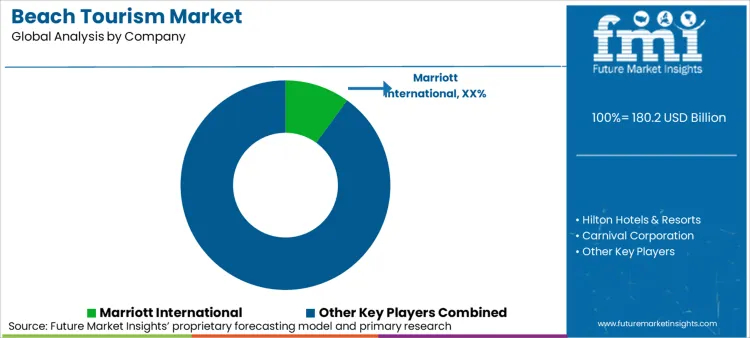
The growth of the industry is propelled by the development in disposable income, the popularity of coastal recreational activities, and sustainable and green tourism. It oligarchy helps the growth of the industry through beach resorts, cruise holidays, and water sports activities. The major trends impacting the industry include digital reservation platforms, customized travel experiences, and eco-friendly Tourism practices.
Market Share Analysis by Company
| Company Name | Estimated Market Share (%) |
|---|---|
| Marriott International | 10-14% |
| Hilton Hotels & Resorts | 8-12% |
| Carnival Corporation | 6-10% |
| Hyatt Hotels Corporation | 4-8% |
| Club Med | 3-7% |
| Other Companies (combined) | 50-60% |
Key Company Offerings and Activities
| Company Name | Key Offerings/Activities |
|---|---|
| Marriott International | Offers luxury beachfront resorts, exclusive vacation packages, and sustainable tourism initiatives. |
| Hilton Hotels & Resorts | Focuses on high-end coastal accommodations, digital booking integration, and loyalty-driven travel experiences. |
| Carnival Corporation | Provides beach destination cruises, eco-tourism packages, and all-inclusive tropical experiences. |
| Hyatt Hotels Corporation | Develops premium resort properties, wellness retreats, and personalized vacation services. |
| Club Med | Specializes in all-inclusive beach resorts with adventure sports, family-friendly activities, and eco-conscious hospitality. |
Key Company Insights
Marriott International (10-14%)
With a focus on luxury beachfront hotels, responsible resort development, and digital-first travel, Marriott International leads the beach tourism industry.
Hilton Hotels & Resorts (8-12)
Hilton deepens its beach tourism presence with upscale coastal resorts, seamless digital booking platforms, and premium membership benefits.
Carnival Corporation (6-10%)
Carnival dominates cruise tourism with handpicked beach outings, destination-centric packages, and environmentally friendly practices.
Hyatt Hotels Corporation (4-8%)
Hyatt continues to expand its footprint in the luxury beach tourism segment, catering to wellness seekers and adventure travellers through customized resort experiences.
Club Med (3-7%)
Club Med prioritizes all-inclusive beach resorts with adventure activities, sustainable tourism efforts, and premium hospitality offerings.
Other Key Players (50-60% Combined)
A diverse range of independent resort operators, boutique hotels, and online travel agencies contribute to the dynamic growth of beach tourism. These include:
- Expedia Group (Online booking platform for beach destinations, hotels, and vacation packages)
- TUI Group (Tour operator specializing in all-inclusive coastal vacations and cruise packages)
- Airbnb (Vacation rental marketplace connecting travellers with unique beachfront stays)
- Royal Caribbean International (Major cruise line offering curated beach tourism experiences and luxury shore excursions)
- Four Seasons Hotels & Resorts (High-end beach resorts providing exclusive luxury accommodations and wellness retreats)
The beach tourism market continues to thrive with the growing emphasis on digital transformation, sustainability, and premium travel experiences.
Recent Developments
- The report includes full coverage of key trends from competitive benchmarking. Some of the recent developments covered in the report:
- In early 2026, Red Sea Global and Fairmont confirmed the opening of Fairmont The Red Sea as part of a regenerative tourism project across an archipelago of over 90 islands along Saudi Arabia's western coast. [1]
- In spring 2026, Mandarin Oriental announced the debut of Punta Negra, a 131-room beachfront property on a private peninsula in Mallorca, Spain. [2]
- In mid-2026, Ennismore confirmed the launch of Rixos Phu Quoc in Vietnam, Asia's first Rixos resort, featuring over 1,700 rooms. [3]
- In February 2026, the Mexican Government launched the Tulum Reborn strategy, opening four new public beach access points. [4]
- In spring 2026, Aman confirmed the opening of Amanvari in East Cape, Baja California Sur, Mexico, an 18-key beachfront resort. [5]
Scope of the Report
| Items | Values |
|---|---|
| Quantitative Units | USD 180.2 billion (2026) to USD 299.2 billion (2036), at a CAGR of 5.2% |
| Market Definition | The beach tourism market covers all travel and hospitality spending associated with visits to coastal and beach destinations for leisure, wellness, or adventure purposes. |
| Direct Supplier Segmentation | Airlines, Hotel Companies, Train, Tour Operators, Government Bodies |
| Indirect Supplier Segmentation | OTA, Traditional Travel Agencies, TMCs, Corporate Buyers, Aggregators |
| Regions Covered | North America, Latin America, Europe, East Asia, South Asia, Oceania, Middle East and Africa |
| Countries Covered | United States, Canada, Mexico, Brazil, Spain, France, Italy, Greece, Saudi Arabia, UAE, India, Thailand, Indonesia, Vietnam, Australia and 40 plus countries |
| Key Companies Profiled | Marriott International, Hilton Worldwide, Accor, Ennismore, Aman, Red Sea Global, TUI Group, Booking Holdings, Expedia Group, COMO Hotels |
| Forecast Period | 2026 to 2036 |
| Approach | Hybrid top-down and bottom-up market modeling validated through primary interviews with hotel groups, national tourism boards, and airline route planners |
Key Segmentation of the Beach Tourism Market
By Direct Suppliers:
- Airlines
- Hotel Companies
- Train
- Tour Operators
- Government Bodies
By Indirect Suppliers:
- OTA (Online Travel Agency)
- Traditional Travel Agencies
- TMC's (Travel Management Companies)
- Corporate Buyers
- Aggregators
By Age:
- Under 15
- 16-25
- 26-35
- 36-45
- 46-55
- Over 55
By Activity Type:
- Boating
- Fishing
- Surfing
- Scuba Diving
- Windsurfing
- Others
By Demographic:
- Male
- Female
- Kid
By Nationality:
- Domestic
- International
By Booking Channel:
- Phone Booking
- Online Booking
- In Person Booking
By Tour Type:
- Individual travel
- Professional Groups
- Group travels
By Country:
- USA
- Canada
- Brazil
- Mexico
- Germany
- United Kingdom
- France
- Spain
- Russia
- India
- China
- Japan
- Malaysia
- Singapore
- Australia
- United Arab Emirates(UAE)
- KSA
- Italy
- Qatar
- Oman
- ROW
Bibliography
- [1] Accor Group. (2026). Accor 2026 Hotel Openings: Fairmont The Red Sea. Corporate Newsroom. https://group.accor.com/en/news-stories/accor-2026-openings
- [2] A Small World. (2026). Hottest New Hotel Openings of 2026: Mandarin Oriental Punta Negra. https://www.asmallworld.com/editorials/articles/the-hottest-new-hotel-openings-of-2026
- [3] Ennismore. (2026). Ennismore 2026 Openings. Corporate Press Release. https://press.accor.com/ennismore-unveils-its-2026-openings
- [4] Government of Mexico. (2026). Tulum Reborn Strategy. Government Announcement, February 2026.
- [5] A Small World. (2026). Amanvari Mexico Opening. https://www.asmallworld.com/editorials/articles/the-hottest-new-hotel-openings-of-2026
- [6] UNWTO. (2025). World Tourism Barometer. https://www.unwto.org/tourism-statistics
- [7] India Ministry of Tourism. (2025). Annual Report on Domestic Tourism. https://tourism.gov.in
- [8] WTTC. (2025). Travel and Tourism Economic Impact Report. https://wttc.org/research/economic-impact
- [9] GoGather. (2026). New All-Inclusive Resorts for Incentive Trips. https://gogather.com/blog/new-all-inclusive-resorts-for-your-incentive-trip
- [10] European Travel Commission. (2025). European Tourism Trends. https://etc-corporate.org
- [11] Future Market Insights. (2026). Beach Tourism Market Report. https://www.futuremarketinsights.com/reports/beach-tourism-market
- [12] Future Market Insights. (2025). Tourism Market Size. https://www.futuremarketinsights.com/reports/tourism-market
- [13] Future Market Insights. (2025). Beach Hotels Market. https://www.futuremarketinsights.com/reports/beach-hotels-sector-overview
- [14] Future Market Insights. (2025). Beach Hotels Competitive Landscape. https://www.futuremarketinsights.com/reports/beach-hotels-market-share-analysis
Frequently Asked Questions
How large is the beach tourism market in 2026?
The global beach tourism market is estimated at USD 180.2 billion in 2026.
What will the market size be by 2036?
The market is projected to reach USD 299.2 billion by 2036.
What is the expected CAGR between 2026 and 2036?
Demand is expected to grow at a CAGR of 5.2% between 2026 and 2036.
Which region holds the largest share?
Europe holds the largest revenue share, anchored by Mediterranean destinations.
Which region is growing fastest?
Southeast Asia, at 7.1% CAGR, is the fastest-growing destination region through 2036.
What direct supplier segment leads?
Hotel companies hold the largest direct supplier share.
Preview the report firsthand - request a free sample
Get SampleGet the brochure for pricing and purchase details.
Get PDFTable of Content
- Executive Summary
- Global Market Outlook
- Demand-side Trends
- Supply-side Trends
- Technology Roadmap Analysis
- Analysis and Recommendations
- Market Overview
- Market Coverage / Taxonomy
- Market Definition / Scope / Limitations
- Research Methodology
- Chapter Orientation
- Analytical Lens and Working Hypotheses
- Market Structure, Signals, and Trend Drivers
- Benchmarking and Cross-market Comparability
- Market Sizing, Forecasting, and Opportunity Mapping
- Research Design and Evidence Framework
- Desk Research Programme (Secondary Evidence)
- Company Annual and Sustainability Reports
- Peer-reviewed Journals and Academic Literature
- Corporate Websites, Product Literature, and Technical Notes
- Earnings Decks and Investor Briefings
- Statutory Filings and Regulatory Disclosures
- Technical White Papers and Standards Notes
- Trade Journals, Industry Magazines, and Analyst Briefs
- Conference Proceedings, Webinars, and Seminar Materials
- Government Statistics Portals and Public Data Releases
- Press Releases and Reputable Media Coverage
- Specialist Newsletters and Curated Briefings
- Sector Databases and Reference Repositories
- FMI Internal Proprietary Databases and Historical Market Datasets
- Subscription Datasets and Paid Sources
- Social Channels, Communities, and Digital Listening Inputs
- Additional Desk Sources
- Expert Input and Fieldwork (Primary Evidence)
- Primary Modes
- Qualitative Interviews and Expert Elicitation
- Quantitative Surveys and Structured Data Capture
- Blended Approach
- Why Primary Evidence is Used
- Field Techniques
- Interviews
- Surveys
- Focus Groups
- Observational and In-context Research
- Social and Community Interactions
- Stakeholder Universe Engaged
- C-suite Leaders
- Board Members
- Presidents and Vice Presidents
- R&D and Innovation Heads
- Technical Specialists
- Domain Subject-matter Experts
- Scientists
- Physicians and Other Healthcare Professionals
- Governance, Ethics, and Data Stewardship
- Research Ethics
- Data Integrity and Handling
- Primary Modes
- Tooling, Models, and Reference Databases
- Desk Research Programme (Secondary Evidence)
- Data Engineering and Model Build
- Data Acquisition and Ingestion
- Cleaning, Normalisation, and Verification
- Synthesis, Triangulation, and Analysis
- Quality Assurance and Audit Trail
- Market Background
- Market Dynamics
- Drivers
- Restraints
- Opportunity
- Trends
- Scenario Forecast
- Demand in Optimistic Scenario
- Demand in Likely Scenario
- Demand in Conservative Scenario
- Opportunity Map Analysis
- Product Life Cycle Analysis
- Supply Chain Analysis
- Investment Feasibility Matrix
- Value Chain Analysis
- PESTLE and Porter’s Analysis
- Regulatory Landscape
- Regional Parent Market Outlook
- Production and Consumption Statistics
- Import and Export Statistics
- Market Dynamics
- Global Market Analysis 2021 to 2025 and Forecast, 2026 to 2036
- Historical Market Size Value (USD Billion) Analysis, 2021 to 2025
- Current and Future Market Size Value (USD Billion) Projections, 2026 to 2036
- Y-o-Y Growth Trend Analysis
- Absolute $ Opportunity Analysis
- Global Market Pricing Analysis 2021 to 2025 and Forecast 2026 to 2036
- Global Market Analysis 2021 to 2025 and Forecast 2026 to 2036, By Direct Suppliers
- Introduction / Key Findings
- Historical Market Size Value (USD Billion) Analysis By Direct Suppliers , 2021 to 2025
- Current and Future Market Size Value (USD Billion) Analysis and Forecast By Direct Suppliers , 2026 to 2036
- Airlines
- Hotel Companies
- Train
- Tour Operators
- Airlines
- Y-o-Y Growth Trend Analysis By Direct Suppliers , 2021 to 2025
- Absolute $ Opportunity Analysis By Direct Suppliers , 2026 to 2036
- Global Market Analysis 2021 to 2025 and Forecast 2026 to 2036, By Age
- Introduction / Key Findings
- Historical Market Size Value (USD Billion) Analysis By Age, 2021 to 2025
- Current and Future Market Size Value (USD Billion) Analysis and Forecast By Age, 2026 to 2036
- 26-35
- 36-45
- Under 15
- 16-25
- 26-35
- Y-o-Y Growth Trend Analysis By Age, 2021 to 2025
- Absolute $ Opportunity Analysis By Age, 2026 to 2036
- Global Market Analysis 2021 to 2025 and Forecast 2026 to 2036, By Region
- Introduction
- Historical Market Size Value (USD Billion) Analysis By Region, 2021 to 2025
- Current Market Size Value (USD Billion) Analysis and Forecast By Region, 2026 to 2036
- North America
- Latin America
- Western Europe
- Eastern Europe
- East Asia
- South Asia and Pacific
- Middle East & Africa
- Market Attractiveness Analysis By Region
- North America Market Analysis 2021 to 2025 and Forecast 2026 to 2036, By Country
- Historical Market Size Value (USD Billion) Trend Analysis By Market Taxonomy, 2021 to 2025
- Market Size Value (USD Billion) Forecast By Market Taxonomy, 2026 to 2036
- By Country
- USA
- Canada
- Mexico
- By Direct Suppliers
- By Age
- By Country
- Market Attractiveness Analysis
- By Country
- By Direct Suppliers
- By Age
- Key Takeaways
- Latin America Market Analysis 2021 to 2025 and Forecast 2026 to 2036, By Country
- Historical Market Size Value (USD Billion) Trend Analysis By Market Taxonomy, 2021 to 2025
- Market Size Value (USD Billion) Forecast By Market Taxonomy, 2026 to 2036
- By Country
- Brazil
- Chile
- Rest of Latin America
- By Direct Suppliers
- By Age
- By Country
- Market Attractiveness Analysis
- By Country
- By Direct Suppliers
- By Age
- Key Takeaways
- Western Europe Market Analysis 2021 to 2025 and Forecast 2026 to 2036, By Country
- Historical Market Size Value (USD Billion) Trend Analysis By Market Taxonomy, 2021 to 2025
- Market Size Value (USD Billion) Forecast By Market Taxonomy, 2026 to 2036
- By Country
- Germany
- UK
- Italy
- Spain
- France
- Nordic
- BENELUX
- Rest of Western Europe
- By Direct Suppliers
- By Age
- By Country
- Market Attractiveness Analysis
- By Country
- By Direct Suppliers
- By Age
- Key Takeaways
- Eastern Europe Market Analysis 2021 to 2025 and Forecast 2026 to 2036, By Country
- Historical Market Size Value (USD Billion) Trend Analysis By Market Taxonomy, 2021 to 2025
- Market Size Value (USD Billion) Forecast By Market Taxonomy, 2026 to 2036
- By Country
- Russia
- Poland
- Hungary
- Balkan & Baltic
- Rest of Eastern Europe
- By Direct Suppliers
- By Age
- By Country
- Market Attractiveness Analysis
- By Country
- By Direct Suppliers
- By Age
- Key Takeaways
- East Asia Market Analysis 2021 to 2025 and Forecast 2026 to 2036, By Country
- Historical Market Size Value (USD Billion) Trend Analysis By Market Taxonomy, 2021 to 2025
- Market Size Value (USD Billion) Forecast By Market Taxonomy, 2026 to 2036
- By Country
- China
- Japan
- South Korea
- By Direct Suppliers
- By Age
- By Country
- Market Attractiveness Analysis
- By Country
- By Direct Suppliers
- By Age
- Key Takeaways
- South Asia and Pacific Market Analysis 2021 to 2025 and Forecast 2026 to 2036, By Country
- Historical Market Size Value (USD Billion) Trend Analysis By Market Taxonomy, 2021 to 2025
- Market Size Value (USD Billion) Forecast By Market Taxonomy, 2026 to 2036
- By Country
- India
- ASEAN
- Australia & New Zealand
- Rest of South Asia and Pacific
- By Direct Suppliers
- By Age
- By Country
- Market Attractiveness Analysis
- By Country
- By Direct Suppliers
- By Age
- Key Takeaways
- Middle East & Africa Market Analysis 2021 to 2025 and Forecast 2026 to 2036, By Country
- Historical Market Size Value (USD Billion) Trend Analysis By Market Taxonomy, 2021 to 2025
- Market Size Value (USD Billion) Forecast By Market Taxonomy, 2026 to 2036
- By Country
- Kingdom of Saudi Arabia
- Other GCC Countries
- Turkiye
- South Africa
- Other African Union
- Rest of Middle East & Africa
- By Direct Suppliers
- By Age
- By Country
- Market Attractiveness Analysis
- By Country
- By Direct Suppliers
- By Age
- Key Takeaways
- Key Countries Market Analysis
- USA
- Pricing Analysis
- Market Share Analysis, 2025
- By Direct Suppliers
- By Age
- Canada
- Pricing Analysis
- Market Share Analysis, 2025
- By Direct Suppliers
- By Age
- Mexico
- Pricing Analysis
- Market Share Analysis, 2025
- By Direct Suppliers
- By Age
- Brazil
- Pricing Analysis
- Market Share Analysis, 2025
- By Direct Suppliers
- By Age
- Chile
- Pricing Analysis
- Market Share Analysis, 2025
- By Direct Suppliers
- By Age
- Germany
- Pricing Analysis
- Market Share Analysis, 2025
- By Direct Suppliers
- By Age
- UK
- Pricing Analysis
- Market Share Analysis, 2025
- By Direct Suppliers
- By Age
- Italy
- Pricing Analysis
- Market Share Analysis, 2025
- By Direct Suppliers
- By Age
- Spain
- Pricing Analysis
- Market Share Analysis, 2025
- By Direct Suppliers
- By Age
- France
- Pricing Analysis
- Market Share Analysis, 2025
- By Direct Suppliers
- By Age
- India
- Pricing Analysis
- Market Share Analysis, 2025
- By Direct Suppliers
- By Age
- ASEAN
- Pricing Analysis
- Market Share Analysis, 2025
- By Direct Suppliers
- By Age
- Australia & New Zealand
- Pricing Analysis
- Market Share Analysis, 2025
- By Direct Suppliers
- By Age
- China
- Pricing Analysis
- Market Share Analysis, 2025
- By Direct Suppliers
- By Age
- Japan
- Pricing Analysis
- Market Share Analysis, 2025
- By Direct Suppliers
- By Age
- South Korea
- Pricing Analysis
- Market Share Analysis, 2025
- By Direct Suppliers
- By Age
- Russia
- Pricing Analysis
- Market Share Analysis, 2025
- By Direct Suppliers
- By Age
- Poland
- Pricing Analysis
- Market Share Analysis, 2025
- By Direct Suppliers
- By Age
- Hungary
- Pricing Analysis
- Market Share Analysis, 2025
- By Direct Suppliers
- By Age
- Kingdom of Saudi Arabia
- Pricing Analysis
- Market Share Analysis, 2025
- By Direct Suppliers
- By Age
- Turkiye
- Pricing Analysis
- Market Share Analysis, 2025
- By Direct Suppliers
- By Age
- South Africa
- Pricing Analysis
- Market Share Analysis, 2025
- By Direct Suppliers
- By Age
- USA
- Market Structure Analysis
- Competition Dashboard
- Competition Benchmarking
- Market Share Analysis of Top Players
- By Regional
- By Direct Suppliers
- By Age
- Competition Analysis
- Competition Deep Dive
- Marriott International
- Overview
- Product Portfolio
- Profitability by Market Segments (Product/Age /Sales Channel/Region)
- Sales Footprint
- Strategy Overview
- Marketing Strategy
- Product Strategy
- Channel Strategy
- Hilton Hotels & Resorts
- Carnival Corporation
- Hyatt Hotels Corporation
- Club Med
- Marriott International
- Competition Deep Dive
- Assumptions & Acronyms Used


