
- Market Size (2026)
- USD 19.4 Bn
- Forecast (2036)
- USD 36.3 Bn
- CAGR (2026 to 2036)
- 6.5%
How Big Is the Beetroot Juice Market in 2026?
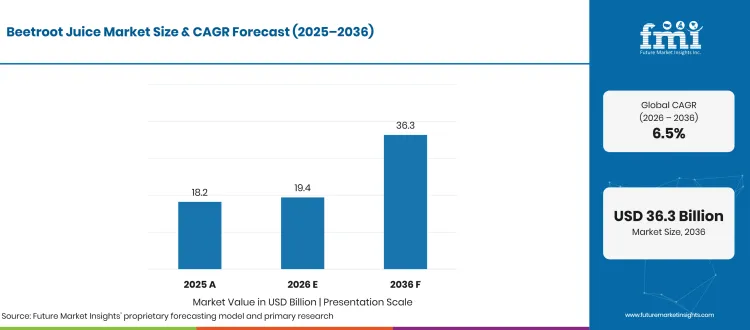
Starting from USD 18.2 billion in 2025, the global beetroot juice market valuation advanced to USD 19.4 billion in 2026, with projections from Future Market Insights (FMI) pointing toward USD 36.3 billion by 2036 at a CAGR of 6.5% as FMI analysis suggests that everyday household juice consumption and sports nitrate dosing will generate USD 16.9 billion in incremental revenue.
| Market Metric | Valuation / Share / Forecast Benchmark |
|---|---|
| 2025 Market Size (Historical) | USD 18.2 billion |
| 2026 Market Size (Estimated) | USD 19.4 billion |
| 2036 Market Size (Projected) | USD 36.3 billion |
| Compound Annual Growth Rate (2026 to 2036) | 6.5% CAGR |
| Incremental Dollar Opportunity (2026 to 2036) | USD 16.9 billion |
| Dominant Product Segment (2026 Share) | Conventional (63.0% share in 2026) | Other Segment Combined (37.0%) |
| Dominant Type Segment (2026 Share) | Regular Juice (63.0% share in 2026) | Other Segment Combined (37.0%) |
| Dominant Distribution Channel (2026 Share) | Supermarkets/Hypermarkets (42.0% share in 2026) | Other Segment Combined (58.0%) |
| Largest Country Markets (2026 Valuation) | United States (USD 5.4 billion), Germany (USD 2.3 billion), United Kingdom (USD 1.9 billion) |
| Fastest-Growing Country Markets (2026 to 2036) | Canada (7.1% CAGR), Mexico (6.6% CAGR), United Kingdom & Germany (6.5% CAGR) |
| Leading Tier-1 Companies | James White Drinks, Haus Rabenhorst, Biotta AG, Biona, Lakewood Organic, Love Beets, Kagome Australia, Naturis |
Source: Future Market Insights analysis of the beetroot juice market, 2026.
This Report Answers
- How large the beetroot juice market is in 2026 and what it reaches by 2036
- Which product, type and distribution channel segments lead in 2026
- What is driving demand and what is holding the category back
- Which countries grow fastest between 2026 and 2036
- What James White Drinks and other leading players have launched
- How the beetroot juice market is defined, segmented and measured
Executive Market Overview
Sports nutrition formulators and cardiovascular wellness brands are ramping up orders for standardized beetroot juice concentrate, capitalizing on clinical evidence that dietary nitrates improve muscle oxygenation and endurance. FMI finds that household buyers purchase multi-serve ambient bottles as a low-sugar alternative within the broader fruit and vegetable juice aisle, while endurance athletes order concentrated single-serve shots for pre-workout dietary nitrate intake. Clinical synthesis published in Nutrients by Tian et al. (June 2025) across 15 meta-analyses confirmed that nitrate-rich beetroot juice intake of 8.3 to 16.4 mmol taken 2 to 3 hours before exercise improves muscle strength in professional athletes (SMD = 0.27) and aerobic endurance in healthy non-athletes (SMD = 0.26). Because observed athletic gains depend on exact nitrate concentration, beverage brands are pairing standardized dosing with natural flavours such as organic lemon and ginger to soften earthy root notes for mainstream grocery buyers.
Retail shelf retention requires balancing accessible everyday pack pricing against strict processing and label compliance. In FMI's view, conventional multi-serve bottles anchor core supermarket volume, whereas certified organic direct juices and standardized functional shots capture higher unit margins per liter. Capacity expansion in Europe illustrates this commercial split, as James White Drinks (April 2025) commissioned a new beetroot press at its Suffolk facility capable of pressing more than 1 million liters of organic beetroot juice annually while adding ginger and turmeric shot variants. Formulators also compete against dry beetroot powder mixes by emphasizing ready-to-drink convenience. Market sizing covers packaged beetroot-dominant juices and concentrated beetroot juice shots sold across retail and online channels, while excluding whole beets, dry powders, minor-beet fruit drinks, and industrial ingredient transfers.
Analyst Perspective
"Beetroot juice processors will expand revenue faster through standardized nitrate shots and lemon-balanced direct glass bottles than through commodity vegetable blends, because repeat buyers pay a premium for verified milligram dosing and palatability. The primary commercial risk is batch-to-batch nitrate variability across raw beet harvests, which can undermine athletic label claims and trigger retail delisting."
- Nandini Roy Choudhury, Principal Consultant, Future Market Insights (FMI)
Key Market Trends & Insights
- Standardized Nitrate Dosing Separates Sports Shots From Everyday Bottles:Athletic nutrition buyers increasingly audit milligram nitrate disclosures before committing to recurring team or subscription orders. Independent laboratory testing published by ConsumerLab (December 2025) across 10 commercial beetroot juices and supplements revealed wide divergence in nitrate content per serving across retail brands, prompting sports dietitians to favor verified concentrated shots. Commercial tracking in Grocery Trader (February 2026) confirms that James White Drinks grew its Beet It Sport range by 35% year-over-year in 2025 and now supplies more than 150 elite sports teams, with export markets led by the United States generating around two-thirds of brand volume.
- Lemon and Botanical Acidulation Widens Household Palatability:Pure pressed beetroot carries geosmin compounds that produce an earthy aftertaste and limit second-bottle conversion among first-time grocery shoppers. Beverage formulators are overcoming taste rejection by blending 1% to 10% organic lemon juice or ginger extract into beet-dominant direct juices, mirroring formulation techniques used in commercial detox drink lines. Product documentation released by Haus Rabenhorst (July 2026) highlights its 700 ml brown-glass organic Rote Bete direct juice refined with lemon juice to preserve natural potassium while smoothing earthy flavor notes for daily household consumption.
- Front-of-Package Nutrition Rules Reshape Juice Formulation and Portion Sizing:National food regulators are tightening sugar and portion disclosures on packaged beverages, pushing beetroot juice bottlers toward smaller single-serve shots and zero-added-sugar vegetable blends. Regulatory enforcement by the Canadian Food Inspection Agency (January 2026) made front-of-package nutrition symbol compliance mandatory from January 1, 2026 for prepackaged foods meeting saturated fat or sugars. Simultaneously, public dietary guidance from the UK Government Office for Health Improvement and Disparities (March 2025) advises limiting combined pure fruit and vegetable juice intake to 150 ml per day, encouraging 70 ml concentrated shot packaging.
What Are the Main Drivers, Restraints, and Opportunities?
Clinical validation of dietary nitrate for athletic endurance and cardiovascular potassium intake drives trial across grocery and sports channels, whereas raw-beet nitrate variability and pathogen-control rules restrain margin expansion, leaving acid-balanced organic blends and subscription packs as the primary revenue opportunity.
Driver: Verified Exercise Nitrate Pathways and NFC Ambient Shelf Expansion
Endurance runners, recreational gym users, and older adults seeking dietary potassium and nitric-oxide precursors represent a consistent purchasing base next to mainstream sports drink buyers. FMI observes that retail velocity accelerates when bottlers offer both ambient multi-serve cartons for kitchen storage and portable shots for athletic dosing. Retail scanner reporting in Grocery Trader (February 2026) shows that the Beet It organic beetroot juice line recorded 58% two-year sales growth through 2025, making it the largest not-from-concentrate ambient juice SKU in United Kingdom grocery retail. Clinical guidance from the NIH Office of Dietary Supplements (March 2025) further documents how dietary nitrate converts to nitric oxide to reduce oxygen cost during submaximal exercise, sustaining repeat orders through 2036.
Restraint: Nitrate Lot Variability, Earthy Flavor Rejection, and Juice HACCP Costs
Repeat purchasing slows when consumers encounter inconsistent nitrate potency across batches or reject the earthy flavor of unblended root juice. FMI notes that raw beetroot nitrate levels fluctuate substantially by soil nitrogen and harvest season, complicating standardized label claims for bottlers that source non-contracted roots. Product testing by ConsumerLab (December 2025) across 10 beet products documented wide serving-to-serving variation in delivered nitrate levels. In addition, low-acid vegetable juice processors supplying North America must maintain validated 5-log pathogen reduction thermal or high-pressure controls under U.S. Food and Drug Administration (February 2025) Juice HACCP regulations, while complying with European Commission (April 2025) Regulation (EC) No 1924/2006 restrictions on unauthorized vascular health claims.
Opportunity: Acidulated Organic Blends, Multi-Day Juice Routines, and D2C Subscriptions
Beverage processors can lift trial-to-repeat conversion by pairing beetroot with small additions of tart lemon or ginger offering structured multi-bottle wellness packs in organic beverages. FMI expects multi-bottle curation and direct-to-consumer replenishment to reduce customer acquisition costs and stabilize monthly bottling schedules. In Germany, Haus Rabenhorst (May 2025) introduced a structured 3-day juice routine (Rabenhorst Saftkur) featuring 5 coordinated 750 ml organic direct juices that integrate Rote Bete direct juice into a guided household consumption regimen. Similarly, Food Manufacture (April 2025) reported that James White Drinks expanded its organic shot portfolio with ginger and turmeric variants following a 47% annual brand growth milestone.
How Is the Beetroot Juice Market Segmented?
Beetroot Juice Market is segmented by Product and Type. Forecast period from 2026 to 2036.
| Segmentation Axis | Sub-Segments Covered | 2026 Leading Segment & Share | Remainder & Total Alignment (2026) |
|---|---|---|---|
| Product | Conventional, Organic | Conventional (63.0% share) | Other Segment Combined (37.0%) | Total (100.0%) |
| Type | Regular Juice, Cold-pressed Juice | Regular Juice (63.0% share) | Other Segment Combined (37.0%) | Total (100.0%) |
| Distribution Channel | Supermarkets/Hypermarkets, Convenience Stores, Online, Others | Supermarkets/Hypermarkets (42.0% share) | Other Segment Combined (58.0%) | Total (100.0%) |
| Region | North America, Latin America, Western Europe, Eastern Europe, East Asia, South Asia and Pacific, Middle East and Africa | North America & Western Europe lead baseline demand | Canada (7.1% CAGR) & Mexico (6.6% CAGR) lead national growth |
Source: Future Market Insights analysis of the beetroot juice market, 2026.
Why Does the Conventional Segment Lead by Product?
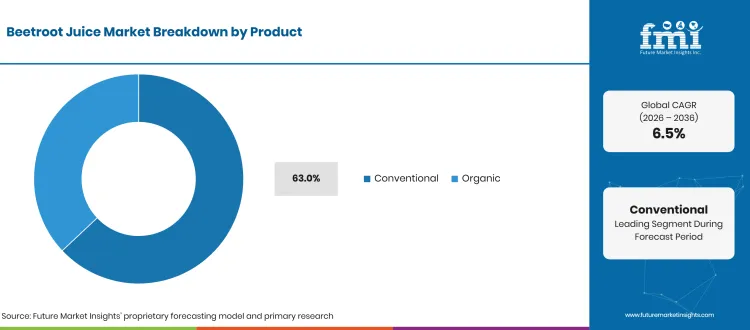
Conventional varieties secure a leading 63.0% share of Product revenue in 2026, driven by lower raw-root procurement costs and accessible retail price points across mainstream supermarkets and foodservice networks. Certified organic production requires segregated pressing schedules and audit fees root contracts that raise per-bottle shelf prices before first-time buyers have tested the flavor. Market monitoring by the USDA Economic Research Service (September 2026) confirms that organic food price premiums remain substantial across North American grocery aisles, enabling conventional processors using standard clean label ingredients to defend high-volume opening price tiers through 2036.
Why Does the Regular Juice Segment Lead by Type?
Regular Juice varieties secure a leading 63.0% share of Type revenue in 2026, supported by 12-to-18-month ambient shelf stability, economical freight handling without refrigerated logistics, and familiar multi-serving packaging for daily household consumption. Cold-pressed Juice appeals to premium chilled-cooler shoppers, but high-pressure processing fees and shorter chilled display windows restrict distribution density outside urban grocers. Capacity records from James White Drinks (April 2025) confirm that its new Suffolk press supports more than 1 million liters of ambient pressed beetroot juice and concentrated shots annually and botanical extracts, reinforcing regular juice leadership through 2036.
Why Does the Supermarkets/Hypermarkets Segment Lead by Distribution Channel?
Supermarkets and hypermarkets account for 42.0% of Distribution Channel sales in 2026, serving as the primary retail channel for family bottles and health-drink displays. In FMI's view, large grocery chains anchor category turnover driven by side-by-side shelf comparison across ambient juice aisles and dedicated health-food bays where shoppers discover beetroot juice next to herbal tea and vegetable blends. Household panel data published by ISMEA (May 2026) shows that supermarkets generated 37.0% of Italian household organic food and beverage retail purchases in 2025, ahead of discount stores and specialist shops. Meanwhile, direct online subscriptions and athletic specialty portals are expanding rapidly as repeat buyers order full-case glass bottles and pre-race nitrate shot boxes.
Regional & Country Outlook
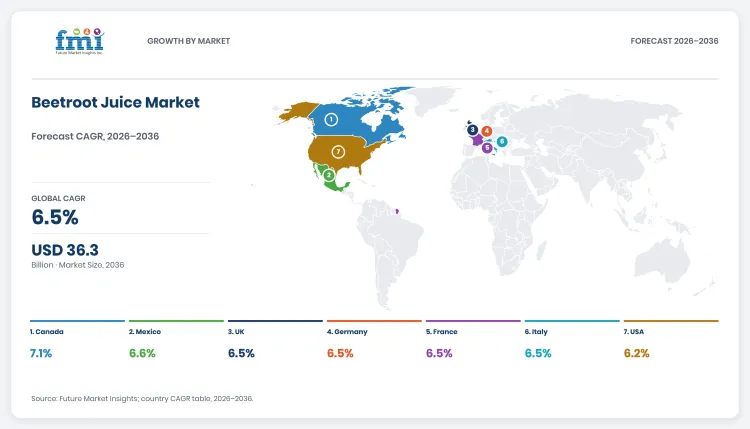
North America and Western Europe represent the core revenue foundation of the global beetroot juice market through 2036, anchored by established glass-bottle vegetable juice habits in Germany and the United Kingdom and high export adoption of concentrated athletic nitrate shots in the United States. FMI projects the seven profiled countries below to account for 59.8% of global market value in 2026 (USD 11.6 billion), rising to USD 21.6 billion by 2036. Canada leads profiled national growth at a 7.1% CAGR, followed by Mexico at 6.6%, while the four profiled European markets expand at 6.5% annually as mainstream grocery chains widen shelf space for functional root juices and botanical supplements.
| Country | 2026 Revenue | 2036 Revenue | 10-Year Addition | 2026 to 2036 CAGR | Global Share (2026 -> 2036) |
|---|---|---|---|---|---|
| Canada | USD 0.8 billion | USD 1.6 billion | +USD 0.8 billion | 7.1% | 4.1% -> 4.4% |
| Mexico | USD 0.6 billion | USD 1.1 billion | +USD 0.5 billion | 6.6% | 3.1% -> 3.1% |
| United Kingdom | USD 1.9 billion | USD 3.6 billion | +USD 1.7 billion | 6.5% | 9.8% -> 9.8% |
| Germany | USD 2.3 billion | USD 4.3 billion | +USD 2.0 billion | 6.5% | 11.9% -> 11.9% |
| France | USD 1.4 billion | USD 2.6 billion | +USD 1.2 billion | 6.5% | 7.2% -> 7.2% |
| Italy | USD 1.2 billion | USD 2.3 billion | +USD 1.1 billion | 6.5% | 6.2% -> 6.3% |
| United States | USD 5.4 billion | USD 9.9 billion | +USD 4.5 billion | 6.2% | 27.8% -> 27.3% |
Source: Future Market Insights analysis of the beetroot juice market, 2026.
United States
Demand for beetroot juice in United States is projected to rise from USD 5.4 billion in 2026 to USD 9.9 billion by 2036, advancing at a 6.2% CAGR and adding USD 4.5 billion in new revenue. FMI observes that United States demand is anchored by two parallel channels, namely multi-pack organic glass bottles in natural and conventional supermarkets and concentrated nitrate shots ordered by collegiate and professional sports programs. Retail distribution tracking by the USDA Economic Research Service (September 2026) confirms that conventional grocery chains remain the primary sales outlet for organic foods and beverages, while Grocery Trader (February 2026) reports that export markets led by the United States accounted for roughly two-thirds of Beet It Sport sales in 2025. FMI expects validated FDA Juice HACCP processing and third-party nitrate verification to govern supplier retention across United States retail and online subscription channels through 2036.
Germany
Buyer adoption of beetroot juice across Germany is estimated to expand from USD 2.3 billion in 2026 to USD 4.3 billion by 2036, spurred by a 6.5% CAGR and generating USD 2.0 billion in commercial expansion. FMI finds that German demand benefits from deeply rooted household consumption of 100% direct vegetable juices (Direktsaft) packaged in returnable and brown-glass bottles across mainstream supermarkets and Reformhaus health stores. Sector figures published by Bund Ökologische Lebensmittelwirtschaft (February 2025) show that German organic food and beverage retail sales rose 5.7% year-over-year, expanding shelf space for certified organic root juices. Product disclosures from Haus Rabenhorst (July 2026) further illustrate how domestic bottlers position 700 ml lemon-refined organic beetroot juice around natural potassium content. In FMI's view, brown-glass quality positioning and multi-day juice routines will sustain steady German retail reorder velocity through 2036.
United Kingdom
Beetroot juice industry in United Kingdom is set to scale from USD 1.9 billion in 2026 to USD 3.6 billion by 2036, driven by a 6.5% CAGR and adding USD 1.7 billion in incremental market value. FMI believes domestic growth is driven by local East Anglian organic beet pressing capacity and high consumer familiarity with clinical nitrate studies across running and cycling communities. In April 2025, James White Drinks (April 2025) commissioned a new Suffolk beetroot press supporting more than 1 million liters of annual organic beetroot juice output, helping its flagship Beet It bottle achieve 58% two-year growth through 2025 as the top NFC ambient juice SKU in British supermarkets. Because UK Government Office for Health Improvement and Disparities (March 2025) dietary guidelines cap daily pure juice intake at 150 ml, FMI anticipates sustained United Kingdom demand for 70 ml concentrated shots and portion-marked cartons through 2036.
France
Sales of beetroot juice throughout France are projected to increase from USD 1.4 billion in 2026 to USD 2.6 billion by 2036, progressing at a 6.5% CAGR and creating USD 1.2 billion in additional revenue. In FMI's assessment, French market expansion is attributed to distinct channel segmentation between mass hypermarkets that prioritize price-accessible multi-serve bottles and specialist organic chains that highlight regional root traceability and lacto-fermented processing and organic tea. National tracking from Agence BIO (June 2025) documents how French organic food and beverage distribution splits between generalist grocery retailers and dedicated specialist bio stores, while European Commission (March 2025) organic-logo rules require at least 95% certified organic agricultural ingredients on packaged labels. FMI projects French beverage brands that pair EU organic certification with balanced lemon-beet flavor profiles to expand supermarket facings through 2036.
Italy
Consumption of beetroot juice across Italy is estimated to climb from USD 1.2 billion in 2026 to USD 2.3 billion by 2036, reflecting a 6.5% CAGR and contributing USD 1.1 billion over the forecast decade. FMI observes that Italian buyer adoption is shifting from specialist herbal shops into mainstream supermarket chains as urban households add functional root juices and superfood beverages to weekly grocery baskets. Retail expenditure data published by ISMEA (May 2026) confirms that Italian household purchases of certified organic foods rose 3.8% in 2025, with supermarkets capturing 37.0% of total organic food turnover and discount chains accounting for 16.0%. FMI expects expanding modern-trade organic assortments across northern and central Italian grocery banners to support consistent bottle rotation and private-label listings through 2036.
Canada
Revenue generated by beetroot juice suppliers in Canada is forecast to expand from USD 0.8 billion in 2026 to USD 1.6 billion by 2036, anchored by a 7.1% CAGR and generating USD 0.8 billion in new category sales. FMI finds that Canadian growth is fueled by strong consumer adoption of organic cold-pressed and glass-bottled functional juices across grocery and natural health retailers, paired with strict federal label qualification gates. Under rules enforced by the Canadian Food Inspection Agency (January 2026), prepackaged beverages must display mandatory front-of-package nutrition symbols from January 1, 2026 when sugar thresholds are exceeded, while Canadian Food Inspection Agency (February 2025) organic regulations restrict the Canada Organic logo to products with at least 95% organic content and bilingual country-of-origin declarations. FMI anticipates compliant zero-added-sugar beetroot juices to capture growing Canadian retail shelf space through 2036.
Mexico
Buyer procurement of beetroot juice throughout Mexico is tracking from USD 0.6 billion in 2026 to USD 1.1 billion by 2036, exhibiting a 6.6% CAGR and contributing USD 0.5 billion to national market value. FMI believes commercial adoption in Mexico is helped by urban supermarket and convenience-store expansion of unsweetened vegetable juices that avoid front-of-pack excess-sugar warning octagons. On July 31, 2025, the Secretaría de Economía, Mexico (July 2025) published an official amendment in the Diario Oficial de la Federación extending Phase 2 of the NOM-051-SCFI/SSA1-2010 nutritional labeling standard through December 31, 2027, before Phase 3 takes effect on January 1, 2028. Because 100% pressed beetroot juice without added caloric sweeteners or sodium avoids octagons, FMI projects Mexican beverage distributors to expand pure and lemon-acidulated beet juice listings across modern retail channels through 2036.
Competitive Environment and Notable Companies
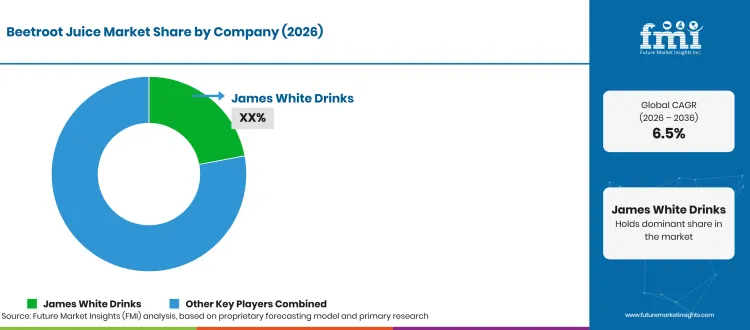
Notable companies operating in the global beetroot juice market includeJames White Drinks, Haus Rabenhorst, Biotta AG and Biona (Lidl UK). Competition divides into two primary operating tiers. Dedicated European and North American organic pressers such as James White Drinks and Haus Rabenhorst standalone 100% direct beetroot juices and standardized dietary-nitrate athletic shots across supermarkets and health stores. In parallel, private-label chilled blenders such as Naturis and industrial vegetable processors such as Kagome Australia supply cold-pressed multi-vegetable blends and bulk beetroot juice concentrates to regional beverage packers.
How Are Companies Positioned in the Beetroot Juice Market?
Leading suppliers differentiate through clinical nitrate standardization and lacto-fermentation formats. James White Drinks (April 2025) anchors both UK grocery cartons and global sports nutrition through its Beet It and Beet It Sport Nitrate 400 lines. In continental Europe, Haus Rabenhorst (July 2026), Biotta AG (May 2025), and Biona (June 2025) emphasize certified organic direct pressing and lacto-fermented brown or clear glass bottles. In North America, Lakewood Organic (August 2025) and Love Beets (July 2025) compete in 32 oz and 10 oz retail formats.
What Matters When a Buyer Selects a Beetroot Juice Supplier?
Retail category managers and sports nutrition buyers evaluate suppliers on four qualification criteria, namely verified pathogen-reduction controls underU.S. Food and Drug Administration (February 2025) Juice HACCP standards and consistent Brix moderation, documented dietary nitrate potency per serving as highlighted by ConsumerLab (December 2025), and certified organic chain-of-custody documentation under USDA NOP or CFIA rules.
Which Capabilities Distinguish Product Offers?
Portfolio capabilities diverge between single-serve athletic dosing and multi-serve household bottles. James White Drinks guarantees400 mg of dietary nitrate per 70 ml Beet It Sport shot and offers ginger and turmeric organic shots. Haus Rabenhorst pairs 700 ml lemon-refined Rote Bete direct juice with 3-day curated juice packages (Saftkur). Lakewood Organic supplies vacuum-sealed 32 oz glass bottles pressed with 1% organic lemon juice and ginger-turmeric beet extensions, while Kagome Australia (April 2025) supplies bulk industrial beetroot juice concentrate for B2B beverage formulators.
How Does Geographic Reach Affect Competition?
Because glass-bottled single-strength beetroot juice is heavy to ship across oceans, ambient bottle competition remains regionally anchored while concentrated70 ml shots trade globally. Grocery Trader (February 2026) confirms that export markets led by the United States generated two-thirds of Beet It Sport sales in 2025 across more than 150 professional sports teams, whereas Biotta AG and Haus Rabenhorst (May 2025) focus single-strength bottles on European grocery chains.
| Verified Company Evidence (2025 to 2026) | Commercial Effect | Buyer Action |
|---|---|---|
| July 2026: Haus Rabenhorst expanded retail positioning of its 700 ml organic Rote Bete direct juice refined with lemon juice in brown glass (Haus Rabenhorst, July 2026). | Links natural potassium disclosure and lemon acidulation to repeat household grocery purchases. | Stock 700 ml to 750 ml acidulated organic glass bottles in mainstream supermarket health aisles. |
| February 2026 & April 2025: James White Drinks commissioned a Suffolk beetroot press (>1 million liters/year capacity) and achieved 58% two-year Beet It growth and 35% YoY Beet It Sport growth in 2025 (James White Drinks, April 2025; Grocery Trader, February 2026). | Secures domestic UK organic pressing supply while scaling 70 ml nitrate shots across 150+ elite sports teams. | Pair 1-liter ambient NFC cartons in grocery aisles with 70 ml standardized nitrate shots in sports nutrition bays. |
| December 2025: ConsumerLab published independent laboratory testing of 10 beetroot juices and supplements including Biotta AG, Lakewood Organic, and Beet It (ConsumerLab, December 2025). | Demonstrates substantial nitrate variation across commercial formats, elevating lot-tested shots over unverified blends. | Require batch-level dietary nitrate and Brix certificates of analysis before approving athletic performance claims. |
Source: Verified corporate disclosures and Future Market Insights analysis, 2026.
| Company | Core Positioning | Verified Activity & Source Attribution |
|---|---|---|
| James White Drinks | UK organic beetroot juice (Beet It) and standardized nitrate sports shots (Beet It Sport) | Commissioned Suffolk beetroot press (>1 million liters/year) in April 2025; recorded 58% two-year Beet It growth and 35% YoY Beet It Sport growth in 2025 (James White Drinks, April 2025; Grocery Trader, February 2026). |
| Haus Rabenhorst | German 700 ml brown-glass organic Rote Bete direct juice and multi-bottle juice routines | Highlighted potassium-rich lemon-refined Rote Bete direct juice in July 2026 after launching its 3-day organic Saftkur routine in May 2025 (Haus Rabenhorst, May 2025 & July 2026). |
| Biotta AG | Swiss field-fresh organic lacto-fermented direct beetroot juice in 500 ml glass bottles | Processes regional Thurgau organic beetroots into natural potassium-rich direct juice evaluated in independent December 2025 testing (Biotta AG, May 2025; ConsumerLab, December 2025). |
| Biona | UK certified organic lacto-fermented pressed beetroot juice in 750 ml glass bottles | Supplies 100% organic pressed beetroot juice across UK natural grocery, supermarket, and international export channels (Biona, June 2025). |
| Lakewood Organic | US 32 oz glass-bottled Pure Beet organic juice with lemon and ginger-turmeric beet blends | Markets QAI-certified organic non-concentrate beet juice through US supermarkets and direct online subscriptions (Lakewood Organic, August 2025; ConsumerLab, December 2025). |
| Love Beets | US flash-pasteurized 10 fl oz and 14 fl oz organic ready-to-drink beet juice | Distributes Oregon Tilth certified organic beet juice and ginger-infused beet beverages across North American grocery coolers (Love Beets, July 2025). |
| Kagome Australia | Australian industrial beetroot juice and concentrate processor | Supplies bulk cold-filled and aseptic beetroot juice concentrates to commercial food and beverage formulators (Kagome Australia, April 2025). |
| Naturis (Lidl UK) | Private-label chilled cold-pressed fruit and beetroot blend juices | Lists cold-pressed apple, beetroot, carrot, and ginger blends in UK supermarket grab-and-go chillers (Lidl UK, May 2025). |
Source: Verified corporate disclosures and Future Market Insights analysis, 2026.
Key takeaways
- Valued at USD 19.4 billion in 2026, on course for USD 36.3 billion by 2036.
- The decade adds USD 16.9 billion in new value at a 6.5% CAGR.
- The product segment is led by Conventional at 63.0% of 2026 revenue.
- 63.0% of type revenue goes to Regular Juice in 2026.
- Canada grows fastest at 7.1% CAGR, ahead of Mexico at 6.6%.
Beetroot Juice Market Report Scope and Research Methodology
Future Market Insights sizes the global beetroot juice market using a bottom-up and top-down triangulation model that reconciles national retail scanner sales, organic pressing capacity, and foodservice procurement across seven regions. Primary research incorporates structured interviews with vegetable juice bottlers, organic root processors, sports nutrition buyers, and grocery category managers examining batch nitrate standardization and lemon acidulation. Desk research cross-checks federal nutrition labeling dockets, organic trade association statistics, peer-reviewed clinical meta-analyses, and verified corporate capacity disclosures published through 2026. Market revenue counts packaged single-strength beetroot juices, concentrated dietary-nitrate shots, and beetroot-dominant liquid blends at retail and foodservice selling prices, while excluding whole table beets, dry beetroot powders, fruit drinks with minor beet coloring, and upstream bulk concentrate transfers to prevent double counting.
| Coverage Field | Report Scope |
|---|---|
| Market definition | Revenue from packaged beetroot-dominant single-strength juices, lacto-fermented direct beet juices, and concentrated beetroot juice shots sold across retail, online, and foodservice channels. |
| Product segmentation (2026 share) | Conventional (63.0% share in 2026); Other Segment Combined / Organic (37.0% share in 2026); Total (100.0%). |
| Type segmentation (2026 share) | Regular Juice (63.0% share in 2026); Other Segment Combined / Cold-pressed Juice (37.0% share in 2026); Total (100.0%). |
| Distribution Channel segmentation (2026 share) | Supermarkets/Hypermarkets (42.0% share in 2026); Other Segment Combined — Convenience Stores, Online, and Others (58.0% share in 2026); Total (100.0%). |
| Packaging formats covered | Multi-serve brown and clear glass bottles (500 ml to 32 oz), aseptic cartons (1 liter), single-serve PET/chilled bottles (10 oz to 14 oz), and concentrated shots (70 ml). |
| Exclusions | Whole fresh or cooked beets, dehydrated beetroot powders and capsules, fruit juices with minor beet pigment, and upstream B2B concentrate sales. |
| Quantitative units | USD billion for global and national market valuations (locked uniformly across 2025, 2026, and 2036). |
| Forecast period & historical base | 2026 to 2036 forecast period (6.5% CAGR); 2025 historical baseline (USD 18.2 billion). |
| Regions covered | North America (United States, Canada); Latin America (Brazil, Mexico, Argentina, Chile); Western Europe (Germany, France, United Kingdom, Italy, Spain, Benelux, Nordics); Eastern Europe (Poland, Czech Republic, Romania, Hungary); East Asia (China, Japan, South Korea); South Asia and Pacific (India, ASEAN, Australia and New Zealand); Middle East and Africa (GCC Countries, South Africa, Türkiye, Israel). |
| Countries profiled in detail | United States, Germany, United Kingdom, France, Italy, Canada, and Mexico. |
| Companies covered | James White Drinks, Haus Rabenhorst, Biotta AG, Biona, Lakewood Organic, Love Beets, Kagome Australia, and Naturis (Lidl UK). |
| Primary research approach | Structured interviews with beverage processors, organic root suppliers, sports dietitians, and supermarket category buyers. |
| Desk research & validation | Cross-checked against USDA ERS, US FDA, CFIA, Secretaría de Economía Mexico, UK OHID, BÖLW, Agence BIO, ISMEA, PubMed clinical reviews, and corporate disclosures. |
Source: Future Market Insights analysis of the beetroot juice market, 2026.
Research Sources and Bibliography
- Agence BIO. (2025, June 12).Observatoire de la consommation bio en France. https://www.agencebio.org/vos-outils/les-chiffres-cles/observatoire-de-la-consommation-bio/
- Biona. (2025, June 18).Biona Organic Beetroot Pressed Juice 750ml Product Specification. https://biona.co.uk/products/beetroot-pressed-juice
- Biotta AG. (2025, May 14).Biotta Beetroot Juice Organic 500 ml Product Dossier. https://biotta.ch/en/products/biotta-edges
- Bund Ökologische Lebensmittelwirtschaft. (2025, February 11).Biofach: 2024 neues Rekordjahr für Bio. https://www.boelw.de/presse/meldungen/artikel/biofach-2024-neues-rekordjahr-fuer-bio/
- Canadian Food Inspection Agency. (2025, February 10).Organic claims on food labels. https://inspection.canada.ca/en/food-labels/labelling/industry/organic-claims
- Canadian Food Inspection Agency. (2026, January 1).Front-of-package (FOP) nutrition symbol compliance guidance. https://inspection.canada.ca/en/food-labels/labelling/industry/nutrition-labelling/fop-nutrition-symbol
- ConsumerLab. (2025, December 9).ConsumerLab Tests of Beetroot and Nitrate Products Yield Shocking Findings. https://www.consumerlab.com/news/beetroot-tests/12-09-2025/
- European Commission. (2025, March 15).The European Union organic logo and labeling rules. https://agriculture.ec.europa.eu/farming/organic-farming/organic-logo_en
- European Commission. (2025, April 20).Nutrition and Health Claims Regulation (EC) No 1924/2006. https://food.ec.europa.eu/food-safety/labelling-and-nutrition/nutrition-and-health-claims_en
- Food Manufacture. (2025, April 16).Beetroot juice maker invests 250k in new machinery. https://www.foodmanufacture.co.uk/Article/2025/04/16/beet-it-juice-maker-reveals-250k-investment/
- Grocery Trader. (2026, February 16).Beet It sees record sales in 2025 reporting 58% growth in two years. https://grocerytrader.co.uk/beet-it-sees-record-sales-in-2025-reporting-58-growth-in-two-years/
- Haus Rabenhorst. (2025, May 5).Vital durchstarten mit der Rabenhorst Saftkur. https://haus-rabenhorst.de/de/news-und-presse/news/vital-durchstarten-mit-der-rabenhorst-saftkur/5
- Haus Rabenhorst. (2026, July 1).Rabenhorst Bio-Direktsaft Rote Bete: Natürlicher Kaliumlieferant und beliebter Begleiter im Sport. https://haus-rabenhorst.de/de/news-und-presse/news/rabenhorst-bio-direktsaft-rote-bete-natuerlicher-kaliumlieferant-und-beliebter-begleiter-im-sport
- ISMEA. (2026, May 14).Biologico: gli acquisti alimentari delle famiglie. La spesa del 2025. https://www.ismeamercati.it/flex/cm/pages/ServeBLOB.php/L/IT/IDPagina/13855
- James White Drinks. (2025, April 15).Big News: We Have Invested 250K in a Brand-New Beetroot Press! https://jameswhite.co.uk/blogs/news/big-news-we-ve-invested-250k-in-a-brand-new-beetroot-press
- Kagome Australia. (2025, April 10).Kagome Australia Superior Industrial Vegetable and Beetroot Products. https://kagome.com.au/industrial/
- Lakewood Organic. (2025, August 12).Lakewood Organic Pure Beet Juice Certified Organic 32oz Glass Specification. https://lakewoodorganic.com/products/lakewood-organic-pure-beet-juice-32-ounce-pack-of-6
- Lidl UK. (2025, May 20).Naturis Cold Pressed Juice Assorted Retail Listing. https://www.lidl.co.uk/p/naturis-cold-pressed-juice-assorted/p10002491
- Love Beets. (2025, July 15).Love Beets Organic Beet Juice 10 fl oz Retail Product Specification. https://www.safeway.com/shop/pd/love-beets-organic-beet-juice-10-oz/970125750
- NIH Office of Dietary Supplements. (2025, March 18).Dietary Supplements for Exercise and Athletic Performance: Health Professional Fact Sheet. https://ods.od.nih.gov/factsheets/ExerciseAndAthleticPerformance-HealthProfessional/
- Nutrients by Tian et al. (2025, June 9).Effects of Beetroot Juice on Physical Performance in Professional Athletes and Healthy Individuals: An Umbrella Review. https://pubmed.ncbi.nlm.nih.gov/40573069/
- Secretaría de Economía, Mexico. (2025, July 31).Acuerdo que amplía la segunda fase de la NOM-051 y actualiza el inicio de la tercera. https://sidof.segob.gob.mx/notas/5764197
- UK Government Office for Health Improvement and Disparities. (2025, March 10).Healthy eating: applying All Our Health. https://www.gov.uk/government/publications/healthy-eating-applying-all-our-health/healthy-eating-applying-all-our-health
- U.S. Food and Drug Administration. (2025, February 14).Guidance for Industry: Questions and Answers on Juice HACCP Regulation. https://www.fda.gov/regulatory-information/search-fda-guidance-documents/guidance-industry-questions-and-answers-juice-haccp-regulation
- USDA Economic Research Service. (2026, September 16).Organic Agriculture: Market Overview and Retail Price Premiums. https://www.ers.usda.gov/topics/natural-resources-environment/organic-agriculture
Table of Content
- Key Takeaways
- Market Size and CAGR
- Top Growth Driver
- Fastest Growing Segment
- Leading Region
- Key Companies
- Emerging Opportunities
- Executive Summary
- Global Market Outlook
- Demand-side Trends
- Supply-side Trends
- Technology Roadmap Analysis
- Analysis and Recommendations
- Analyst Perspective (What is happening? Why now? What should investors know?)
- Key Questions Answered
- How large is the market?
- What is the CAGR?
- What are key trends?
- Which region dominates?
- Who are the leaders?
Read More...
- Market Overview
- Market Coverage / Taxonomy
- Market Definition / Scope / Limitations
- Research Methodology
- Chapter Orientation
- Analytical Lens and Working Hypotheses
- Market Structure, Signals, and Trend Drivers
- Benchmarking and Cross-market Comparability
- Market Sizing, Forecasting, and Opportunity Mapping
- Research Design and Evidence Framework
- Desk Research Programme (Secondary Evidence)
- Expert Input and Fieldwork (Primary Evidence)
- Tooling, Models, and Reference Databases
- Data Engineering and Model Build
- Quality Assurance and Audit Trail
- Market Background
- Market Dynamics (Drivers, Restraints, Opportunity, Trends)
- Scenario Forecast (Optimistic, Likely, Conservative)
- Impact Analysis
- AI Impact
- Sustainability Impact
- Regulatory Impact
- Technology Impact
- Consumer / Buyer Analysis
- Purchase Drivers
- Adoption Barriers
- Buyer Journey
- Opportunity Map Analysis
- Product Life Cycle Analysis
- Supply Chain Analysis
- Investment Feasibility Matrix
- Value Chain Analysis
- PESTLE and Porter's Analysis
- Regulatory Landscape
- Regional Parent Market Outlook
- Production and Consumption Statistics
- Import and Export Statistics
- Global Market Analysis and Forecast, 2021 to 2036
- Historical Market Size Value (USD Billion) Analysis, 2021 to 2025
- Current and Future Market Size Value (USD Billion) Projections, 2026 to 2036
- Y-o-Y Growth Trend Analysis
- Absolute $ Opportunity Analysis
- Global Market Pricing Analysis, 2021 to 2036
- Global Market Analysis and Forecast, By Product, 2021 to 2036
- Introduction / Key Findings
- Historical Market Size Value (USD Billion) Analysis By Product, 2021 to 2025
- Current and Future Market Size Value (USD Billion) Analysis and Forecast By Product, 2026 to 2036
- Conventional
- Organic
- Y-o-Y Growth Trend Analysis By Product, 2021 to 2025
- Absolute $ Opportunity Analysis By Product, 2026 to 2036
- Global Market Analysis and Forecast, By Type, 2021 to 2036
- Introduction / Key Findings
- Historical Market Size Value (USD Billion) Analysis By Type, 2021 to 2025
- Current and Future Market Size Value (USD Billion) Analysis and Forecast By Type, 2026 to 2036
- Regular Juice
- Cold-pressed Juice
- Y-o-Y Growth Trend Analysis By Type, 2021 to 2025
- Absolute $ Opportunity Analysis By Type, 2026 to 2036
- Global Market Analysis and Forecast, By Distribution Channel, 2021 to 2036
- Introduction / Key Findings
- Historical Market Size Value (USD Billion) Analysis By Distribution Channel, 2021 to 2025
- Current and Future Market Size Value (USD Billion) Analysis and Forecast By Distribution Channel, 2026 to 2036
- Supermarkets/Hypermarkets
- Convenience Stores
- Online
- Others
- Y-o-Y Growth Trend Analysis By Distribution Channel, 2021 to 2025
- Absolute $ Opportunity Analysis By Distribution Channel, 2026 to 2036
- Global Market Analysis and Forecast, By Region, 2021 to 2036
- Introduction
- Historical Market Size Value (USD Billion) Analysis By Region, 2021 to 2025
- Current Market Size Value (USD Billion) Analysis and Forecast By Region, 2026 to 2036
- North America
- Western Europe
- East Asia
- South Asia and Pacific
- Market Attractiveness Analysis By Region
- North America Market Analysis and Forecast, By Country, 2021 to 2036
- Historical Market Size Value (USD Billion) Trend Analysis By Market Taxonomy, 2021 to 2025
- Market Size Value (USD Billion) Forecast By Market Taxonomy, 2026 to 2036
- By Country
- United States
- Canada
- By Product
- By Type
- By Distribution Channel
- By Country
- Market Attractiveness Analysis
- By Country
- By Product
- By Type
- By Distribution Channel
- Key Takeaways
- Western Europe Market Analysis and Forecast, By Country
- Historical Market Size Value (USD Billion) Trend Analysis By Market Taxonomy, 2021 to 2025
- Market Size Value (USD Billion) Forecast By Market Taxonomy, 2026 to 2036
- By Country
- United Kingdom
- Germany
- France
- By Product
- By Type
- By Distribution Channel
- By Country
- Market Attractiveness Analysis
- By Country
- By Product
- By Type
- By Distribution Channel
- Key Takeaways
- East Asia Market Analysis and Forecast, By Country
- Historical Market Size Value (USD Billion) Trend Analysis By Market Taxonomy, 2021 to 2025
- Market Size Value (USD Billion) Forecast By Market Taxonomy, 2026 to 2036
- By Country
- China
- Japan
- South Korea
- By Product
- By Type
- By Distribution Channel
- By Country
- Market Attractiveness Analysis
- By Country
- By Product
- By Type
- By Distribution Channel
- Key Takeaways
- South Asia and Pacific Market Analysis and Forecast, By Country
- Historical Market Size Value (USD Billion) Trend Analysis By Market Taxonomy, 2021 to 2025
- Market Size Value (USD Billion) Forecast By Market Taxonomy, 2026 to 2036
- By Country
- India
- Australia
- Rest of world aggregate
- By Product
- By Type
- By Distribution Channel
- By Country
- Market Attractiveness Analysis
- By Country
- By Product
- By Type
- By Distribution Channel
- Key Takeaways
- Key Countries Market Analysis
- United States
- Pricing Analysis
- Market Share Analysis, 2025
- By Product
- By Type
- By Distribution Channel
- Canada
- Pricing Analysis
- Market Share Analysis, 2025
- By Product
- By Type
- By Distribution Channel
- Germany
- Pricing Analysis
- Market Share Analysis, 2025
- By Product
- By Type
- By Distribution Channel
- United Kingdom
- Pricing Analysis
- Market Share Analysis, 2025
- By Product
- By Type
- By Distribution Channel
- France
- Pricing Analysis
- Market Share Analysis, 2025
- By Product
- By Type
- By Distribution Channel
- India
- Pricing Analysis
- Market Share Analysis, 2025
- By Product
- By Type
- By Distribution Channel
- China
- Pricing Analysis
- Market Share Analysis, 2025
- By Product
- By Type
- By Distribution Channel
- Japan
- Pricing Analysis
- Market Share Analysis, 2025
- By Product
- By Type
- By Distribution Channel
- South Korea
- Pricing Analysis
- Market Share Analysis, 2025
- By Product
- By Type
- By Distribution Channel
- Australia
- Pricing Analysis
- Market Share Analysis, 2025
- By Product
- By Type
- By Distribution Channel
- United States
- Market Structure Analysis
- Competition Dashboard
- Competition Benchmarking
- Market Share Analysis of Top Players
- By Regional
- By Product
- By Type
- By Distribution Channel
- Emerging Startups
- Innovation Benchmarking
- Competition Analysis
- Competition Deep Dive
- James White Drinks
- Overview
- Product Portfolio
- Profitability by Market Segments
- Sales Footprint
- Strategy Overview
- Marketing Strategy
- Product Strategy
- Channel Strategy
- Haus Rabenhorst
- Biotta AG
- Biona
- Lakewood Organic
- Love Beets
- Kagome Australia
- Naturis (Lidl UK)
- James White Drinks
- Case Studies
- Success Stories
- Recent Developments
- Competition Deep Dive
- Assumptions & Acronyms Used
List of Tables
- Table 1: Global Market Value (USD Billion) Forecast by Region, 2021 to 2036
- Table 2: Global Market Value (USD Billion) Forecast by Product, 2021 to 2036
- Table 3: Global Market Value (USD Billion) Forecast by Type, 2021 to 2036
- Table 4: Global Market Value (USD Billion) Forecast by Distribution Channel, 2021 to 2036
- Table 5: North America Market Value (USD Billion) Forecast by Country, 2021 to 2036
- Table 6: North America Market Value (USD Billion) Forecast by Product, 2021 to 2036
- Table 7: North America Market Value (USD Billion) Forecast by Type, 2021 to 2036
- Table 8: North America Market Value (USD Billion) Forecast by Distribution Channel, 2021 to 2036
- Table 9: Western Europe Market Value (USD Billion) Forecast by Country, 2021 to 2036
- Table 10: Western Europe Market Value (USD Billion) Forecast by Product, 2021 to 2036
- Table 11: Western Europe Market Value (USD Billion) Forecast by Type, 2021 to 2036
- Table 12: Western Europe Market Value (USD Billion) Forecast by Distribution Channel, 2021 to 2036
- Table 13: East Asia Market Value (USD Billion) Forecast by Country, 2021 to 2036
- Table 14: East Asia Market Value (USD Billion) Forecast by Product, 2021 to 2036
- Table 15: East Asia Market Value (USD Billion) Forecast by Type, 2021 to 2036
- Table 16: East Asia Market Value (USD Billion) Forecast by Distribution Channel, 2021 to 2036
- Table 17: South Asia and Pacific Market Value (USD Billion) Forecast by Country, 2021 to 2036
- Table 18: South Asia and Pacific Market Value (USD Billion) Forecast by Product, 2021 to 2036
- Table 19: South Asia and Pacific Market Value (USD Billion) Forecast by Type, 2021 to 2036
- Table 20: South Asia and Pacific Market Value (USD Billion) Forecast by Distribution Channel, 2021 to 2036
List of Figures
- Figure 1: Global Market Pricing Analysis
- Figure 2: Global Market Value (USD Billion) Forecast 2021-2036
- Figure 3: Global Market Value Share and BPS Analysis by Product, 2026 and 2036
- Figure 4: Global Market Y-o-Y Growth Comparison by Product, 2026-2036
- Figure 5: Global Market Attractiveness Analysis by Product
- Figure 6: Global Market Value Share and BPS Analysis by Type, 2026 and 2036
- Figure 7: Global Market Y-o-Y Growth Comparison by Type, 2026-2036
- Figure 8: Global Market Attractiveness Analysis by Type
- Figure 9: Global Market Value Share and BPS Analysis by Distribution Channel, 2026 and 2036
- Figure 10: Global Market Y-o-Y Growth Comparison by Distribution Channel, 2026-2036
- Figure 11: Global Market Attractiveness Analysis by Distribution Channel
- Figure 12: Global Market Value (USD Billion) Share and BPS Analysis by Region, 2026 and 2036
- Figure 13: Global Market Y-o-Y Growth Comparison by Region, 2026-2036
- Figure 14: Global Market Attractiveness Analysis by Region
- Figure 15: North America Market Incremental Dollar Opportunity, 2026-2036
- Figure 16: Western Europe Market Incremental Dollar Opportunity, 2026-2036
- Figure 17: East Asia Market Incremental Dollar Opportunity, 2026-2036
- Figure 18: South Asia and Pacific Market Incremental Dollar Opportunity, 2026-2036
- Figure 19: North America Market Value Share and BPS Analysis by Country, 2026 and 2036
- Figure 20: North America Market Value Share and BPS Analysis by Product, 2026 and 2036
- Figure 21: North America Market Y-o-Y Growth Comparison by Product, 2026-2036
- Figure 22: North America Market Attractiveness Analysis by Product
- Figure 23: North America Market Value Share and BPS Analysis by Type, 2026 and 2036
- Figure 24: North America Market Y-o-Y Growth Comparison by Type, 2026-2036
- Figure 25: North America Market Attractiveness Analysis by Type
- Figure 26: North America Market Value Share and BPS Analysis by Distribution Channel, 2026 and 2036
- Figure 27: North America Market Y-o-Y Growth Comparison by Distribution Channel, 2026-2036
- Figure 28: North America Market Attractiveness Analysis by Distribution Channel
- Figure 29: Western Europe Market Value Share and BPS Analysis by Country, 2026 and 2036
- Figure 30: Western Europe Market Value Share and BPS Analysis by Product, 2026 and 2036
- Figure 31: Western Europe Market Y-o-Y Growth Comparison by Product, 2026-2036
- Figure 32: Western Europe Market Attractiveness Analysis by Product
- Figure 33: Western Europe Market Value Share and BPS Analysis by Type, 2026 and 2036
- Figure 34: Western Europe Market Y-o-Y Growth Comparison by Type, 2026-2036
- Figure 35: Western Europe Market Attractiveness Analysis by Type
- Figure 36: Western Europe Market Value Share and BPS Analysis by Distribution Channel, 2026 and 2036
- Figure 37: Western Europe Market Y-o-Y Growth Comparison by Distribution Channel, 2026-2036
- Figure 38: Western Europe Market Attractiveness Analysis by Distribution Channel
- Figure 39: East Asia Market Value Share and BPS Analysis by Country, 2026 and 2036
- Figure 40: East Asia Market Value Share and BPS Analysis by Product, 2026 and 2036
- Figure 41: East Asia Market Y-o-Y Growth Comparison by Product, 2026-2036
- Figure 42: East Asia Market Attractiveness Analysis by Product
- Figure 43: East Asia Market Value Share and BPS Analysis by Type, 2026 and 2036
- Figure 44: East Asia Market Y-o-Y Growth Comparison by Type, 2026-2036
- Figure 45: East Asia Market Attractiveness Analysis by Type
- Figure 46: East Asia Market Value Share and BPS Analysis by Distribution Channel, 2026 and 2036
- Figure 47: East Asia Market Y-o-Y Growth Comparison by Distribution Channel, 2026-2036
- Figure 48: East Asia Market Attractiveness Analysis by Distribution Channel
- Figure 49: South Asia and Pacific Market Value Share and BPS Analysis by Country, 2026 and 2036
- Figure 50: South Asia and Pacific Market Value Share and BPS Analysis by Product, 2026 and 2036
- Figure 51: South Asia and Pacific Market Y-o-Y Growth Comparison by Product, 2026-2036
- Figure 52: South Asia and Pacific Market Attractiveness Analysis by Product
- Figure 53: South Asia and Pacific Market Value Share and BPS Analysis by Type, 2026 and 2036
- Figure 54: South Asia and Pacific Market Y-o-Y Growth Comparison by Type, 2026-2036
- Figure 55: South Asia and Pacific Market Attractiveness Analysis by Type
- Figure 56: South Asia and Pacific Market Value Share and BPS Analysis by Distribution Channel, 2026 and 2036
- Figure 57: South Asia and Pacific Market Y-o-Y Growth Comparison by Distribution Channel, 2026-2036
- Figure 58: South Asia and Pacific Market Attractiveness Analysis by Distribution Channel
- Figure 59: Global Market - Tier Structure Analysis
- Figure 60: Global Market - Company Share Analysis
Frequently Asked Questions
How big is the beetroot juice market in 2026?
Future Market Insights estimates the global beetroot juice market valuation at USD 19.4 billion in 2026, advancing from USD 18.2 billion in 2025 across retail and online beverage channels.
How fast is the beetroot juice market expected to grow through 2036?
Global beetroot juice sales are projected to expand at a 6.5% CAGR from 2026 to 2036, reaching USD 36.3 billion by 2036 and generating USD 16.9 billion in incremental revenue.
Which Product segment leads the beetroot juice market?
Conventional segment leads the Product axis with 63.0% of global market share in 2026, as conventional root sourcing supports accessible supermarket price points.
Which Type segment leads the beetroot juice market?
Regular Juice segment holds 63.0% of Type revenue in 2026, because ambient pasteurized multi-serve bottles offer longer shelf life and lower distribution cost than chilled cold-pressed formats.
Which Distribution Channel leads the beetroot juice market?
Supermarkets/Hypermarkets channel captures 42.0% of global beetroot juice sales in 2026, serving as the primary channel for household juice purchases and health-drink displays.
Which country is the largest beetroot juice market?
United States is the largest national beetroot juice market in the profiled set, accounting for USD 5.4 billion in 2026 (27.8% global share) and projected to reach USD 9.9 billion by 2036 at a 6.2% CAGR.
Which countries are expected to grow fastest in the beetroot juice market?
Canada is projected to register the fastest growth among profiled countries at a 7.1% CAGR from 2026 to 2036, followed by Mexico at 6.6% and the United Kingdom and Germany.5% each.
Which companies are notable players in the beetroot juice market?
Notable companies operating in the beetroot juice market includeJames White Drinks, Haus Rabenhorst, Biotta AG and Biona (Lidl UK).
Preview the report firsthand - request a free sample
Get SampleGet the brochure for pricing and purchase details.
Get PDF
