

- Market Size (2026)
- USD 54.8 Mn
- Forecast (2036)
- USD 125.0 Mn
- CAGR (2026 to 2036)
- 8.6%
How big is Bidirectional Fleet EV Charging Control Modules Market in 2026?
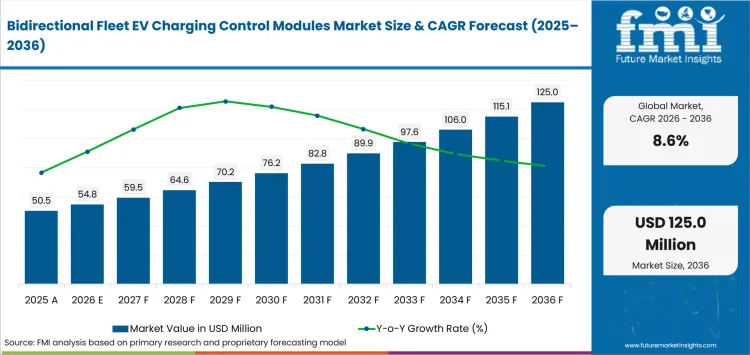
USD 54.8 million in 2026 and USD 125.0 million by 2036 at an 8.6% CAGR.
Demand for bidirectional fleet EV charging control modules are estimated to rise at 8.6% CAGR through 2036, increasing valuation from USD 54.8 million in 2026 to USD 125.0 million by 2036. Fleet operators evaluate vehicle-to-grid controls through verified vehicle and charger compatibility instead of isolated software demonstrations. The U.S. Department of Energy released its VGI strategy in January 2025 to support safe grid connections and repeatable implementation decisions. Control modules create commercial value by translating grid signals into protected charging and discharge instructions across scheduled fleet operations. Repeat purchasing depends on controls that preserve departure readiness and support utility interconnection without creating a separate depot workflow.
United States fleet projects usually begin with utility interconnection reviews and approved-equipment checks across individual service territories. Chinese pilots add coordinated dispatch and settlement across city programs involving several grid organizations during scaled trials. Connected charging infrastructure scales more predictably as site controls coordinate power ceilings and vehicle schedules through one operating layer. China's National Energy Administration reported in October 2025 that 17 provinces had launched scaled vehicle-grid interaction pilots with 3,832 bidirectional chargers. The pilots require grid operators and charging providers to align access rules with settlement processes across participating organizations. Project planners compare investment cases more accurately by separating module performance from vehicle certification and utility approval. The distinction prevents local regulatory delays from being misread as technical failure during multi-site rollout decisions.
Key Takeaways of Bidirectional Fleet EV Charging Control Modules Market
- Demand rises as fleet operators need one control layer that protects departure schedules and coordinates charging with authorized energy export across connected vehicles.
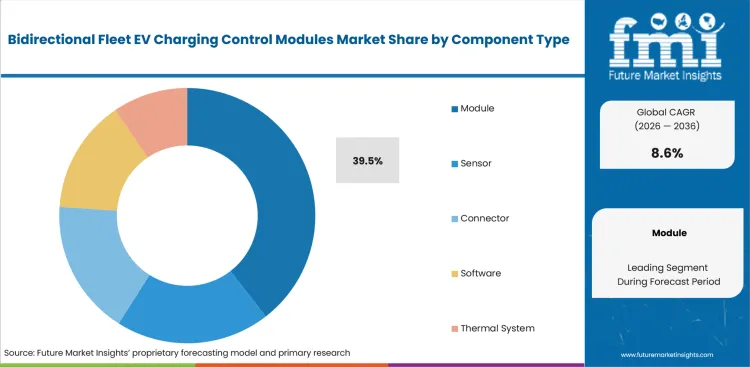
- Module is expected to lead component type demand with 39.5% share in 2026, supported by integrated power conversion and communication requirements.
- Passenger car is projected to hold 31.0% of vehicle type demand in 2026, reflecting earlier availability of compatible bidirectional platforms.
- Battery electric is estimated to capture 74.0% of propulsion demand in 2026, attributable to larger usable batteries and direct charge-discharge control.
- Limited model compatibility and uneven utility interconnection rules remain the principal barriers to repeat fleet deployment across multiple operating sites.
- Wallbox, Nuvve and Fermata Energy II LLC provide dedicated bidirectional hardware or fleet energy control for commercial programs. The Mobility House and Dreev focus on orchestration; ABB, Siemens and Schneider Electric integrate depot power across complex electrical sites.
Analyst Perspective
"Fleet operators gain little from bidirectional hardware that cannot preserve route readiness or pass utility interconnection review. The stronger commercial model combines vehicle-compatible controls, depot power management and accountable service under one operating plan. Dedicated V2G specialists can prove energy-market performance; infrastructure groups reduce installation risk across complex depot electrical systems. Leading offers must connect both capabilities without forcing fleets to rebuild charging assets for every vehicle platform."
- Nikhil Kaitwade, Principal Analyst, Future Market Insights
How is the Bidirectional Fleet EV Charging Control Modules Market segmented?
The bidirectional fleet EV charging control modules industry is segmented by component type; vehicle type; propulsion; sales channel; and region.
The market is segmented by component type, vehicle type, propulsion, sales channel, and region according to the commercial function being purchased. Component type covers sensors, modules, connectors, software, and thermal systems that coordinate charging commands across connected equipment. Vehicle type separates passenger cars, light commercial vehicles, heavy trucks, two-wheelers, and buses according to duty cycles and parking time. Propulsion distinguishes battery electric, plug-in hybrid, fuel cell, hybrid, and retrofit architectures through their available discharge pathways. Sales channels cover OEM integration, aftermarket sales, fleet operators, distributors, and direct sales across different purchasing routes. Regional analysis reflects utility rules and service coverage that influence installation planning and continuing support. Related fleet charging stations define the surrounding infrastructure used to connect vehicles with site-level charging controls. Wider vehicle electrification activity influences platform design without changing the narrower revenue boundary tracked in this report.
What supports module demand within the component type category?
Bidirectional operation requires a control layer that coordinates battery limits with power conversion and external communication. The International Energy Agency explained in May 2026 that V2G adds requirements across battery management systems and vehicle power electronics. Module architectures combine those functions and validate commands ahead of each change in electricity flow. Related power electronics provide the component base; fleet programs pay for verified coordination across the complete charging route.
- By component type, module is estimated to hold 39.5% share in 2026 owing to its role in linking battery protection with charger communication. Integrated designs reduce separate validation tasks and give OEM engineering teams one defined interface for bidirectional commands. The configuration limits repeated testing during staged expansion across several depot locations and compatible vehicle platforms.
- OEM engineering teams favor modular controllers that accept vehicle updates without replacing every surrounding charging component. Reusable interfaces support one validated architecture across several compatible platforms and shorten complex integration programs. Service technicians gain clearer fault isolation during depot maintenance; comparable records support faster diagnosis across vehicles using the same module family.
Why does passenger car remain central to vehicle type demand?
Passenger cars provide the broadest route from consumer platforms into company-car and workplace charging programs. BMW Group and E.ON announced Germany's first commercial customer V2G solution in September 2025 for the BMW iX3. The launch gives module developers a current reference for vehicle authorization and energy-market participation across compatible passenger platforms. Automotive battery controls remain central because bidirectional discharge must preserve driving range and warranty conditions throughout scheduled use.
- The passenger car segment is likely to capture 31.0% share in 2026 attributable to earlier availability of compatible bidirectional platforms. Fleet managers can test control modules through company cars and shared vehicles ahead of heavier commercial duty cycles. Successful trials provide operating evidence for larger programs without committing depot budgets to heavy-duty platforms.
- Corporate fleets adopt passenger-car modules through workplace charging programs that already record dwell time and departure requirements. These installations expose communication faults without placing an entire bus or truck depot at operational risk. Program managers can compare energy savings with departure reliability prior to extending controls into more complex duty cycles.
What strengthens battery electric demand within the propulsion category?
Battery electric vehicles place all propulsion energy inside a controllable high-voltage pack and create a direct route for measured charging and discharge. PG&E reported in August 2025 that Fremont Unified School District had launched 14 electric school buses with 22 chargers; six high-power units were designed for grid export. The deployment shows why battery management systems must work with site controls that preserve route readiness during dispatch events.
- Battery electric is set to lead the propulsion category with 74.0% share in 2026 due to its direct battery-to-charger energy path. Higher usable capacity gives fleet controllers more flexibility to preserve driving reserves and schedule energy export around planned departures. The operating margin supports longer dispatch windows without reducing energy reserved for scheduled fleet service.
- Bus and delivery fleets aggregate several battery electric vehicles through one depot controller and dispatch capacity according to route schedules. Plug-in hybrids retain fuel-system constraints and smaller usable batteries that reduce energy available for repeat grid services. Battery electric platforms therefore give operators a clearer basis for valuing recurring charging and discharge services.
How does OEM integration shape sales channel demand?
OEM integration embeds communication controls and battery protections during vehicle development instead of adding them through a later retrofit. The Mobility House announced in December 2025 that Toyota Motor Europe selected its energy platform for smart charging in Germany. The agreement places charging control inside Toyota's approved customer ecosystem and identifies V2G as a later service phase. Smart charging adapters support connector continuity; OEM-approved software remains decisive for authorizing every bidirectional charging command.
- By sales channel, OEM is forecast to represent 38.0% share in 2026 driven by direct access to vehicle software and warranty controls. Factory integration gives module developers earlier visibility into communication protocols and validation requirements across new electric platforms. Early access reduces redesign risk and clarifies which control functions remain eligible under vehicle warranty terms.
- Fleet operators rely on OEM channels for compatible vehicles and documented battery limits during initial deployment. Aftermarket providers serve existing fleets but face narrower vehicle coverage and greater responsibility for proving safe integration. The added burden makes retrofit adoption practical mainly for fleets with repeatable vehicle and charger configurations.
What are the drivers, restraints, and opportunities in the Bidirectional Fleet EV Charging Control Modules Market?
Fleet electrification and grid flexibility support demand; limited interoperability and uncertain revenue routes restrain broader commercial deployment. Upgradeable modules create a phased route from managed charging to verified energy export.
- Driver: Fleet operators need coordinated controls that protect mobility schedules and reduce site power costs through managed charging or local grid programs.
- Restraint: Limited vehicle compatibility and fragmented interconnection rules prevent one module architecture from scaling across every fleet and utility territory.
- Opportunity: Upgradeable modules can begin with managed charging and activate energy export through verified vehicle interfaces as local programs mature.
Fleet electrification can outpace depot electrical capacity and increases the need for coordinated charging controls. The U.S. Department of Energy explained in June 2025 that managed charging can reduce equipment upgrades without compromising vehicle readiness. Control modules schedule charging within site power limits and reserve sufficient energy for planned routes. Adjacent AC charging systems define conventional deployments that do not return electricity to the grid. EV thermal systems also affect discharge limits because controllers must protect battery temperature during energy export.
Interoperability creates a material restraint across commercial V2G projects that require compatible vehicles and consistent communication standards. ISO published an amendment to ISO 15118-20 in July 2026 covering AC distributed-energy-resource service and stronger security requirements. Module developers must validate battery limits and grid interfaces across each vehicle model and utility territory. A single unsupported interface can block energy export from an otherwise functional commercial depot installation. Every additional validation route raises engineering effort and delays repeat use across multiple fleet operating sites.
Integrated depot energy management is one of the significant opportunity for modules that begin with managed charging and later add verified energy export. ABB E-mobility and Esyasoft announced a strategic partnership in February 2026 for turnkey fleet electrification across public-transit and enterprise projects. The partnership combines charging hardware with fleet management and energy optimization across several international operating regions. Upgradeable modules can preserve established site equipment as compatible vehicles and utility programs expand across fleet networks. The staged route lowers replacement costs and gives operators measurable performance ahead of bidirectional service.
Which country CAGRs are profiled in the Bidirectional Fleet EV Charging Control Modules Market?
| Country | CAGR |
|---|---|
| China | 11.6% |
| South Korea | 10.8% |
| India | 9.9% |
| United States | 9.0% |
| Japan | 8.2% |
| Germany | 7.3% |
How do country-level CAGRs compare in the Bidirectional Fleet EV Charging Control Modules Market?
The country forecast spans 4.3 percentage points between China and Germany and separates pilot expansion from steadier commercial development. China and South Korea form the upper group as public programs create defined routes for bidirectional testing. India and the United States follow through different mechanisms involving technical coordination and utility-specific approval. Japan and Germany record more measured rates because equipment eligibility and energy-market treatment shape deployment timing. Similar percentages therefore conceal major differences in vehicle access, service networks and compensation structures across these markets.
- China uses scaled city pilots to test dispatch instructions and settlement records across several participating grid organizations.
- South Korea combines compatible vehicle platforms with utility-backed trials that expose control modules to normal customer travel patterns.
- India is building technical cooperation around smart charging and interoperability; commercial energy-export settlement remains less developed.
- United States projects use established fleet contracts and utility pilots although interconnection requirements remain specific to each service territory.
- Japan benefits from certified bidirectional hardware routes and equipment subsidies; fleet-scale grid compensation remains less standardized.
- Germany combines automotive engineering with evolving energy-market rules although final implementation details continue to affect project timing.
The full report provides country-level CAGR analysis across North America, Latin America, Europe, East Asia, South Asia, Oceania and the Middle East and Africa.
Country-wise Analysis
- Chinese fleet projects must meet local grid-access and metering requirements before vehicles export energy through city pilot programs. The Chinese bidirectional fleet EV charging control modules sector is projected to record 11.6% CAGR during the assessment period, supported by scaled policy trials. The National Development and Reform Commission announced the first group of scaled vehicle-grid interaction pilots in April 2025. The program gives module developers defined environments for testing dispatch instructions and settlement records across compatible fleets. Domestic charger manufacturing and large electric fleets support integration and local service coverage across urban depot networks. Different grid operators require separate interfaces and operating tests that raise engineering costs across regional rollouts. Developers should prioritize configurable communication layers that preserve battery protections across each approved operating route.
- Jeju deployments require compatible IONIQ 9 or EV9 vehicles and a suitable site for installing a bidirectional charger. Local engineering teams confirm site eligibility and charger compatibility prior to enrolling vehicles in the service. Bidirectional fleet EV charging control module sales in South Korea are forecast to expand at 10.8% CAGR by 2036, reinforced by direct customer participation in grid trials. Hyundai Motor Group expanded its Jeju V2G pilot to 40 resident participants in May 2026. The program provides evidence from normal travel patterns and renewable-energy conditions instead of controlled laboratory schedules. Domestic vehicle engineering and utility participation support detailed module validation across active customer travel patterns. Limited vehicle eligibility and pilot-scale charger availability remain material frictions for broader fleet deployment across additional operating regions.
- Indian control-module projects must align charging hardware with evolving interoperability and V2G testing requirements ahead of commercial energy export. The Press Information Bureau reported in March 2026 that India and the European Union held a workshop covering smart charging and bidirectional interoperability. The program gives automakers and charging developers a clearer route for comparing control interfaces and testing methods. Bidirectional fleet EV charging control module demand in India is forecast to rise at 9.9% CAGR over the forecast period, aided by technical cooperation on interoperability. Domestic engineering institutions and public charging investment support depot electrification programs across several regional fleet corridors. Commercial settlement rules for exported vehicle energy remain less developed and limit revenue certainty across planned fleet projects. Project sponsors should separate managed-charging savings from future V2G income during investment planning and contract evaluation.
- United States fleet projects require utility interconnection approval before bidirectional chargers send vehicle energy into buildings or distribution networks. The United States' bidirectional fleet EV charging control modules outlook is anticipated to advance at 9.0% CAGR over the assessment period, underpinned by public fleet contracts and utility programs. Established purchasing routes and experienced integrators support coordinated implementation across several public fleet depot sites. Utility service territories apply different rules and require separate interconnection applications for neighboring depot locations. Nuvve reported in February 2025 that its New Mexico contract addressed more than 5,000 fleet vehicles and supporting infrastructure. The contract includes V2G and microgrid development alongside coordinated charging deployment across several public fleet programs. Module developers should package interconnection support with software validation and dependable local maintenance coverage for each site.
- Japanese bidirectional equipment installations rely on subsidy eligibility and certified V2H hardware routes that support controlled vehicle discharge. Specialized installer networks enable module qualification across established CHAdeMO systems and approved local equipment deployment routes. Adoption of bidirectional fleet EV charging control modules in Japan is estimated to expand at 8.2% CAGR through 2036, shaped by equipment subsidies and established CHAdeMO routes. The Ministry of Economy, Trade and Industry published its V2H equipment subsidy outline in June 2025. The program gives installers and equipment providers a defined route for eligible bidirectional hardware deployment. Fleet-scale grid revenue remains less standardized than home energy use and limits commercial certainty across fleet projects. Providers should adapt service plans to local connector standards and maintain dependable support across dispersed fleet locations.
- German bidirectional projects must align vehicle interfaces with metering and energy-market rules before fleets receive value from exported electricity. The Bundesnetzagentur published draft MiSpeL rules in September 2025 that proposed new treatment for market-active storage and bidirectional charging. The consultation provides a direct enabler for connecting vehicle controls with energy-market participation under defined accounting options. In Germany, demand for bidirectional fleet EV charging control modules is predicted to advance at 7.3% CAGR through 2036 due to improving energy-market treatment. Established automotive engineering and energy-service companies support local integration and maintenance across major fleet corridors. The draft rules required further implementation decisions and created timing uncertainty for commercial fleet investment schedules. Integration teams should prove metering accuracy and vehicle protection alongside energy-market connectivity across every planned fleet site.
Who are the notable companies in the Bidirectional Fleet EV Charging Control Modules Market?
Wallbox, Nuvve, Fermata Energy II LLC, The Mobility House, Dreev, ABB, Siemens, and Schneider Electric are the notable companies shaping this market.
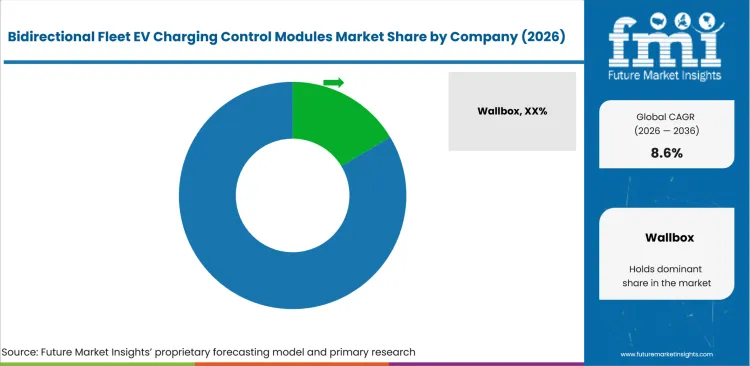
The competitive field combines dedicated V2G specialists with electrical infrastructure groups that support depot and grid integration. Wallbox and Nuvve provide bidirectional charging hardware alongside control software for coordinated vehicle energy management. Nuvve completed the Fermata asset purchase in April 2025 and held 51% of Fermata Energy II LLC at year-end. The Mobility House Energy remains focused on V2G aggregation and electricity-market trading across commercial fleet programs. Edenred signed an agreement in June 2026 to acquire the separate TMH Solutions business; closing was expected during the third quarter. EDF acquired Nuvve's remaining Dreev interest in October 2025 and Dreev retained licensed V2G software rights. ABB, Siemens and Schneider Electric provide depot power systems with different levels of direct bidirectional capability.
- Wallbox and Nuvve focus on dedicated bidirectional hardware and fleet energy software for scheduled vehicle charging. Their portfolios require separate evaluation of charger compatibility and utility integration across each intended deployment. Fleet operators therefore compare software accountability and service coverage alongside charger specifications during commercial selection.
- The Mobility House and Dreev compete through fleet aggregation and energy-market orchestration rather than proprietary vehicle manufacturing. Their strongest role appears in projects requiring hardware-neutral charging control and participation in European electricity systems. Both companies rely on partner chargers and compatible vehicles to complete deployments across regional programs.
- ABB, Siemens and Schneider Electric support depot electrification through power distribution and load management across complex sites. Their current portfolios emphasize site integration and scalable charging rather than dedicated fleet V2G modules. Commercial projects need partner software or vehicle-specific controls to complete bidirectional functions across connected depot assets.
Competitive Benchmarking: Bidirectional Fleet EV Charging Control Modules Market
| Company | Bidirectional Charging Hardware | Fleet Energy Control | Depot and Grid Integration | Geographic Reach |
|---|---|---|---|---|
| Wallbox | High | Medium | Medium | Global |
| Nuvve | High | High | High | Global |
| Fermata Energy II LLC | Medium | High | Medium | North America |
| The Mobility House | Medium | High | Medium | Europe and North America |
| Dreev | Medium | High | High | Europe |
| ABB | Medium | Medium | High | Global |
| Siemens | Low | Medium | High | Global |
| Schneider Electric | Low | Medium | High | Global |
Key Developments in the Bidirectional Fleet EV Charging Control Modules Market
- In January 2025, Nuvve launched a charger line spanning 20 kW to 360 kW for school buses and commercial fleets. The portfolio includes bidirectional models with OCPP support alongside FLEETBOX and GIVe software integration for fleet operations. The launch broadens hardware choices across light-duty and heavy-duty settings with different commercial operating schedules. Fleet programs gain one commercial route for charger validation and coordinated energy control during phased depot electrification.
- In January 2025, Schneider Electric and The Mobility House Solutions announced a partnership covering trucks and buses alongside passenger cars. The combined offer links power infrastructure with hardware-neutral charge management across operational commercial fleet depots. Schneider Electric contributes distribution and energy-management systems; The Mobility House Solutions contributes ChargePilot software and fleet integration. The partnership creates a defined route for adding future energy services without replacing the complete charging architecture.
- In June 2026, The Mobility House joined EcoG and EV-Tech to introduce the ChargeLine BiDi bidirectional DC wallbox. The design supports ISO 15118-20 and OCPP interfaces alongside OEM integration testing across compatible vehicle platforms. Commercial deliveries were scheduled to begin during autumn 2026 and provide programs with a defined implementation timetable. The development creates an interoperable hardware route that connects vehicle communication with established charging-control software.
- In May 2026, ABB E-mobility launched the OM X-Series for megawatt-scale continuous-duty charging across fleet and industrial sites. The architecture supports more than 100 charge points and site power from 800 kW beyond 10 MW. ABB stated that the site-level DC design supports future vehicle-to-grid energy flows across large depots. The platform gives high-utilization sites an infrastructure route for phased bidirectional capability across expanding fleet operations.
Bidirectional Fleet EV Charging Control Modules Market - Report Scope
| Coverage field | Report scope |
|---|---|
| Market breakdown | Component type; vehicle type; propulsion; sales channel; and region. |
| Quantitative Units | Revenue in USD Million, CAGR in %. |
| Market Definition | Commercially tracked revenue from standalone or integrated control modules that manage bidirectional charging commands across electric fleet vehicles and connected charging infrastructure. |
| Regions Covered | North America, Latin America, Europe, East Asia, South Asia and Pacific, and Middle East and Africa. |
| Countries Covered | China, South Korea, India, United States, Japan, Germany, and 30+ countries. |
| Key Companies Profiled | Wallbox, Nuvve, Fermata Energy II LLC, The Mobility House, Dreev, ABB, Siemens, and Schneider Electric. |
| Forecast Period | 2026 to 2036. |
| Approach | Hybrid bottom-up and top-down market sizing supported by primary interviews and official desk research. |
Bidirectional Fleet EV Charging Control Modules Market - Research Methodology
| Method | Approach |
|---|---|
| Primary Research | FMI analysts gathered input from manufacturers, service providers, technology developers, distributors, end users, procurement teams, and subject-matter experts. Interviews examined purchasing decisions, product or service evaluation, adoption barriers, approval requirements, pricing considerations, and expectations for technical or commercial support. Respondents were also asked what evidence is required before a trial, pilot, or initial order develops into regular purchasing. |
| Desk Research | Desk research covered government statistics, regulatory publications, trade data, industry associations, technical literature, standards, company filings, product information, and official corporate announcements. Sources were reviewed for relevance, publication date, geographic coverage, and consistency with the defined market scope. Claims relating to performance, applications, approvals, capacity, investment, and commercial activity were retained only when supported by credible public evidence. |
| Market Sizing and Forecasting | The market model combined the baseline value with historical performance, segment structure, pricing and volume indicators, adoption levels, company participation, and country-level demand conditions. Forecast assumptions considered economic activity, investment trends, regulatory developments, technology adoption, purchasing cycles, supply availability, and barriers to wider market use. Segment and regional estimates were reconciled before the final market total was calculated. |
| Data Validation | Estimates were checked against multiple independent indicators, including public data, company activity, trade patterns, industry developments, and findings from primary interviews. Validation also tested whether products, services, applications, and company revenues fell within the defined market boundaries. Adjacent categories, unsupported claims, overlapping revenues, and activities without direct market relevance were excluded to reduce double counting and maintain consistency across segments and countries. |
Bidirectional Fleet EV Charging Control Modules Market by Segments
Bidirectional Fleet EV Charging Control Modules Market segmented by Component Type:
- Sensor
- Module
- Connector
- Software
- Thermal System
Bidirectional Fleet EV Charging Control Modules Market segmented by Vehicle Type:
- Passenger Car
- Light Commercial Vehicle
- Heavy Truck
- Two Wheeler
- Bus
Bidirectional Fleet EV Charging Control Modules Market segmented by Propulsion:
- Battery Electric
- Plug-in Hybrid
- Fuel Cell
- Hybrid
- ICE Retrofit
Bidirectional Fleet EV Charging Control Modules Market segmented by Sales Channel:
- OEM
- Aftermarket
- Fleet Operators
- Distributors
- Direct Sales
Bidirectional Fleet EV Charging Control Modules Market by Region:
- North America
- United States
- Canada
- Mexico
- Latin America
- Brazil
- Chile
- Rest of Latin America
- Western Europe
- Germany
- UK
- Italy
- Spain
- France
- Nordic
- BENELUX
- Rest of Western Europe
- Eastern Europe
- Russia
- Poland
- Hungary
- Balkan and Baltic
- Rest of Eastern Europe
- East Asia
- China
- Japan
- South Korea
- South Asia and Pacific
- India
- ASEAN
- Australia and New Zealand
- Rest of South Asia and Pacific
- Middle East and Africa
- Kingdom of Saudi Arabia
- Other GCC Countries
- Turkiye
- South Africa
- Other African Union
- Rest of Middle East and Africa
Research Sources and Bibliography
- Wallbox N.V. (2026, April 9). Form 20-F.
- U.S. Department of Energy. (2025, June 18). Managed and Bidirectional Charging.
- U.S. Department of Energy. (2025, January 17). DOE Releases Strategy to Promote Widespread Deployment of Vehicle Grid Integration (VGI) Solutions.
- BMW Group. (2025, September 10). BMW Group and E.ON introduce Germany’s first customer solution enabling electric cars to actively participate in the energy market.
- Pacific Gas and Electric Company. (2025, August 11). In Fremont, PG&E Helps Launch Another Vehicle-to-Grid Electric School Bus Fleet.
- The Mobility House. (2026, June 17). Vehicle-to-grid for the mass market: scalable and interoperable bidirectional charging station from The Mobility House, EcoG and EV-Tech.
- The Mobility House. (2025, December 8). Toyota Motor Europe Selects The Mobility House Energy for its EV Charging Ecosystem.
- Siemens. (2025, October 4). SICHARGE FLEX: Siemens unveils Next-Gen EV Charging System for the Megawatt era.
- Schneider Electric. (2026, January 22). Schneider Electric Launches Schneider StarCharge Fast 720: High-Power EV Charging for All Road Users.
- Schneider Electric. (2025, January 16). Schneider Electric Partners with The Mobility House Solutions to Deploy Smart EV fleet Charging.
- Press Information Bureau. (2026, March 17). India-EU Trade and Technology Council 2nd Workshop on EV Charging Technologies: Advanced Cooperation on Standardisation, Smart and Bidirectional Charging, Megawatt Charging Systems, and Wireless Charging.
- Nuvve Holding Corp. (2026, March 31). Form 10-K.
- Nuvve Holding Corp. (2025, October 14). Form 8-K.
- Nuvve Holding Corp. (2025, February 28). Nuvve Highlights Details of Recent State of New Mexico Contract.
- Nuvve Holding Corp. (2025, January 14). Nuvve Launches New Product Line, Expanding Portfolio of Bidirectional and Unidirectional Charging Solutions.
- National Energy Administration. (2025, October 31).
- National Development and Reform Commission. (2025, April 2).
- Ministry of Economy, Trade and Industry. (2025, June 13).
- International Organization for Standardization. (2026, July 13). ISO 15118-20:2022/Amd 1:2026 Road vehicles - Vehicle to grid communication interface - Part 20: 2nd generation network layer and application layer requirements - Amendment 1: AC DER service, MCS service, and improved security concept.
- International Energy Agency. (2026, May 20). Vehicle-to-grid technology.
- Hyundai Motor Group. (2026, May 15). [Hyundai Motor Group begins V2G pilot service for general customers in Jeju].
- Edenred. (2026, June 15). Edenred strengthens its electric charging offering with the acquisition of The Mobility House Solutions.
- Bundesnetzagentur. (2025, September 19). Bundesnetzagentur ermöglicht flexible Speichernutzung und bidirektionales Laden von Autos.
- ABB E-mobility. (2026, May 5). ABB E-mobility Launches OM X-Series for Highest-Duty Cycle, Megawatt-Scale Charging Use Cases.
- ABB E-mobility. (2026, February 9). ABB E-mobility and Esyasoft e-Mobility Announce Strategic Partnership to Accelerate Global EV Charging Deployments.
This bibliography is provided for reader reference and is not exhaustive. The full report contains the complete reference list and detailed citations.
This Report Answers
- How large is the bidirectional fleet EV charging control modules market in 2026 and 2036?
- Why does module lead component type demand during 2026?
- How do passenger-car duty cycles influence control-module adoption?
- Why does battery electric dominate propulsion demand?
- What establishes OEM as the leading sales channel?
- Which country conditions explain the country CAGR comparison?
- How do utility interconnection requirements affect commercial deployment?
- Which companies provide bidirectional hardware or fleet energy control?
- What limits repeat purchasing across multiple fleet sites?
Frequently Asked Questions
How big is the Bidirectional Fleet EV Charging Control Modules Market in 2026?
USD 54.8 million in 2026, the bidirectional fleet EV charging control modules market reaches USD 125.0 million by 2036. The U.S. Department of Energy released its VGI strategy in January 2025 to support safe grid connections, while China's National Energy Administration reported 3,832 bidirectional chargers across 17 provincial pilots by October 2025.
What is the CAGR of the Bidirectional Fleet EV Charging Control Modules Market from 2026 to 2036?
At 8.6% CAGR, the bidirectional fleet EV charging control modules market grows from USD 54.8 million in 2026 to USD 125.0 million by 2036. Fleet operators require controls that preserve departure readiness and support utility interconnection, with repeat purchasing depending on verified vehicle and charger compatibility across scheduled fleet operations.
Which component type leads the Bidirectional Fleet EV Charging Control Modules Market?
Modules hold 39.5% share of the bidirectional fleet EV charging control modules market by component type in 2026, backed by their role in linking battery protection with charger communication. Integrated designs reduce separate validation tasks and give OEM engineering teams one defined interface for bidirectional commands across several depot locations.
How much will the Bidirectional Fleet EV Charging Control Modules Market add between 2026 and 2036?
USD 70.2 million will be added to the bidirectional fleet EV charging control modules market between 2026 and 2036, growing from USD 54.8 million to USD 125.0 million. Upgradeable modules entering managed charging programs and later activating verified energy export across compatible vehicles and maturing utility programs drive this expansion.
Who are the leading companies in the Bidirectional Fleet EV Charging Control Modules Market?
Eight companies shape the bidirectional fleet EV charging control modules market, including Wallbox, Nuvve, Fermata Energy II LLC, The Mobility House, Dreev, ABB, Siemens, and Schneider Electric. Competition centers on dedicated bidirectional hardware, fleet energy orchestration, and depot power integration across global, European, and North American commercial fleet programs.
Preview the report firsthand - request a free sample
Get SampleGet the brochure for pricing and purchase details.
Get PDFTable of Content
- Key Takeaways
- Market Size and CAGR
- Top Growth Driver
- Fastest Growing Segment
- Leading Region
- Key Companies
- Emerging Opportunities
- Executive Summary
- Global Market Outlook
- Demand-side Trends
- Supply-side Trends
- Technology Roadmap Analysis
- Analysis and Recommendations
- Analyst Perspective (What is happening? Why now? What should investors know?)
- Key Questions Answered
- How large is the market?
- What is the CAGR?
- What are key trends?
- Which region dominates?
- Who are the leaders?
- Market Overview
- Market Coverage / Taxonomy
- Market Definition / Scope / Limitations
- Research Methodology
- Chapter Orientation
- Analytical Lens and Working Hypotheses
- Market Structure, Signals, and Trend Drivers
- Benchmarking and Cross-market Comparability
- Market Sizing, Forecasting, and Opportunity Mapping
- Research Design and Evidence Framework
- Desk Research Programme (Secondary Evidence)
- Expert Input and Fieldwork (Primary Evidence)
- Tooling, Models, and Reference Databases
- Data Engineering and Model Build
- Quality Assurance and Audit Trail
- Market Background
- Market Dynamics (Drivers, Restraints, Opportunity, Trends)
- Scenario Forecast (Optimistic, Likely, Conservative)
- Impact Analysis
- AI Impact
- Sustainability Impact
- Regulatory Impact
- Technology Impact
- Consumer / Buyer Analysis
- Purchase Drivers
- Adoption Barriers
- Buyer Journey
- Opportunity Map Analysis
- Product Life Cycle Analysis
- Supply Chain Analysis
- Investment Feasibility Matrix
- Value Chain Analysis
- PESTLE and Porter's Analysis
- Regulatory Landscape
- Regional Parent Market Outlook
- Production and Consumption Statistics
- Import and Export Statistics
- Global Market Analysis and Forecast, 2021 to 2036
- Historical Market Size Value (USD Million) Analysis, 2021 to 2025
- Current and Future Market Size Value (USD Million) Projections, 2026 to 2036
- Y-o-Y Growth Trend Analysis
- Absolute $ Opportunity Analysis
- Global Market Pricing Analysis, 2021 to 2036
- Global Market Analysis and Forecast, By Component Type, 2021 to 2036
- Introduction / Key Findings
- Historical Market Size Value (USD Million) Analysis By Component Type, 2021 to 2025
- Current and Future Market Size Value (USD Million) Analysis and Forecast By Component Type, 2026 to 2036
- Module
- Sensor
- Connector
- Software
- Thermal System
- Module
- Y-o-Y Growth Trend Analysis By Component Type, 2021 to 2025
- Absolute $ Opportunity Analysis By Component Type, 2026 to 2036
- Global Market Analysis and Forecast, By Vehicle Type, 2021 to 2036
- Introduction / Key Findings
- Historical Market Size Value (USD Million) Analysis By Vehicle Type, 2021 to 2025
- Current and Future Market Size Value (USD Million) Analysis and Forecast By Vehicle Type, 2026 to 2036
- Passenger Car
- Light Commercial Vehicle
- Heavy Truck
- Two Wheeler
- Bus
- Passenger Car
- Y-o-Y Growth Trend Analysis By Vehicle Type, 2021 to 2025
- Absolute $ Opportunity Analysis By Vehicle Type, 2026 to 2036
- Global Market Analysis and Forecast, By Propulsion, 2021 to 2036
- Introduction / Key Findings
- Historical Market Size Value (USD Million) Analysis By Propulsion, 2021 to 2025
- Current and Future Market Size Value (USD Million) Analysis and Forecast By Propulsion, 2026 to 2036
- Battery Electric
- Plug-in Hybrid
- Fuel Cell
- Hybrid
- ICE Retrofit
- Battery Electric
- Y-o-Y Growth Trend Analysis By Propulsion, 2021 to 2025
- Absolute $ Opportunity Analysis By Propulsion, 2026 to 2036
- Global Market Analysis and Forecast, By Sales Channel, 2021 to 2036
- Introduction / Key Findings
- Historical Market Size Value (USD Million) Analysis By Sales Channel, 2021 to 2025
- Current and Future Market Size Value (USD Million) Analysis and Forecast By Sales Channel, 2026 to 2036
- OEM
- Tier 1
- Aftermarket
- Fleet Retrofit
- Charging Network
- OEM
- Y-o-Y Growth Trend Analysis By Sales Channel, 2021 to 2025
- Absolute $ Opportunity Analysis By Sales Channel, 2026 to 2036
- Global Market Analysis and Forecast, By Region, 2021 to 2036
- Introduction
- Historical Market Size Value (USD Million) Analysis By Region, 2021 to 2025
- Current Market Size Value (USD Million) Analysis and Forecast By Region, 2026 to 2036
- North America
- Latin America
- Western Europe
- Eastern Europe
- East Asia
- South Asia and Pacific
- Middle East & Africa
- Market Attractiveness Analysis By Region
- North America Market Analysis and Forecast, By Country, 2021 to 2036
- Historical Market Size Value (USD Million) Trend Analysis By Market Taxonomy, 2021 to 2025
- Market Size Value (USD Million) Forecast By Market Taxonomy, 2026 to 2036
- By Country
- USA
- Canada
- By Component Type
- By Vehicle Type
- By Propulsion
- By Sales Channel
- By Country
- Market Attractiveness Analysis
- By Country
- By Component Type
- By Vehicle Type
- By Propulsion
- By Sales Channel
- Key Takeaways
- Latin America Market Analysis and Forecast, By Country
- Historical Market Size Value (USD Million) Trend Analysis By Market Taxonomy, 2021 to 2025
- Market Size Value (USD Million) Forecast By Market Taxonomy, 2026 to 2036
- By Country
- Brazil
- Mexico
- Chile
- Rest of Latin America
- By Component Type
- By Vehicle Type
- By Propulsion
- By Sales Channel
- By Country
- Market Attractiveness Analysis
- By Country
- By Component Type
- By Vehicle Type
- By Propulsion
- By Sales Channel
- Key Takeaways
- Western Europe Market Analysis and Forecast, By Country
- Historical Market Size Value (USD Million) Trend Analysis By Market Taxonomy, 2021 to 2025
- Market Size Value (USD Million) Forecast By Market Taxonomy, 2026 to 2036
- By Country
- Germany
- UK
- Italy
- Spain
- France
- Nordic
- BENELUX
- Rest of Western Europe
- By Component Type
- By Vehicle Type
- By Propulsion
- By Sales Channel
- By Country
- Market Attractiveness Analysis
- By Country
- By Component Type
- By Vehicle Type
- By Propulsion
- By Sales Channel
- Key Takeaways
- Eastern Europe Market Analysis and Forecast, By Country
- Historical Market Size Value (USD Million) Trend Analysis By Market Taxonomy, 2021 to 2025
- Market Size Value (USD Million) Forecast By Market Taxonomy, 2026 to 2036
- By Country
- Russia
- Poland
- Hungary
- Balkan & Baltic
- Rest of Eastern Europe
- By Component Type
- By Vehicle Type
- By Propulsion
- By Sales Channel
- By Country
- Market Attractiveness Analysis
- By Country
- By Component Type
- By Vehicle Type
- By Propulsion
- By Sales Channel
- Key Takeaways
- East Asia Market Analysis and Forecast, By Country
- Historical Market Size Value (USD Million) Trend Analysis By Market Taxonomy, 2021 to 2025
- Market Size Value (USD Million) Forecast By Market Taxonomy, 2026 to 2036
- By Country
- China
- Japan
- South Korea
- By Component Type
- By Vehicle Type
- By Propulsion
- By Sales Channel
- By Country
- Market Attractiveness Analysis
- By Country
- By Component Type
- By Vehicle Type
- By Propulsion
- By Sales Channel
- Key Takeaways
- South Asia and Pacific Market Analysis and Forecast, By Country
- Historical Market Size Value (USD Million) Trend Analysis By Market Taxonomy, 2021 to 2025
- Market Size Value (USD Million) Forecast By Market Taxonomy, 2026 to 2036
- By Country
- India
- ASEAN
- Australia & New Zealand
- Rest of South Asia and Pacific
- By Component Type
- By Vehicle Type
- By Propulsion
- By Sales Channel
- By Country
- Market Attractiveness Analysis
- By Country
- By Component Type
- By Vehicle Type
- By Propulsion
- By Sales Channel
- Key Takeaways
- Middle East & Africa Market Analysis and Forecast, By Country
- Historical Market Size Value (USD Million) Trend Analysis By Market Taxonomy, 2021 to 2025
- Market Size Value (USD Million) Forecast By Market Taxonomy, 2026 to 2036
- By Country
- Kingdom of Saudi Arabia
- Other GCC Countries
- Türkiye
- South Africa
- Other African Union
- Rest of Middle East & Africa
- By Component Type
- By Vehicle Type
- By Propulsion
- By Sales Channel
- By Country
- Market Attractiveness Analysis
- By Country
- By Component Type
- By Vehicle Type
- By Propulsion
- By Sales Channel
- Key Takeaways
- Key Countries Market Analysis
- USA
- Pricing Analysis
- Market Share Analysis, 2025
- By Component Type
- By Vehicle Type
- By Propulsion
- By Sales Channel
- Canada
- Pricing Analysis
- Market Share Analysis, 2025
- By Component Type
- By Vehicle Type
- By Propulsion
- By Sales Channel
- Mexico
- Pricing Analysis
- Market Share Analysis, 2025
- By Component Type
- By Vehicle Type
- By Propulsion
- By Sales Channel
- Brazil
- Pricing Analysis
- Market Share Analysis, 2025
- By Component Type
- By Vehicle Type
- By Propulsion
- By Sales Channel
- Chile
- Pricing Analysis
- Market Share Analysis, 2025
- By Component Type
- By Vehicle Type
- By Propulsion
- By Sales Channel
- Germany
- Pricing Analysis
- Market Share Analysis, 2025
- By Component Type
- By Vehicle Type
- By Propulsion
- By Sales Channel
- UK
- Pricing Analysis
- Market Share Analysis, 2025
- By Component Type
- By Vehicle Type
- By Propulsion
- By Sales Channel
- Italy
- Pricing Analysis
- Market Share Analysis, 2025
- By Component Type
- By Vehicle Type
- By Propulsion
- By Sales Channel
- Spain
- Pricing Analysis
- Market Share Analysis, 2025
- By Component Type
- By Vehicle Type
- By Propulsion
- By Sales Channel
- France
- Pricing Analysis
- Market Share Analysis, 2025
- By Component Type
- By Vehicle Type
- By Propulsion
- By Sales Channel
- India
- Pricing Analysis
- Market Share Analysis, 2025
- By Component Type
- By Vehicle Type
- By Propulsion
- By Sales Channel
- ASEAN
- Pricing Analysis
- Market Share Analysis, 2025
- By Component Type
- By Vehicle Type
- By Propulsion
- By Sales Channel
- Australia & New Zealand
- Pricing Analysis
- Market Share Analysis, 2025
- By Component Type
- By Vehicle Type
- By Propulsion
- By Sales Channel
- China
- Pricing Analysis
- Market Share Analysis, 2025
- By Component Type
- By Vehicle Type
- By Propulsion
- By Sales Channel
- Japan
- Pricing Analysis
- Market Share Analysis, 2025
- By Component Type
- By Vehicle Type
- By Propulsion
- By Sales Channel
- South Korea
- Pricing Analysis
- Market Share Analysis, 2025
- By Component Type
- By Vehicle Type
- By Propulsion
- By Sales Channel
- Russia
- Pricing Analysis
- Market Share Analysis, 2025
- By Component Type
- By Vehicle Type
- By Propulsion
- By Sales Channel
- Poland
- Pricing Analysis
- Market Share Analysis, 2025
- By Component Type
- By Vehicle Type
- By Propulsion
- By Sales Channel
- Hungary
- Pricing Analysis
- Market Share Analysis, 2025
- By Component Type
- By Vehicle Type
- By Propulsion
- By Sales Channel
- Kingdom of Saudi Arabia
- Pricing Analysis
- Market Share Analysis, 2025
- By Component Type
- By Vehicle Type
- By Propulsion
- By Sales Channel
- Türkiye
- Pricing Analysis
- Market Share Analysis, 2025
- By Component Type
- By Vehicle Type
- By Propulsion
- By Sales Channel
- South Africa
- Pricing Analysis
- Market Share Analysis, 2025
- By Component Type
- By Vehicle Type
- By Propulsion
- By Sales Channel
- USA
- Market Structure Analysis
- Competition Dashboard
- Competition Benchmarking
- Market Share Analysis of Top Players
- By Regional
- By Component Type
- By Vehicle Type
- By Propulsion
- By Sales Channel
- Emerging Startups
- Innovation Benchmarking
- Competition Analysis
- Competition Deep Dive
- Wallbox
- Overview
- Product Portfolio
- Profitability by Market Segments
- Sales Footprint
- Strategy Overview
- Marketing Strategy
- Product Strategy
- Channel Strategy
- Nuvve
- Fermata Energy II LLC
- The Mobility House
- Dreev
- ABB
- Siemens
- Schneider Electric
- Wallbox
- Case Studies
- Success Stories
- Recent Developments
- Competition Deep Dive
- Assumptions & Acronyms Used


