

- Market Size (2026)
- USD 372.5 Mn
- Forecast (2036)
- USD 931.6 Mn
- CAGR (2026 to 2036)
- 9.6%
How big is Biscotti Market in 2026?
USD 372.5 million in 2026 and USD 931.6 million by 2036 at a 9.6% CAGR.
Biscotti demand is projected to expand at a 9.6% CAGR between 2026 and 2036 as manufacturers serve both retail and foodservice channels through different package formats and consumption occasions. Biscotti's long shelf life and compatibility with hot beverages support recurring purchases across cafés, restaurants and grocery stores. USDA Economic Research Service data published in June 2026 showed that food away from home accounted for 56.3% of total USA food expenditures in 2025. The scale of out-of-home consumption creates a consistent sales route for individually portioned biscotti served alongside coffee and specialty beverages.
Premium biscuits also face price pressure as coffee and specialty bakery alternatives compete for the same discretionary purchase. The USA. Bureau of Labor Statistics reported in August 2026 that cookie prices increased 2.0% year over year in July. This increase keeps recipe cost and pack size visible during retail reviews, even for brands that defend a premium shelf price.
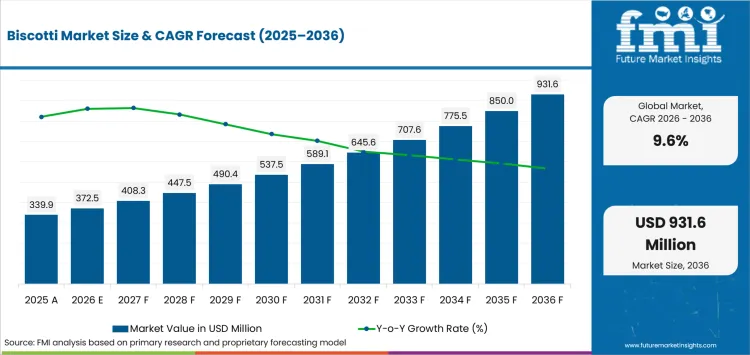
Key Takeaways of Biscotti Market
- Demand expands when a dry twice-baked biscuit earns repeat placement beside coffee and within premium packaged-snack assortments.
- Based on product type, classic - original is projected to account for 39.0% in 2026 due to its familiar twice-baked identity and clear shelf reference.
- By claim - nature, conventional is estimated to hold 56.0% in 2026 owing to familiar recipes that avoid added certification costs.
- Fresh is projected to hold 31.0% share in 2026 owing to specialty bakeries monetizing texture without requiring wider distribution.
- Nutrition disclosure and promotion rules narrow assortment economics by raising claim-review costs and changing multibuy execution for qualifying biscuits.
- Some of the key players in this market include The Biscotti Company, Lotus Bakeries, Mondelez International, pladis, Bahlsen, Arnott's, Ferrero, and Grupo Bimbo.
Analyst Perspective
"Biscotti earns premium pricing only if its twice-baked texture reaches the shelf without excess breakage or stale notes. Retail and foodservice economics diverge because pack count and case size determine whether claim documentation and portion handling justify extra production complexity."
- Nandini Roy Choudhury, Principal Consultant, Future Market Insights
How is the Biscotti Market segmented?
The biscotti market is segmented by product type, claim - nature, format, packaging format, sales channel and region.
Product type separates classic - original biscotti from chocolate-dipped, flavored, nut-based, seed-based, mini, and premium artisan products. Claim - nature covers conventional, clean-label, organic, gluten-free, and fortified recipes that use different bakery ingredients and qualification routes. Format and packaging separate freshness needs from single-serve, multipack, family, and foodservice case economics. Sales channel distinguishes grocery, specialty bakery, online, convenience, and distributor routes based on who controls assortment and replenishment.
What makes Classic - original central to the Product type category?
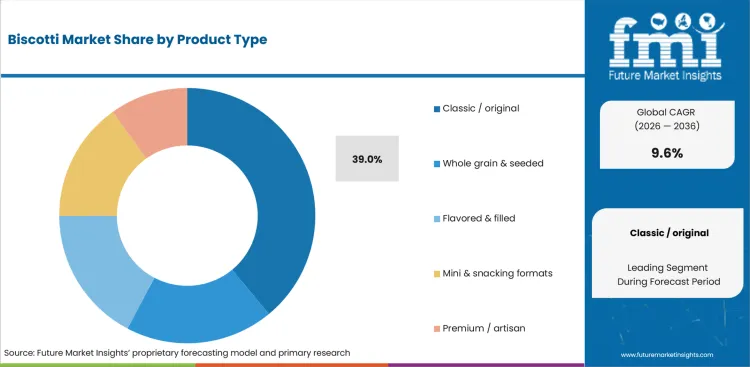
Classic - original biscotti gives retailers a familiar twice-baked reference point while flavors or coatings create variety. Comparable bakery products compete on convenience, while bakery mixes compete on production simplicity. Premium programs earn their price through crisp texture and provenance.
- By product type, classic - original is forecast to represent 39.0% in 2026 driven by recognizable twice-baked texture and a familiar coffee-pairing identity.
- Retailers gained a direct national selling example on June 9, 2026, through The Biscotti Company's QVC three-flavor Biscottini bundle. Chocolate Anise debuted in the assortment, showing how one core twice-baked format can carry flavor extensions without losing category identity.
Why does Conventional lead the Claim - nature category?
Conventional biscotti covers the broadest shelf set because familiar formulations require fewer certification steps than organic or gluten-free alternatives. High-protein bakery mixes illustrate the reformulation pressure facing fortified products. Conventional recipes also preserve crisp texture with fewer controls during routine production.
- The conventional segment is likely to capture 56.0% share in 2026 attributable to familiar taste and fewer certification steps for mainstream recipes.
- South Korea's Ministry of Food and Drug Safety amended food-labeling standards in April 2025 before broader nutrition labeling took effect in 2026. More visible nutrition data increases documentation work for claim-led recipes and keeps conventional products on a simpler qualification route.
How does Fresh retain the lead within the Format category?
Fresh biscotti performs best in bakery operations that replenish frequently and protect crisp texture during short local selling cycles. Frozen bakery programs offer longer inventory windows with different storage economics. Fresh formats depend on nearby outlets able to absorb routine production.
- Fresh is set to lead the format category with 31.0% share in 2026 due to local bakery replenishment protecting crisp texture.
- The Campbell's Company stated in September 2025 that Pepperidge Farm fresh bakery held share and Farmhouse buns and rolls supported momentum. The update reflects the commercial value of frequent replenishment without establishing the approved biscotti share.
What supports Multipack leadership in the Packaging format category?
Multipacks let retailers offer multiple portions at one shelf price without wrapping every biscotti for immediate consumption. Personalized bakery products use pack architecture to separate flavor and occasion within a range. Inner portions reduce breakage risk, while the outer pack keeps the price ladder clear.
- Based on packaging format, multipack is projected to account for 36.0% in 2026 due to repeat household use and visible price ladders.
- In March 2025 The Campbell's Company identified multipack expansion and single-serve portions as active value actions within its snacks portfolio. This documents how pack architecture changes price points and purchase occasions without requiring a new core product.
What are the drivers, restraints and opportunities in the Biscotti Market?
Foodservice and premium grocery occasions increase demand, while promotion and nutrition rules constrain execution. Claim-led product development offers the clearest route to differentiated revenue.
- Driver: Coffee and snack occasions raise reorder potential because one dry biscuit serves retail shelves and foodservice cases without changing its core recipe.
- Restraint: Promotion restrictions and nutrition disclosure raise review costs for qualifying biscuits and reduce flexibility for familiar multibuy tactics.
- Opportunity: Qualified dietary variants earn separate shelf space once taste and texture remain credible after reformulation.
Foodservice Coffee Occasions Expand Replenishment
Cafes give biscotti a second reorder route because portioned dry biscuits can accompany beverages without requiring a perishable dessert program. USDA Economic Research Service data updated in July 2026 show inflation-adjusted foodservice sales rose 73.0% between 1997 and 2025. Higher foodservice throughput increases the value of bakery processing equipment that keeps bake consistency and breakage rates stable during larger production runs for regional accounts.
Promotion Rules Tighten Retail Pack Economics
Retail promotion rules weaken biscotti pack economics because qualifying sweet biscuits may lose familiar multibuy tactics under restricted programs. UK government guidance published in March 2026 confirms that the new nutrient profiling model is being applied to advertising and promotion restrictions. Manufacturers therefore need shelf prices that work without relying on volume discounts during regular annual account reviews in regulated grocery programs.
Qualified Claim Variants Broaden Assortment
Claim-led biscotti earns a clearer place in the assortment when a formulation solves a defined dietary need and has credible qualification. Arnott's launched Gluten Free Jatz and Barbecue Shapes in April 2025 with Coeliac Australia and New Zealand endorsement. That biscuit launch shows how third-party qualification can support premium recipe work alongside confectionery mixes used for flavor development, provided taste and texture survive reformulation.
Which country CAGRs are profiled in the Biscotti Market?
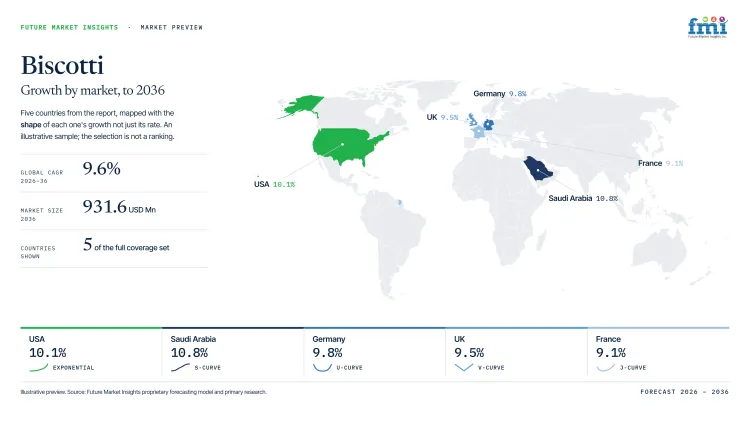
| Country | CAGR |
|---|---|
| Saudi Arabia | 10.8% |
| USA | 10.1% |
| Germany | 9.8% |
| UK | 9.5% |
| France | 9.1% |
How do country-level CAGRs compare in the Biscotti Market?
The five forecasts span 1.3 percentage points, meaning growth is concentrated rather than widely separated between leading and trailing markets. UAE and Saudi Arabia form the upper group. South Korea and the USA remain above 10.0% through different channel structures. Germany trails only narrowly, so account economics may matter more than headline CAGR.
- Saudi distributors use portions that serve retail and cafe counters.
- USA accounts separate grocery pricing from foodservice economics and flour mixes influence formulation costs.
- German specialty accounts value provenance and baking tools that protect repeatable production consistency.
- UK retailers prioritize convenient formats, supporting broader biscuit and snack distribution through established grocery channels.
- French specialty accounts value premium presentation, distinctive flavors, and dependable quality for repeat purchases.
Comparable CAGRs therefore produce different returns once compliance effort and service distance are factored into account economics. The full report provides country-level CAGR analysis across North America, Latin America, Europe, East Asia, South Asia, Oceania, and the Middle East and Africa.
Country-wise Analysis
- Cafes, restaurant chains, and premium retailers increasingly need nutrition files that can be copied directly into physical menus and digital ordering systems because portioned premium snacks move between foodservice counters and modern retail accounts. The Saudi Food and Drug Authority announced in June 2025 that expanded menu nutrition rules would apply from July 1, 2025. Arabic labeling and separate case specifications can raise launch costs for importers using one regional stock pool. Biscotti sales in Saudi Arabia are forecast to expand at a 10.8% CAGR by 2036, supported by a widening foodservice base and demand for channel-ready portions. Brands with complete nutrition files should face less account-level onboarding work.
- USA retailers place biscotti in mainstream cookie aisles, large premium bakery sets, and seasonal gifting programs, exposing smaller brands to sharp price comparisons before repeat grocery velocity is established. The Census Bureau reported in August 2026 that e-commerce represented 17.1% of total USA retail sales during the second quarter, giving niche flavors another route beyond physical shelf trials. The USA biscotti sector is projected to record a 10.1% CAGR during the assessment period, supported by broad grocery coverage and direct-to-consumer access. Manufacturers need clear price ladders before expanding pack counts into more national online inventory slots.
- Organic certification carries visible demand in German specialty retail and communal catering because institutional foodservice provides an additional route beyond premium grocery shelves. Germany's federal food ministry stated in February 2025 that about 16 million people eat daily in communal-catering facilities. Biscotti demand in Germany is forecast to rise at a 9.8% CAGR over the forecast period, aided by organic retail depth. Ingredient sourcing and audit requirements raise unit costs before account rollout, so companies entering Germany need dependable production consistency and strong commercial qualification rather than rapid assortment expansion.
- UK grocery retailers, specialty food stores, and cafes provide multiple routes for biscotti brands as consumers increasingly seek premium snack formats that complement coffee occasions and gifting. Established supermarket networks also allow new flavors and pack sizes to be tested without requiring extensive physical distribution infrastructure. The UK biscotti market is projected to grow at a 9.5% CAGR through 2036, supported by premium bakery demand and established retail penetration. Suppliers need competitive pack architecture and reliable replenishment because crowded biscuit shelves can limit visibility for brands that enter with narrow assortments.
- French specialty retailers, cafes, and premium grocery accounts favor biscotti positioned around provenance, artisanal quality, and distinctive flavor combinations. Gifting and coffee-pairing occasions create opportunities for premium formats, while established bakery traditions increase the importance of ingredient quality and presentation. Biscotti demand in France is forecast to advance at a 9.1% CAGR over the forecast period, reflecting steady premiumization across specialty and modern retail channels. Producers entering France need credible product differentiation and consistent quality because established local bakery preferences can make undifferentiated imported offerings harder to scale.
Who are the notable companies in the Biscotti Market?
The Biscotti Company, Lotus Bakeries, Mondelez International, pladis, Bahlsen, Arnott's, Ferrero and Grupo Bimbo are the notable companies profiled in this market.
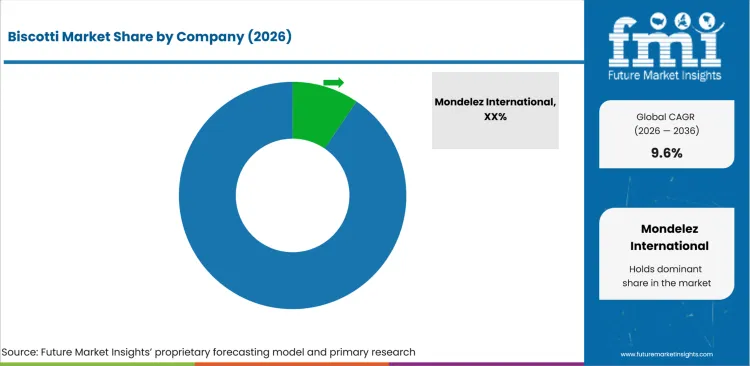
The Biscotti Company supplies the exact twice-baked category from a specialist USA base, while Lotus Bakeries targets premium dry-biscuit occasions globally. Mondelez International and pladis bring large branded-biscuit portfolios with extensive retail access. Bahlsen and Arnott's compete through premium recipes and claim-led extensions that require distinct qualification and retail positioning.
- Direct and premium specialists include The Biscotti Company plus Lotus Bakeries with both brands building identity through crisp dry-biscuit occasions and coffee pairing.
- Large biscuit groups include Mondelez International, pladis, Bahlsen and Arnott's with multiple branded lines supported by broad retail execution.
- Diversified sweet-food platforms include Ferrero and Grupo Bimbo with manufacturing scale and distribution resources extending beyond a single biscuit family.
Competitive Benchmarking: Biscotti Market
| Company | Biscuit Portfolio Depth | Pack and Format Breadth | Claim and Premium Proof | Geographic Reach |
|---|---|---|---|---|
| The Biscotti Company | High | Medium | High | United States |
| Lotus Bakeries | High | High | High | Global |
| Mondelez International | High | High | High | Global |
| pladis | High | High | High | Global |
| Bahlsen | High | High | Medium | Europe and selected international markets |
| Arnott's | High | High | High | Australia, New Zealand and selected export markets |
| Ferrero | Medium | High | High | Global |
| Grupo Bimbo | High | High | Medium | Global |
Scoring basis: High biscuit portfolio depth requires at least three documented biscuit families or an exact biscotti specialist with several current variants. High pack and format breadth requires three verified selling formats under the evidence thresholds used for this benchmark. Medium requires two verified formats, while Low identifies one documented format within the same evidence base. High claim and premium proof requires three documented claim or provenance cues.
Key Developments in the Biscotti Market
- In 2026, Arnott's expanded its biscuit portfolio with Tim Tam Strawberries & Cream and new Shapes variants, alongside gluten-free and reduced-sugar offerings.
- In 2025, Ferrero expanded its biscuit portfolio with Kinderini, a three-layer wheat biscuit featuring 18 facial designs.
- In February 2026, Grupo Bimbo reported full-year 2025 results, supported by its broad bakery and snack portfolio and global distribution network.
Key Players in the Biscotti Market
Biscotti and Premium Dry-Biscuit Specialists
- The Biscotti Company
- Lotus Bakeries
- Bahlsen
Global Branded-Biscuit Platforms
- Mondelez International
- pladis
- Arnott's
- Ferrero
Diversified Bakery Platform
- Grupo Bimbo
Biscotti Market - Report Scope
| Coverage field | Report scope |
|---|---|
| Market breakdown | By product type, claim - nature, format, packaging format, sales channel and region. |
| Quantitative Units | USD Million |
| Market Definition | Revenue includes biscotti and directly equivalent cantucci-style sweet bakery products sold inside the stated product, claim, format, packaging and channel universe. Adjacent cookies, crackers, cakes and other bakery products are excluded unless sold as biscotti or a directly equivalent twice-baked product. |
| Regions Covered | North America, Latin America, Western Europe, Eastern Europe, East Asia, South Asia and Pacific, Middle East and Africa. |
| Countries Covered | UAE, Saudi Arabia, South Korea, USA, Germany; 20+ countries included in the full report. |
| Key Companies Profiled | The Biscotti Company, Lotus Bakeries, Mondelez International, pladis, Bahlsen, Arnott's, Ferrero, Grupo Bimbo. |
| Forecast Period | 2026 to 2036 |
| Approach | Primary and secondary research with market triangulation. |
Biscotti Market - Research Methodology
| Method | Approach |
|---|---|
| Primary Research | FMI analysts gathered input from manufacturers, service providers, technology developers, distributors, end users, procurement teams, and subject-matter experts. Interviews examined purchasing decisions, product or service evaluation, adoption barriers, approval requirements, pricing considerations, and expectations for technical or commercial support. Respondents were also asked what evidence is required before a trial, pilot, or initial order develops into regular purchasing. |
| Desk Research | Desk research covered government statistics, regulatory publications, trade data, industry associations, technical literature, standards, company filings, product information, and official corporate announcements. Sources were reviewed for relevance, publication date, geographic coverage, and consistency with the defined market scope. Claims relating to performance, applications, approvals, capacity, investment, and commercial activity were retained only when supported by credible public evidence. |
| Market Sizing and Forecasting | The market model combined the baseline value with historical performance, segment structure, pricing and volume indicators, adoption levels, company participation, and country-level demand conditions. Forecast assumptions considered economic activity, investment trends, regulatory developments, technology adoption, purchasing cycles, supply availability, and barriers to wider market use. Segment and regional estimates were reconciled before the final market total was calculated. |
| Data Validation | Estimates were checked against multiple independent indicators, including public data, company activity, trade patterns, industry developments, and findings from primary interviews. Validation also tested whether products, services, applications, and company revenues fell within the defined market boundaries. Adjacent categories, unsupported claims, overlapping revenues, and activities without direct market relevance were excluded to reduce double counting and maintain consistency across segments and countries. |
Biscotti Market by Segments
Biscotti Market segmented by product type:
- Classic - original
- Chocolate dipped
- Flavored
- Chocolate
- Cranberry
- Orange
- Lemon
- Coffee / espresso
- Anise
- Nut-based
- Almond
- Hazelnut
- Pistachio
- Seed-based
- Sesame
- Sunflower seed
- Mini / snack-size
- Premium / artisan
Biscotti Market segmented by claim - nature:
- Conventional
- Clean-label
- Organic
- Gluten-free
- High-protein / fortified
Biscotti Market segmented by format:
- Fresh
- Frozen
- Ambient / shelf-stable
- Ready-to-bake / par-baked
Biscotti Market segmented by packaging format:
- Single-serve / individual
- Multipack
- Family / loaf pack
- Foodservice bulk
Biscotti Market segmented by sales channel:
- Supermarkets & hypermarkets
- Specialty bakeries & patisseries
- Online / DTC
- Convenience stores
- Foodservice distributors
Biscotti Market by Region:
- North America
- United States
- Canada
- Latin America
- Brazil
- Mexico
- Chile
- Rest of Latin America
- Western Europe
- Germany
- United Kingdom
- Italy
- Spain
- France
- Nordics
- Benelux
- Rest of Western Europe
- Eastern Europe
- Russia
- Poland
- Hungary
- Balkan and Baltic States
- Rest of Eastern Europe
- East Asia
- China
- Japan
- South Korea
- South Asia and Pacific
- India
- ASEAN
- Australia and New Zealand
- Rest of South Asia and Pacific
- Middle East and Africa
- Kingdom of Saudi Arabia
- Other GCC Countries
- Türkiye
- South Africa
- Other African Union Countries
- Rest of Middle East and Africa
Research Sources and Bibliography
- USA Department of Agriculture, Economic Research Service. (2026, June 11). Total USA food spending reached $2.51 trillion in 2025.
- USA Bureau of Labor Statistics. (2026, August 12). Consumer Price Index - July 2026.
- Ministry of Food and Drug Safety, Republic of Korea. (2025, April 21). Partial amendment to the Food Labeling Standards, Notification No. 2025-27.
- The Campbell's Company. (2025, March). Q2 fiscal 2025 investor presentation.
- The Campbell's Company. (2025, September). Fiscal 2025 fourth-quarter earnings results.
- USA Department of Agriculture, Economic Research Service. (2026, July 8). Food Service Industry - Market Segments.
- UK Government. (2026, March 25). Applying the new NPM to advertising and promotions restrictions.
- Arnott's. (2025, April 10). Arnott's Gluten Free Biscuits and Snacks Range.
- Ministry of Economy and Tourism, United Arab Emirates. (2026, April 13). Emirates Tourism Council discusses new action plans to enhance the growth and resilience of the sector in the coming period.
- Saudi Food and Drug Authority. (2025, June 18). SFDA to Implement New Food Rules for Transparency and Consumer Health.
- Ministry of Agriculture, Food and Rural Affairs, Republic of Korea. (2026, April 8). Q1 2026 K-Food Plus Exports Reach USD 3.35 Billion, Up 3.5% Year-over-Year.
- USA Census Bureau. (2026, August 18). Quarterly Retail E-Commerce Sales.
- Federal Ministry of Food and Agriculture, Germany. (2025, February 15). Das BMEL auf der BIOFACH 2025.
- Lotus Bakeries. (2026, May 12). Lotus Bakeries marks the start of the expansion of its Lembeke production site.
- Yıldız Holding. (2025, July 14). McVitie's Owner Pumps £68m Into British Operations.
- The Biscotti Company. (2026, June 9). The Mangia Mangia Biscottini is Back on QVC.
- The Biscotti Company. (2025, November 19). Biscottini QVC Exclusive Holiday Trio.
- Mondelez International. (2025, November 13). Mondelez International brings the world's favourite Biscoff to India.
- Yıldız Holding. (2025, April 28). Turkish Food Giant Ülker Takes a Strong Step Towards Growth in Uzbekistan.
- Bahlsen. (2025, April 4). Bahlsen Markenrelaunch: Neues Design betont Genussmomente.
- Bahlsen. (2025, August 20). Bahlsen startet neue Kampagne: Einen Keks lang nur ich.
- Ferrero Group. (2026, February 6). Ferrero Group Reports Consolidated Financial Statements for the 2024/2025 Financial Year.
- Lotus Bakeries. (2026, May 4). Biscoff and Tomorrowland introduce a limited edition Biscoff Sandwich Cookie Espresso.
- Grupo Bimbo. (2026, February 25). 4Q25 and Full Year 2025 results.
- Mondelez International. (2026, May 11). Oreo Turns Golden with a Vanilla Twist.
- Arnott's. (2026, May 20). Arnott's NZ X Peter Alexander Giveaway.
- Mars, Incorporated. (2025, December 11). Mars Completes Acquisition of Kellanova.
This Report Answers
- What is the biscotti market size in 2026 and what value is forecast for 2036?
- Which product and channel conditions are supporting repeat biscotti purchases during the forecast period?
- Why does classic - original hold the leading share within the product type category?
- How do conventional recipes compare with organic and gluten-free propositions during retail qualification?
- Why does fresh retain the leading share within the format category despite its shorter selling window?
- What pack economics support multipack leadership in the packaging format category?
- How do the profiled country CAGRs translate into different entry conditions for biscotti companies?
- Which companies are benchmarked for biscuit depth and pack breadth within the competitive field?
- Which promotion and labeling requirements reduce assortment flexibility or raise launch costs?
Frequently Asked Questions
How big is the biscotti market in 2026?
The biscotti market is valued at USD 372.5 million in 2026 and is projected to reach USD 931.6 million by 2036. Premium grocery placement and foodservice coffee occasions provide the main repeat-purchase routes.
What is the CAGR of the biscotti market from 2026 to 2036?
The biscotti market is projected to grow at a CAGR of 9.6% between 2026 and 2036. Premium snack occasions and channel-specific packs allow the same dry biscuit to serve grocery and foodservice demand.
Which product type leads the biscotti market?
The classic - original segment is expected to hold 39.0% of the biscotti market in 2026, driven by its recognizable crisp texture and coffee-pairing identity. Familiar recipes also reduce the explanation needed during a first retail purchase.
Which claim - nature segment holds an additional dominant position in the biscotti market?
The conventional segment is expected to hold 56.0% of the biscotti market in 2026, attributable to familiar taste and price points with fewer certification requirements. Specialty claims need stronger qualification because certification and formulation checks increase launch work ahead of wider retailer distribution.
Which companies are active in the biscotti market?
Key companies operating in the biscotti market include The Biscotti Company, Lotus Bakeries, Mondelez International, pladis, Bahlsen, Arnott's, Ferrero, and Grupo Bimbo. Their competitive positions differ by biscuit specialization and retail reach in major grocery and foodservice channels.
Preview the report firsthand - request a free sample
Get SampleGet the brochure for pricing and purchase details.
Get PDFTable of Content
- Key Takeaways
- Market Size and CAGR
- Top Growth Driver
- Fastest Growing Segment
- Leading Region
- Key Companies
- Emerging Opportunities
- Executive Summary
- Global Market Outlook
- Demand-side Trends
- Supply-side Trends
- Technology Roadmap Analysis
- Analysis and Recommendations
- Analyst Perspective (What is happening? Why now? What should investors know?)
- Key Questions Answered
- How large is the market?
- What is the CAGR?
- What are key trends?
- Which region dominates?
- Who are the leaders?
- Market Overview
- Market Coverage / Taxonomy
- Market Definition / Scope / Limitations
- Research Methodology
- Chapter Orientation
- Analytical Lens and Working Hypotheses
- Market Structure, Signals, and Trend Drivers
- Benchmarking and Cross-market Comparability
- Market Sizing, Forecasting, and Opportunity Mapping
- Research Design and Evidence Framework
- Desk Research Programme (Secondary Evidence)
- Expert Input and Fieldwork (Primary Evidence)
- Tooling, Models, and Reference Databases
- Data Engineering and Model Build
- Quality Assurance and Audit Trail
- Market Background
- Market Dynamics (Drivers, Restraints, Opportunity, Trends)
- Scenario Forecast (Optimistic, Likely, Conservative)
- Impact Analysis
- AI Impact
- Sustainability Impact
- Regulatory Impact
- Technology Impact
- Consumer / Buyer Analysis
- Purchase Drivers
- Adoption Barriers
- Buyer Journey
- Opportunity Map Analysis
- Product Life Cycle Analysis
- Supply Chain Analysis
- Investment Feasibility Matrix
- Value Chain Analysis
- PESTLE and Porter's Analysis
- Regulatory Landscape
- Regional Parent Market Outlook
- Production and Consumption Statistics
- Import and Export Statistics
- Global Market Analysis and Forecast, 2021 to 2036
- Historical Market Size Value (USD Million) Analysis, 2021 to 2025
- Current and Future Market Size Value (USD Million) Projections, 2026 to 2036
- Y-o-Y Growth Trend Analysis
- Absolute $ Opportunity Analysis
- Global Market Pricing Analysis, 2021 to 2036
- Global Market Analysis and Forecast, By Product Type, 2021 to 2036
- Introduction / Key Findings
- Historical Market Size Value (USD Million) Analysis By Product Type, 2021 to 2025
- Current and Future Market Size Value (USD Million) Analysis and Forecast By Product Type, 2026 to 2036
- Classic / original
- Whole grain & seeded
- Flavored & filled
- Mini & snacking formats
- Premium / artisan
- Classic / original
- Y-o-Y Growth Trend Analysis By Product Type, 2021 to 2025
- Absolute $ Opportunity Analysis By Product Type, 2026 to 2036
- Global Market Analysis and Forecast, By Claim / Nature, 2021 to 2036
- Introduction / Key Findings
- Historical Market Size Value (USD Million) Analysis By Claim / Nature, 2021 to 2025
- Current and Future Market Size Value (USD Million) Analysis and Forecast By Claim / Nature, 2026 to 2036
- Conventional
- Clean label
- Organic
- Gluten-free
- High-protein / fortified
- Conventional
- Y-o-Y Growth Trend Analysis By Claim / Nature, 2021 to 2025
- Absolute $ Opportunity Analysis By Claim / Nature, 2026 to 2036
- Global Market Analysis and Forecast, By Format, 2021 to 2036
- Introduction / Key Findings
- Historical Market Size Value (USD Million) Analysis By Format, 2021 to 2025
- Current and Future Market Size Value (USD Million) Analysis and Forecast By Format, 2026 to 2036
- Fresh
- Frozen
- Ambient packaged
- Chilled
- Par-baked / thaw-and-serve
- Fresh
- Y-o-Y Growth Trend Analysis By Format, 2021 to 2025
- Absolute $ Opportunity Analysis By Format, 2026 to 2036
- Global Market Analysis and Forecast, By Packaging Format, 2021 to 2036
- Introduction / Key Findings
- Historical Market Size Value (USD Million) Analysis By Packaging Format, 2021 to 2025
- Current and Future Market Size Value (USD Million) Analysis and Forecast By Packaging Format, 2026 to 2036
- Multipack
- Single-serve
- Family / loaf pack
- Bulk foodservice
- Multipack
- Y-o-Y Growth Trend Analysis By Packaging Format, 2021 to 2025
- Absolute $ Opportunity Analysis By Packaging Format, 2026 to 2036
- Global Market Analysis and Forecast, By Sales Channel, 2021 to 2036
- Introduction / Key Findings
- Historical Market Size Value (USD Million) Analysis By Sales Channel, 2021 to 2025
- Current and Future Market Size Value (USD Million) Analysis and Forecast By Sales Channel, 2026 to 2036
- Supermarkets & hypermarkets
- Artisan & specialty bakeries
- Convenience & forecourt
- Online & DTC
- Foodservice distributors
- Supermarkets & hypermarkets
- Y-o-Y Growth Trend Analysis By Sales Channel, 2021 to 2025
- Absolute $ Opportunity Analysis By Sales Channel, 2026 to 2036
- Global Market Analysis and Forecast, By Region, 2021 to 2036
- Introduction
- Historical Market Size Value (USD Million) Analysis By Region, 2021 to 2025
- Current Market Size Value (USD Million) Analysis and Forecast By Region, 2026 to 2036
- North America
- Latin America
- Western Europe
- Eastern Europe
- East Asia
- South Asia and Pacific
- Middle East & Africa
- Market Attractiveness Analysis By Region
- North America Market Analysis and Forecast, By Country, 2021 to 2036
- Historical Market Size Value (USD Million) Trend Analysis By Market Taxonomy, 2021 to 2025
- Market Size Value (USD Million) Forecast By Market Taxonomy, 2026 to 2036
- By Country
- USA
- Canada
- By Product Type
- By Claim / Nature
- By Format
- By Packaging Format
- By Sales Channel
- By Country
- Market Attractiveness Analysis
- By Country
- By Product Type
- By Claim / Nature
- By Format
- By Packaging Format
- By Sales Channel
- Key Takeaways
- Latin America Market Analysis and Forecast, By Country
- Historical Market Size Value (USD Million) Trend Analysis By Market Taxonomy, 2021 to 2025
- Market Size Value (USD Million) Forecast By Market Taxonomy, 2026 to 2036
- By Country
- Brazil
- Mexico
- Chile
- Rest of Latin America
- By Product Type
- By Claim / Nature
- By Format
- By Packaging Format
- By Sales Channel
- By Country
- Market Attractiveness Analysis
- By Country
- By Product Type
- By Claim / Nature
- By Format
- By Packaging Format
- By Sales Channel
- Key Takeaways
- Western Europe Market Analysis and Forecast, By Country
- Historical Market Size Value (USD Million) Trend Analysis By Market Taxonomy, 2021 to 2025
- Market Size Value (USD Million) Forecast By Market Taxonomy, 2026 to 2036
- By Country
- Germany
- UK
- Italy
- Spain
- France
- Nordic
- BENELUX
- Rest of Western Europe
- By Product Type
- By Claim / Nature
- By Format
- By Packaging Format
- By Sales Channel
- By Country
- Market Attractiveness Analysis
- By Country
- By Product Type
- By Claim / Nature
- By Format
- By Packaging Format
- By Sales Channel
- Key Takeaways
- Eastern Europe Market Analysis and Forecast, By Country
- Historical Market Size Value (USD Million) Trend Analysis By Market Taxonomy, 2021 to 2025
- Market Size Value (USD Million) Forecast By Market Taxonomy, 2026 to 2036
- By Country
- Russia
- Poland
- Hungary
- Balkan & Baltic
- Rest of Eastern Europe
- By Product Type
- By Claim / Nature
- By Format
- By Packaging Format
- By Sales Channel
- By Country
- Market Attractiveness Analysis
- By Country
- By Product Type
- By Claim / Nature
- By Format
- By Packaging Format
- By Sales Channel
- Key Takeaways
- East Asia Market Analysis and Forecast, By Country
- Historical Market Size Value (USD Million) Trend Analysis By Market Taxonomy, 2021 to 2025
- Market Size Value (USD Million) Forecast By Market Taxonomy, 2026 to 2036
- By Country
- China
- Japan
- South Korea
- By Product Type
- By Claim / Nature
- By Format
- By Packaging Format
- By Sales Channel
- By Country
- Market Attractiveness Analysis
- By Country
- By Product Type
- By Claim / Nature
- By Format
- By Packaging Format
- By Sales Channel
- Key Takeaways
- South Asia and Pacific Market Analysis and Forecast, By Country
- Historical Market Size Value (USD Million) Trend Analysis By Market Taxonomy, 2021 to 2025
- Market Size Value (USD Million) Forecast By Market Taxonomy, 2026 to 2036
- By Country
- India
- ASEAN
- Australia & New Zealand
- Rest of South Asia and Pacific
- By Product Type
- By Claim / Nature
- By Format
- By Packaging Format
- By Sales Channel
- By Country
- Market Attractiveness Analysis
- By Country
- By Product Type
- By Claim / Nature
- By Format
- By Packaging Format
- By Sales Channel
- Key Takeaways
- Middle East & Africa Market Analysis and Forecast, By Country
- Historical Market Size Value (USD Million) Trend Analysis By Market Taxonomy, 2021 to 2025
- Market Size Value (USD Million) Forecast By Market Taxonomy, 2026 to 2036
- By Country
- Kingdom of Saudi Arabia
- Other GCC Countries
- Türkiye
- South Africa
- Other African Union
- Rest of Middle East & Africa
- By Product Type
- By Claim / Nature
- By Format
- By Packaging Format
- By Sales Channel
- By Country
- Market Attractiveness Analysis
- By Country
- By Product Type
- By Claim / Nature
- By Format
- By Packaging Format
- By Sales Channel
- Key Takeaways
- Key Countries Market Analysis
- USA
- Pricing Analysis
- Market Share Analysis, 2025
- By Product Type
- By Claim / Nature
- By Format
- By Packaging Format
- By Sales Channel
- Canada
- Pricing Analysis
- Market Share Analysis, 2025
- By Product Type
- By Claim / Nature
- By Format
- By Packaging Format
- By Sales Channel
- Mexico
- Pricing Analysis
- Market Share Analysis, 2025
- By Product Type
- By Claim / Nature
- By Format
- By Packaging Format
- By Sales Channel
- Brazil
- Pricing Analysis
- Market Share Analysis, 2025
- By Product Type
- By Claim / Nature
- By Format
- By Packaging Format
- By Sales Channel
- Chile
- Pricing Analysis
- Market Share Analysis, 2025
- By Product Type
- By Claim / Nature
- By Format
- By Packaging Format
- By Sales Channel
- Germany
- Pricing Analysis
- Market Share Analysis, 2025
- By Product Type
- By Claim / Nature
- By Format
- By Packaging Format
- By Sales Channel
- UK
- Pricing Analysis
- Market Share Analysis, 2025
- By Product Type
- By Claim / Nature
- By Format
- By Packaging Format
- By Sales Channel
- Italy
- Pricing Analysis
- Market Share Analysis, 2025
- By Product Type
- By Claim / Nature
- By Format
- By Packaging Format
- By Sales Channel
- Spain
- Pricing Analysis
- Market Share Analysis, 2025
- By Product Type
- By Claim / Nature
- By Format
- By Packaging Format
- By Sales Channel
- France
- Pricing Analysis
- Market Share Analysis, 2025
- By Product Type
- By Claim / Nature
- By Format
- By Packaging Format
- By Sales Channel
- India
- Pricing Analysis
- Market Share Analysis, 2025
- By Product Type
- By Claim / Nature
- By Format
- By Packaging Format
- By Sales Channel
- ASEAN
- Pricing Analysis
- Market Share Analysis, 2025
- By Product Type
- By Claim / Nature
- By Format
- By Packaging Format
- By Sales Channel
- Australia & New Zealand
- Pricing Analysis
- Market Share Analysis, 2025
- By Product Type
- By Claim / Nature
- By Format
- By Packaging Format
- By Sales Channel
- China
- Pricing Analysis
- Market Share Analysis, 2025
- By Product Type
- By Claim / Nature
- By Format
- By Packaging Format
- By Sales Channel
- Japan
- Pricing Analysis
- Market Share Analysis, 2025
- By Product Type
- By Claim / Nature
- By Format
- By Packaging Format
- By Sales Channel
- South Korea
- Pricing Analysis
- Market Share Analysis, 2025
- By Product Type
- By Claim / Nature
- By Format
- By Packaging Format
- By Sales Channel
- Russia
- Pricing Analysis
- Market Share Analysis, 2025
- By Product Type
- By Claim / Nature
- By Format
- By Packaging Format
- By Sales Channel
- Poland
- Pricing Analysis
- Market Share Analysis, 2025
- By Product Type
- By Claim / Nature
- By Format
- By Packaging Format
- By Sales Channel
- Hungary
- Pricing Analysis
- Market Share Analysis, 2025
- By Product Type
- By Claim / Nature
- By Format
- By Packaging Format
- By Sales Channel
- Kingdom of Saudi Arabia
- Pricing Analysis
- Market Share Analysis, 2025
- By Product Type
- By Claim / Nature
- By Format
- By Packaging Format
- By Sales Channel
- Türkiye
- Pricing Analysis
- Market Share Analysis, 2025
- By Product Type
- By Claim / Nature
- By Format
- By Packaging Format
- By Sales Channel
- South Africa
- Pricing Analysis
- Market Share Analysis, 2025
- By Product Type
- By Claim / Nature
- By Format
- By Packaging Format
- By Sales Channel
- USA
- Market Structure Analysis
- Competition Dashboard
- Competition Benchmarking
- Market Share Analysis of Top Players
- By Regional
- By Product Type
- By Claim / Nature
- By Format
- By Packaging Format
- By Sales Channel
- Emerging Startups
- Innovation Benchmarking
- Competition Analysis
- Competition Deep Dive
- Mondelez International
- Overview
- Product Portfolio
- Profitability by Market Segments
- Sales Footprint
- Strategy Overview
- Marketing Strategy
- Product Strategy
- Channel Strategy
- pladis
- Bahlsen
- Lotus Bakeries
- Walkers Shortbread
- Kellanova
- Arnott's
- Ferrero
- Grupo Bimbo
- Campbell Company
- Mondelez International
- Case Studies
- Success Stories
- Recent Developments
- Competition Deep Dive
- Assumptions & Acronyms Used


