

- Market Size (2026)
- USD 128.9 Mn
- Forecast (2036)
- USD 263.2 Mn
- CAGR (2026 to 2036)
- 7.4%
How big is Caneles Market in 2026?
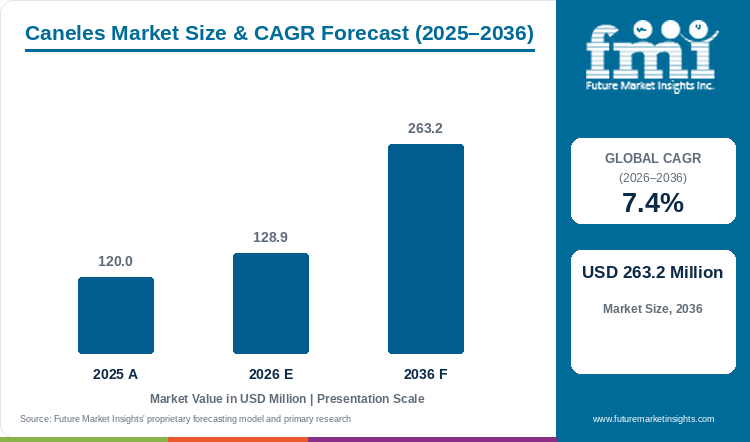
The caneles market demonstrated steady progress from USD 120.0 million in 2025 to USD 128.9 million in 2026, building toward a targeted valuation of USD 263.2 million by 2036 at a CAGR of 7.4%.
Global caneles demand stood at USD 120.0 million in 2025 before reaching an estimated USD 128.9 million in 2026, and is projected to climb to USD 263.2 million by 2036 at a 7.4% CAGR to create USD 134.3 million in added value. Within the product type segment, classic / original is estimated to hold a 36.0% share in 2026, attributed to repeat shopper preference for a dark caramelized sugar crust and vanilla-rum custard center. Coffee-shop beverage pairing and boxed pastry gifting are fueling adoption of thaw-and-re-crisp Bordeaux pastries. Because par-baked fluted molds let cafés serve warm single-serve specialties in 12 minutes without skilled pastry chefs, the market is advancing faster than frozen pastries at 5.4% CAGR. According to Finsbury Food Group, its April 2026 acquisition of Flower & White added a sweet-treat brand growing at 30% per year across retail and foodservice channels [1]. In addition to this, Dessert Holdings bought Willamette Valley Pie Co. in July 2025 to widen its artisan dessert network in North America, though crust softening from moisture migration within 24 hours still limits ambient supermarket shelf life.
Key Market Trends & Insights
- By product type: Classic / original is estimated to hold a 36.0% share in 2026 because the fluted caramelized Bordeaux shell and vanilla-rum custard interior remain the category benchmark.
- By claim / nature: Conventional is projected to account for a 58.0% share in 2026 because whole milk and egg yolk with dairy butter support smooth batter mixing and golden crust browning.
- By format: Fresh is predicted to record a 30.0% share in 2026 because same-day baking prevents interior custard moisture from softening the glassy caramelized exterior.
- By packaging format: Multipack is expected to hold a 34.0% share in 2026 because 4-piece to 12-piece gift boxes match travel-retail and boutique patisserie sharing occasions.
- By sales channel: Supermarkets & hypermarkets is forecast to register a 36.0% share in 2026 as in-store bakery bake-off counters and chilled patisserie cases expand household trial beyond boutique shops.
Regional Highlights
- Top national expansion: The UAE is projected to lead profiled national markets at an 8.6% CAGR through 2036 under rising international overnight visitor arrivals and luxury hotel espresso-bar menus.
- Broader country progression: Saudi Arabia is expected to expand at an 8.3% CAGR ahead of South Korea at 8.0% and the USA at 7.7%, while Japan is forecast to advance at a 6.4% CAGR.
Market Size & Forecast
Table 1: Market Size and Forecast for the Caneles Market (USD million and CAGR percentage), 2025 to 2036
| Metric | Value |
|---|---|
| 2025 Market Size | USD 120.0 million |
| Estimated Market Size in 2026 | USD 128.9 million |
| Projected Market Size by 2036 | USD 263.2 million |
| CAGR, 2026 to 2036 | 7.4% |
| Added Revenue, 2026 to 2036 | USD 134.3 million |
Coffee-shop chains and hotel catering kitchens face persistent shortages of trained pastry chefs and rising kitchen labor costs. Preparation of canelés from scratch requires resting the liquid batter for up to 48 hours in cold rooms and baking in beeswax-lined copper molds at 220 degrees Celsius for an hour. In January 2025, baking trials published in Foods showed that delayed superheated steam injection speeds up crust browning and sugar caramelization to reach a browning index of 120 while keeping the inner crumb soft [2]. As a result, foodservice buyers are switching to centralized frozen bakery products where industrial ovens complete the long bake and café staff finish the pastries in a 10-minute convection cycle.
Café-Counter and Patisserie-Unit Sizing
Table 2: Café-Counter and Patisserie-Unit Sizing for the Caneles Market (USD million and operational ranges), 2025 to 2036
| Metric | 2025 | 2026 | 2036 |
|---|---|---|---|
| Market size (USD million) | 120.0 | 128.9 | 263.2 |
| Commercial canelé volume (million pieces) | 88.0 to 98.0 | 94.0 to 105.0 | 178.0 to 198.0 |
| Crust-retention shelf window (hours ambient) | 18.0 to 24.0 | 20.0 to 26.0 | 28.0 to 36.0 |
| Wholesale price per piece (USD) | 1.20 to 1.45 | 1.25 to 1.50 | 1.35 to 1.65 |
Operational note: Piece and price ranges reconcile 45-to-60 gram classic canelé wholesale cartons and 18-to-25 gram miniature catering trays against specialty café attachment rates and boutique patisserie box pricing.
Extension of the crisp sugar crust window beyond 24 hours at room temperature remains the main hurdle for wholesale pastry distributors. Commercial bakeries producing European viennoiserie blast-freeze freshly unmolded canelés at minus 35 degrees Celsius so steam from the custard center cannot soften the caramelized shell.
Per Capita & Specialty Café Outlet Sizing
Table 3: Per Capita and Café Outlet Spending Indicators for the Caneles Market (USD), 2025 to 2036
| Metric | 2025 | 2026 | 2036 |
|---|---|---|---|
| World population (billion) | 8.2 | 8.3 | 9.0 |
| Spend per 1,000 people (USD) | 14.6 | 15.5 | 29.2 |
| Annual spend per stocking café/bakery (USD) | 1,850 to 2,150 | 1,950 to 2,280 | 3,200 to 3,750 |
| Frozen & par-baked fulfillment share (%) | 41.0% to 45.0% | 42.5% to 46.5% | 54.0% to 58.5% |
Table 4: Specialty Bakery & Café Spending Indicators for the Caneles Market (USD and percentages), 2026
| Metric | Value | Institutional Reference Basis |
|---|---|---|
| Market size, 2026 | USD 128.9 million | 2026 global revenue baseline |
| Stocking cafés & patisseries globally | 61,000 outlets | Specialty coffee, hotel & patisserie outlet pool |
| Market spend per stocking outlet | USD 2,113.1 | Annualized wholesale canelé procurement |
| Supermarket & hypermarket revenue, 2026 | USD 46.4 million | 36.0% sales channel segment allocation |
Grocery in-store bakeries prefer frozen bake-off trays that fit standard convection ovens during morning croissant runs. Foodservice distributors bundle fluted Bordeaux pastries with ready-to-finish bakery goods so store staff can restock display domes twice a day without throwaway waste.
Analyst Perspective
"Canelés succeed commercially only when the contrast between a brittle caramelized shell and a moist custard interior survives distribution from commissary to coffee counter. Bakery manufacturers that pair blast-frozen par-baked molds with validated 10-minute café re-crisping protocols will capture high-margin foodservice and in-store bakery listings."
- Nandini Roy Choudhury, Principal Analyst at Future Market Insights
How is the caneles market segmented?
The caneles market is segmented by product type, claim / nature, format, packaging format, and sales channel. In 2026, Classic / original is estimated to hold 36.0%, conventional 58.0%, fresh 30.0%, multipack 34.0%, and supermarkets & hypermarkets 36.0%.
By product type: Classic / original, whole grain & seeded, flavored & filled, mini & snacking formats, and premium / artisan.
By claim / nature: Conventional, clean label, organic, gluten-free, and high-protein / fortified.
By format: Fresh, frozen, ambient packaged, chilled, and par-baked / thaw-and-serve.
By packaging format: Multipack, single-serve, family / loaf pack, and bulk foodservice.
By sales channel: Supermarkets & hypermarkets, artisan & specialty bakeries, convenience & forecourt, online & DTC, and foodservice distributors.
Why does Classic / Original lead the product type category?
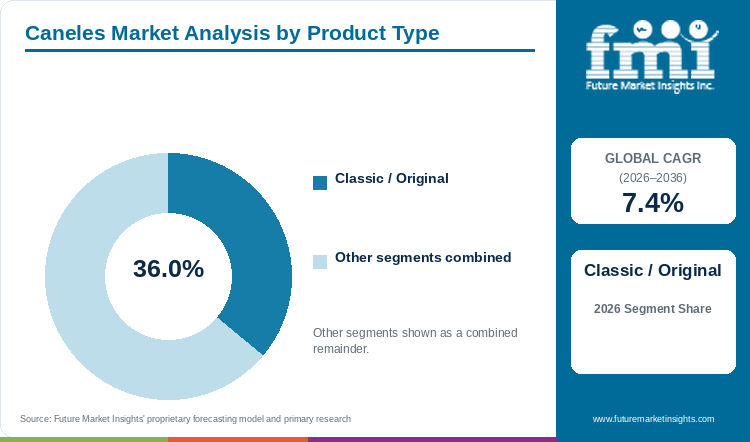
Classic / original is estimated to hold a 36.0% share of the product type segment in 2026, anchored by traditional Bordeaux vanilla-rum custard recipes.
Table 5: Product Type Share for the Caneles Market (percentage share), 2026
| Product Type | Share (2026) |
|---|---|
| Classic / Original | 36.0% |
| Other Segments Combined* | 64.0% |
| Total | 100.0% |
*Calculated as the balance remaining after deducting the leading segment's reported share from 100.0%.
Table 6: Product Type Leadership and Market Growth for the Caneles Market (segment and CAGR percentage), 2026 to 2036
| Metric | Value |
|---|---|
| Global CAGR (2026 to 2036) | 7.4% |
| Leading Segment | Classic / Original |
Espresso-bar buyers and specialty grocers stock Classic / original canelés first because the dark caramelized sugar crust and vanilla-rum custard center need no explanation next to commercial croissants. Meanwhile, flavored & filled and mini & snacking formats help boutique shops build higher-value gift boxes in East Asia and Western Europe.
- Classic / original is estimated to hold a 36.0% share of the product type segment in 2026, driven by baseline espresso-bar pairing and travel-retail gift boxes.
- In March 2025, bakery texture-profile trials published in Food Science & Nutrition confirmed that plant polyphenol extracts lower free moisture and keep the inner crumb soft in high-moisture cakes without changing acidity [3].
How does Conventional retain leadership in the claim / nature segment?
Conventional is projected to account for a 58.0% share of the claim / nature segment in 2026, supported by authentic egg-yolk, dairy, and sucrose batter chemistry.
Authentic canelé texture relies on egg-yolk lecithin emulsification and pure sucrose caramelization at 210 degrees Celsius. Although R&D kitchens testing clean-label bakery flours and rice-flour blends are rolling out gluten-free options, Conventional recipes remain the cost and taste benchmark for commercial bakeries.
- Conventional is projected to account for a 58.0% share of the claim / nature segment in 2026, owing to lower ingredient cost and reliable crust caramelization without hydrocolloid stabilizers.
- An August 2025 rheological study published in the Journal of the Science of Food and Agriculture demonstrated that pairing aquafaba powder with 0.1 to 0.5 grams of psyllium husk in rice-flour batters replicates egg-based cake height and moisture retention for gluten-free lines [4].
What makes Fresh the principal format segment?
Fresh is predicted to record a 30.0% share of the format segment in 2026, supported by same-day bake-off counter sales that prevent shell softening.
When a baked canelé sits at room humidity for more than a day, moisture from the soft custard interior migrates outward and turns the crisp sugar shell chewy. Artisan patisseries and grocery bake-off counters therefore focus on Fresh day-baked sales, while multi-site coffee chains order frozen baked goods and par-baked / thaw-and-serve trays that restore crust snap in café ovens.
- Fresh is predicted to record a 30.0% share of the format segment in 2026, attributable to superior crust-to-custard sensory contrast during the first 12 hours post-bake.
- Cryoprotective bakery research published in Foods in August 2026 established that 0.5% soybean oligosaccharide supplementation limits ice crystal damage during frozen storage and reduces post-bake crumb firmness by 15.27% [5].
Why is Multipack the largest packaging format?
Multipack is expected to hold a 34.0% share of the packaging format segment in 2026, driven by boxed gifting and multi-piece household sharing.
Because a single canelé weighs only 20 to 60 grams, supermarkets and patisseries pack 4 to 12 pieces into rigid Multipack boxes and clear clamshells to lift average basket spend. Presentation boxes reinforced with cake boards and drums protect the fluted ridges from crushing during courier delivery and grocery shelf stacking.
- Multipack is expected to hold a 34.0% share of the packaging format segment in 2026, reinforced by corporate gifting boxes and supermarket 4-pack clamshells.
- In November 2025, bakery fat-and-fiber trials published in Food Chemistry confirmed that structured oil-fiber blends slow crumb staling and preserve moisture across multi-day packaged storage [6].
Why do Supermarkets & Hypermarkets lead the sales channel segment?
Supermarkets & hypermarkets is forecast to register a 36.0% share of the sales channel segment in 2026, enabled by in-store bakery bake-off programs.
Supermarkets & hypermarkets turn canelés from a rare boutique purchase into a regular weekly grocery treat by baking off frozen par-baked units at in-store bakery tables. Category managers place 4-count chilled and ambient packs near mini frozen dessert novelties and brioche loaves to capture at-home coffee occasions.
- Supermarkets & hypermarkets is forecast to register a 36.0% share of the sales channel segment in 2026, linked to nationwide grocery store footprints and private-label Bordeaux patisserie tiers.
- In August 2025, Finsbury Food Group acquired a 70% majority stake in London specialty bakery brand Lola's Cupcakes to expand direct-to-consumer and high-footfall retail kiosk fulfillment [7].
What are the drivers, restraints, and opportunities in the caneles market?
In the caneles market, specialty coffee-shop pairing and boxed gifting drive adoption, whereas rapid sucrose-crust moisture absorption restrains ambient shelf life and blast-frozen re-crisp formats enable foodservice scale.
- Driver: Third-wave espresso bars and travel-retail gift counters create recurring demand for portion-controlled Bordeaux pastries.
- Restraint: Outward moisture migration from the custard core softens the caramelized crust within 24 hours while dairy and wheat allergens require strict out-of-home labeling.
- Opportunity: Cryogenically frozen par-baked canelés and moisture-barrier modified-atmosphere multipacks allow café chains and grocers to serve crisp pastries without copper-mold labor.
Growth Analysis and Future Potential: Qualitative Demand Catalysts
Specialty coffee chains and hotel foodservice managers are upgrading counter pastry menus beyond basic muffins toward high-margin European single-serve treats. Because a 50-gram canelé takes up less than a third of the tray space of a croissant while selling at a similar price, cafés generate higher sales per square foot of display case. Future Market Insights notes that commercial bakers are blending pregelatinized bakery flours into liquid batters to keep viscosity steady during 24-hour cold resting. In July 2026, response-surface pastry formulation trials published in Foods showed that balancing butter and sugar ratios lifts sensory scores to 95.03 while slowing fat oxidation [8]. Central bakery commissaries apply these standardized batter recipes to ship consistent fluted pastries across multi-city café networks.
Risk Assessment of the Caneles Market: Operational and Formulation Friction
Water-activity imbalance between the moist 0.92-water-activity custard core and the dry 0.35-water-activity caramelized crust is the main technical hurdle limiting packaged shelf life. When baked canelés are sealed inside standard plastic film at room temperature, trapped moisture dissolves the glassy sugar shell within 12 to 18 hours and leaves the surface sticky. Efforts to cut sugar or swap sucrose for liquid polyols also weaken crust browning and alter flavor. In February 2025, a cake-sweetener substitution study published in the Journal of the Science of Food and Agriculture showed that replacing sucrose with liquid syrups shifts crust color (Delta E > 3) and increases baking weight loss [9]. In addition, mandatory egg and dairy allergen labeling at café counters adds compliance work for independent foodservice operators.
Commercial Opportunity Analysis: Formulation Differentiation and Value-Add Formats
Bakery manufacturers that solve post-thaw shell crispness and gluten-free batter stability are winning new contracts with airline caterers and grocery freezers. Application of a thin hydrophobic cocoa-butter or beeswax film inside the mold before blast-freezing at minus 35 degrees Celsius preserves crust snap across 12 months of frozen storage. In March 2026, a frozen gluten-free cake batter study published in Food Technology and Biotechnology confirmed that adding 10% to 20% pumpkin-seed protein concentrate with 0.2% xanthan gum stabilizes batter viscosity and cake porosity across 60 days at minus 18 degrees Celsius [10]. Producers are also launching 18-gram bite-sized canelé assortments flavored with Uji matcha and roasted Hojicha tea as well as salted caramel. Pre-set 10-minute convection oven re-crisping programs allow coffee shops to turn frozen canelés into a low-waste counter item.
Caneles Market by Country (2026 to 2036)
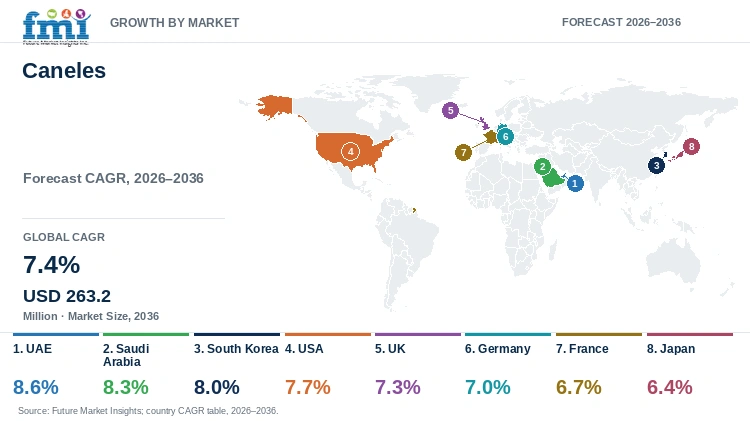
As per FMI, the UAE is projected to lead canelés demand growth across profiled countries at an 8.6% CAGR through 2036, whereas Japan is forecast to progress at a 6.4% CAGR. National growth rates reflect distinct commercial pathways across luxury Gulf hotel hospitality and espresso-bar pairing in South Korea as well as artisan provenance in France and department-store gifting in Japan.
Table 7: Country CAGR and Primary Growth Levers for the Caneles Market (CAGR percentage and operational drivers), 2026 to 2036
| Country | CAGR (2026 to 2036) | Primary Growth Lever |
|---|---|---|
| UAE | 8.6% | 12.54M Dubai international overnight visitors (Jan-Aug 2025) and luxury hotel patisserie counters |
| Saudi Arabia | 8.3% | 116M domestic and inbound tourists (SAR 284,000M spend) and specialty coffee-shop expansion |
| South Korea | 8.0% | High-density specialty coffee-shop sector and Finsbury/European flavour-led café pairings |
| USA | 7.7% | Thaw-and-serve in-store bakery adoption and direct-to-consumer gluten-free artisan gifting |
| UK | 7.3% | London event catering, nationwide postal gift boxes, and FSA retail allergen surveillance |
| Germany | 7.0% | Urban Bordeaux patisserie boutique expansion and frozen foodservice bake-off adoption |
| France | 6.7% | Bordeaux tourism provenance, travel-hub boutique networks, and 24-hour express gift shipping |
| Japan | 6.4% | Department-store miniature gift assortments and seasonal matcha/hojicha flavor rotation |
Source: Future Market Insights analysis
UAE Caneles Market Outlook (2026 to 2036)
Commercial canelés sales in the UAE are projected to expand at an 8.6% CAGR from 2026 to 2036, representing the fastest growth rate among the eight profiled countries. Unlike European markets where neighborhood boulangeries dominate daily sales, the UAE concentrates demand inside luxury hotel lounges and gourmet gifting boutiques across Dubai and Abu Dhabi. According to the Dubai Department of Economy and Tourism, Dubai welcomed 12.54 million international overnight visitors between January and August 2025 while hotel occupancy averaged 78.5% across 152,000 rooms [11]. Local patisseries such as Odeon Dubai and imported frozen commissary lines from France supply alcohol-free vanilla canelés adapted to Gulf hospitality and corporate gifting standards across five-star resort properties.
Key takeaway: In the UAE, record international hospitality traffic and alcohol-free vanilla formulations are projected to drive an 8.6% CAGR.
Saudi Arabia Caneles Market Outlook (2026 to 2036)
Unlike mature Western bakery markets, Saudi Arabia is experiencing rapid structural expansion in specialty espresso lounges and luxury resort dining across Riyadh and Jeddah. The caneles market in Saudi Arabia is estimated to grow at an 8.3% CAGR between 2026 and 2036 supported by commercial foodservice and hospitality buildouts. In June 2025, the Saudi Ministry of Tourism announced that combined domestic and inbound tourists exceeded 116 million in 2024 with total tourism expenditure reaching SAR 284,000 million across kingdom destinations [12]. Because traditional Bordeaux recipes contain rum, importers and central Riyadh commissaries formulate halal-certified Madagascar bourbon-vanilla and cardamom-infused canelés delivered frozen to specialty café chains and hotel banquet kitchens.
Key takeaway: In Saudi Arabia, SAR 284,000 million tourism hospitality demand and halal vanilla-cardamom recipes are estimated to sustain an 8.3% CAGR.
South Korea Caneles Market Outlook (2026 to 2036)
What distinguishes South Korea from European patisserie markets is its dense specialty coffee-shop culture where visual single-serve Bordeaux pastries command strong beverage-pairing margins. In February 2026, Finsbury Food Group's 2026 Bakery Flavour Trends analysis highlighted how social-media virality around matcha and pistachio as well as miso-caramel profiles drives rapid patisserie menu rotation across urban cafés [13]. Demand for canelés in South Korea is forecast to rise at an 8.0% CAGR from 2026 to 2036 across independent roasteries and upscale department-store food halls in Seoul and Busan. To prevent high café rent and labor costs from eroding margins, Seoul bakery distributors supply blast-frozen par-baked canelés that baristas re-crisp in counter convection ovens.
Key takeaway: In South Korea, viral matcha and pistachio café pairings across urban roasteries are forecast to propel an 8.0% CAGR for bake-off canelés.
USA Caneles Market Outlook (2026 to 2036)
In the USA, commercial demand splits between coastal artisan bakeries baking in seasoned copper molds and national supermarket in-store bakeries adopting thaw-and-re-crisp frozen cases. Whereas buyers in France purchase canelés primarily as classic vanilla-rum singles, consumers in the USA respond strongly to clean-label multipacks and allergen-friendly direct-to-consumer gift boxes shipped nationwide. In March 2025, a national United States caregiver cohort study of 3,062 households published in Nutrients highlighted heightened household vigilance around egg and dairy food allergens when purchasing commercial baked foods [14]. Accordingly, the caneles market in the USA is anticipated to progress at a 7.7% CAGR through 2036 behind clearly labeled supermarket multipacks and online artisan gifting.
Key takeaway: In the USA, supermarket bake-off adoption and allergen-transparent online gifting are anticipated to support a 7.7% CAGR.
UK Caneles Market Outlook (2026 to 2036)
Sales of canelés in the UK are predicted to advance at a 7.3% CAGR between 2026 and 2036, supported by London specialty patisserie counters and nationwide postal gift boxes. Unlike continental Europe where counter sales dominate, UK specialists such as Babelle have proven that ambient-protected postal boxes and miniature event trays generate year-round B2B and DTC revenue. In July 2026, the UK Food Standards Agency published its Retail Surveillance Survey Sampling Programme 2025/26 covering 845 food products and confirming strict inspection of undeclared milk and egg proteins in bakery and snack items [15]. Wholesale frozen suppliers that provide pre-printed allergen stickers and consistent re-crisping instructions capture London café and specialty grocery accounts across major metropolitan high streets.
Key takeaway: In the UK, nationwide postal gifting and FSA-compliant allergen labeling are predicted to drive a 7.3% CAGR.
Germany Caneles Market Outlook (2026 to 2036)
Unlike France where canelés are a mainstream travel-hub staple, Germany treats Cannelé Bordelais as an upscale Bordeaux patisserie specialty concentrated in Berlin and Munich cafés. The caneles market in Germany is projected to register a 7.0% CAGR from 2026 to 2036 across urban Konditorei counters and premium supermarket bake-off stations. In August 2025, a dietary socioeconomic study of households in Germany published in the Journal of Nutrition documented distinct income gradients in confectionery and bakery purchasing that favor small-portion premium indulgences among high-income urban buyers [16]. Because high master-baker wages in Germany make 60-minute copper-mold baking cost-prohibitive for mid-sized shops, wholesalers in Germany import frozen par-baked stock from France.
Key takeaway: In Germany, urban Bordeaux-patisserie positioning and labor-saving frozen imports are projected to sustain a 7.0% CAGR.
France Caneles Market Outlook (2026 to 2036)
France represents the global provenance anchor for the canelés market, with Gironde and Bordeaux heritage brands operating high-throughput boutiques across TGV rail stations and airports. In March 2025, a low-field NMR bakery moisture-control study published in the Journal of the Science of Food and Agriculture demonstrated that oligosaccharide-hydrocolloid systems cut starch retrogradation enthalpy by 59.96% and preserve crust color during storage [17]. Commercial canelés valuation in France is expected to grow at a 6.7% CAGR over the 2026 to 2036 forecast period across destination boutiques and frozen foodservice supply. Because domestic consumers judge texture against freshly depinned Bordeaux standards, industrial bakers in France invest heavily in 24-hour express parcel logistics and cryo-frozen restaurant trays.
Key takeaway: In France, Bordeaux travel-retail boutiques and cryo-frozen restaurant catering are expected to anchor a 6.7% CAGR.
Japan Caneles Market Outlook (2026 to 2036)
In contrast to Western markets that sell uniform 55-gram pieces, Japan has transformed the canelé into a precision miniature gifting category featuring seasonal flavor rotations and department-store basement (depachika) boutiques. In November 2025, a nationwide dietary cohort in Japan study of 93,759 participants published in Nutrients confirmed strong consumer attentiveness to portion control and ingredient quality across domestic food choices [18]. The caneles market in Japan is slated to record a 6.4% CAGR from 2026 to 2036 across specialist chains including Canelé du Japon and Kuramae Cannelé plus convenience-store chilled dessert shelves. Sustaining repeat sales in Japan's mature bakery market requires rotating roasted green-tea and red-bean toppings while guaranteeing freshly baked exterior crunch.
Key takeaway: In Japan, depachika miniature gift boxes and convenience-store chilled patisserie tiers are slated to support a 6.4% CAGR.
Full report country CAGRs cover: North America; Latin America; Western Europe; Eastern Europe; East Asia; South Asia and Pacific; Middle East and Africa.
Who are the notable companies in the caneles market?
Mademoiselle Desserts, Rich Products, Sara Lee Frozen Bakery, Dessert Holdings, Finsbury Food Group, Premier Foods, McKee Foods, Hostess Brands, Bauli, and Dr. Oetker are the notable companies profiled in the caneles market.
FMI analysis indicates that commercial competition bridges specialized patisserie manufacturers in France and large frozen-and-packaged bakery groups. European frozen-patisserie specialists operate automated multi-mold tunnel ovens and blast freezers to supply authentic fluted pastries to in-store bakeries and hotels. Broader sweet-bakery platforms in North America and Europe deploy cold-chain distribution and direct-to-consumer gifting infrastructure to scale specialty French desserts.
- Frozen and Specialty Patisserie Platforms: Mademoiselle Desserts (Emmi Desserts) and Dessert Holdings as well as Rich Products and Sara Lee Frozen Bakery with Finsbury Food Group supply commercial bake-off pastry channels.
- Packaged Sweet-Bakery and Retail Cake Groups: Premier Foods and McKee Foods as well as Hostess Brands (J. M. Smucker) and Bauli Group operate high-velocity ambient multipack and grocery bakery distribution networks.
- Baking Ingredients and Professional Dessert Systems: Dr. Oetker supplies professional patisserie mixes and vanilla flavorings for international foodservice bakery accounts.
Competitive Benchmarking: Caneles Market
Table 8: Competitive Benchmarking for the Caneles Market (qualitative capability ratings), 2026
| Company | Patisserie & Fluted-Mold Capability | Frozen Bake-Off & Cold-Chain | Retail & Foodservice Channel Reach | Geographic Reach |
|---|---|---|---|---|
| Mademoiselle Desserts | High | High | High | High |
| Rich Products | Medium | High | High | High |
| Sara Lee Frozen Bakery | Medium | High | High | Medium |
| Dessert Holdings | High | High | High | Medium |
| Finsbury Food Group | High | Medium | High | Medium |
| Premier Foods | Medium | Medium | High | High |
| McKee Foods | Medium | Medium | High | Medium |
| Hostess Brands | Medium | Medium | High | Medium |
| Bauli | High | Medium | High | High |
| Dr. Oetker | Medium | Medium | High | High |
Scoring basis: Capability tiers evaluate documented French patisserie and molded-pastry production expertise as well as blast-frozen par-baked cold-chain logistics and established account access across supermarket in-store bakeries and specialty coffee chains.
Key Developments in the Caneles Market
- Dessert Holdings completed the acquisition of Willamette Valley Pie Co. in July 2025, expanding its clean-label artisan dessert manufacturing and retail and foodservice distribution in North America [19].
- Premier Foods launched expanded Mr Kipling Signature Collection and seasonal bakery multipack ranges in September 2025 to capture festive sharing and gifting occasions [20].
- McKee Foods introduced Little Debbie Big Pack multipack bakery formats in June 2025 to address multi-serving household grocery demand across North America [21].
Key Players in the Caneles Market
Frozen and Premium Dessert Supply Platforms
- Mademoiselle Desserts
- Rich Products
- Sara Lee Frozen Bakery
- Dessert Holdings
- Finsbury Food Group
Packaged Sweet-Bakery and Snack Brands
- Premier Foods
- McKee Foods
- Hostess Brands
- Bauli
Baking Ingredients and Prepared Dessert Systems
- Dr. Oetker
Caneles Market - Report Scope
Table 9: Report Scope for the Caneles Market (coverage fields and definitions), 2026 to 2036
| Coverage field | Report scope |
|---|---|
| Market breakdown | Product Type; Claim / Nature; Format; Packaging Format; Sales Channel |
| Quantitative Units | USD Million |
| Market Definition | Includes commercial manufacturer and specialty bakery revenue from finished, par-baked, and frozen canelés sold through the stated product, claim, format, pack, and channel classifications. Excludes ordinary loaf cakes and dry dessert premixes as well as copper molds and beverages sold with the pastry. |
| Regions Covered | North America; Latin America; Western Europe; Eastern Europe; East Asia; South Asia and Pacific; Middle East and Africa |
| Countries Covered | UAE, Saudi Arabia, South Korea, USA, UK, Germany, France, Japan, and additional countries in the full report |
| Key Companies Covered | Mademoiselle Desserts, Rich Products, Sara Lee Frozen Bakery, Dessert Holdings, Finsbury Food Group, Premier Foods, McKee Foods, Hostess Brands, Bauli, Dr. Oetker |
| Forecast Period | 2026 to 2036 |
| Approach | Primary and secondary research with top-down and bottom-up market triangulation. |
Caneles Market - Research Methodology
Table 10: Research Methodology for the Caneles Market (research methods and approach), 2026 edition
| Method | Approach |
|---|---|
| Primary Research | Structured interviews with Bordeaux patisserie production managers and frozen foodservice bakery directors as well as specialty coffee-chain pastry buyers to validate piece weights and wholesale case pricing. |
| Secondary Research | Analysis of corporate M&A disclosures and national tourism datasets (Dubai DET, Saudi Ministry of Tourism) as well as UK FSA retail surveillance reports and PubMed baking-science literature. |
| Market Sizing and Forecasting | Top-down specialty patisserie and café-accompaniment expenditure models reconciled against bottom-up piece volumes and wholesale carton prices from 2025 to 2036. |
| Country Forecasting Model | Econometric national projections weight specialty coffee-shop density and international overnight tourist arrivals as well as frozen bake-off penetration across eight profiled countries. |
| Operational Benchmark Traceability | Piece-volume and per-outlet spending indicators in Tables 2, 3, and 4 trace to commercial café registries and Dubai DET hospitality statistics as well as peer-reviewed superheated-steam caramelization trials. |
| Data Triangulation and Validation | Demand estimates are cross-checked against commercial frozen-patisserie line capacities and boutique store networks to exclude non-canelé cake revenues and unverified adjacent snack sales. |
Caneles Market by Segments
Caneles Market segmented by Product Type:
- Classic / Original
- Whole Grain & Seeded
- Flavored & Filled
- Mini & Snacking Formats
- Premium / Artisan
Caneles Market segmented by Claim / Nature:
- Conventional
- Clean Label
- Organic
- Gluten-Free
- High-Protein / Fortified
Caneles Market segmented by Format:
- Fresh
- Frozen
- Ambient Packaged
- Chilled
- Par-Baked / Thaw-and-Serve
Caneles Market segmented by Packaging Format:
- Multipack
- Single-Serve
- Family / Loaf Pack
- Bulk Foodservice
Caneles Market segmented by Sales Channel:
- Supermarkets & Hypermarkets
- Artisan & Specialty Bakeries
- Convenience & Forecourt
- Online & DTC
- Foodservice Distributors
Caneles Market by Region
- North America
- United States
- Canada
- Latin America
- Brazil
- Mexico
- Argentina
- Chile
- Western Europe
- Germany
- France
- United Kingdom
- Italy
- Spain
- Benelux
- Nordics
- Eastern Europe
- Poland
- Czech Republic
- Romania
- Hungary
- East Asia
- China
- Japan
- South Korea
- South Asia and Pacific
- India
- ASEAN
- Australia and New Zealand
- Middle East and Africa
- GCC Countries
- South Africa
- Türkiye
- Israel
Research Sources and Bibliography
- [1] Finsbury Food Group Ltd. (2026, April 30). Finsbury Food Group Acquires Flower & White to Boost Direct-to-Consumer and Specialty Sweet Treats Growth. Finsbury Food Group Official Press Release.
- [2] Kim, H. J., et al. (2025, January 15). Development of Rice Cake Fortified With Acorn Flour and Inulin Using Superheated Steam-Assisted Baking to Accelerate Crust Caramelization. Foods, 14(2), 218 (PubMed PMID 39816484).
- [3] Yilmaz, M., et al. (2025, March 4). Enrichment of Oil Cake With Cinnamon Extract Positively Effects Antioxidant Activity, Water Activity, and Texture Profile Analysis. Food Science & Nutrition, 13(3), e4812 (PubMed PMID 40041712).
- [4] Gomez, M., et al. (2025, August 22). Psyllium and its role in improving rheology and structural properties of vegan gluten-free cake formulated with aquafaba powder. Journal of the Science of Food and Agriculture, 105(11), 5890-5899 (PubMed PMID 40844206).
- [5] Wang, L., et al. (2026, August 18). Cryoprotective Role of Soybean Oligosaccharides in Frozen Dough: Enhanced Gluten Stability and Bread Quality. Foods, 15(16), 2878 (PubMed PMID 42650572).
- [6] Chen, X., et al. (2025, November 10). Protein-fiber bigels from foam-templated oleogels enhance gluten network, crumb resilience, and staling control in baked goods. Food Chemistry, 495, 146812 (PubMed PMID 41224048).
- [7] Finsbury Food Group Ltd. (2025, August 15). Finsbury Food Group Acquires Majority Stake in Lola's Cupcakes to Expand Direct-to-Consumer and Retail Footprint. Finsbury Food Group Official Corporate Announcement.
- [8] Abulizi, A., et al. (2026, July 30). Optimization of Formulation Parameters for Reduced-Fat Katima Cereal Pastries Using Box-Behnken Response Surface Methodology. Foods, 15(15), 2714 (PubMed PMID 42587943).
- [9] Ozdemir, N., et al. (2025, February 12). Do sugar substitutes affect quality characteristics, crust colour, water activity, and HMF levels of baked cakes?. Journal of the Science of Food and Agriculture, 105(5), 2910-2919 (PubMed PMID 40116182).
- [10] Novotni, D., et al. (2026, March 18). Effect of Pumpkin Seed Protein Concentrate and Xanthan Gum on the Rheology and Porosity of Gluten-Free Frozen Batter and Cakes. Food Technology and Biotechnology, 64(1), 45-56 (PubMed PMID 42328297).
- [11] Dubai Department of Economy and Tourism. (2025, September 11). Tourism Performance Report January - August 2025: International Overnight Visitor Arrivals and Hotel Occupancy. Government of Dubai Official Statistics.
- [12] Saudi Ministry of Tourism. (2025, June 22). Ministry of Tourism: Saudi Arabia Tops 100 Million Tourist Mark for the Second Year in a Row with Record Hospitality Expenditure. Kingdom of Saudi Arabia Ministry of Tourism.
- [13] Finsbury Food Group Ltd. (2026, February 17). Bakery Flavour Trends 2026: From Matcha and Miso Caramel to Elevated Nostalgia in Specialty Café Pastries. Finsbury Food Group Media Insights.
- [14] Gupta, R. S., et al. (2025, March 19). Food allergen introduction practices and parent/caregiver attitudes toward tree nut, egg, and milk allergens in the United States. Nutrients, 17(6), 1084 (PubMed PMID 40176928).
- [15] Food Standards Agency, Scarrett, A., Cooke, S., & Bachelor, J. (2026, July 2). Retail Surveillance Survey Sampling Programme 2025/26: Allergen Compliance and Labelling Assessment Across UK Food Businesses. FSA Research and Evidence, DOI 10.46756/001c.162217.
- [16] Alexy, U., et al. (2025, August 14). Unfavourable food consumption including confectionery and desserts is exacerbated by socio-economic gradients in German cohorts. British Journal of Nutrition, 134(4), 612-621 (PubMed PMID 40692206).
- [17] Li, Z., et al. (2025, March 30). Effects of oligosaccharides, sodium carboxymethyl cellulose and d-allulose on moisture control, crust colour, and starch retrogradation in bakery products. Journal of the Science of Food and Agriculture, 105(6), 3412-3422 (PubMed PMID 39660575).
- [18] Misawa, Y., et al. (2025, November 10). Dietary Intake Patterns and Nutritional Outcomes in the Japan Environment and Children's Study Cohort. Nutrients, 17(21), 3490 (PubMed PMID 41212804).
- [19] Dessert Holdings. (2025, July 14). Dessert Holdings Acquires Willamette Valley Pie Co. to Expand Artisanal Retail and Foodservice Dessert Platform. Dessert Holdings Official Acquisition Release.
- [20] Premier Foods plc. (2025, September 12). Mr Kipling Brings Early Seasonal Joy to Shoppers with New Signature Collection Launches and Packaged Patisserie. Premier Foods Corporate Newsroom.
- [21] McKee Foods Corporation. (2025, June 25). Little Debbie Snacks Introduces Big Pack Old Fashioned Donuts for Multipack Retail Channels. McKee Foods Official Press Release.
- [22] Emmi Group. (2025, November 20). Premium Desserts from Emmi: Integrating French Patisserie Expertise Across Mademoiselle Desserts and International Networks. Emmi Group Corporate Report.
- [23] Bauli S.p.A. (2025, May 15). Olivieri 1882 Entra a Far Parte del Gruppo Bauli per Espandere l'Alta Pasticceria Artigianale. Bauli Group Corporate Announcement.
This bibliography is provided for reader reference and is not exhaustive. The full report contains the complete reference list and detailed citations.
This Report Answers
- How large is the caneles market in 2026 and what is forecast for 2036?
- Which café-pairing and gifting occasions support commercial demand for canelés?
- Why does Classic / original lead the product type category?
- Why does conventional lead the claim / nature category globally?
- How do growth rates differ between the UAE and Western European markets?
- Which companies operate relevant Bordeaux patisserie and frozen bake-off platforms today?
- What moisture-migration and allergen factors limit ambient shelf life in the caneles market?
- What should café and grocery buyers test before qualifying a frozen or par-baked canelé supplier?
Frequently Asked Questions
How big is the caneles market in 2026, and what is forecast for 2036?
According to FMI, global caneles market value is estimated to reach USD 128.9 million in 2026 from USD 120.0 million in 2025. The market is projected to reach USD 263.2 million by 2036 as coffee chains and in-store bakeries adopt par-baked and frozen fluted pastries.
What is the CAGR for the caneles market from 2026 to 2036?
Future Market Insights projects a 7.4% compound annual growth rate between 2026 and 2036, generating USD 134.3 million in incremental market value across retail and hospitality channels.
Which product type segment leads the caneles market?
Classic / original is estimated to hold a 36.0% share of the product type segment in 2026 because buyers anchor repeat espresso-pairing and gift orders on the traditional caramelized Bordeaux shell and vanilla-rum custard interior.
Which claim / nature segment leads the caneles market?
Conventional is projected to account for a 58.0% share of the claim / nature segment in 2026 because whole milk and egg yolks with sucrose deliver reliable Maillard crust caramelization without hydrocolloid off-notes.
Which country has the highest growth outlook during the assessment period?
The UAE is projected to lead profiled national growth at an 8.6% CAGR through 2036, supported by 12.54 million international overnight visitors in Dubai during January-August 2025 and luxury hotel patisserie counters.
Who are the leading players profiled in the caneles market?
Major companies include Mademoiselle Desserts and Rich Products as well as Sara Lee Frozen Bakery and Dessert Holdings. Additional major participants include Finsbury Food Group and Premier Foods along with McKee Foods and Hostess Brands as well as Bauli and Dr. Oetker.
Preview the report firsthand - request a free sample
Get SampleGet the brochure for pricing and purchase details.
Get PDFTable of Content
- Key Takeaways
- Market Size and CAGR
- Top Growth Driver
- Fastest Growing Segment
- Leading Region
- Key Companies
- Emerging Opportunities
- Executive Summary
- Global Market Outlook
- Demand-side Trends
- Supply-side Trends
- Technology Roadmap Analysis
- Analysis and Recommendations
- Analyst Perspective (What is happening? Why now? What should investors know?)
- Key Questions Answered
- How large is the market?
- What is the CAGR?
- What are key trends?
- Which region dominates?
- Who are the leaders?
- Market Overview
- Market Coverage / Taxonomy
- Market Definition / Scope / Limitations
- Research Methodology
- Chapter Orientation
- Analytical Lens and Working Hypotheses
- Market Structure, Signals, and Trend Drivers
- Benchmarking and Cross-market Comparability
- Market Sizing, Forecasting, and Opportunity Mapping
- Research Design and Evidence Framework
- Desk Research Programme (Secondary Evidence)
- Expert Input and Fieldwork (Primary Evidence)
- Tooling, Models, and Reference Databases
- Data Engineering and Model Build
- Quality Assurance and Audit Trail
- Market Background
- Market Dynamics (Drivers, Restraints, Opportunity, Trends)
- Scenario Forecast (Optimistic, Likely, Conservative)
- Impact Analysis
- AI Impact
- Sustainability Impact
- Regulatory Impact
- Technology Impact
- Consumer / Buyer Analysis
- Purchase Drivers
- Adoption Barriers
- Buyer Journey
- Opportunity Map Analysis
- Product Life Cycle Analysis
- Supply Chain Analysis
- Investment Feasibility Matrix
- Value Chain Analysis
- PESTLE and Porter's Analysis
- Regulatory Landscape
- Regional Parent Market Outlook
- Production and Consumption Statistics
- Import and Export Statistics
- Global Market Analysis and Forecast, 2021 to 2036
- Historical Market Size Value (USD Million) Analysis, 2021 to 2025
- Current and Future Market Size Value (USD Million) Projections, 2026 to 2036
- Y-o-Y Growth Trend Analysis
- Absolute $ Opportunity Analysis
- Global Market Pricing Analysis, 2021 to 2036
- Global Market Analysis and Forecast, By Product Type, 2021 to 2036
- Introduction / Key Findings
- Historical Market Size Value (USD Million) Analysis By Product Type, 2021 to 2025
- Current and Future Market Size Value (USD Million) Analysis and Forecast By Product Type, 2026 to 2036
- Classic / Original
- Whole Grain & Seeded
- Flavored & Filled
- Mini & Snacking Formats
- Premium / Artisan
- Y-o-Y Growth Trend Analysis By Product Type, 2021 to 2025
- Absolute $ Opportunity Analysis By Product Type, 2026 to 2036
- Global Market Analysis and Forecast, By Claim / Nature, 2021 to 2036
- Introduction / Key Findings
- Historical Market Size Value (USD Million) Analysis By Claim / Nature, 2021 to 2025
- Current and Future Market Size Value (USD Million) Analysis and Forecast By Claim / Nature, 2026 to 2036
- Conventional
- Clean Label
- Organic
- Gluten-Free
- High-Protein / Fortified
- Y-o-Y Growth Trend Analysis By Claim / Nature, 2021 to 2025
- Absolute $ Opportunity Analysis By Claim / Nature, 2026 to 2036
- Global Market Analysis and Forecast, By Format, 2021 to 2036
- Introduction / Key Findings
- Historical Market Size Value (USD Million) Analysis By Format, 2021 to 2025
- Current and Future Market Size Value (USD Million) Analysis and Forecast By Format, 2026 to 2036
- Fresh
- Frozen
- Ambient Packaged
- Chilled
- Par-Baked / Thaw-and-Serve
- Y-o-Y Growth Trend Analysis By Format, 2021 to 2025
- Absolute $ Opportunity Analysis By Format, 2026 to 2036
- Global Market Analysis and Forecast, By Packaging Format, 2021 to 2036
- Introduction / Key Findings
- Historical Market Size Value (USD Million) Analysis By Packaging Format, 2021 to 2025
- Current and Future Market Size Value (USD Million) Analysis and Forecast By Packaging Format, 2026 to 2036
- Multipack
- Single-Serve
- Family / Loaf Pack
- Bulk Foodservice
- Y-o-Y Growth Trend Analysis By Packaging Format, 2021 to 2025
- Absolute $ Opportunity Analysis By Packaging Format, 2026 to 2036
- Global Market Analysis and Forecast, By Sales Channel, 2021 to 2036
- Introduction / Key Findings
- Historical Market Size Value (USD Million) Analysis By Sales Channel, 2021 to 2025
- Current and Future Market Size Value (USD Million) Analysis and Forecast By Sales Channel, 2026 to 2036
- Supermarkets & Hypermarkets
- Artisan & Specialty Bakeries
- Convenience & Forecourt
- Online & DTC
- Foodservice Distributors
- Y-o-Y Growth Trend Analysis By Sales Channel, 2021 to 2025
- Absolute $ Opportunity Analysis By Sales Channel, 2026 to 2036
- Global Market Analysis and Forecast, By Region, 2021 to 2036
- Introduction
- Historical Market Size Value (USD Million) Analysis By Region, 2021 to 2025
- Current Market Size Value (USD Million) Analysis and Forecast By Region, 2026 to 2036
- North America
- Latin America
- Western Europe
- Eastern Europe
- East Asia
- South Asia and Pacific
- Middle East and Africa
- Market Attractiveness Analysis By Region
- North America Market Analysis and Forecast, By Country, 2021 to 2036
- Historical Market Size Value (USD Million) Trend Analysis By Market Taxonomy, 2021 to 2025
- Market Size Value (USD Million) Forecast By Market Taxonomy, 2026 to 2036
- By Country
- United States
- Canada
- By Product Type
- By Claim / Nature
- By Format
- By Packaging Format
- By Sales Channel
- By Country
- Market Attractiveness Analysis
- By Country
- By Product Type
- By Claim / Nature
- By Format
- By Packaging Format
- By Sales Channel
- Key Takeaways
- Latin America Market Analysis and Forecast, By Country
- Historical Market Size Value (USD Million) Trend Analysis By Market Taxonomy, 2021 to 2025
- Market Size Value (USD Million) Forecast By Market Taxonomy, 2026 to 2036
- By Country
- Brazil
- Mexico
- Argentina
- Chile
- By Product Type
- By Claim / Nature
- By Format
- By Packaging Format
- By Sales Channel
- By Country
- Market Attractiveness Analysis
- By Country
- By Product Type
- By Claim / Nature
- By Format
- By Packaging Format
- By Sales Channel
- Key Takeaways
- Western Europe Market Analysis and Forecast, By Country
- Historical Market Size Value (USD Million) Trend Analysis By Market Taxonomy, 2021 to 2025
- Market Size Value (USD Million) Forecast By Market Taxonomy, 2026 to 2036
- By Country
- Germany
- France
- United Kingdom
- Italy
- Spain
- Benelux
- Nordics
- By Product Type
- By Claim / Nature
- By Format
- By Packaging Format
- By Sales Channel
- By Country
- Market Attractiveness Analysis
- By Country
- By Product Type
- By Claim / Nature
- By Format
- By Packaging Format
- By Sales Channel
- Key Takeaways
- Eastern Europe Market Analysis and Forecast, By Country
- Historical Market Size Value (USD Million) Trend Analysis By Market Taxonomy, 2021 to 2025
- Market Size Value (USD Million) Forecast By Market Taxonomy, 2026 to 2036
- By Country
- Poland
- Czech Republic
- Romania
- Hungary
- By Product Type
- By Claim / Nature
- By Format
- By Packaging Format
- By Sales Channel
- By Country
- Market Attractiveness Analysis
- By Country
- By Product Type
- By Claim / Nature
- By Format
- By Packaging Format
- By Sales Channel
- Key Takeaways
- East Asia Market Analysis and Forecast, By Country
- Historical Market Size Value (USD Million) Trend Analysis By Market Taxonomy, 2021 to 2025
- Market Size Value (USD Million) Forecast By Market Taxonomy, 2026 to 2036
- By Country
- China
- Japan
- South Korea
- By Product Type
- By Claim / Nature
- By Format
- By Packaging Format
- By Sales Channel
- By Country
- Market Attractiveness Analysis
- By Country
- By Product Type
- By Claim / Nature
- By Format
- By Packaging Format
- By Sales Channel
- Key Takeaways
- South Asia and Pacific Market Analysis and Forecast, By Country
- Historical Market Size Value (USD Million) Trend Analysis By Market Taxonomy, 2021 to 2025
- Market Size Value (USD Million) Forecast By Market Taxonomy, 2026 to 2036
- By Country
- India
- ASEAN
- Australia and New Zealand
- By Product Type
- By Claim / Nature
- By Format
- By Packaging Format
- By Sales Channel
- By Country
- Market Attractiveness Analysis
- By Country
- By Product Type
- By Claim / Nature
- By Format
- By Packaging Format
- By Sales Channel
- Key Takeaways
- Middle East and Africa Market Analysis and Forecast, By Country
- Historical Market Size Value (USD Million) Trend Analysis By Market Taxonomy, 2021 to 2025
- Market Size Value (USD Million) Forecast By Market Taxonomy, 2026 to 2036
- By Country
- GCC Countries
- South Africa
- Türkiye
- Israel
- By Product Type
- By Claim / Nature
- By Format
- By Packaging Format
- By Sales Channel
- By Country
- Market Attractiveness Analysis
- By Country
- By Product Type
- By Claim / Nature
- By Format
- By Packaging Format
- By Sales Channel
- Key Takeaways
- Key Countries Market Analysis
- United States
- Pricing Analysis
- Market Share Analysis, 2025
- By Product Type
- By Claim / Nature
- By Format
- By Packaging Format
- By Sales Channel
- Canada
- Pricing Analysis
- Market Share Analysis, 2025
- By Product Type
- By Claim / Nature
- By Format
- By Packaging Format
- By Sales Channel
- Mexico
- Pricing Analysis
- Market Share Analysis, 2025
- By Product Type
- By Claim / Nature
- By Format
- By Packaging Format
- By Sales Channel
- Brazil
- Pricing Analysis
- Market Share Analysis, 2025
- By Product Type
- By Claim / Nature
- By Format
- By Packaging Format
- By Sales Channel
- Chile
- Pricing Analysis
- Market Share Analysis, 2025
- By Product Type
- By Claim / Nature
- By Format
- By Packaging Format
- By Sales Channel
- Germany
- Pricing Analysis
- Market Share Analysis, 2025
- By Product Type
- By Claim / Nature
- By Format
- By Packaging Format
- By Sales Channel
- United Kingdom
- Pricing Analysis
- Market Share Analysis, 2025
- By Product Type
- By Claim / Nature
- By Format
- By Packaging Format
- By Sales Channel
- Italy
- Pricing Analysis
- Market Share Analysis, 2025
- By Product Type
- By Claim / Nature
- By Format
- By Packaging Format
- By Sales Channel
- Spain
- Pricing Analysis
- Market Share Analysis, 2025
- By Product Type
- By Claim / Nature
- By Format
- By Packaging Format
- By Sales Channel
- France
- Pricing Analysis
- Market Share Analysis, 2025
- By Product Type
- By Claim / Nature
- By Format
- By Packaging Format
- By Sales Channel
- India
- Pricing Analysis
- Market Share Analysis, 2025
- By Product Type
- By Claim / Nature
- By Format
- By Packaging Format
- By Sales Channel
- ASEAN
- Pricing Analysis
- Market Share Analysis, 2025
- By Product Type
- By Claim / Nature
- By Format
- By Packaging Format
- By Sales Channel
- Australia and New Zealand
- Pricing Analysis
- Market Share Analysis, 2025
- By Product Type
- By Claim / Nature
- By Format
- By Packaging Format
- By Sales Channel
- China
- Pricing Analysis
- Market Share Analysis, 2025
- By Product Type
- By Claim / Nature
- By Format
- By Packaging Format
- By Sales Channel
- Japan
- Pricing Analysis
- Market Share Analysis, 2025
- By Product Type
- By Claim / Nature
- By Format
- By Packaging Format
- By Sales Channel
- South Korea
- Pricing Analysis
- Market Share Analysis, 2025
- By Product Type
- By Claim / Nature
- By Format
- By Packaging Format
- By Sales Channel
- Poland
- Pricing Analysis
- Market Share Analysis, 2025
- By Product Type
- By Claim / Nature
- By Format
- By Packaging Format
- By Sales Channel
- Hungary
- Pricing Analysis
- Market Share Analysis, 2025
- By Product Type
- By Claim / Nature
- By Format
- By Packaging Format
- By Sales Channel
- Türkiye
- Pricing Analysis
- Market Share Analysis, 2025
- By Product Type
- By Claim / Nature
- By Format
- By Packaging Format
- By Sales Channel
- South Africa
- Pricing Analysis
- Market Share Analysis, 2025
- By Product Type
- By Claim / Nature
- By Format
- By Packaging Format
- By Sales Channel
- UAE
- Pricing Analysis
- Market Share Analysis, 2025
- By Product Type
- By Claim / Nature
- By Format
- By Packaging Format
- By Sales Channel
- Saudi Arabia
- Pricing Analysis
- Market Share Analysis, 2025
- By Product Type
- By Claim / Nature
- By Format
- By Packaging Format
- By Sales Channel
- United States
- Market Structure Analysis
- Competition Dashboard
- Competition Benchmarking
- Market Share Analysis of Top Players
- By Regional
- By Product Type
- By Claim / Nature
- By Format
- By Packaging Format
- By Sales Channel
- Emerging Startups
- Innovation Benchmarking
- Competition Analysis
- Competition Deep Dive
- Mademoiselle Desserts
- Overview
- Product Portfolio
- Profitability by Market Segments
- Sales Footprint
- Strategy Overview
- Marketing Strategy
- Product Strategy
- Channel Strategy
- Rich Products
- Sara Lee Frozen Bakery
- Dessert Holdings
- Finsbury Food Group
- Premier Foods
- McKee Foods
- Hostess Brands
- Bauli
- Dr. Oetker
- Mademoiselle Desserts
- Case Studies
- Success Stories
- Recent Developments
- Competition Deep Dive
- Assumptions & Acronyms Used


