

- Market Size (2026)
- USD 620.7 Mn
- Forecast (2036)
- USD 1030.5 Mn
- CAGR (2026 to 2036)
- 5.2%
How big is Captive Screws Market in 2026?
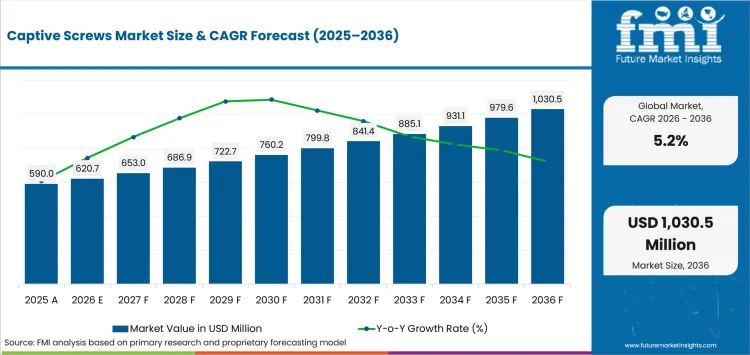
USD 620.7 million in 2026 and USD 1,030.5 million by 2036 at a 5.2% CAGR.
Captive screw demand is projected to rise from USD 620.7 million in 2026 to USD 1,030.5 million by 2036 at 5.2% CAGR. Retained hardware earns specification value on service panels because a loose screw can damage equipment or extend maintenance time. Similar qualification logic applies to automotive fasteners and aerospace fasteners because approved hardware enters the equipment drawing. In May 2025 the Global Electronics Association found that electronics manufacturers expected shipments and orders to rise over the following six months. Higher equipment activity increases the number of service panels requiring repeat access and retained hardware.
Electronics manufacturing provides a second demand route because dense boards increase the cost of dropped hardware during maintenance. In February 2025 IPC documented a 19.9% year-over-year rise in North American PCB shipments during January. That production activity expands the installed equipment base requiring controlled service access. The same loose-part constraint applies to rack servers and interconnecting electronic components during field service. Revenue depends on successful design-ins where panel geometry and installation torque justify retained hardware.
Key Takeaways of Captive Screws Market
- Removable guards and frequently serviced electronics make fastener retention a design requirement where loose hardware raises safety or downtime exposure.
- By screw type, knurled captive screws are estimated to hold 27.0% in 2026 owing to convenient hand access on service panels.
- In 2026, stainless steel is expected to lead material with 38.0% share because corrosion resistance protects exposed threads during repeated servicing.
- Below M3 is set to lead the thread size category with 22.0% share in 2026 due to compact enclosures limiting available fastening space.
- Panel preparation and qualification can slow replacement decisions because retained designs must fit sheet thickness and approved tightening conditions.
- Some of the key players in this market include PennEngineering, Southco, Essentra Components, PENCOM, JW Winco, TR Fastenings, Bossard, and Böllhoff.
Analyst Perspective
"Captive screw programs are won at the panel drawing because retainer geometry and installation load determine whether an engineer accepts the design. Margin follows companies that supply samples quickly and hold the approved configuration through production without forcing a new enclosure layout."
- Nikhil Kaitwade, Principal Consultant, Future Market Insights
How is the Captive Screws Market segmented?
The captive screws market is segmented by screw type, material, thread size, end use, sales channel and region.
Market taxonomy covers screw type, material, thread size, end use, sales channel and region for the market assessment. Screw types include knurled, slotted, Phillips, socket head and spring-loaded designs used in serviceable panel applications. Material groups include stainless steel, carbon steel, aluminum, brass and nylon or plastic for different corrosion and weight requirements. Thread sizes range from below M3 through above M8, and end uses cover electronics enclosures, aerospace, industrial machinery, medical devices and telecom equipment. Sales channels include fastener distributors, direct OEM supply, catalog or e-commerce and custom fastener companies.
Why does Stainless steel lead the Material category?
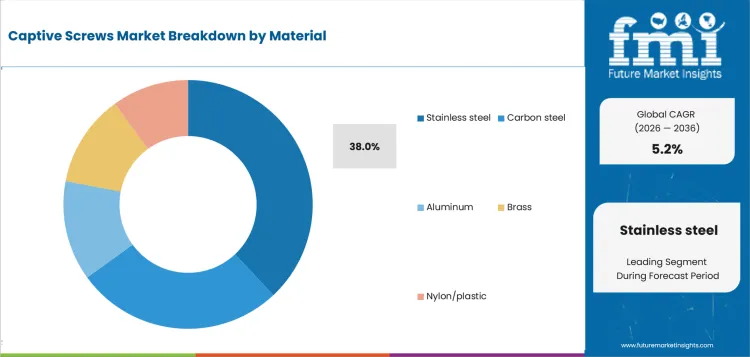
Stainless steel suits captive hardware that stays attached for the panel life and is handled through repeated maintenance cycles. Worldstainless reported in February 2026 that global melt-shop production reached 64.2 million tonnes during 2025. Broad material availability supports standard stainless ranges without removing grade-specific qualification for exposed equipment.
- In 2026, stainless steel is expected to lead material with 38.0% share because corrosion resistance protects exposed threads during repeated servicing.
- Maintenance engineers still need the selected grade to match cleaning exposure and adjacent panel materials. Carbon steel stays competitive in protected assemblies where corrosion resistance does not justify the stainless premium.
What makes Knurled captive screws central to the Screw type category?
Knurled heads suit panels that technicians open by hand during inspection or component replacement. Their grip reduces tool dependence during routine access without changing the retained screw function. This use case is common beside fabricated covers built from sheet metal.
- By screw type, the knurled captive screws segment is estimated to hold 27.0% in 2026 owing to frequent manual access on service panels.
- IPC stated in January 2025 that its electronics demand index returned to 100 during December after four months below that threshold. Serviceable electronics remain a practical outlet for retained hand-operated fasteners as installed equipment expands.
How does below M3 lead the Thread size category?
Below M3 captive screws serve assemblies where the retainer already consumes space that a conventional screw does not require. SEMI announced in January 2025 that eighteen semiconductor fabs were expected to start construction during 2025. New semiconductor manufacturing equipment increases the need to preserve clearance near boards and connectors.
- By thread size, below M3 is forecast to represent 22.0% in 2026 driven by compact electronics with restricted fastening footprints.
- Small retained hardware must preserve board clearance without weakening installation control near connectors and thermal hardware. Larger thread sizes retain an advantage on industrial panels requiring higher clamp load and rugged service.
What supports Electronics enclosures as the leading End use?
Electronics enclosures place service access beside circuitry that can be damaged by a loose screw during maintenance. Captive hardware keeps the fastener with the cover and reduces loose-part handling. The same constraint is visible in factory-floor micro data centers and rack equipment.
- Electronics enclosures are set to lead the end use category with 31.0% share in 2026 due to repeated access and loose-part control requirements.
- IPC reported in March 2025 that February PCB shipments increased 11.3% year over year and bookings increased 17.8%. Higher electronics activity expands the population of serviceable panels that require application-level qualification before captive fasteners enter production.
What are the drivers, restraints and opportunities in the Captive Screws Market?
Safety retention and repeated service access increase design-in demand. Panel preparation and qualification slow substitution. Compact electronics reward smaller retained formats with faster engineering support.
- Driver: Machinery guards and serviceable electronics raise the cost of loose hardware where technicians repeatedly remove access panels.
- Restraint: Captive designs require matched panel geometry and installation conditions before an engineer can replace an already-qualified conventional screw.
- Opportunity: Miniature electronics reward companies that provide smaller retained screws with rapid sampling and clear integration data for enclosure designers.
Loss prevention becomes a specification issue once removable guards or service covers must keep their fixing hardware attached. In February 2025 Elesa+Ganter introduced GN 7045.2 and GN 7984.2 loss-protection cap screws for captive assembly under machinery requirements. Standard retained hardware gives machinery engineers a direct specification route, though the selected installation method still has to properly match the panel construction.
Qualification becomes expensive as captive hardware changes the panel interface or requires a different installation sequence. TR Fastenings launched its Virtual Innovation Centre in May 2026 with application-engineering and teardown analysis for product evaluation. The service addresses fastening review before production release for assemblies requiring geometry checks whereas conventional screws retain an economic advantage on panels with limited loose-part exposure.
Compact equipment programs reward fastener companies that pair smaller retained formats with nearby stock and application support. Bossard completed the Ferdinand Gross acquisition in January 2025 and expanded regional distribution for fastening products in Germany and Eastern Europe. The broader network shortens sample and replenishment cycles after qualification, which improves the route from standard captive prototypes into repeat production orders.
Which country CAGRs are profiled in the Captive Screws Market?
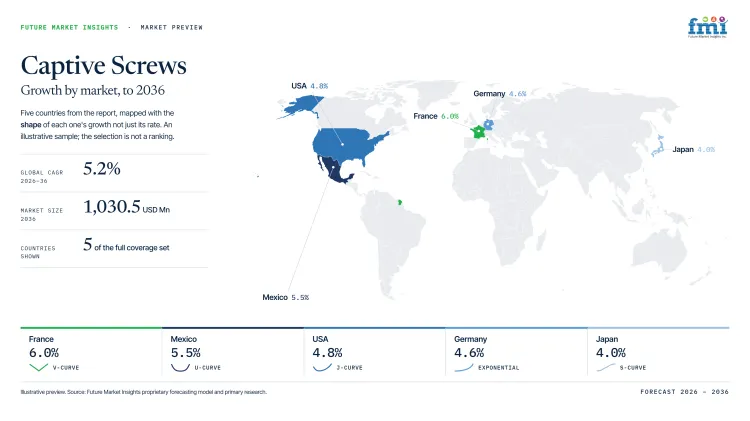
| Country | CAGR |
|---|---|
| France | 6.0% |
| Mexico | 5.5% |
| USA | 4.8% |
| Germany | 4.6% |
| Japan | 4.0% |
How do country-level CAGRs compare in the Captive Screws Market?
The five countries span 2.0 percentage points from France at 6.0% to Japan at 4.0%. France and Mexico form the faster pair because electronics investment and manufacturing transfers support fresh fastener demand. The USA and Germany form the middle band, while Japan grows more slowly from a mature manufacturing base.
- French OEM programs shift from distributor samples to direct supply after volumes stabilize.
- Mexican contract manufacturers inherit US fastener drawings that restrict geometry changes during transfers.
- US OEMs mix metric and inch fasteners, complicating stocked assortment planning for distributors.
- German industrial programs emphasize documented material and dimensional consistency across supplier changes.
- Japanese manufacturers favor established fastener specifications, limiting substitution after qualification.
CAGR differences describe pace because qualification time and channel fit determine conversion. The full report provides country-level CAGR analysis across North America, Latin America, Europe, East Asia, South Asia, Oceania and the Middle East and Africa.
Country-wise Analysis
- France places captive screws inside semiconductor, aerospace and industrial-equipment programs that require documented hardware before production release. Captive screw demand in France is forecast to rise at 6.0% CAGR over the forecast period, driven by electronics investment and machinery compliance work. In January 2025 the Direction générale des Entreprises identified 115 active semiconductor companies and about 35,000 sector jobs. Local engineering depth supports qualification for complex panels, but aerospace and machinery programs can extend approval cycles for retained hardware. Companies with French stock and installation documentation can shorten prototype review before OEMs commit an approved screw configuration to production.
- Electronics assembly in Baja California and Jalisco makes replenishment discipline critical because low-value fastening shortages can stop export production lines. Data México recorded 527 economic units in semiconductor and other electronic-component manufacturing during May 2026. Mexico is estimated to post 5.5% CAGR over the forecast period, tied to concentrated manufacturing and cross-border sourcing for retained hardware. Local distribution supports mixed metric and inch programs serving multinational OEMs from the same assembly clusters. Uncommon captive configurations face longer replenishment because imported SKU variety fragments local stocking depth. Companies positioning standard families near major plants gain an advantage over remote custom-only supply models.
- US captive screw demand spans large data-center equipment programs, aerospace platforms and industrial machinery with very different validation expectations. The Department of Commerce’s February 2026 financial report recorded 20 CHIPS Program Office awards made by June 30 2025. Those awards broaden equipment investment that requires controlled service access and documented hardware choices during production qualification. The USA captive screws sector is projected to record 4.8% CAGR during the assessment period, attributable to broad electronics and machinery activity. National distribution supports rapid samples and replacement supply, but specification diversity forces each OEM to manage different material and installation requirements.
- German captive screw demand is supported by automotive, industrial machinery, electronics and medical-equipment manufacturing, where controlled service access and repeatable hardware specifications are important. Germany’s captive screws sector is forecast to expand at 4.6% CAGR through 2036, reflecting steady demand from high-value engineering applications. Germany’s strong automotive and industrial equipment base supports continued use of captive hardware in panels, covers and serviceable assemblies. Supplier qualification and engineering documentation remain important because OEMs typically require consistent materials, dimensions and installation performance across production programs. Standardized catalog options can shorten sampling cycles, while application-specific requirements create opportunities for suppliers offering technical customization without full redesigns.
- Japanese captive screw demand is concentrated across electronics, precision machinery, automotive equipment and industrial systems, where compact assemblies and repeated service access support captive hardware use. Japan’s captive screws sector is projected to grow at 4.0% CAGR through 2036, reflecting mature manufacturing activity and a strong preference for reliable, qualified components. Japanese OEMs generally emphasize dimensional consistency, long-term supplier reliability and stable specifications once hardware enters production. High precision requirements can favor suppliers with strong engineering support and quality documentation, while mature production volumes limit the need for frequent geometry changes. Broad standard catalogs therefore remain commercially relevant when they meet established quality and fit requirements.
Who are the notable companies in the Captive Screws Market?
PennEngineering, Southco, Essentra Components, PENCOM, JW Winco, TR Fastenings, Bossard and Böllhoff are the notable companies serving this market.
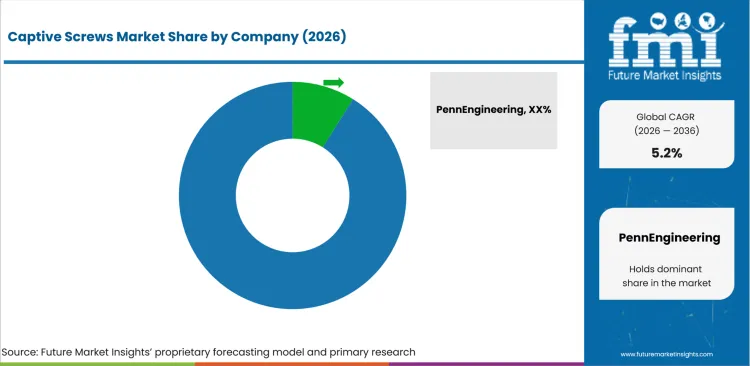
The field separates into dedicated captive-panel engineering and broader fastening platforms with deeper logistics coverage. PennEngineering and Southco compete closest to enclosure design-ins because both address retention geometry and panel integration. PENCOM and JW Winco cover narrower engineered configurations, whereas Essentra Components and TR Fastenings extend standard availability through broader catalogs. Bossard and Böllhoff widen regional supply support for industrial programs that resemble aerospace fastener manufacturing in their documentation needs. Electronics specialists face comparable qualification work on server-access applications that require repeated maintenance without loose hardware.
- PennEngineering, Southco and PENCOM focus on retained panel hardware where fastener geometry and installation method enter the equipment drawing.
- JW Winco and Böllhoff serve machinery programs through engineered standard parts and application support for specialized fastening requirements.
- Essentra Components, TR Fastenings and Bossard compete through broader availability with technical support and multi-country distribution for industrial programs.
Competitive Benchmarking: Captive Screws Market
| Company | Captive Fastener Breadth | Application Engineering Depth | Supply-Chain Integration | Geographic Reach |
|---|---|---|---|---|
| PennEngineering | High | High | High | Global |
| Southco | High | High | High | Global |
| Essentra Components | High | Medium | High | Europe, Americas and Asia |
| PENCOM | High | High | Medium | North America, Europe and Asia |
| JW Winco | High | Medium | Medium | North America and Europe |
| TR Fastenings | Medium | High | High | Europe, North America and Asia |
| Bossard | Medium | High | High | Global |
| Böllhoff | Medium | High | High | Global |
Scoring basis: High captive-fastener breadth requires at least three documented retained screw or panel-fastener families, Medium requires two and Low identifies one. High engineering depth requires design support plus testing or customization, Medium reflects one technical-support route and Low reflects standard support. High supply-chain integration requires manufacturing or engineering plus multi-region stocking, Medium reflects documented regional distribution and Low identifies one primary route.
Key Developments in the Captive Screws Market
- In January 2026, Southco opened a 2,255-square-meter manufacturing facility in Chon Buri with captive screws listed among its production priorities. The Thailand site shortens supply distance for Southeast Asian programs requiring retained panel hardware.
- In November 2025, PENCOM released its CMU surface-mount captive screw for automated printed-circuit-board assembly using pick-and-place and reflow processes. The launch places captive fastening directly inside standard SMT production flows for compact electronics.
- In August 2025, ZJK Industrial Co., Ltd. deployed semi-automatic punching equipment for captive screw production and reported more than threefold efficiency improvement. The equipment addresses assembly complexity created by screws, housings and springs requiring controlled stamping.
Key Players in the Captive Screws Market
Captive and Catalog Fastener Platforms
- PennEngineering
- Southco
- Essentra Components
Precision and Industrial Standard Parts
- PENCOM
- JW Winco
Engineering and Distribution Networks
- TR Fastenings
- Bossard
- Böllhoff
Captive Screws Market - Report Scope
| Coverage field | Report scope |
|---|---|
| Market breakdown | By screw type, material, thread size, end use, sales channel and region. |
| Quantitative Units | USD Million. |
| Market Definition | Revenue from captive screws and captive screw assemblies sold within the stated segmentation universe. Ordinary non-retained screws, separate installation tooling and downstream equipment revenue are excluded. |
| Regions Covered | North America, Latin America, Western Europe, Eastern Europe, East Asia, South Asia and Pacific and Middle East and Africa. |
| Countries Covered | France, Mexico, Poland, UK, USA and 25+ countries included in the full report. |
| Key Companies Profiled | PennEngineering, Southco, Essentra Components, PENCOM, JW Winco, TR Fastenings, Bossard, Böllhoff. |
| Forecast Period | 2026 to 2036. |
| Approach | Primary and secondary research with market triangulation. |
Captive Screws Market - Research Methodology
| Method | Approach |
|---|---|
| Primary Research | FMI analysts gathered input from manufacturers, service providers, technology developers, distributors, end users, procurement teams, and subject-matter experts. Interviews examined purchasing decisions, product or service evaluation, adoption barriers, approval requirements, pricing considerations, and expectations for technical or commercial support. Respondents were also asked what evidence is required before a trial, pilot, or initial order develops into regular purchasing. |
| Desk Research | Desk research covered government statistics, regulatory publications, trade data, industry associations, technical literature, standards, company filings, product information, and official corporate announcements. Sources were reviewed for relevance, publication date, geographic coverage, and consistency with the defined market scope. Claims relating to performance, applications, approvals, capacity, investment, and commercial activity were retained only when supported by credible public evidence. |
| Market Sizing and Forecasting | The market model combined the baseline value with historical performance, segment structure, pricing and volume indicators, adoption levels, company participation, and country-level demand conditions. Forecast assumptions considered economic activity, investment trends, regulatory developments, technology adoption, purchasing cycles, supply availability, and barriers to wider market use. Segment and regional estimates were reconciled before the final market total was calculated. |
| Data Validation | Estimates were checked against multiple independent indicators, including public data, company activity, trade patterns, industry developments, and findings from primary interviews. Validation also tested whether products, services, applications, and company revenues fell within the defined market boundaries. Adjacent categories, unsupported claims, overlapping revenues, and activities without direct market relevance were excluded to reduce double counting and maintain consistency across segments and countries. |
Captive Screws Market by Segments
Captive Screws Market segmented by Screw Type:
- Knurled captive screws
- Slotted captive screws
- Phillips captive screws
- Socket head captive screws
- Spring-loaded captive screws
Captive Screws Market segmented by Material:
- Stainless steel
- Carbon steel
- Aluminum
- Brass
- Nylon/plastic
Captive Screws Market segmented by Thread Size:
- Below M3
- M3-M5
- M5-M8
- Above M8
Captive Screws Market segmented by End Use:
- Electronics enclosures
- Aerospace
- Industrial machinery
- Medical devices
- Telecom equipment
Captive Screws Market segmented by Sales Channel:
- Fastener distributors
- Direct OEM supply
- Catalog/e-commerce
- Custom fastener suppliers
Captive Screws Market by Region:
- North America
- United States
- Canada
- Latin America
- Brazil
- Mexico
- Argentina
- Chile
- Western Europe
- Germany
- France
- United Kingdom
- Italy
- Spain
- Benelux
- Nordics
- Eastern Europe
- Poland
- Czech Republic
- Romania
- Hungary
- East Asia
- China
- Japan
- South Korea
- South Asia and Pacific
- India
- ASEAN
- Australia and New Zealand
- Middle East and Africa
- GCC Countries
- South Africa
- Türkiye
- Israel
Research Sources and Bibliography
- Global Electronics Association. (2025, May 22). Electronics industry demand holds steady amid tariff turbulence.
- IPC International, Inc. (2025, January 28). Electronics industry demand reaches neutral ground.
- IPC International, Inc. (2025, February 20). North American PCB industry sales up 19.9 percent in January.
- IPC International, Inc. (2025, March 31). North American PCB industry sales up 11.3 percent in February.
- SEMI. (2025, January 7). Eighteen new semiconductor fabs to start construction in 2025, SEMI reports.
- World Stainless Association. (2026, February 27). Stainless steel melt shop production increases by 2.1% in 2025.
- Direction générale des Entreprises. (2025, January 8). Les semi-conducteurs : un marché mondialisé et une dépendance européenne.
- Secretaría de Economía. (2026, May). Semiconductor and other electronic component manufacturing. Data México.
- Polish Investment and Trade Agency. (2025, August). The professional electronics sector 2025.
- Department for Science, Innovation and Technology. (2026, June 8). Semiconductor sector study 2026.
- USA Department of Commerce. (2026, February). USA Department of Commerce fiscal year 2025 agency financial report.
- Elesa+Ganter. (2025, February 20). Compact special-screws for mechanical engineering.
- TR Fastenings. (2026, May 5). Introducing our Virtual Innovation Centre: An immersive engineering platform.
- Bossard Group. (2025, January 7). Acquisition of the Ferdinand Gross Group.
- Southco. (2026, February 11). Southco expands Southeast Asia footprint with Chon Buri facility opening.
- PENCOM. (2025, November 13). Introducing PENCOM’s CMU surface-mount captive screws.
- ZJK Industrial Co., Ltd. (2025, August 4). ZJK Industrial Co., Ltd. triples captive screw production efficiency with new semi-automatic equipment.
- PennEngineering. (2026, July 1). PennEngineering launches Sherex by PEM blind rivet nut portfolio across Europe.
- Essentra Components. (2025, September 17). Essentra launches new PEEK fastener range offering exceptional thermal stability and mechanical properties.
- Southco. (2025, October 7). Southco celebrates grand opening in Foshan.
- PENCOM. (2025, February 3). PENCOM acquires Integrated Defense Products (IDP).
- ZJK Industrial Co., Ltd. (2025, November 24). ZJK Industrial and Chaince Digital announce strategic partnership for USA-based precision components R&D and manufacturing base.
- TR Fastenings. (2025, August 14). TR strengthens Central European operations global vision.
- Bossard Group. (2025, July 15). With the Bossard Exploration Lab, we are creating space for bright minds and bold ideas.
- Böllhoff. (2025, October 16). New production facility inaugurated in Türkiye.
- Essentra Components. (2025, August 6). Seratech partners with Essentra to enhance processing efficiency and facilitate growth.
- JW Winco. (2025, May 20). Special applications require special screws - beyond typical standards.
- NBK. (2025, July 29). New products introduced: Special screws.
This bibliography is provided for reader reference and is not exhaustive. The full report contains the complete reference list and detailed citations.
This Report Answers
- What is the captive screws market size in 2026 and what value is projected by 2036?
- Which safety and service conditions increase demand for retained panel fasteners?
- Why do knurled captive screws hold 27.0% of screw-type demand in 2026?
- Why does stainless steel account for 38.0% of material demand in 2026?
- Why does below M3 capture 22.0% of thread-size demand in 2026?
- How do country growth rates compare among France, Mexico, Poland, the UK and the USA?
- Which companies compete through captive-fastener engineering and distribution coverage?
- Which qualification factors can slow a captive screw design-in?
- How much incremental value is projected between 2026 and 2036?
Frequently Asked Questions
How big is the captive screws market in 2026?
The captive screws market is valued at USD 620.7 million in 2026 and is projected to reach USD 1,030.5 million by 2036. Repeated service access and retained-hardware requirements support demand on machinery and electronics panels.
What is the CAGR of the captive screws market from 2026 to 2036?
The captive screws market is projected to grow at a CAGR of 5.2% between 2026 and 2036. Equipment designs requiring attached hardware during panel removal sustain specification demand through the forecast period.
Which screw type leads the captive screws market?
The knurled captive screws segment is expected to hold 27.0% of the captive screws market in 2026, driven by frequent manual access on service panels. Knurled heads let technicians open retained hardware without tool dependence during routine maintenance.
Which material holds the largest share of the captive screws market?
The stainless steel segment is expected to hold 38.0% of the captive screws market in 2026, attributable to corrosion resistance during repeated handling. Durable surfaces preserve specified hardware condition through longer equipment service intervals and maintenance cycles.
How much incremental opportunity will the captive screws market add between 2026 and 2036?
The captive screws market is expected to add USD 409.8 million in value between 2026 and 2036. Machinery guards and compact electronic enclosures extend retained-hardware design-ins where service access makes loose screws costly.
Which countries are projected to record the highest growth in the captive screws market?
France is projected to grow at 6.0% CAGR, followed by Mexico at 5.5% and Poland at 5.2% through 2036. Electronics manufacturing and industrial qualification activity support the faster rates among the profiled countries.
Which companies are active in the captive screws market?
Key companies operating in the captive screws market include PennEngineering, Southco, Essentra Components, PENCOM, JW Winco, TR Fastenings, Bossard and Böllhoff. Their positions differ through retained-fastener breadth, application engineering, regional inventory and production support.
Preview the report firsthand - request a free sample
Get SampleGet the brochure for pricing and purchase details.
Get PDFTable of Content
- Key Takeaways
- Market Size and CAGR
- Top Growth Driver
- Fastest Growing Segment
- Leading Region
- Key Companies
- Emerging Opportunities
- Executive Summary
- Global Market Outlook
- Demand-side Trends
- Supply-side Trends
- Technology Roadmap Analysis
- Analysis and Recommendations
- Analyst Perspective (What is happening? Why now? What should investors know?)
- Key Questions Answered
- How large is the market?
- What is the CAGR?
- What are key trends?
- Which region dominates?
- Who are the leaders?
- Market Overview
- Market Coverage / Taxonomy
- Market Definition / Scope / Limitations
- Research Methodology
- Chapter Orientation
- Analytical Lens and Working Hypotheses
- Market Structure, Signals, and Trend Drivers
- Benchmarking and Cross-market Comparability
- Market Sizing, Forecasting, and Opportunity Mapping
- Research Design and Evidence Framework
- Desk Research Programme (Secondary Evidence)
- Expert Input and Fieldwork (Primary Evidence)
- Tooling, Models, and Reference Databases
- Data Engineering and Model Build
- Quality Assurance and Audit Trail
- Market Background
- Market Dynamics (Drivers, Restraints, Opportunity, Trends)
- Scenario Forecast (Optimistic, Likely, Conservative)
- Impact Analysis
- AI Impact
- Sustainability Impact
- Regulatory Impact
- Technology Impact
- Consumer / Buyer Analysis
- Purchase Drivers
- Adoption Barriers
- Buyer Journey
- Opportunity Map Analysis
- Product Life Cycle Analysis
- Supply Chain Analysis
- Investment Feasibility Matrix
- Value Chain Analysis
- PESTLE and Porter's Analysis
- Regulatory Landscape
- Regional Parent Market Outlook
- Production and Consumption Statistics
- Import and Export Statistics
- Global Market Analysis and Forecast, 2021 to 2036
- Historical Market Size Value (USD Million) Analysis, 2021 to 2025
- Current and Future Market Size Value (USD Million) Projections, 2026 to 2036
- Y-o-Y Growth Trend Analysis
- Absolute $ Opportunity Analysis
- Global Market Pricing Analysis, 2021 to 2036
- Global Market Analysis and Forecast, By Screw Type, 2021 to 2036
- Introduction / Key Findings
- Historical Market Size Value (USD Million) Analysis By Screw Type, 2021 to 2025
- Current and Future Market Size Value (USD Million) Analysis and Forecast By Screw Type, 2026 to 2036
- Knurled captive screws
- Slotted captive screws
- Phillips captive screws
- Socket head captive screws
- Spring-loaded captive screws
- Knurled captive screws
- Y-o-Y Growth Trend Analysis By Screw Type, 2021 to 2025
- Absolute $ Opportunity Analysis By Screw Type, 2026 to 2036
- Global Market Analysis and Forecast, By Material, 2021 to 2036
- Introduction / Key Findings
- Historical Market Size Value (USD Million) Analysis By Material, 2021 to 2025
- Current and Future Market Size Value (USD Million) Analysis and Forecast By Material, 2026 to 2036
- Stainless steel
- Carbon steel
- Aluminum
- Brass
- Nylon/plastic
- Stainless steel
- Y-o-Y Growth Trend Analysis By Material, 2021 to 2025
- Absolute $ Opportunity Analysis By Material, 2026 to 2036
- Global Market Analysis and Forecast, By Thread Size, 2021 to 2036
- Introduction / Key Findings
- Historical Market Size Value (USD Million) Analysis By Thread Size, 2021 to 2025
- Current and Future Market Size Value (USD Million) Analysis and Forecast By Thread Size, 2026 to 2036
- Below M3
- M3-M5
- M5-M8
- Above M8
- Below M3
- Y-o-Y Growth Trend Analysis By Thread Size, 2021 to 2025
- Absolute $ Opportunity Analysis By Thread Size, 2026 to 2036
- Global Market Analysis and Forecast, By End Use, 2021 to 2036
- Introduction / Key Findings
- Historical Market Size Value (USD Million) Analysis By End Use, 2021 to 2025
- Current and Future Market Size Value (USD Million) Analysis and Forecast By End Use, 2026 to 2036
- Electronics enclosures
- Aerospace
- Industrial machinery
- Medical devices
- Telecom equipment
- Electronics enclosures
- Y-o-Y Growth Trend Analysis By End Use, 2021 to 2025
- Absolute $ Opportunity Analysis By End Use, 2026 to 2036
- Global Market Analysis and Forecast, By Sales Channel, 2021 to 2036
- Introduction / Key Findings
- Historical Market Size Value (USD Million) Analysis By Sales Channel, 2021 to 2025
- Current and Future Market Size Value (USD Million) Analysis and Forecast By Sales Channel, 2026 to 2036
- Fastener distributors
- Direct OEM supply
- Catalog/e-commerce
- Custom fastener suppliers
- Fastener distributors
- Y-o-Y Growth Trend Analysis By Sales Channel, 2021 to 2025
- Absolute $ Opportunity Analysis By Sales Channel, 2026 to 2036
- Global Market Analysis and Forecast, By Region, 2021 to 2036
- Introduction
- Historical Market Size Value (USD Million) Analysis By Region, 2021 to 2025
- Current Market Size Value (USD Million) Analysis and Forecast By Region, 2026 to 2036
- North America
- Latin America
- Western Europe
- Eastern Europe
- East Asia
- South Asia and Pacific
- Middle East & Africa
- Market Attractiveness Analysis By Region
- North America Market Analysis and Forecast, By Country, 2021 to 2036
- Historical Market Size Value (USD Million) Trend Analysis By Market Taxonomy, 2021 to 2025
- Market Size Value (USD Million) Forecast By Market Taxonomy, 2026 to 2036
- By Country
- USA
- Canada
- By Screw Type
- By Material
- By Thread Size
- By End Use
- By Sales Channel
- By Country
- Market Attractiveness Analysis
- By Country
- By Screw Type
- By Material
- By Thread Size
- By End Use
- By Sales Channel
- Key Takeaways
- Latin America Market Analysis and Forecast, By Country
- Historical Market Size Value (USD Million) Trend Analysis By Market Taxonomy, 2021 to 2025
- Market Size Value (USD Million) Forecast By Market Taxonomy, 2026 to 2036
- By Country
- Brazil
- Mexico
- Chile
- Rest of Latin America
- By Screw Type
- By Material
- By Thread Size
- By End Use
- By Sales Channel
- By Country
- Market Attractiveness Analysis
- By Country
- By Screw Type
- By Material
- By Thread Size
- By End Use
- By Sales Channel
- Key Takeaways
- Western Europe Market Analysis and Forecast, By Country
- Historical Market Size Value (USD Million) Trend Analysis By Market Taxonomy, 2021 to 2025
- Market Size Value (USD Million) Forecast By Market Taxonomy, 2026 to 2036
- By Country
- Germany
- UK
- Italy
- Spain
- France
- Nordic
- BENELUX
- Rest of Western Europe
- By Screw Type
- By Material
- By Thread Size
- By End Use
- By Sales Channel
- By Country
- Market Attractiveness Analysis
- By Country
- By Screw Type
- By Material
- By Thread Size
- By End Use
- By Sales Channel
- Key Takeaways
- Eastern Europe Market Analysis and Forecast, By Country
- Historical Market Size Value (USD Million) Trend Analysis By Market Taxonomy, 2021 to 2025
- Market Size Value (USD Million) Forecast By Market Taxonomy, 2026 to 2036
- By Country
- Russia
- Poland
- Hungary
- Balkan & Baltic
- Rest of Eastern Europe
- By Screw Type
- By Material
- By Thread Size
- By End Use
- By Sales Channel
- By Country
- Market Attractiveness Analysis
- By Country
- By Screw Type
- By Material
- By Thread Size
- By End Use
- By Sales Channel
- Key Takeaways
- East Asia Market Analysis and Forecast, By Country
- Historical Market Size Value (USD Million) Trend Analysis By Market Taxonomy, 2021 to 2025
- Market Size Value (USD Million) Forecast By Market Taxonomy, 2026 to 2036
- By Country
- China
- Japan
- South Korea
- By Screw Type
- By Material
- By Thread Size
- By End Use
- By Sales Channel
- By Country
- Market Attractiveness Analysis
- By Country
- By Screw Type
- By Material
- By Thread Size
- By End Use
- By Sales Channel
- Key Takeaways
- South Asia and Pacific Market Analysis and Forecast, By Country
- Historical Market Size Value (USD Million) Trend Analysis By Market Taxonomy, 2021 to 2025
- Market Size Value (USD Million) Forecast By Market Taxonomy, 2026 to 2036
- By Country
- India
- ASEAN
- Australia & New Zealand
- Rest of South Asia and Pacific
- By Screw Type
- By Material
- By Thread Size
- By End Use
- By Sales Channel
- By Country
- Market Attractiveness Analysis
- By Country
- By Screw Type
- By Material
- By Thread Size
- By End Use
- By Sales Channel
- Key Takeaways
- Middle East & Africa Market Analysis and Forecast, By Country
- Historical Market Size Value (USD Million) Trend Analysis By Market Taxonomy, 2021 to 2025
- Market Size Value (USD Million) Forecast By Market Taxonomy, 2026 to 2036
- By Country
- Kingdom of Saudi Arabia
- Other GCC Countries
- Türkiye
- South Africa
- Other African Union
- Rest of Middle East & Africa
- By Screw Type
- By Material
- By Thread Size
- By End Use
- By Sales Channel
- By Country
- Market Attractiveness Analysis
- By Country
- By Screw Type
- By Material
- By Thread Size
- By End Use
- By Sales Channel
- Key Takeaways
- Key Countries Market Analysis
- USA
- Pricing Analysis
- Market Share Analysis, 2025
- By Screw Type
- By Material
- By Thread Size
- By End Use
- By Sales Channel
- Canada
- Pricing Analysis
- Market Share Analysis, 2025
- By Screw Type
- By Material
- By Thread Size
- By End Use
- By Sales Channel
- Mexico
- Pricing Analysis
- Market Share Analysis, 2025
- By Screw Type
- By Material
- By Thread Size
- By End Use
- By Sales Channel
- Brazil
- Pricing Analysis
- Market Share Analysis, 2025
- By Screw Type
- By Material
- By Thread Size
- By End Use
- By Sales Channel
- Chile
- Pricing Analysis
- Market Share Analysis, 2025
- By Screw Type
- By Material
- By Thread Size
- By End Use
- By Sales Channel
- Germany
- Pricing Analysis
- Market Share Analysis, 2025
- By Screw Type
- By Material
- By Thread Size
- By End Use
- By Sales Channel
- UK
- Pricing Analysis
- Market Share Analysis, 2025
- By Screw Type
- By Material
- By Thread Size
- By End Use
- By Sales Channel
- Italy
- Pricing Analysis
- Market Share Analysis, 2025
- By Screw Type
- By Material
- By Thread Size
- By End Use
- By Sales Channel
- Spain
- Pricing Analysis
- Market Share Analysis, 2025
- By Screw Type
- By Material
- By Thread Size
- By End Use
- By Sales Channel
- France
- Pricing Analysis
- Market Share Analysis, 2025
- By Screw Type
- By Material
- By Thread Size
- By End Use
- By Sales Channel
- India
- Pricing Analysis
- Market Share Analysis, 2025
- By Screw Type
- By Material
- By Thread Size
- By End Use
- By Sales Channel
- ASEAN
- Pricing Analysis
- Market Share Analysis, 2025
- By Screw Type
- By Material
- By Thread Size
- By End Use
- By Sales Channel
- Australia & New Zealand
- Pricing Analysis
- Market Share Analysis, 2025
- By Screw Type
- By Material
- By Thread Size
- By End Use
- By Sales Channel
- China
- Pricing Analysis
- Market Share Analysis, 2025
- By Screw Type
- By Material
- By Thread Size
- By End Use
- By Sales Channel
- Japan
- Pricing Analysis
- Market Share Analysis, 2025
- By Screw Type
- By Material
- By Thread Size
- By End Use
- By Sales Channel
- South Korea
- Pricing Analysis
- Market Share Analysis, 2025
- By Screw Type
- By Material
- By Thread Size
- By End Use
- By Sales Channel
- Russia
- Pricing Analysis
- Market Share Analysis, 2025
- By Screw Type
- By Material
- By Thread Size
- By End Use
- By Sales Channel
- Poland
- Pricing Analysis
- Market Share Analysis, 2025
- By Screw Type
- By Material
- By Thread Size
- By End Use
- By Sales Channel
- Hungary
- Pricing Analysis
- Market Share Analysis, 2025
- By Screw Type
- By Material
- By Thread Size
- By End Use
- By Sales Channel
- Kingdom of Saudi Arabia
- Pricing Analysis
- Market Share Analysis, 2025
- By Screw Type
- By Material
- By Thread Size
- By End Use
- By Sales Channel
- Türkiye
- Pricing Analysis
- Market Share Analysis, 2025
- By Screw Type
- By Material
- By Thread Size
- By End Use
- By Sales Channel
- South Africa
- Pricing Analysis
- Market Share Analysis, 2025
- By Screw Type
- By Material
- By Thread Size
- By End Use
- By Sales Channel
- USA
- Market Structure Analysis
- Competition Dashboard
- Competition Benchmarking
- Market Share Analysis of Top Players
- By Regional
- By Screw Type
- By Material
- By Thread Size
- By End Use
- By Sales Channel
- Emerging Startups
- Innovation Benchmarking
- Competition Analysis
- Competition Deep Dive
- PennEngineering
- Overview
- Product Portfolio
- Profitability by Market Segments
- Sales Footprint
- Strategy Overview
- Marketing Strategy
- Product Strategy
- Channel Strategy
- Southco
- Essentra Components
- Accu
- JW Winco
- RAF Electronic Hardware
- Bossard
- Böllhoff
- TR Fastenings
- PFC Fasteners
- PennEngineering
- Case Studies
- Success Stories
- Recent Developments
- Competition Deep Dive
- Assumptions & Acronyms Used


