

- Industry Size (2026)
- USD 3.3 Bn
- Forecast (2036)
- USD 12.5 Bn
- CAGR (2026 to 2036)
- 14.2%
Factory-Floor Micro Data Center Infrastructure Market Size, Market Forecast and Outlook By FMI
The factory floor micro data center infrastructure reached the valuation of USD 2.8 billion in 2025 and surpassed the same significantly to USD 3.3 billion in 2026 with a CAGR of 14.2% during the forecast period. Revenue expansion lifts the total opportunity to USD 12.5 billion through 2036 as the cumulative buildup of localized compute nodes enables the future of micro data centers in smart factories by bridging the gap between cloud-based oversight and physical production speed.
Plant directors seeking a micro data center for manufacturing are no longer deciding between cloud or on-premise; they are deciding how much compute can survive within ten meters of a vibrating CNC machine. The decision is driven by the physical limitations of data gravity where the latency cost of round-tripping quality inspection images to a remote colocation edge data center exceeds the cost of installing local nodes. When analyzing the ROI of factory floor micro data center deployments, firms find that the reduction in micro-stoppages justifies the initial spend. FMI notes that while heat is the obvious enemy, electromagnetic interference in high-voltage environments remains a persistent silent killer of edge reliability.
Summary of Factory-Floor Micro Data Center Infrastructure Market
- Factory-Floor Micro Data Center Infrastructure Market Definition
- The market represents a specialized tier of hardware engineered for high-availability compute. It provides the physical protection required to run localized Industry 4.0 micro data center applications.
- Demand Drivers in the Market
- The requirement for real-time analytics micro data center factory performance forces managers to deploy compute nodes within the immediate proximity of assembly lines.
- Rising micro data center security for factory floor mandates for air-gapped networks compel IT directors to localize industrial data-ops rather than relying on external connections.
- The expansion of smart sensors obligates operations heads to consolidate fragmented gateway hardware into a managed edge micro data center factory floor nodes.
- Key Segments Analyzed in the FMI Report
- Racks & Enclosures: Racks & Enclosures is estimated to garner 42.0% share in 2026, as environmental sealing remains the primary barrier to IT survival on the floor.
- Schneider Electric: Schneider Electric is expected to hold 18.0% of the competitive landscape in 2026, leveraging its deep integration within industrial power networks.
- China: China is projected to track a 18.0% CAGR, driven by a national push for autonomous manufacturing clusters.
- Analyst Opinion at FMI
- Rahul Pandita, Principal Analyst, Technology, at FMI, opines, "When asking what is factory floor micro data center technology, many focus on the hardware, but the true value is latency reduction. We are seeing a practitioner paradox where the more a factory automates, the less it can afford to be connected to an external cloud for its core decision loops. The industrial edge computing micro data center is becoming the 'brain' of the manufacturing cell."
- Strategic Implications / Executive Takeaways
- Operations directors must prioritize IP65 ratings to avoid the challenges deploying micro data center factory units in unconditioned floor spaces.
- IT-OT architects should implement unified management platforms to prevent 'edge sprawl' across geographically dispersed micro-nodes.
- Supply chain managers face a structural shortage of data center power management components, requiring longer lead-time planning.
- Methodology
- Primary Insights: Interviews with floor-level decision-makers ensure data reflects real-world operational constraints.
- Data Anchoring: Market values are tied to verified shipment volumes of hardened enclosures and industrial cooling.
- Triangulation: Forecasting models combine industrial IoT growth with power infrastructure investment cycles.
- Validation: Continuous update cycles ensure the forecast accounts for edge ai for smart manufacturing requirements.
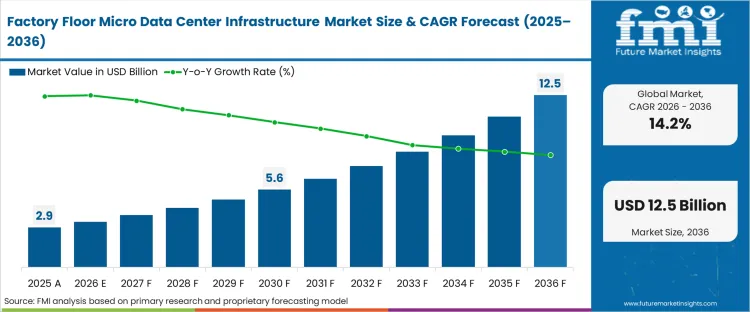
The structural gate for this market is the transition from pilot setups to integrated, software-defined industrial compute fabrics. This shift is triggered by the arrival of industrial edge computing micro data center requirements that process high-bandwidth AI streams locally. Once a facility crosses the threshold of concurrent vision systems, the individual gateway becomes insufficient, necessitating a coordinated micro mobile data center approach. Understanding how to deploy micro data center on factory floor zones becomes the primary operational challenge, as these units must scale without requiring a clean-room environment.
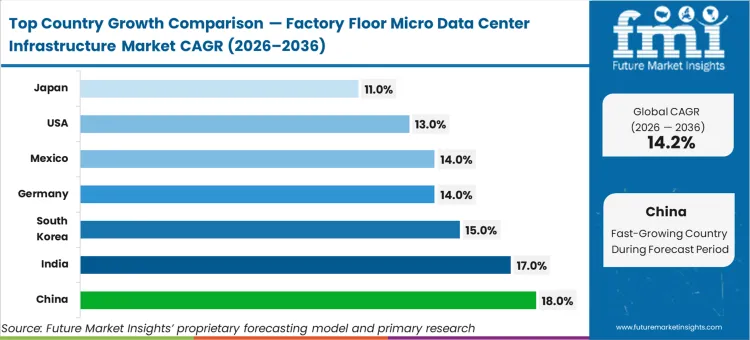
China factory floor micro data center expansion is projected to witness growth at a CAGR of 18.0%, followed by India factory micro data center growth at 17.0%. The German sector is set to achieve a CAGR of 14.0%, while Mexico records a 14.0% rate. United States sales are expected to expand at 13.0%, with Japan and South Korea tracking at 11.0% and 15.0% respectively. This micro data center CAGR forecast 2036 reflects a varied pace of brownfield automation versus greenfield smart factory construction.
Factory-Floor Micro Data Center Infrastructure Market Definition
The factory floor micro data center infrastructure comprises physical and logical components designed to house compute resources directly within a production zone. This rugged micro data center for manufacturing is architected for NEMA or IP-rated protection against dust, moisture, and vibration. This framework encompasses structural enclosures and thermal management required to maintain modular data center uptime in non-conditioned spaces.
Factory-Floor Micro Data Center Infrastructure Market Inclusions
This market includes self-contained racks, liquid-to-air cooling manifolds, and UPS specifically rated for industrial power surges. It also includes data center infrastructure management (DCIM) software tailored for remote orchestration of hundreds of nodes. Service components such as factory-integrated testing and environmental sensors are also within scope for micro data center power cooling infrastructure.
Factory-Floor Micro Data Center Infrastructure Market Exclusions
Excluded from this market are standard enterprise-grade components designed exclusively for Tier III or IV temperature-controlled halls. General-purpose industrial PCs (IPCs) without integrated enclosure systems and cloud-based storage services are also excluded. The large-scale modular data center factory acceptance test services for hyperscale facilities are further considered outside the functional boundary of factory-floor micro-installations.
Factory-Floor Micro Data Center Infrastructure Market Research Methodology
- Primary Research: FMI conducted deep-dive interviews with Industrial Automation Engineers and IT-OT Convergence Architects regarding the best micro data center for industrial automation.
- Desk Research: Our analysts aggregated data from NEMA/IP enclosure certification registries and micro data center infrastructure suppliers shipment databases.
- Market-Sizing and Forecasting: The baseline anchors to the documented installation rate of industrial IoT gateways relative to square footage.
- Data Validation and Update Cycle: Forecasts were cross-validated using independent secondary data streams from power hardware and top suppliers micro data center industrial portfolios.
Segmental Analysis
Factory-Floor Micro Data Center Infrastructure Market Analysis by Power & Cooling Infrastructure
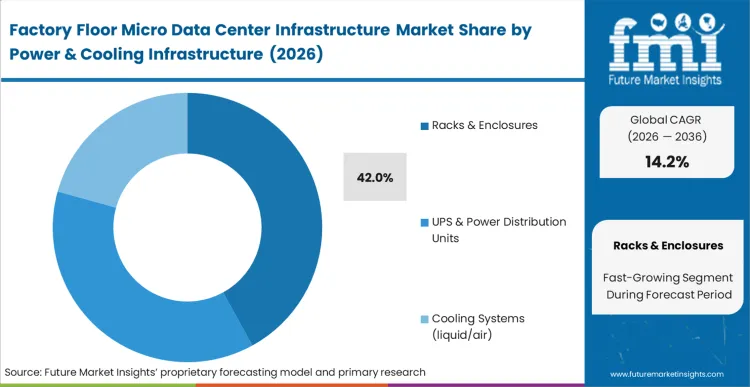
The shift toward high-density compute on the shop floor has moved thermal management to the primary constraint of micro-node reliability. In the micro data center vs traditional data center manufacturing debate, the former succeeds by utilizing data center liquid cooling solutions that operate in closed-loop configurations. FMI notes that Racks & Enclosures dominate the sector with 42.0% share because the physical cabinet serves as the first line of defense. Buyers are increasingly opting for integrated units to optimize micro data center energy efficiency factory metrics, reducing the failure points during floor-side installation. The consequence for plant managers who rely on standard server racks is a predictable cycle of hardware overheating.
- Vibration Isolation: Dampening mechanisms prevent kinetic energy from the floor from causing drive failures. This is a critical feature when evaluating the best micro data center for industrial automation in heavy machinery zones.
- Thermal Recovery: Closed-loop manifolds allow for high-compute loads to be maintained in ambient temperatures exceeding 40°C. Operations heads use these to deploy GPU-heavy servers for real-time analytics micro data center factory tasks.
- Power Conditioning: Integrated switchgear for data centers shields sensitive processors from voltage sags common in heavy industrial grids. Electrical engineers prioritize these units to prevent localized server reboots during large motor startups.
Factory-Floor Micro Data Center Infrastructure Market Analysis by IT & Compute Hardware
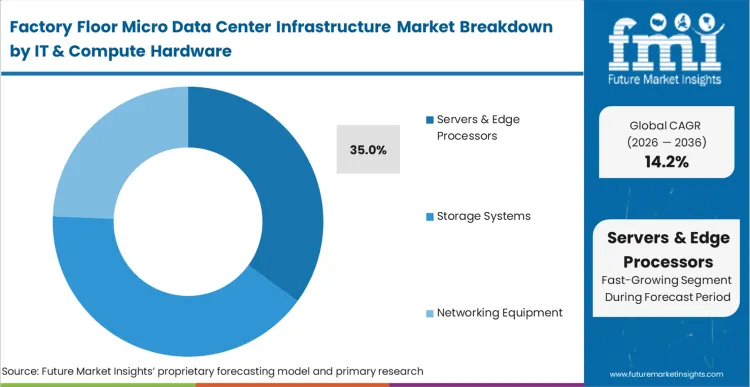
The decision to move compute hardware to the floor is a response to the "latency wall" encountered by automated assembly lines. As facilities integrate more factory floor edge ai industrial pcs, the IT hardware itself must be architected for modularity and rapid field replacement. FMI views the compute segment as the most dynamic, as the hardware lifecycle (3-5 years) is significantly shorter than the enclosure's lifespan. This creates a structural need for standardized internal mounting that can accommodate multiple generations of edge processors. A buyer who locks into a proprietary form factor faces significant re-tooling costs when upgrading to next-generation AI accelerators.
- Storage Resiliency: Solid-state arrays with industrial-grade endurance provide the necessary buffer for data center storage when network connectivity is intermittent. This validates the hardware choice for facilities running critical process control.
- Modular Compute: Swappable blade architectures allow for the IT payload to be upgraded without disturbing the IP-rated enclosure. Maintenance teams favor this architecture when consulting a factory floor micro data center installation guide for multi-generational upgrades.
- Network Redundancy: Integrated 10/25GbE floor-side networking ensures high-bandwidth sensor data can be aggregated locally. This makes the buyer more resilient to wide-area network outages that would otherwise halt production.
Factory-Floor Micro Data Center Infrastructure Market Analysis by Management & Security Software
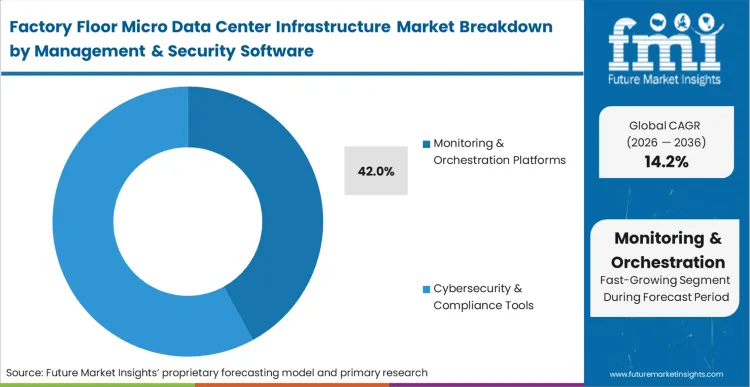
FMI indicates that the integration of software-defined security is a core requirement to air-gap localized process data. Management platforms are now expected to provide a "single pane of glass" that bridges IT health and OT environmental health. The operational consequence for organizations that delay software centralization is an unmanageable mesh of "ghost" edge devices. Displacement of manual monitoring is the primary driver for advanced orchestration software within micro-infrastructure. As a single plant might deploy dozens of micro-nodes, the previous approach of per-device management is failing to keep pace with edge computing enclosure environmental test requirements.
- Remote Orchestration: Automated deployment tools allow a central IT team to push security patches to floor-side nodes without physical intervention. This simplifies the operational phase for multi-site manufacturers with limited on-site staff.
- Predictive Health: Sensors within the infrastructure alert maintenance teams to cooling fan degradation or data center transformer issues before a failure occurs. This is a core part of a predictive maintenance micro data center application strategy.
- Compliance Tracking: Real-time logging of environmental data ensures the facility meets micro data center regulatory compliance industrial standards. Security officers use these logs to validate that localized industrial AI remains within governed parameters.
Factory-Floor Micro Data Center Infrastructure Market Drivers, Restraints, and Opportunities
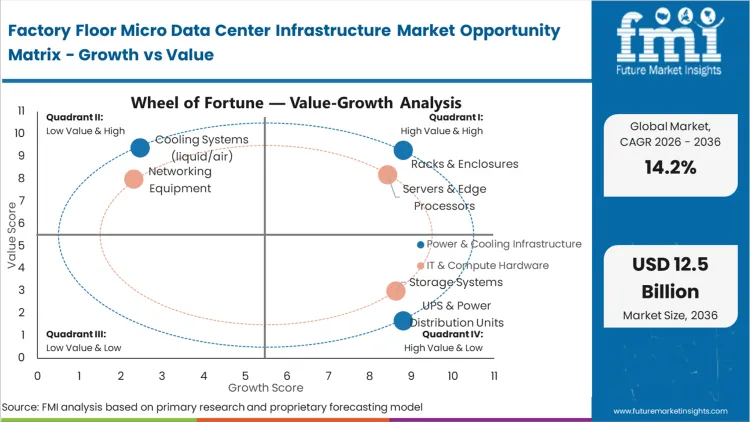
The imperative for sub-millisecond responsiveness within autonomous assembly cells is the primary structural force compelling the adoption of factory floor micro data center infrastructure. As industrial robotics transition toward high-velocity, AI-driven motion, the inherent latency of cloud-based processing evolves from a mere technical delay into a critical safety and operational liability. Consequently, deploying a micro data center for automotive factory environments is becoming a baseline requirement for managers determined to embed localized intelligence directly into the production zone. Those who hesitate to commit to this architectural shift face an accelerating performance gap against competitors who have already successfully decentralized their compute logic. FMI’s analysis underscores that the current stakes transcend simple IT optimization, directly impacting the fundamental throughput and resilience of the manufacturing line.
The primary restraint remains the deep-seated organizational friction between traditional IT departments and floor-side OT (Operations Technology) teams. The challenges deploying micro data center factory units are fundamentally structural; IT departments prioritize rigid security and standardization, whereas OT teams prioritize absolute uptime and physical durability, frequently resulting in a qualification stalemate. While a rugged micro data center for manufacturing necessitates the fusion of both disciplines, many organizations still lack a unified procurement framework or budget for "floor-side IT". An emerging partial solution is the "infrastructure-as-a-service" model where specialized micro data center infrastructure suppliers manage the unit, though this remains constrained by manufacturer sensitivity regarding external access to localized process data.
Opportunities in the Factory-Floor Micro Data Center Infrastructure Market
- Brownfield Retrofitting: Legacy factories require modular, "drop-in" compute nodes that do not require building dedicated server rooms. Small-to-medium enterprises capture this by using micro mobile data center units to add AI to older lines.
- Liquid Cooling Integration: As edge processors become more power-hungry, the opportunity for specialized liquid cooled edge data center vendors to displace air-cooled systems is expanding. High-precision manufacturers use this to maintain thermal stability in compact enclosures.
- Security-as-a-Feature: Vendors who embed hardware-level encryption into the micro-rack itself gain an advantage. These organizations capture value by ensuring their localized industrial foundation models are physically and digitally tamper-proof.
Regional Analysis
The structural shift toward floor-side compute nodes is manifesting across global industrial hubs as manufacturers localize data processing to overcome the physical limitations of legacy networking. Based on the regional analysis, the factory floor micro data center infrastructure market is segmented into North America, Latin America, Europe, Asia Pacific, Oceania, and Middle East & Africa across 40 plus countries.
.webp "Top Country Growth Comparison Factory Floor Micro Data Center Infrastructure Market Cagr (2026 2036)")
| Country | CAGR (2026 to 2036) |
|---|---|
| China | 18.0% |
| India | 17.0% |
| South Korea | 15.0% |
| Germany | 14.0% |
| Mexico | 14.0% |
| United States | 13.0% |
| Japan | 11.0% |
Source: Future Market Insights (FMI) analysis, based on proprietary forecasting model and primary research
Asia Pacific Factory-Floor Micro Data Center Infrastructure Market Analysis
A supply-chain advantage defines this region, where the proximity of IT hardware production to semiconductor fabrication facilities accelerates the deployment of specialized cooling and enclosure designs. Rather than the retrofitting seen in other zones, Asia Pacific manufacturers are building Industry 4.0 micro data center requirements directly into the foundations of greenfield facilities. FMI analysts opine that high-humidity environments in this region are forcing a more rapid iteration of united states edge server market architectures to ensure high-precision reliability.
- China: A unique structural advantage exists in the factory floor micro data center China market, as domestic micro-node standards are swiftly integrated into national manufacturing mandates at an annual expansion rate of 18.0%. Chinese procurement directors face an existential "modernize or vacate" pressure while industrial zones transition toward high-tech, autonomous production. This trajectory positions Chinese buyers to capture the largest global share of high-automated electronics production.
- India: India factory micro data center growth is tracking at 17.0% as the "Make in India" initiative spawns a new generation of smart factories that bypass legacy IT architectures entirely. For localized aerospace and defense manufacturing, the deployment of best micro data center for industrial automation solutions provides the necessary data residency and low-latency control. This rapid adoption clears the bottleneck of manual quality control in emerging industrial corridors.
- South Korea: Driven by the need for lights-out manufacturing and a shrinking labor pool, the South Korean sector is poised for a Compound Annual Growth Rate of 15.0%. These facilities rely on localized cloud plc systems to maintain 24/7 uptime without human intervention. This adoption clears the bottleneck of manual quality control in high-speed battery production lines.
- Japan: Space-constrained urban facilities in Japan are retrofitting ruggedized enclosures into existing footprints, leading to a forecast 11.0% CAGR. The Japan micro data center adoption trend reflects a practitioner reality where infrastructure must survive in tight zones alongside legacy robotics. The growth reflects a practitioner reality where infrastructure must be retrofitted into extremely space-constrained urban factories.
FMI analyses, the Asia Pacific region is consolidating its position as a global leader in industrial decentralization by leveraging its robust manufacturing base and rapid digital transformation to build a future-ready, low-latency compute fabric.
Europe Factory-Floor Micro Data Center Infrastructure Market Analysis
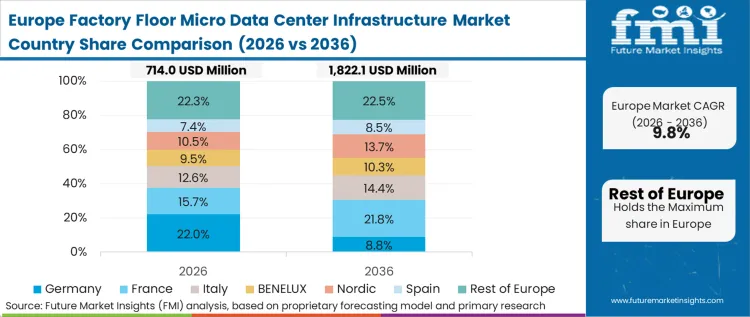
European market dynamics are shaped by stringent energy and data policy mandates, favoring high-efficiency cooling over traditional centralized server waste. Beyond theory, the "Industry 4.0" framework in this region compels manufacturers to deploy localized nodes that satisfy strict carbon-accounting rules. Based on FMI's view, the preference here leans toward low-footprint, "silent" designs that integrate liquid cooled edge data center technologies to minimize environmental impact while maintaining floor-side speed.
- Germany: The German industry is projected to witness growth at a CAGR of 14.0%, as energy efficiency standards transform the shift to liquid-cooled micro-nodes from an IT choice into a financial necessity. To achieve preferred status within EU automotive procurement frameworks, manufacturers are rapidly adopting these localized rugged micro data center for manufacturing units. Companies that act now achieve preferred vendor status in the green-manufacturing procurement frameworks favored by EU brands.
As per FMI’s assessment, Europe’s strategic focus on data sovereignty and environmental sustainability is driving a specialized market for energy-efficient micro-nodes, effectively aligning industrial productivity with the region's climate-neutral goals.
North America Factory-Floor Micro Data Center Infrastructure Market Analysis
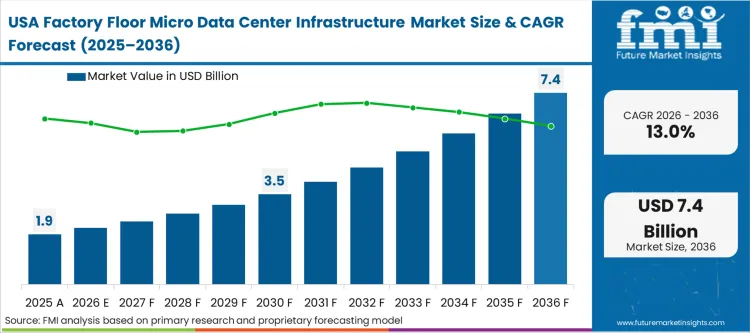
North American adoption is primarily behavior-led, fueled by a resurgence in nearshoring and the construction of massive greenfield plants for semiconductors and electric vehicle batteries. These sites utilize "edge-first" designs, bypassing traditional central data halls for immediate floor-side logic. FMI notes that the competitive intensity is currently centered on "pre-integrated" units that reduce the burden on a limited pool of specialized IT labor, allowing modular data center units to be deployed with minimal on-site configuration.
- United States: Modernization of floor-side analytics in aerospace and automotive plants is driving the United States market toward a CAGR of 13.0%. For buyers in this region, the failure to integrate high-security localized nodes often leads to exclusion from defense contracts that mandate specific data governance. Manufacturers that delay these upgrades face immediate exclusion from high-precision defense contracts that require localized data governance.
- Mexico: Mexican facilities are emerging as highly competitive alternatives to offshore production, often integrating the latest micro mobile data center hardware during initial construction. Sales in Mexico are forecast to register a CAGR of 14.0% through 2036. This positions Mexican facilities as highly competitive alternatives for latency-sensitive electronics.
Per FMI’s reports, North America market embodies the fusion of advanced AI inference and the revitalization of domestic manufacturing is creating a robust, high-security edge environment that serves as a benchmark for industrial modernization.
Competitive Aligners for Market Players
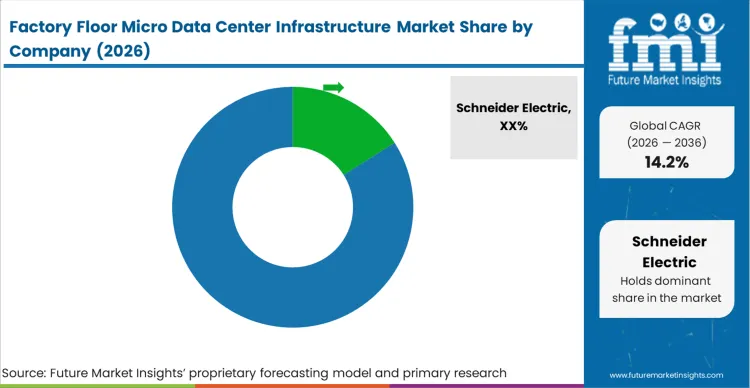
The market's moderate concentration level is structurally tied to the dual requirement of IT expertise and industrial electrical engineering. When performing a Schneider Electric vs Vertiv micro data center comparison, buyers look at the vendor's ability to guarantee uptime in an environment where standard servers would fail. Leading companies hold their position because they own the power path from the transformer to the processor, a structural advantage that pure IT players like Dell or HPE must bridge through partnerships. Qualified vendors are distinguished by their IP-rating certifications and their ability to provide integrated fire suppression within a single cabinet.
Incumbents like Schneider Electric and Rittal GmbH & Co. KG possess a structural advantage in their deep relationships with industrial distributors who handle floor-side installations. A challenger must build more than just a better enclosure; they must build a service network capable of maintaining hardware in diverse industrial zones. One FMI-linked modular data center assessment shows that the most successful challengers are focusing on "application-specific" micro-nodes that come pre-loaded with software, bypassing the general-purpose infrastructure competition.
Buyer power is consolidating as large firms move toward "standardized edge blueprints" to reduce the cost of factory floor micro data center infrastructure over multi-site deployments. This creates a structural tension between buyers wanting open-standard enclosures and dominant vendors incentivized to sell proprietary management ecosystems. Through 2036, the market is expected to remain moderately concentrated as the "physics of the floor", heat and vibration, continue to favor incumbents with deep roots in industrial enclosures. However, the rise of software-defined infrastructure will eventually force a displacement of vendors who cannot offer high-level orchestration alongside physical protection.
Key Players in Factory-Floor Micro Data Center Infrastructure Market
- Schneider Electric
- Vertiv Group Corp.
- Hewlett Packard Enterprise
- Eaton Corporation
- Rittal GmbH & Co. KG
- Siemens AG
- Dell Technologies
Scope of the Report
| Metric | Value |
|---|---|
| Quantitative Units | USD 3.3 billion to USD 12.5 billion, at a CAGR of 14.2% |
| Market Definition | The factory floor micro data center infrastructure required to house and protect compute resources directly within industrial environments. |
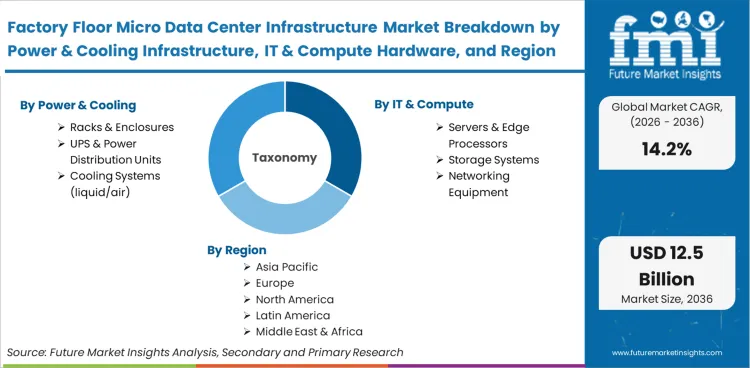
| Power & Cooling Segmentation | UPS & Power Distribution Units, Cooling Systems (liquid/air), Racks & Enclosures |
| IT & Compute Segmentation | Servers & Edge Processors, Storage Systems, Networking Equipment |
| Management Segmentation | Monitoring & Orchestration Platforms, Cybersecurity & Compliance Tools |
| Application Segmentation | Predictive Maintenance & Analytics, Real-Time Process Control, Quality Inspection |
| Regions Covered | North America, Latin America, Europe, East Asia, South Asia, Oceania, Middle East & Africa |
| Countries Covered | China, India, USA, Germany, Japan, South Korea, Mexico, and 40 plus countries |
| Key Companies Profiled | Schneider Electric, Vertiv Group Corp., HPE, Eaton, Rittal, Siemens, Dell |
| Forecast Period | 2026 to 2036 |
| Approach | FMI utilized a supply-side analysis of enclosure shipments combined with primary interviews of floor-level OT architects. |
Source: Future Market Insights (FMI) analysis, based on proprietary forecasting model and primary research
Segments
Power & Cooling Infrastructure:
- UPS & Power Distribution Units
- Cooling Systems (liquid/air)
- Racks & Enclosures
IT & Compute Hardware:
- Servers & Edge Processors
- Storage Systems
- Networking Equipment
Management & Security Software:
- Monitoring & Orchestration Platforms
- Cybersecurity & Compliance Tools
Application-Specific Deployments:
- Predictive Maintenance & Analytics
- Real-Time Process Control
- Quality Inspection & Vision Systems
Regions:
- North America
- United States
- Canada
- Latin America
- Brazil
- Mexico
- Europe
- Germany
- United Kingdom
- France
- Italy
- Spain
- Asia-Pacific
- China
- Japan
- South Korea
- India
- Rest of Asia-Pacific
Bibliography
- Guo, J., Zhang, M., Li, Y., Li, C., & Guo, M. (2025, January). A comprehensive survey of micro datacenter: Current technologies and future possibilities. Frontiers in Computer Science.
- Sarikaya, O. M., Kuzay, M., Demirel, E., et al. (2025, February). Energy efficiency enhancement in two European data centers through CFD modeling. Scientific Reports.
- United Nations Industrial Development Organization. (2024, March). World manufacturing production: Quarterly report, Q4 2023. UNIDO Statistics Portal.
- Vertiv Group Corp. (2024, February). 2024 annual report.
- Schneider Electric SE. (2024, February). Full year 2024 results and investor presentation.
- National Institute of Standards and Technology. (2025, November). Manufacturing cyber-physical systems framework update. NIST Special Publication.
- International Energy Agency. (2025, January). Data centres and energy: Outlook 2025. IEA.
- Deloitte. (2025, January). 2025 Smart manufacturing and operations survey: Navigating challenges to implementation. Deloitte Insights.
- European Telecommunications Standards Institute. (2024, April). Multi-access edge computing (MEC) industrial use cases. ETSI GR MEC.
- International Organization for Standardization. (2025). ISO/IEC 21836:2024 Information technology. Data centres. Server energy efficiency.
This bibliography is provided for reader reference. The full FMI report contains the complete reference list with primary source documentation.
This Report Addresses
- Market intelligence to support strategic decision making across localized cooling systems, NEMA-rated enclosures, and industrial UPS hardware
- Market size estimation and 10-year revenue forecasts from 2026 to 2036, supported by shop-floor enclosure shipment volume tracking
- Growth opportunity mapping across automotive, electronics, and semiconductor manufacturing with emphasis on the transition to integrated edge-AI fabrics
- Segment and regional revenue forecasts covering liquid-cooled nodes across high-ambient temperature zones in China and Mexico
- Competition strategy assessment including power-to-processor integration, IP-rating certification, and industrial-channel reach
- Product development tracking including GPU-optimized edge chassis, closed-loop cooling manifolds, and NEMA-12 compliant micro-racks
- Market access analysis covering Industry 4.0 policy frameworks, data residency laws, and industrial electrical safety standards
- Market report delivery in PDF, Excel, PPT, and interactive dashboard formats for executive strategy, greenfield facility planning, and operational benchmarking use
Frequently Asked Questions
What is factory floor micro data center technology and why do manufacturers need one?
A factory floor micro data center infrastructure is a self-contained, ruggedized IT environment that houses compute hardware directly on the production floor to ensure real-time data processing for automated systems and quality vision cameras.
What will the market be valued at by 2036?
The market is projected to reach USD 12.5 billion by 2036, reflecting a global industrial shift toward decentralizing compute to support high-bandwidth AI at the machine level.
What is the forecast CAGR for factory-floor micro data center market to 2036?
A CAGR of 14.2% is expected, driven by capital-intensive factory refresh cycles where manufacturers replace fragmented gateways with managed micro-nodes to improve operational resilience.
Which segment leads the micro data center power cooling infrastructure market?
Racks & Enclosures lead with a 42.0% share because the physical housing is the most critical component for ensuring a rugged micro data center for manufacturing can survive harsh shop-floor conditions.
Who manufactures factory floor micro data centers for major industrial players?
Top suppliers micro data center industrial leaders include Schneider Electric, Vertiv Group Corp., and Rittal GmbH & Co. KG, who offer integrated power and cooling solutions that traditional IT vendors cannot match alone.
Which countries are growing fastest for factory micro data center adoption?
China and India are leading the growth, with the factory floor micro data center China market expanding at 18.0% CAGR and India factory micro data center growth following at 17.0%.
How do micro data centers support predictive maintenance in manufacturing?
A predictive maintenance micro data center application strategy utilizes localized compute to process high-frequency vibration and heat data from floor sensors to identify potential machine failures before they occur.
What are the biggest challenges deploying micro data centers on factory floors?
The primary challenges deploying micro data center factory units include managing extreme heat without clean-room HVAC and overcoming the organizational friction between IT and OT departments.
How much does a factory-floor micro data center cost and what is the ROI?
While the cost of factory floor micro data center infrastructure is significant, most firms see a full ROI within two years through optimized line throughput and the elimination of wide-area network latency.
What is the micro data center regulatory compliance industrial requirement for Europe?
In Europe, stringent carbon-accounting laws have established micro data center energy efficiency factory standards that prioritize localized, closed-loop cooling to minimize the industrial compute carbon footprint.
What is the difference between a micro data center vs traditional data center manufacturing setup?
A micro data center for manufacturing is physically hardened and deployed directly in the industrial zone to provide the low latency required for real-time robotic control, unlike traditional remote data centers.
How do micro data centers integrate with existing PLC and IIoT systems?
Modern micro-nodes use specialized micro DC management software to act as an orchestration layer, aggregating raw sensor data and converting it into actionable process adjustments for connected PLCs.
Preview the report firsthand - request a free sample
Get SampleGet the brochure for pricing and purchase details.
Get PDFTable of Content
- Key Takeaways
- Market Size and CAGR
- Top Growth Driver
- Fastest Growing Segment
- Leading Region
- Key Companies
- Emerging Opportunities
- Executive Summary
- Global Market Outlook
- Demand-side Trends
- Supply-side Trends
- Technology Roadmap Analysis
- Analysis and Recommendations
- Analyst Perspective (What is happening? Why now? What should investors know?)
- Key Questions Answered
- How large is the market?
- What is the CAGR?
- What are key trends?
- Which region dominates?
- Who are the leaders?
- Market Overview
- Market Coverage / Taxonomy
- Market Definition / Scope / Limitations
- Research Methodology
- Chapter Orientation
- Analytical Lens and Working Hypotheses
- Market Structure, Signals, and Trend Drivers
- Benchmarking and Cross-market Comparability
- Market Sizing, Forecasting, and Opportunity Mapping
- Research Design and Evidence Framework
- Desk Research Programme (Secondary Evidence)
- Expert Input and Fieldwork (Primary Evidence)
- Tooling, Models, and Reference Databases
- Data Engineering and Model Build
- Quality Assurance and Audit Trail
- Market Background
- Market Dynamics (Drivers, Restraints, Opportunity, Trends)
- Scenario Forecast (Optimistic, Likely, Conservative)
- Impact Analysis
- AI Impact
- Sustainability Impact
- Regulatory Impact
- Technology Impact
- Consumer / Buyer Analysis
- Purchase Drivers
- Adoption Barriers
- Buyer Journey
- Opportunity Map Analysis
- Product Life Cycle Analysis
- Supply Chain Analysis
- Investment Feasibility Matrix
- Value Chain Analysis
- PESTLE and Porter's Analysis
- Regulatory Landscape
- Regional Parent Market Outlook
- Production and Consumption Statistics
- Import and Export Statistics
- Global Market Analysis and Forecast, 2021 to 2036
- Historical Market Size Value (USD Billion) Analysis, 2021 to 2025
- Current and Future Market Size Value (USD Billion) Projections, 2026 to 2036
- Y-o-Y Growth Trend Analysis
- Absolute $ Opportunity Analysis
- Global Market Pricing Analysis, 2021 to 2036
- Global Market Analysis and Forecast, By Power & Cooling Infrastructure, 2021 to 2036
- Introduction / Key Findings
- Historical Market Size Value (USD Billion) Analysis By Power & Cooling Infrastructure, 2021 to 2025
- Current and Future Market Size Value (USD Billion) Analysis and Forecast By Power & Cooling Infrastructure, 2026 to 2036
- Racks & Enclosures
- Cooling Systems (liquid/air)
- UPS & Power Distribution Units
- Racks & Enclosures
- Y-o-Y Growth Trend Analysis By Power & Cooling Infrastructure, 2021 to 2025
- Absolute $ Opportunity Analysis By Power & Cooling Infrastructure, 2026 to 2036
- Global Market Analysis and Forecast, By IT & Compute Hardware, 2021 to 2036
- Introduction / Key Findings
- Historical Market Size Value (USD Billion) Analysis By IT & Compute Hardware, 2021 to 2025
- Current and Future Market Size Value (USD Billion) Analysis and Forecast By IT & Compute Hardware, 2026 to 2036
- Servers & Edge Processors
- Storage Systems
- Networking Equipment
- Servers & Edge Processors
- Y-o-Y Growth Trend Analysis By IT & Compute Hardware, 2021 to 2025
- Absolute $ Opportunity Analysis By IT & Compute Hardware, 2026 to 2036
- Global Market Analysis and Forecast, By Management & Security Software, 2021 to 2036
- Introduction / Key Findings
- Historical Market Size Value (USD Billion) Analysis By Management & Security Software, 2021 to 2025
- Current and Future Market Size Value (USD Billion) Analysis and Forecast By Management & Security Software, 2026 to 2036
- Monitoring & Orchestration Platforms
- Cybersecurity & Compliance Tools
- Monitoring & Orchestration Platforms
- Y-o-Y Growth Trend Analysis By Management & Security Software, 2021 to 2025
- Absolute $ Opportunity Analysis By Management & Security Software, 2026 to 2036
- Global Market Analysis and Forecast, By Application-Specific Deployments, 2021 to 2036
- Introduction / Key Findings
- Historical Market Size Value (USD Billion) Analysis By Application-Specific Deployments, 2021 to 2025
- Current and Future Market Size Value (USD Billion) Analysis and Forecast By Application-Specific Deployments, 2026 to 2036
- Predictive Maintenance & Analytics
- Real-Time Process Control
- Quality Inspection & Vision Systems
- Predictive Maintenance & Analytics
- Y-o-Y Growth Trend Analysis By Application-Specific Deployments, 2021 to 2025
- Absolute $ Opportunity Analysis By Application-Specific Deployments, 2026 to 2036
- Global Market Analysis and Forecast, By Region, 2021 to 2036
- Introduction
- Historical Market Size Value (USD Billion) Analysis By Region, 2021 to 2025
- Current Market Size Value (USD Billion) Analysis and Forecast By Region, 2026 to 2036
- North America
- Latin America
- Western Europe
- Eastern Europe
- East Asia
- South Asia and Pacific
- Middle East & Africa
- Market Attractiveness Analysis By Region
- North America Market Analysis and Forecast, By Country, 2021 to 2036
- Historical Market Size Value (USD Billion) Trend Analysis By Market Taxonomy, 2021 to 2025
- Market Size Value (USD Billion) Forecast By Market Taxonomy, 2026 to 2036
- By Country
- USA
- Canada
- By Power & Cooling Infrastructure
- By IT & Compute Hardware
- By Management & Security Software
- By Application-Specific Deployments
- By Country
- Market Attractiveness Analysis
- By Country
- By Power & Cooling Infrastructure
- By IT & Compute Hardware
- By Management & Security Software
- By Application-Specific Deployments
- Key Takeaways
- Latin America Market Analysis and Forecast, By Country
- Historical Market Size Value (USD Billion) Trend Analysis By Market Taxonomy, 2021 to 2025
- Market Size Value (USD Billion) Forecast By Market Taxonomy, 2026 to 2036
- By Country
- Brazil
- Mexico
- Chile
- Rest of Latin America
- By Power & Cooling Infrastructure
- By IT & Compute Hardware
- By Management & Security Software
- By Application-Specific Deployments
- By Country
- Market Attractiveness Analysis
- By Country
- By Power & Cooling Infrastructure
- By IT & Compute Hardware
- By Management & Security Software
- By Application-Specific Deployments
- Key Takeaways
- Western Europe Market Analysis and Forecast, By Country
- Historical Market Size Value (USD Billion) Trend Analysis By Market Taxonomy, 2021 to 2025
- Market Size Value (USD Billion) Forecast By Market Taxonomy, 2026 to 2036
- By Country
- Germany
- UK
- Italy
- Spain
- France
- Nordic
- BENELUX
- Rest of Western Europe
- By Power & Cooling Infrastructure
- By IT & Compute Hardware
- By Management & Security Software
- By Application-Specific Deployments
- By Country
- Market Attractiveness Analysis
- By Country
- By Power & Cooling Infrastructure
- By IT & Compute Hardware
- By Management & Security Software
- By Application-Specific Deployments
- Key Takeaways
- Eastern Europe Market Analysis and Forecast, By Country
- Historical Market Size Value (USD Billion) Trend Analysis By Market Taxonomy, 2021 to 2025
- Market Size Value (USD Billion) Forecast By Market Taxonomy, 2026 to 2036
- By Country
- Russia
- Poland
- Hungary
- Balkan & Baltic
- Rest of Eastern Europe
- By Power & Cooling Infrastructure
- By IT & Compute Hardware
- By Management & Security Software
- By Application-Specific Deployments
- By Country
- Market Attractiveness Analysis
- By Country
- By Power & Cooling Infrastructure
- By IT & Compute Hardware
- By Management & Security Software
- By Application-Specific Deployments
- Key Takeaways
- East Asia Market Analysis and Forecast, By Country
- Historical Market Size Value (USD Billion) Trend Analysis By Market Taxonomy, 2021 to 2025
- Market Size Value (USD Billion) Forecast By Market Taxonomy, 2026 to 2036
- By Country
- China
- Japan
- South Korea
- By Power & Cooling Infrastructure
- By IT & Compute Hardware
- By Management & Security Software
- By Application-Specific Deployments
- By Country
- Market Attractiveness Analysis
- By Country
- By Power & Cooling Infrastructure
- By IT & Compute Hardware
- By Management & Security Software
- By Application-Specific Deployments
- Key Takeaways
- South Asia and Pacific Market Analysis and Forecast, By Country
- Historical Market Size Value (USD Billion) Trend Analysis By Market Taxonomy, 2021 to 2025
- Market Size Value (USD Billion) Forecast By Market Taxonomy, 2026 to 2036
- By Country
- India
- ASEAN
- Australia & New Zealand
- Rest of South Asia and Pacific
- By Power & Cooling Infrastructure
- By IT & Compute Hardware
- By Management & Security Software
- By Application-Specific Deployments
- By Country
- Market Attractiveness Analysis
- By Country
- By Power & Cooling Infrastructure
- By IT & Compute Hardware
- By Management & Security Software
- By Application-Specific Deployments
- Key Takeaways
- Middle East & Africa Market Analysis and Forecast, By Country
- Historical Market Size Value (USD Billion) Trend Analysis By Market Taxonomy, 2021 to 2025
- Market Size Value (USD Billion) Forecast By Market Taxonomy, 2026 to 2036
- By Country
- Kingdom of Saudi Arabia
- Other GCC Countries
- Türkiye
- South Africa
- Other African Union
- Rest of Middle East & Africa
- By Power & Cooling Infrastructure
- By IT & Compute Hardware
- By Management & Security Software
- By Application-Specific Deployments
- By Country
- Market Attractiveness Analysis
- By Country
- By Power & Cooling Infrastructure
- By IT & Compute Hardware
- By Management & Security Software
- By Application-Specific Deployments
- Key Takeaways
- Key Countries Market Analysis
- USA
- Pricing Analysis
- Market Share Analysis, 2025
- By Power & Cooling Infrastructure
- By IT & Compute Hardware
- By Management & Security Software
- By Application-Specific Deployments
- Canada
- Pricing Analysis
- Market Share Analysis, 2025
- By Power & Cooling Infrastructure
- By IT & Compute Hardware
- By Management & Security Software
- By Application-Specific Deployments
- Mexico
- Pricing Analysis
- Market Share Analysis, 2025
- By Power & Cooling Infrastructure
- By IT & Compute Hardware
- By Management & Security Software
- By Application-Specific Deployments
- Brazil
- Pricing Analysis
- Market Share Analysis, 2025
- By Power & Cooling Infrastructure
- By IT & Compute Hardware
- By Management & Security Software
- By Application-Specific Deployments
- Chile
- Pricing Analysis
- Market Share Analysis, 2025
- By Power & Cooling Infrastructure
- By IT & Compute Hardware
- By Management & Security Software
- By Application-Specific Deployments
- Germany
- Pricing Analysis
- Market Share Analysis, 2025
- By Power & Cooling Infrastructure
- By IT & Compute Hardware
- By Management & Security Software
- By Application-Specific Deployments
- UK
- Pricing Analysis
- Market Share Analysis, 2025
- By Power & Cooling Infrastructure
- By IT & Compute Hardware
- By Management & Security Software
- By Application-Specific Deployments
- Italy
- Pricing Analysis
- Market Share Analysis, 2025
- By Power & Cooling Infrastructure
- By IT & Compute Hardware
- By Management & Security Software
- By Application-Specific Deployments
- Spain
- Pricing Analysis
- Market Share Analysis, 2025
- By Power & Cooling Infrastructure
- By IT & Compute Hardware
- By Management & Security Software
- By Application-Specific Deployments
- France
- Pricing Analysis
- Market Share Analysis, 2025
- By Power & Cooling Infrastructure
- By IT & Compute Hardware
- By Management & Security Software
- By Application-Specific Deployments
- India
- Pricing Analysis
- Market Share Analysis, 2025
- By Power & Cooling Infrastructure
- By IT & Compute Hardware
- By Management & Security Software
- By Application-Specific Deployments
- ASEAN
- Pricing Analysis
- Market Share Analysis, 2025
- By Power & Cooling Infrastructure
- By IT & Compute Hardware
- By Management & Security Software
- By Application-Specific Deployments
- Australia & New Zealand
- Pricing Analysis
- Market Share Analysis, 2025
- By Power & Cooling Infrastructure
- By IT & Compute Hardware
- By Management & Security Software
- By Application-Specific Deployments
- China
- Pricing Analysis
- Market Share Analysis, 2025
- By Power & Cooling Infrastructure
- By IT & Compute Hardware
- By Management & Security Software
- By Application-Specific Deployments
- Japan
- Pricing Analysis
- Market Share Analysis, 2025
- By Power & Cooling Infrastructure
- By IT & Compute Hardware
- By Management & Security Software
- By Application-Specific Deployments
- South Korea
- Pricing Analysis
- Market Share Analysis, 2025
- By Power & Cooling Infrastructure
- By IT & Compute Hardware
- By Management & Security Software
- By Application-Specific Deployments
- Russia
- Pricing Analysis
- Market Share Analysis, 2025
- By Power & Cooling Infrastructure
- By IT & Compute Hardware
- By Management & Security Software
- By Application-Specific Deployments
- Poland
- Pricing Analysis
- Market Share Analysis, 2025
- By Power & Cooling Infrastructure
- By IT & Compute Hardware
- By Management & Security Software
- By Application-Specific Deployments
- Hungary
- Pricing Analysis
- Market Share Analysis, 2025
- By Power & Cooling Infrastructure
- By IT & Compute Hardware
- By Management & Security Software
- By Application-Specific Deployments
- Kingdom of Saudi Arabia
- Pricing Analysis
- Market Share Analysis, 2025
- By Power & Cooling Infrastructure
- By IT & Compute Hardware
- By Management & Security Software
- By Application-Specific Deployments
- Türkiye
- Pricing Analysis
- Market Share Analysis, 2025
- By Power & Cooling Infrastructure
- By IT & Compute Hardware
- By Management & Security Software
- By Application-Specific Deployments
- South Africa
- Pricing Analysis
- Market Share Analysis, 2025
- By Power & Cooling Infrastructure
- By IT & Compute Hardware
- By Management & Security Software
- By Application-Specific Deployments
- USA
- Market Structure Analysis
- Competition Dashboard
- Competition Benchmarking
- Market Share Analysis of Top Players
- By Regional
- By Power & Cooling Infrastructure
- By IT & Compute Hardware
- By Management & Security Software
- By Application-Specific Deployments
- Emerging Startups
- Innovation Benchmarking
- Competition Analysis
- Competition Deep Dive
- Schneider Electric
- Overview
- Product Portfolio
- Profitability by Market Segments
- Sales Footprint
- Strategy Overview
- Marketing Strategy
- Product Strategy
- Channel Strategy
- Vertiv Group Corp.
- Hewlett Packard Enterprise
- Eaton Corporation
- Rittal GmbH & Co. KG
- Siemens AG
- Dell Technologies
- Schneider Electric
- Case Studies
- Success Stories
- Recent Developments
- Competition Deep Dive
- Assumptions & Acronyms Used


