

- Market Size (2026)
- USD 364.5 Mn
- Forecast (2036)
- USD 989.4 Mn
- CAGR (2026 to 2036)
- 10.5%
How big is Cardiometabolic Protein Nutrition Market in 2026?
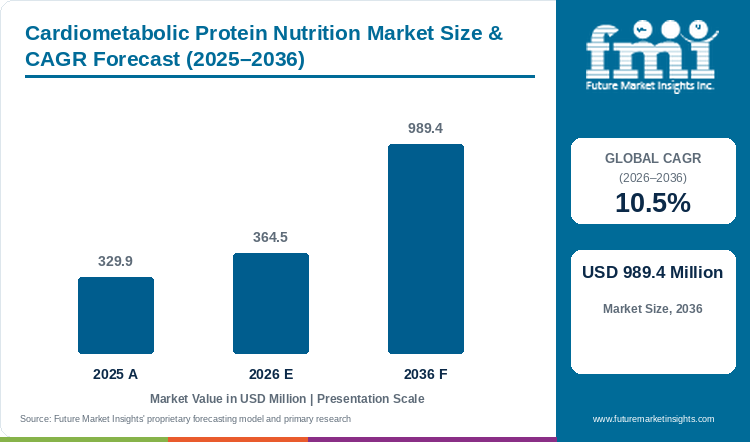
Demand for cardiometabolic protein nutrition is projected to expand at 10.5% CAGR between 2026 and 2036. Industry value grows from USD 329.9 million in 2025 to USD 364.5 million in 2026 and is projected to reach USD 989.4 million by 2036.
Consumers managing weight, blood sugar and cholesterol compare protein, fiber, sugar and saturated fat before adding nutrition products into regular diet. In 2026, CDC reported 40.1 million Americans with diabetes and 115.2 million adults with prediabetes. Shakes, powders and snacks having fixed servings are therefore likely to support repeat consumption. According to FMI, cardiometabolic protein nutrition market rises from USD 329.9 million in 2025 to USD 364.5 million in 2026 and is anticipated to reach USD 989.4 million by 2036 at 10.5% CAGR.[1] This is expected to improve demand for clinical nutrition products having a clear metabolic purpose.
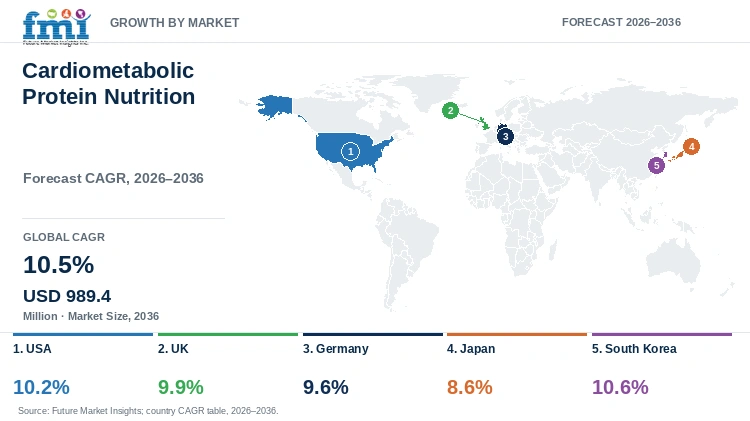
Digital purchase and weight-management participation support South Korean adoption, while wider pharmacy, supermarket and direct-to-consumer availability supports the USA. South Korea is estimated to rise at 10.6% CAGR during 2026 to 2036, compared with 10.2% in the USA. South Korea reported 34.4% adult obesity and 65% participation in weight control during 2025.[2] Portioned products can create growth avenues through digital channels, whereas the established diabetes population will upkeep USA demand. FMI analysis finds buyer preference moving towards products where sugar, fat, fiber and serving quantity are easier to compare. Taste and price can still impede regular use.
Key Takeaways
- Rising attention towards diabetes, obesity and cardiovascular conditions is boosting demand for protein products having controlled sugar, saturated fat, fiber and serving size.
- Based on product type, heart-smart protein shakes are projected to account for 44.8% in 2026, owing to easy consumption and availability of measured nutrition in one serving.
- By protein source, plant blends are estimated to hold 49.6% in 2026, supported by plant-based preference and flexibility in combining protein, fiber, taste and texture.
- In 2026, cholesterol management is expected to lead health claim focus with 48.8% share, driven by consumer comparison of saturated fat, fiber and added sugar.
- South Korea is projected to expand at 10.6% CAGR and the USA at 10.2% CAGR through 2036, owing to different retail and weight-management adoption patterns.
- Notable companies include Abbott, Nestle Health Science, Danone, Huel, OWYN, Premier Protein, Quest Nutrition, Orgain, and Supergut.
Analyst Perspective
“I see better adoption for products where sugar, fat, fiber and serving quantity are understood without difficult comparison. Products developed for one cardiometabolic requirement will gain higher preference than those carrying several broad wellness claims.”
- Nandini Roy Choudhury, Principal Consultant, Future Market Insights.
How is the cardiometabolic protein nutrition market segmented?
Cardiometabolic protein nutrition market is segmented by product type, protein source, health claim focus, form, sales channel, and region. In 2026, heart-smart protein shakes are projected to hold 44.8%, plant blends 49.6%, cholesterol management 48.8%, RTD 49.8%, and online or DTC 41.5%.
Cardiometabolic protein nutrition market is segmented by product type, protein source, health claim focus, form, sales channel, and region.
By product type: heart-smart protein shakes, low-GI high-protein powders, plant protein with sterols or fiber, protein snacks, and others.
By protein source: plant blends, whey and milk, soy, and others.
By health claim focus: cholesterol management, glycemic control, blood pressure support, and others.
By form: RTD, powders, and bars and snacks.
By sales channel: online or DTC, retail pharmacy, supermarkets and hypermarkets, specialty and health stores, and others.
By region: North America, Latin America, Western Europe, Eastern Europe, East Asia, South Asia and Pacific, and Middle East and Africa.
Why do heart-smart protein shakes remain relevant within product type?
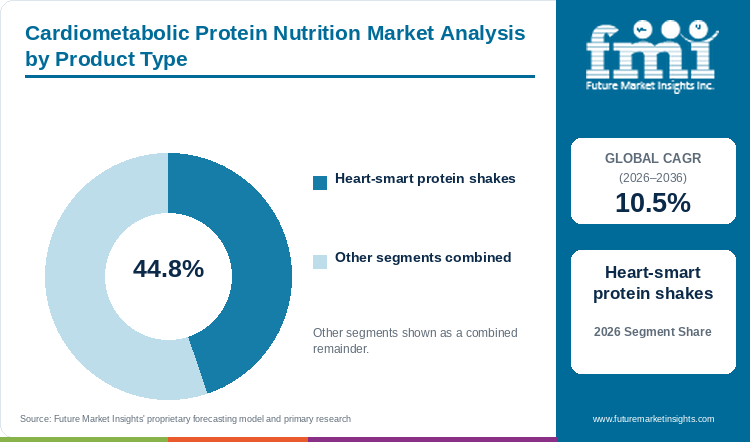
Based on product type, heart-smart protein shakes are projected to account for 44.8% in 2026, owing to one-step consumption and measured nutrition in every serving.
Heart-smart protein shakes provide protein, sugar, saturated fat, fiber and calories in one ready serving, which is increasing their adoption among consumers following planned nutrition routines. These products do not require mixing and can also be carried to workplace, travel and other regular activities. In November 2025, Abbott launched advanced Ensure Diabetes Care with high protein, high fiber and a low-glycemic carbohydrate blend.[3] The formula is developed for blood sugar, cholesterol and weight management, due to which similar plant-based protein beverages and nutritional shakes are expected to witness increasing use in cardiometabolic nutrition.
- Heart-smart protein shakes are projected to hold 44.8% of product type demand in 2026, as fixed portions provide protein and related nutrients without mixing or measuring.
- Ready servings are likely to gain better preference where consumers need the same nutrition quantity during every use.
What supports plant blends as a preferred protein source choice?
By protein source, plant blends are estimated to hold 49.6% in 2026, supported by source flexibility and lower saturated-fat formulation possibilities.
Plant-based diets have gained popularity among vegan, flexitarian and dairy-avoiding consumers, which is encouraging the use of pea, soy and other vegan protein sources. Blending more than one source allows manufacturers to work on amino-acid profile, fiber, taste and texture according to the product requirement. In September 2026, Danone completed the acquisition of Huel, adding plant-based powders, RTD shakes, bars and functional beverages to its nutrition portfolio.[4] Expansion of such complete nutrition formats is expected to increase the availability of plant blends through digital and retail channels.
- Plant blends are estimated to hold 49.6% of protein source demand in 2026, as combining multiple sources improves formulation choices for manufacturers.
- Use of pea, soy and other plant proteins also supports products developed for vegan, flexitarian and dairy-avoiding consumers.
How does cholesterol management shape health claim demand?
In 2026, cholesterol management is expected to lead health claim focus with 48.8% share, owing to increasing comparison of saturated fat, fiber and added sugar.
Consumers managing cholesterol are generally required to observe saturated fat, fiber, sodium and added sugar, which makes the nutrition label important during purchase. The U.S. FDA made its updated healthy claim effective from April 28, 2025 and qualifying products are required to meet limits for saturated fat, sodium and added sugars.[5] As per the analysis from FMI, this is expected to increase demand for functional foods where formulation and health claim are clearly connected. Products having unclear or broad wellness claims can face lower acceptance when nutrient information does not support the stated purpose.
- Cholesterol management is estimated to represent 48.8% of health claim demand in 2026, as important nutrient limits can be compared directly on pack.
- Products carrying simple nutrient information are expected to gain better acceptance than products having broad and difficult health claims.
Which operating need keeps RTD formats commercially relevant?
By form, RTD is forecast to represent 49.8% in 2026, driven by no preparation requirement and fixed serving quantity.
RTD protein products eliminate mixing, measuring and preparation, due to which they can be consumed during work, travel or alongside everyday sports nutrition routines. Fixed serving quantity also helps consumers compare protein, sugar and calories without changing the preparation each time. In April 2025, Simply Good Foods reported around 52% point-of-sale growth for OWYN during its fiscal second quarter.[6] This growth shows rising retail interest for plant-based shakes where convenience and low-sugar positioning are provided together.
- RTD is forecast to hold 49.8% of form demand in 2026, as ready consumption supports regular use at home, workplace and during travel.
- Availability across supermarkets, pharmacies and online channels is expected to further support the adoption of ready-to-drink protein products.
Why does online or DTC retain a notable sales position?
Online or DTC is set to lead the sales channel with 41.5% share in 2026, influenced by detailed product information and repeat home delivery.
Cardiometabolic nutrition products require more information related to ingredients, serving routine, sugar, fat and fiber than ordinary specialized nutrition lines. Digital platforms can provide this information before purchase and can also support subscription or repeat delivery. In January 2026, Huel reported in its annual financial filing that online and direct-to-consumer subscription orders accounted for over 70% of total revenue across the UK, Europe, and the USA.[7] FMI research indicates that online channels will remain important for products consumed daily or weekly, as education, ordering and replenishment can take place through the same platform.
- Online or DTC is projected to hold 41.5% of sales in 2026, as product information, purchase and repeat delivery are available through one channel.
- Consumers can compare ingredients and serving information before purchase, while subscriptions support regular delivery of frequently consumed products.
What are the drivers, restraints, and opportunities in the cardiometabolic protein nutrition market?
Increasing diabetes, obesity and cardiovascular risk is driving the market, while availability of ordinary protein foods restricts premium adoption. Development of protein products with fiber, low-GI ingredients and controlled sugar is expected to create growth opportunities.
- Driver: Rising diabetes, obesity and weight-management requirements are increasing attention towards protein products having controlled sugar and saturated fat.
- Restraint: Eggs, dairy, legumes and general protein products can meet regular protein needs at lower cost, which restricts premium product adoption.
- Opportunity: Products combining protein, fiber, low-GI carbohydrates and controlled sugar are expected to create wider growth opportunities.
Risk Management Expands Protein Use
Diabetes, obesity and cardiovascular risk are becoming part of everyday food decisions for a large consumer population. In January 2026, the American Heart Association reported that cardiovascular disease and related metabolic conditions account for over 930,000 U.S. deaths annually, with obesity affecting more than 40% of adults.[8] This is creating demand for medical food formats, shakes, powders and snacks that provide protein with controlled sugar, saturated fat, fiber and calories in one serving. However, products promoted only for high protein can receive lower preference when the remaining nutrition information does not support the intended metabolic use.
Ordinary Foods Limit Premium Conversion
Eggs, dairy, legumes, and conventional whey protein ingredients provide familiar and lower-cost options for meeting daily protein requirements. Germany’s Federal Centre for Nutrition states that healthy adults generally require 0.8 grams of protein per kilogram of body weight and usually do not require high-protein products.[9] This availability restricts consumers from paying more only for protein quantity. Cardiometabolic products will therefore need to provide an additional benefit related to controlled sugar, saturated fat, fiber or portion size.
Evidence-Led Formulation Opens Value
Protein products can create wider use beyond fitness when they combine prebiotic fiber, low-glycemic carbohydrates and controlled sugar in a convenient serving. In April 2025, the European Food Safety Authority published scientific guidance on low-glycemic carbohydrate and dietary fiber formulations for metabolic glucose regulation.[10] FMI data suggests that similar formulations can gain demand when the nutrition purpose is easy to understand and the product does not require difficult preparation. Development of shakes, powders and snacks for one clear metabolic requirement can therefore create growth opportunities across healthcare, retail and online channels.
Which country CAGRs are profiled in the cardiometabolic protein nutrition market?
| Country | CAGR |
|---|---|
| USA | 10.2% |
| UK | 9.9% |
| Germany | 9.6% |
| Japan | 8.6% |
| South Korea | 10.6% |
How do country-level CAGRs compare in the cardiometabolic protein nutrition market?
According to FMI, country growth rates differ through 2036 because lifestyle patterns, healthcare initiatives, and retail distribution channels are not uniform across markets. South Korea and the USA lead projected growth above 10.1 per cent, while Japan, Germany, and the UK follow distinct dietary and regulatory structures.
- The USA demand gains from high prediabetes and diabetes prevalence alongside established direct-to-consumer and retail pharmacy distribution.
- The UK combines structured national diabetes prevention initiatives with expanding public awareness of dietary sugar and saturated fat.
- Germany emphasizes clinical nutrition guidance, portioned nutritional profiles, and balanced whole-food dietary integration.
- Japan prioritizes stringent functional food labeling, health ministry monitoring, and portion-controlled wellness products.
- South Korea benefits from high consumer engagement in weight management and rapid discovery across digital commerce platforms.
Full report country CAGRs cover: North America; Latin America; Western Europe; Eastern Europe; East Asia; South Asia and Pacific; Middle East and Africa.
Country-wise Analysis
- Cardiometabolic protein nutrition demand in the USA is forecast to rise at 10.2% CAGR over the forecast period, owing to a large diabetes and prediabetes population. In September 2026, the National Center for Health Statistics reported that adults with type 2 diabetes accounted for 13.8 million outpatient health center visits, with overweight or obesity present in over 85% of cases.[11] Wide availability through pharmacies, supermarkets and DTC channels is expected to support the sales of vegan protein powder options, controlled-serving shakes, and snacks. Products showing a clear difference in sugar, saturated fat, fiber and calories are likely to gain higher preference in the crowded U.S. protein nutrition market.
- Adoption of cardiometabolic protein nutrition in the UK is estimated to expand at 9.9% CAGR through 2036, supported by structured diabetes prevention and weight-management programs. In December 2025, NHS England reported that nearly one million people had started its diabetes prevention scheme.[12] Completion of the program reduced type 2 diabetes risk by 37% and participants lost 3.3 kilograms on average. Such programs are expected to increase the use of portioned nutrition products that can be added into regular diet and behavior-change routines.
- Germany is estimated to post 9.6% CAGR over the forecast period, owing to increasing overweight population and demand for controlled nutrition products. In March 2025, Destatis reported that 54% of German adults were overweight, compared with 53% across the EU.[13] However, consumers can meet regular protein requirements through dairy, eggs and legumes, which increases price comparison with specialist products. Products having controlled sugar, saturated fat, fiber and fixed serving size are expected to witness better adoption than products promoted only for high protein.
- The cardiometabolic protein nutrition sector in Japan is projected to record 8.6% CAGR during the assessment period, supported by increasing diabetes concerns and regular nutrition monitoring. In December 2025, Japan’s health ministry reported that around 11 million people were strongly suspected of having diabetes and around 7 million people could not be ruled out.[14] An FMI analyst notes that this consumer base is expected to support measured demand for portioned protein products, while local claim requirements and preference for suitable serving sizes will continue to influence product adoption.
- By 2036, South Korea is projected to grow at 10.6% CAGR, owing to high participation in weight management and increasing discovery of nutrition products through digital channels. In September 2025, the Korean Society for the Study of Obesity reported in its 2025 Obesity Fact Sheet that adult abdominal obesity reached 24.5%, with obesity raising type 2 diabetes risk by 2.6 times.[15] This is increasing comparison of protein, sugar, calories and serving convenience. Products developed for one clear metabolic requirement and supported by easy repeat ordering are expected to witness higher demand.
Who are the notable companies in the cardiometabolic protein nutrition market?
Abbott, Nestle Health Science, Danone, Huel, OWYN, Premier Protein, Quest Nutrition, Orgain, and Supergut are notable companies profiled in this market.
Cardiometabolic protein nutrition market includes medical nutrition companies, consumer protein brands and plant-based nutrition businesses. Abbott and Nestle Health Science provide adult and medical nutrition products, while Danone is expanding its specialized and functional nutrition presence. Premier Protein, OWYN and Quest Nutrition offer shakes, bars, snacks and powders through retail channels. Huel has a strong digital and retail model, whereas Orgain and Supergut are focused on plant-based and fiber-led products. In the FMI report, company presence is linked with formulation purpose, product format and the channels through which consumers can purchase the product regularly.
- Medical and specialized nutrition providers: Abbott and Nestle Health Science provide adult formulation platforms and clinical nutrition lines.
- Functional and complete nutrition platforms: Danone and Huel combine plant-based powders, RTD shakes, and direct-to-consumer delivery.
- Consumer protein and metabolic specialists: Premier Protein, OWYN, Quest Nutrition, Orgain, and Supergut offer targeted convenience and fiber-led nutrition.
Competitive Benchmarking: Cardiometabolic Protein Nutrition Market
| Company | Formulation depth | Format flexibility | Target specificity | Reach |
|---|---|---|---|---|
| Abbott | High | High | High | High |
| Nestle Health Science | High | High | High | High |
| Danone | High | High | High | High |
| Huel | Medium | High | High | Medium |
| OWYN | Medium | High | High | Medium |
| Premier Protein | Medium | High | Medium | High |
| Quest Nutrition | Medium | High | Medium | High |
| Orgain | Medium | High | Medium | High |
| Supergut | Medium | Medium | High | Medium |
High represents broad public evidence across the stated capability, Medium represents narrower evidence, and Low represents limited documented breadth. These ratings describe public company capability and do not indicate product quality, revenue share or company ranking.
Key Developments in the Cardiometabolic Protein Nutrition Market
- In September 2026, Danone completed its acquisition of Huel, adding plant-based powders, RTD shakes, bars, and functional beverages to its portfolio.
- In July 2026, Orgain introduced its 35g Dairy Free Protein Shake, combining high plant-based protein with zero added sugar for dietary management.[16]
- In January 2026, Quest Nutrition launched a 45-gram high-protein ready-to-drink line with one gram of sugar for metabolic and fitness nutrition.[17]
- In November 2025, Abbott launched advanced Ensure Diabetes Care with high protein, high fiber, and a low-glycemic carbohydrate blend.
Key Players in the Cardiometabolic Protein Nutrition Market
Medical and specialized adult nutrition providers
- Abbott
- Nestle Health Science
Complete and plant-based nutrition platforms
- Danone
- Huel
Targeted protein and metabolic health specialists
- OWYN
- Premier Protein
- Quest Nutrition
- Orgain
- Supergut
Cardiometabolic Protein Nutrition Market - Report Scope
| Coverage field | Report scope |
|---|---|
| Market breakdown | Product type; protein source; health claim focus; form; sales channel; region. |
| Quantitative units | USD million. |
| Market definition | Supplier revenue from branded protein nutrition positioned for cardiometabolic, glycemic, cholesterol, blood-pressure, or weight-management use. Medicines and general sports protein without cardiometabolic positioning are excluded. |
| Regions covered | North America; Latin America; Western Europe; Eastern Europe; East Asia; South Asia and Pacific; Middle East and Africa. |
| Countries covered | USA, UK, Germany, Japan, South Korea, and additional countries in the full report. |
| Key companies profiled | Abbott, Nestle Health Science, Danone, Huel, OWYN, Premier Protein, Quest Nutrition, Orgain, and Supergut. |
| Forecast period | 2026 to 2036. |
| Approach | The Future Market Insights report covers supplier activity, segment structure, application routes, and country adoption conditions within the stated market boundary. |
Cardiometabolic Protein Nutrition Market - Research Methodology
| Method | Approach |
|---|---|
| Primary Research | Analysts gathered input from manufacturers, service providers, technology developers, distributors, end users, procurement teams, and subject-matter experts. Interviews examined purchasing decisions, product evaluation, adoption barriers, approval requirements, pricing, and technical support. |
| Desk Research | Desk research covered government statistics, regulatory publications, trade data, industry associations, technical literature, standards, company filings, product information, and official corporate announcements. Sources were checked for date, geography, and direct market relevance. |
| Market Sizing and Forecasting | The model combined the baseline value with historical performance, segment structure, pricing and volume indicators, adoption levels, company participation, and country demand conditions. Forecast assumptions included regulation, technology use, purchasing cycles, and supply availability. |
| Data Validation | Estimates were checked against public data, company activity, trade patterns, and primary-research findings. Adjacent categories, unsupported claims, overlapping revenue, and activities outside the defined market were excluded. |
Cardiometabolic Protein Nutrition Market by Segments
Cardiometabolic Protein Nutrition Market segmented by Product Type:
- Heart-smart protein shakes
- Low-GI high-protein powders
- Plant protein with sterols or fiber
- Protein snacks
- Others
Cardiometabolic Protein Nutrition Market segmented by Protein Source:
- Plant blends
- Whey and milk
- Soy
- Others
Cardiometabolic Protein Nutrition Market segmented by Health Claim Focus:
- Cholesterol management
- Glycemic control
- Blood pressure support
- Others
Cardiometabolic Protein Nutrition Market segmented by Form:
- RTD
- Powders
- Bars and snacks
Cardiometabolic Protein Nutrition Market segmented by Sales Channel:
- Online or DTC
- Retail pharmacy
- Supermarkets and hypermarkets
- Specialty and health stores
- Others
Cardiometabolic Protein Nutrition Market by Region
- North America
- United States
- Canada
- Latin America
- Brazil
- Mexico
- Argentina
- Chile
- Western Europe
- Germany
- France
- United Kingdom
- Italy
- Spain
- Benelux
- Nordics
- Eastern Europe
- Poland
- Czech Republic
- Romania
- Hungary
- East Asia
- China
- Japan
- South Korea
- South Asia and Pacific
- India
- ASEAN
- Australia and New Zealand
- Middle East and Africa
- GCC Countries
- South Africa
- Türkiye
- Israel
Research Sources and Bibliography
- [1] Centers for Disease Control and Prevention. (2026, September 16). National Diabetes Statistics Report.
- [2] Korea Disease Control and Prevention Agency. (2025, November 25). One in Three Korean Adults Is Obese.
- [3] Abbott. (2025, November 13). Abbott Launches New and Advanced Ensure Diabetes Care.
- [4] Danone. (2026, September 4). Danone Completes Its Acquisition of Huel.
- [5] U.S. Food and Drug Administration. (2025, February 24). FDA Finalizes Updated Healthy Nutrient Content Claim.
- [6] The Simply Good Foods Company. (2025, April 9). Fiscal Second Quarter 2025 Financial Results.
- [7] Huel Limited. (2026, January). Annual Report and Financial Statements for the Year Ended 2025. Companies House.
- [8] American Heart Association. (2026, January 21). 2026 Heart Disease and Stroke Statistics: A Report of US and Global Data From the American Heart Association. Circulation.
- [9] Federal Centre for Nutrition. (2026). Proteine - Baustoffe des Lebens.
- [10] European Food Safety Authority. (2025, April 18). Scientific Opinion on Low-GI Carbohydrate and Dietary Fiber Formulations.
- [11] National Center for Health Statistics. (2026, September 9). Health Center Visits by Adults With Type 2 Diabetes. NCHS Data Brief No. 569.
- [12] NHS England. (2025, December 30). NHS Diabetes Prevention Scheme Helps One Million People.
- [13] Federal Statistical Office of Germany. (2025, March 19). More Than Half of Adults in the EU Are Overweight.
- [14] Ministry of Health, Labour and Welfare, Japan. (2025, December 2). Results of the 2024 National Health and Nutrition Survey.
- [15] Korean Society for the Study of Obesity. (2025, September 4). 2025 Obesity Fact Sheet.
- [16] Orgain. (2026, July 13). 35g Dairy Free Protein Shake Launch.
- [17] Quest Nutrition. (2026, January 9). Quest Nutrition Expands High-Protein RTD Portfolio.
- [18] Premier Protein. (2025, July 1). Premier Protein Launches Almondmilk Non-Dairy Protein Shakes.
- [19] Nestle Health Science. (2026). Nestle Health Science and Nestle Nutrition integration notice.
- [20] MADE Group. (2026, June 21). Strategic Functional Nutrition and Beverage Expansion.
This bibliography is provided for reader reference. The full report contains the complete reference list and detailed citations.
This Report Answers
- What is Cardiometabolic Protein Nutrition Market worth during 2026?
- What value is Cardiometabolic Protein Nutrition Market projected by 2036?
- Which product type holds notable Cardiometabolic Protein Nutrition Market share?
- Which protein source holds notable Cardiometabolic Protein Nutrition Market share?
- Which countries have notable Cardiometabolic Protein Nutrition Market growth?
- Which companies are notable in Cardiometabolic Protein Nutrition Market today?
Frequently Asked Questions
How large is the Cardiometabolic Protein Nutrition Market expected to be in 2026?
The cardiometabolic protein nutrition market is expected to reach USD 364.5 million in 2026 and reach USD 989.4 million by 2036.
What CAGR is forecast for the Cardiometabolic Protein Nutrition Market through 2036?
The cardiometabolic protein nutrition market is projected to grow at a 10.5% CAGR from 2026 to 2036. Growth is supported by increasing adoption of protein products having controlled sugar, saturated fat, fiber and fixed serving size.
Which product type holds a notable cardiometabolic protein nutrition demand share in 2026?
Future Market Insights projects heart-smart protein shakes to hold 44.8% of product type demand in 2026. The segment benefits from easy consumption, measured nutrition, and no mixing requirement.
Which protein source holds a notable cardiometabolic protein nutrition share in 2026?
FMI finds that plant blends will hold 49.6% of protein source demand in 2026. Demand is supported by plant-based preference and wider formulation possibilities for protein, fiber, taste and texture.
Which country has a notable cardiometabolic protein nutrition expansion outlook during the forecast period?
South Korea is anticipated to expand at a 10.6% CAGR during the 2026 to 2036 assessment period. Growth is supported by high weight-management participation and increasing digital nutrition purchases.
Which companies are active in the Cardiometabolic Protein Nutrition Market during 2026?
Future Market Insights analysis identifies notable companies including Abbott, Nestle Health Science, Danone, Huel, OWYN, Premier Protein, Quest Nutrition, Orgain, and Supergut. These companies are focusing on specialized formulations, plant-based products, RTD formats and digital sales channels.
Preview the report firsthand - request a free sample
Get SampleGet the brochure for pricing and purchase details.
Get PDFTable of Content
- Key Takeaways
- Market Size and CAGR
- Top Growth Driver
- Fastest Growing Segment
- Leading Region
- Key Companies
- Emerging Opportunities
- Executive Summary
- Global Market Outlook
- Demand-side Trends
- Supply-side Trends
- Technology Roadmap Analysis
- Analysis and Recommendations
- Analyst Perspective (What is happening? Why now? What should investors know?)
- Key Questions Answered
- How large is the market?
- What is the CAGR?
- What are key trends?
- Which region dominates?
- Who are the leaders?
- Market Overview
- Market Coverage / Taxonomy
- Market Definition / Scope / Limitations
- Research Methodology
- Chapter Orientation
- Analytical Lens and Working Hypotheses
- Market Structure, Signals, and Trend Drivers
- Benchmarking and Cross-market Comparability
- Market Sizing, Forecasting, and Opportunity Mapping
- Research Design and Evidence Framework
- Desk Research Programme (Secondary Evidence)
- Expert Input and Fieldwork (Primary Evidence)
- Tooling, Models, and Reference Databases
- Data Engineering and Model Build
- Quality Assurance and Audit Trail
- Market Background
- Market Dynamics (Drivers, Restraints, Opportunity, Trends)
- Scenario Forecast (Optimistic, Likely, Conservative)
- Impact Analysis
- AI Impact
- Sustainability Impact
- Regulatory Impact
- Technology Impact
- Consumer / Buyer Analysis
- Purchase Drivers
- Adoption Barriers
- Buyer Journey
- Opportunity Map Analysis
- Product Life Cycle Analysis
- Supply Chain Analysis
- Investment Feasibility Matrix
- Value Chain Analysis
- PESTLE and Porter's Analysis
- Regulatory Landscape
- Regional Parent Market Outlook
- Production and Consumption Statistics
- Import and Export Statistics
- Global Market Analysis and Forecast, 2021 to 2036
- Historical Market Size Value (USD Million) Analysis, 2021 to 2025
- Current and Future Market Size Value (USD Million) Projections, 2026 to 2036
- Y-o-Y Growth Trend Analysis
- Absolute $ Opportunity Analysis
- Global Market Pricing Analysis, 2021 to 2036
- Global Market Analysis and Forecast, By Product Type, 2021 to 2036
- Introduction / Key Findings
- Historical Market Size Value (USD Million) Analysis By Product Type, 2021 to 2025
- Current and Future Market Size Value (USD Million) Analysis and Forecast By Product Type, 2026 to 2036
- Heart-smart protein shakes
- Low-GI high-protein powders
- Plant protein with sterols or fiber
- Protein snacks
- Others
- Y-o-Y Growth Trend Analysis By Product Type, 2021 to 2025
- Absolute $ Opportunity Analysis By Product Type, 2026 to 2036
- Global Market Analysis and Forecast, By Protein Source, 2021 to 2036
- Introduction / Key Findings
- Historical Market Size Value (USD Million) Analysis By Protein Source, 2021 to 2025
- Current and Future Market Size Value (USD Million) Analysis and Forecast By Protein Source, 2026 to 2036
- Plant blends
- Whey and milk
- Soy
- Others
- Y-o-Y Growth Trend Analysis By Protein Source, 2021 to 2025
- Absolute $ Opportunity Analysis By Protein Source, 2026 to 2036
- Global Market Analysis and Forecast, By Health Claim Focus, 2021 to 2036
- Introduction / Key Findings
- Historical Market Size Value (USD Million) Analysis By Health Claim Focus, 2021 to 2025
- Current and Future Market Size Value (USD Million) Analysis and Forecast By Health Claim Focus, 2026 to 2036
- Cholesterol management
- Glycemic control
- Blood pressure support
- Others
- Y-o-Y Growth Trend Analysis By Health Claim Focus, 2021 to 2025
- Absolute $ Opportunity Analysis By Health Claim Focus, 2026 to 2036
- Global Market Analysis and Forecast, By Form, 2021 to 2036
- Introduction / Key Findings
- Historical Market Size Value (USD Million) Analysis By Form, 2021 to 2025
- Current and Future Market Size Value (USD Million) Analysis and Forecast By Form, 2026 to 2036
- RTD
- Powders
- Bars and snacks
- Y-o-Y Growth Trend Analysis By Form, 2021 to 2025
- Absolute $ Opportunity Analysis By Form, 2026 to 2036
- Global Market Analysis and Forecast, By Sales Channel, 2021 to 2036
- Introduction / Key Findings
- Historical Market Size Value (USD Million) Analysis By Sales Channel, 2021 to 2025
- Current and Future Market Size Value (USD Million) Analysis and Forecast By Sales Channel, 2026 to 2036
- Online or DTC
- Retail pharmacy
- Supermarkets and hypermarkets
- Specialty and health stores
- Others
- Y-o-Y Growth Trend Analysis By Sales Channel, 2021 to 2025
- Absolute $ Opportunity Analysis By Sales Channel, 2026 to 2036
- Global Market Analysis and Forecast, By Region, 2021 to 2036
- Introduction
- Historical Market Size Value (USD Million) Analysis By Region, 2021 to 2025
- Current Market Size Value (USD Million) Analysis and Forecast By Region, 2026 to 2036
- North America
- Latin America
- Western Europe
- Eastern Europe
- East Asia
- South Asia and Pacific
- Middle East and Africa
- Market Attractiveness Analysis By Region
- North America Market Analysis and Forecast, By Country, 2021 to 2036
- Historical Market Size Value (USD Million) Trend Analysis By Market Taxonomy, 2021 to 2025
- Market Size Value (USD Million) Forecast By Market Taxonomy, 2026 to 2036
- By Country
- United States
- Canada
- By Product Type
- By Protein Source
- By Health Claim Focus
- By Form
- By Sales Channel
- By Country
- Market Attractiveness Analysis
- By Country
- By Product Type
- By Protein Source
- By Health Claim Focus
- By Form
- By Sales Channel
- Key Takeaways
- Latin America Market Analysis and Forecast, By Country
- Historical Market Size Value (USD Million) Trend Analysis By Market Taxonomy, 2021 to 2025
- Market Size Value (USD Million) Forecast By Market Taxonomy, 2026 to 2036
- By Country
- Brazil
- Mexico
- Argentina
- Chile
- By Product Type
- By Protein Source
- By Health Claim Focus
- By Form
- By Sales Channel
- By Country
- Market Attractiveness Analysis
- By Country
- By Product Type
- By Protein Source
- By Health Claim Focus
- By Form
- By Sales Channel
- Key Takeaways
- Western Europe Market Analysis and Forecast, By Country
- Historical Market Size Value (USD Million) Trend Analysis By Market Taxonomy, 2021 to 2025
- Market Size Value (USD Million) Forecast By Market Taxonomy, 2026 to 2036
- By Country
- Germany
- France
- United Kingdom
- Italy
- Spain
- Benelux
- Nordics
- By Product Type
- By Protein Source
- By Health Claim Focus
- By Form
- By Sales Channel
- By Country
- Market Attractiveness Analysis
- By Country
- By Product Type
- By Protein Source
- By Health Claim Focus
- By Form
- By Sales Channel
- Key Takeaways
- Eastern Europe Market Analysis and Forecast, By Country
- Historical Market Size Value (USD Million) Trend Analysis By Market Taxonomy, 2021 to 2025
- Market Size Value (USD Million) Forecast By Market Taxonomy, 2026 to 2036
- By Country
- Poland
- Czech Republic
- Romania
- Hungary
- By Product Type
- By Protein Source
- By Health Claim Focus
- By Form
- By Sales Channel
- By Country
- Market Attractiveness Analysis
- By Country
- By Product Type
- By Protein Source
- By Health Claim Focus
- By Form
- By Sales Channel
- Key Takeaways
- East Asia Market Analysis and Forecast, By Country
- Historical Market Size Value (USD Million) Trend Analysis By Market Taxonomy, 2021 to 2025
- Market Size Value (USD Million) Forecast By Market Taxonomy, 2026 to 2036
- By Country
- China
- Japan
- South Korea
- By Product Type
- By Protein Source
- By Health Claim Focus
- By Form
- By Sales Channel
- By Country
- Market Attractiveness Analysis
- By Country
- By Product Type
- By Protein Source
- By Health Claim Focus
- By Form
- By Sales Channel
- Key Takeaways
- South Asia and Pacific Market Analysis and Forecast, By Country
- Historical Market Size Value (USD Million) Trend Analysis By Market Taxonomy, 2021 to 2025
- Market Size Value (USD Million) Forecast By Market Taxonomy, 2026 to 2036
- By Country
- India
- ASEAN
- Australia and New Zealand
- By Product Type
- By Protein Source
- By Health Claim Focus
- By Form
- By Sales Channel
- By Country
- Market Attractiveness Analysis
- By Country
- By Product Type
- By Protein Source
- By Health Claim Focus
- By Form
- By Sales Channel
- Key Takeaways
- Middle East and Africa Market Analysis and Forecast, By Country
- Historical Market Size Value (USD Million) Trend Analysis By Market Taxonomy, 2021 to 2025
- Market Size Value (USD Million) Forecast By Market Taxonomy, 2026 to 2036
- By Country
- GCC Countries
- South Africa
- Türkiye
- Israel
- By Product Type
- By Protein Source
- By Health Claim Focus
- By Form
- By Sales Channel
- By Country
- Market Attractiveness Analysis
- By Country
- By Product Type
- By Protein Source
- By Health Claim Focus
- By Form
- By Sales Channel
- Key Takeaways
- Key Countries Market Analysis
- United States
- Pricing Analysis
- Market Share Analysis, 2025
- By Product Type
- By Protein Source
- By Health Claim Focus
- By Form
- By Sales Channel
- Canada
- Pricing Analysis
- Market Share Analysis, 2025
- By Product Type
- By Protein Source
- By Health Claim Focus
- By Form
- By Sales Channel
- Mexico
- Pricing Analysis
- Market Share Analysis, 2025
- By Product Type
- By Protein Source
- By Health Claim Focus
- By Form
- By Sales Channel
- Brazil
- Pricing Analysis
- Market Share Analysis, 2025
- By Product Type
- By Protein Source
- By Health Claim Focus
- By Form
- By Sales Channel
- Chile
- Pricing Analysis
- Market Share Analysis, 2025
- By Product Type
- By Protein Source
- By Health Claim Focus
- By Form
- By Sales Channel
- Germany
- Pricing Analysis
- Market Share Analysis, 2025
- By Product Type
- By Protein Source
- By Health Claim Focus
- By Form
- By Sales Channel
- United Kingdom
- Pricing Analysis
- Market Share Analysis, 2025
- By Product Type
- By Protein Source
- By Health Claim Focus
- By Form
- By Sales Channel
- Italy
- Pricing Analysis
- Market Share Analysis, 2025
- By Product Type
- By Protein Source
- By Health Claim Focus
- By Form
- By Sales Channel
- Spain
- Pricing Analysis
- Market Share Analysis, 2025
- By Product Type
- By Protein Source
- By Health Claim Focus
- By Form
- By Sales Channel
- France
- Pricing Analysis
- Market Share Analysis, 2025
- By Product Type
- By Protein Source
- By Health Claim Focus
- By Form
- By Sales Channel
- India
- Pricing Analysis
- Market Share Analysis, 2025
- By Product Type
- By Protein Source
- By Health Claim Focus
- By Form
- By Sales Channel
- ASEAN
- Pricing Analysis
- Market Share Analysis, 2025
- By Product Type
- By Protein Source
- By Health Claim Focus
- By Form
- By Sales Channel
- Australia and New Zealand
- Pricing Analysis
- Market Share Analysis, 2025
- By Product Type
- By Protein Source
- By Health Claim Focus
- By Form
- By Sales Channel
- China
- Pricing Analysis
- Market Share Analysis, 2025
- By Product Type
- By Protein Source
- By Health Claim Focus
- By Form
- By Sales Channel
- Japan
- Pricing Analysis
- Market Share Analysis, 2025
- By Product Type
- By Protein Source
- By Health Claim Focus
- By Form
- By Sales Channel
- South Korea
- Pricing Analysis
- Market Share Analysis, 2025
- By Product Type
- By Protein Source
- By Health Claim Focus
- By Form
- By Sales Channel
- Poland
- Pricing Analysis
- Market Share Analysis, 2025
- By Product Type
- By Protein Source
- By Health Claim Focus
- By Form
- By Sales Channel
- Hungary
- Pricing Analysis
- Market Share Analysis, 2025
- By Product Type
- By Protein Source
- By Health Claim Focus
- By Form
- By Sales Channel
- Türkiye
- Pricing Analysis
- Market Share Analysis, 2025
- By Product Type
- By Protein Source
- By Health Claim Focus
- By Form
- By Sales Channel
- South Africa
- Pricing Analysis
- Market Share Analysis, 2025
- By Product Type
- By Protein Source
- By Health Claim Focus
- By Form
- By Sales Channel
- United States
- Market Structure Analysis
- Competition Dashboard
- Competition Benchmarking
- Market Share Analysis of Top Players
- By Regional
- By Product Type
- By Protein Source
- By Health Claim Focus
- By Form
- By Sales Channel
- Emerging Startups
- Innovation Benchmarking
- Competition Analysis
- Competition Deep Dive
- Abbott
- Overview
- Product Portfolio
- Profitability by Market Segments
- Sales Footprint
- Strategy Overview
- Marketing Strategy
- Product Strategy
- Channel Strategy
- Nestle Health Science
- Danone
- Huel
- OWYN
- Premier Protein
- Quest Nutrition
- Orgain
- Supergut
- Abbott
- Case Studies
- Success Stories
- Recent Developments
- Competition Deep Dive
- Assumptions & Acronyms Used


