

- Market Size (2026)
- USD 420.6 Mn
- Forecast (2036)
- USD 739.1 Mn
- CAGR (2026 to 2036)
- 5.8%
How big is Cargo Hold Testers Market in 2026?
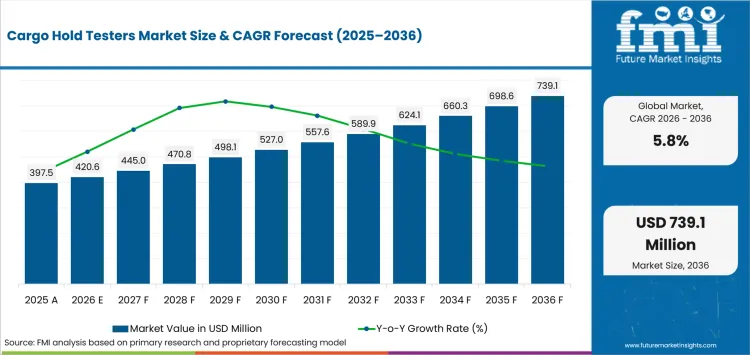
USD 420.6 million in 2026 and USD 739.1 million by 2036 at a 5.8% CAGR.
Demand for cargo hold testers are projected to rise at 5.8% CAGR through 2036, increasing from USD 420.6 million in 2026 to USD 739.1 million by 2036. Dedicated cargo-hold units differ from non-destructive testing equipment because they measure leakage across hatch seals during vessel inspections. Classification acceptance requires competent operators and traceable instruments that surveyors can evaluate during scheduled vessel attendance. Lloyd's Register includes ultrasonic tightness testing within its approved service-supplier categories, linking equipment selection with recognized operating competence. Port engineers therefore favor portable systems that support rapid checks without delaying cargo work during short port calls and surveys.
Country demand varies with fleet composition and the distance between vessel calls and qualified marine service centers or repair hubs. The adjacent ship repair services market supports equipment adoption around major ports but remote schedules increase travel and recalibration expense across trading routes. DNV expressly includes ultrasonic hatch tightness testing within its approval categories for service providers supporting classified ships. Fleet managers therefore compare instruments through measurement repeatability and the support route that protects calibration during vessel transfers. Portable hardware loses practical value if technical assistance cannot reach the ship during its next cargo or survey commitment within available time.
Key Takeaways
- Classification and cargo-protection requirements increase demand for repeatable hatch integrity evidence across dry-cargo vessel inspections.
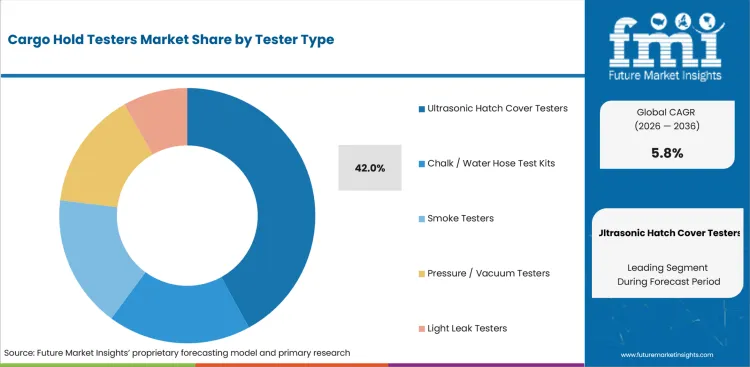
- Ultrasonic hatch cover testers are projected to represent 42% share in 2026 owing to measurable leak location across portable inspections.
- Hatch cover tightness is estimated to account for 48% share in 2026 due to direct cargo exposure and survey findings.
- Bulk carriers are forecast to capture 39% share in 2026 driven by extensive hatch openings and repeated loading stress.
- Calibration access and approved technician coverage constrain vessel operators trading beyond established marine service clusters.
- Coltraco Ultrasonics, SDT Ultrasound Solutions, Cygnus Instruments, Class Instrumentation Ltd, Martek Marine, SAG Measure, Kozen Marine Survey Company and Technos Mihara Corporation compete through equipment or inspection services.
Analyst Perspective
“Commercial value comes from repeatable seal measurements that direct repairs before cargo or survey commitments are disrupted. Fleet managers should purchase reporting and calibration support because hardware cannot preserve evidence quality across crew changes. Strong service models connect measured leakage with targeted maintenance and dependable attendance across normal vessel routes.”
- Nikhil Kaitwade, Principal Analyst, Future Market Insights
How is the cargo hold testers market segmented?
The cargo hold testers industry is segmented by tester type, application, vessel type, buyer type, sales channel and region.
The framework separates tester types by measurement method and the preparation required aboard each vessel. Applications distinguish hatch tightness from wider hold leakage across defined closing boundaries and cargo spaces. Vessel type captures differences in hatch geometry, loading stress and exposure during normal trading operations. Buyer type identifies the organization controlling equipment budgets and accepting maintenance evidence across managed fleets. Sales channels separate distributor supply from direct OEM contracts and bundled inspection services across fleet purchasing routes. Regional analysis compares approved technician access and calibration routes, while adjacent marine electronics testers cannot replace cargo-boundary verification during scheduled vessel condition checks.
Why do ultrasonic hatch cover testers lead the tester type category?
Ultrasonic systems locate seal leakage without wetting decks or emptying cargo holds during vessel inspections. Broader ultrasonic NDT equipment checks ship materials but hatch testing uses dedicated transmitters and calibrated receivers. ClassNK reviews maritime service companies through documented personnel qualifications, suitable instruments and controlled testing procedures. The approval framework makes operator competence and equipment control part of an accepted testing route.
- The tester type category is forecast to be led by ultrasonic hatch cover testers at 42.0% share in 2026 due to precise leak location and auditable readings across holds. Compared with water procedures, portable ultrasonic testing reduces scheduling conflicts and directs targeted repairs across recurring vessel inspections and survey programs.
- Ship managers adopt ultrasonic units through fleet procedures that define calibration intervals and reference values across managed vessels. Standardized kits reduce interpretation differences, while central records preserve comparable results through crew changes and vessel transfers. Accessible recalibration and training routines maintain operator confidence during recurring inspections at unfamiliar operating ports.
Why does hatch cover tightness command the application category?
Hatch cover tightness testing addresses cargo boundaries exposed to weather and compression during dry-cargo operations. Adjacent condition monitoring systems organize records but dedicated testers determine whether sealing interfaces pass leakage thresholds. Lloyd's Register recognizes ultrasonic hatch testing within its approved service-supplier framework for classified vessel inspections. Qualified services support recurring surveys without substituting general maintenance records for direct seal evidence aboard vessels.
- Hatch cover tightness is projected to hold 48% share in 2026 owing to direct exposure to cargo damage and formal survey findings across dry-cargo operations. A failed gasket can compromise an otherwise serviceable hold, so survey preparation prioritizes measured sealing performance before formal cargo-risk reviews and recurring vessel acceptance work.
- Technical managers schedule tightness tests around annual surveys and repairs that disturb hatch panels across managed fleets. Shared templates let offices compare readings with earlier results across repairs and recurring vessel surveys. Documented repair verification strengthens adoption and prevents each inspection from becoming an isolated event without useful maintenance history.
Why do bulk carriers represent the vessel type category?
Bulk carriers combine hatch openings with abrasive commodities and frequent loading that accelerates sealing wear. Measured predictive maintenance workflows help technical teams schedule gasket and steelwork repairs from inspection trends. Portable testing supports recurring checks across trading routes without arranging hose tests or empty holds.
- By vessel type, bulk carriers are forecast to represent 39% in 2026 driven by hatch geometry and abrasive loading exposure. Portable instruments support inspections across changing schedules, while gasket condition and panel alignment determine repair priorities. Comparable readings help managers direct repairs before survey attendance across multiple commercial ports and surveys.
- Fleet operators prefer portable systems that technicians can carry between ships without arranging water tests or empty holds. Purchasing decisions balance transmitter coverage against repair access and calibration support across worldwide vessel routes. Comparable electronic records preserve inspection history and help managers prioritize work across commercial ports and charter schedules.
Why do shipowners and operators shape the buyer type category?
Shipowners and managers control vessel budgets and remain accountable for inspection readiness across trading schedules. Adjacent machine condition monitoring offers a comparison but hatch testers address a defined cargo-boundary risk. Cygnus Instruments designed Hatch Sure to display measurable leakage and locate defects during shipboard inspections. Central teams compare vessel condition without relying on changing crew descriptions or informal repair notes.
- In 2026, shipowners and operators are expected to lead buyer type with 34% share because they control maintenance planning. Direct ownership encourages equipment standardization across managed vessels, recurring inspection programs and central technical departments. Central purchasing improves reporting consistency and supports common calibration procedures through personnel changes across each fleet.
- Large fleet managers standardize equipment through shared procedures and central purchasing across their managed vessel fleets. Smaller vessel operators frequently rely on survey firms for intermittent testing and approved attendance support. Irregular use can weaken crew familiarity, so smaller fleets need refresher training or dependable vessel-side service before scheduled surveys.
Why do marine equipment distributors shape the sales channel category?
Marine distributors connect portable testers with delivery and technical guidance beside calibration or repair routes. Adjacent condition monitoring services illustrate the value of recurring technical support across dispersed vessel operations. Class Instrumentation supplies CARGO-SAFE DATA with stored readings and usable electronic export for inspection records. Distributor value extends beyond delivery through repair coordination during short port calls or equipment failures.
- By sales channel, marine equipment distributors are estimated to hold 42% in 2026 owing to local delivery and established ship-manager relationships across major ports. Distributor inventory and technical coordination reduce downtime across dispersed vessel routes, preventing equipment faults from delaying cargo operations during limited port stays and scheduled inspection surveys.
- Operators use distributors for routine kits and accessories across established port networks and recurring vessel calls. Fleet-wide specifications can pass through direct OEM contracts that align central hardware and reporting formats. Bundled survey services provide another route for intermittent users, while channel selection depends on delivery timing and technical depth.
What are the drivers, restraints and opportunities in the cargo hold testers market?
Driver: Inspection and cargo-protection requirements are increasing demand for measurable hatch integrity checks. Restraint: Calibration and service-supplier approval can raise ownership costs outside major port clusters. Opportunity: Digital reporting can connect leak location, repair evidence and recurring maintenance decisions.
- Driver: Classification and cargo-protection requirements increase demand for repeatable hatch integrity evidence across dry-cargo fleets.
- Restraint: Calibration access and approved technician coverage can raise ownership costs beyond established marine service clusters.
- Opportunity: Electronic records can connect measured leakage with repair priorities and recurring fleet maintenance evidence.
Classification and charter reviews require evidence that hatch closing appliances maintain weather tightness throughout vessel operations. Adjacent corrosion testing services cover steel risks but cargo hold testers locate leakage around seals and panel interfaces. RINA includes ultrasonic hatch tightness testing among activities performed by approved service providers during classified vessel inspections. The approval route gives managers recognized support and reduces disputes over repair priorities during survey preparation and cargo acceptance.
Service access limits adoption when calibrated instruments and qualified technicians cannot reach vessels during narrow port schedules. Martek Marine supports Hatchtite through a five-year calibration period and clear detailed vessel-side operating guidance. The interval reduces routine returns but does not remove functional checks or eventual recalibration requirements. Smaller fleets face higher travel expense and replacement delays, so purchase plans need repair turnaround and temporary coverage across normal vessel trading routes.
Digital reporting gives instrument manufacturers a practical route to improve repair decisions across managed vessel fleets. Coltraco Ultrasonics designed Portascanner WATERTIGHT PRO to record leak location and calculate individual or overall flow rates. Structured exports help technical offices connect each reading with repair verification across crew changes and vessel transfers. Commercial adoption depends on integrating those records with maintenance systems rather than treating each test as an isolated survey task.
Which country CAGRs are profiled in the cargo hold testers market?
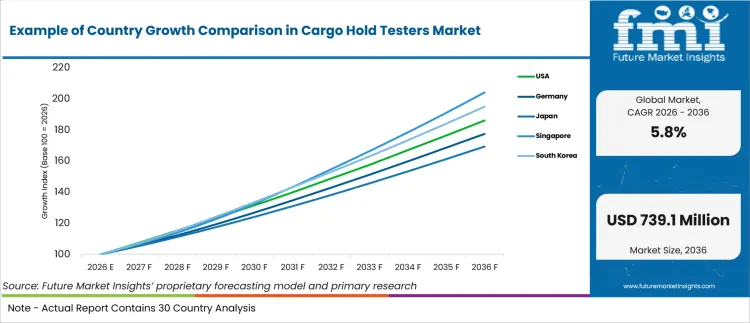
| Country | CAGR |
|---|---|
| United States | 6.4% |
| Germany | 5.9% |
| Japan | 5.4% |
| Singapore | 7.4% |
| South Korea | 6.9% |
How do country-level CAGRs compare in the cargo hold testers market?
The five forecasts form a uniform 0.5-percentage-point progression across a 2.0-point range without a defensible commercial tier break. Singapore and South Korea combine concentrated port or shipyard activity with accessible technical support for vessel attendance. The United States and Germany depend more on recurring compliance work and replacement purchasing through established maritime service networks. Japan follows a controlled domestic route that emphasizes approved providers and careful equipment qualification across class procedures. Similar growth rates conceal different entry conditions around technician approval, calibration access and vessel scheduling across normal trading routes.
- United States demand reflects broad port coverage and recurring compliance activity across domestic and international vessel calls.
- Germany relies on mature repair networks and planned replacement purchasing across high-volume commercial seaports and established service clusters.
- Japan favors approved domestic providers and controlled equipment changes within established shipyard and classification routines.
- Singapore benefits from concentrated ship management and rapid technical attendance around one major international port.
- South Korea connects tester demand with shipyard commissioning and repair acceptance across principal industrial ports.
Comparable rates can produce different equipment entry conditions because service distance and approval routes vary by country. The full report provides country-level CAGR analysis across North America, Latin America, Europe, East Asia, South Asia, Oceania and the Middle East and Africa.
Country-wise Analysis
- United States operators face broad Coast Guard examination exposure across domestic and international commercial vessel routes. The Coast Guard reported in May 2026 that officers completed 8,999 SOLAS safety examinations during 2025 and recorded 77 detentions. The United States cargo hold testers outlook is anticipated to advance at 6.4% CAGR over the assessment period, supported by major port clusters and established marine service providers. Approved instruments support adoption around coastal centers but service distance can delay recalibration across less-connected routes. Fleet specifications should connect equipment standards with support coverage for normal ports and temporary replacement during recurring inspection cycles.
- German ship managers operate through high-volume seaports and a mature network of classification or repair specialists across commercial routes. Cargo hold tester demand in Germany is forecast to rise at 5.9% CAGR over the forecast period, underpinned by recurring replacement and documented maintenance procedures. Destatis reported in March 2026 that German seaports handled 284.4 million tonnes during 2025 and increased throughput by 3.8%. Dense port services improve testing access but technician costs and short berth windows constrain smaller operators. Purchasing plans should reserve calibration capacity beside expected surveys and provide temporary replacement coverage across regular commercial routes and vessel schedules.
- Japanese vessel maintenance relies on approved domestic service companies and close coordination with shipyard survey teams and maintenance networks. ClassNK lists Technos Mihara Corporation as an approved ultrasonic hatch tightness provider through February 2029 for recognized vessel inspections at domestic and overseas ports. Japan is estimated to post 5.4% CAGR over the forecast period, shaped by approved providers and controlled equipment qualification. Recognized service coverage supports operator competence but conservative approval practices can lengthen equipment changes across established fleets. Manufacturers need local training and documentation that fit class procedures across overseas vessel attendance routes without disrupting established domestic shipyard routines.
- Singapore concentrates ship managers and survey firms beside marine service providers within a high-traffic international port and regional management hub. By 2036, Singapore is projected to grow at 7.4% CAGR supported by frequent vessel calls and accessible technical support. MPA reported in January 2026 that vessel arrivals reached 3.22 billion gross tonnage during 2025 and container throughput reached 44.66 million TEUs. Concentrated service capacity accelerates calibration and training but compressed port stays complicate careful technician attendance planning. Service contracts need rapid response and accepted reporting formats across multilingual management teams and several flag administrations during short calls and scheduled surveys.
- South Korean demand centers on large ports and shipyard-linked commissioning routes that require reliable acceptance evidence. The Ministry of Oceans and Fisheries reported in January 2026 that national ports handled 1.571 billion tonnes during 2025 and non-container cargo reached 1.018 billion tonnes. The South Korean cargo hold testers sector is projected to record 6.9% CAGR during the assessment period, reinforced by newbuild and repair activity. Domestic technical capability supports rapid deployment but purchasing remains sensitive to changing shipyard delivery and repair cycles. Companies need service partners and spare capacity that cover commissioning peaks without weakening calibration control or delivery schedules.
Who are the notable companies in the cargo hold testers market?
Coltraco Ultrasonics, SDT Ultrasound Solutions, Cygnus Instruments, Class Instrumentation Ltd, Martek Marine, SAG Measure, Kozen Marine Survey Company and Technos Mihara Corporation are the notable companies shaping this market.
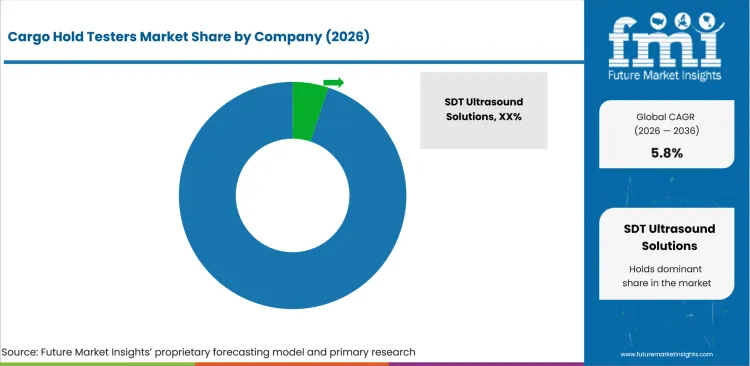
The competitive field is fragmented between specialized instrument manufacturers and vessel-side inspection firms rather than controlled by one integrated provider. Portable ultrasonic testing platforms compete through transmitter coverage, quantified leak interpretation and reporting convenience across shipboard systems and records. Service firms compete through technician approval, calibration access and attendance speed near active ports across vessel routes and surveys. Entry remains possible for focused manufacturers with credible approval routes or survey companies with trained personnel and recognized procedures at regional ports.
- Coltraco Ultrasonics and SDT Ultrasound Solutions provide dedicated platforms with quantified readings and electronic reporting options for repeatable vessel inspections. Cygnus Instruments adds shipboard measurement and global support, so selection depends on reading consistency and usable evidence across recurring surveys.
- Class Instrumentation Ltd and Martek Marine emphasize portable kits with calibration or technical support for loaded cargo holds. SAG Measure adds stored leakage records and PDF export for survey documentation, making repair turnaround and reporting depth equipment comparisons during selection.
- Kozen Marine Survey Company and Technos Mihara Corporation connect ultrasonic equipment with trained vessel-side inspection services. Their value depends on recognized personnel and documented practices, so managers should verify approval validity and technician availability before short attendance windows at ports.
Competitive Benchmarking: Cargo Hold Testers Market
| Company | Dedicated Hatch Testing | Measured Leak Interpretation | Calibration or Training Support | Geographic Reach |
|---|---|---|---|---|
| Coltraco Ultrasonics | High | High | High | Global |
| SDT Ultrasound Solutions | High | High | High | Global |
| Cygnus Instruments | Medium | Medium | Medium | Global |
| Class Instrumentation Ltd | High | High | High | Global |
| Martek Marine | Medium | Medium | High | Global |
| SAG Measure | Medium | High | Medium | Asia and export markets |
| Kozen Marine Survey Company | Low | Medium | High | Europe and Türkiye |
| Technos Mihara Corporation | Low | Low | Medium | Japan and selected overseas ports |
Scoring basis: High dedicated capability requires two proprietary systems or one platform with native reporting; Medium requires one proprietary tester and Low requires a verified third-party service. High interpretation capability requires stored readings with electronic export; Medium requires quantified results and Low confirms leak location without native electronic records. High support requires documented calibration and training; Medium covers one verified route and Low covers guidance without a formal program. Geographic reach records verified service or distribution regions for each company without inferring coverage from corporate size.
Key Developments in the Cargo Hold Testers Market
- In July 2025, SAG Measure introduced a class-approved tester storing 999 readings and exporting PDF survey records.
- In November 2025, SDT Ultrasound Solutions connected HATCHecker with operator-led verification and structured reporting guidance.
- In November 2025, Cygnus Instruments issued shipboard guidance covering hatch-test preparation and measurable leak interpretation.
- In July 2026, Martek Marine published inspection guidance connecting ultrasonic testing with survey preparation and repair documentation.
Cargo Hold Testers Market - Report Scope
| Coverage field | Report scope |
|---|---|
| Market breakdown | By tester type, application, vessel type, buyer type, sales channel and region. |
| Quantitative Units | USD million. |
| Market Definition | The market covers portable and service-integrated equipment used to verify cargo hold and hatch cover tightness, including ultrasonic, hose, smoke, pressure, vacuum and light-leak testing systems. |
| Regions Covered | North America, Latin America, Europe, East Asia, South Asia and Pacific and Middle East and Africa. |
| Countries Covered | United States, Germany, Japan, Singapore and South Korea. |
| Key Companies Profiled | Coltraco Ultrasonics, SDT Ultrasound Solutions, Cygnus Instruments, Class Instrumentation Ltd, Martek Marine, SAG Measure, Kozen Marine Survey Company, Technos Mihara Corporation |
| Forecast Period | 2026-2036. |
| Approach | Hybrid bottom-up and top-down market sizing supported by primary interviews and official desk research. |
Cargo Hold Testers Market - Research Methodology
| Method | Approach |
|---|---|
| Primary Research | FMI analysts gathered input from manufacturers, service providers, technology developers, distributors, end users, procurement teams, and subject-matter experts. Interviews examined purchasing decisions, product or service evaluation, adoption barriers, approval requirements, pricing considerations, and expectations for technical or commercial support. Respondents were also asked what evidence is required before a trial, pilot, or initial order develops into regular purchasing. |
| Desk Research | Desk research covered government statistics, regulatory publications, trade data, industry associations, technical literature, standards, company filings, product information, and official corporate announcements. Sources were reviewed for relevance, publication date, geographic coverage, and consistency with the defined market scope. Claims relating to performance, applications, approvals, capacity, investment, and commercial activity were retained only when supported by credible public evidence. |
| Market Sizing and Forecasting | The market model combined the baseline value with historical performance, segment structure, pricing and volume indicators, adoption levels, company participation, and country-level demand conditions. Forecast assumptions considered economic activity, investment trends, regulatory developments, technology adoption, purchasing cycles, supply availability, and barriers to wider market use. Segment and regional estimates were reconciled before the final market total was calculated. |
| Data Validation | Estimates were checked against multiple independent indicators, including public data, company activity, trade patterns, industry developments, and findings from primary interviews. Validation also tested whether products, services, applications, and company revenues fell within the defined market boundaries. Adjacent categories, unsupported claims, overlapping revenues, and activities without direct market relevance were excluded to reduce double counting and maintain consistency across segments and countries. |
Cargo Hold Testers Market by Segments
Cargo Hold Testers Market segmented by Tester Type:
- Ultrasonic Hatch Cover Testers
- Chalk / Water Hose Test Kits
- Smoke Testers
- Pressure / Vacuum Testers
- Light Leak Testers
Cargo Hold Testers Market segmented by Application:
- Hatch Cover Tightness
- Cargo Hold Leak Detection
- Bulk Carrier Inspection
- Container Vessel Inspection
Cargo Hold Testers Market segmented by Vessel Type:
- Bulk Carriers
- Container Ships
- Tankers
- General Cargo Ships
- Ro-Ro / Other
Cargo Hold Testers Market segmented by Buyer Type:
- Shipowners / Operators
- Marine Surveyors
- Shipyards
- Port State / Class Inspectors
Cargo Hold Testers Market segmented by Sales Channel:
- Marine Equipment Distributors
- Direct OEM
- Survey Service Bundled
Cargo Hold Testers Market by Region:
- North America
- United States
- Canada
- Latin America
- Brazil
- Chile
- Mexico
- Rest of Latin America
- Western Europe
- Germany
- United Kingdom
- Italy
- Spain
- France
- Nordics
- Benelux
- Rest of Western Europe
- Eastern Europe
- Russia
- Poland
- Hungary
- Balkan and Baltic States
- Rest of Eastern Europe
- East Asia
- China
- Japan
- South Korea
- South Asia and Pacific
- India
- ASEAN
- Australia and New Zealand
- Rest of South Asia and Pacific
- Middle East and Africa
- Kingdom of Saudi Arabia
- Other GCC Countries
- Türkiye
- South Africa
- Other African Union Countries
- Rest of Middle East and Africa
Research Sources and Bibliography
- United States Coast Guard. (2026, May 19). 2025 Port State Control Annual Report Posted.
- Statistisches Bundesamt. (2026, March 10). Seeverkehr 2025: Güterumschlag steigt um 3,8 % gegenüber dem Vorjahr.
- ClassNK. (n.d.). APPROVED SERVICE SUPPLIERS: TECHNOS MIHARA CORPORATION.
- Maritime and Port Authority of Singapore. (2026, January 13). Singapore Posts Record Port Performance in 2025 and Develops Future Readiness through Industry Collaborations for 2026.
- Ministry of Oceans and Fisheries, Republic of Korea. (2026, January 29).
- Coltraco Ultrasonics. (n.d.). Portascanner WATERTIGHT PRO.
- Coltraco Ultrasonics. (n.d.). Portascanner WATERTIGHT PLUS.
- SDT Ultrasound Solutions. (n.d.). HATCHecker.
- SDT Ultrasound Solutions. (n.d.). Hardware Support.
- SDT Ultrasound Solutions. (2025, November 6). How Ultrasonic Tools Accelerate the Pursuit of Reliability.
- Cygnus Instruments. (n.d.). Cygnus Hatch Sure for Ships.
- Cygnus Instruments. (2025, November 18). Why Choose Ultrasonic Testing for Hatch Cover Inspection?.
- Class Instrumentation Ltd. (n.d.). CARGO-SAFE DATA Ultrasonic Hatch Cover Tester.
- Martek Marine. (n.d.). Hatchtite Cover Testing Device.
- Martek Marine. (n.d.). About Martek Marine.
- SAG Measure. (2025, July 16). Quick Detection of Hatch Cover Leaks-SAG Portable Ultrasonic Hatch Cover Watertight Indicator.
- TECHNOS MIHARA CORPORATION. (n.d.). Tightness testing of hatches with ultrasonic equipment.
- Martek Marine. (2026, July 22). How to Pass the New Hatch Cover Inspections.
This bibliography is provided for reader reference and is not exhaustive. The full report contains the complete reference list and detailed citations
This Report Answers
- How large is the global Crack Repair Resins market, and what is its growth outlook?
- What factors support the adoption of resin-based concrete and structural crack repair solutions?
- Why do epoxy-based crack repair resins hold the largest share of the market?
- How do resin injection techniques restore structural integrity and prevent further deterioration?
- How do structural, non-structural, dormant, and active cracks differ in repair requirements?
- Why do market demand, repair practices, and growth opportunities vary across countries?
- Which leading companies provide integrated crack repair resin systems and related solutions?
- What technical, environmental, and application-related factors can limit repair effectiveness?
- How should contractors evaluate and select crack repair resins based on performance, durability, and project requirements?
Frequently Asked Questions
What is driving growth in the cargo hold testers market?
Classification requirements support measurable hatch integrity checks, while ultrasonic systems help avoid disruptive water-testing procedures during vessel inspections.
Who are the key players in the cargo hold testers market?
Equipment manufacturers and inspection specialists serve the market, with selection often determined by measurement quality, calibration support, and service coverage.
What is a notable restraint in the cargo hold testers market?
Limited calibration access outside major ports can increase operating costs, while short vessel stays restrict repair and validation schedules.
Why should executives track the cargo hold testers market?
The market directly links cargo protection with vessel availability, making fleet-wide equipment standards and operator training important management priorities.
What business problem does the cargo hold testers market address?
Cargo hold testers identify leakage paths that can damage cargo and provide measured results that support repairs and survey documentation.
What should ship managers evaluate in the cargo hold testers market?
Ship managers should compare measurement repeatability, calibration availability, and reporting compatibility to maintain consistent testing across vessels.
What limits return on investment in the cargo hold testers market?
Irregular equipment usage can leave purchased systems underutilized, while limited service access may extend calibration and repair downtime.
What supports long-term confidence in the cargo hold testers market?
Approved testing methods and consistent electronic recordkeeping support confidence across dry-cargo fleets and strengthen recurring maintenance decisions.
Preview the report firsthand - request a free sample
Get SampleGet the brochure for pricing and purchase details.
Get PDFTable of Content
- Key Takeaways
- Market Size and CAGR
- Top Growth Driver
- Fastest Growing Segment
- Leading Region
- Key Companies
- Emerging Opportunities
- Executive Summary
- Global Market Outlook
- Demand-side Trends
- Supply-side Trends
- Technology Roadmap Analysis
- Analysis and Recommendations
- Analyst Perspective (What is happening? Why now? What should investors know?)
- Key Questions Answered
- How large is the market?
- What is the CAGR?
- What are key trends?
- Which region dominates?
- Who are the leaders?
- Market Overview
- Market Coverage / Taxonomy
- Market Definition / Scope / Limitations
- Research Methodology
- Chapter Orientation
- Analytical Lens and Working Hypotheses
- Market Structure, Signals, and Trend Drivers
- Benchmarking and Cross-market Comparability
- Market Sizing, Forecasting, and Opportunity Mapping
- Research Design and Evidence Framework
- Desk Research Programme (Secondary Evidence)
- Expert Input and Fieldwork (Primary Evidence)
- Tooling, Models, and Reference Databases
- Data Engineering and Model Build
- Quality Assurance and Audit Trail
- Market Background
- Market Dynamics (Drivers, Restraints, Opportunity, Trends)
- Scenario Forecast (Optimistic, Likely, Conservative)
- Impact Analysis
- AI Impact
- Sustainability Impact
- Regulatory Impact
- Technology Impact
- Consumer / Buyer Analysis
- Purchase Drivers
- Adoption Barriers
- Buyer Journey
- Opportunity Map Analysis
- Product Life Cycle Analysis
- Supply Chain Analysis
- Investment Feasibility Matrix
- Value Chain Analysis
- PESTLE and Porter's Analysis
- Regulatory Landscape
- Regional Parent Market Outlook
- Production and Consumption Statistics
- Import and Export Statistics
- Global Market Analysis and Forecast, 2021 to 2036
- Historical Market Size Value (USD Million) Analysis, 2021 to 2025
- Current and Future Market Size Value (USD Million) Projections, 2026 to 2036
- Y-o-Y Growth Trend Analysis
- Absolute $ Opportunity Analysis
- Global Market Pricing Analysis, 2021 to 2036
- Global Market Analysis and Forecast, By Tester Type, 2021 to 2036
- Introduction / Key Findings
- Historical Market Size Value (USD Million) Analysis By Tester Type, 2021 to 2025
- Current and Future Market Size Value (USD Million) Analysis and Forecast By Tester Type, 2026 to 2036
- Ultrasonic Hatch Cover Testers
- Chalk / Water Hose Test Kits
- Smoke Testers
- Pressure / Vacuum Testers
- Light Leak Testers
- Ultrasonic Hatch Cover Testers
- Y-o-Y Growth Trend Analysis By Tester Type, 2021 to 2025
- Absolute $ Opportunity Analysis By Tester Type, 2026 to 2036
- Global Market Analysis and Forecast, By Application, 2021 to 2036
- Introduction / Key Findings
- Historical Market Size Value (USD Million) Analysis By Application, 2021 to 2025
- Current and Future Market Size Value (USD Million) Analysis and Forecast By Application, 2026 to 2036
- Hatch Cover Tightness
- Cargo Hold Leak Detection
- Bulk Carrier Inspection
- Container Vessel Inspection
- Hatch Cover Tightness
- Y-o-Y Growth Trend Analysis By Application, 2021 to 2025
- Absolute $ Opportunity Analysis By Application, 2026 to 2036
- Global Market Analysis and Forecast, By Vessel Type, 2021 to 2036
- Introduction / Key Findings
- Historical Market Size Value (USD Million) Analysis By Vessel Type, 2021 to 2025
- Current and Future Market Size Value (USD Million) Analysis and Forecast By Vessel Type, 2026 to 2036
- Bulk Carriers
- Container Ships
- Tankers
- General Cargo Ships
- Ro-Ro / Other
- Bulk Carriers
- Y-o-Y Growth Trend Analysis By Vessel Type, 2021 to 2025
- Absolute $ Opportunity Analysis By Vessel Type, 2026 to 2036
- Global Market Analysis and Forecast, By Buyer Type, 2021 to 2036
- Introduction / Key Findings
- Historical Market Size Value (USD Million) Analysis By Buyer Type, 2021 to 2025
- Current and Future Market Size Value (USD Million) Analysis and Forecast By Buyer Type, 2026 to 2036
- Shipowners / Operators
- Marine Surveyors
- Shipyards
- Port State / Class Inspectors
- Shipowners / Operators
- Y-o-Y Growth Trend Analysis By Buyer Type, 2021 to 2025
- Absolute $ Opportunity Analysis By Buyer Type, 2026 to 2036
- Global Market Analysis and Forecast, By Sales Channel, 2021 to 2036
- Introduction / Key Findings
- Historical Market Size Value (USD Million) Analysis By Sales Channel, 2021 to 2025
- Current and Future Market Size Value (USD Million) Analysis and Forecast By Sales Channel, 2026 to 2036
- Marine Equipment Distributors
- Direct OEM
- Survey Service Bundled
- Marine Equipment Distributors
- Y-o-Y Growth Trend Analysis By Sales Channel, 2021 to 2025
- Absolute $ Opportunity Analysis By Sales Channel, 2026 to 2036
- Global Market Analysis and Forecast, By Region, 2021 to 2036
- Introduction
- Historical Market Size Value (USD Million) Analysis By Region, 2021 to 2025
- Current Market Size Value (USD Million) Analysis and Forecast By Region, 2026 to 2036
- North America
- Latin America
- Western Europe
- Eastern Europe
- East Asia
- South Asia and Pacific
- Middle East & Africa
- Market Attractiveness Analysis By Region
- North America Market Analysis and Forecast, By Country, 2021 to 2036
- Historical Market Size Value (USD Million) Trend Analysis By Market Taxonomy, 2021 to 2025
- Market Size Value (USD Million) Forecast By Market Taxonomy, 2026 to 2036
- By Country
- USA
- Canada
- By Tester Type
- By Application
- By Vessel Type
- By Buyer Type
- By Sales Channel
- By Country
- Market Attractiveness Analysis
- By Country
- By Tester Type
- By Application
- By Vessel Type
- By Buyer Type
- By Sales Channel
- Key Takeaways
- Latin America Market Analysis and Forecast, By Country
- Historical Market Size Value (USD Million) Trend Analysis By Market Taxonomy, 2021 to 2025
- Market Size Value (USD Million) Forecast By Market Taxonomy, 2026 to 2036
- By Country
- Brazil
- Mexico
- Chile
- Rest of Latin America
- By Tester Type
- By Application
- By Vessel Type
- By Buyer Type
- By Sales Channel
- By Country
- Market Attractiveness Analysis
- By Country
- By Tester Type
- By Application
- By Vessel Type
- By Buyer Type
- By Sales Channel
- Key Takeaways
- Western Europe Market Analysis and Forecast, By Country
- Historical Market Size Value (USD Million) Trend Analysis By Market Taxonomy, 2021 to 2025
- Market Size Value (USD Million) Forecast By Market Taxonomy, 2026 to 2036
- By Country
- Germany
- UK
- Italy
- Spain
- France
- Nordic
- BENELUX
- Rest of Western Europe
- By Tester Type
- By Application
- By Vessel Type
- By Buyer Type
- By Sales Channel
- By Country
- Market Attractiveness Analysis
- By Country
- By Tester Type
- By Application
- By Vessel Type
- By Buyer Type
- By Sales Channel
- Key Takeaways
- Eastern Europe Market Analysis and Forecast, By Country
- Historical Market Size Value (USD Million) Trend Analysis By Market Taxonomy, 2021 to 2025
- Market Size Value (USD Million) Forecast By Market Taxonomy, 2026 to 2036
- By Country
- Russia
- Poland
- Hungary
- Balkan & Baltic
- Rest of Eastern Europe
- By Tester Type
- By Application
- By Vessel Type
- By Buyer Type
- By Sales Channel
- By Country
- Market Attractiveness Analysis
- By Country
- By Tester Type
- By Application
- By Vessel Type
- By Buyer Type
- By Sales Channel
- Key Takeaways
- East Asia Market Analysis and Forecast, By Country
- Historical Market Size Value (USD Million) Trend Analysis By Market Taxonomy, 2021 to 2025
- Market Size Value (USD Million) Forecast By Market Taxonomy, 2026 to 2036
- By Country
- China
- Japan
- South Korea
- By Tester Type
- By Application
- By Vessel Type
- By Buyer Type
- By Sales Channel
- By Country
- Market Attractiveness Analysis
- By Country
- By Tester Type
- By Application
- By Vessel Type
- By Buyer Type
- By Sales Channel
- Key Takeaways
- South Asia and Pacific Market Analysis and Forecast, By Country
- Historical Market Size Value (USD Million) Trend Analysis By Market Taxonomy, 2021 to 2025
- Market Size Value (USD Million) Forecast By Market Taxonomy, 2026 to 2036
- By Country
- India
- ASEAN
- Australia & New Zealand
- Rest of South Asia and Pacific
- By Tester Type
- By Application
- By Vessel Type
- By Buyer Type
- By Sales Channel
- By Country
- Market Attractiveness Analysis
- By Country
- By Tester Type
- By Application
- By Vessel Type
- By Buyer Type
- By Sales Channel
- Key Takeaways
- Middle East & Africa Market Analysis and Forecast, By Country
- Historical Market Size Value (USD Million) Trend Analysis By Market Taxonomy, 2021 to 2025
- Market Size Value (USD Million) Forecast By Market Taxonomy, 2026 to 2036
- By Country
- Kingdom of Saudi Arabia
- Other GCC Countries
- Türkiye
- South Africa
- Other African Union
- Rest of Middle East & Africa
- By Tester Type
- By Application
- By Vessel Type
- By Buyer Type
- By Sales Channel
- By Country
- Market Attractiveness Analysis
- By Country
- By Tester Type
- By Application
- By Vessel Type
- By Buyer Type
- By Sales Channel
- Key Takeaways
- Key Countries Market Analysis
- USA
- Pricing Analysis
- Market Share Analysis, 2025
- By Tester Type
- By Application
- By Vessel Type
- By Buyer Type
- By Sales Channel
- Canada
- Pricing Analysis
- Market Share Analysis, 2025
- By Tester Type
- By Application
- By Vessel Type
- By Buyer Type
- By Sales Channel
- Mexico
- Pricing Analysis
- Market Share Analysis, 2025
- By Tester Type
- By Application
- By Vessel Type
- By Buyer Type
- By Sales Channel
- Brazil
- Pricing Analysis
- Market Share Analysis, 2025
- By Tester Type
- By Application
- By Vessel Type
- By Buyer Type
- By Sales Channel
- Chile
- Pricing Analysis
- Market Share Analysis, 2025
- By Tester Type
- By Application
- By Vessel Type
- By Buyer Type
- By Sales Channel
- Germany
- Pricing Analysis
- Market Share Analysis, 2025
- By Tester Type
- By Application
- By Vessel Type
- By Buyer Type
- By Sales Channel
- UK
- Pricing Analysis
- Market Share Analysis, 2025
- By Tester Type
- By Application
- By Vessel Type
- By Buyer Type
- By Sales Channel
- Italy
- Pricing Analysis
- Market Share Analysis, 2025
- By Tester Type
- By Application
- By Vessel Type
- By Buyer Type
- By Sales Channel
- Spain
- Pricing Analysis
- Market Share Analysis, 2025
- By Tester Type
- By Application
- By Vessel Type
- By Buyer Type
- By Sales Channel
- France
- Pricing Analysis
- Market Share Analysis, 2025
- By Tester Type
- By Application
- By Vessel Type
- By Buyer Type
- By Sales Channel
- India
- Pricing Analysis
- Market Share Analysis, 2025
- By Tester Type
- By Application
- By Vessel Type
- By Buyer Type
- By Sales Channel
- ASEAN
- Pricing Analysis
- Market Share Analysis, 2025
- By Tester Type
- By Application
- By Vessel Type
- By Buyer Type
- By Sales Channel
- Australia & New Zealand
- Pricing Analysis
- Market Share Analysis, 2025
- By Tester Type
- By Application
- By Vessel Type
- By Buyer Type
- By Sales Channel
- China
- Pricing Analysis
- Market Share Analysis, 2025
- By Tester Type
- By Application
- By Vessel Type
- By Buyer Type
- By Sales Channel
- Japan
- Pricing Analysis
- Market Share Analysis, 2025
- By Tester Type
- By Application
- By Vessel Type
- By Buyer Type
- By Sales Channel
- South Korea
- Pricing Analysis
- Market Share Analysis, 2025
- By Tester Type
- By Application
- By Vessel Type
- By Buyer Type
- By Sales Channel
- Russia
- Pricing Analysis
- Market Share Analysis, 2025
- By Tester Type
- By Application
- By Vessel Type
- By Buyer Type
- By Sales Channel
- Poland
- Pricing Analysis
- Market Share Analysis, 2025
- By Tester Type
- By Application
- By Vessel Type
- By Buyer Type
- By Sales Channel
- Hungary
- Pricing Analysis
- Market Share Analysis, 2025
- By Tester Type
- By Application
- By Vessel Type
- By Buyer Type
- By Sales Channel
- Kingdom of Saudi Arabia
- Pricing Analysis
- Market Share Analysis, 2025
- By Tester Type
- By Application
- By Vessel Type
- By Buyer Type
- By Sales Channel
- Türkiye
- Pricing Analysis
- Market Share Analysis, 2025
- By Tester Type
- By Application
- By Vessel Type
- By Buyer Type
- By Sales Channel
- South Africa
- Pricing Analysis
- Market Share Analysis, 2025
- By Tester Type
- By Application
- By Vessel Type
- By Buyer Type
- By Sales Channel
- USA
- Market Structure Analysis
- Competition Dashboard
- Competition Benchmarking
- Market Share Analysis of Top Players
- By Regional
- By Tester Type
- By Application
- By Vessel Type
- By Buyer Type
- By Sales Channel
- Emerging Startups
- Innovation Benchmarking
- Competition Analysis
- Competition Deep Dive
- SDT Ultrasound Solutions
- Overview
- Product Portfolio
- Profitability by Market Segments
- Sales Footprint
- Strategy Overview
- Marketing Strategy
- Product Strategy
- Channel Strategy
- Cygnus Instruments
- Coltraco Ultrasonics
- Class Instrumentation
- Martek Marine
- Drew Marine
- Wilhelmsen
- Krohne Marine
- Dacon Inspection
- TQC Sheen
- SDT Ultrasound Solutions
- Case Studies
- Success Stories
- Recent Developments
- Competition Deep Dive
- Assumptions & Acronyms Used


