

- Market Size (2026)
- USD 249.3 Mn
- Forecast (2036)
- USD 695.2 Mn
- CAGR (2026 to 2036)
- 10.8%
How big is Chitin Soil Additives Market in 2026?
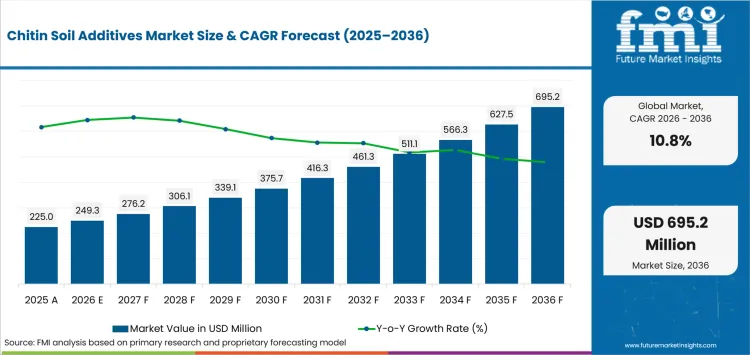
USD 249.3 million in 2026 and USD 695.2 million by 2036 at a 10.8% CAGR.
Demand in the chitin soil additives market is projected to rise from USD 249.3 million in 2026 to USD 695.2 million by 2036 at a 10.8% CAGR. Commercial demand strengthens once a chitin formulation addresses a defined crop problem and follows a usable sales route. In February 2025, Tidal Grow AgriScience introduced two chitosan-based crop inputs in Canada after securing authorization for distribution and sale. The Canadian approvals link formulation work to a real registration route instead of ingredient novelty alone.
Country conditions separate early interest from repeat purchasing because crop systems and qualification routes differ by jurisdiction. Germany illustrates that distinction through a large organic farming base that already uses documented input programs. The German Federal Statistical Office reported about 1.8 million organic hectares in 2024 and an 11.1% share of agricultural area. Germany therefore offers meaningful trial capacity, but product documentation and field economics still determine whether chitin inputs earn repeat orders.
Key Takeaways
- Demand rises as growers seek biological soil inputs that pair defined chitin chemistry with crop-specific application guidance and credible field evidence.
- By product type, raw - crude extract grades are estimated to hold 40.0% in 2026 owing to their fit with direct soil-amendment economics.
- In 2026, cereals & grains are expected to lead crop type with 36.9% share because broad treated acreage magnifies strict cost-per-hectare limits.
- Soil application is projected to hold 44.3% share in 2026 owing to direct placement within root-zone and soil-biological programs.
- Feedstock variation and changing application rates can delay repeat purchasing because agronomists need consistent composition between batches and crop programs.
- Some of the key players in this market include Tidal Grow AgriScience, Sym-Agro Inc., REPLOID Group AG, Innovafeed, HiProMine S.A., Novochizol SA, Cascade Columbia Distribution, and FytoFend SA.
Analyst Perspective
"Chitin soil additives earn repeat orders after formulation teams turn material chemistry into application rates that agronomists can test under commercial field conditions. Commercial value depends on stable composition and crop-level evidence because growers compare cost per treated hectare before extending a trial into routine use."
- Nikhil Kaitwade, Principal Consultant, Future Market Insights
How is the chitin soil additives market segmented?
The market is segmented by product type, crop type, application method, farm type and sales channel.
Product type covers raw - crude extract grades, refined & standardized fractions, formulated end-use blends and others. Crop type includes cereals & grains, fruits & vegetables, oilseeds & pulses, turf & ornamentals and others. Application method covers soil, foliar, fertigation / drip, seed and other routes. Farm type includes large commercial farms, mid-size farms, smallholders, greenhouses & nurseries and others. Sales channels include agri-input distributors, cooperatives, agri-retail chains, online / direct-to-farm and others.
What makes raw - crude extract grades central to the product type category?
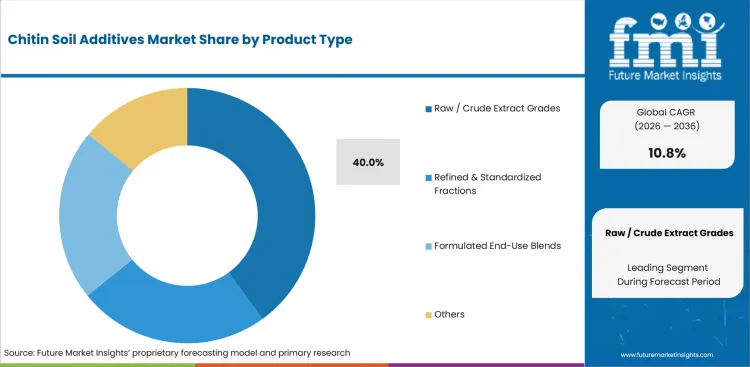
Raw - crude extract grades fit field programs that can spread solid or minimally processed material without requiring spray-grade solubility. Agronomists mainly test whether composition stays consistent at an acceptable cost per treated hectare.
- Based on product type, raw - crude extract grades are projected to account for 40.0% in 2026 due to direct soil-amendment economics.
- USDA Agricultural Research Service documented a two-year study in January 2025 where yellow mealworm frass increased soil carbon twofold and nitrogen threefold versus poultry litter and ammonium nitrate. The USDA field result strengthens the case for minimally processed insect-derived organic fertilizer inputs that retain molted skins and other residues.
What supports demand for cereals & grains within the crop type category?
Cereal growers evaluate new soil inputs against large field areas and narrow per-hectare margins before expanding a trial. Chitin formulations therefore need simple rates and compatibility with existing fertility passes without adding labor-intensive handling.
- The cereals & grains segment is set to lead the crop type category with 36.9% share in 2026 due to broad treated acreage and input-cost discipline.
- Germany recorded 6.03 million hectares of cereal cultivation for harvest in May 2026 according to the Federal Statistical Office. The German cereal area makes field efficiency central to selection and gives biological inputs a credible route after agronomists compare them with existing biostimulant programs.
How does soil application shape demand within the application method category?
Soil application places chitin beside familiar soil conditioner programs where agronomists can assess root-zone response through standard field operations. The route also accommodates grades that are difficult to dissolve or keep stable in fine spray equipment.
- By application method, soil application is forecast to represent 44.3% in 2026 driven by direct placement within soil-conditioning and root-zone programs.
- The European Food Safety Authority noted in April 2025 that EU rules authorize chitin for use as fertilizer, soil conditioner and nutrient. The same review records national chitosan and chitin biostimulant authorizations used in agriculture. Those routes clarify which evidence formulators need before comparing biorational pesticide claims.
What drives agri-input distributors within the sales channel category?
Agri-input distributors translate formulation detail into field use because local agronomists already manage crop programs and application timing. Chitin grades require explanation before repeat orders, which gives technically trained distributors a direct commercial role.
- The agri-input distributors segment is likely to capture 42.4% share in 2026 attributable to local technical support and inventory access.
- Tidal Grow AgriScience formed its Formulator Strategic Alliance with Heartland Co-op in July 2025 to route new crop-input technology through a major Midwest cooperative. The arrangement shows why agricultural adjuvants and biological inputs often need channel partners that translate formulation performance into field recommendations.
What are the drivers, restraints and opportunities in the chitin soil additives market?
Reduced-chemical farming programs increase interest in chitin inputs, qualification requirements slow wider adoption and formulation-plus-channel models offer the clearest route to repeat sales.
- Driver: Lower-chemical crop programs give chitin inputs a defined agronomic role as growers review alternatives to conventional insecticide or fertilizer routines.
- Restraint: Composition and claim requirements increase qualification work because manufacturers must prove formulation content and give growers defensible application instructions.
- Opportunity: Standardized chitin products can earn repeat revenue after field evidence and local distribution turn technical performance into a reproducible farm program.
Lower-chemical crop programs give chitin inputs a clearer agronomic problem than broad biological positioning alone. DEFRA reported in March 2025 that Sustainable Farming Incentive agreements covered 800,000 hectares of English arable land farmed without insecticides. That acreage expands the evaluation set for plant growth regulators and related biological inputs without proving demand for chitin products. Chitin products still need crop-specific economics before the policy setting converts into repeat purchasing.
Qualification costs rise when labels or performance claims exceed the evidence available for a specific chitin formulation. Japan's Ministry of Agriculture published biostimulant guidelines in May 2025 covering effect claims, supporting evidence and safety confirmation. The guidance makes documentation part of commercial positioning, so formulators need use-specific records before distributors place chitin products within specialty fertilizers programs for commercial crop systems.
Commercial upside improves once a producer pairs material supply with a channel that already serves farms and understands biological inputs. Innovafeed and Agryco announced a January 2025 partnership to commercialize Hilucia insect-frass fertilizer through Agryco's agricultural-input platform. The arrangement reduces the cost of building a separate sales route and gives insect-derived soil inputs a clearer path through established biofertilizer channels.
Which country CAGRs are profiled in the chitin soil additives market?
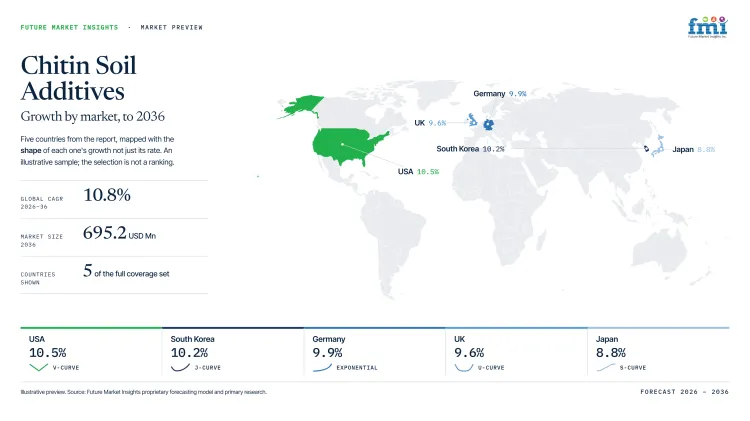
| Country | CAGR |
|---|---|
| USA | 10.5% |
| South Korea | 10.2% |
| Germany | 9.9% |
| UK | 9.6% |
| Japan | 8.8% |
How do country-level CAGRs compare in the chitin soil additives market?
The forecasts span 1.7 percentage points from USA at 10.5% CAGR to Japan at 8.8% CAGR and place USA with South Korea above 10%. Germany and UK occupy the middle band because qualification routes and channel access shape conversion more strongly than forecast pace during qualification.
- USA row-crop scale makes treatment economics decisive for commercial biological soil inputs.
- South Korean intensive crop programs reward concentrated inputs with simple repeat application.
- Germany's mechanized cereal farms favor inputs that fit spreading passes without extra operations.
- UK margins keep treatment economics central even where biological categories are familiar.
- Japan's regional crop mix favors small trials before national distributors widen product listings.
Commercial entry therefore depends more on each country's purchase gate than forecast ranking. The full report provides country-level CAGR analysis across North America, Latin America, Europe, East Asia, South Asia, Oceania and the Middle East and Africa.
Country-wise Analysis
- USA crop-input dealers already sell commercial biological products through networks that can turn a successful trial into broader farm programs. The USA is estimated to post 10.5% CAGR over the forecast period, tied to a large commercial crop base and mature specialty-input channels. USDA Agricultural Marketing Service updated its chitosan record in April 2026 and lists the substance as under National Organic Standards Board review for crop use. The review gives formulators a visible federal route without removing state registration requirements. Companies entering the USA therefore need crop-specific labels and dealer training before asking regional crop-input distributors to carry inventory.
- South Korean farms using public organic-input support operate within certification rules that make eligibility documentation part of the purchase decision. The November 2025 Ministry of Agriculture policy change gives certified eco-friendly farms priority for organic agricultural material support and requires longer-supported conventional farms to prepare conversion plans. Chitin soil additive demand in South Korea is forecast to rise at 10.2% CAGR over the forecast period, helped by those formal support routes. The revised rules give documented biological inputs a clearer path into certified-farm programs. Certification work imposes a cost constraint and can temper expansion even where public support improves product access.
- German arable farms give biological soil inputs a large trial base because cereal production runs through professional agronomy programs and mechanized field operations. The chitin soil additives sector in Germany is projected to record 9.9% CAGR during the assessment period, attributable to that commercial farming base and formal product evaluation. Destatis reported 45 million tonnes of grain harvested in 2025 and said output rose 16% from the previous year. Large field programs let agronomists test application efficiency under normal commercial operating conditions before broader purchasing decisions. Wider stocking depends on stable composition and German field evidence more than forecast pace alone.
- UK growers increasingly review biological inputs through independent agronomy advisers who interpret environmental schemes and whole-farm crop plans for commercial operations. DEFRA recorded 540 thousand hectares farmed organically in 2025 and said the area increased 7.3% from 2024. The acreage gives soil-input companies a larger pool of farms accustomed to documented biological practices and formal production records. Adoption of chitin soil additives in the UK is estimated to expand at 9.6% CAGR through 2036, aided by those advisory channels. Broader adoption is likely to follow where crop-level economics remain visible to advisers before wider distributor stocking despite seasonal changes in farm-support conditions.
- Japanese distributors usually expect local performance evidence before recommending a less familiar biological input to growers with established crop programs. Label clarity is equally important because advisers must explain the intended agronomic use without overstating plant-protection claims. Chitin soil additive sales in Japan are forecast to expand at 8.8% CAGR by 2036, because input-reduction policy raises interest in biological alternatives. The Ministry of Agriculture's fiscal 2025 environmental direct-payment program supports practices that reduce synthetic fertilizer and pesticide use by at least 50% from regional conventional levels. Compared with other profiled markets, Japan places more weight on localized trial evidence before distributor expansion.
Who are the notable companies in the chitin soil additives market?
Tidal Grow AgriScience, Sym-Agro Inc., REPLOID Group AG, Innovafeed, HiProMine S.A., Novochizol SA, Cascade Columbia Distribution, and FytoFend SA are the notable companies serving this market.
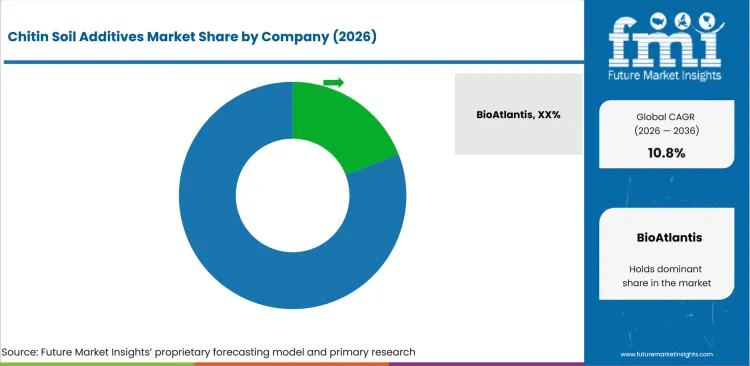
Competition spans direct chitosan formulators, insect-frass fertilizer producers and crop-biological companies with documented chitin routes. Entry barriers come from formulation control and local qualification records instead of corporate size alone.
- Tidal Grow AgriScience and Sym-Agro Inc. sell formulated chitosan crop inputs for plant-health and crop-protection programs.
- REPLOID Group AG, Innovafeed and HiProMine S.A. commercialize insect-frass fertilizers used in soil amendment and crop nutrition programs.
- Novochizol SA develops agricultural chitosan technology, Cascade Columbia Distribution handles USA chitosan regulatory work and FytoFend SA develops a chitosan oligosaccharide route for crop protection.
Competitive Benchmarking: Chitin Soil Additives Market
| Company | Direct chitin or chitosan evidence | Commercial qualification | Application proof | Geographic Reach |
|---|---|---|---|---|
| Tidal Grow AgriScience | High | High | High | North America |
| Sym-Agro Inc. | High | Medium | High | North America |
| REPLOID Group AG | Medium | High | Medium | Europe |
| Innovafeed | Medium | Medium | Medium | Europe and international sales |
| HiProMine S.A. | High | High | High | Europe |
| Novochizol SA | High | Medium | Medium | Europe and India |
| Cascade Columbia Distribution | High | Low | Low | North America |
| FytoFend SA | High | High | High | Europe |
Direct-evidence scoring is High for a documented agricultural chitin or chitosan product, Medium for chitin-bearing fertilizer evidence and Low for narrower regulatory or distribution records. Commercial qualification is High with multiple approvals or accepted listings, Medium with one verified launch or approval and Low for petition-stage evidence. Application proof is High for at least three documented crop or use routes, Medium for two routes and Low for one verified route.
Key Developments in the Chitin Soil Additives Market
- In December 2025, REPLOID Group AG secured inclusion of AgriVio insect-frass fertilizer in the German Input List after FiBL review confirmed its use in organic farming.
- In August 2025, Novochizol SA and Aquagri launched AgrINovo as a chitosan-derived agricultural platform covering biostimulants and fertilizers as well as crop-protection formulations.
- In May 2025, Sym-Agro Inc. launched KitoGard as a soil-applied chitosan nematicide for perennial fruit and nut crop programs.
Key Players in the Chitin Soil Additives Market
Direct agricultural chitin and chitosan platforms
- Tidal Grow AgriScience
- Sym-Agro Inc.
- REPLOID Group AG
Biological fertilizer and chitosan technology platforms
- Innovafeed
- HiProMine S.A.
- Novochizol SA
Chitosan distribution and crop-protection specialists
- Cascade Columbia Distribution
- FytoFend SA
Chitin Soil Additives Market - Report Scope
| Coverage field | Report scope |
|---|---|
| Market breakdown | By product type, crop type, application method, farm type, sales channel and region. |
| Quantitative Units | USD million. |
| Market Definition | Commercial chitin-containing or chitosan-derived soil additives and agricultural formulations used to modify soil, root-zone or crop-input performance within the defined segmentation. |
| Regions Covered | North America, Latin America, Europe, East Asia, South Asia and Pacific, and Middle East and Africa. |
| Countries Covered | USA, South Korea, Germany, UK, Japan, and 20+ countries included in the full report. |
| Key Companies Profiled | Tidal Grow AgriScience, Sym-Agro Inc., REPLOID Group AG, Innovafeed, HiProMine S.A., Novochizol SA, Cascade Columbia Distribution, and FytoFend SA. |
| Forecast Period | 2026 to 2036. |
| Approach | Primary and secondary research with market triangulation. |
Chitin Soil Additives Market - Research Methodology
| Method | Approach |
|---|---|
| Primary Research | FMI analysts gathered input from manufacturers, service providers, technology developers, distributors, end users, procurement teams, and subject-matter experts. Interviews examined purchasing decisions, product or service evaluation, adoption barriers, approval requirements, pricing considerations, and expectations for technical or commercial support. Respondents were also asked what evidence is required before a trial, pilot, or initial order develops into regular purchasing. |
| Desk Research | Desk research covered government statistics, regulatory publications, trade data, industry associations, technical literature, standards, company filings, product information, and official corporate announcements. Sources were reviewed for relevance, publication date, geographic coverage, and consistency with the defined market scope. Claims relating to performance, applications, approvals, capacity, investment, and commercial activity were retained only when supported by credible public evidence. |
| Market Sizing and Forecasting | The market model combined the baseline value with historical performance, segment structure, pricing and volume indicators, adoption levels, company participation, and country-level demand conditions. Forecast assumptions considered economic activity, investment trends, regulatory developments, technology adoption, purchasing cycles, supply availability, and barriers to wider market use. Segment and regional estimates were reconciled before the final market total was calculated. |
| Data Validation | Estimates were checked against multiple independent indicators, including public data, company activity, trade patterns, industry developments, and findings from primary interviews. Validation also tested whether products, services, applications, and company revenues fell within the defined market boundaries. Adjacent categories, unsupported claims, overlapping revenues, and activities without direct market relevance were excluded to reduce double counting and maintain consistency across segments and countries. |
Chitin Soil Additives Market by Segments
Chitin Soil Additives Market segmented by Product Type:
- Raw - crude Extract Grades
- Refined & Standardized Fractions
- Formulated End-Use Blends
- Others
Chitin Soil Additives Market segmented by Crop Type:
- Cereals & Grains
- Fruits & Vegetables
- Oilseeds & Pulses
- Turf & Ornamentals
- Others
Chitin Soil Additives Market segmented by Application Method:
- Soil Application
- Foliar Application
- Fertigation / Drip
- Seed Application
- Others
Chitin Soil Additives Market segmented by Farm Type:
- Large Commercial Farms
- Mid-Size Farms
- Smallholders
- Greenhouses & Nurseries
- Others
Chitin Soil Additives Market segmented by Sales Channel:
- Agri-Input Distributors
- Cooperatives
- Agri-Retail Chains
- Online / Direct-to-Farm
- Others
Chitin Soil Additives Market by Region:
- North America
- United States
- Canada
- Latin America
- Brazil
- Mexico
- Argentina
- Chile
- Western Europe
- Germany
- France
- United Kingdom
- Italy
- Spain
- Benelux
- Nordics
- Eastern Europe
- Poland
- Czech Republic
- Romania
- Hungary
- East Asia
- China
- Japan
- South Korea
- South Asia and Pacific
- India
- ASEAN
- Australia and New Zealand
- Middle East and Africa
- GCC Countries
- South Africa
- Türkiye
- Israel
Research Sources and Bibliography
- Tidal Grow AgriScience. (2025, February 26). Tidal Grow AgriScience Expands Regenerative Agricultural Solutions into Canada.
- German Federal Statistical Office. (2026, February 17). Organic Farming in the EU 2024.
- USA Department of Agriculture, Agricultural Research Service. (2025, January 29). No Waste Left Behind: Insect Frass Can Improve Soil Fertility.
- German Federal Statistical Office. (2026, May 19). Cereal cultivation expands in 2026.
- European Food Safety Authority. (2025, April 3). Statement concerning the review of the approval of the basic substances chitosan and chitosan hydrochloride when used in plant protection.
- Tidal Grow AgriScience. (2025, July 8). Tidal Grow AgriScience Establishes Formulator Strategic Alliance to Lead Crop Input Innovation Delivery.
- Department for Environment, Food & Rural Affairs. (2025, March 11). An update on the Sustainable Farming Incentive.
- Ministry of Agriculture, Forestry and Fisheries of Japan. (2025, May 30). Guidelines on labeling and related matters for biostimulants.
- Innovafeed. (2025, January 30). Innovafeed and Agryco announce strategic partnership to market frass, an innovative, sustainable fertilizer.
- USA Department of Agriculture, Agricultural Marketing Service. (2026, April 9). Chitosan.
- Ministry of Agriculture, Food and Rural Affairs of South Korea. (2025, November 13). Organic agricultural material system improvement prioritizes eco-friendly farmers.
- German Federal Statistical Office. (2026, January 23). 2025 grain and potato harvest: 45 million tons of grain and 14 million tons of potatoes.
- Department for Environment, Food & Rural Affairs. (2026, May 7). Organic farming statistics 2025: United Kingdom.
- Ministry of Agriculture, Forestry and Fisheries of Japan. (2025, March 17). Environmental conservation direct payment for fiscal 2025.
- REPLOID Group AG. (2025, December 11). In-house fertilizer AgriVio included in the Input List Germany.
- Novochizol SA. (2025, August 4). AGRINOVO: Indian-Swiss partnership for healthier agriculture.
- Sym-Agro Inc. (2025, May 16). Sym-Agro Launches KitoGard: A Smarter Solution for Nematode Control & Root Disease for Perennial Fruit Growers.
- HiProMine S.A. (2025, July 1). HiProSoil and EIT Food / Agroekoton - How field trials are transforming the quality of organic fertilizers.
- HiProMine S.A. (2025, July 7). HiProSoil: natural support for plant health through chitin and humic acids.
- Cascade Columbia Distribution. (2025, May 19). May 2025 Chitosan Petition.
- FytoFend SA. (2026, May). Novel opportunity for tomato protection against bacteriosis - Emergency authorization granted for Ibisco (Fytosave) in Italy.
- Tidal Grow AgriScience. (2025, August 19). Tidal Grow Spectra Now Approved for Use on California Crops.
- REPLOID Group AG. (2026, March 24). REPLOID is growing its team and creating space for further growth and innovation.
- Vietnam Food Joint Stock Company. (2026, July 21). Vietnam Food Joint Stock Company develops a biological solution to improve and restore degraded agricultural soil.
- Qingdao MacroAlga Biotechnology Co., Ltd. (2026, July 15). Qingdao MacroAlga Shines at AgTech International AGRO EXPO Malaysia.
- SEAWIN Biotech Group. (2026, June 30). Ministry of Agriculture and Rural Affairs Key Laboratory of Biostimulants and Functional Fertilizers Officially Launched at SEAWIN Biotech.
This Report Answers
- How large is the chitin soil additives market in 2026 and 2036?
- Which operating conditions are increasing commercial demand for chitin soil additives?
- Why do raw - crude extract grades account for 40.0% of product type demand in 2026?
- Why do cereals & grains hold the largest crop type share in 2026?
- Why does soil application represent 44.3% of application method demand in 2026?
- What factors restrain wider qualification of chitin soil additives?
- How do the five profiled country CAGRs differ from 2026 to 2036?
- Which companies have current chitin, chitosan or chitin-bearing agricultural activity?
- How do product qualification and distribution affect repeat purchasing?
Frequently Asked Questions
How big is the chitin soil additives market in 2026?
The chitin soil additives market is valued at USD 249.3 million in 2026 and is projected to reach USD 695.2 million by 2036. Growth is tied to crop-specific biological input programs that document field performance and application fit.
What is the CAGR of the chitin soil additives market from 2026 to 2036?
The chitin soil additives market is projected to grow at a CAGR of 10.8% between 2026 and 2036. Expansion depends on clearer qualification routes and repeatable field economics for chitin-based soil and crop inputs.
Which product type leads the chitin soil additives market?
The raw - crude extract grades segment is expected to hold 40.0% of the chitin soil additives market in 2026, driven by direct soil-amendment economics. Lower processing intensity supports field-scale use in programs that do not require spray-grade solubility.
Which application method leads the chitin soil additives market?
The soil application segment is expected to hold 44.3% of the chitin soil additives market in 2026, supported by direct root-zone placement. The route also accommodates grades that are difficult to standardize for fine foliar or drip equipment.
Which companies are active in the chitin soil additives market?
Key companies operating in the market include Tidal Grow AgriScience, Sym-Agro Inc., REPLOID Group AG, Innovafeed, HiProMine S.A., Novochizol SA, Cascade Columbia Distribution, and FytoFend SA. Their positions differ by formulation control, qualification records and agricultural channel access.
Preview the report firsthand - request a free sample
Get SampleGet the brochure for pricing and purchase details.
Get PDFTable of Content
- Key Takeaways
- Market Size and CAGR
- Top Growth Driver
- Fastest Growing Segment
- Leading Region
- Key Companies
- Emerging Opportunities
- Executive Summary
- Global Market Outlook
- Demand-side Trends
- Supply-side Trends
- Technology Roadmap Analysis
- Analysis and Recommendations
- Analyst Perspective (What is happening? Why now? What should investors know?)
- Key Questions Answered
- How large is the market?
- What is the CAGR?
- What are key trends?
- Which region dominates?
- Who are the leaders?
- Market Overview
- Market Coverage / Taxonomy
- Market Definition / Scope / Limitations
- Research Methodology
- Chapter Orientation
- Analytical Lens and Working Hypotheses
- Market Structure, Signals, and Trend Drivers
- Benchmarking and Cross-market Comparability
- Market Sizing, Forecasting, and Opportunity Mapping
- Research Design and Evidence Framework
- Desk Research Programme (Secondary Evidence)
- Expert Input and Fieldwork (Primary Evidence)
- Tooling, Models, and Reference Databases
- Data Engineering and Model Build
- Quality Assurance and Audit Trail
- Market Background
- Market Dynamics (Drivers, Restraints, Opportunity, Trends)
- Scenario Forecast (Optimistic, Likely, Conservative)
- Impact Analysis
- AI Impact
- Sustainability Impact
- Regulatory Impact
- Technology Impact
- Consumer / Buyer Analysis
- Purchase Drivers
- Adoption Barriers
- Buyer Journey
- Opportunity Map Analysis
- Product Life Cycle Analysis
- Supply Chain Analysis
- Investment Feasibility Matrix
- Value Chain Analysis
- PESTLE and Porter's Analysis
- Regulatory Landscape
- Regional Parent Market Outlook
- Production and Consumption Statistics
- Import and Export Statistics
- Global Market Analysis and Forecast, 2021 to 2036
- Historical Market Size Value (USD Million) Analysis, 2021 to 2025
- Current and Future Market Size Value (USD Million) Projections, 2026 to 2036
- Y-o-Y Growth Trend Analysis
- Absolute $ Opportunity Analysis
- Global Market Pricing Analysis, 2021 to 2036
- Global Market Analysis and Forecast, By Product Type, 2021 to 2036
- Introduction / Key Findings
- Historical Market Size Value (USD Million) Analysis By Product Type, 2021 to 2025
- Current and Future Market Size Value (USD Million) Analysis and Forecast By Product Type, 2026 to 2036
- Raw / Crude Extract Grades
- Refined & Standardized Fractions
- Formulated End-Use Blends
- Others
- Raw / Crude Extract Grades
- Y-o-Y Growth Trend Analysis By Product Type, 2021 to 2025
- Absolute $ Opportunity Analysis By Product Type, 2026 to 2036
- Global Market Analysis and Forecast, By Crop Type, 2021 to 2036
- Introduction / Key Findings
- Historical Market Size Value (USD Million) Analysis By Crop Type, 2021 to 2025
- Current and Future Market Size Value (USD Million) Analysis and Forecast By Crop Type, 2026 to 2036
- Cereals & Grains
- Fruits & Vegetables
- Oilseeds & Pulses
- Turf & Ornamentals
- Others
- Cereals & Grains
- Y-o-Y Growth Trend Analysis By Crop Type, 2021 to 2025
- Absolute $ Opportunity Analysis By Crop Type, 2026 to 2036
- Global Market Analysis and Forecast, By Application Method, 2021 to 2036
- Introduction / Key Findings
- Historical Market Size Value (USD Million) Analysis By Application Method, 2021 to 2025
- Current and Future Market Size Value (USD Million) Analysis and Forecast By Application Method, 2026 to 2036
- Soil Application
- Foliar Application
- Fertigation / Drip
- Seed Application
- Others
- Soil Application
- Y-o-Y Growth Trend Analysis By Application Method, 2021 to 2025
- Absolute $ Opportunity Analysis By Application Method, 2026 to 2036
- Global Market Analysis and Forecast, By Farm Type, 2021 to 2036
- Introduction / Key Findings
- Historical Market Size Value (USD Million) Analysis By Farm Type, 2021 to 2025
- Current and Future Market Size Value (USD Million) Analysis and Forecast By Farm Type, 2026 to 2036
- Large Commercial Farms
- Mid-Size Farms
- Smallholders
- Greenhouses & Nurseries
- Others
- Large Commercial Farms
- Y-o-Y Growth Trend Analysis By Farm Type, 2021 to 2025
- Absolute $ Opportunity Analysis By Farm Type, 2026 to 2036
- Global Market Analysis and Forecast, By Sales Channel, 2021 to 2036
- Introduction / Key Findings
- Historical Market Size Value (USD Million) Analysis By Sales Channel, 2021 to 2025
- Current and Future Market Size Value (USD Million) Analysis and Forecast By Sales Channel, 2026 to 2036
- Agri-Input Distributors
- Cooperatives
- Agri-Retail Chains
- Online / Direct-to-Farm
- Others
- Agri-Input Distributors
- Y-o-Y Growth Trend Analysis By Sales Channel, 2021 to 2025
- Absolute $ Opportunity Analysis By Sales Channel, 2026 to 2036
- Global Market Analysis and Forecast, By Region, 2021 to 2036
- Introduction
- Historical Market Size Value (USD Million) Analysis By Region, 2021 to 2025
- Current Market Size Value (USD Million) Analysis and Forecast By Region, 2026 to 2036
- North America
- Latin America
- Western Europe
- Eastern Europe
- East Asia
- South Asia and Pacific
- Middle East & Africa
- Market Attractiveness Analysis By Region
- North America Market Analysis and Forecast, By Country, 2021 to 2036
- Historical Market Size Value (USD Million) Trend Analysis By Market Taxonomy, 2021 to 2025
- Market Size Value (USD Million) Forecast By Market Taxonomy, 2026 to 2036
- By Country
- USA
- Canada
- By Product Type
- By Crop Type
- By Application Method
- By Farm Type
- By Sales Channel
- By Country
- Market Attractiveness Analysis
- By Country
- By Product Type
- By Crop Type
- By Application Method
- By Farm Type
- By Sales Channel
- Key Takeaways
- Latin America Market Analysis and Forecast, By Country
- Historical Market Size Value (USD Million) Trend Analysis By Market Taxonomy, 2021 to 2025
- Market Size Value (USD Million) Forecast By Market Taxonomy, 2026 to 2036
- By Country
- Brazil
- Mexico
- Chile
- Rest of Latin America
- By Product Type
- By Crop Type
- By Application Method
- By Farm Type
- By Sales Channel
- By Country
- Market Attractiveness Analysis
- By Country
- By Product Type
- By Crop Type
- By Application Method
- By Farm Type
- By Sales Channel
- Key Takeaways
- Western Europe Market Analysis and Forecast, By Country
- Historical Market Size Value (USD Million) Trend Analysis By Market Taxonomy, 2021 to 2025
- Market Size Value (USD Million) Forecast By Market Taxonomy, 2026 to 2036
- By Country
- Germany
- UK
- Italy
- Spain
- France
- Nordic
- BENELUX
- Rest of Western Europe
- By Product Type
- By Crop Type
- By Application Method
- By Farm Type
- By Sales Channel
- By Country
- Market Attractiveness Analysis
- By Country
- By Product Type
- By Crop Type
- By Application Method
- By Farm Type
- By Sales Channel
- Key Takeaways
- Eastern Europe Market Analysis and Forecast, By Country
- Historical Market Size Value (USD Million) Trend Analysis By Market Taxonomy, 2021 to 2025
- Market Size Value (USD Million) Forecast By Market Taxonomy, 2026 to 2036
- By Country
- Russia
- Poland
- Hungary
- Balkan & Baltic
- Rest of Eastern Europe
- By Product Type
- By Crop Type
- By Application Method
- By Farm Type
- By Sales Channel
- By Country
- Market Attractiveness Analysis
- By Country
- By Product Type
- By Crop Type
- By Application Method
- By Farm Type
- By Sales Channel
- Key Takeaways
- East Asia Market Analysis and Forecast, By Country
- Historical Market Size Value (USD Million) Trend Analysis By Market Taxonomy, 2021 to 2025
- Market Size Value (USD Million) Forecast By Market Taxonomy, 2026 to 2036
- By Country
- China
- Japan
- South Korea
- By Product Type
- By Crop Type
- By Application Method
- By Farm Type
- By Sales Channel
- By Country
- Market Attractiveness Analysis
- By Country
- By Product Type
- By Crop Type
- By Application Method
- By Farm Type
- By Sales Channel
- Key Takeaways
- South Asia and Pacific Market Analysis and Forecast, By Country
- Historical Market Size Value (USD Million) Trend Analysis By Market Taxonomy, 2021 to 2025
- Market Size Value (USD Million) Forecast By Market Taxonomy, 2026 to 2036
- By Country
- India
- ASEAN
- Australia & New Zealand
- Rest of South Asia and Pacific
- By Product Type
- By Crop Type
- By Application Method
- By Farm Type
- By Sales Channel
- By Country
- Market Attractiveness Analysis
- By Country
- By Product Type
- By Crop Type
- By Application Method
- By Farm Type
- By Sales Channel
- Key Takeaways
- Middle East & Africa Market Analysis and Forecast, By Country
- Historical Market Size Value (USD Million) Trend Analysis By Market Taxonomy, 2021 to 2025
- Market Size Value (USD Million) Forecast By Market Taxonomy, 2026 to 2036
- By Country
- Kingdom of Saudi Arabia
- Other GCC Countries
- Türkiye
- South Africa
- Other African Union
- Rest of Middle East & Africa
- By Product Type
- By Crop Type
- By Application Method
- By Farm Type
- By Sales Channel
- By Country
- Market Attractiveness Analysis
- By Country
- By Product Type
- By Crop Type
- By Application Method
- By Farm Type
- By Sales Channel
- Key Takeaways
- Key Countries Market Analysis
- USA
- Pricing Analysis
- Market Share Analysis, 2025
- By Product Type
- By Crop Type
- By Application Method
- By Farm Type
- By Sales Channel
- Canada
- Pricing Analysis
- Market Share Analysis, 2025
- By Product Type
- By Crop Type
- By Application Method
- By Farm Type
- By Sales Channel
- Mexico
- Pricing Analysis
- Market Share Analysis, 2025
- By Product Type
- By Crop Type
- By Application Method
- By Farm Type
- By Sales Channel
- Brazil
- Pricing Analysis
- Market Share Analysis, 2025
- By Product Type
- By Crop Type
- By Application Method
- By Farm Type
- By Sales Channel
- Chile
- Pricing Analysis
- Market Share Analysis, 2025
- By Product Type
- By Crop Type
- By Application Method
- By Farm Type
- By Sales Channel
- Germany
- Pricing Analysis
- Market Share Analysis, 2025
- By Product Type
- By Crop Type
- By Application Method
- By Farm Type
- By Sales Channel
- UK
- Pricing Analysis
- Market Share Analysis, 2025
- By Product Type
- By Crop Type
- By Application Method
- By Farm Type
- By Sales Channel
- Italy
- Pricing Analysis
- Market Share Analysis, 2025
- By Product Type
- By Crop Type
- By Application Method
- By Farm Type
- By Sales Channel
- Spain
- Pricing Analysis
- Market Share Analysis, 2025
- By Product Type
- By Crop Type
- By Application Method
- By Farm Type
- By Sales Channel
- France
- Pricing Analysis
- Market Share Analysis, 2025
- By Product Type
- By Crop Type
- By Application Method
- By Farm Type
- By Sales Channel
- India
- Pricing Analysis
- Market Share Analysis, 2025
- By Product Type
- By Crop Type
- By Application Method
- By Farm Type
- By Sales Channel
- ASEAN
- Pricing Analysis
- Market Share Analysis, 2025
- By Product Type
- By Crop Type
- By Application Method
- By Farm Type
- By Sales Channel
- Australia & New Zealand
- Pricing Analysis
- Market Share Analysis, 2025
- By Product Type
- By Crop Type
- By Application Method
- By Farm Type
- By Sales Channel
- China
- Pricing Analysis
- Market Share Analysis, 2025
- By Product Type
- By Crop Type
- By Application Method
- By Farm Type
- By Sales Channel
- Japan
- Pricing Analysis
- Market Share Analysis, 2025
- By Product Type
- By Crop Type
- By Application Method
- By Farm Type
- By Sales Channel
- South Korea
- Pricing Analysis
- Market Share Analysis, 2025
- By Product Type
- By Crop Type
- By Application Method
- By Farm Type
- By Sales Channel
- Russia
- Pricing Analysis
- Market Share Analysis, 2025
- By Product Type
- By Crop Type
- By Application Method
- By Farm Type
- By Sales Channel
- Poland
- Pricing Analysis
- Market Share Analysis, 2025
- By Product Type
- By Crop Type
- By Application Method
- By Farm Type
- By Sales Channel
- Hungary
- Pricing Analysis
- Market Share Analysis, 2025
- By Product Type
- By Crop Type
- By Application Method
- By Farm Type
- By Sales Channel
- Kingdom of Saudi Arabia
- Pricing Analysis
- Market Share Analysis, 2025
- By Product Type
- By Crop Type
- By Application Method
- By Farm Type
- By Sales Channel
- Türkiye
- Pricing Analysis
- Market Share Analysis, 2025
- By Product Type
- By Crop Type
- By Application Method
- By Farm Type
- By Sales Channel
- South Africa
- Pricing Analysis
- Market Share Analysis, 2025
- By Product Type
- By Crop Type
- By Application Method
- By Farm Type
- By Sales Channel
- USA
- Market Structure Analysis
- Competition Dashboard
- Competition Benchmarking
- Market Share Analysis of Top Players
- By Regional
- By Product Type
- By Crop Type
- By Application Method
- By Farm Type
- By Sales Channel
- Emerging Startups
- Innovation Benchmarking
- Competition Analysis
- Competition Deep Dive
- BioAtlantis
- Overview
- Product Portfolio
- Profitability by Market Segments
- Sales Footprint
- Strategy Overview
- Marketing Strategy
- Product Strategy
- Channel Strategy
- Hello Nature (Italpollina)
- Sicit Group
- Tessenderlo Group
- Algaia
- Gelymar
- Kimitec
- Seipasa
- BioAtlantis
- Case Studies
- Success Stories
- Recent Developments
- Competition Deep Dive
- Assumptions & Acronyms Used


