

- Market Size (2026)
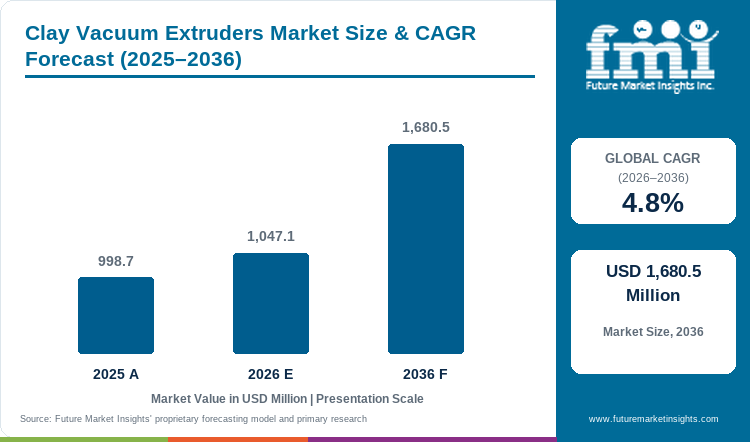
- USD 1047.1 Mn
- Forecast (2036)
- USD 1680.5 Mn
- CAGR (2026 to 2036)
- 4.8%
How big is Clay Vacuum Extruders Market in 2026?
USD 1,047.1 million in 2026 and USD 1,680.5 million by 2036 at a 4.8% CAGR.
Sales of clay vacuum extruders are estimated to rise at 4.8% CAGR through 2036, increasing valuation from USD 998.7 million in 2025 to USD 1,047.1 million in 2026, and reaching USD 1,680.5 million by 2036. Brick and tile plants replace shaping equipment as worn parts change clay density or raise shutdown risk. J.C. Steele’s 2026 seminars focus on better extruder use and daily operating practice. Plant teams also compare brick making machines by usable output and maintenance needs. Vacuum stability and die fit remain part of the same approval decision.
South Africa is projected to grow at 5.8% CAGR, while Germany is projected at 4.0%. Statistics South Africa measured 79.4% capacity use for glass and non-metallic mineral products in May 2026. That level shows active use of the country’s building materials plants and raises the cost of long production stops. South African plants therefore place more weight on reliable service and spare parts. German sites focus more on power use and the fit of new equipment with older lines. Both markets still require clay trials before managers schedule a shutdown. The same machine can therefore face different approval needs even when the core shaping task is similar.
Key Takeaways
- Plant renewal supports demand because worn augers and unstable pressure can lower usable output before firing.
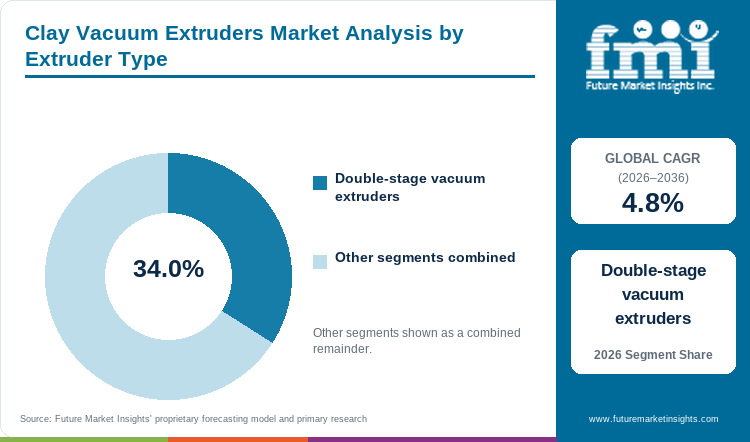
- Based on extruder type, double-stage vacuum extruders are projected to account for 34.0% in 2026. Staged de-airing separates clay preparation from final shaping.
- Bricks are expected to represent 42.0% of output product revenue in 2026. Repeated runs make pressure changes and wear costs easier to measure.
- For end use, brick manufacturing is forecast to represent 45.0% in 2026. Long production runs make forming stops expensive for plant teams.
- Clay-specific testing slows approval because raw material, moisture, tooling, cutting, drying, and installation timing all affect final machine performance.
- Some of the key players in this market include J.C. Steele & Sons, Verdés, HÄNDLE, Bedeschi S.p.A., Bongioanni Macchine S.p.A., Rieter Morando, SABO S.A., CERIC Technologies, SACMI Group (Cosmec), and Bernini Impianti.
Analyst Perspective
“Clay trials and shutdown planning can matter more than rated throughput. Suppliers that link shaping performance with practical service give plant managers a clearer production plan.”
- Nikhil Kaitwade, Principal Consultant, Future Market Insights
How is the clay vacuum extruders market segmented?
The clay vacuum extruders market is segmented by Extruder Type, Output Product, End Use, Capacity, Sales Channel, and Region.
The clay vacuum extruders market is segmented by extruder type, output product, end use, capacity, sales channel, and region. Extruder type covers five machine designs used for different forming needs. Output product includes bricks, hollow blocks, roof tiles, ceramic profiles, and refractory shapes. End use identifies the plant using the machine. Capacity groups systems by practical output range and plant scale. Sales channel shows how plants buy equipment and service.
What makes double-stage vacuum extruders central to the extruder type category?
Double-stage systems mix and de-air clay before the final shaping step. J.C. Steele’s 2026 seminar agenda covers extruder efficiency and daily operation. Plants also compare industrial automation because drives and controls help keep pressure stable during long runs. Separate stages give operators more room to adjust mixing and shaping as clay feed conditions change.
- Based on extruder type, double-stage vacuum extruders are projected to account for 34.0% in 2026. Staged preparation improves clay mixing before final shaping.
- Operators still test feeders, mixers, dies, cutters, and vacuum response as one line because a machine rating cannot prove full production performance.
Why do bricks lead the output product category?
Brick lines reveal density changes during cutting and drying because the same product repeats at high volume. ANICER lists 5,578 ceramic companies in Brazil and reports billions of clay blocks and roof tiles each year. That scale makes steady extrusion important for clay construction products because small forming errors can affect large production runs.
- By output product, bricks are estimated to hold 42.0% in 2026. Repeated production makes pressure changes and wear costs easier to track.
- Hollow blocks and roof tiles need more specialized shapes. Brick runs give plant teams a simpler way to track how pressure changes affect daily output.
How does brick manufacturing shape the end use category?
Brick plants connect extrusion pressure with cutting, drying, and firing during every production run. The U.S. Census places brick and structural clay products within clay building material manufacturing. Plants making roofing materials use similar process controls but may need different dies and product settings. Long campaigns make poor machine fit costly because one forming problem can affect the rest of the line.
- In 2026, brick manufacturing is expected to lead end use with 45.0% share. Long production runs raise the cost of forming stops.
- Easy maintenance also affects selection because planned die or auger changes can protect kiln loading and keep customer deliveries on schedule.
What supports 10-30 tph demand within the capacity category?
The 10-30 tph band gives regional plants industrial output without the footprint of the largest machines. Plant engineers can match barrel size and vacuum duty to local clay. material handling equipment must feed the line at a steady rate so rated output remains useful. This capacity range also lets plants stage upgrades without rebuilding every upstream and downstream system at once.
- By capacity, the 10-30 tph segment is forecast to represent 39.0% in 2026. Mid-sized plants value lower project cost and flexible upgrades.
- Larger systems need enough preparation and firing capacity to use the added output without building excess work in process or creating new downtime.
Why do ceramic machinery OEMs lead the sales channel category?
Ceramic machinery OEMs can match feeders, mixers, vacuum units, dies, cutters, and controls before startup begins. Turnkey firms remain important when a new factory needs one company to manage the full project. Downstream industrial robots may handle finished material but they do not replace the extruder supplier’s duty to manage clay feed. One lead supplier can reduce coordination work during startup, testing, and later repairs.
- Ceramic machinery OEMs are projected to hold 43.0% share in 2026. Startup support and one technical contact reinforce their role in shaping projects.
- Aftermarket service supports installed machines because plants still need wear parts and field help long after the first capital project ends.
What are the drivers, restraints and opportunities in the Clay Vacuum Extruders Market?
Plant renewal supports demand, clay-specific qualification delays orders, and modular retrofits can reduce the risk of modernization.
- Driver: Producers replace shaping equipment when wear or unstable pressure reduces usable output during repeated production runs.
- Restraint: A new extruder needs clay trials and full-line checks before managers approve installation downtime and capital spending.
- Opportunity: Modular mid-range systems can combine efficient drives with monitoring, faster tooling changes, and local service during staged plant upgrades.
Plants replace equipment when worn parts make output less stable and a shutdown becomes worth the cost. Augers and barrels can change pressure before a full machine failure stops the line. HÄNDLE’s March 2026 ceramitec program showed energy-saving drives and 100-bar extrusion technology. That work links machine choice with power use and daily running cost. Plants using factory automation controls can watch pressure and drive signals during normal production. Site trials then show whether the machine keeps clay density steady with the plant’s real feed. Pressure records help maintenance teams plan wear work before the next shutdown. Managers can replace parts before defects rise further. A steady pressure record also gives them a clear basis for spare-parts planning.
Clay trials remain difficult because mineral mix, moisture, additives, and feed quality can change machine results. J.C. Steele announced a June 2026 seminar on stiff extrusion, efficiency, and daily operation. The program covers practical work that plants complete before accepting a new setup. Dies and cutters must match the clay column leaving the extruder. Dryers can expose density problems that were hard to see during shaping. Installation also takes an active line out of service. Managers delay approval if testing is not linked to a clear startup plan. The new setup must keep drying stable once production resumes. A clear test plan also helps teams set the shutdown window and prepare staff before installation starts.
Mid-sized plants can upgrade clay preparation and shaping without rebuilding the whole factory. SABO Heavy Clay signed a January 2026 cooperation memorandum covering pilot work, automation, building materials, and training in Libya. The agreement connects engineering support with equipment work in project-led markets. A supplier can pair a 10-30 tph system with monitored drives and a clear wear-parts plan. Remote checks can reduce specialist travel and speed early fault finding. Local startup help gives operators a simpler route from clay trials to steady output. Regional spare-parts stocks can also shorten delays after a wear-part failure. This approach reduces the risk of a staged upgrade. It can spread capital work over planned shutdowns instead of one large rebuild.
Which country CAGRs are profiled in the Clay Vacuum Extruders Market?
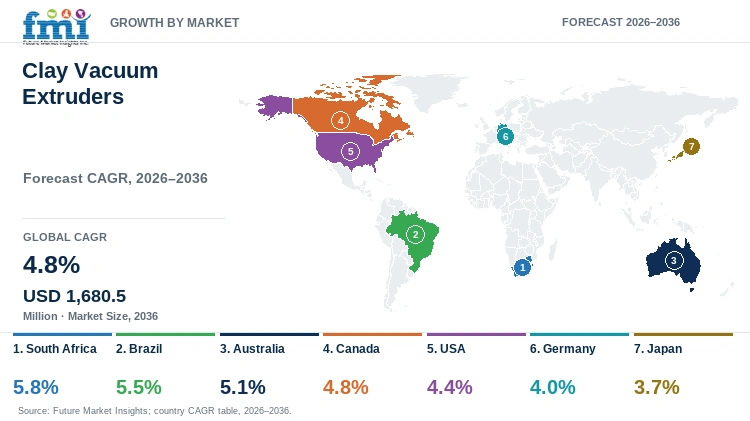
| Country | CAGR |
|---|---|
| South Africa | 5.8% |
| Brazil | 5.5% |
| Australia | 5.1% |
| Canada | 4.8% |
| USA | 4.4% |
| Germany | 4.0% |
| Japan | 3.7% |
How do country-level CAGRs compare in the Clay Vacuum Extruders Market?
The seven country forecasts differ by 2.1 percentage points. South Africa and Brazil form the upper group as plant renewal supports faster growth. Australia and Canada sit in the middle range with more flexible output needs. USA and Germany rely more on replacement work in older plants. Japan grows at 3.7% because careful testing can extend equipment decisions. The rates show forecast speed instead of current revenue. Each country has a different plant base and project cycle.
- South Africa combines active mineral production with service limits, so uptime support carries extra weight during equipment approval.
- Brazil has a large red-ceramic base, while uneven financing and plant standards can slow equipment upgrades in regional factories.
- Australia has plants spread over long distances, so modular equipment and remote support can reduce service delays during uneven project cycles.
- Canada’s changing housing mix favors flexible dies and regional service as plants adjust product runs between different project types.
- US replacement demand depends on matching new extruders with installed feeders, dryers, dies, controls, and maintenance routines.
- Germany gives more weight to energy use and upgrade engineering as mature plants replace shaping equipment inside existing lines.
- Japan combines careful testing with compact plant layouts, which raises service and engineering needs even during slower equipment growth.
Countries with similar CAGRs can still buy equipment in different ways because plant age, service reach, and project timing differ. The full report provides country-level CAGR analysis across North America, Latin America, Western Europe, Eastern Europe, East Asia, South Asia and Pacific, and the Middle East and Africa.
Country-wise Analysis
- South African plants manage linked clay lines under power and service limits that can make downtime expensive. Sales of clay vacuum extruders in South Africa are forecast to expand at 5.8% CAGR by 2036, influenced by plant renewal needs. Statistics South Africa measured 82.6% capacity use for glass and non-metallic mineral products in February 2026. The same division was 0.7 percentage points above the level a year earlier. Plant managers therefore have a reason to protect output during maintenance work. Local parts can shorten stops on shaping lines. Durable drives also help plants handle unstable operating conditions. Remote checks can guide technicians between site visits. Regional spare stocks can help a plant return to output sooner after wear parts fail.
- Brazil’s large brick and tile base includes plants with different levels of automation and access to capital. Brazil is projected to record 5.5% CAGR through 2036, supported by renewal needs in repeated brick and tile production. The Ministry of Cities opened a May 2025 MCMV-FAR selection cycle for 110,000 urban homes. That program adds visibility to future building-material demand and production planning. Plants still need to match any new extruder with local clay behavior. Trials set the right tooling and vacuum levels before installation. Financing can slow a full-line replacement. Modular packages let managers divide the work into smaller steps. Local technical support can then connect each investment stage with proven plant output.
- Australian plants serve a wide geography and face building cycles that can change quickly between regions. Clay vacuum extruder demand in Australia is forecast to rise at 5.1% CAGR over the forecast period, shaped by modular capacity needs. The Australian Bureau of Statistics recorded 17,687 dwelling approvals in July 2026 after a 3.6% monthly fall. That national movement can change the production plans of brick and tile plants. Sites making quarry tiles and roof products may also need different run sizes. Oversized machines add risk if firing capacity cannot keep pace. Mid-range systems give plants more room to adjust output. Regional parts stocks and remote checks reduce service delays when specialist travel takes longer.
- Canadian plants serve housing projects that move between rental, multi-unit, and lower-density construction. Canada is anticipated to record 4.8% CAGR through 2036, linked to flexible product planning. CMHC counted 259,028 housing starts in 2025 and reported 5.6% annual growth. That national activity gives clay producers a changing mix of project types to serve. Plants still size machines against their own firing capacity and product range. A change in brick shape can require new dies without replacing the full line. Seasonal production also increases the value of flexible tooling. Broad local service can reduce delays during these changes. Plants far from major service centers gain most from nearby parts and field support.
- US brick and structural-clay plants work from a large installed base, so many projects replace or improve older machines. The USA clay vacuum extruders sector is projected to record 4.4% CAGR during the assessment period, tied to installed-line renewal. The U.S. Census classifies brick, clay roofing tile, and refractories within clay building material manufacturing. That national classification confirms a broad base of plants using clay shaping processes. Existing feeders and mixers can limit the output of a new extruder. Cutters, dryers, and kilns can create the same problem. Older sites may also make installation work harder. Suppliers need trials that match these interfaces. Fast service helps plants protect long production runs after startup.
- Germany’s mature clay plants focus on machine fit, power use, and maintenance before they approve a replacement. Germany is estimated to post 4.0% CAGR over the forecast period, constrained by a measured replacement cycle. Destatis reported industrial production down 1.1% month over month in July 2026. Construction production rose 0.9% during the same month. Plants making kiln refractory bricks or structural clay still check their own use rates before changing shaping equipment. Older controls can make an upgrade harder. Limited floor space can also affect the installation plan. Service access matters once the line restarts. Suppliers can support approval with clear energy data, clay trials, and service plans that match the installed equipment.
- Japanese plants use compact layouts and careful approval steps before changing production equipment. Adoption of clay vacuum extruders in Japan is estimated to expand at 3.7% CAGR through 2036, shaped by a cautious replacement cycle. Japan’s Ministry of Land reported July 2026 housing starts 8.2% above the prior-year month. That national increase gives building-material producers a firmer view of near-term construction activity. Plant teams still test a new machine against local clay and available floor space. Compact sites leave little room for installation mistakes. Custom tooling can shorten technical review. Clear controls also help operators learn the new setup. Service plans must limit disruption during startup and early product approval.
Who are the notable companies in the Clay Vacuum Extruders Market?
J.C. Steele & Sons, Verdés, HÄNDLE, Bedeschi S.p.A., Bongioanni Macchine S.p.A., Rieter Morando, SABO S.A., CERIC Technologies, SACMI Group (Cosmec), and Bernini Impianti serve the defined clay extrusion and heavy-clay plant boundary.
Clay extruder makers compete with full-line heavy-clay engineers and ceramic plant firms. New suppliers need good clay testing and forming skill. They also need startup help and local service. Direct specialists focus on clay behavior and wear cost during daily production. Full-line groups reduce problems between preparation and shaping machines. SACMI Group (Cosmec) and Bernini Impianti support automation and heat-treatment parts of ceramic projects. Their work supports wider plant projects and does not make them direct vacuum-extruder suppliers.
- J.C. Steele & Sons, Verdés, HÄNDLE, Bongioanni Macchine S.p.A., and Rieter Morando provide direct clay shaping equipment.
- Bedeschi S.p.A., SABO S.A., and CERIC Technologies provide heavy-clay engineering and line integration.
- SACMI Group (Cosmec) and Bernini Impianti support automation and thermal parts of ceramic plant projects.
Competitive Benchmarking: Clay Vacuum Extruders Market
| Company | Vacuum Extrusion Depth | Heavy-clay Line Integration | Service or Technical Support | Geographic Reach |
|---|---|---|---|---|
| J.C. Steele & Sons | High | High | High | Global |
| Verdés | High | High | High | Europe, Americas, Asia, Africa |
| HÄNDLE | High | High | High | Europe and international markets |
| Bedeschi S.p.A. | High | High | High | Global project base |
| Bongioanni Macchine S.p.A. | High | High | Medium | Europe, MENA, Central Asia, Latin America |
| Rieter Morando | High | High | High | Europe, Americas, Africa, Asia |
| SABO S.A. | Low | High | Medium | 50+ countries |
| CERIC Technologies | Medium | High | Medium | Europe, North Africa, Middle East |
| SACMI Group (Cosmec) | Low | High | High | Global ceramic markets |
| Bernini Impianti | Low | Medium | Medium | Europe, Africa, Latin America |
Scoring basis: High means the company has direct vacuum extrusion or heavy-clay shaping work. Medium means the company shows line engineering with relevant extrusion work. Low means the company supports plant integration without direct extrusion work. Service scores also consider project reach and startup help. Spare parts, training, and engineering support complete the service check.
Key Developments in the Clay Vacuum Extruders Market
- In July 2026, Bedeschi S.p.A. reported a clay preparation line for Tupi Guarani Cerâmica in Brazil. The installed line handles clay before the shaping stage.
- In June 2026, Bongioanni Macchine S.p.A. reported a GAMMA die installation in Kurdistan. The setup uses a TECNO 750M extruder and 710D de-airing mixer.
- In May 2026, SACMI Group reported a SAMA NVPP500/750 vacuum extruder installation at Zapel in Poland. The machine processes technical ceramic bodies.
Key Players in the Clay Vacuum Extruders Market
Vacuum extrusion and shaping specialists
- J.C. Steele & Sons
- Verdés
- HÄNDLE
- Bedeschi S.p.A.
- Bongioanni Macchine S.p.A.
- Rieter Morando
Heavy-clay engineering providers
- SABO S.A.
- CERIC Technologies
Ceramic plant integration providers
- SACMI Group (Cosmec)
- Bernini Impianti
Clay Vacuum Extruders Market - Report Scope
| Coverage field | Report scope |
|---|---|
| Market breakdown | By extruder type, output product, end use, capacity, sales channel, and region. |
| Quantitative Units | USD million. |
| Market Definition | Revenue includes industrial clay vacuum extruders and directly attributable de-airing, drive, commissioning, upgrade, spare-parts, and service revenue. Downstream clay products and unrelated kiln or handling revenue are excluded. |
| Regions Covered | North America, Latin America, Western Europe, Eastern Europe, East Asia, South Asia and Pacific, and Middle East and Africa. |
| Countries Covered | South Africa, Brazil, Australia, Canada, USA, Germany, Japan, and 20+ countries included in the full report. |
| Key Companies Profiled | J.C. Steele & Sons, Verdés, HÄNDLE, Bedeschi S.p.A., Bongioanni Macchine S.p.A., Rieter Morando, SABO S.A., CERIC Technologies, SACMI Group (Cosmec), Bernini Impianti. |
| Forecast Period | 2026 to 2036. |
| Approach | Primary and secondary research with market triangulation. |
Clay Vacuum Extruders Market - Research Methodology
| Method | Approach |
|---|---|
| Primary Research | FMI analysts gathered input from manufacturers, service providers, technology developers, distributors, end users, procurement teams, and subject-matter experts. Interviews examined purchasing decisions, product or service evaluation, adoption barriers, approval requirements, pricing considerations, and expectations for technical or commercial support. Respondents were also asked what evidence is required before a trial, pilot, or initial order develops into regular purchasing. |
| Desk Research | Desk research covered government statistics, regulatory publications, trade data, industry associations, technical literature, standards, company filings, product information, and official corporate announcements. Sources were reviewed for relevance, publication date, geographic coverage, and consistency with the defined market scope. Claims relating to performance, applications, approvals, capacity, investment, and commercial activity were retained only when supported by credible public evidence. |
| Market Sizing and Forecasting | The market model combined the baseline value with historical performance, segment structure, pricing and volume indicators, adoption levels, company participation, and country-level demand conditions. Forecast assumptions considered economic activity, investment trends, regulatory developments, technology adoption, purchasing cycles, supply availability, and barriers to wider market use. Segment and regional estimates were reconciled before the final market total was calculated. |
| Data Validation | Estimates were checked against multiple independent indicators, including public data, company activity, trade patterns, industry developments, and findings from primary interviews. Validation also tested whether products, services, applications, and company revenues fell within the defined market boundaries. Adjacent categories, unsupported claims, overlapping revenues, and activities without direct market relevance were excluded to reduce double counting and maintain consistency across segments and countries. |
Clay Vacuum Extruders Market by Segments
Clay Vacuum Extruders Market segmented by Extruder Type:
- Double-stage vacuum extruders
- Single-stage vacuum extruders
- Heavy-duty brick extruders
- Roof tile extruders
- Custom profile extruders
Clay Vacuum Extruders Market segmented by Output Product:
- Bricks
- Hollow blocks
- Roof tiles
- Ceramic tubes - profiles
- Refractory shapes
Clay Vacuum Extruders Market segmented by End Use:
- Brick manufacturing
- Structural clay products
- Roof tile plants
- Ceramic extrusion
- Refractory plants
Clay Vacuum Extruders Market segmented by Capacity:
- Below 10 tph
- 10-30 tph
- 30-60 tph
- Above 60 tph
Clay Vacuum Extruders Market segmented by Sales Channel:
- Ceramic machinery OEMs
- Turnkey plant projects
- Direct equipment sales
- Aftermarket - service
Clay Vacuum Extruders Market by Region:
- North America
- USA
- Canada
- Mexico
- Latin America
- Brazil
- Mexico
- Chile
- Rest of Latin America
- Western Europe
- Germany
- United Kingdom
- Italy
- Spain
- France
- Nordics
- Benelux
- Rest of Western Europe
- Eastern Europe
- Russia
- Poland
- Hungary
- Balkan and Baltic States
- Rest of Eastern Europe
- East Asia
- China
- Japan
- South Korea
- South Asia and Pacific
- India
- ASEAN
- Australia and New Zealand
- Rest of South Asia and Pacific
- Middle East and Africa
- Kingdom of Saudi Arabia
- Other GCC Countries
- Türkiye
- South Africa
- Other African Union Countries
- Rest of Middle East and Africa
Research Sources and Bibliography
- J.C. Steele & Sons. (2026, May 8). Extrusion Seminar June 23rd & 24th, 2026.
- Statistics South Africa. (2026, August 6). Manufacturing: Utilisation of production capacity by large enterprises, May 2026.
- ANICER. (2025, October 6). Dados do Setor.
- U.S. Census Bureau. (n.d.). North American Industry Classification System: Clay Building Material and Refractories Manufacturing.
- HÄNDLE GmbH. (2026, March). ceramitec 2026.
- SABO S.A. (2026, January 15). Memorandum of Understanding (MoU) with the Libyan Development and Reconstruction Fund.
- Australian Bureau of Statistics. (2026, September 1). Total dwelling approvals fall 3.6% in July.
- Canada Mortgage and Housing Corporation. (2026, January 16). Housing starts up 5.6% in 2025 from 2024.
- Ministry of Cities of Brazil. (2025, May 19). MCMV-FAR 2025: Urban Housing Selection.
- German Federal Statistical Office. (2026, September 7). Production in July 2026: -1.1% on the previous month.
- Ministry of Land, Infrastructure, Transport and Tourism of Japan. (2026, August 31). Building Starts Statistics Survey Report, July 2026.
- Bedeschi S.p.A. (2026, July 20). Bedeschi Clay Preparation Line for Tupi Guarani Cerâmica.
- Bongioanni Macchine S.p.A. (2026, June 23). New GAMMA die installed for brick production in Kurdistan.
- SACMI Group. (2026, May 11). Zapel installs a new SAMA NVPP500/750 extruder to produce ceramic insulators.
- Statistics South Africa. (2026, May 7). Manufacturing: Utilisation of production capacity by large enterprises, February 2026.
This bibliography is provided for reader reference and is not exhaustive. The full report contains the complete reference list and detailed citations.
This Report Answers
- What value is forecast for clay vacuum extruders through 2036?
- What makes plants replace vacuum extrusion equipment?
- Why do double-stage systems hold the highest extruder-type share?
- How do brick lines turn shaping consistency into equipment demand?
- What limits approval of a new vacuum extruder in an existing plant?
- How do country growth rates differ across the profiled markets?
- Which companies supply clay shaping or full-line plant systems?
- What should plant managers test before scheduling an extrusion retrofit?
- How do line limits and shutdown time affect return on investment?
Frequently Asked Questions
How big is the clay vacuum extruders market in 2026?
The clay vacuum extruders market is valued at USD 1,047.1 million in 2026 and USD 1,680.5 million by 2036. Plant replacement supports growth because factories need steady forming and reliable uptime.
What CAGR is forecast for clay vacuum extruders through 2036?
The clay vacuum extruders market is projected to grow at 4.8% CAGR through 2036. Replacement work and clay trials shape demand, while local service and project timing affect final orders.
Which extruder type leads the clay vacuum extruders market?
The double-stage vacuum extruders segment is expected to hold 34.0% of extruder type revenue in 2026. Separate mixing and de-airing help plants keep final shaping steady during normal production.
Which output product holds the largest current share?
The bricks segment is projected to hold 42.0% of output product revenue in 2026. Repeated forming lets plant teams measure pressure changes, wear, and tooling life against daily production cost.
Which companies are active in the clay vacuum extruders market?
Key companies include J.C. Steele & Sons, Verdés, HÄNDLE, Bedeschi S.p.A., Bongioanni Macchine S.p.A., Rieter Morando, SABO S.A., CERIC Technologies, SACMI Group (Cosmec), and Bernini Impianti. Their work covers extrusion, heavy-clay engineering, service, automation, and plant integration.
What problem do clay vacuum extruders solve?
Clay vacuum extruders remove trapped air and form prepared clay into a steady column for cutting or further shaping. Stable density helps plants reduce size changes and defects during later drying or firing.
What is a notable restraint in the clay vacuum extruders market?
Clay-specific testing is a key restraint because feed quality and moisture can change machine results. Plants also check vacuum response, tooling, cutting, and drying before they approve installation downtime.
What should plant managers evaluate before buying a clay vacuum extruder?
Plant managers should compare clay test results, usable output, vacuum stability, pressure, and tooling fit. They should also check wear access, service speed, and how the machine matches preparation and firing equipment.
Preview the report firsthand - request a free sample
Get SampleGet the brochure for pricing and purchase details.
Get PDFTable of Content
- Key Takeaways
- Market Size and CAGR
- Top Growth Driver
- Fastest Growing Segment
- Leading Region
- Key Companies
- Emerging Opportunities
- Executive Summary
- Global Market Outlook
- Demand-side Trends
- Supply-side Trends
- Technology Roadmap Analysis
- Analysis and Recommendations
- Analyst Perspective (What is happening? Why now? What should investors know?)
- Key Questions Answered
- How large is the market?
- What is the CAGR?
- What are key trends?
- Which region dominates?
- Who are the leaders?
- Market Overview
- Market Coverage / Taxonomy
- Market Definition / Scope / Limitations
- Research Methodology
- Chapter Orientation
- Analytical Lens and Working Hypotheses
- Market Structure, Signals, and Trend Drivers
- Benchmarking and Cross-market Comparability
- Market Sizing, Forecasting, and Opportunity Mapping
- Research Design and Evidence Framework
- Desk Research Programme (Secondary Evidence)
- Expert Input and Fieldwork (Primary Evidence)
- Tooling, Models, and Reference Databases
- Data Engineering and Model Build
- Quality Assurance and Audit Trail
- Market Background
- Market Dynamics (Drivers, Restraints, Opportunity, Trends)
- Scenario Forecast (Optimistic, Likely, Conservative)
- Impact Analysis
- AI Impact
- Sustainability Impact
- Regulatory Impact
- Technology Impact
- Consumer / Buyer Analysis
- Purchase Drivers
- Adoption Barriers
- Buyer Journey
- Opportunity Map Analysis
- Product Life Cycle Analysis
- Supply Chain Analysis
- Investment Feasibility Matrix
- Value Chain Analysis
- PESTLE and Porter's Analysis
- Regulatory Landscape
- Regional Parent Market Outlook
- Production and Consumption Statistics
- Import and Export Statistics
- Global Market Analysis and Forecast, 2021 to 2036
- Historical Market Size Value (USD Million) Analysis, 2021 to 2025
- Current and Future Market Size Value (USD Million) Projections, 2026 to 2036
- Y-o-Y Growth Trend Analysis
- Absolute $ Opportunity Analysis
- Global Market Pricing Analysis, 2021 to 2036
- Global Market Analysis and Forecast, By Extruder Type, 2021 to 2036
- Introduction / Key Findings
- Historical Market Size Value (USD Million) Analysis By Extruder Type, 2021 to 2025
- Current and Future Market Size Value (USD Million) Analysis and Forecast By Extruder Type, 2026 to 2036
- Double-stage vacuum extruders
- Single-stage vacuum extruders
- Heavy-duty brick extruders
- Roof tile extruders
- Custom profile extruders
- Y-o-Y Growth Trend Analysis By Extruder Type, 2021 to 2025
- Absolute $ Opportunity Analysis By Extruder Type, 2026 to 2036
- Global Market Analysis and Forecast, By Output Product, 2021 to 2036
- Introduction / Key Findings
- Historical Market Size Value (USD Million) Analysis By Output Product, 2021 to 2025
- Current and Future Market Size Value (USD Million) Analysis and Forecast By Output Product, 2026 to 2036
- Bricks
- Hollow blocks
- Roof tiles
- Ceramic tubes - profiles
- Refractory shapes
- Y-o-Y Growth Trend Analysis By Output Product, 2021 to 2025
- Absolute $ Opportunity Analysis By Output Product, 2026 to 2036
- Global Market Analysis and Forecast, By End Use, 2021 to 2036
- Introduction / Key Findings
- Historical Market Size Value (USD Million) Analysis By End Use, 2021 to 2025
- Current and Future Market Size Value (USD Million) Analysis and Forecast By End Use, 2026 to 2036
- Brick manufacturing
- Structural clay products
- Roof tile plants
- Ceramic extrusion
- Refractory plants
- Y-o-Y Growth Trend Analysis By End Use, 2021 to 2025
- Absolute $ Opportunity Analysis By End Use, 2026 to 2036
- Global Market Analysis and Forecast, By Capacity, 2021 to 2036
- Introduction / Key Findings
- Historical Market Size Value (USD Million) Analysis By Capacity, 2021 to 2025
- Current and Future Market Size Value (USD Million) Analysis and Forecast By Capacity, 2026 to 2036
- Below 10 tph
- 10-30 tph
- 30-60 tph
- Above 60 tph
- Y-o-Y Growth Trend Analysis By Capacity, 2021 to 2025
- Absolute $ Opportunity Analysis By Capacity, 2026 to 2036
- Global Market Analysis and Forecast, By Sales Channel, 2021 to 2036
- Introduction / Key Findings
- Historical Market Size Value (USD Million) Analysis By Sales Channel, 2021 to 2025
- Current and Future Market Size Value (USD Million) Analysis and Forecast By Sales Channel, 2026 to 2036
- Ceramic machinery OEMs
- Turnkey plant projects
- Direct equipment sales
- Aftermarket - service
- Y-o-Y Growth Trend Analysis By Sales Channel, 2021 to 2025
- Absolute $ Opportunity Analysis By Sales Channel, 2026 to 2036
- Global Market Analysis and Forecast, By Region, 2021 to 2036
- Introduction
- Historical Market Size Value (USD Million) Analysis By Region, 2021 to 2025
- Current Market Size Value (USD Million) Analysis and Forecast By Region, 2026 to 2036
- North America
- Latin America
- Western Europe
- Eastern Europe
- East Asia
- South Asia and Pacific
- Middle East and Africa
- Market Attractiveness Analysis By Region
- North America Market Analysis and Forecast, By Country, 2021 to 2036
- Historical Market Size Value (USD Million) Trend Analysis By Market Taxonomy, 2021 to 2025
- Market Size Value (USD Million) Forecast By Market Taxonomy, 2026 to 2036
- By Country
- USA
- Canada
- Mexico
- By Extruder Type
- By Output Product
- By End Use
- By Capacity
- By Sales Channel
- By Country
- Market Attractiveness Analysis
- By Country
- By Extruder Type
- By Output Product
- By End Use
- By Capacity
- By Sales Channel
- Key Takeaways
- Latin America Market Analysis and Forecast, By Country
- Historical Market Size Value (USD Million) Trend Analysis By Market Taxonomy, 2021 to 2025
- Market Size Value (USD Million) Forecast By Market Taxonomy, 2026 to 2036
- By Country
- Brazil
- Mexico
- Chile
- Rest of Latin America
- By Extruder Type
- By Output Product
- By End Use
- By Capacity
- By Sales Channel
- By Country
- Market Attractiveness Analysis
- By Country
- By Extruder Type
- By Output Product
- By End Use
- By Capacity
- By Sales Channel
- Key Takeaways
- Western Europe Market Analysis and Forecast, By Country
- Historical Market Size Value (USD Million) Trend Analysis By Market Taxonomy, 2021 to 2025
- Market Size Value (USD Million) Forecast By Market Taxonomy, 2026 to 2036
- By Country
- Germany
- United Kingdom
- Italy
- Spain
- France
- Nordics
- Benelux
- Rest of Western Europe
- By Extruder Type
- By Output Product
- By End Use
- By Capacity
- By Sales Channel
- By Country
- Market Attractiveness Analysis
- By Country
- By Extruder Type
- By Output Product
- By End Use
- By Capacity
- By Sales Channel
- Key Takeaways
- Eastern Europe Market Analysis and Forecast, By Country
- Historical Market Size Value (USD Million) Trend Analysis By Market Taxonomy, 2021 to 2025
- Market Size Value (USD Million) Forecast By Market Taxonomy, 2026 to 2036
- By Country
- Russia
- Poland
- Hungary
- Balkan and Baltic States
- Rest of Eastern Europe
- By Extruder Type
- By Output Product
- By End Use
- By Capacity
- By Sales Channel
- By Country
- Market Attractiveness Analysis
- By Country
- By Extruder Type
- By Output Product
- By End Use
- By Capacity
- By Sales Channel
- Key Takeaways
- East Asia Market Analysis and Forecast, By Country
- Historical Market Size Value (USD Million) Trend Analysis By Market Taxonomy, 2021 to 2025
- Market Size Value (USD Million) Forecast By Market Taxonomy, 2026 to 2036
- By Country
- China
- Japan
- South Korea
- By Extruder Type
- By Output Product
- By End Use
- By Capacity
- By Sales Channel
- By Country
- Market Attractiveness Analysis
- By Country
- By Extruder Type
- By Output Product
- By End Use
- By Capacity
- By Sales Channel
- Key Takeaways
- South Asia and Pacific Market Analysis and Forecast, By Country
- Historical Market Size Value (USD Million) Trend Analysis By Market Taxonomy, 2021 to 2025
- Market Size Value (USD Million) Forecast By Market Taxonomy, 2026 to 2036
- By Country
- India
- ASEAN
- Australia and New Zealand
- Rest of South Asia and Pacific
- By Extruder Type
- By Output Product
- By End Use
- By Capacity
- By Sales Channel
- By Country
- Market Attractiveness Analysis
- By Country
- By Extruder Type
- By Output Product
- By End Use
- By Capacity
- By Sales Channel
- Key Takeaways
- Middle East and Africa Market Analysis and Forecast, By Country
- Historical Market Size Value (USD Million) Trend Analysis By Market Taxonomy, 2021 to 2025
- Market Size Value (USD Million) Forecast By Market Taxonomy, 2026 to 2036
- By Country
- Kingdom of Saudi Arabia
- Other GCC Countries
- Türkiye
- South Africa
- Other African Union Countries
- Rest of Middle East and Africa
- By Extruder Type
- By Output Product
- By End Use
- By Capacity
- By Sales Channel
- By Country
- Market Attractiveness Analysis
- By Country
- By Extruder Type
- By Output Product
- By End Use
- By Capacity
- By Sales Channel
- Key Takeaways
- Key Countries Market Analysis
- USA
- Pricing Analysis
- Market Share Analysis, 2025
- By Extruder Type
- By Output Product
- By End Use
- By Capacity
- By Sales Channel
- Canada
- Pricing Analysis
- Market Share Analysis, 2025
- By Extruder Type
- By Output Product
- By End Use
- By Capacity
- By Sales Channel
- Mexico
- Pricing Analysis
- Market Share Analysis, 2025
- By Extruder Type
- By Output Product
- By End Use
- By Capacity
- By Sales Channel
- Brazil
- Pricing Analysis
- Market Share Analysis, 2025
- By Extruder Type
- By Output Product
- By End Use
- By Capacity
- By Sales Channel
- Chile
- Pricing Analysis
- Market Share Analysis, 2025
- By Extruder Type
- By Output Product
- By End Use
- By Capacity
- By Sales Channel
- Germany
- Pricing Analysis
- Market Share Analysis, 2025
- By Extruder Type
- By Output Product
- By End Use
- By Capacity
- By Sales Channel
- United Kingdom
- Pricing Analysis
- Market Share Analysis, 2025
- By Extruder Type
- By Output Product
- By End Use
- By Capacity
- By Sales Channel
- Italy
- Pricing Analysis
- Market Share Analysis, 2025
- By Extruder Type
- By Output Product
- By End Use
- By Capacity
- By Sales Channel
- Spain
- Pricing Analysis
- Market Share Analysis, 2025
- By Extruder Type
- By Output Product
- By End Use
- By Capacity
- By Sales Channel
- France
- Pricing Analysis
- Market Share Analysis, 2025
- By Extruder Type
- By Output Product
- By End Use
- By Capacity
- By Sales Channel
- India
- Pricing Analysis
- Market Share Analysis, 2025
- By Extruder Type
- By Output Product
- By End Use
- By Capacity
- By Sales Channel
- ASEAN
- Pricing Analysis
- Market Share Analysis, 2025
- By Extruder Type
- By Output Product
- By End Use
- By Capacity
- By Sales Channel
- Australia and New Zealand
- Pricing Analysis
- Market Share Analysis, 2025
- By Extruder Type
- By Output Product
- By End Use
- By Capacity
- By Sales Channel
- China
- Pricing Analysis
- Market Share Analysis, 2025
- By Extruder Type
- By Output Product
- By End Use
- By Capacity
- By Sales Channel
- Japan
- Pricing Analysis
- Market Share Analysis, 2025
- By Extruder Type
- By Output Product
- By End Use
- By Capacity
- By Sales Channel
- South Korea
- Pricing Analysis
- Market Share Analysis, 2025
- By Extruder Type
- By Output Product
- By End Use
- By Capacity
- By Sales Channel
- Russia
- Pricing Analysis
- Market Share Analysis, 2025
- By Extruder Type
- By Output Product
- By End Use
- By Capacity
- By Sales Channel
- Poland
- Pricing Analysis
- Market Share Analysis, 2025
- By Extruder Type
- By Output Product
- By End Use
- By Capacity
- By Sales Channel
- Hungary
- Pricing Analysis
- Market Share Analysis, 2025
- By Extruder Type
- By Output Product
- By End Use
- By Capacity
- By Sales Channel
- Kingdom of Saudi Arabia
- Pricing Analysis
- Market Share Analysis, 2025
- By Extruder Type
- By Output Product
- By End Use
- By Capacity
- By Sales Channel
- Türkiye
- Pricing Analysis
- Market Share Analysis, 2025
- By Extruder Type
- By Output Product
- By End Use
- By Capacity
- By Sales Channel
- South Africa
- Pricing Analysis
- Market Share Analysis, 2025
- By Extruder Type
- By Output Product
- By End Use
- By Capacity
- By Sales Channel
- Australia
- Pricing Analysis
- Market Share Analysis, 2025
- By Extruder Type
- By Output Product
- By End Use
- By Capacity
- By Sales Channel
- USA
- Market Structure Analysis
- Competition Dashboard
- Competition Benchmarking
- Market Share Analysis of Top Players
- By Regional
- By Extruder Type
- By Output Product
- By End Use
- By Capacity
- By Sales Channel
- Emerging Startups
- Innovation Benchmarking
- Competition Analysis
- Competition Deep Dive
- J.C. Steele & Sons
- Overview
- Product Portfolio
- Profitability by Market Segments
- Sales Footprint
- Strategy Overview
- Marketing Strategy
- Product Strategy
- Channel Strategy
- Verdés
- HÄNDLE
- Bedeschi S.p.A.
- Bongioanni Macchine S.p.A.
- Rieter Morando
- SABO S.A.
- CERIC Technologies
- SACMI Group (Cosmec)
- Bernini Impianti
- J.C. Steele & Sons
- Case Studies
- Success Stories
- Recent Developments
- Competition Deep Dive
- Assumptions & Acronyms Used


