

- Market Size (2026)
- USD 677.6 Mn
- Forecast (2036)
- USD 1073.9 Mn
- CAGR (2026 to 2036)
- 4.7%
How big is Clay Fine Roller Mills Market in 2026?
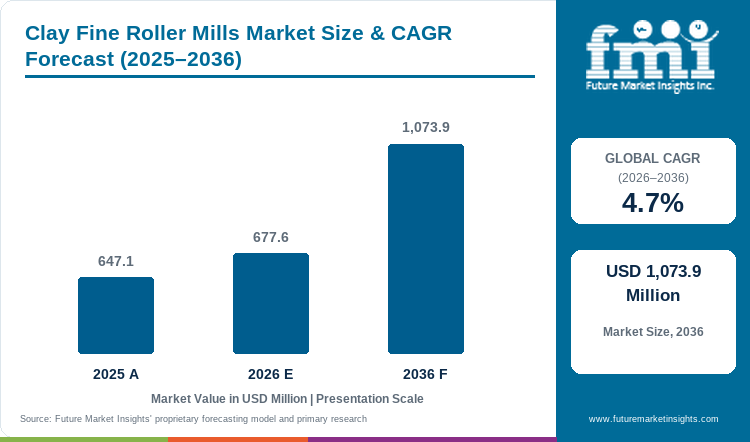
USD 677.6 million in 2026 and USD 1,073.9 million by 2036 at a 4.7% CAGR.
Sales of clay fine roller mills are estimated to rise at 4.7% CAGR through 2036. Valuation rises from USD 647.1 million in 2025 to USD 677.6 million in 2026 and reaches USD 1,073.9 million by 2036. Plant teams use fine grinding to remove large clay particles before extrusion. This helps reduce product rejects. In March 2026, HÄNDLE showed ALPHA II fine roller mills at ceramitec with very small roller gaps. The presentation described a current fine-grinding method for preparing clay before shaping.
Hungary is projected to grow at 6.0% CAGR through 2036. Germany is projected at 4.3%. The 1.7-point gap comes from different project timing and replacement needs. In May 2026, Destatis reported that Germany completed 206,600 homes in 2025. This was 18.0% lower than in 2024. Lower completions make German expansion projects more cautious. Existing plants still need replacement equipment. Clay trials remain important in both countries because the roll gap and wear rate must suit the clay before approval.
Key Takeaways
- Clay plants replace or rebuild fine roller mills when gap drift starts to hurt extrusion quality, product rejects, or line uptime.
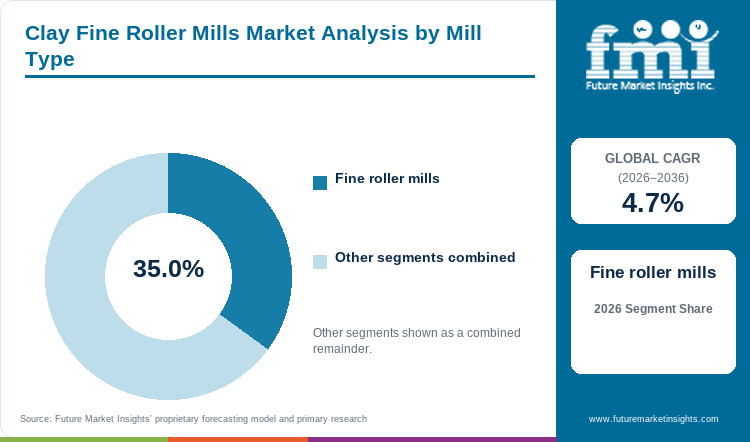
- Based on mill type, fine roller mills are projected to account for 35.0% in 2026, driven by their role in final particle control.
- By roll surface, smooth rolls are estimated to hold 34.0% in 2026, supported by adjustable shear and easy wear checks.
- By end use, brick production is forecast to represent 41.0% in 2026. Its share is attributable to the many brick plants that process clay every day.
- Clay trials and shutdown planning can delay a replacement order. Foundation and electrical work can add more time even when plants can see the process loss.
- Some of the key players in this market include HÄNDLE, Verdés, Bedeschi, J.C. Steele & Sons, Bongioanni Macchine, Rieter Morando, SABO S.A., CLEIA, COSMEC and Bernini Impianti.
Analyst Perspective
"A fine roller mill earns approval once the supplier proves stable gap control with the plant's actual clay. Fast service then helps the plant keep that result between planned shutdowns."
- Nandini Roy Choudhury, Principal Consultant, Future Market Insights
How is the clay fine roller mills market segmented?
Clay Fine Roller Mills Market is segmented by Mill Type, Roll Surface, End Use, Capacity, Sales Channel and Region.
The clay fine roller mills market is segmented by mill type, roll surface, end use, capacity, sales channel and region. Mill type includes fine, primary, differential, hydraulic gap-controlled and high-pressure roller mills. Roll surfaces include smooth, corrugated, hard-faced and coated rolls that resist wear. End uses include brick, roof tile, ceramic body, refractory clay and clay block production. Capacity ranges from below 10 tph to above 80 tph. Sales channels include ceramic machinery OEMs, full plant projects, replacement rolls and direct equipment sales.
What makes fine roller mills central to the mill type category?
Fine roller mills handle the last controlled size-reduction step before clay reaches mixing or extrusion. Plants compare grinding mill equipment by particle control and roll wear during final grinding. In August 2026, Verdés introduced its TERRA fine roller range for very fine clay grinding with narrow roller gaps. The range is designed to give more even clay before mixing and shaping.
- Based on mill type, fine roller mills are projected to account for 35.0% in 2026, driven by direct control of final clay particle size.
- Plants approve the setup once clay trials show that a narrow gap can run without heavy wear or unstable feed.
How do smooth rolls influence selection within the roll surface category?
Smooth rolls press moist clay with a controlled surface. A small speed difference between the rolls adds shear. Bentonite feed is one special clay that can need controlled wet grinding. In October 2025, Verdés described final wet grinding of special clays with two smooth rolls and a small speed difference.
- By roll surface, smooth rolls are estimated to hold 34.0% in 2026, supported by steady clay flattening and easy wear checks.
- Corrugated rolls become more useful when the feed is hard to grip. Hard-faced rolls are useful when abrasive clay causes faster wear.
How does brick production shape demand within the end use category?
Brick plants process clay without long breaks, so small changes in rejects or downtime can raise costs quickly. Brick-making machines use the same clay preparation and forming flow. In July 2026, Bedeschi reported completion of a clay preparation line at Tupi Guarani Cerâmica in Brazil. The project links clay preparation directly with active brick production.
- In 2026, brick production is expected to lead end use with 41.0% share, attributable to its large base of continuously operating clay plants.
- Roof tile and refractory lines may need tighter control. Their production base is usually smaller than the base for mainstream brick output.
What supports the 10-30 tph category within capacity?
The 10-30 tph band gives established plants useful output without the major civil work needed by the largest mills. Material handling equipment must still match the feeders and transfer points near the mill. In August 2025, SABO reported a fully automated brick plant in Astana. The plant was designed for about 430 tonnes per day. Bigger projects therefore need more work to connect each part of the line.
- By capacity, 10-30 tph is forecast to represent 38.0% in 2026. Its position is supported by practical upgrade needs and useful output for many plants.
- Larger mills can bring more design and setup work. These orders occur less often. They also need more site work before installation.
What drives ceramic machinery OEMs within the sales channel category?
A roller mill must match the clay moisture and the size of incoming lumps. It must also match the drives, guards and shaping equipment that follows it. Industrial automation changes how plant controls and line connections are set up. In June 2025, Bongioanni Macchine reported delivery of a brick plant with linked preparation and forming equipment. One OEM can reduce connection problems during startup by handling more of the line.
- Ceramic machinery OEMs are projected to hold 39.0% in 2026, influenced by their ability to match machine choice with plant startup.
- Direct equipment sales still work for plants with strong in-house skills. Replacement rolls serve mills already in use and often need a shorter approval process.
What are the drivers, restraints and opportunities in the Clay Fine Roller Mills Market?
Clay-body consistency supports replacement demand, site work slows capital approval and mill revamps widen the service opportunity.
- Driver: Plant teams tighten final grinding when large clay particles or gap drift start to hurt extrusion quality and line output.
- Restraint: Clay trials and installation work can lengthen approval for a replacement mill. Uncertain construction demand can add more delay.
- Opportunity: Electronic gap controls and rebuilt wear parts can keep older lines working longer. Service-led upgrades can also delay the need for a full line replacement.
Process losses make final grinding a production decision
Continuous clay processing makes gap drift costly because the same defect can repeat in every tonne of clay. Industrial ceramics also need steady clay quality before forming. In April 2026, HÄNDLE held a customer day on preparation machines, service and wear parts. The event focused on support for machines already in use. Plant managers can justify replacement when trials link steady gap control with fewer rejects or fewer stops.
Site work and uncertain end demand can delay capital approval
A fine roller mill may need foundation work, electrical changes, guarding and a planned production stop before startup. Factory automation controls can add more connection work during an upgrade. In August 2026, the U.S. Census Bureau reported July housing starts 13.5% below the prior-year level. Permits were 3.1% higher. Mixed construction signals can delay optional expansion spending. Replacement work can still move forward when a worn mill causes a clear production loss.
Revamping gives suppliers a route into the installed base
Many plants can improve clay processing without replacing every machine in the line. Rebuild programs for mineral processing equipment often focus on the worn stage that limits output. In July 2025, Bedeschi reported an upgrade of an MB187 pan mill used for decades in clay brick production. Fine roller mill specialists can target similar upgrade budgets with clay tests, new roll shells and planned service.
Which country CAGRs are profiled in the Clay Fine Roller Mills Market?
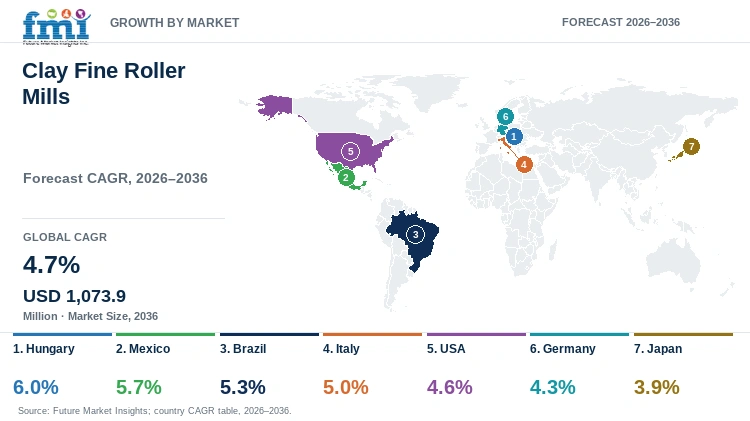
| Country | CAGR |
|---|---|
| Hungary | 6.0% |
| Mexico | 5.7% |
| Brazil | 5.3% |
| Italy | 5.0% |
| USA | 4.6% |
| Germany | 4.3% |
| Japan | 3.9% |
How do country-level CAGRs compare in the Clay Fine Roller Mills Market?
The profiled CAGRs span 2.1 percentage points, from Hungary at 6.0% to Japan at 3.9%. Hungary and Mexico form the higher-growth group. Brazil and Italy follow. USA, Germany and Japan form the lower-growth group. CAGR alone does not show current market size or the quality of future orders.
- Hungary has good access to Central European machine makers and repair shops. Home building activity is also recovering.
- Mexico links national housing programs with phased additions to local building-material capacity.
- Brazil places greater value on field setup and spare-part supply because plants are spread over a large area.
- Italy has many established heavy-clay plants. This makes upgrades of machines already in use a common project type.
- US plant decisions often depend on a clear payback case and fast domestic service.
- Germany places more weight on upgrade compatibility inside older and well-established preparation halls.
- Japan places more weight on long equipment life and steady quality than on the highest rated output.
Similar CAGRs can still lead to different order patterns. The main differences are machines already in use, service reach and project timing.
The full report provides country-level CAGR analysis across North America, Latin America, Western Europe, Eastern Europe, East Asia, South Asia and Pacific and the Middle East and Africa.
Country-wise Analysis
- Hungarian clay plants can use machine makers and repair shops in Central Europe. Hungary is projected to grow at 6.0% CAGR through 2036, supported by stronger home building activity. In July 2026, the Hungarian Central Statistical Office reported that first-half home completions rose 22%. Planned homes rose 29%. The market has a limited number of large plants. One major project can therefore change annual equipment demand. Suppliers need fast wear-part service. Upgrade designs must also match the layout and feed system already used at each plant.
- Mexico is adding homes under a national program that can bring forward decisions on building-material capacity. Clay fine roller mill demand in Mexico is forecast to rise at 5.7% CAGR through 2036. Plan México set a goal of one million social homes by 2030. It also identified 577,000 new housing credits in 2025. Plants are spread over a wide area. Suppliers therefore need local spare parts and service. Phased mill sizing lets a plant add output in steps instead of funding the largest setup at once. This can lower service and expansion risk.
- Brazilian brick producers often buy preparation equipment as part of larger plant upgrades that need field setup. Brazil is estimated to post 5.3% CAGR over the forecast period, influenced by selected capacity additions and replacement work. In January 2026, IBGE reported that Brazil's construction cost index rose 5.63% during 2025. Higher project costs can slow a full-line investment. They do not remove the need to replace worn preparation equipment. Plants may split work into stages to control spending. Regional parts supply can also reduce service delays over Brazil's large operating area.
- Italy has a long-established brick and ceramic machinery base, which makes rebuild work practical. Clay fine roller mill demand in Italy is forecast to expand at 5.0% CAGR through 2036. In July 2026, Confindustria Ceramica reported 57 manufacturers operating 76 plants. These plants produced 3.9 million tonnes of clay building materials in 2025. Italian machine makers also serve ceramic tiles, so clay-processing skills extend beyond brick lines. Many plants already have usable equipment. Plant teams therefore need clear energy savings, lower repair needs, or better output before they approve a replacement.
- US brick plants usually need a plant-level payback case before they replace preparation machinery. The USA is projected to record 4.6% CAGR during the assessment period, linked to a large base of clay-product plants. In January 2026, the U.S. Geological Survey reported about 26 million tons of clay production in 2025. Common clay was used for brick, aggregate and cement. Roller-mill orders compete with other repair and upkeep needs. Local clay trials can prove the process benefit. Domestic service can then shorten approval for a worn mill and reduce downtime risk.
- German plants often install replacement machinery inside older production halls with tight space and design limits. Germany is estimated to post 4.3% CAGR over the forecast period, influenced by upgrade demand and cautious construction spending. In September 2026, Destatis reported that permits for new homes rose 13.5% from January through July 2026. Better permit activity can support demand. Mature plants still check energy use, service life and repair cost before they replace working equipment. Mill suppliers need efficient drives, accurate line connections and dependable wear-part delivery.
- Japanese buyers usually value steady gap control and long service life more than the highest rated output. Adoption of clay fine roller mills in Japan is estimated to expand at 3.9% CAGR through 2036, constrained by a smaller housing pipeline. In January 2026, Japan's Ministry of Land, Infrastructure, Transport and Tourism reported that 2025 housing starts fell in owner-occupied, rental and for-sale categories. Lower new-build volume extends the payback period for added capacity. Many replacement projects therefore focus on compact equipment. Local technical support and proof of steady product quality can make the replacement case easier to approve.
Who are the notable companies in the Clay Fine Roller Mills Market?
HÄNDLE, Verdés, Bedeschi, J.C. Steele & Sons, Bongioanni Macchine, Rieter Morando, SABO S.A., CLEIA, COSMEC and Bernini Impianti are active within the defined clay-preparation and heavy-clay equipment boundary.
Competition is split between fine-grinding specialists and plant builders that handle more of the production line. Fine roller mill orders depend on clay tests, gap control, roll wear and service speed. Full-line builders can connect preparation with shaping and automation. Upgrades of clay building products plants can also involve handling, drying and firing specialists. These firms enter the same project when the owner changes several parts of the line at once.
- HÄNDLE, Verdés, J.C. Steele & Sons and Rieter Morando have direct roles in clay preparation or roll-based size reduction.
- Bedeschi, Bongioanni Macchine, SABO S.A. and CLEIA compete in larger heavy-clay plant projects. Their work can include several parts of a plant upgrade.
- COSMEC and Bernini Impianti add automation, handling, or firing-system work. Their role can change the timing and size of a full plant upgrade.
Competitive Benchmarking: Clay Fine Roller Mills Market
| Company | Fine-Grinding Scope | Clay-Line Integration | Modernization & Support | Geographic Reach |
|---|---|---|---|---|
| HÄNDLE | High | High | High | Global |
| Verdés | High | High | Medium | Global |
| Bedeschi | Medium | High | High | Global |
| J.C. Steele & Sons | High | Medium | High | North America and international |
| Bongioanni Macchine | Medium | High | High | Europe and international |
| Rieter Morando | High | High | High | Europe and international |
| SABO S.A. | Medium | High | High | Europe, Central Asia and Middle East |
| CLEIA | Low | High | High | Europe, North Africa and international |
| COSMEC | Low | High | High | Europe and North America |
| Bernini Impianti | Low | Medium | High | Europe and international |
Scoring basis: High fine-grinding scope means a company shows a strong range of dedicated roller mills. Medium means it shows relevant clay-preparation machines. Low means it works on clay plants but does not show a fine-roll core. High integration means the company covers several stages of a clay line. High upgrade support requires recent project or service proof. Geographic reach lists the regions served and is not scored.
Key Developments in the Clay Fine Roller Mills Market
- In April 2026, Bedeschi installed two specialized robotic grippers for a major US brick producer.
- In January 2026, Bongioanni Macchine launched an on-site scanning service for customer equipment and parts.
- In December 2025, SABO documented a partnership with ALA S.R.L. Equipment from the partnership had started operating earlier in 2025.
Key Players in the Clay Fine Roller Mills Market
Fine-grinding and clay-preparation specialists
- HÄNDLE
- Verdés
- J.C. Steele & Sons
- Rieter Morando
Turnkey heavy-clay machinery integrators
- Bedeschi
- Bongioanni Macchine
- SABO S.A.
- CLEIA
Automation and thermal-system partners
- COSMEC
- Bernini Impianti
Clay Fine Roller Mills Market - Report Scope
| Coverage field | Report scope |
|---|---|
| Market breakdown | By mill type, roll surface, end use, capacity, sales channel and region. |
| Quantitative Units | USD million. |
| Market Definition | Revenue from new clay fine roller mills and mill-specific replacement rolls used in clay preparation is included. Downstream finished products and unrelated machinery are excluded. |
| Regions Covered | North America, Latin America, Western Europe, Eastern Europe, East Asia, South Asia and Pacific and Middle East and Africa. |
| Countries Covered | Hungary, Mexico, Brazil, Italy, USA, Germany, Japan and 20+ countries included in the full report. |
| Key Companies Profiled | HÄNDLE, Verdés, Bedeschi, J.C. Steele & Sons, Bongioanni Macchine, Rieter Morando, SABO S.A., CLEIA, COSMEC, Bernini Impianti. |
| Forecast Period | 2026 to 2036. |
| Approach | Primary and secondary research with market triangulation. |
Clay Fine Roller Mills Market - Research Methodology
| Method | Approach |
|---|---|
| Primary Research | FMI analysts gathered input from manufacturers, service providers, technology developers, distributors, end users, procurement teams and subject-matter experts. Interviews examined purchasing decisions, product or service evaluation, adoption barriers, approval requirements, pricing considerations and expectations for technical or commercial support. Respondents were also asked what evidence is required before a trial, pilot, or initial order develops into regular purchasing. |
| Desk Research | Desk research covered government statistics, regulatory publications, trade data, industry associations, technical literature, standards, company filings, product information and official corporate announcements. Sources were reviewed for relevance, publication date, geographic coverage and consistency with the defined market scope. Claims relating to performance, applications, approvals, capacity, investment and commercial activity were retained only when supported by credible public evidence. |
| Market Sizing and Forecasting | The market model combined the baseline value with historical performance, segment structure, pricing and volume indicators, adoption levels, company participation and country-level demand conditions. Forecast assumptions considered economic activity, investment trends, regulatory developments, technology adoption, purchasing cycles, supply availability and barriers to wider market use. Segment and regional estimates were reconciled before the final market total was calculated. |
| Data Validation | Estimates were checked against multiple independent indicators, including public data, company activity, trade patterns, industry developments and findings from primary interviews. Validation also tested whether products, services, applications and company revenues fell within the defined market boundaries. Adjacent categories, unsupported claims, overlapping revenues and activities without direct market relevance were excluded to reduce double counting and maintain consistency across segments and countries. |
Clay Fine Roller Mills Market by Segments
Clay Fine Roller Mills Market segmented by Mill Type:
- Fine roller mills
- Primary roller mills
- Differential roller mills
- Hydraulic gap-controlled mills
- High-pressure roller mills
Clay Fine Roller Mills Market segmented by Roll Surface:
- Smooth rolls
- Corrugated rolls
- Hard-faced rolls
- Wear-resistant coated rolls
Clay Fine Roller Mills Market segmented by End Use:
- Brick production
- Roof tile production
- Ceramic bodies
- Refractory clay processing
- Clay block plants
Clay Fine Roller Mills Market segmented by Capacity:
- 10-30 tph
- Below 10 tph
- 30-80 tph
- Above 80 tph
Clay Fine Roller Mills Market segmented by Sales Channel:
- Ceramic machinery OEMs
- Turnkey plant projects
- Aftermarket roll replacement
- Direct equipment sales
Clay Fine Roller Mills Market by Region:
- North America
- United States
- Canada
- Latin America
- Brazil
- Mexico
- Chile
- Rest of Latin America
- Western Europe
- Germany
- United Kingdom
- Italy
- Spain
- France
- Nordics
- Benelux
- Rest of Western Europe
- Eastern Europe
- Russia
- Poland
- Hungary
- Balkan and Baltic States
- Rest of Eastern Europe
- East Asia
- China
- Japan
- South Korea
- South Asia and Pacific
- India
- ASEAN
- Australia and New Zealand
- Rest of South Asia and Pacific
- Middle East and Africa
- Kingdom of Saudi Arabia
- Other GCC Countries
- Türkiye
- South Africa
- Other African Union Countries
- Rest of Middle East and Africa
Research Sources and Bibliography
- HÄNDLE GmbH Maschinen und Anlagenbau. (2026, March). HÄNDLE at ceramitec 2026: ALPHA II fine roller mills.
- Federal Statistical Office of Germany (Destatis). (2026, May 22). 18.0% fewer new dwellings completed in 2025 than in the previous year.
- VERDÉS - Talleres Felipe Verdés. (2026, August 26). TERRA fine roller mills for ultra-fine clay grinding.
- Verdés. (2025, October). Kaolin, bentonite and other special clays processing with Verdés machines.
- Bedeschi S.p.A. (2026, July 20). Clay preparation line completed at Tupi Guarani Cerâmica in Brazil.
- SABO S.A. (2025, August 27). Automated brick plant for ENKI in Astana.
- Bongioanni Macchine S.p.A. (2025, June 25). Brick production plant delivery.
- HÄNDLE GmbH Maschinen und Anlagenbau. (2026, April 1). Customer Day after ceramitec 2026.
- U.S. Census Bureau. (2026, August 18). New residential construction, July 2026.
- Bedeschi S.p.A. (2025, July 7). After sales and revamping services - Brick Business Unit.
- Hungarian Central Statistical Office. (2026, July). Housing construction, construction permits, first half 2026.
- Government of Mexico. (2025). Plan México: housing and INFONAVIT credit targets.
- Brazilian Institute of Geography and Statistics. (2026, January 9). National construction cost index closes 2025 with a 5.63% increase.
- Confindustria Ceramica. (2026, July 6). The clay building materials industry.
- U.S. Geological Survey. (2026, January). Mineral Commodity Summaries 2026: Clays.
- Federal Statistical Office of Germany (Destatis). (2026, September 18). Building permits for dwellings, January to July 2026.
- Ministry of Land, Infrastructure, Transport and Tourism, Japan. (2026, January). Housing starts in 2025.
- Bedeschi S.p.A. (2026, April 20). Bedeschi robotic grippers for US client.
- Bongioanni Macchine S.p.A. (2026, January 8). On-site scanning service at customer facilities.
- SABO S.A. (2025, December 9). New partnership announcement: ALA S.R.L x SABO S.A.
- HÄNDLE GmbH Maschinen und Anlagenbau. (2025, March 11). Preparation and shaping plant supplied to HEWA Group in Iraq.
- Verdés. (2025, November 21). Verdés: Innovation and improvements.
- Bedeschi S.p.A. (2025, July 25). Bedeschi grippers for brick handling.
- J.C. Steele & Sons. (2026, May 8). Extrusion Seminar, June 23 and 24, 2026.
- ACIMAC. (2026, June 26). COSMEC: efficiency and automation in the United States.
- SABO S.A. (2025, October 23). Project for HEWA Group in Erbil by Heavy Clay & Power Distribution Teams.
- Rieter Morando S.r.l. (2026, August). New DR6 roof tile press delivered.
- Tuilerie Lambert. (2025, August). Robotized destacking and palletizing modernization with CLEIA.
- Bernini Impianti. (2026, July 12). Firing system conversion for a heavy-clay customer.
- J.C. Steele & Sons. (2026, July 11). Extrusion Seminar, August 25 and 26, 2026.
- Bedeschi S.p.A. (2026, May 19). Fully automatic clay-block filling plant with rock-wool granulate.
- Bongioanni Macchine S.p.A. (2026, June). GAMMA die installation for a heavy-clay customer in Kurdistan.
- SABO S.A. (2025, March). Fully electric kiln for block production at Wienerberger Uttendorf.
- J.C. Steele & Sons. (2025, April 21). Extrusion Seminar, June 17 and 18, 2025.
This bibliography is provided for reader reference and is not exhaustive. The full report contains the complete reference list and detailed citations
This Report Answers
- How large is the clay fine roller mills market in 2026?
- What value is projected for clay fine roller mills by 2036?
- Which mill type holds the largest estimated 2026 share?
- Why do smooth rolls remain important in clay preparation?
- Which end use accounts for the largest estimated 2026 share?
- How do capacity and retrofit needs change mill selection?
- Which profiled countries have the higher forecast CAGRs?
- What slows replacement approval at established clay plants?
- Which companies are active in clay preparation and heavy-clay projects?
- How do service and wear management affect repeat equipment spending?
Frequently Asked Questions
How big is the clay fine roller mills market in 2026?
The clay fine roller mills market reaches USD 677.6 million in 2026. It is projected to reach USD 1,073.9 million by 2036. Replacement demand depends on stable gap control, clay trials and reliable service support.
What is the CAGR of the clay fine roller mills market?
The clay fine roller mills market is projected to grow at 4.7% CAGR from 2026 to 2036. Growth comes from new capacity at selected plants. It also comes from replacing worn clay-preparation equipment at established plants.
Which mill type leads the clay fine roller mills market?
Fine roller mills are projected to account for 35.0% of mill type revenue in 2026. Plants use them for the final controlled size-reduction step before mixing or extrusion.
Which roll surface holds the largest estimated 2026 share?
Smooth rolls are estimated to hold 34.0% of roll surface revenue in 2026. Plants use them for steady clay flattening, adjustable shear and simple wear checks.
Which end use has the largest estimated 2026 share?
Brick production is forecast to represent 41.0% of end-use revenue in 2026. Continuous clay preparation makes gap control, roll wear and line uptime important to plant costs.
Which companies are active in the clay fine roller mills market?
Key companies include HÄNDLE, Verdés, Bedeschi, J.C. Steele & Sons, Bongioanni Macchine, Rieter Morando, SABO S.A., CLEIA, COSMEC and Bernini Impianti. Their work includes fine grinding and clay-line engineering. It also includes automation, service and firing systems.
Preview the report firsthand - request a free sample
Get SampleGet the brochure for pricing and purchase details.
Get PDFTable of Content
- Key Takeaways
- Market Size and CAGR
- Top Growth Driver
- Fastest Growing Segment
- Leading Region
- Key Companies
- Emerging Opportunities
- Executive Summary
- Global Market Outlook
- Demand-side Trends
- Supply-side Trends
- Technology Roadmap Analysis
- Analysis and Recommendations
- Analyst Perspective (What is happening? Why now? What should investors know?)
- Key Questions Answered
- How large is the market?
- What is the CAGR?
- What are key trends?
- Which region dominates?
- Who are the leaders?
- Market Overview
- Market Coverage / Taxonomy
- Market Definition / Scope / Limitations
- Research Methodology
- Chapter Orientation
- Analytical Lens and Working Hypotheses
- Market Structure, Signals, and Trend Drivers
- Benchmarking and Cross-market Comparability
- Market Sizing, Forecasting, and Opportunity Mapping
- Research Design and Evidence Framework
- Desk Research Programme (Secondary Evidence)
- Expert Input and Fieldwork (Primary Evidence)
- Tooling, Models, and Reference Databases
- Data Engineering and Model Build
- Quality Assurance and Audit Trail
- Market Background
- Market Dynamics (Drivers, Restraints, Opportunity, Trends)
- Scenario Forecast (Optimistic, Likely, Conservative)
- Impact Analysis
- AI Impact
- Sustainability Impact
- Regulatory Impact
- Technology Impact
- Consumer / Buyer Analysis
- Purchase Drivers
- Adoption Barriers
- Buyer Journey
- Opportunity Map Analysis
- Product Life Cycle Analysis
- Supply Chain Analysis
- Investment Feasibility Matrix
- Value Chain Analysis
- PESTLE and Porter's Analysis
- Regulatory Landscape
- Regional Parent Market Outlook
- Production and Consumption Statistics
- Import and Export Statistics
- Global Market Analysis and Forecast, 2021 to 2036
- Historical Market Size Value (USD Million) Analysis, 2021 to 2025
- Current and Future Market Size Value (USD Million) Projections, 2026 to 2036
- Y-o-Y Growth Trend Analysis
- Absolute $ Opportunity Analysis
- Global Market Pricing Analysis, 2021 to 2036
- Global Market Analysis and Forecast, By Mill Type, 2021 to 2036
- Introduction / Key Findings
- Historical Market Size Value (USD Million) Analysis By Mill Type, 2021 to 2025
- Current and Future Market Size Value (USD Million) Analysis and Forecast By Mill Type, 2026 to 2036
- Fine roller mills
- Primary roller mills
- Differential roller mills
- Hydraulic gap-controlled mills
- High-pressure roller mills
- Y-o-Y Growth Trend Analysis By Mill Type, 2021 to 2025
- Absolute $ Opportunity Analysis By Mill Type, 2026 to 2036
- Global Market Analysis and Forecast, By Roll Surface, 2021 to 2036
- Introduction / Key Findings
- Historical Market Size Value (USD Million) Analysis By Roll Surface, 2021 to 2025
- Current and Future Market Size Value (USD Million) Analysis and Forecast By Roll Surface, 2026 to 2036
- Smooth rolls
- Corrugated rolls
- Hard-faced rolls
- Wear-resistant coated rolls
- Y-o-Y Growth Trend Analysis By Roll Surface, 2021 to 2025
- Absolute $ Opportunity Analysis By Roll Surface, 2026 to 2036
- Global Market Analysis and Forecast, By End Use, 2021 to 2036
- Introduction / Key Findings
- Historical Market Size Value (USD Million) Analysis By End Use, 2021 to 2025
- Current and Future Market Size Value (USD Million) Analysis and Forecast By End Use, 2026 to 2036
- Brick production
- Roof tile production
- Ceramic bodies
- Refractory clay processing
- Clay block plants
- Y-o-Y Growth Trend Analysis By End Use, 2021 to 2025
- Absolute $ Opportunity Analysis By End Use, 2026 to 2036
- Global Market Analysis and Forecast, By Capacity, 2021 to 2036
- Introduction / Key Findings
- Historical Market Size Value (USD Million) Analysis By Capacity, 2021 to 2025
- Current and Future Market Size Value (USD Million) Analysis and Forecast By Capacity, 2026 to 2036
- 10-30 tph
- Below 10 tph
- 30-80 tph
- Above 80 tph
- Y-o-Y Growth Trend Analysis By Capacity, 2021 to 2025
- Absolute $ Opportunity Analysis By Capacity, 2026 to 2036
- Global Market Analysis and Forecast, By Sales Channel, 2021 to 2036
- Introduction / Key Findings
- Historical Market Size Value (USD Million) Analysis By Sales Channel, 2021 to 2025
- Current and Future Market Size Value (USD Million) Analysis and Forecast By Sales Channel, 2026 to 2036
- Ceramic machinery OEMs
- Turnkey plant projects
- Aftermarket roll replacement
- Direct equipment sales
- Y-o-Y Growth Trend Analysis By Sales Channel, 2021 to 2025
- Absolute $ Opportunity Analysis By Sales Channel, 2026 to 2036
- Global Market Analysis and Forecast, By Region, 2021 to 2036
- Introduction
- Historical Market Size Value (USD Million) Analysis By Region, 2021 to 2025
- Current Market Size Value (USD Million) Analysis and Forecast By Region, 2026 to 2036
- North America
- Latin America
- Western Europe
- Eastern Europe
- East Asia
- South Asia and Pacific
- Middle East and Africa
- Market Attractiveness Analysis By Region
- North America Market Analysis and Forecast, By Country, 2021 to 2036
- Historical Market Size Value (USD Million) Trend Analysis By Market Taxonomy, 2021 to 2025
- Market Size Value (USD Million) Forecast By Market Taxonomy, 2026 to 2036
- By Country
- United States
- Canada
- By Mill Type
- By Roll Surface
- By End Use
- By Capacity
- By Sales Channel
- By Country
- Market Attractiveness Analysis
- By Country
- By Mill Type
- By Roll Surface
- By End Use
- By Capacity
- By Sales Channel
- Key Takeaways
- Latin America Market Analysis and Forecast, By Country
- Historical Market Size Value (USD Million) Trend Analysis By Market Taxonomy, 2021 to 2025
- Market Size Value (USD Million) Forecast By Market Taxonomy, 2026 to 2036
- By Country
- Brazil
- Mexico
- Chile
- Rest of Latin America
- By Mill Type
- By Roll Surface
- By End Use
- By Capacity
- By Sales Channel
- By Country
- Market Attractiveness Analysis
- By Country
- By Mill Type
- By Roll Surface
- By End Use
- By Capacity
- By Sales Channel
- Key Takeaways
- Western Europe Market Analysis and Forecast, By Country
- Historical Market Size Value (USD Million) Trend Analysis By Market Taxonomy, 2021 to 2025
- Market Size Value (USD Million) Forecast By Market Taxonomy, 2026 to 2036
- By Country
- Germany
- United Kingdom
- Italy
- Spain
- France
- Nordics
- Benelux
- Rest of Western Europe
- By Mill Type
- By Roll Surface
- By End Use
- By Capacity
- By Sales Channel
- By Country
- Market Attractiveness Analysis
- By Country
- By Mill Type
- By Roll Surface
- By End Use
- By Capacity
- By Sales Channel
- Key Takeaways
- Eastern Europe Market Analysis and Forecast, By Country
- Historical Market Size Value (USD Million) Trend Analysis By Market Taxonomy, 2021 to 2025
- Market Size Value (USD Million) Forecast By Market Taxonomy, 2026 to 2036
- By Country
- Russia
- Poland
- Hungary
- Balkan and Baltic States
- Rest of Eastern Europe
- By Mill Type
- By Roll Surface
- By End Use
- By Capacity
- By Sales Channel
- By Country
- Market Attractiveness Analysis
- By Country
- By Mill Type
- By Roll Surface
- By End Use
- By Capacity
- By Sales Channel
- Key Takeaways
- East Asia Market Analysis and Forecast, By Country
- Historical Market Size Value (USD Million) Trend Analysis By Market Taxonomy, 2021 to 2025
- Market Size Value (USD Million) Forecast By Market Taxonomy, 2026 to 2036
- By Country
- China
- Japan
- South Korea
- By Mill Type
- By Roll Surface
- By End Use
- By Capacity
- By Sales Channel
- By Country
- Market Attractiveness Analysis
- By Country
- By Mill Type
- By Roll Surface
- By End Use
- By Capacity
- By Sales Channel
- Key Takeaways
- South Asia and Pacific Market Analysis and Forecast, By Country
- Historical Market Size Value (USD Million) Trend Analysis By Market Taxonomy, 2021 to 2025
- Market Size Value (USD Million) Forecast By Market Taxonomy, 2026 to 2036
- By Country
- India
- ASEAN
- Australia and New Zealand
- Rest of South Asia and Pacific
- By Mill Type
- By Roll Surface
- By End Use
- By Capacity
- By Sales Channel
- By Country
- Market Attractiveness Analysis
- By Country
- By Mill Type
- By Roll Surface
- By End Use
- By Capacity
- By Sales Channel
- Key Takeaways
- Middle East and Africa Market Analysis and Forecast, By Country
- Historical Market Size Value (USD Million) Trend Analysis By Market Taxonomy, 2021 to 2025
- Market Size Value (USD Million) Forecast By Market Taxonomy, 2026 to 2036
- By Country
- Kingdom of Saudi Arabia
- Other GCC Countries
- Türkiye
- South Africa
- Other African Union Countries
- Rest of Middle East and Africa
- By Mill Type
- By Roll Surface
- By End Use
- By Capacity
- By Sales Channel
- By Country
- Market Attractiveness Analysis
- By Country
- By Mill Type
- By Roll Surface
- By End Use
- By Capacity
- By Sales Channel
- Key Takeaways
- Key Countries Market Analysis
- United States
- Pricing Analysis
- Market Share Analysis, 2025
- By Mill Type
- By Roll Surface
- By End Use
- By Capacity
- By Sales Channel
- Canada
- Pricing Analysis
- Market Share Analysis, 2025
- By Mill Type
- By Roll Surface
- By End Use
- By Capacity
- By Sales Channel
- Mexico
- Pricing Analysis
- Market Share Analysis, 2025
- By Mill Type
- By Roll Surface
- By End Use
- By Capacity
- By Sales Channel
- Brazil
- Pricing Analysis
- Market Share Analysis, 2025
- By Mill Type
- By Roll Surface
- By End Use
- By Capacity
- By Sales Channel
- Chile
- Pricing Analysis
- Market Share Analysis, 2025
- By Mill Type
- By Roll Surface
- By End Use
- By Capacity
- By Sales Channel
- Germany
- Pricing Analysis
- Market Share Analysis, 2025
- By Mill Type
- By Roll Surface
- By End Use
- By Capacity
- By Sales Channel
- United Kingdom
- Pricing Analysis
- Market Share Analysis, 2025
- By Mill Type
- By Roll Surface
- By End Use
- By Capacity
- By Sales Channel
- Italy
- Pricing Analysis
- Market Share Analysis, 2025
- By Mill Type
- By Roll Surface
- By End Use
- By Capacity
- By Sales Channel
- Spain
- Pricing Analysis
- Market Share Analysis, 2025
- By Mill Type
- By Roll Surface
- By End Use
- By Capacity
- By Sales Channel
- France
- Pricing Analysis
- Market Share Analysis, 2025
- By Mill Type
- By Roll Surface
- By End Use
- By Capacity
- By Sales Channel
- India
- Pricing Analysis
- Market Share Analysis, 2025
- By Mill Type
- By Roll Surface
- By End Use
- By Capacity
- By Sales Channel
- ASEAN
- Pricing Analysis
- Market Share Analysis, 2025
- By Mill Type
- By Roll Surface
- By End Use
- By Capacity
- By Sales Channel
- Australia and New Zealand
- Pricing Analysis
- Market Share Analysis, 2025
- By Mill Type
- By Roll Surface
- By End Use
- By Capacity
- By Sales Channel
- China
- Pricing Analysis
- Market Share Analysis, 2025
- By Mill Type
- By Roll Surface
- By End Use
- By Capacity
- By Sales Channel
- Japan
- Pricing Analysis
- Market Share Analysis, 2025
- By Mill Type
- By Roll Surface
- By End Use
- By Capacity
- By Sales Channel
- South Korea
- Pricing Analysis
- Market Share Analysis, 2025
- By Mill Type
- By Roll Surface
- By End Use
- By Capacity
- By Sales Channel
- Russia
- Pricing Analysis
- Market Share Analysis, 2025
- By Mill Type
- By Roll Surface
- By End Use
- By Capacity
- By Sales Channel
- Poland
- Pricing Analysis
- Market Share Analysis, 2025
- By Mill Type
- By Roll Surface
- By End Use
- By Capacity
- By Sales Channel
- Hungary
- Pricing Analysis
- Market Share Analysis, 2025
- By Mill Type
- By Roll Surface
- By End Use
- By Capacity
- By Sales Channel
- Kingdom of Saudi Arabia
- Pricing Analysis
- Market Share Analysis, 2025
- By Mill Type
- By Roll Surface
- By End Use
- By Capacity
- By Sales Channel
- Türkiye
- Pricing Analysis
- Market Share Analysis, 2025
- By Mill Type
- By Roll Surface
- By End Use
- By Capacity
- By Sales Channel
- South Africa
- Pricing Analysis
- Market Share Analysis, 2025
- By Mill Type
- By Roll Surface
- By End Use
- By Capacity
- By Sales Channel
- United States
- Market Structure Analysis
- Competition Dashboard
- Competition Benchmarking
- Market Share Analysis of Top Players
- By Regional
- By Mill Type
- By Roll Surface
- By End Use
- By Capacity
- By Sales Channel
- Emerging Startups
- Innovation Benchmarking
- Competition Analysis
- Competition Deep Dive
- HÄNDLE
- Overview
- Product Portfolio
- Profitability by Market Segments
- Sales Footprint
- Strategy Overview
- Marketing Strategy
- Product Strategy
- Channel Strategy
- Verdés
- Bedeschi
- J.C. Steele & Sons
- Bongioanni Macchine
- Rieter Morando
- SABO S.A.
- CLEIA
- COSMEC
- Bernini Impianti
- HÄNDLE
- Case Studies
- Success Stories
- Recent Developments
- Competition Deep Dive
- Assumptions & Acronyms Used


