

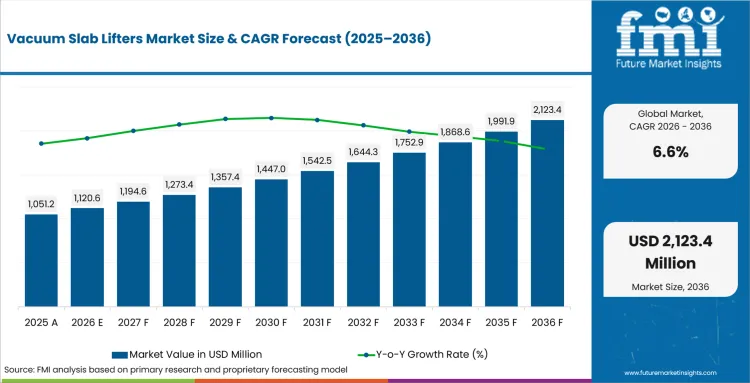
- Market Size (2026)
- USD 1120.6 Mn
- Forecast (2036)
- USD 2123.4 Mn
- CAGR (2026 to 2036)
- 6.6%
How big is Vacuum Slab Lifters Market in 2026?
USD 1120.6 million in 2026 and USD 2123.4 million by 2036 at 6.6% CAGR.
Demand for vacuum slab lifters is projected to expand at 6.6% CAGR between 2026 and 2036, increasing valuation from USD 1120.6 million in 2026 to USD 2123.4 million by 2036. Restricted operating buildings favor compact equipment that reaches interior work zones without disrupting surrounding production schedules. In February 2025, Vacuworx documented nearly one-tonne concrete floor slabs lifted inside an operating pharmaceutical facility. The project linked host-machine access with precise placement and continuity, supporting material handling equipment across controlled restoration work.
United States workshops and UK contractors follow different operating routes; American fabricators assess crane fit beside silica controls, while UK teams emphasize rental access and lifting duties. In May 2026, HSE reported that dry engineered-stone fabrication produced silica exposure five to ten times above equivalent wet methods. Vacuum lifting must fit wet processing rather than replace exposure safeguards; distributors gain orders by matching construction equipment attachments with pad selection and repair coverage.
Key Takeaways of Vacuum Slab Lifters Market
- Mechanical slab movement reduces difficult manual contact and supports predictable transfers across workshops and construction sites.
- Battery-powered vacuum lifters are expected to capture 28.0% share in 2026 owing to cordless mobility.
- The 250–500 kg category is projected to hold 36.0% share in 2026 reflecting common workshop loads.
- Multi-pad frames are estimated to represent 39.0% share in 2026 owing to distributed surface contact.
- Seal contamination and unsuitable surfaces can interrupt transfers despite sufficient published capacity and compatible host equipment.
- Wood’s Powr-Grip, Aardwolf, ANVER and Righetti focus on stone handling, while Schmalz, Probst, Vacuworx and VIAVAC extend competition through portable, construction, or panel systems.
Analyst Perspective
“Vacuum slab lifters earn repeat use through reliable surface contact and disciplined handling rather than headline capacity. Stone fabricators need pads matched to actual finishes and alarms that support clear decisions across every transfer. Installation crews judge portable systems through attachment fit and service response; project utilization then determines whether rental or ownership provides the stronger commercial case.”
- Nikhil Kaitwade, Principal Analyst, Future Market Insights
How is the Vacuum Slab Lifters Market segmented?
Segmentation covers lifter type, load capacity, pad configuration, application, end use, sales channel and region.
Lifter type separates battery-powered, electric, pneumatic, crane-mounted and forklift-mounted systems by energy source and carrier interface. Load capacity spans equipment below 250 kg through units above 1,000 kg, while pad configuration distinguishes single, dual, multi-pad and rotating frames. Application covers stone slabs, glass, metal sheets and precast concrete systems; end use identifies fabrication shops, warehouses, construction sites and glass processors. Sales channels include manufacturers, dealers, rental providers and catalog routes and each category reflects surface condition, transfer orientation, host machine, service access and expected utilization throughout purchasing decisions.
What supports demand for battery-powered vacuum lifters within the lifter type category?
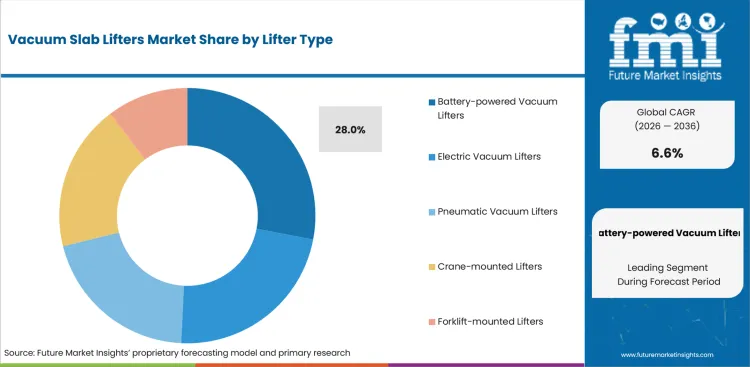
Self-contained lifters follow the site mobility of modern power tools without fixed supply lines across active work zones. Battery rotation and visible vacuum status become practical tests for dependable use during repeated transfers.
- The battery-powered vacuum lifters segment is likely to capture 28.0% share in 2026 attributable to mobile installation needs. Cordless systems support compact construction equipment across temporary work zones; quick deployment and broad host-machine compatibility sustain the segment’s position.
- Stone installers adopt battery-powered lifters through charging discipline and dependable service rather than the mobility benefit alone. Planned battery rotation protects long shifts; local replacement access also limits downtime across successive slab transfers.
How do fabricators evaluate the 250–500 kg load capacity category?
Mid-capacity equipment suits countertops and building materials that exceed practical manual handling limits without requiring the largest frames. Aardwolf stated in June 2025 that its AVLP range spans several capacities and mounting options. Fabricators use that breadth to match recurring weights with existing cranes and retain a documented operating limit.
- The 250–500 kg segment is set to lead the load capacity category with 36.0% share in 2026 due to common workshop load profiles. The range fits counterbalance forklifts and shop cranes across routine countertop handling; dealers can cover frequent orders through fewer stocked configurations.
- Fabrication shops adopt mid-capacity lifters as shared assets across several machines and recurring slab formats. Application testing remains necessary since published capacity cannot confirm a reliable seal on every finish; load records and pad checks protect utilization.
How do multi-pad frames influence purchasing within the pad configuration category?
Large slabs need distributed support that limits bending and avoids openings during controlled tilting operations. Righetti presented lightweight modular frames at GIS Expo in September 2025; the configuration connects pad placement with surface geometry and carrier capacity.
- In 2026, multi-pad frames are expected to lead pad configuration with 39.0% share because broad slabs need distributed contact. Adjustable spacing aligns suction points with intact material; independent pad control also helps crane systems accommodate openings without replacing the complete frame.
- Fabricators adopt multi-pad frames to cover varied dimensions through one serviceable platform with fewer equipment changes. Regular cleaning and seal inspection remain essential across every active suction point; neglected pads can undermine output during high-mix production.
What drives stone slab handling within the application category?
Stone slabs combine substantial mass with finished surfaces that chains or clamps can mark during handling. Workshops therefore need controlled movement between racks and cutting equipment; in February 2025, Aardwolf linked vacuum handling with surface protection and pre-use inspection. The same operating sequence supports throughput without treating suction as suitable for cracked or unstable material.
- Based on application, stone slab handling is projected to account for 43.0% in 2026 due to repeated fabrication transfers. Vacuum contact protects finished faces and complements stone cutting blades between storage and machining; consistent methods also reduce changes across recurring formats.
- Stone processors adopt vacuum lifters for rack unloading and machine feeding through a separate risk-control mechanism. Surface testing and correct pad selection govern dependable use across changing finishes; rough material can reduce usable capacity despite unchanged slab weight.
Why are stone fabrication shops central within the end use category?
Fabrication shops repeat slab transfers near racks and finishing equipment, concentrating lifting hazards beside silica and machine controls throughout daily production. In March 2026, OSHA cited two Georgia stone manufacturers for silica and machine-safety failures; controlled movement supports separation without replacing respiratory protection or machine guarding.
- By end use, stone fabrication shops are estimated to hold 37.0% in 2026 owing to frequent rack-to-machine movement. Vacuum systems protect finished faces during repeated transfers; heavy lifting equipment supports larger loads across several production stages within one facility.
- Workshop adoption depends on crane fit and floor layout alongside technician access and operator training. Nearby replacement seals and documented inspections protect scheduled output; a distant repair route can erase labor gains during customer delivery periods.
How do material handling dealers support the sales channel category?
Vacuum lifters require application matching beyond published capacity, so regional dealers translate slab finish and host equipment into serviceable configurations. Demonstrations and spare seals raise dealer value, while repair access supports workshops without dedicated vacuum technicians.
- The sales channel is forecast to be led by material handling dealers at 36.0% share in 2026 due to regional service needs. Dealers connect building materials users with demonstrations and spare parts; local inventory also shortens replacement delays across project-based demand.
- Smaller regional contractors rarely justify permanent technical staffing across irregular project schedules and seasonal installation work. Dealers combine training with responsive repairs across short assignments; direct purchasing suits operators with stable utilization and internal maintenance.
What are the drivers, restraints and opportunities in the Vacuum Slab Lifters Market?
Mechanical transfer supports demand, while surface condition and service access determine returns across slab-handling applications.
- Driver: Mechanical slab transfer reduces difficult manual contact and supports more predictable movement across connected fabrication stages.
- Restraint: Surface contamination and unsuitable pad contact can reduce holding performance despite an adequate published capacity.
- Opportunity: Rental and service packages give project-based users access without permanent maintenance teams or idle specialized equipment.
Planned slab transfer supports demand because heavy sheets can become unstable during loading or unloading operations. In January 2026, HSE reported that two granite slabs weighing more than 900 kilograms fell from a lorry after safety posts were removed. The incident ties equipment choice to restraint and staffing within a documented handling plan onsite.
Surface variation limits adoption because rated capacity assumes dependable contact, while hidden fissures or unsupported edges can fracture large sheets. HSE guidance updated in April 2025 requires planned handling alongside trained staff and inspected lifting equipment. Workshops must test actual surfaces and transfer routes instead of applying one rating across every slab condition.
Rental and service packages suit installers with uneven project schedules and limited maintenance capacity onsite. The commercial model combines matched equipment with inspection and repair access, reducing idle ownership costs without weakening application testing or operator responsibility.
Which country CAGRs are profiled in the Vacuum Slab Lifters Market?
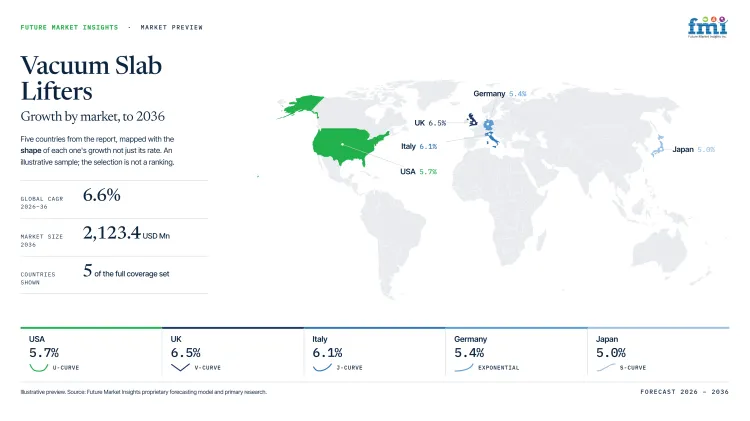
| Country | CAGR |
|---|---|
| United States | 5.7% |
| Germany | 5.4% |
| Japan | 5.0% |
| Italy | 6.1% |
| UK | 6.5% |
How do country-level CAGRs compare in the Vacuum Slab Lifters Market?
The country forecasts span 1.5 percentage points, but their commercial routes differ more than the rates imply. UK and Italy remain close; United States and Germany differ by three-tenths of one point. Japan follows a moderate expansion path shaped by compact equipment needs and careful qualification requirements locally.
- UK projects combine formal lifting duties with rental access that supports short installation schedules across regional sites.
- Italy links established stone processing with uneven investment cycles among smaller workshops serving regional construction clusters.
- United States orders depend on safety documentation and distributor coverage alongside compatible cranes and forklifts.
- Germany combines formal equipment review with demand for service records and application documentation across contractor decisions.
- Japan favors compact systems and disciplined procedures across constrained sites facing limited space and skilled-labor pressure.
Comparable growth rates can produce different order values through local purchasing models and service routes. The full report provides country-level CAGR analysis across North America, Latin America, Europe, East Asia, South Asia, Oceania and the Middle East and Africa.
Country-wise Analysis
- United States stone fabricators work within slab-handling rules that shape training and unloading procedures across facilities. United States is estimated to post 5.7% CAGR over the forecast period, supported by established distributors and compatible cranes. An August 2025 OSHA inspection record documented a February fatality involving granite slabs that leaned during forklift unloading. The record reinforces mechanical handling and trained supervision; fragmented maintenance access can delay purchases among smaller workshops.
- German workshops classify vacuum devices as force-fit lifting attachments and cannot treat suction as a mechanical lock. Adoption of vacuum slab lifters in Germany is estimated to expand at 5.4% CAGR through 2036, linked to formal training and service records. In July 2025, DGUV explained that suction-held loads cannot travel above personnel and require updated risk assessments. Clear rules support qualification; regional service gaps can extend approval among smaller workshops and service projects.
- Japanese contractors must use negative-pressure lifting attachments within specified working loads and keep personnel clear of suspended loads. The Japan vacuum slab lifters sector is projected to record 5.0% CAGR during the assessment period, influenced by compact sites and careful qualification. Japan’s labor ministry applies those duties directly to vacuum-based lifting accessories; compact systems fit constrained projects despite imported-parts and local-instruction frictions.
- Italian stone workshops combine established fabrication skills with formal handling procedures for slabs and blocks. By 2036, Italy is projected to grow at 6.1% CAGR, supported by recurring fabrication and installation work. Italy’s national qualifications atlas requires safe lifting and movement of stone slabs during workshop and storage tasks. Local application knowledge supports pad selection; uneven utilization delays purchases outside major stone districts and service routes.
- UK contractors operate under detailed lifting duties that raise expectations for competence and equipment inspection. Vacuum slab lifter sales in UK are forecast to expand at 6.5% CAGR by 2036, reinforced by rental access and façade installation activity. HSE updated its LOLER guidance in January 2026 and requires fit-for-purpose equipment with planned supervision and periodic examination. Rental access supports short projects; training and liability checks can extend approval across smaller regional contractors and installers.
Who are the notable companies in the Vacuum Slab Lifters Market?
Wood’s Powr-Grip, Schmalz, Aardwolf, ANVER, Vacuworx, VIAVAC, Righetti Vacuum Lifters and Probst GmbH shape competition.
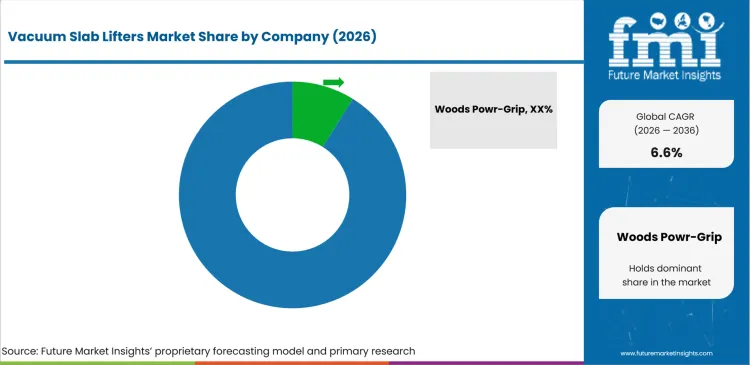
The competitive field remains fragmented because specialists serve distinct surfaces and carrier interfaces across several load ranges. Stone systems compete through seal flexibility and tilt control; construction units emphasize portability and attachment speed and broader expansion requires regional service and replacement parts.
- Wood’s Powr-Grip; Aardwolf; ANVER; and Righetti cover stone-focused frames across varied pad counts and power sources; their position rests on application breadth and workshop channels.
- Schmalz and Probst compete through portable slab tools; Vacuworx connects larger systems with excavators and loaders, while attachment compatibility and field support shape construction orders.
- VIAVAC serves panel and glass projects through rental, inspection and repair routes; the model supports short installations without permanent technical teams.
Competitive Benchmarking: Vacuum Slab Lifters Market
| Company | Slab and Panel Handling | Portable or Battery Systems | Service and Channel Support | Geographic Reach |
|---|---|---|---|---|
| Wood’s Powr-Grip | High | High | High | Global |
| Schmalz | Medium | High | High | Global |
| Aardwolf | High | High | High | Global |
| ANVER | High | Medium | Medium | North America and international sales |
| Vacuworx | High | High | High | Global |
| VIAVAC | Medium | Medium | High | Europe and international dealers |
| Righetti Vacuum Lifters | High | High | Medium | Europe and international dealers |
| Probst GmbH | High | High | High | Global |
Scoring basis: High means verified breadth across several applications; medium means narrower confirmed coverage; low applies only to documented limits. Portable scores reflect cordless breadth, while service scores cover parts, training, inspection and repair access; geographic reach never replaces capability evidence.
Key Developments in the Vacuum Slab Lifters Market
- In September 2025, Vacuworx announced an exclusive Texas partnership with AmeriTex Pipe & Products for contractors installing reinforced concrete products. Qualifying jobsites receive RC Series lifters on loan during installation; the arrangement links equipment access with material delivery and reduces a separate capital decision.
- In March 2026, Schmalz launched the battery-powered Gripster max for glass; wood; metal; drywall; ceramic; and stone tiles. The handheld system displays theoretical capacity and operating warnings through a cordless pump; contractors can introduce vacuum assistance without adopting a larger suspended frame.
- In January 2026, Probst introduced the M-JET-250 cordless device for natural stone; concrete slabs; tiles; and porous materials. Crews can use the unit directly or connect it with carrier equipment; tool-free plate changes support several materials across one active site.
- In March 2025, Vacuworx extended its standard warranty from one year to two years across several vacuum-lifter series. The coverage reduces second-year repair exposure for construction and concrete users; clearer service risk supports capital approval without implying universal application fit.
Vacuum Slab Lifters Market - Report Scope
| Coverage field | Report scope |
|---|---|
| Market breakdown | Lifter type, load capacity, pad configuration, application, end use, sales channel and region. |
| Market Definition | Vacuum-powered equipment that grips, moves, tilts, rotates, or places stone, glass, metal, concrete and related slabs or panels. |
| Regions Covered | North America, Latin America, Western Europe, Eastern Europe, East Asia, South Asia and Pacific and Middle East and Africa. |
| Countries Covered | United States, Germany, Japan, Italy, UK and 30+ countries in full report. |
| Key Companies Profiled | Wood’s Powr-Grip, Schmalz, Aardwolf, ANVER, Vacuworx, VIAVAC, Righetti Vacuum Lifters, Probst GmbH |
| Forecast Period | 2026 to 2036. |
| Approach | Hybrid bottom-up and top-down sizing supported by primary interviews and official desk research. |
Vacuum Slab Lifters Market - Research Methodology
| Method | Approach |
|---|---|
| Primary Research | FMI analysts gathered input from manufacturers, service providers, technology developers, distributors, end users, procurement teams and subject-matter experts. Interviews examined purchasing decisions, product or service evaluation, adoption barriers, approval requirements, pricing considerations and expectations for technical or commercial support. Respondents were also asked what evidence is required before a trial, pilot, or initial order develops into regular purchasing. |
| Desk Research | Desk research covered government statistics, regulatory publications, trade data, industry associations, technical literature, standards, company filings, product information and official corporate announcements. Sources were reviewed for relevance, publication date, geographic coverage and consistency with the defined market scope. Claims relating to performance, applications, approvals, capacity, investment and commercial activity were retained only when supported by credible public evidence. |
| Market Sizing and Forecasting | The market model combined the baseline value with historical performance, segment structure, pricing and volume indicators, adoption levels, company participation and country-level demand conditions. Forecast assumptions considered economic activity, investment trends, regulatory developments, technology adoption, purchasing cycles, supply availability and barriers to wider market use. Segment and regional estimates were reconciled before the final market total was calculated. |
| Data Validation | Estimates were checked against multiple independent indicators, including public data, company activity, trade patterns, industry developments and findings from primary interviews. Validation also tested whether products, services, applications and company revenues fell within the defined market boundaries. Adjacent categories, unsupported claims, overlapping revenues and activities without direct market relevance were excluded to reduce double counting and maintain consistency across segments and countries. |
Vacuum Slab Lifters Market by Segments
Vacuum Slab Lifters Market segmented by Lifter Type:
- Battery-powered vacuum lifters
- Electric vacuum lifters
- Pneumatic vacuum lifters
- Crane-mounted lifters
- Forklift-mounted lifters
Vacuum Slab Lifters Market segmented by Load Capacity:
- 250–500 kg
- <250 kg
- 500–1,000 kg
- >1,000 kg
Vacuum Slab Lifters Market segmented by Pad Configuration:
- Multi-pad frame
- Dual pad
- Single pad
- Tilting / rotating frame
Vacuum Slab Lifters Market segmented by Application:
- Stone slab handling
- Glass handling
- Metal sheet handling
- Precast / concrete panel handling
Vacuum Slab Lifters Market segmented by End Use:
- Stone fabrication shops
- Warehouses / distribution
- Construction sites
- Glass fabricators
Vacuum Slab Lifters Market segmented by Sales Channel:
- Material handling dealers
- Direct manufacturer
- Rental / service channel
- Online / catalog
Vacuum Slab Lifters Market by Region:
- North America
- United States
- Canada
- Latin America
- Brazil
- Mexico
- Argentina
- Chile
- Western Europe
- Germany
- France
- United Kingdom
- Italy
- Spain
- Benelux
- Nordics
- Eastern Europe
- Poland
- Czech Republic
- Romania
- Hungary
- East Asia
- China
- Japan
- South Korea
- South Asia and Pacific
- India
- ASEAN
- Australia and New Zealand
- Middle East and Africa
- GCC Countries
- South Africa
- Türkiye
- Israel
Research Sources and Bibliography
- Aardwolf Industries LLC. (2025, February 28). Why a vacuum lifter is essential for stone fabrication.
- Aardwolf Industries LLC. (2025, June 29). What is a vacuum lifter?
- Jansen, D. (2025, July 16). Interview: Lasten sicher greifen, halten, transportieren. Arbeit & Gesundheit.
- Health and Safety Executive. (2025, April 4). Handling and storage of large sheet stone slabs.
- Health and Safety Executive. (2026, January 22). Lifting Operations and Lifting Equipment Regulations 1998 (LOLER).
- Health and Safety Executive. (2026, January 30). Stone company fined £50,000 after worker fatally struck by falling granite slabs.
- Health and Safety Executive. (2026, May 11). HSE says no dry cutting of engineered stone ahead of inspection crackdown.
- Istituto nazionale per l’analisi delle politiche pubbliche. (n.d.). Operatore alla lavorazione dei materiali lapidei.
- Ministry of Health, Labour and Welfare. (n.d.).
- Occupational Safety and Health Administration. (2025, August 8). Inspection detail: Old World Granite and Stone LLC (Inspection No. 1805821.015).
- Occupational Safety and Health Administration. (2026, March 26). US Department of Labor cites Georgia stone product manufacturers for exposing workers to respirable crystalline silica, other safety violations.
- Probst GmbH. (2026, January 9). M-JET-250 – New vacuum hand-held laying device for slabs weighing up to 250 kg from Probst.
- Righetti S.r.l. (2025, September). Righetti at GIS Expo 2025: A comeback full of new products.
- Schmalz. (2026, March 13). Let it grip rather than having to grip.
- Vacuworx. (2025, February 24). Compact electric construction equipment in action: Safe and disruption-free lifting in a pharmaceutical plant.
- Vacuworx. (2025, March 4). Vacuworx extends warranty to 2 years – More protection, more confidence.
- Vacuworx. (2025, September 16). Vacuworx and AmeriTex Pipe & Products announce exclusive equipment partnership in Texas.
This bibliography is provided for reader reference and is not exhaustive. The full report contains the complete reference list and detailed citations
This Report Answers
- How large is the global vacuum slab lifters market and what is its growth outlook?
- Why are battery-powered vacuum slab lifters gaining adoption across material handling operations?
- Which load ranges are best suited for mid-capacity vacuum slab lifting equipment?
- How do multi-pad vacuum lifting frames improve slab protection and handling safety?
- Which environmental and operational conditions can limit vacuum suction reliability?
- How do purchasing channels and procurement practices differ across key countries?
- Which companies are leading the vacuum slab lifter and slab handling equipment market?
- How should buyers evaluate suppliers based on service, maintenance and support capabilities?
- Which technological developments and competitive trends are shaping the Vacuum Slab Lifters market?
Frequently Asked Questions
How big is the Vacuum Slab Lifters Market in 2026?
The vacuum slab lifters market is valued at USD 1120.6 million in 2026 and is forecast to reach USD 2123.4 million by 2036. Growth is supported by restricted operating buildings that favor compact, mechanized slab movement reaching interior work zones without disrupting surrounding production schedules.
What is the CAGR of the Vacuum Slab Lifters Market from 2026 to 2036?
The vacuum slab lifters market grows at a CAGR of 6.6% between 2026 and 2036, supported by mechanized slab transfer that reduces difficult manual contact and supports more predictable movement across connected fabrication stages in stone, glass, and construction applications.
Which application leads the Vacuum Slab Lifters Market?
Stone slab handling accounts for 43.0% of the vacuum slab lifters market by application in 2026, driven by repeated fabrication transfers where vacuum contact protects finished faces and complements cutting equipment between storage and machining stages.
How much will the Vacuum Slab Lifters Market add between 2026 and 2036?
The vacuum slab lifters market is set to add USD 1002.8 million between 2026 and 2036, growing from USD 1120.6 million to USD ,123.4 million as mechanized slab handling expands across stone fabrication, construction, and material handling operations worldwide.
Who are the leading companies in the Vacuum Slab Lifters Market?
Eight companies lead the vacuum slab lifters market, including Wood's Powr-Grip, Schmalz, Aardwolf, ANVER, Vacuworx, VIAVAC, Righetti Vacuum Lifters, and Probst GmbH, competing through slab and panel handling, portable or battery systems, and service and channel support across global networks.
Preview the report firsthand - request a free sample
Get SampleGet the brochure for pricing and purchase details.
Get PDFTable of Content
- Key Takeaways
- Market Size and CAGR
- Top Growth Driver
- Fastest Growing Segment
- Leading Region
- Key Companies
- Emerging Opportunities
- Executive Summary
- Global Market Outlook
- Demand-side Trends
- Supply-side Trends
- Technology Roadmap Analysis
- Analysis and Recommendations
- Analyst Perspective (What is happening? Why now? What should investors know?)
- Key Questions Answered
- How large is the market?
- What is the CAGR?
- What are key trends?
- Which region dominates?
- Who are the leaders?
- Market Overview
- Market Coverage / Taxonomy
- Market Definition / Scope / Limitations
- Research Methodology
- Chapter Orientation
- Analytical Lens and Working Hypotheses
- Market Structure, Signals, and Trend Drivers
- Benchmarking and Cross-market Comparability
- Market Sizing, Forecasting, and Opportunity Mapping
- Research Design and Evidence Framework
- Desk Research Programme (Secondary Evidence)
- Expert Input and Fieldwork (Primary Evidence)
- Tooling, Models, and Reference Databases
- Data Engineering and Model Build
- Quality Assurance and Audit Trail
- Market Background
- Market Dynamics (Drivers, Restraints, Opportunity, Trends)
- Scenario Forecast (Optimistic, Likely, Conservative)
- Impact Analysis
- AI Impact
- Sustainability Impact
- Regulatory Impact
- Technology Impact
- Consumer / Buyer Analysis
- Purchase Drivers
- Adoption Barriers
- Buyer Journey
- Opportunity Map Analysis
- Product Life Cycle Analysis
- Supply Chain Analysis
- Investment Feasibility Matrix
- Value Chain Analysis
- PESTLE and Porter's Analysis
- Regulatory Landscape
- Regional Parent Market Outlook
- Production and Consumption Statistics
- Import and Export Statistics
- Global Market Analysis and Forecast, 2021 to 2036
- Historical Market Size Value (USD Million) Analysis, 2021 to 2025
- Current and Future Market Size Value (USD Million) Projections, 2026 to 2036
- Y-o-Y Growth Trend Analysis
- Absolute $ Opportunity Analysis
- Global Market Pricing Analysis, 2021 to 2036
- Global Market Analysis and Forecast, By Lifter Type, 2021 to 2036
- Introduction / Key Findings
- Historical Market Size Value (USD Million) Analysis By Lifter Type, 2021 to 2025
- Current and Future Market Size Value (USD Million) Analysis and Forecast By Lifter Type, 2026 to 2036
- Battery-powered Vacuum Lifters
- Electric Vacuum Lifters
- Pneumatic Vacuum Lifters
- Crane-mounted Lifters
- Forklift-mounted Lifters
- Battery-powered Vacuum Lifters
- Y-o-Y Growth Trend Analysis By Lifter Type, 2021 to 2025
- Absolute $ Opportunity Analysis By Lifter Type, 2026 to 2036
- Global Market Analysis and Forecast, By Load Capacity, 2021 to 2036
- Introduction / Key Findings
- Historical Market Size Value (USD Million) Analysis By Load Capacity, 2021 to 2025
- Current and Future Market Size Value (USD Million) Analysis and Forecast By Load Capacity, 2026 to 2036
- 250–500 kg
- <250 kg
- 500–1,000 kg
- >1,000 kg
- 250–500 kg
- Y-o-Y Growth Trend Analysis By Load Capacity, 2021 to 2025
- Absolute $ Opportunity Analysis By Load Capacity, 2026 to 2036
- Global Market Analysis and Forecast, By Pad Configuration, 2021 to 2036
- Introduction / Key Findings
- Historical Market Size Value (USD Million) Analysis By Pad Configuration, 2021 to 2025
- Current and Future Market Size Value (USD Million) Analysis and Forecast By Pad Configuration, 2026 to 2036
- Multi-pad Frame
- Dual Pad
- Single Pad
- Tilting / Rotating Frame
- Multi-pad Frame
- Y-o-Y Growth Trend Analysis By Pad Configuration, 2021 to 2025
- Absolute $ Opportunity Analysis By Pad Configuration, 2026 to 2036
- Global Market Analysis and Forecast, By Application, 2021 to 2036
- Introduction / Key Findings
- Historical Market Size Value (USD Million) Analysis By Application, 2021 to 2025
- Current and Future Market Size Value (USD Million) Analysis and Forecast By Application, 2026 to 2036
- Stone Slab Handling
- Glass Handling
- Metal Sheet Handling
- Precast / Concrete Panel Handling
- Stone Slab Handling
- Y-o-Y Growth Trend Analysis By Application, 2021 to 2025
- Absolute $ Opportunity Analysis By Application, 2026 to 2036
- Global Market Analysis and Forecast, By End Use, 2021 to 2036
- Introduction / Key Findings
- Historical Market Size Value (USD Million) Analysis By End Use, 2021 to 2025
- Current and Future Market Size Value (USD Million) Analysis and Forecast By End Use, 2026 to 2036
- Stone Fabrication Shops
- Warehouses / Distribution
- Construction Sites
- Glass Fabricators
- Stone Fabrication Shops
- Y-o-Y Growth Trend Analysis By End Use, 2021 to 2025
- Absolute $ Opportunity Analysis By End Use, 2026 to 2036
- Global Market Analysis and Forecast, By Sales Channel
- Introduction / Key Findings
- Historical Market Size Value (USD Million) Analysis By Sales Channel, 2021 to 2025
- Current and Future Market Size Value (USD Million) Analysis and Forecast By Sales Channel, 2026 to 2036
- Material Handling Dealers
- Direct Manufacturer
- Rental / Service Channel
- Online / Catalog
- Material Handling Dealers
- Y-o-Y Growth Trend Analysis By Sales Channel, 2021 to 2025
- Absolute $ Opportunity Analysis By Sales Channel, 2026 to 2036
- Global Market Analysis and Forecast, By Region, 2021 to 2036
- Introduction
- Historical Market Size Value (USD Million) Analysis By Region, 2021 to 2025
- Current Market Size Value (USD Million) Analysis and Forecast By Region, 2026 to 2036
- North America
- Latin America
- Western Europe
- Eastern Europe
- East Asia
- South Asia and Pacific
- Middle East & Africa
- Market Attractiveness Analysis By Region
- North America Market Analysis and Forecast, By Country, 2021 to 2036
- Historical Market Size Value (USD Million) Trend Analysis By Market Taxonomy, 2021 to 2025
- Market Size Value (USD Million) Forecast By Market Taxonomy, 2026 to 2036
- By Country
- USA
- Canada
- By Lifter Type
- By Load Capacity
- By Pad Configuration
- By Application
- By End Use
- By Sales Channel
- By Country
- Market Attractiveness Analysis
- By Country
- By Lifter Type
- By Load Capacity
- By Pad Configuration
- By Application
- By End Use
- By Sales Channel
- Key Takeaways
- Latin America Market Analysis and Forecast, By Country
- Historical Market Size Value (USD Million) Trend Analysis By Market Taxonomy, 2021 to 2025
- Market Size Value (USD Million) Forecast By Market Taxonomy, 2026 to 2036
- By Country
- Brazil
- Mexico
- Chile
- Rest of Latin America
- By Lifter Type
- By Load Capacity
- By Pad Configuration
- By Application
- By End Use
- By Sales Channel
- By Country
- Market Attractiveness Analysis
- By Country
- By Lifter Type
- By Load Capacity
- By Pad Configuration
- By Application
- By End Use
- By Sales Channel
- Key Takeaways
- Western Europe Market Analysis and Forecast, By Country
- Historical Market Size Value (USD Million) Trend Analysis By Market Taxonomy, 2021 to 2025
- Market Size Value (USD Million) Forecast By Market Taxonomy, 2026 to 2036
- By Country
- Germany
- UK
- Italy
- Spain
- France
- Nordic
- BENELUX
- Rest of Western Europe
- By Lifter Type
- By Load Capacity
- By Pad Configuration
- By Application
- By End Use
- By Sales Channel
- By Country
- Market Attractiveness Analysis
- By Country
- By Lifter Type
- By Load Capacity
- By Pad Configuration
- By Application
- By End Use
- By Sales Channel
- Key Takeaways
- Eastern Europe Market Analysis and Forecast, By Country
- Historical Market Size Value (USD Million) Trend Analysis By Market Taxonomy, 2021 to 2025
- Market Size Value (USD Million) Forecast By Market Taxonomy, 2026 to 2036
- By Country
- Russia
- Poland
- Hungary
- Balkan & Baltic
- Rest of Eastern Europe
- By Lifter Type
- By Load Capacity
- By Pad Configuration
- By Application
- By End Use
- By Sales Channel
- By Country
- Market Attractiveness Analysis
- By Country
- By Lifter Type
- By Load Capacity
- By Pad Configuration
- By Application
- By End Use
- By Sales Channel
- Key Takeaways
- East Asia Market Analysis and Forecast, By Country
- Historical Market Size Value (USD Million) Trend Analysis By Market Taxonomy, 2021 to 2025
- Market Size Value (USD Million) Forecast By Market Taxonomy, 2026 to 2036
- By Country
- China
- Japan
- South Korea
- By Lifter Type
- By Load Capacity
- By Pad Configuration
- By Application
- By End Use
- By Sales Channel
- By Country
- Market Attractiveness Analysis
- By Country
- By Lifter Type
- By Load Capacity
- By Pad Configuration
- By Application
- By End Use
- By Sales Channel
- Key Takeaways
- South Asia and Pacific Market Analysis and Forecast, By Country
- Historical Market Size Value (USD Million) Trend Analysis By Market Taxonomy, 2021 to 2025
- Market Size Value (USD Million) Forecast By Market Taxonomy, 2026 to 2036
- By Country
- India
- ASEAN
- Australia & New Zealand
- Rest of South Asia and Pacific
- By Lifter Type
- By Load Capacity
- By Pad Configuration
- By Application
- By End Use
- By Sales Channel
- By Country
- Market Attractiveness Analysis
- By Country
- By Lifter Type
- By Load Capacity
- By Pad Configuration
- By Application
- By End Use
- By Sales Channel
- Key Takeaways
- Middle East & Africa Market Analysis and Forecast, By Country
- Historical Market Size Value (USD Million) Trend Analysis By Market Taxonomy, 2021 to 2025
- Market Size Value (USD Million) Forecast By Market Taxonomy, 2026 to 2036
- By Country
- Kingdom of Saudi Arabia
- Other GCC Countries
- Türkiye
- South Africa
- Other African Union
- Rest of Middle East & Africa
- By Lifter Type
- By Load Capacity
- By Pad Configuration
- By Application
- By End Use
- By Sales Channel
- By Country
- Market Attractiveness Analysis
- By Country
- By Lifter Type
- By Load Capacity
- By Pad Configuration
- By Application
- By End Use
- By Sales Channel
- Key Takeaways
- Key Countries Market Analysis
- USA
- Pricing Analysis
- Market Share Analysis, 2025
- By Lifter Type
- By Load Capacity
- By Pad Configuration
- By Application
- By End Use
- By Sales Channel
- Canada
- Pricing Analysis
- Market Share Analysis, 2025
- By Lifter Type
- By Load Capacity
- By Pad Configuration
- By Application
- By End Use
- By Sales Channel
- Mexico
- Pricing Analysis
- Market Share Analysis, 2025
- By Lifter Type
- By Load Capacity
- By Pad Configuration
- By Application
- By End Use
- By Sales Channel
- Brazil
- Pricing Analysis
- Market Share Analysis, 2025
- By Lifter Type
- By Load Capacity
- By Pad Configuration
- By Application
- By End Use
- By Sales Channel
- Chile
- Pricing Analysis
- Market Share Analysis, 2025
- By Lifter Type
- By Load Capacity
- By Pad Configuration
- By Application
- By End Use
- By Sales Channel
- Germany
- Pricing Analysis
- Market Share Analysis, 2025
- By Lifter Type
- By Load Capacity
- By Pad Configuration
- By Application
- By End Use
- By Sales Channel
- UK
- Pricing Analysis
- Market Share Analysis, 2025
- By Lifter Type
- By Load Capacity
- By Pad Configuration
- By Application
- By End Use
- By Sales Channel
- Italy
- Pricing Analysis
- Market Share Analysis, 2025
- By Lifter Type
- By Load Capacity
- By Pad Configuration
- By Application
- By End Use
- By Sales Channel
- Spain
- Pricing Analysis
- Market Share Analysis, 2025
- By Lifter Type
- By Load Capacity
- By Pad Configuration
- By Application
- By End Use
- By Sales Channel
- France
- Pricing Analysis
- Market Share Analysis, 2025
- By Lifter Type
- By Load Capacity
- By Pad Configuration
- By Application
- By End Use
- By Sales Channel
- India
- Pricing Analysis
- Market Share Analysis, 2025
- By Lifter Type
- By Load Capacity
- By Pad Configuration
- By Application
- By End Use
- By Sales Channel
- ASEAN
- Pricing Analysis
- Market Share Analysis, 2025
- By Lifter Type
- By Load Capacity
- By Pad Configuration
- By Application
- By End Use
- By Sales Channel
- Australia & New Zealand
- Pricing Analysis
- Market Share Analysis, 2025
- By Lifter Type
- By Load Capacity
- By Pad Configuration
- By Application
- By End Use
- By Sales Channel
- China
- Pricing Analysis
- Market Share Analysis, 2025
- By Lifter Type
- By Load Capacity
- By Pad Configuration
- By Application
- By End Use
- By Sales Channel
- Japan
- Pricing Analysis
- Market Share Analysis, 2025
- By Lifter Type
- By Load Capacity
- By Pad Configuration
- By Application
- By End Use
- By Sales Channel
- South Korea
- Pricing Analysis
- Market Share Analysis, 2025
- By Lifter Type
- By Load Capacity
- By Pad Configuration
- By Application
- By End Use
- By Sales Channel
- Russia
- Pricing Analysis
- Market Share Analysis, 2025
- By Lifter Type
- By Load Capacity
- By Pad Configuration
- By Application
- By End Use
- By Sales Channel
- Poland
- Pricing Analysis
- Market Share Analysis, 2025
- By Lifter Type
- By Load Capacity
- By Pad Configuration
- By Application
- By End Use
- By Sales Channel
- Hungary
- Pricing Analysis
- Market Share Analysis, 2025
- By Lifter Type
- By Load Capacity
- By Pad Configuration
- By Application
- By End Use
- By Sales Channel
- Kingdom of Saudi Arabia
- Pricing Analysis
- Market Share Analysis, 2025
- By Lifter Type
- By Load Capacity
- By Pad Configuration
- By Application
- By End Use
- By Sales Channel
- Türkiye
- Pricing Analysis
- Market Share Analysis, 2025
- By Lifter Type
- By Load Capacity
- By Pad Configuration
- By Application
- By End Use
- By Sales Channel
- South Africa
- Pricing Analysis
- Market Share Analysis, 2025
- By Lifter Type
- By Load Capacity
- By Pad Configuration
- By Application
- By End Use
- By Sales Channel
- USA
- Market Structure Analysis
- Competition Dashboard
- Competition Benchmarking
- Market Share Analysis of Top Players
- By Regional
- By Lifter Type
- By Load Capacity
- By Pad Configuration
- By Application
- By End Use
- By Sales Channel
- Emerging Startups
- Innovation Benchmarking
- Competition Analysis
- Competition Deep Dive
- Woods Powr-Grip
- Overview
- Product Portfolio
- Profitability by Market Segments
- Sales Footprint
- Strategy Overview
- Marketing Strategy
- Product Strategy
- Channel Strategy
- Schmalz
- Aardwolf
- Manzelli
- ANVER
- Pannkoke Flachglastechnik
- Vacuworx
- Viavac
- GIS AG
- Biesse
- Woods Powr-Grip
- Case Studies
- Success Stories
- Recent Developments
- Competition Deep Dive
- Assumptions & Acronyms Used


