

- Market Size (2026)
- USD 560.6 Mn
- Forecast (2036)
- USD 873.2 Mn
- CAGR (2026 to 2036)
- 4.5%
How big is Clay Wet Pan Mills Market in 2026?
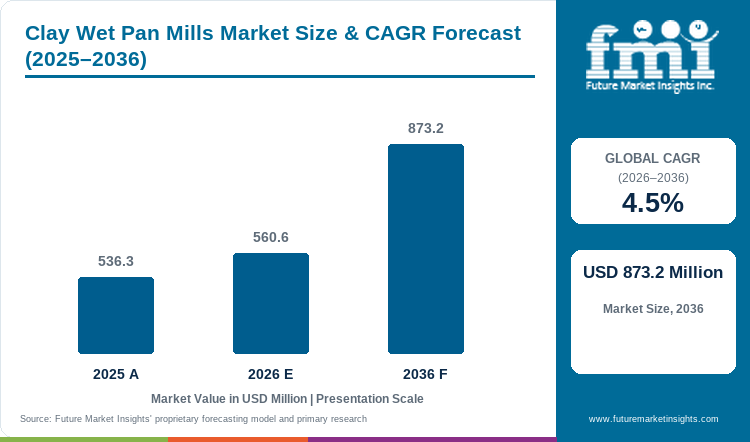
USD 560.6 million in 2026 and USD 873.2 million by 2036 at a 4.5% CAGR.
Sales of clay wet pan mills are estimated to rise at 4.5% CAGR through 2036, increasing valuation from USD 536.3 million in 2025 to USD 560.6 million in 2026, and reaching USD 873.2 million by 2036. Plant teams use wet pan mills to crush hard clay pieces and mix water before finer preparation. Verdés stated in May 2026 that plants should select wet-grinding equipment around clay properties and the required process result. That choice keeps mill size and setup tied to real material behavior. It also helps plants avoid buying capacity that does not solve the feed problem.
Country conditions change how plants time replacement and retrofit work. The USA is projected to grow at 4.8% CAGR through 2036. Romania is projected at 6.1% over the same period. The U.S. Census Bureau reported a 1.275 million annual housing-start rate for August 2026. That level was 1.2% below August 2025 and keeps capital planning sensitive to construction cycles. Romania follows a different path as building activity and plant upgrades raise the need for reliable preparation equipment. In both countries, service access can decide whether a plant replaces one machine or delays a wider line upgrade.
Key Takeaways
- Changing clay feed raises demand for mills that crush and mix material while keeping moisture more stable before forming.
- Based on mill type, traditional wet pan mills are projected to account for 30.0% in 2026, supported by familiar repair needs.
- By application, clay grinding is estimated to hold 34.0% in 2026, driven by the need to remove hard clay pieces.
- In 2026, brick plants are expected to lead end use with 43.0% share, supported by steady clay preparation before extrusion.
- Capital approval can slow when structural work or wear cost raises project risk and shutdown time adds another hurdle.
- Key players include Verdés and HÄNDLE. Bongioanni Macchine and Bedeschi also compete with Rieter Morando. J.C. Steele & Sons and SABO S.A. are also active. CERIC Technologies and COSMEC S.r.l. appear with Bernini Impianti.
Analyst Perspective
"Plants usually decide on a wet pan mill after they test how it handles their clay. A good supplier carries that test result into installation and startup. Spare parts and later repairs also matter."
- Nikhil Kaitwade, Principal Consultant, Future Market Insights
How is the clay wet pan mills market segmented?
Clay Wet Pan Mills Market is segmented by Mill Type, Application, End Use, Capacity, Sales Channel, and Region. Forecast period from 2026 to 2036.
The clay wet pan mills market is segmented by mill type, application, end use, capacity, sales channel, and region. Mill type separates the main machine designs used for clay preparation. Application covers grinding, mixing, moisture control, and recycled clay work. End use includes brick plants and ceramic raw-material plants. Capacity and sales channel show output needs and how plants buy the system.
What makes traditional wet pan mills central to the mill type category?
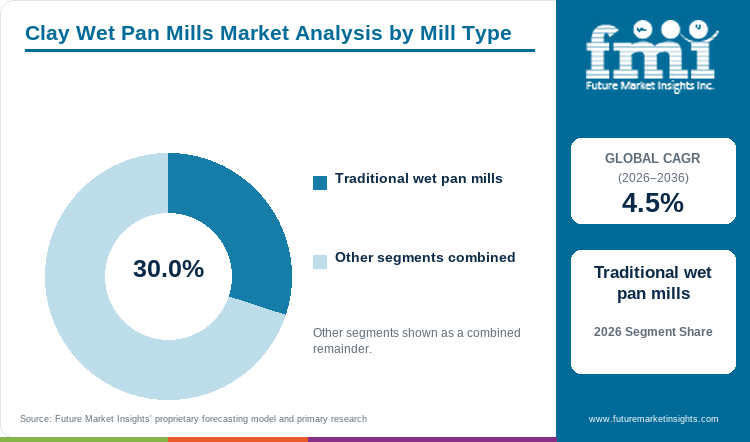
Traditional wet pan mills use a simple mechanical process that plant teams know well. Heavy runners break coarse clay while a grid controls the discharge size. Plants making clay-based construction products keep this design when long service life and practical repair work matter.
- Traditional wet pan mills are set to lead the mill type category with 30.0% share in 2026, supported by familiar repair work.
- HÄNDLE and Rieter Morando describe wet pan mills that crush, mix, add moisture, and press clay through a grid in one stage.
How does clay grinding shape demand within the application category?
Clay grinding removes hard pieces before industrial mixers and extruders receive the clay body. Runner pressure breaks coarse material while the grid controls what leaves the pan. Plants can also add water during this step. That combination gives the next machine a more even feed.
- The application category is forecast to be led by clay grinding at 34.0% share in 2026, driven by coarse reduction before mixing and forming.
- Verdés stated in May 2026 that wet-grinding equipment should match clay properties and the process result a plant needs.
Why do brick plants lead the end use category?
Brick plants need even clay because unstable feed can disturb extrusion and product shape. Hard pieces or uneven moisture also raise stress on downstream machines. Long operating lives make runners, grids, drives, and service part of the wider brick making machines decision.
- Brick plants are projected to hold 43.0% of end use demand in 2026, supported by repeatable clay preparation before extrusion.
- Italy had 57 clay product makers with 76 plants in 2025, according to Confindustria Ceramica. These sites create repeat mill repair and preparation work.
What supports 5-15 tph within the capacity category?
The 5-15 tph class gives medium-duty plants useful output without the civil work needed for larger machines. Its size also suits phased upgrades in existing plants. Larger systems need stronger feeders, conveyor belts, and closer line balancing across each production stage.
- By capacity, 5-15 tph is forecast to represent 39.0% in 2026, influenced by medium-duty output and manageable retrofit work.
- This size works well when a planned shutdown can absorb the new mill. Plants can then keep most nearby machines and connections.
How do ceramic machinery OEMs influence the sales channel category?
Plants choose wet pan mills beside feeders, mixers, and forming equipment. Ceramic machinery OEMs can connect clay testing with layout and startup work. Turnkey contractors handle full plants. Dealers and service firms cover smaller replacement or repair needs.
- Ceramic machinery OEMs are set to lead the sales channel with 41.0% share in 2026, enabled by integrated selection and startup support.
- OEM work also reaches machines that shape prepared clay after mixing. These include extruder and compounding machines.
What are the drivers, restraints and opportunities in the Clay Wet Pan Mills Market?
Variable clay raises the value of controlled preparation, brownfield shutdown risk slows capital approval, and service-backed retrofit packages support selective expansion.
- Driver: Changing clay feed raises the need for steady grinding and mixing. Moisture control also matters before forming.
- Restraint: Structural work and wear cost can delay project approval. Production downtime can also slow a needed equipment change.
- Opportunity: Plants can add new controls without replacing a full line. Local service can make that work much easier. Recycled clay use can also support staged upgrades.
Variable clay raises the value of controlled preparation
Plant engineers need steady clay feed because small material changes can disturb forming. Wet pan mills break hard pieces and mix water before finer equipment receives the clay. HÄNDLE describes pan mills that crush and mix clay before adding moisture through the same preparation stage. The same machine can also press clay through a grid. As industrial automation expands, unstable feed can cause more stops across connected machines and raise the need for better preparation. Plants therefore value equipment that handles clay changes without constant manual correction. A stable feed can protect product quality and reduce avoidable adjustments during a production shift. That control can make daily line work easier for operators.
Brownfield shutdown exposure makes capital approval harder
Brownfield projects become harder to approve when a new mill needs floor work or feeder changes. Plant managers also need a shutdown window for installation and startup. The US Census Bureau reported a 1.275 million annual housing-start rate for August 2026. That rate was 1.2% below August 2025 and keeps building-material investment sensitive to construction cycles. Plants may protect essential repairs before they approve a larger replacement package. Wear parts and power needs also raise the full ownership cost. Suppliers can reduce this barrier by showing the outage plan and service needs before an order. Clear site planning gives finance teams a better cost case when several maintenance projects compete for the same budget.
Service-backed retrofits create a practical expansion route
Many plants need better clay preparation but cannot replace the full line at once. A retrofit lets them improve one weak stage while keeping useful equipment in service. Feed tests can set runner pressure and water addition before installation. Modular controls can connect the mill with existing material handling equipment. Bedeschi installed a complete clay preparation line for Tupi Guarani Cerâmica in July 2026. That project shows current spending on raw-material preparation at a working heavy-clay production site. Local spare parts and planned rebuilds can make staged upgrades easier to support over time. Suppliers gain repeat work through commissioning and wear parts while later line changes add more service demand.
Which country CAGRs are profiled in the Clay Wet Pan Mills Market?
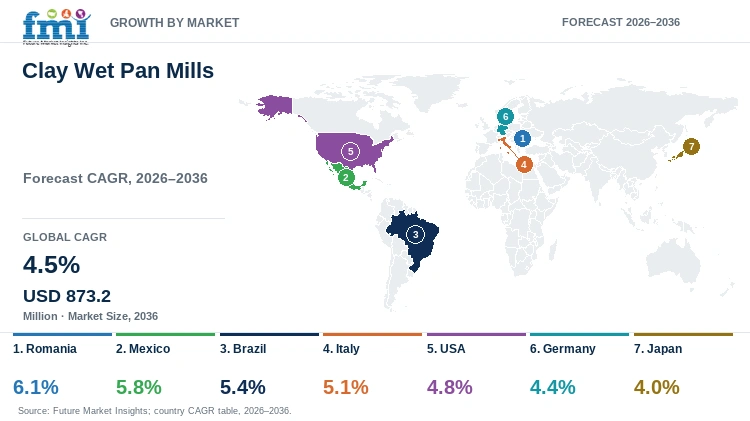
| Country | CAGR |
|---|---|
| Romania | 6.1% |
| Mexico | 5.8% |
| Brazil | 5.4% |
| Italy | 5.1% |
| USA | 4.8% |
| Germany | 4.4% |
| Japan | 4.0% |
How do country-level CAGRs compare in the Clay Wet Pan Mills Market?
The profiled country CAGRs range from 4.0% to 6.1% through 2036. Romania and Mexico sit at the faster end. Brazil and Italy form the middle range. The USA follows at 4.8% while Germany reaches 4.4%. Japan has the lowest profiled rate at 4.0%.
- Romania has rising building work and older plants, so local parts and restart help can support mill upgrades.
- Mexico has large housing plans, so nearby service helps brick plants manage imported mills.
- Brazil has plants spread across wide regions, so modular equipment and nearby spare parts can reduce long service delays.
- Italy has many established clay plants, so repair planning and wear-part service matter more than large new sites.
- US plants may delay mill replacement when housing slows and other repair work competes for the same budget.
- German plants check power use and machine fit before they approve upgrades to clay preparation equipment.
- Japan relies more on older housing stock, so plants favor smaller upgrades that limit disruption at established sites.
Similar CAGRs can still create different sales conditions because plant age and service access vary by country. The rate alone does not tell the full sales story. Plant age and service access still change how projects move. The full report provides country-level CAGR analysis across North America, Latin America, Western Europe, Eastern Europe, East Asia, South Asia and Pacific, and the Middle East and Africa.
Country-wise Analysis
- The USA is estimated to post 4.8% CAGR over the forecast period, influenced by replacement needs and changing construction activity. The U.S. Census Bureau reported a 1.275 million annual housing-start rate for August 2026. That rate was 1.2% below August 2025. Brick producers therefore balance mill replacement against other repair and reliability work. Plants still need steady clay preparation when older equipment wears or feed quality changes. Domestic parts supply can shorten repair delays during planned shutdowns. A staged startup plan also lowers the risk of restarting an existing line. Suppliers need to show service coverage and machine output when they compete for brownfield orders.
- Germany's clay wet pan mills outlook is anticipated to advance at 4.4% CAGR through 2036, shaped by careful project screening. Destatis counted 149,748 approved building projects in 2025. The count was 145,010 in 2024. That rise supports construction demand without removing pressure on plant budgets. Heavy-clay producers still review power use before replacing large preparation equipment. They also check whether a new mill can work with installed feeders and forming machines. Clear test data can shorten that review while local parts and service reduce shutdown risk. Suppliers that document energy needs and connection work can make retrofit decisions easier for established German plants.
- Adoption of clay wet pan mills in Japan is estimated to expand at 4.0% CAGR through 2036, supported by selective renewal. Japan's housing ministry adopted a new Basic Plan for Housing in March 2026. The plan covers fiscal years 2026 through 2035 and gives more weight to existing housing stock. That policy setting favors maintenance and renewal over rapid greenfield expansion. Ceramic and tile plants face a similar need for careful site work. Compact installation can reduce disruption around older equipment. Predictable parts supply also matters when plants plan limited shutdown windows. Suppliers need practical retrofit support instead of a large-capacity sales pitch alone.
- Clay wet pan mill demand in Brazil is forecast to rise at 5.4% CAGR through 2036, supported by regional plant upgrades. IBGE reported that Brazil's construction industry employed 2.5 million people in 2024. The same industry generated R$522.5 billion in value that year. Brick and tile plants serve this large downstream base from many regions. Long travel distances can make imported parts slower to replace. Medium-capacity mills can reduce the scale of site work for regional plants. Local service and stocked wear parts also help plants control downtime. Suppliers that combine modular equipment with nearby support can compete beyond the largest industrial centers.
- Italy is estimated to post 5.1% CAGR through 2036, supported by its large base of established clay plants. Confindustria Ceramica counted 57 clay-building-material makers operating 76 plants in 2025. Those plants produced about 3.9 million tonnes during the year. This installed base creates regular work for mill upgrades and wear-part replacement. Many projects can reuse mixers and kiln refractory bricks that still work well. That favors targeted mill changes over full plant replacement. Italy also has local machinery skills that help during setup and repairs. Suppliers need to show how a new mill improves clay consistency while useful equipment stays in service.
- Clay wet pan mill sales in Mexico are forecast to expand at 5.8% CAGR by 2036, supported by staged plant investment. SEDATU reported 667,000 homes contracted under the Housing for Wellbeing program by September 2026. It also reported 277,000 homes in active construction across the country. That scale supports building-material demand while regional brick plants still face equipment cost and service limits. Imported machinery can add financing and parts risk. Medium-capacity packages let plants spread spending across planned upgrades. Trained local service teams can also shorten repair delays. Suppliers that offer clear startup support can make imported equipment easier for smaller producers to manage.
- Romania's clay wet pan mills outlook is anticipated to advance at 6.1% CAGR over the assessment period, supported by brownfield upgrades. Eurostat reported Romanian construction output 18.4% above June 2025 levels in June 2026. Output also rose 4.9% from the previous month. That pace can increase pressure on established building-material plants to keep older lines reliable. A wet pan retrofit still needs mechanical work and careful control changes. Regional spare parts matter when restart dates are tight. Service teams can reduce delay by planning wear parts before the shutdown starts. Suppliers that combine equipment with startup support can capture more modernization work.
Who are the notable companies in the Clay Wet Pan Mills Market?
Verdés, HÄNDLE, Bongioanni Macchine, Bedeschi, Rieter Morando, J.C. Steele & Sons, SABO S.A., CERIC Technologies, COSMEC S.r.l., and Bernini Impianti are active within the defined clay wet pan mills and heavy-clay equipment boundary.
Competition includes wet-pan specialists and full-line heavy-clay integrators. Verdés and HÄNDLE document direct clay-preparation work. Bongioanni Macchine and Bedeschi do the same across wider plant systems. Rieter Morando also covers direct preparation equipment. SABO S.A. and CERIC Technologies work across plant systems with COSMEC S.r.l. J.C. Steele & Sons and Bernini Impianti support shaping or firing work that can change preparation needs.
- Five suppliers show direct wet-pan or clay-preparation work. They include Verdés and HÄNDLE. Bongioanni Macchine and Bedeschi also qualify with Rieter Morando.
- SABO S.A. and CERIC Technologies provide wider plant-integration work. COSMEC S.r.l. also supports heavy-clay engineering projects.
- J.C. Steele & Sons and Bernini Impianti support shaping or firing systems that can change upstream preparation needs.
Competitive Benchmarking: Clay Wet Pan Mills Market
| Company | Direct Wet-Pan Depth | Clay-Line Integration | Lifecycle Service | Geographic Reach |
|---|---|---|---|---|
| Verdés | High | High | Medium | Europe, Americas, Africa and Asia |
| HÄNDLE | High | High | High | Europe with global project coverage |
| Bongioanni Macchine | High | High | High | Europe, Americas, Asia and Africa |
| Bedeschi | Medium | High | High | Global |
| Rieter Morando | High | High | High | Europe with global project coverage |
| J.C. Steele & Sons | Medium | High | High | North America with global exports |
| SABO S.A. | Low | High | High | Europe, North America and international projects |
| CERIC Technologies | Low | High | High | Europe, Africa, Americas and Asia |
| COSMEC S.r.l. | Low | High | Medium | Europe, Americas, Africa and Asia |
| Bernini Impianti | Low | Low | Medium | Europe with international kiln projects |
Scoring basis: High wet-pan depth means the supplier has a documented wet-pan product line. Medium means it sells direct clay-preparation equipment. Low means its work is in nearby heavy-clay systems. High integration means the supplier covers several process steps. High service means it provides startup help and parts plus technical support.
Key Developments in the Clay Wet Pan Mills Market
- In August 2026, Rieter Morando delivered a new DR6 roof tile press for a customer production line designed and produced by the company.
- In July 2026, Bedeschi installed a complete clay preparation line at Tupi Guarani Cerâmica in Brazil for brick production.
- In March 2026, SABO S.A. announced three General Shale modernization projects with Reymond Products in North America. The work includes new brick-setting equipment and a Canadian dehacker.
Key Players in the Clay Wet Pan Mills Market
Direct Wet-Pan and Clay-Preparation Specialists
- Verdés
- HÄNDLE
- Bongioanni Macchine
- Bedeschi
- Rieter Morando
Heavy-Clay Plant and Automation Integrators
- SABO S.A.
- CERIC Technologies
- COSMEC S.r.l.
Shaping and Thermal-System Specialists
- J.C. Steele & Sons
- Bernini Impianti
Clay Wet Pan Mills Market - Report Scope
| Coverage field | Report scope |
|---|---|
| Market breakdown | By mill type, application, end use, capacity, sales channel and region. |
| Quantitative Units | USD million. |
| Market Definition | Commercial wet pan mills used to crush, mix, homogenize, or condition clay before heavy-clay forming are included. Finished brick, tile, and ceramic product revenue is excluded. |
| Regions Covered | North America, Latin America, Western Europe, Eastern Europe, East Asia, South Asia and Pacific, and Middle East and Africa. |
| Countries Covered | USA, Germany, Japan, Brazil, Italy, Mexico, Romania, and 20+ countries included in the full report. |
| Key Companies Profiled | Verdés, HÄNDLE, Bongioanni Macchine, Bedeschi, Rieter Morando, J.C. Steele & Sons, SABO S.A., CERIC Technologies, COSMEC S.r.l., and Bernini Impianti. |
| Forecast Period | 2026 to 2036. |
| Approach | Primary and secondary research with market triangulation. |
Clay Wet Pan Mills Market - Research Methodology
| Method | Approach |
|---|---|
| Primary Research | FMI analysts gathered input from manufacturers, service providers, technology developers, distributors, end users, procurement teams, and subject-matter experts. Interviews examined purchasing decisions, product or service evaluation, adoption barriers, approval requirements, pricing considerations, and expectations for technical or commercial support. Respondents were also asked what evidence is required before a trial, pilot, or initial order develops into regular purchasing. |
| Desk Research | Desk research covered government statistics, regulatory publications, trade data, industry associations, technical literature, standards, company filings, product information, and official corporate announcements. Sources were reviewed for relevance, publication date, geographic coverage, and consistency with the defined market scope. Claims relating to performance, applications, approvals, capacity, investment, and commercial activity were retained only when supported by credible public evidence. |
| Market Sizing and Forecasting | The market model combined the baseline value with historical performance, segment structure, pricing and volume indicators, adoption levels, company participation, and country-level demand conditions. Forecast assumptions considered economic activity, investment trends, regulatory developments, technology adoption, purchasing cycles, supply availability, and barriers to wider market use. Segment and regional estimates were reconciled before the final market total was calculated. |
| Data Validation | Estimates were checked against multiple independent indicators, including public data, company activity, trade patterns, industry developments, and findings from primary interviews. Validation also tested whether products, services, applications, and company revenues fell within the defined market boundaries. Adjacent categories, unsupported claims, overlapping revenues, and activities without direct market relevance were excluded to reduce double counting and maintain consistency across segments and countries. |
Clay Wet Pan Mills Market by Segments
Clay Wet Pan Mills Market segmented by Mill Type:
- Traditional wet pan mills
- Heavy-duty wet pan mills
- Continuous wet pan mills
- Variable-speed pan mills
- Integrated mixing pan mills
Clay Wet Pan Mills Market segmented by Application:
- Clay grinding
- Clay mixing
- Homogenization
- Moisture conditioning
- Recycled clay processing
Clay Wet Pan Mills Market segmented by End Use:
- Brick plants
- Clay roofing tiles
- Ceramic raw material plants
- Refractory plants
- Artisanal and small plants
Clay Wet Pan Mills Market segmented by Capacity:
- Below 5 tph
- 5-15 tph
- 15-40 tph
- Above 40 tph
Clay Wet Pan Mills Market segmented by Sales Channel:
- Ceramic machinery OEMs
- Turnkey brick plants
- Dealer and distributor
- Aftermarket and service
Clay Wet Pan Mills Market by Region:
- North America
- United States
- Canada
- Latin America
- Brazil
- Mexico
- Chile
- Rest of Latin America
- Western Europe
- Germany
- United Kingdom
- Italy
- Spain
- France
- Nordics
- Benelux
- Rest of Western Europe
- Eastern Europe
- Russia
- Poland
- Hungary
- Balkan and Baltic States
- Rest of Eastern Europe
- East Asia
- China
- Japan
- South Korea
- South Asia and Pacific
- India
- ASEAN
- Australia and New Zealand
- Rest of South Asia and Pacific
- Middle East and Africa
- Kingdom of Saudi Arabia
- Other GCC Countries
- Türkiye
- South Africa
- Other African Union Countries
- Rest of Middle East and Africa
Research Sources and Bibliography
- Verdés. (2026, May 21). Choosing wisely the right machine for the wet grinding process.
- HÄNDLE. (n.d.). Wet and mixing pan mills Duo / Quadro.
- Rieter Morando. (n.d.). KAF - Wet pan mill.
- Bongioanni Macchine. (n.d.). Wet pan mills.
- SABO S.A. (2026, March 26). 3 new projects with Reymond Products and General Shale.
- U.S. Census Bureau. (2026, September 17). Monthly new residential construction, August 2026.
- Bedeschi S.p.A. (2026, July 20). Bedeschi' clay preparation line for Tupi Guarani Cerâmica.
- Federal Statistical Office of Germany (Destatis). (2026). Building permits for building construction in Germany: 2021 to 2025.
- Ministry of Land, Infrastructure, Transport and Tourism, Japan. (2026, March 27). Cabinet decision on the new Basic Plan for Housing.
- Brazilian Institute of Geography and Statistics. (2026, June 10). In 2024, construction industry employs 2.5 million.
- Confindustria Ceramica. (2026, July 6). Clay building materials.
- Secretariat of Agrarian, Territorial and Urban Development, Mexico. (2026, September 14). El Programa de Vivienda para el Bienestar avanza; hay 667 mil viviendas contratadas y 277 mil en proceso de obra: Sedatu.
- Eurostat. (2026, August 20). Production in construction down by 1.3% in the euro area and by 1.0% in the EU.
- Rieter Morando S.r.l. (2026, August). New DR6 roof tile press delivered.
- VERDES - Talleres Felipe Verdés. (2026, September). TERRA fine roller mills for ultra-fine grinding.
- Bongioanni Macchine. (2026, September). Bongioanni Macchine at KazBuild 2026.
- J.C. Steele & Sons. (2026, July 11). Extrusion seminar August 25th & 26th, 2026.
- COSMEC S.r.l. (2026). Company updates and heavy-clay automation activity.
- CERIC Technologies. (n.d.). CERIC Technologies company profile.
- Bernini Impianti. (2026). Kiln burners and latest news.
This bibliography gives key sources used in the article. It is not the full source list. The complete report includes more sources and detailed citations.
This Report Answers
- How large is the clay wet pan mills market in 2026?
- Which clay problems support demand for wet pan mill equipment?
- Which mill type holds the leading verified share in 2026?
- Why does clay grinding lead the application category in 2026?
- Which end use holds 43.0% share in the 2026 base year?
- How do the seven profiled country CAGRs compare through 2036?
- Which companies supply wet-pan equipment or wider heavy-clay plant systems?
- How do shutdown time and wear cost affect project approval?
Frequently Asked Questions
How big is the clay wet pan mills market in 2026?
The clay wet pan mills market stands at USD 560.6 million in 2026. It is projected to reach USD 873.2 million by 2036. Brownfield upgrades support demand when plants need better clay preparation but want to keep useful equipment in service.
What is the CAGR of the clay wet pan mills market from 2026 to 2036?
The clay wet pan mills market is projected to grow at 4.5% CAGR from 2026 to 2036. Replacement work supports the forecast as plants seek steady preparation without rebuilding a full production line.
Which mill type leads the clay wet pan mills market in 2026?
Traditional wet pan mills are projected to hold 30.0% of mill type demand in 2026. Their simple mechanical design supports repair and adjustment in plants that handle changing clay feed.
Which application segment leads the clay wet pan mills market in 2026?
Clay grinding is estimated to hold 34.0% of application demand in 2026. The step breaks hard clay pieces before mixing and forming. That helps downstream equipment receive a more even feed.
Which countries record the highest profiled growth in the clay wet pan mills market?
Romania is projected at 6.1% CAGR through 2036. Mexico follows at 5.8% and Brazil at 5.4%. Construction activity and plant age differ across these markets. Service access and upgrade timing also change each growth path.
Which companies are active in the clay wet pan mills market?
Key companies include Verdés and HÄNDLE. Bongioanni Macchine and Bedeschi also compete with Rieter Morando. J.C. Steele & Sons and SABO S.A. are also active. CERIC Technologies and COSMEC S.r.l. appear with Bernini Impianti. They compete through clay-preparation depth and plant integration. Technical support and service coverage also shape the offer.
Preview the report firsthand - request a free sample
Get SampleGet the brochure for pricing and purchase details.
Get PDFTable of Content
- Key Takeaways
- Market Size and CAGR
- Top Growth Driver
- Fastest Growing Segment
- Leading Region
- Key Companies
- Emerging Opportunities
- Executive Summary
- Global Market Outlook
- Demand-side Trends
- Supply-side Trends
- Technology Roadmap Analysis
- Analysis and Recommendations
- Analyst Perspective (What is happening? Why now? What should investors know?)
- Key Questions Answered
- How large is the market?
- What is the CAGR?
- What are key trends?
- Which region dominates?
- Who are the leaders?
- Market Overview
- Market Coverage / Taxonomy
- Market Definition / Scope / Limitations
- Research Methodology
- Chapter Orientation
- Analytical Lens and Working Hypotheses
- Market Structure, Signals, and Trend Drivers
- Benchmarking and Cross-market Comparability
- Market Sizing, Forecasting, and Opportunity Mapping
- Research Design and Evidence Framework
- Desk Research Programme (Secondary Evidence)
- Expert Input and Fieldwork (Primary Evidence)
- Tooling, Models, and Reference Databases
- Data Engineering and Model Build
- Quality Assurance and Audit Trail
- Market Background
- Market Dynamics (Drivers, Restraints, Opportunity, Trends)
- Scenario Forecast (Optimistic, Likely, Conservative)
- Impact Analysis
- AI Impact
- Sustainability Impact
- Regulatory Impact
- Technology Impact
- Consumer / Buyer Analysis
- Purchase Drivers
- Adoption Barriers
- Buyer Journey
- Opportunity Map Analysis
- Product Life Cycle Analysis
- Supply Chain Analysis
- Investment Feasibility Matrix
- Value Chain Analysis
- PESTLE and Porter's Analysis
- Regulatory Landscape
- Regional Parent Market Outlook
- Production and Consumption Statistics
- Import and Export Statistics
- Global Market Analysis and Forecast, 2021 to 2036
- Historical Market Size Value (USD Million) Analysis, 2021 to 2025
- Current and Future Market Size Value (USD Million) Projections, 2026 to 2036
- Y-o-Y Growth Trend Analysis
- Absolute $ Opportunity Analysis
- Global Market Pricing Analysis, 2021 to 2036
- Global Market Analysis and Forecast, By Mill Type, 2021 to 2036
- Introduction / Key Findings
- Historical Market Size Value (USD Million) Analysis By Mill Type, 2021 to 2025
- Current and Future Market Size Value (USD Million) Analysis and Forecast By Mill Type, 2026 to 2036
- Traditional wet pan mills
- Heavy-duty wet pan mills
- Continuous wet pan mills
- Variable-speed pan mills
- Integrated mixing pan mills
- Y-o-Y Growth Trend Analysis By Mill Type, 2021 to 2025
- Absolute $ Opportunity Analysis By Mill Type, 2026 to 2036
- Global Market Analysis and Forecast, By Application, 2021 to 2036
- Introduction / Key Findings
- Historical Market Size Value (USD Million) Analysis By Application, 2021 to 2025
- Current and Future Market Size Value (USD Million) Analysis and Forecast By Application, 2026 to 2036
- Clay grinding
- Clay mixing
- Homogenization
- Moisture conditioning
- Recycled clay processing
- Y-o-Y Growth Trend Analysis By Application, 2021 to 2025
- Absolute $ Opportunity Analysis By Application, 2026 to 2036
- Global Market Analysis and Forecast, By End Use, 2021 to 2036
- Introduction / Key Findings
- Historical Market Size Value (USD Million) Analysis By End Use, 2021 to 2025
- Current and Future Market Size Value (USD Million) Analysis and Forecast By End Use, 2026 to 2036
- Brick plants
- Clay roofing tiles
- Ceramic raw material plants
- Refractory plants
- Artisanal and small plants
- Y-o-Y Growth Trend Analysis By End Use, 2021 to 2025
- Absolute $ Opportunity Analysis By End Use, 2026 to 2036
- Global Market Analysis and Forecast, By Capacity, 2021 to 2036
- Introduction / Key Findings
- Historical Market Size Value (USD Million) Analysis By Capacity, 2021 to 2025
- Current and Future Market Size Value (USD Million) Analysis and Forecast By Capacity, 2026 to 2036
- Below 5 tph
- 5-15 tph
- 15-40 tph
- Above 40 tph
- Y-o-Y Growth Trend Analysis By Capacity, 2021 to 2025
- Absolute $ Opportunity Analysis By Capacity, 2026 to 2036
- Global Market Analysis and Forecast, By Sales Channel, 2021 to 2036
- Introduction / Key Findings
- Historical Market Size Value (USD Million) Analysis By Sales Channel, 2021 to 2025
- Current and Future Market Size Value (USD Million) Analysis and Forecast By Sales Channel, 2026 to 2036
- Ceramic machinery OEMs
- Turnkey brick plants
- Dealer and distributor
- Aftermarket and service
- Y-o-Y Growth Trend Analysis By Sales Channel, 2021 to 2025
- Absolute $ Opportunity Analysis By Sales Channel, 2026 to 2036
- Global Market Analysis and Forecast, By Region, 2021 to 2036
- Introduction
- Historical Market Size Value (USD Million) Analysis By Region, 2021 to 2025
- Current Market Size Value (USD Million) Analysis and Forecast By Region, 2026 to 2036
- North America
- Latin America
- Western Europe
- Eastern Europe
- East Asia
- South Asia and Pacific
- Middle East and Africa
- Market Attractiveness Analysis By Region
- North America Market Analysis and Forecast, By Country, 2021 to 2036
- Historical Market Size Value (USD Million) Trend Analysis By Market Taxonomy, 2021 to 2025
- Market Size Value (USD Million) Forecast By Market Taxonomy, 2026 to 2036
- By Country
- United States
- Canada
- By Mill Type
- By Application
- By End Use
- By Capacity
- By Sales Channel
- By Country
- Market Attractiveness Analysis
- By Country
- By Mill Type
- By Application
- By End Use
- By Capacity
- By Sales Channel
- Key Takeaways
- Latin America Market Analysis and Forecast, By Country
- Historical Market Size Value (USD Million) Trend Analysis By Market Taxonomy, 2021 to 2025
- Market Size Value (USD Million) Forecast By Market Taxonomy, 2026 to 2036
- By Country
- Brazil
- Mexico
- Chile
- Rest of Latin America
- By Mill Type
- By Application
- By End Use
- By Capacity
- By Sales Channel
- By Country
- Market Attractiveness Analysis
- By Country
- By Mill Type
- By Application
- By End Use
- By Capacity
- By Sales Channel
- Key Takeaways
- Western Europe Market Analysis and Forecast, By Country
- Historical Market Size Value (USD Million) Trend Analysis By Market Taxonomy, 2021 to 2025
- Market Size Value (USD Million) Forecast By Market Taxonomy, 2026 to 2036
- By Country
- Germany
- United Kingdom
- Italy
- Spain
- France
- Nordics
- Benelux
- Rest of Western Europe
- By Mill Type
- By Application
- By End Use
- By Capacity
- By Sales Channel
- By Country
- Market Attractiveness Analysis
- By Country
- By Mill Type
- By Application
- By End Use
- By Capacity
- By Sales Channel
- Key Takeaways
- Eastern Europe Market Analysis and Forecast, By Country
- Historical Market Size Value (USD Million) Trend Analysis By Market Taxonomy, 2021 to 2025
- Market Size Value (USD Million) Forecast By Market Taxonomy, 2026 to 2036
- By Country
- Russia
- Poland
- Hungary
- Balkan and Baltic States
- Rest of Eastern Europe
- By Mill Type
- By Application
- By End Use
- By Capacity
- By Sales Channel
- By Country
- Market Attractiveness Analysis
- By Country
- By Mill Type
- By Application
- By End Use
- By Capacity
- By Sales Channel
- Key Takeaways
- East Asia Market Analysis and Forecast, By Country
- Historical Market Size Value (USD Million) Trend Analysis By Market Taxonomy, 2021 to 2025
- Market Size Value (USD Million) Forecast By Market Taxonomy, 2026 to 2036
- By Country
- China
- Japan
- South Korea
- By Mill Type
- By Application
- By End Use
- By Capacity
- By Sales Channel
- By Country
- Market Attractiveness Analysis
- By Country
- By Mill Type
- By Application
- By End Use
- By Capacity
- By Sales Channel
- Key Takeaways
- South Asia and Pacific Market Analysis and Forecast, By Country
- Historical Market Size Value (USD Million) Trend Analysis By Market Taxonomy, 2021 to 2025
- Market Size Value (USD Million) Forecast By Market Taxonomy, 2026 to 2036
- By Country
- India
- ASEAN
- Australia and New Zealand
- Rest of South Asia and Pacific
- By Mill Type
- By Application
- By End Use
- By Capacity
- By Sales Channel
- By Country
- Market Attractiveness Analysis
- By Country
- By Mill Type
- By Application
- By End Use
- By Capacity
- By Sales Channel
- Key Takeaways
- Middle East and Africa Market Analysis and Forecast, By Country
- Historical Market Size Value (USD Million) Trend Analysis By Market Taxonomy, 2021 to 2025
- Market Size Value (USD Million) Forecast By Market Taxonomy, 2026 to 2036
- By Country
- Kingdom of Saudi Arabia
- Other GCC Countries
- Türkiye
- South Africa
- Other African Union Countries
- Rest of Middle East and Africa
- By Mill Type
- By Application
- By End Use
- By Capacity
- By Sales Channel
- By Country
- Market Attractiveness Analysis
- By Country
- By Mill Type
- By Application
- By End Use
- By Capacity
- By Sales Channel
- Key Takeaways
- Key Countries Market Analysis
- United States
- Pricing Analysis
- Market Share Analysis, 2025
- By Mill Type
- By Application
- By End Use
- By Capacity
- By Sales Channel
- Canada
- Pricing Analysis
- Market Share Analysis, 2025
- By Mill Type
- By Application
- By End Use
- By Capacity
- By Sales Channel
- Mexico
- Pricing Analysis
- Market Share Analysis, 2025
- By Mill Type
- By Application
- By End Use
- By Capacity
- By Sales Channel
- Brazil
- Pricing Analysis
- Market Share Analysis, 2025
- By Mill Type
- By Application
- By End Use
- By Capacity
- By Sales Channel
- Chile
- Pricing Analysis
- Market Share Analysis, 2025
- By Mill Type
- By Application
- By End Use
- By Capacity
- By Sales Channel
- Germany
- Pricing Analysis
- Market Share Analysis, 2025
- By Mill Type
- By Application
- By End Use
- By Capacity
- By Sales Channel
- United Kingdom
- Pricing Analysis
- Market Share Analysis, 2025
- By Mill Type
- By Application
- By End Use
- By Capacity
- By Sales Channel
- Italy
- Pricing Analysis
- Market Share Analysis, 2025
- By Mill Type
- By Application
- By End Use
- By Capacity
- By Sales Channel
- Spain
- Pricing Analysis
- Market Share Analysis, 2025
- By Mill Type
- By Application
- By End Use
- By Capacity
- By Sales Channel
- France
- Pricing Analysis
- Market Share Analysis, 2025
- By Mill Type
- By Application
- By End Use
- By Capacity
- By Sales Channel
- India
- Pricing Analysis
- Market Share Analysis, 2025
- By Mill Type
- By Application
- By End Use
- By Capacity
- By Sales Channel
- ASEAN
- Pricing Analysis
- Market Share Analysis, 2025
- By Mill Type
- By Application
- By End Use
- By Capacity
- By Sales Channel
- Australia and New Zealand
- Pricing Analysis
- Market Share Analysis, 2025
- By Mill Type
- By Application
- By End Use
- By Capacity
- By Sales Channel
- China
- Pricing Analysis
- Market Share Analysis, 2025
- By Mill Type
- By Application
- By End Use
- By Capacity
- By Sales Channel
- Japan
- Pricing Analysis
- Market Share Analysis, 2025
- By Mill Type
- By Application
- By End Use
- By Capacity
- By Sales Channel
- South Korea
- Pricing Analysis
- Market Share Analysis, 2025
- By Mill Type
- By Application
- By End Use
- By Capacity
- By Sales Channel
- Russia
- Pricing Analysis
- Market Share Analysis, 2025
- By Mill Type
- By Application
- By End Use
- By Capacity
- By Sales Channel
- Poland
- Pricing Analysis
- Market Share Analysis, 2025
- By Mill Type
- By Application
- By End Use
- By Capacity
- By Sales Channel
- Hungary
- Pricing Analysis
- Market Share Analysis, 2025
- By Mill Type
- By Application
- By End Use
- By Capacity
- By Sales Channel
- Kingdom of Saudi Arabia
- Pricing Analysis
- Market Share Analysis, 2025
- By Mill Type
- By Application
- By End Use
- By Capacity
- By Sales Channel
- Türkiye
- Pricing Analysis
- Market Share Analysis, 2025
- By Mill Type
- By Application
- By End Use
- By Capacity
- By Sales Channel
- South Africa
- Pricing Analysis
- Market Share Analysis, 2025
- By Mill Type
- By Application
- By End Use
- By Capacity
- By Sales Channel
- Romania
- Pricing Analysis
- Market Share Analysis, 2025
- By Mill Type
- By Application
- By End Use
- By Capacity
- By Sales Channel
- United States
- Market Structure Analysis
- Competition Dashboard
- Competition Benchmarking
- Market Share Analysis of Top Players
- By Regional
- By Mill Type
- By Application
- By End Use
- By Capacity
- By Sales Channel
- Emerging Startups
- Innovation Benchmarking
- Competition Analysis
- Competition Deep Dive
- Verdés
- Overview
- Product Portfolio
- Profitability by Market Segments
- Sales Footprint
- Strategy Overview
- Marketing Strategy
- Product Strategy
- Channel Strategy
- HÄNDLE
- Bongioanni Macchine
- Bedeschi
- Rieter Morando
- J.C. Steele & Sons
- SABO S.A.
- CERIC Technologies
- COSMEC S.r.l.
- Bernini Impianti
- Verdés
- Case Studies
- Success Stories
- Recent Developments
- Competition Deep Dive
- Assumptions & Acronyms Used


