

- Market Size (2026)
- USD 1071.0 Mn
- Forecast (2036)
- USD 1728.0 Mn
- CAGR (2026 to 2036)
- 4.9%
How big is Panel Grooving Machines Market in 2026?
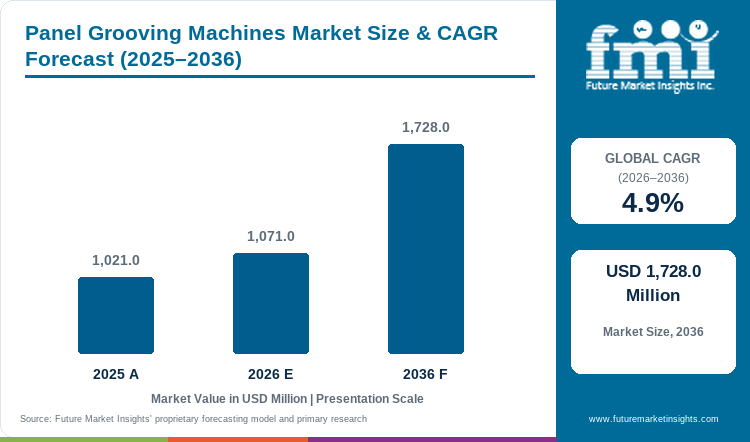
USD 1,071.0 million in 2026 and USD 1,728.0 million by 2036, expanding at 4.9% CAGR.
Sales of panel grooving machines are estimated to rise at 4.9% CAGR through 2036, increasing valuation from USD 1,021.0 million in 2025 to USD 1,071.0 million in 2026, and reaching USD 1,728.0 million by 2036. Woodworking manufacturers are increasingly prioritizing automation investments that reduce setup dependence and improve production consistency during labor shortages. VDMA stated in February 2025 that automation and digitalization help woodworking manufacturers lower operating costs while addressing qualified-labor constraints. Programmed grooving fits that woodworking machinery investment case because stored settings reduce repeated adjustment during mixed panel runs. Buyers are more likely to invest when documented groove accuracy is accompanied by measurable changeover savings.
Country growth differs because equipment approval uses different productivity tests in each major market. USA demand is forecast at 4.8% CAGR while Japan is forecast at 4.0% CAGR through 2036. The Japan Woodworking Machinery Association updated productivity-certificate requirements in April 2025 for woodworking and furniture equipment. Its criteria measure processing speed alongside tool-change time and labor saving before supported investment receives approval.
Key Takeaways
- High-mix furniture production supports grooving demand because stored programs preserve geometry during frequent pattern changes.
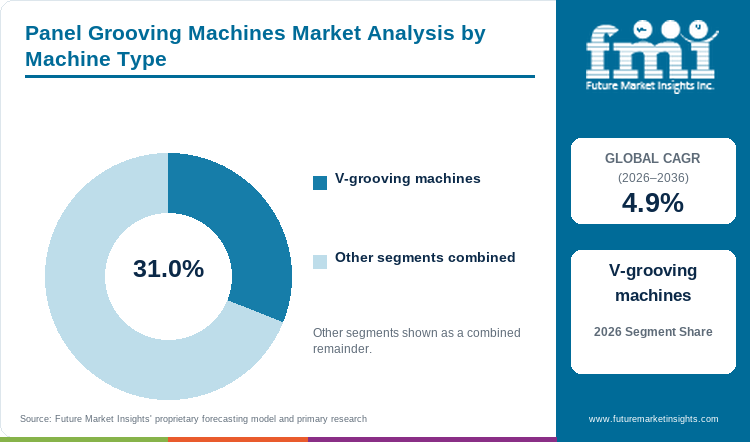
- V-grooving machines are projected to hold 31.0% share in 2026, driven by folded-edge geometry that requires controlled angle and depth.
- By panel material, MDF/HDF is forecast to represent 30.0% in 2026, supported by uniform board structure that permits repeatable programmed cutting.
- Furniture panels are likely to capture 32.0% share in 2026, attributable to grooving being combined with drilling and routing before assembly.
- Installed-cost approval can slow adoption because extraction and programming support must be ready before production starts.
- Some of the key players in this market include SCM Group, Biesse, HOMAG, Felder Group, Casadei Busellato, Cehisa, Jai Industries, Nanxing Machinery, KDT Machinery, and Masterwood.
Analyst Perspective
“Panel grooving pays when repeatable geometry shortens setup without forcing a factory to rebuild its panel flow. Buyers should test holding and extraction together before comparing programming effort with local service response.”
- Nikhil Kaitwade, Principal Consultant, Future Market Insights
How is the panel grooving machines market segmented?
Panel grooving machines are segmented by machine type, panel material, end use, automation, sales channel and region.
The panel grooving machines market is segmented by machine type, panel material, end use, automation, sales channel and region. Machine type covers V-grooving, CNC grooving, multi-head, notching and decorative machines while panel materials include MDF/HDF, plywood, particleboard, laminates and composites. End use covers furniture panels, wall panels, doors, cabinet components and decorative interiors while automation includes fully CNC, semi-automatic, manual feed and inline grooving cells. Sales channels include machinery OEMs, dealer/distributor networks, direct factory sales and aftermarket/service routes.
What makes V-grooving machines central to the machine type category?
V-grooving machines form folded edges and decorative profiles that depend on controlled angle and depth. SCM documents woodworking CNC tools with integrated X-axis grooving inside broader drilling and routing programs. Buyers compare dedicated groove output with the flexibility of sharing panel references across several programmed operations.
- By machine type, V-grooving machines are estimated to hold 31.0% in 2026, owing to folded-edge geometry that requires controlled angle and depth.
- SCM's startech cn v integrates a disc cutter for X-axis grooving inside a CNC drilling center used for programmed panel processing.
How does MDF/HDF shape selection within the panel material category?
MDF/HDF gives machine builders a uniform board structure that supports repeatable groove depth during programmed runs. CEHISA specifies MDF beside plywood and particleboard on automated equipment for common wood based panels. Grooving suppliers still validate tooling and extraction against the customer's actual board mix before production.
- MDF/HDF is projected to hold 30.0% share in 2026, supported by uniform board structure that improves repeatable groove depth.
- CEHISA lists MDF beside plywood and particleboard on automated panel equipment used for routine engineered-board processing.
Why do furniture panels account for 32.0% of end use demand?
Furniture plants combine drilling and routing with grooving before assembly so part references remain synchronized. Felder Group documents furniture manufacturing on CNC equipment that produces holes, grooves and connections in one operation. That workflow favors grooving systems that preserve programmed geometry during short-batch cabinet and component changes.
- By end use, furniture panels are forecast to represent 32.0% in 2026, attributable to grooving being combined with drilling and routing before assembly.
- Felder Group documents furniture production that combines holes and grooves with connections inside one programmed CNC operation.
What operating condition supports fully CNC automation demand?
Fully CNC systems suit mixed batches that require repeatable panel handling and frequent program changes without manual repositioning. Nanxing Machinery documents industrial automation equipment that grooves both panel faces and routes shapes without manual turning. Buyers compare programming flexibility with conveyor reliability because faster axes add little value if panel references drift.
- In 2026, fully CNC systems are expected to lead automation with 36.0% share, supported by stored programs that reduce repeated positioning work.
- Nanxing Machinery documents six-sided CNC equipment that combines grooving with routing and conveyor integration without manual panel turning.
Why do machinery OEMs account for 41.0% of sales channel demand?
Machinery OEMs control configuration and commissioning decisions before grooving equipment enters routine commercial production. Jai Industries links cabinetry tools with CNC panel machines that include grooving plus national sales and service coverage. Buyers use dealer support locally but rely on the manufacturer for software setup and machine integration.
- Machinery OEMs are set to lead the sales channel category with 41.0% share in 2026, driven by configuration and commissioning decisions made before production release.
- Jai Industries documents national sales and service coverage beside CNC panel equipment with direct grooving capability.
What are the drivers, restraints and opportunities in the Panel Grooving Machines Market?
Programmable production expands demand while installation requirements slow approval and compact CNC platforms widen buyer access.
- Driver: Mixed furniture runs reward programmed groove settings because operators can change panel patterns without manual resetting.
- Restraint: Extraction and training requirements can delay capital approval if expected machine utilization is uncertain.
- Opportunity: Compact CNC platforms can bring repeatable grooving into smaller plants without requiring a complete inline cell.
Driver: Programmable Production
Short furniture runs make manual groove setup expensive because each change consumes operator time and positioning effort. HOMAG introduced the DRILLTEQ H-230 at LIGNA 2025 with controlled clamps and a grooving saw option for six-sided processing. Its stand-alone or connected layout lets panel automation systems add programmed grooving without forcing a complete line replacement. Suppliers strengthen capital approval by quantifying changeover savings beside groove accuracy during mixed furniture production.
Restraint: Installation Requirements
Grooving installations need extraction and tooling discipline before commercial production begins because cutting wood generates dust and noise. The US Bureau of Labor Statistics identifies both hazards for woodworkers and notes regular use of protective equipment. Plants therefore size wood dust extraction to the cutting load before approving machine installation or operator training. Suppliers reduce approval friction by defining utilities and commissioning tasks inside the original capital proposal.
Opportunity: Compact CNC
Smaller panel shops often need CNC repeatability without the floor space or handling investment required by a complete line. SCM introduced the morbidelli x50 in July 2025 for first-time nesting users and emphasized simplified programming within a compact installation. Suitable timber cutting machine tooling and stable panel holding can extend the same configuration toward repeatable grooving work. OEMs reach smaller buyers by pairing staged automation with local commissioning plus practical operator training support.
Which country CAGRs are profiled in the Panel Grooving Machines Market?
| Country | CAGR |
|---|---|
| Germany | 6.1% |
| Mexico | 5.8% |
| Brazil | 5.4% |
| Italy | 5.1% |
| USA | 4.8% |
| France | 4.4% |
| Japan | 4.0% |
How do country-level CAGRs compare in the Panel Grooving Machines Market?
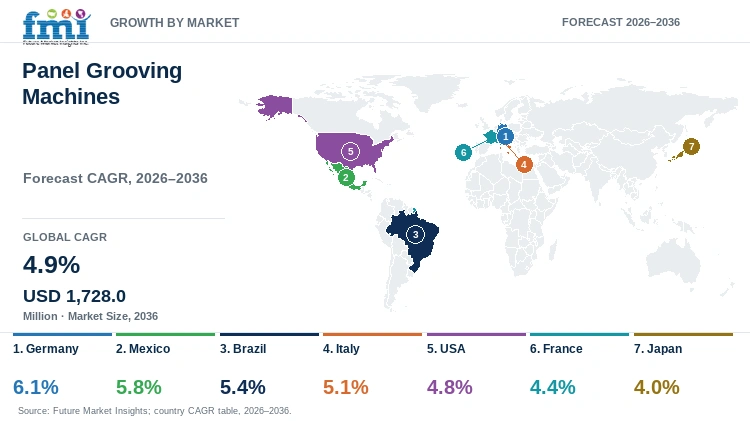
Germany and Mexico form the upper CAGR group before Brazil and Italy while USA, France and Japan complete a 2.1-point spread shaped by different investment timing rather than absolute market size.
- Germany’s strong machinery-engineering heritage raises expectations for productivity gains, making performance improvements central to panel grooving machine replacement decisions.
- In Mexico, demand for imported machinery increases the value of local commissioning expertise, technical support, and after-sales service capabilities.
- Brazilian manufacturers often favor modular automation investments that provide flexibility during uneven capital-spending cycles.
- Italy’s mature woodworking-machinery ecosystem supports replacement demand from experienced buyers seeking efficiency upgrades and process improvements.
- The USA’s broad range of equipment options shifts competition beyond machine specifications toward integration quality, service support, and operational reliability.
- French manufacturers running diverse panel products and production programs often prefer flexible replacement solutions that can adapt to changing workloads.
- In Japan, investment decisions are closely tied to measurable productivity benefits, with setup-time reductions and labor-efficiency improvements carrying significant weight during equipment qualification.
The full report provides country-level CAGR analysis across North America, Latin America, Western Europe, Eastern Europe, East Asia, South Asia and Pacific, and the Middle East and Africa.
Country-wise Analysis
- German woodworking plants operate within a mature machinery base where automation proposals face experienced technical review. By 2036, Germany is projected to grow at 6.1% CAGR, owing to replacement decisions that require measurable productivity gains. World Bank WITS recorded 3,452 German imports of drilling or morticing machines for wood and cork in 2024, confirming active machinery purchasing without measuring panel grooving machines directly. Suppliers need cycle-time evidence and local service to convert technical interest into capital approval.
- Mexican furniture plants depend heavily on imported woodworking equipment so nearby commissioning becomes more important as CNC complexity increases. Mexico's panel grooving machines outlook is anticipated to advance at 5.8% CAGR over the assessment period, driven by imported-equipment purchasing. World Bank WITS recorded 2,299 Mexican imports of drilling or morticing machines for wood and cork in 2024. The national adjacent-equipment count confirms active purchasing without treating that category as panel grooving machines. Suppliers improve order conversion with staged CNC configurations plus service coverage during routine production.
- Brazilian panel processors operate with a smaller imported equipment flow and investment timing can change quickly with manufacturing conditions. Panel grooving machine demand in Brazil is forecast to rise at 5.4% CAGR over the forecast period, attributable to modular investment choices. World Bank WITS recorded 837 Brazilian imports of drilling or morticing machines for wood and cork in 2024. Modular CNC offers and local spare-parts support can protect payback during uneven capital cycles.
- Italian furniture factories operate beside a dense domestic woodworking-technology industry that gives buyers many alternatives for replacing panel machinery. Adoption of panel grooving machines in Italy is estimated to expand at 5.1% CAGR through 2036, supported by selective replacement investment. Acimall reported in May 2026 that domestic sales of Italian wood and furniture technology rose 15.0% during 2025. Imports increased 24.5% in the same year and confirmed active national equipment purchasing. Grooving suppliers still need measurable cycle-time gains plus responsive application support to displace capable installed machinery.
- US manufacturers can source from a broad international equipment base so factories compare several automation routes before replacing panel machinery. The USA panel grooving machines sector is projected to record 4.8% CAGR during the assessment period, shaped by integration-led replacement decisions. World Bank WITS recorded 111,895 United States imports of drilling or morticing machines for wood and cork in 2024. Suppliers are competing on integration quality and service response because simple machine availability rarely settles complex replacement decisions.
- French panel processors compare imported woodworking machinery with existing drilling and finishing equipment before replacing a dedicated production step. In France, panel grooving machine demand is predicted to advance at 4.4% CAGR through 2036, influenced by flexible replacement requirements. World Bank WITS recorded 6,838 French imports of drilling or morticing machines for wood and cork in 2024. Suppliers are strengthening approval by supporting several furniture and interior-panel programs on one serviced platform.
- Japanese machinery buyers use formal productivity measures during qualification of equipment that receives investment-support treatment. Japan is estimated to post 4.0% CAGR over the forecast period, aided by productivity certification that rewards measurable operating gains. The Japan Woodworking Machinery Association updated its productivity-certificate process in April 2025 for woodworking and furniture manufacturing equipment. Its criteria include processing speed plus tool-change time and documented labor-saving performance during supported investment reviews. Those measures fit CNC grooving decisions where programmed accuracy must produce visible operating improvement. Suppliers should document cycle changes and compact installation requirements before buyers grant routine production approval.
Who are the notable companies in the Panel Grooving Machines Market?
SCM Group, Biesse, HOMAG, Felder Group, Casadei Busellato, Cehisa, Jai Industries, Nanxing Machinery, KDT Machinery, and Masterwood serve the panel grooving machines market.
Broad CNC groups compete with panel specialists and workshop-focused machinery companies that document grooving or adjacent panel functions. Entry depends on repeatable panel handling plus dust extraction systems fitted to the customer's production flow. Software and service coverage become decisive once grooving enters a connected panel production cell.
- SCM Group, Biesse, HOMAG and Felder Group offer CNC routes that place grooving beside other panel operations.
- Casadei Busellato, Jai Industries and Masterwood serve panel-processing requirements spanning workshop and industrial production settings.
- Nanxing Machinery and KDT Machinery emphasize CNC panel automation while Cehisa supplies customized panel equipment with documented grooving units and international support.
Competitive Benchmarking: Panel Grooving Machines Market
| Company | Grooving Capability | Automation Integration | Panel Workflow Breadth | Geographic Reach |
|---|---|---|---|---|
| SCM Group | High | High | High | Global |
| Biesse | High | High | High | Global |
| HOMAG | High | High | High | Global |
| Felder Group | High | High | High | International |
| Casadei Busellato | High | Medium | High | Europe and export markets |
| Cehisa | High | Medium | Medium | International |
| Jai Industries | High | Medium | High | India and export markets |
| Nanxing Machinery | High | High | High | China and international sales |
| KDT Machinery | High | High | High | 70+ countries |
| Masterwood | High | Medium | High | Italy and international sales |
Scoring basis: High grooving capability requires evidence of multiple groove or slot functions within current machinery lines. Medium covers one documented grooving route inside broader CNC processing while Low covers one narrow function. High automation requires connected handling or cell integration while Medium covers CNC control without complete cell evidence. Workflow breadth is High for three adjacent panel functions and Medium for two while Low covers one.
Key Developments in the Panel Grooving Machines Market
- In June 2026, HOMAG introduced the DRILLTEQ H-610 with CNC-controlled clamping and grooving-unit options for connected six-sided panel processing.
- In February 2026, Biesse opened its Guadalajara branch to expand direct woodworking-equipment support in Mexico and Central America.
- In September 2025, KDT Machinery completed its Hongmaster acquisition and established Guangdong Hongmaster Numerical Control Technology for CNC equipment manufacturing.
Key Players in the Panel Grooving Machines Market
Integrated CNC and Automated Panel Lines
- SCM Group
- Biesse
- HOMAG
- Felder Group
Flexible Panel-Processing Platforms
- Casadei Busellato
- Jai Industries
- Masterwood
Panel Automation and Finishing Specialists
- Nanxing Machinery
- KDT Machinery
- Cehisa
Panel Grooving Machines Market - Report Scope
| Coverage field | Report scope |
|---|---|
| Market breakdown | By machine type, panel material, end use, automation, sales channel and region. |
| Quantitative Units | USD million. |
| Market Definition | Revenue includes panel grooving machines and grooving-capable panel-processing equipment sold within the defined segmentation universe. |
| Regions Covered | North America, Latin America, Western Europe, Eastern Europe, East Asia, South Asia and Pacific, and Middle East and Africa. |
| Countries Covered | Germany, Mexico, Brazil, Italy, USA, France, Japan, and 20+ countries included in the full report. |
| Key Companies Profiled | SCM Group, Biesse, HOMAG, Felder Group, Casadei Busellato, Cehisa, Jai Industries, Nanxing Machinery, KDT Machinery, and Masterwood. |
| Forecast Period | 2026 to 2036. |
| Approach | Primary and secondary research with market triangulation. |
Panel Grooving Machines Market - Research Methodology
| Method | Approach |
|---|---|
| Primary Research | FMI analysts gathered input from manufacturers, service providers, technology developers, distributors, end users, procurement teams, and subject-matter experts. Interviews examined purchasing decisions, product or service evaluation, adoption barriers, approval requirements, pricing considerations, and expectations for technical or commercial support. Respondents were also asked what evidence is required before a trial, pilot, or initial order develops into regular purchasing. |
| Desk Research | Desk research covered government statistics, regulatory publications, trade data, industry associations, technical literature, standards, company filings, product information, and official corporate announcements. Sources were reviewed for relevance, publication date, geographic coverage, and consistency with the defined market scope. Claims relating to performance, applications, approvals, capacity, investment, and commercial activity were retained only when supported by credible public evidence. |
| Market Sizing and Forecasting | The market model combined the baseline value with historical performance, segment structure, pricing and volume indicators, adoption levels, company participation, and country-level demand conditions. Forecast assumptions considered economic activity, investment trends, regulatory developments, technology adoption, purchasing cycles, supply availability, and barriers to wider market use. Segment and regional estimates were reconciled before the final market total was calculated. |
| Data Validation | Estimates were checked against multiple independent indicators, including public data, company activity, trade patterns, industry developments, and findings from primary interviews. Validation also tested whether products, services, applications, and company revenues fell within the defined market boundaries. Adjacent categories, unsupported claims, overlapping revenues, and activities without direct market relevance were excluded to reduce double counting and maintain consistency across segments and countries. |
Panel Grooving Machines Market by Segments
Panel Grooving Machines Market segmented by Machine Type:
- V-grooving machines
- CNC grooving machines
- Multi-head groovers
- Panel notching machines
- Decorative grooving machines
Panel Grooving Machines Market segmented by Panel Material:
- MDF/HDF
- Plywood
- Particleboard
- Laminated panels
- Composite panels
Panel Grooving Machines Market segmented by End Use:
- Furniture panels
- Wall panels
- Doors
- Cabinet components
- Decorative interiors
Panel Grooving Machines Market segmented by Automation:
- Fully CNC
- Semi-automatic
- Manual feed
- Inline grooving cell
Panel Grooving Machines Market segmented by Sales Channel:
- Machinery OEMs
- Dealer/distributor network
- Direct factory sales
- Aftermarket/service
Panel Grooving Machines Market by Region:
- North America
- United States
- Canada
- Latin America
- Brazil
- Mexico
- Argentina
- Chile
- Western Europe
- Germany
- France
- United Kingdom
- Italy
- Spain
- Benelux
- Nordics
- Eastern Europe
- Poland
- Czech Republic
- Romania
- Hungary
- East Asia
- China
- Japan
- South Korea
- South Asia and Pacific
- India
- ASEAN
- Australia and New Zealand
- Middle East and Africa
- GCC Countries
- South Africa
- Türkiye
- Israel
Research Sources and Bibliography
- VDMA Woodworking Machinery Association. (2025, February 20). Innovation and Automation for the Wood Industry.
- Japan Woodworking Machinery Association. (2025, April 2). 2025年4月以降の生産性向上要件証明書の申請開始のご案内.
- SCM Group. (n.d.). startech cn v. Retrieved September 16, 2026.
- CEHISA. (n.d.). AVANT 4.0 Series. Retrieved September 16, 2026.
- Felder Group. (n.d.). CNC Machining Centre profit H80I. Retrieved September 16, 2026.
- Nanxing Machinery. (n.d.). CNC 6-sided Drilling Machine ND612. Retrieved September 16, 2026.
- Jai Industries. (n.d.). Optimus. Retrieved September 16, 2026.
- HOMAG. (2025, May 26). CNC processing - new solutions from entry-level to industrial production.
- HOMAG. (2025, June 17). HOMAG at LIGNA 2025: Building Living Spaces with innovation and passion.
- USA Bureau of Labor Statistics. (2026, August 27). Woodworkers: Occupational Outlook Handbook.
- SCM Group. (2025, July 11). SCM new entries for CNC machining centres and flexible drilling at Ligna 2025.
- World Bank, World Integrated Trade Solution. (2026). Germany drilling or morticing machines for working wood or cork imports by country, 2024.
- World Bank, World Integrated Trade Solution. (2026). Mexico drilling or morticing machines for working wood or cork imports by country, 2024.
- World Bank, World Integrated Trade Solution. (2026). Brazil drilling or morticing machines for working wood or cork imports by country, 2024.
- Acimall. (2026, May 5). ACIMALL: The 2025 final balance indicates a stable trend in the wood and furniture technology sector.
- World Bank, World Integrated Trade Solution. (2026). Drilling or morticing machines for working wood or cork imports by country, 2024.
- World Bank, World Integrated Trade Solution. (2026). France drilling or morticing machines for working wood or cork imports by country, 2024.
- HOMAG. (2026, June 2). DRILLTEQ H-610: Welcome to Formula Drill - The new High-Speed Machining Center for the 6-side-processing.
- Biesse. (2026, February 2). Mexican Market: Biesse strengthens its presence in Latin America through expansion in Mexico.
- KDT Machinery. (2025, September 2). KDT Group Acquires Hongmaster to Accelerate Strategic Deployment in High-End Intelligent Manufacturing.
- Biesse. (2026, May 1). Hansen & Company Woodworks Unveils HCo 2.0 Powered by Biesse.
- Felder Group. (2025, May 26). LIGNA 2025.
- Casadei Busellato. (2025, June 10). Ligna, a record edition for Casadei Busellato.
- SCM Group. (2025, July 4). New “gabbiani p / pt” panel saws: full control of the production process.
- LIGNA. (2025). MVD900. Masterwood.
- LIGNA. (2025). Nanxing Nesting Workstation. Nanxing Machinery.
- KDT Machinery. (2025, June 3). LIGNA 2025 | KDT Ends on a High, Showcasing Chinese Innovation to the World.
- Casadei Busellato. (n.d.). Automatic boring and grooving center. Retrieved September 16, 2026.
- Masterwood. (n.d.). MS 320 G. Retrieved September 16, 2026.
- KDT Machinery. (n.d.). KD-612ES. Retrieved September 16, 2026.
- SCM Group. (2026, September 8). SCM’s new Accord 500 Edge awarded at IWF 2026.
- Biesse. (n.d.). IWF 2026. Retrieved September 16, 2026.
- Felder Group. (n.d.). IWF Atlanta 2026. Retrieved September 16, 2026.
- Casadei Busellato. (n.d.). Casadei Busellato and JKL at IWF 2026. Retrieved September 16, 2026.
- CEHISA GROUP. (2026, September). Another tailor-made solution by CEHISA GROUP [LinkedIn post].
- Jai Industries. (2026, February). INDIAWOOD Bengaluru live machine demonstrations and new launches [LinkedIn post].
- Nanxing Machinery. (2026, April 28). Nanxing Tech Day Brazil: Advancing the Future of Woodworking Machinery.
- KDT Machinery. (2025, November 10). Empowering Global Excellence: KDT's CNC Training System Forges Your Worldwide Competitiveness.
- Masterwood. (2025). MasterDays 2025. Retrieved September 16, 2026.
- HOMAG. (2025, April 14). The Heartbeat of Woodworking. HOMAG India at the INDIAWOOD 2025.
This bibliography is provided for reader reference and is not exhaustive. The full report contains the complete reference list and detailed citations.
This Report Answers
- How large is the panel grooving machines market in 2026 and 2036?
- Which operating conditions support programmed grooving investment during furniture production?
- Why do V-grooving machines account for 31.0% of machine type demand?
- How does MDF/HDF affect repeatable grooving setup during panel production?
- Why do furniture panels represent 32.0% of end use demand?
- How do CAGRs differ among Germany, Mexico, Brazil, Italy, USA, France and Japan?
- Which companies provide documented grooving capability and CNC panel integration?
- Which installation requirements can delay panel grooving machine approval decisions?
Frequently Asked Questions
How big is the Panel Grooving Machines Market in 2026?
The panel grooving machines market is valued at USD 1,071.0 million in 2026 and is projected to reach USD 1,728.0 million by 2036. Mixed panel runs support programmed groove settings that reduce repeated manual adjustment during frequent design changes.
What is the CAGR of the Panel Grooving Machines Market from 2026 to 2036?
The panel grooving machines market is projected to grow at 4.9% CAGR between 2026 and 2036. CNC control reduces repeated setup while preserving groove depth and position during frequent product changes.
Which machine type accounts for 31.0% of Panel Grooving Machines Market demand in 2026?
The V-grooving machines segment is expected to hold 31.0% of machine type demand in the panel grooving machines market during 2026. Folded-edge production requires controlled groove angle and depth before panels move into final assembly.
How much value will the Panel Grooving Machines Market add by 2036?
The panel grooving machines market is expected to add USD 657.0 million in annual value between 2026 and 2036. Programmable panel machining reduces repeated setup during mixed furniture production and frequent pattern changes.
Which companies are active in the Panel Grooving Machines Market?
Key companies include SCM Group, Biesse, HOMAG, Felder Group, Casadei Busellato, Cehisa, Jai Industries, Nanxing Machinery, KDT Machinery and Masterwood. Buyers compare grooving capability with automation integration and service coverage before approving complex panel machinery investments.
Preview the report firsthand - request a free sample
Get SampleGet the brochure for pricing and purchase details.
Get PDFTable of Content
- Key Takeaways
- Market Size and CAGR
- Top Growth Driver
- Fastest Growing Segment
- Leading Region
- Key Companies
- Emerging Opportunities
- Executive Summary
- Global Market Outlook
- Demand-side Trends
- Supply-side Trends
- Technology Roadmap Analysis
- Analysis and Recommendations
- Analyst Perspective (What is happening? Why now? What should investors know?)
- Key Questions Answered
- How large is the market?
- What is the CAGR?
- What are key trends?
- Which region dominates?
- Who are the leaders?
- Market Overview
- Market Coverage / Taxonomy
- Market Definition / Scope / Limitations
- Research Methodology
- Chapter Orientation
- Analytical Lens and Working Hypotheses
- Market Structure, Signals, and Trend Drivers
- Benchmarking and Cross-market Comparability
- Market Sizing, Forecasting, and Opportunity Mapping
- Research Design and Evidence Framework
- Desk Research Programme (Secondary Evidence)
- Expert Input and Fieldwork (Primary Evidence)
- Tooling, Models, and Reference Databases
- Data Engineering and Model Build
- Quality Assurance and Audit Trail
- Market Background
- Market Dynamics (Drivers, Restraints, Opportunity, Trends)
- Scenario Forecast (Optimistic, Likely, Conservative)
- Impact Analysis
- AI Impact
- Sustainability Impact
- Regulatory Impact
- Technology Impact
- Consumer / Buyer Analysis
- Purchase Drivers
- Adoption Barriers
- Buyer Journey
- Opportunity Map Analysis
- Product Life Cycle Analysis
- Supply Chain Analysis
- Investment Feasibility Matrix
- Value Chain Analysis
- PESTLE and Porter's Analysis
- Regulatory Landscape
- Regional Parent Market Outlook
- Production and Consumption Statistics
- Import and Export Statistics
- Global Market Analysis and Forecast, 2021 to 2036
- Historical Market Size Value (USD Million) Analysis, 2021 to 2025
- Current and Future Market Size Value (USD Million) Projections, 2026 to 2036
- Y-o-Y Growth Trend Analysis
- Absolute $ Opportunity Analysis
- Global Market Pricing Analysis, 2021 to 2036
- Global Market Analysis and Forecast, By Machine Type, 2021 to 2036
- Introduction / Key Findings
- Historical Market Size Value (USD Million) Analysis By Machine Type, 2021 to 2025
- Current and Future Market Size Value (USD Million) Analysis and Forecast By Machine Type, 2026 to 2036
- V-grooving machines
- CNC grooving machines
- Multi-head groovers
- Panel notching machines
- Decorative grooving machines
- Y-o-Y Growth Trend Analysis By Machine Type, 2021 to 2025
- Absolute $ Opportunity Analysis By Machine Type, 2026 to 2036
- Global Market Analysis and Forecast, By Panel Material, 2021 to 2036
- Introduction / Key Findings
- Historical Market Size Value (USD Million) Analysis By Panel Material, 2021 to 2025
- Current and Future Market Size Value (USD Million) Analysis and Forecast By Panel Material, 2026 to 2036
- MDF/HDF
- Plywood
- Particleboard
- Laminated panels
- Composite panels
- Y-o-Y Growth Trend Analysis By Panel Material, 2021 to 2025
- Absolute $ Opportunity Analysis By Panel Material, 2026 to 2036
- Global Market Analysis and Forecast, By End Use, 2021 to 2036
- Introduction / Key Findings
- Historical Market Size Value (USD Million) Analysis By End Use, 2021 to 2025
- Current and Future Market Size Value (USD Million) Analysis and Forecast By End Use, 2026 to 2036
- Furniture panels
- Wall panels
- Doors
- Cabinet components
- Decorative interiors
- Y-o-Y Growth Trend Analysis By End Use, 2021 to 2025
- Absolute $ Opportunity Analysis By End Use, 2026 to 2036
- Global Market Analysis and Forecast, By Automation, 2021 to 2036
- Introduction / Key Findings
- Historical Market Size Value (USD Million) Analysis By Automation, 2021 to 2025
- Current and Future Market Size Value (USD Million) Analysis and Forecast By Automation, 2026 to 2036
- Fully CNC
- Semi-automatic
- Manual feed
- Inline grooving cell
- Y-o-Y Growth Trend Analysis By Automation, 2021 to 2025
- Absolute $ Opportunity Analysis By Automation, 2026 to 2036
- Global Market Analysis and Forecast, By Sales Channel, 2021 to 2036
- Introduction / Key Findings
- Historical Market Size Value (USD Million) Analysis By Sales Channel, 2021 to 2025
- Current and Future Market Size Value (USD Million) Analysis and Forecast By Sales Channel, 2026 to 2036
- Machinery OEMs
- Dealer/distributor network
- Direct factory sales
- Aftermarket/service
- Y-o-Y Growth Trend Analysis By Sales Channel, 2021 to 2025
- Absolute $ Opportunity Analysis By Sales Channel, 2026 to 2036
- Global Market Analysis and Forecast, By Region, 2021 to 2036
- Introduction
- Historical Market Size Value (USD Million) Analysis By Region, 2021 to 2025
- Current Market Size Value (USD Million) Analysis and Forecast By Region, 2026 to 2036
- North America
- Latin America
- Western Europe
- Eastern Europe
- East Asia
- South Asia and Pacific
- Middle East and Africa
- Market Attractiveness Analysis By Region
- North America Market Analysis and Forecast, By Country, 2021 to 2036
- Historical Market Size Value (USD Million) Trend Analysis By Market Taxonomy, 2021 to 2025
- Market Size Value (USD Million) Forecast By Market Taxonomy, 2026 to 2036
- By Country
- United States
- Canada
- By Machine Type
- By Panel Material
- By End Use
- By Automation
- By Sales Channel
- By Country
- Market Attractiveness Analysis
- By Country
- By Machine Type
- By Panel Material
- By End Use
- By Automation
- By Sales Channel
- Key Takeaways
- Latin America Market Analysis and Forecast, By Country
- Historical Market Size Value (USD Million) Trend Analysis By Market Taxonomy, 2021 to 2025
- Market Size Value (USD Million) Forecast By Market Taxonomy, 2026 to 2036
- By Country
- Brazil
- Mexico
- Argentina
- Chile
- By Machine Type
- By Panel Material
- By End Use
- By Automation
- By Sales Channel
- By Country
- Market Attractiveness Analysis
- By Country
- By Machine Type
- By Panel Material
- By End Use
- By Automation
- By Sales Channel
- Key Takeaways
- Western Europe Market Analysis and Forecast, By Country
- Historical Market Size Value (USD Million) Trend Analysis By Market Taxonomy, 2021 to 2025
- Market Size Value (USD Million) Forecast By Market Taxonomy, 2026 to 2036
- By Country
- Germany
- France
- United Kingdom
- Italy
- Spain
- Benelux
- Nordics
- By Machine Type
- By Panel Material
- By End Use
- By Automation
- By Sales Channel
- By Country
- Market Attractiveness Analysis
- By Country
- By Machine Type
- By Panel Material
- By End Use
- By Automation
- By Sales Channel
- Key Takeaways
- Eastern Europe Market Analysis and Forecast, By Country
- Historical Market Size Value (USD Million) Trend Analysis By Market Taxonomy, 2021 to 2025
- Market Size Value (USD Million) Forecast By Market Taxonomy, 2026 to 2036
- By Country
- Poland
- Czech Republic
- Romania
- Hungary
- By Machine Type
- By Panel Material
- By End Use
- By Automation
- By Sales Channel
- By Country
- Market Attractiveness Analysis
- By Country
- By Machine Type
- By Panel Material
- By End Use
- By Automation
- By Sales Channel
- Key Takeaways
- East Asia Market Analysis and Forecast, By Country
- Historical Market Size Value (USD Million) Trend Analysis By Market Taxonomy, 2021 to 2025
- Market Size Value (USD Million) Forecast By Market Taxonomy, 2026 to 2036
- By Country
- China
- Japan
- South Korea
- By Machine Type
- By Panel Material
- By End Use
- By Automation
- By Sales Channel
- By Country
- Market Attractiveness Analysis
- By Country
- By Machine Type
- By Panel Material
- By End Use
- By Automation
- By Sales Channel
- Key Takeaways
- South Asia and Pacific Market Analysis and Forecast, By Country
- Historical Market Size Value (USD Million) Trend Analysis By Market Taxonomy, 2021 to 2025
- Market Size Value (USD Million) Forecast By Market Taxonomy, 2026 to 2036
- By Country
- India
- ASEAN
- Australia and New Zealand
- By Machine Type
- By Panel Material
- By End Use
- By Automation
- By Sales Channel
- By Country
- Market Attractiveness Analysis
- By Country
- By Machine Type
- By Panel Material
- By End Use
- By Automation
- By Sales Channel
- Key Takeaways
- Middle East and Africa Market Analysis and Forecast, By Country
- Historical Market Size Value (USD Million) Trend Analysis By Market Taxonomy, 2021 to 2025
- Market Size Value (USD Million) Forecast By Market Taxonomy, 2026 to 2036
- By Country
- GCC Countries
- South Africa
- Türkiye
- Israel
- By Machine Type
- By Panel Material
- By End Use
- By Automation
- By Sales Channel
- By Country
- Market Attractiveness Analysis
- By Country
- By Machine Type
- By Panel Material
- By End Use
- By Automation
- By Sales Channel
- Key Takeaways
- Key Countries Market Analysis
- United States
- Pricing Analysis
- Market Share Analysis, 2025
- By Machine Type
- By Panel Material
- By End Use
- By Automation
- By Sales Channel
- Canada
- Pricing Analysis
- Market Share Analysis, 2025
- By Machine Type
- By Panel Material
- By End Use
- By Automation
- By Sales Channel
- Mexico
- Pricing Analysis
- Market Share Analysis, 2025
- By Machine Type
- By Panel Material
- By End Use
- By Automation
- By Sales Channel
- Brazil
- Pricing Analysis
- Market Share Analysis, 2025
- By Machine Type
- By Panel Material
- By End Use
- By Automation
- By Sales Channel
- Chile
- Pricing Analysis
- Market Share Analysis, 2025
- By Machine Type
- By Panel Material
- By End Use
- By Automation
- By Sales Channel
- Germany
- Pricing Analysis
- Market Share Analysis, 2025
- By Machine Type
- By Panel Material
- By End Use
- By Automation
- By Sales Channel
- United Kingdom
- Pricing Analysis
- Market Share Analysis, 2025
- By Machine Type
- By Panel Material
- By End Use
- By Automation
- By Sales Channel
- Italy
- Pricing Analysis
- Market Share Analysis, 2025
- By Machine Type
- By Panel Material
- By End Use
- By Automation
- By Sales Channel
- Spain
- Pricing Analysis
- Market Share Analysis, 2025
- By Machine Type
- By Panel Material
- By End Use
- By Automation
- By Sales Channel
- France
- Pricing Analysis
- Market Share Analysis, 2025
- By Machine Type
- By Panel Material
- By End Use
- By Automation
- By Sales Channel
- India
- Pricing Analysis
- Market Share Analysis, 2025
- By Machine Type
- By Panel Material
- By End Use
- By Automation
- By Sales Channel
- ASEAN
- Pricing Analysis
- Market Share Analysis, 2025
- By Machine Type
- By Panel Material
- By End Use
- By Automation
- By Sales Channel
- Australia and New Zealand
- Pricing Analysis
- Market Share Analysis, 2025
- By Machine Type
- By Panel Material
- By End Use
- By Automation
- By Sales Channel
- China
- Pricing Analysis
- Market Share Analysis, 2025
- By Machine Type
- By Panel Material
- By End Use
- By Automation
- By Sales Channel
- Japan
- Pricing Analysis
- Market Share Analysis, 2025
- By Machine Type
- By Panel Material
- By End Use
- By Automation
- By Sales Channel
- South Korea
- Pricing Analysis
- Market Share Analysis, 2025
- By Machine Type
- By Panel Material
- By End Use
- By Automation
- By Sales Channel
- Poland
- Pricing Analysis
- Market Share Analysis, 2025
- By Machine Type
- By Panel Material
- By End Use
- By Automation
- By Sales Channel
- Hungary
- Pricing Analysis
- Market Share Analysis, 2025
- By Machine Type
- By Panel Material
- By End Use
- By Automation
- By Sales Channel
- Türkiye
- Pricing Analysis
- Market Share Analysis, 2025
- By Machine Type
- By Panel Material
- By End Use
- By Automation
- By Sales Channel
- South Africa
- Pricing Analysis
- Market Share Analysis, 2025
- By Machine Type
- By Panel Material
- By End Use
- By Automation
- By Sales Channel
- United States
- Market Structure Analysis
- Competition Dashboard
- Competition Benchmarking
- Market Share Analysis of Top Players
- By Regional
- By Machine Type
- By Panel Material
- By End Use
- By Automation
- By Sales Channel
- Emerging Startups
- Innovation Benchmarking
- Competition Analysis
- Competition Deep Dive
- SCM Group
- Overview
- Product Portfolio
- Profitability by Market Segments
- Sales Footprint
- Strategy Overview
- Marketing Strategy
- Product Strategy
- Channel Strategy
- Biesse
- HOMAG
- Felder Group
- Casadei Busellato
- Cehisa
- Jai Industries
- Nanxing Machinery
- KDT Machinery
- Masterwood
- SCM Group
- Case Studies
- Success Stories
- Recent Developments
- Competition Deep Dive
- Assumptions & Acronyms Used


