

- Market Size (2026)
- USD 16.8 Bn
- Forecast (2036)
- USD 39.0 Bn
- CAGR (2026 to 2036)
- 8.8%
How big is Cloud Security Posture Management Software Market in 2026?
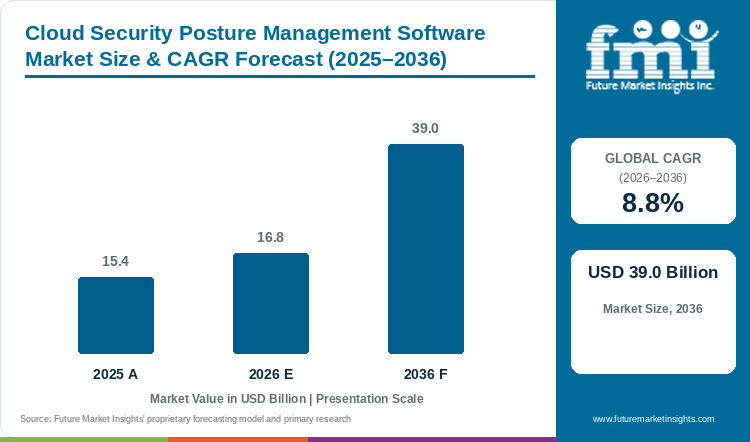
Worldwide cloud security posture management software billings hit an estimated USD 16.8 Billion for 2026 after posting USD 15.4 Billion in 2025, with a projected 8.8% CAGR lifting expected 2036 expenditure to USD 39.0 Billion.
As per FMI, global cloud security posture management software spending moves beyond its USD 15.4 Billion 2025 baseline to record an estimated USD 16.8 Billion during 2026, while a projected 8.8% CAGR carries expected 2036 turnover to USD 39.0 Billion and creates USD 22.2 Billion in net expansion. Decentralized software engineering squads provisioning ephemeral containers and object storage buckets through automated deployment scripts frequently introduce unencrypted database endpoints and over-privileged identity roles that bypass perimeter firewalls across multi-cloud cloud encryption architectures. In August 2026, the Cloud Security Alliance confirmed in its Top Threats to Cloud Computing survey report that inadequate identity and access management alongside excessive non-human permissions and API threats ranked as the primary risks across enterprise cloud estates [1]. Owing to the speed of continuous agentless API inspection over host-based agents, configuration assessment is anticipated to claim 42.4% of 2026 solution expenditure, while national software demand is forecast to progress at 8.4% annually in Germany up to 9.9% across Australia despite alert fatigue in security operations centers.
Key Market Trends & Insights
- By solution: Configuration assessment is anticipated to secure 42.4% of 2026 solution expenditure because agentless API connectors detect open network ports and permissive storage rules within minutes of code deployment.
- By cloud environment: Public cloud environments are projected to generate 40.7% of 2026 environment revenue as enterprises scale containerized microservices across Amazon Web Services and Microsoft Azure.
- By deployment: SaaS delivery is expected to capture 38.3% of 2026 deployment turnover by offering instant cross-account API onboarding and automatic compliance rule updates without on-premises appliances.
- By end use: BFSI organizations are forecast to command 42.4% of 2026 end use software spend to maintain continuous audit evidence for payment card and banking resilience regulators.
Regional Highlights
- Fastest national software growth: Mandatory critical infrastructure hardening is anticipated to lift Australian software spend by 9.9% annually between 2026 and 2036 across federal and enterprise cloud tenants.
- Comparative country expansion: Canadian tenants post an expected 9.5% annual growth and British banks record a projected 9.1% above U.S. enterprise spend at 9.0%, whereas Japanese buyers reach a forecast 8.5% and German industry expands at an estimated 8.4%.
Market Size & Forecast
Table 1: Market Size and Forecast for the Cloud Security Posture Management Software Market (USD billion and CAGR percentage), 2025 to 2036
| Metric | Value |
|---|---|
| 2025 Market Size | USD 15.4 Billion |
| Estimated Market Size in 2026 | USD 16.8 Billion |
| Projected Market Size by 2036 | USD 39.0 Billion |
| CAGR, 2026 to 2036 | 8.8% |
| Added Revenue, 2026 to 2036 | USD 22.2 Billion |
Chief information security officers are consolidating standalone configuration scanners with identity entitlement engines as artificial intelligence workloads multiply non-human service tokens across cloud tenants. In March 2026, the Cloud Security Alliance reported in its State of Cloud and AI Security analysis that machine and non-human identities now outnumber human users by a 100-to-1 ratio while plain-text secrets in Infrastructure as Code state files expose cloud tenants [2]. Consequently, enterprise security teams are linking control-plane posture telemetry directly to server security runtimes so analysts can revoke dormant administrative keys before lateral movement occurs.
Cloud Account Monitored Assets and Misconfiguration Drift Sizing
Table 2: Cloud Account Monitored Assets and Misconfiguration Drift Sizing Indicators for the Cloud Security Posture Management Software Market (USD Billion and operational ranges), mixed historical and forecast years from 2025 to 2036
| Metric | 2025 | 2026 | 2036 |
|---|---|---|---|
| Market size (USD Billion) | 15.4 | 16.8 | 39.0 |
| Monitored public and private cloud accounts (million) | 2.1 to 2.5 | 2.3 to 2.7 | 5.8 to 6.9 |
| Daily evaluated cloud configuration checks (billion) | 12.5 to 16.0 | 14.0 to 18.5 | 42.0 to 55.0 |
| Average misconfigurations detected per tenant (monthly count) | 480 to 720 | 450 to 680 | 180 to 310 |
Operational note: Monitored account ranges reflect commercial public cloud subscriptions across AWS and Microsoft Azure alongside Google Cloud and private Kubernetes clusters benchmarked against CIS security standards.
Automated policy engines execute billions of daily configuration checks across active cloud accounts to flag unencrypted block storage and exposed management ports. Integrating continuous drift telemetry into central industrial cyber security operations centers is projected to cut monthly unresolved misconfigurations per tenant by more than half through 2036.
Enterprise Tenant Procurement and Software Subscription Sizing
Enterprise software procurement teams structure posture management licenses around monitored cloud workload counts and annual compute consumption tiers. Security directors pair control-plane configuration scanning with api security feeds to prioritize internet-facing containers carrying both unpatched CVEs and excessive IAM roles.
Table 3: Enterprise Tenant Procurement and Software Subscription Sizing Indicators for the Cloud Security Posture Management Software Market (USD and license metrics), mixed historical and forecast years from 2025 to 2036
| Metric | 2025 | 2026 | 2036 |
|---|---|---|---|
| Active enterprise CSPM tenant licenses (thousand) | 38.5 | 42.0 | 85.0 |
| Average annual CSPM software spend per enterprise (USD) | 400,000 | 400,000 | 458,820 |
| Mid-market cloud posture subscription price band (USD/year) | 35,000 to 75,000 | 38,000 to 80,000 | 55,000 to 110,000 |
| Large enterprise multi-cloud subscription price band (USD/year) | 280,000 to 750,000 | 300,000 to 820,000 | 520,000 to 1,350,000 |
Table 4: End-Use Sector Revenue Indicators for the Cloud Security Posture Management Software Market (USD Billion and percentages), 2026
| Benchmark Indicator | 2026 Value | Institutional Reference Basis |
|---|---|---|
| Global market valuation, 2026 | USD 16.8 Billion | 2026 commercial enterprise software subscription baseline |
| BFSI sector revenue, 2026 | USD 7.1 Billion | 42.4% share of global end-use software licensing |
| Configuration assessment revenue, 2026 | USD 7.1 Billion | 42.4% share of global solution expenditure |
| Public cloud environment revenue, 2026 | USD 6.8 Billion | 40.7% share of cloud environment deployments |
Analyst Perspective
"Security operations teams cannot manually triage thousands of isolated configuration alerts across ephemeral cloud clusters. Agentless graph engines that correlate identity entitlements with network exposure are replacing standalone compliance scanners."
- Sudip Saha, Co-founder, FMI
How is the cloud security posture management software market segmented?
The cloud security posture management software market is segmented by solution, cloud environment, deployment, end use, and region. In 2026, configuration assessment is projected at 42.4%, public cloud at 40.7%, SaaS at 38.3%, and BFSI at 42.4%.
By solution: configuration assessment, compliance monitoring, risk prioritization, and automated remediation.
By cloud environment: public cloud, private cloud, hybrid cloud, and multi-cloud.
By deployment: SaaS, self-hosted, cloud-native agentless, and hybrid.
By end use: BFSI, technology, healthcare, and government.
Why Does Configuration Assessment Lead Solution Expenditure?
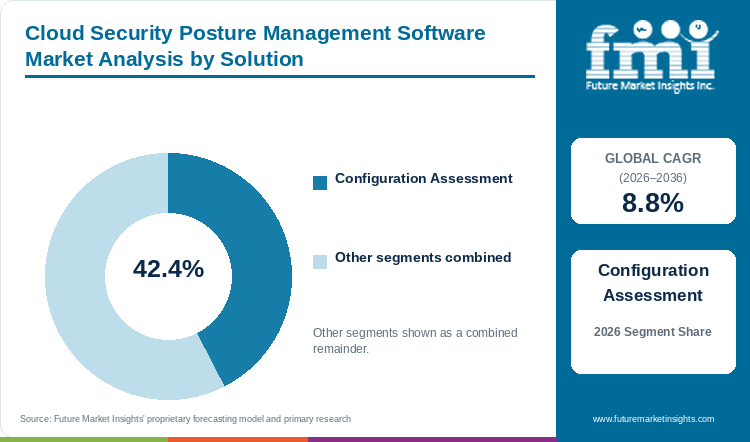
Configuration assessment is anticipated to claim 42.4% of 2026 solution expenditure, backed by continuous control-plane API polling across clouds.
Table 5: Solution Share for the Cloud Security Posture Management Software Market (percentage share), 2026
| Solution | Share (2026) |
|---|---|
| Configuration Assessment | 42.4% |
| Other Segments Combined | 57.6%* |
| Total | 100.0% |
*Note: Combined share of remaining solution categories totaling 100.0% of 2026 market demand.
Table 6: Solution Leadership and Market Growth for the Cloud Security Posture Management Software Market (segment and CAGR percentage), 2026 to 2036
| Metric | Value |
|---|---|
| Global CAGR (2026 to 2036) | 8.8% |
| Leading Segment | Configuration Assessment |
Polling cloud provider management APIs every few minutes allows security teams to inventory newly spun-up virtual machines and storage buckets without installing kernel agents that slow application performance. As enterprise developers push daily infrastructure changes across hundreds of virtual private clouds, manual firewall and encryption audits fail to keep pace. Security engineers pair continuous configuration inspection with identity and access management governance to spot publicly readable object storage and unrestricted SSH ports before external attackers scan them.
- Real-time agentless API inventory discovery is anticipated to enable configuration assessment to claim 42.4% of 2026 solution turnover.
- Palo Alto Networks, Inc. introduced Cortex Cloud in February 2025 to merge Prisma Cloud posture capabilities with Cortex CDR after Unit 42 research showed 80% of security exposures resided on cloud attack surfaces [3].
What Keeps Public Cloud Ahead Across Cloud Environment Deployments?
Public cloud is projected to generate 40.7% of 2026 cloud environment subscriptions, reflecting rapid workload deployment on hyperscale clusters.
Elastic compute scaling and managed database services on Amazon Web Services and Microsoft Azure alongside Google Cloud concentrate enterprise posture spend within public cloud environments. Decentralized product engineering squads frequently provision serverless functions and Kubernetes nodes outside central IT ticketing queues, creating shadow cloud assets with default security group settings. Organizations connect public cloud telemetry to network security policy management playbooks so misconfigured public IP endpoints are quarantined automatically across global availability zones.
- High workload density across commercial hyperscalers is projected to give public cloud 40.7% of 2026 cloud environment billings.
- Microsoft Corporation updated Microsoft Defender for Cloud in August 2026 to unify agentless multicloud posture management and AI security posture management across Azure and AWS alongside Google Cloud [4].
How Does SaaS Delivery Capture 38.3% of Deployment Turnover?
Within the deployment breakdown, SaaS is expected to account for 38.3% of 2026 turnover, reinforced by instant API onboarding.
Vendor-hosted SaaS posture consoles connect to enterprise cloud accounts in minutes via read-only API role delegation, eliminating the need to provision dedicated virtual appliances or manage database patches. Multi-tenant cloud consoles push updated regulatory benchmark rules and attack-path graph algorithms simultaneously across global subsidiaries. Security architects also link SaaS posture engines with big data security discovery modules to locate unencrypted personally identifiable information inside cloud object stores.
- Zero infrastructure maintenance and rapid cross-account API onboarding are expected to give SaaS 38.3% of 2026 deployment revenue.
- CrowdStrike Holdings, Inc. announced Falcon Cloud Security innovations in March 2026 featuring Application Explorer and Timeline Explorer alongside an adversary-informed Cloud Risk Engine [5].
Why Do BFSI Institutions Account for 42.4% of End Use Licensing?
BFSI is forecast to represent 42.4% of 2026 end use licensing, linked to mandatory banking digital operational resilience audits.
Commercial banks and payment processors alongside insurance carriers process millions of real-time financial transactions under strict supervisory regimes including PCI DSS 4.0 and the European Union Digital Operational Resilience Act. Financial compliance officers cannot rely on quarterly spreadsheet audits when digital banking microservices deploy multiple times per day. Automated posture software generates immutable configuration audit trails and enforces cryptographic key rotation policies across regulated banking workloads.
- Continuous regulatory audit documentation and financial data governance are forecast to place BFSI at 42.4% of 2026 end use spend.
- Check Point Software Technologies Ltd. and Wiz rolled out an integrated cloud network security and CNAPP posture solution in September 2025 that automates gateway-based remediation flows across enterprise and financial clouds [6].
What are the drivers, restraints, and opportunities in the cloud security posture management software market?
Multi-cloud workload sprawl and statutory resilience audits are projected to drive enterprise posture software subscriptions through 2036, while high false-positive alert volumes accelerate migration toward attack-path graph engines.
- Driver: Rapid expansion of multi-cloud microservices and strict financial and government compliance rules compel enterprises to automate continuous control-plane configuration audits.
- Restraint: High volumes of unprioritized configuration alerts and complex cross-account identity permissions create analyst fatigue across security operations centers.
- Opportunity: Embedding shift-left Infrastructure as Code scanning into developer pull requests and correlating toxic risk graphs is anticipated to expand DevSecOps contract values through 2036.
Growth Analysis and Future Potential: Multi-Cloud Expansion and Regulatory Enforcement
Distributing enterprise applications across multiple hyperscale cloud providers multiplies distinct identity models and network security groups alongside storage encryption controls that security teams must govern simultaneously. Future Market Insights projects that unmonitored control-plane changes remain the leading cause of cloud data exposure when engineering teams bypass manual change boards. In April 2025, the Cloud Security Alliance reported in its State of SaaS Security survey of 420 professionals that 63% of organizations experienced external data oversharing and 58% struggled to enforce identity privileges [7]. Correlating control-plane posture checks with threat hunting feeds enables security analysts to remediate actively exploited misconfigurations first.
Risk Assessment and Operational Hurdles: Alert Fatigue and Cross-Account Permission Complexity
Conventional rule-based posture scanners flag every non-compliant storage tag or internal port with equal urgency, flooding security operations queues with thousands of daily notifications. When analysts cannot tell whether a misconfigured virtual machine is actually reachable from the public internet, critical exposures remain unpatched alongside benign development alerts. In August 2025, the SANS Institute highlighted in its Future of Cloud Security analysis that tooling fragmentation and overprivileged IAM accounts alongside overlapping multicloud configurations create hidden security gaps across enterprise teams [8]. Aligning posture rules with data center security least-privilege policies requires contextual graph analysis rather than static checklist scanning.
Commercial Opportunity Analysis: Graph-Based Risk Correlation and Shift-Left Remediation
Combining agentless disk snapshot scanning with Infrastructure as Code template checks lets software vendors prevent misconfigurations before cloud resources ever reach production. Modern graph engines link internet ingress paths and container vulnerabilities with over-privileged IAM roles into a single prioritized remediation ticket within cloud computing workflows. National Institute of Standards and Technology authors released final Special Publication 800-70 Revision 5 guidance in May 2026 establishing automated security configuration checklists mapped to CSF 2.0 and SP 800-53 controls across cloud platforms [9]. Vendors that embed automated Terraform pull-request fixes directly into GitHub and GitLab pipelines are expected to secure multi-year DevSecOps platform renewals.
Cloud Security Posture Management Software Market by Country (2026 to 2036)
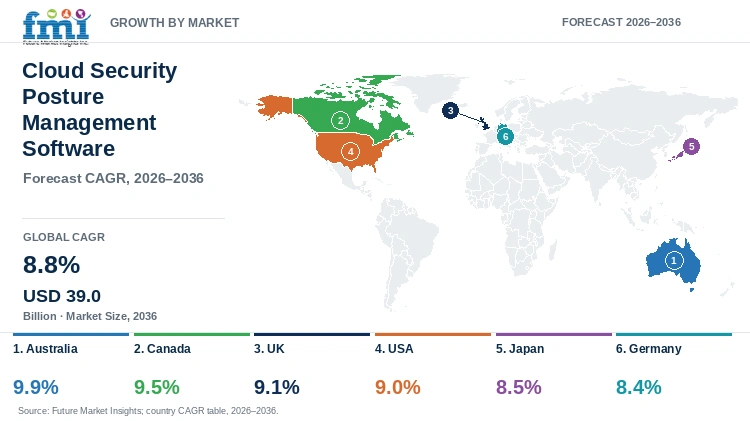
According to FMI, critical infrastructure cyber legislation is anticipated to lift Australian software expenditure by 9.9% annually through 2036 ahead of Canadian cloud assessment baselines at 9.5% and British financial rules at 9.1%, whereas German industrial accounts are forecast to advance at 8.4%. Public-sector cloud certification standards and cross-border privacy governance rules shape purchasing priorities across each domestic market.
Table 7: Country CAGR and Primary Growth Levers for the Cloud Security Posture Management Software Market (CAGR percentage and operational drivers), 2026 to 2036
| Country | CAGR (2026 to 2036) | Primary Growth Lever |
|---|---|---|
| Australia | 9.9% | Essential Eight cloud mitigation mandates and ASD Blueprint for Secure Cloud hardening |
| Canada | 9.5% | CCCS Cloud Security Assessment Program baselines and Quebec Law 25 cross-border privacy assessment safeguards |
| UK | 9.1% | NCSC cloud security principles and financial operational resilience rules |
| USA | 9.0% | NIST SP 800-53 Release 5.2.0 continuous monitoring and multi-cloud graph consolidation |
| Japan | 8.5% | Digital Agency government cloud migration and IPA ISMAP security evaluation standards |
| Germany | 8.4% | BSI C5:2026 cloud compliance catalogue criteria and sovereign data privacy enforcement |
Source: Future Market Insights analysis
Australia Cloud Security Posture Management Software Market Outlook (2026 to 2036)
Australia differs from North American and European cloud security markets because critical-infrastructure risk management program rules require board-approved cyber risk governance across energy and banking alongside telecommunications operators using recognized security frameworks. In September 2026, the Australian Signals Directorate updated its Blueprint for Secure Cloud to align conditional access and Essential Eight templates alongside system security plan configurations with the Information Security Manual [10]. Scarce domestic cloud security engineers across Sydney and Melbourne slow manual alert reviews, prompting Australian government agencies and regulated enterprises to adopt agentless platforms with pre-built compliance templates. Consequently, Australian cloud security posture management software turnover is projected to rise 9.9% annually from 2026 to 2036.
Key takeaway: In Australia, critical infrastructure cyber mandates and domestic analyst shortages are projected to accelerate procurement of automated Essential Eight posture software.
Canada Cloud Security Posture Management Software Market Outlook (2026 to 2036)
In June 2026, the Canadian Centre for Cyber Security updated its Cloud Security Assessment Program establishing standardized Cloud Low and Cloud Medium alongside Cloud High control baselines for evaluating public cloud environments up to Protected B sensitivity [11]. Unlike U.S. enterprises operating under a single federal framework, organizations handling personal information in Quebec must comply with Law 25 rules requiring a privacy impact assessment and written contractual safeguards demonstrating adequate protection before transferring personal data outside the province. Backed by multi-cloud modernization across Toronto financial groups and federal agencies, Canadian posture management software expenditure is expected to climb 9.5% per annum until 2036 as vendors automate cross-border transfer governance across Montreal and Toronto cloud zones.
Key takeaway: In Canada, federal cloud security assessment baselines and provincial cross-border privacy assessment safeguards are expected to sustain strong enterprise demand for automated posture tools.
UK Cloud Security Posture Management Software Market Outlook (2026 to 2036)
Supervisory third-party cloud concentration rules enforced by the Prudential Regulation Authority and the Bank of England set the United Kingdom apart from continental European enterprise software markets. Clearing banks and fintech platforms in London must continuously prove that misconfigured cloud storage or identity drift cannot disrupt critical payment services. In February and March 2026, the National Cyber Security Centre published cloud security guidance examining Cloud Security Posture Management tooling and emerging AI-driven SaaS governance risks across UK organizations [12]. Although legacy hybrid mainframe connections create visibility gaps across retail bank estates, British cloud security posture management software revenue is anticipated to gain 9.1% each year through 2036 as CISOs deploy unified attack-path graph consoles.
Key takeaway: In the UK, NCSC cloud guidance and financial operational resilience audits are anticipated to drive adoption of attack-path posture management platforms.
USA Cloud Security Posture Management Software Market Outlook (2026 to 2036)
No other national market matches the United States in multi-cloud account density, where Fortune 500 corporations and federal civilian agencies routinely govern thousands of concurrent AWS and Azure alongside Google Cloud subscriptions running generative AI workloads. National Institute of Standards and Technology reviewers released Special Publication 800-53 Release 5.2.0 in August 2025, strengthening automated control assessment and software update integrity standards in response to Executive Order 14306 [13]. Driven by FedRAMP continuous monitoring mandates and rapid AI pipeline deployment, U.S. posture management software turnover is predicted to grow 9.0% per annum through 2036, even as severe SOC alert fatigue forces buyers to replace standalone scanners with unified graph suites.
Key takeaway: In the USA, NIST 800-53 continuous monitoring standards and multi-cloud scale are predicted to drive enterprise consolidation into unified posture and identity suites.
Japan Cloud Security Posture Management Software Market Outlook (2026 to 2036)
Whereas Western DevSecOps teams frequently enable autonomous policy auto-remediation, Japanese conglomerates rely on consensus-based change management and system-integrator outsourcing that prohibit unapproved scripts from modifying live manufacturing or banking cloud workloads. Across 2025 and 2026, the Information-technology Promotion Agency expanded its Information system Security Management and Assessment Program (ISMAP) and AI security advisories to verify cloud service security baselines for government and enterprise procurement [14]. Reflecting Digital Agency cloud migration across Tokyo and Nagoya industrial groups, Japanese cloud security posture management software billings are estimated to advance 8.5% per year over the ten-year horizon as cybersecurity vendors deliver localized Japanese management consoles equipped with multi-stage human approval gates.
Key takeaway: In Japan, ISMAP cloud certification standards and industrial cloud migration are estimated to support steady demand for posture platforms with staged approval gates.
Germany Cloud Security Posture Management Software Market Outlook (2026 to 2036)
By the end of March 2026, the Federal Office for Information Security published its final revised Cloud Computing Compliance Criteria Catalogue (C5:2026) introducing machine-readable YAML criteria and EUCS alignment alongside sharpened sovereignty and container controls [15]. Germany differs fundamentally from Anglo-American cloud markets because automotive and industrial equipment manufacturers enforce strict sovereign cloud hosting and works-council employee privacy rules that bar security tools from exporting developer metadata outside European borders. Anchored by C5:2026 attestations and European DORA banking audits, German cloud security posture management software demand is forecast to expand at 8.4% per annum through 2036 as cybersecurity vendors deploy agentless posture telemetry hosted exclusively inside sovereign Frankfurt cloud zones.
Key takeaway: In Germany, BSI C5:2026 compliance criteria and strict data residency rules are forecast to favor locally hosted agentless posture management deployments.
Full report country CAGRs cover: North America; Latin America; Western Europe; Eastern Europe; East Asia; South Asia and Pacific; Middle East and Africa.
Who are the notable companies in the cloud security posture management software market?
Palo Alto Networks, Inc. (Prisma Cloud), CrowdStrike Holdings, Inc. (Falcon Cloud Security), Check Point Software Technologies Ltd., Wiz, Inc., Orca Security, Microsoft Corporation (Microsoft Defender for Cloud), Tenable Holdings, Inc., and Zscaler, Inc. are the notable companies in the cloud security posture management software market.
FMI analysts observe that competition divides between cloud-native agentless graph specialists and integrated enterprise cybersecurity platform vendors alongside zero-trust exposure management providers. Pure-play cloud security innovators differentiate through rapid API snapshot scanning that maps toxic combinations of network exposure and vulnerable packages with excessive identity privileges without installing host agents. Meanwhile, multi-domain security leaders bundle posture governance with endpoint detection and runtime container defense alongside automated SOC playbooks.
- Cloud-Native Posture & Graph Innovators: Wiz, Inc. and Orca Security deliver agentless disk snapshot analysis and contextual risk graphs that pinpoint exploitable multi-cloud attack paths.
- Enterprise Cybersecurity & Hybrid Cloud Giants: Palo Alto Networks and CrowdStrike Holdings alongside Microsoft Corporation integrate multi-cloud posture governance with runtime workload protection.
- Network & Vulnerability Management Specialists: Check Point Software Technologies and Tenable Holdings together with Zscaler combine posture auditing with identity exposure and data protection.
Competitive Benchmarking: Cloud Security Posture Management Software Market
Table 8: Competitive Benchmarking for the Cloud Security Posture Management Software Market (qualitative capability ratings), 2026
| Company | Agentless Multi-Cloud Depth | Attack Path Graph Analytics | CI/CD Shift-Left Integration | Enterprise Ecosystem Breadth |
|---|---|---|---|---|
| Palo Alto Networks, Inc. (Prisma Cloud) | High | High | High | High |
| CrowdStrike Holdings, Inc. (Falcon Cloud Security) | High | High | High | High |
| Check Point Software Technologies Ltd. | Medium | High | High | High |
| Wiz, Inc. | High | High | High | Medium |
| Orca Security | High | High | Medium | Medium |
| Microsoft Corporation (Microsoft Defender for Cloud) | High | High | High | High |
| Tenable Holdings, Inc. | Medium | Medium | High | High |
| Zscaler, Inc. | Medium | High | Medium | High |
Scoring basis: Agentless Multi-Cloud Depth is rated High when a platform provides read-only API and snapshot onboarding across AWS and Azure alongside Google Cloud without guest agents. Attack Path Graph Analytics is High when the engine correlates network exposure and vulnerable software with over-privileged IAM identities. CI/CD Shift-Left Integration reflects native Terraform and CloudFormation pull-request scanning combined with global SIEM and ticketing integrations.
Key Developments in the Cloud Security Posture Management Software Market
- In February 2026, Wiz, Inc. detailed its unified Security Graph architecture correlating agentless CSPM configuration telemetry with CIEM identity entitlements and IaC pipeline scanning [16].
- In January 2026, Orca Security outlined its five-stage CNAPP maturity model uniting SideScanning agentless CSPM and CIEM with Data Security Posture Management and AI security controls [17].
- In September 2025, Tenable Holdings, Inc. published its State of Cloud and AI Security 2025 study showing 82% of enterprises operate hybrid environments and 63% manage multiple cloud providers [18].
Key Players in the Cloud Security Posture Management Software Market
Cloud-Native Posture & Graph Innovators
- Wiz, Inc.
- Orca Security
Enterprise Cybersecurity & Hybrid Cloud Giants
- Palo Alto Networks, Inc. (Prisma Cloud)
- CrowdStrike Holdings, Inc. (Falcon Cloud Security)
- Microsoft Corporation (Microsoft Defender for Cloud)
Network & Vulnerability Management Specialists
- Check Point Software Technologies Ltd.
- Tenable Holdings, Inc.
- Zscaler, Inc.
Cloud Security Posture Management Software Market - Report Scope
Table 9: Report Scope for the Cloud Security Posture Management Software Market (coverage fields and definitions), 2026 to 2036
| Coverage field | Report scope |
|---|---|
| Market breakdown | Solution; Cloud Environment; Deployment; End Use; Region |
| Quantitative Units | USD Billion |
| Market Definition | Includes enterprise software subscription and license revenue from cloud security posture management platforms covering configuration assessment, compliance monitoring, risk prioritization, and automated remediation. Category Scope Note: The valuation captures standalone CSPM modules and posture-attributed subscription value within converged CNAPP suites across public, private, and hybrid clouds, excluding standalone endpoint antivirus software, hardware network firewalls, and managed security service labor. |
| Regions Covered | North America; Latin America; Western Europe; Eastern Europe; East Asia; South Asia and Pacific; Middle East and Africa |
| Countries Covered | Australia, Canada, UK, USA, Japan, Germany, and additional countries in the full report |
| Key Companies Covered | Palo Alto Networks, Inc. (Prisma Cloud), CrowdStrike Holdings, Inc. (Falcon Cloud Security), Check Point Software Technologies Ltd., Wiz, Inc., Orca Security, Microsoft Corporation (Microsoft Defender for Cloud), Tenable Holdings, Inc., Zscaler, Inc. |
| Forecast Period | 2026 to 2036 |
| Approach | Primary and secondary research with market triangulation. |
Cloud Security Posture Management Software Market - Research Methodology
Table 10: Research Methodology for the Cloud Security Posture Management Software Market (research methods and approach), 2026 edition
| Method | Approach |
|---|---|
| Primary Research | Primary interviews were conducted with enterprise chief information security officers, cloud security architects, DevSecOps engineering leads, and banking compliance directors to verify API scanning cadences and licensing models. |
| Secondary Research | Secondary research encompassed vendor SEC Form 10-K filings, hyperscale cloud marketplace listings, NIST and BSI cloud compliance publications, and Cloud Security Alliance benchmark surveys. |
| Market Sizing and Forecasting | Market sizing and forecasting for 2026 to 2036 were built by combining bottom-up enterprise cloud tenant license counts and average annual subscription bands with top-down cloud security software expenditure. |
| Data Triangulation and Validation | Estimates are triangulated against commercial hyperscale cloud workload growth, enterprise CNAPP adoption rates, and regulatory compliance deadlines without double counting standalone endpoint protection suites. |
| Country Forecasting Model | Country-level CAGRs are calibrated against the 8.8% global baseline using national public-sector cloud migration rates, cross-border privacy assessment obligations, and domestic cybersecurity analyst workforce gaps. |
| Operational Benchmark Traceability | Operational indicators in Tables 2, 3, and 4 are derived from Cloud Security Alliance survey benchmarks, NIST SP 800-70 configuration check registries, and commercial enterprise CSPM pricing schedules. |
Cloud Security Posture Management Software Market by Segments
Cloud Security Posture Management Software Market segmented by Solution:
- Configuration Assessment
- Compliance Monitoring
- Risk Prioritization
- Automated Remediation
Cloud Security Posture Management Software Market segmented by Cloud Environment:
- Public Cloud
- Private Cloud
- Hybrid Cloud
- Multi-Cloud
Cloud Security Posture Management Software Market segmented by Deployment:
- SaaS
- Self-Hosted
- Cloud-Native Agentless
- Hybrid
Cloud Security Posture Management Software Market segmented by End Use:
- BFSI
- Technology
- Healthcare
- Government
Cloud Security Posture Management Software Market by Region
- North America
- United States
- Canada
- Latin America
- Brazil
- Mexico
- Argentina
- Chile
- Western Europe
- Germany
- France
- United Kingdom
- Italy
- Spain
- Benelux
- Nordics
- Eastern Europe
- Poland
- Czech Republic
- Romania
- Hungary
- East Asia
- China
- Japan
- South Korea
- South Asia and Pacific
- India
- ASEAN
- Australia and New Zealand
- Middle East and Africa
- GCC Countries
- South Africa
- Türkiye
- Israel
Research Sources and Bibliography
- [1] Cloud Security Alliance (CSA). (2026, August 12). Top Threats to Cloud Computing Survey Report 2026. Cloud Security Alliance.
- [2] Cloud Security Alliance (CSA). (2026, March 13). The State of Cloud and AI Security in 2026. Cloud Security Alliance.
- [3] Palo Alto Networks, Inc. (2025, February 13). Palo Alto Networks Introduces Cortex Cloud, the Future of Real-Time Cloud Security. Palo Alto Networks.
- [4] Microsoft Corporation. (2026, August 10). Microsoft Defender for Cloud Overview. Microsoft Learn.
- [5] CrowdStrike Holdings, Inc. (2026, March 24). CrowdStrike Delivers Industry's First Adversary-Informed Cloud Risk Prioritization to Stop AI-Powered Adversaries. CrowdStrike.
- [6] Check Point Software Technologies Ltd. (2025, September 29). Check Point Enters Next Level of Strategic Partnership with Wiz to Deliver Integrated CNAPP and Cloud Network Security Solution. Check Point Software Technologies.
- [7] Cloud Security Alliance (CSA). (2025, April 21). State of SaaS Security Report 2025. Cloud Security Alliance.
- [8] SANS Institute. (2025, August 08). The Future of Cloud Security: 5 Essential Insights for 2025. SANS Institute.
- [9] National Institute of Standards and Technology (NIST). (2026, May 08). Final NIST SP 800-70r5 is available. NIST Computer Security Resource Center.
- [10] Australian Signals Directorate (ASD). (2026, September 18). Change log | ASD's Blueprint for Secure Cloud. Australian Signals Directorate.
- [11] Canadian Centre for Cyber Security (CCCS). (2026, June 19). Cloud Security Assessment Program. Canadian Centre for Cyber Security.
- [12] National Cyber Security Centre (NCSC). (2026, March 24). Cloud | National Cyber Security Centre. UK National Cyber Security Centre.
- [13] National Institute of Standards and Technology (NIST). (2025, August 27). NIST Releases Revision to SP 800-53 Controls. NIST Computer Security Resource Center.
- [14] Information-technology Promotion Agency (IPA). (2026, October 16). 情報セキュリティ | IPA 独立行政法人 情報処理推進機構. Information-technology Promotion Agency, Japan.
- [15] Federal Office for Information Security (BSI). (2026, March 31). C5:2026 - BSI. Federal Office for Information Security (BSI).
- [16] Wiz, Inc. (2026, February 20). CNAPP vs. CSPM Explained: Which Cloud Security Tool Wins?. Wiz CloudSec Academy.
- [17] Orca Security. (2026, January 06). Where to Start Your Cloud Security Program: CSPM, CWPP, or Runtime Data? A Modern Guide to CNAPP Maturity. Orca Security.
- [18] Tenable Holdings, Inc. (2025, September 10). Tenable Research Shows Organizations Struggling to Keep Pace with Cloud Security Challenges. Tenable Investor Relations.
- [19] Zscaler, Inc. (2026, January 27). Zscaler 2026 AI Threat Report: 83% Year-over-Year Surge in AI Activity Creates Growing Oversight Gap for Global Enterprises. Zscaler.
- [20] Palo Alto Networks, Inc. (2025, August 05). Palo Alto Networks Redefines Application Security with the Industry's Most Comprehensive Prevention-First ASPM. Palo Alto Networks.
- [21] Cybersecurity and Infrastructure Security Agency (CISA). (2026, September 15). CISA and NIST Release Guidelines to Protect Federal Cloud Identity Systems from Token Theft, Forgery, and Misuse. Cybersecurity and Infrastructure Security Agency.
This bibliography is provided for reader reference and is not exhaustive. The full report contains the complete reference list and detailed citations.
This Report Answers
- How large is the cloud security posture management software market in 2026 and what is forecast for 2036?
- Which enterprise multi-cloud risks support demand for cloud security posture management software?
- Why does configuration assessment lead the solution category?
- Why does BFSI lead the end use category globally?
- How do software growth rates differ across Australia, Canada, the UK, the USA, Japan, and Germany?
- Which leading companies supply agentless multi-cloud posture platforms today?
- What limits adoption or supplier switching in the cloud security posture management software market?
- What should security leaders evaluate before purchasing cloud security posture management software?
Frequently Asked Questions
How big is the cloud security posture management software market in 2026, and what is forecast for 2036?
Global cloud security posture management software expenditure is estimated at USD 16.8 Billion in 2026 (up from USD 15.4 Billion in 2025) and is projected to reach USD 39.0 Billion by 2036 as enterprises automate multi-cloud configuration governance.
What is the CAGR for the cloud security posture management software market from 2026 to 2036?
As per FMI, software spending is expected to expand at an 8.8% CAGR between 2026 and 2036, representing an estimated USD 22.2 Billion increase in annual subscription revenue between 2026 and 2036.
Which solution segment leads the cloud security posture management software market?
Configuration assessment is anticipated to capture 42.4% of 2026 solution expenditure because continuous control-plane API polling discovers open storage buckets and permissive security groups without host agents.
Which end use segment leads the cloud security posture management software market?
BFSI institutions are forecast to generate 42.4% of 2026 end use software billings to enforce continuous PCI DSS 4.0 and DORA digital resilience audit trails across banking workloads.
Which country has a notable growth outlook during the assessment period?
Future Market Insights projects that Australia leads national growth with an expected 9.9% CAGR from 2026 to 2036, driven by Essential Eight cloud hardening rules across federal and critical-infrastructure tenants.
Who are the key players in the market?
Leading vendors include Palo Alto Networks, Inc. (Prisma Cloud), CrowdStrike Holdings, Inc. (Falcon Cloud Security), Check Point Software Technologies Ltd., Wiz, Inc., Orca Security, Microsoft Corporation (Microsoft Defender for Cloud), Tenable Holdings, Inc., and Zscaler, Inc.
Preview the report firsthand - request a free sample
Get SampleGet the brochure for pricing and purchase details.
Get PDFTable of Content
- Key Takeaways
- Market Size and CAGR
- Top Growth Driver
- Fastest Growing Segment
- Leading Region
- Key Companies
- Emerging Opportunities
- Executive Summary
- Global Market Outlook
- Demand-side Trends
- Supply-side Trends
- Technology Roadmap Analysis
- Analysis and Recommendations
- Analyst Perspective (What is happening? Why now? What should investors know?)
- Key Questions Answered
- How large is the market?
- What is the CAGR?
- What are key trends?
- Which region dominates?
- Who are the leaders?
- Market Overview
- Market Coverage / Taxonomy
- Market Definition / Scope / Limitations
- Research Methodology
- Chapter Orientation
- Analytical Lens and Working Hypotheses
- Market Structure, Signals, and Trend Drivers
- Benchmarking and Cross-market Comparability
- Market Sizing, Forecasting, and Opportunity Mapping
- Research Design and Evidence Framework
- Desk Research Programme (Secondary Evidence)
- Expert Input and Fieldwork (Primary Evidence)
- Tooling, Models, and Reference Databases
- Data Engineering and Model Build
- Quality Assurance and Audit Trail
- Market Background
- Market Dynamics (Drivers, Restraints, Opportunity, Trends)
- Scenario Forecast (Optimistic, Likely, Conservative)
- Impact Analysis
- AI Impact
- Sustainability Impact
- Regulatory Impact
- Technology Impact
- Consumer / Buyer Analysis
- Purchase Drivers
- Adoption Barriers
- Buyer Journey
- Opportunity Map Analysis
- Product Life Cycle Analysis
- Supply Chain Analysis
- Investment Feasibility Matrix
- Value Chain Analysis
- PESTLE and Porter's Analysis
- Regulatory Landscape
- Regional Parent Market Outlook
- Production and Consumption Statistics
- Import and Export Statistics
- Global Market Analysis and Forecast, 2021 to 2036
- Historical Market Size Value (USD Billion) Analysis, 2021 to 2025
- Current and Future Market Size Value (USD Billion) Projections, 2026 to 2036
- Y-o-Y Growth Trend Analysis
- Absolute $ Opportunity Analysis
- Global Market Pricing Analysis, 2021 to 2036
- Global Market Analysis and Forecast, By Solution, 2021 to 2036
- Introduction / Key Findings
- Historical Market Size Value (USD Billion) Analysis By Solution, 2021 to 2025
- Current and Future Market Size Value (USD Billion) Analysis and Forecast By Solution, 2026 to 2036
- Configuration Assessment
- Compliance Monitoring
- Risk Prioritization
- Automated Remediation
- Y-o-Y Growth Trend Analysis By Solution, 2021 to 2025
- Absolute $ Opportunity Analysis By Solution, 2026 to 2036
- Global Market Analysis and Forecast, By Cloud Environment, 2021 to 2036
- Introduction / Key Findings
- Historical Market Size Value (USD Billion) Analysis By Cloud Environment, 2021 to 2025
- Current and Future Market Size Value (USD Billion) Analysis and Forecast By Cloud Environment, 2026 to 2036
- Public Cloud
- Private Cloud
- Hybrid Cloud
- Multi-Cloud
- Y-o-Y Growth Trend Analysis By Cloud Environment, 2021 to 2025
- Absolute $ Opportunity Analysis By Cloud Environment, 2026 to 2036
- Global Market Analysis and Forecast, By Deployment, 2021 to 2036
- Introduction / Key Findings
- Historical Market Size Value (USD Billion) Analysis By Deployment, 2021 to 2025
- Current and Future Market Size Value (USD Billion) Analysis and Forecast By Deployment, 2026 to 2036
- SaaS
- Self-Hosted
- Cloud-Native Agentless
- Hybrid
- Y-o-Y Growth Trend Analysis By Deployment, 2021 to 2025
- Absolute $ Opportunity Analysis By Deployment, 2026 to 2036
- Global Market Analysis and Forecast, By End Use, 2021 to 2036
- Introduction / Key Findings
- Historical Market Size Value (USD Billion) Analysis By End Use, 2021 to 2025
- Current and Future Market Size Value (USD Billion) Analysis and Forecast By End Use, 2026 to 2036
- BFSI
- Technology
- Healthcare
- Government
- Y-o-Y Growth Trend Analysis By End Use, 2021 to 2025
- Absolute $ Opportunity Analysis By End Use, 2026 to 2036
- Global Market Analysis and Forecast, By Region, 2021 to 2036
- Introduction
- Historical Market Size Value (USD Billion) Analysis By Region, 2021 to 2025
- Current Market Size Value (USD Billion) Analysis and Forecast By Region, 2026 to 2036
- North America
- Latin America
- Western Europe
- Eastern Europe
- East Asia
- South Asia and Pacific
- Middle East and Africa
- Market Attractiveness Analysis By Region
- North America Market Analysis and Forecast, By Country, 2021 to 2036
- Historical Market Size Value (USD Billion) Trend Analysis By Market Taxonomy, 2021 to 2025
- Market Size Value (USD Billion) Forecast By Market Taxonomy, 2026 to 2036
- By Country
- United States
- Canada
- By Solution
- By Cloud Environment
- By Deployment
- By End Use
- By Country
- Market Attractiveness Analysis
- By Country
- By Solution
- By Cloud Environment
- By Deployment
- By End Use
- Key Takeaways
- Latin America Market Analysis and Forecast, By Country
- Historical Market Size Value (USD Billion) Trend Analysis By Market Taxonomy, 2021 to 2025
- Market Size Value (USD Billion) Forecast By Market Taxonomy, 2026 to 2036
- By Country
- Brazil
- Mexico
- Argentina
- Chile
- By Solution
- By Cloud Environment
- By Deployment
- By End Use
- By Country
- Market Attractiveness Analysis
- By Country
- By Solution
- By Cloud Environment
- By Deployment
- By End Use
- Key Takeaways
- Western Europe Market Analysis and Forecast, By Country
- Historical Market Size Value (USD Billion) Trend Analysis By Market Taxonomy, 2021 to 2025
- Market Size Value (USD Billion) Forecast By Market Taxonomy, 2026 to 2036
- By Country
- Germany
- France
- United Kingdom
- Italy
- Spain
- Benelux
- Nordics
- By Solution
- By Cloud Environment
- By Deployment
- By End Use
- By Country
- Market Attractiveness Analysis
- By Country
- By Solution
- By Cloud Environment
- By Deployment
- By End Use
- Key Takeaways
- Eastern Europe Market Analysis and Forecast, By Country
- Historical Market Size Value (USD Billion) Trend Analysis By Market Taxonomy, 2021 to 2025
- Market Size Value (USD Billion) Forecast By Market Taxonomy, 2026 to 2036
- By Country
- Poland
- Czech Republic
- Romania
- Hungary
- By Solution
- By Cloud Environment
- By Deployment
- By End Use
- By Country
- Market Attractiveness Analysis
- By Country
- By Solution
- By Cloud Environment
- By Deployment
- By End Use
- Key Takeaways
- East Asia Market Analysis and Forecast, By Country
- Historical Market Size Value (USD Billion) Trend Analysis By Market Taxonomy, 2021 to 2025
- Market Size Value (USD Billion) Forecast By Market Taxonomy, 2026 to 2036
- By Country
- China
- Japan
- South Korea
- By Solution
- By Cloud Environment
- By Deployment
- By End Use
- By Country
- Market Attractiveness Analysis
- By Country
- By Solution
- By Cloud Environment
- By Deployment
- By End Use
- Key Takeaways
- South Asia and Pacific Market Analysis and Forecast, By Country
- Historical Market Size Value (USD Billion) Trend Analysis By Market Taxonomy, 2021 to 2025
- Market Size Value (USD Billion) Forecast By Market Taxonomy, 2026 to 2036
- By Country
- India
- ASEAN
- Australia and New Zealand
- By Solution
- By Cloud Environment
- By Deployment
- By End Use
- By Country
- Market Attractiveness Analysis
- By Country
- By Solution
- By Cloud Environment
- By Deployment
- By End Use
- Key Takeaways
- Middle East and Africa Market Analysis and Forecast, By Country
- Historical Market Size Value (USD Billion) Trend Analysis By Market Taxonomy, 2021 to 2025
- Market Size Value (USD Billion) Forecast By Market Taxonomy, 2026 to 2036
- By Country
- GCC Countries
- South Africa
- Türkiye
- Israel
- By Solution
- By Cloud Environment
- By Deployment
- By End Use
- By Country
- Market Attractiveness Analysis
- By Country
- By Solution
- By Cloud Environment
- By Deployment
- By End Use
- Key Takeaways
- Key Countries Market Analysis
- United States
- Pricing Analysis
- Market Share Analysis, 2025
- By Solution
- By Cloud Environment
- By Deployment
- By End Use
- Canada
- Pricing Analysis
- Market Share Analysis, 2025
- By Solution
- By Cloud Environment
- By Deployment
- By End Use
- Mexico
- Pricing Analysis
- Market Share Analysis, 2025
- By Solution
- By Cloud Environment
- By Deployment
- By End Use
- Brazil
- Pricing Analysis
- Market Share Analysis, 2025
- By Solution
- By Cloud Environment
- By Deployment
- By End Use
- Chile
- Pricing Analysis
- Market Share Analysis, 2025
- By Solution
- By Cloud Environment
- By Deployment
- By End Use
- Germany
- Pricing Analysis
- Market Share Analysis, 2025
- By Solution
- By Cloud Environment
- By Deployment
- By End Use
- United Kingdom
- Pricing Analysis
- Market Share Analysis, 2025
- By Solution
- By Cloud Environment
- By Deployment
- By End Use
- Italy
- Pricing Analysis
- Market Share Analysis, 2025
- By Solution
- By Cloud Environment
- By Deployment
- By End Use
- Spain
- Pricing Analysis
- Market Share Analysis, 2025
- By Solution
- By Cloud Environment
- By Deployment
- By End Use
- France
- Pricing Analysis
- Market Share Analysis, 2025
- By Solution
- By Cloud Environment
- By Deployment
- By End Use
- India
- Pricing Analysis
- Market Share Analysis, 2025
- By Solution
- By Cloud Environment
- By Deployment
- By End Use
- ASEAN
- Pricing Analysis
- Market Share Analysis, 2025
- By Solution
- By Cloud Environment
- By Deployment
- By End Use
- Australia and New Zealand
- Pricing Analysis
- Market Share Analysis, 2025
- By Solution
- By Cloud Environment
- By Deployment
- By End Use
- China
- Pricing Analysis
- Market Share Analysis, 2025
- By Solution
- By Cloud Environment
- By Deployment
- By End Use
- Japan
- Pricing Analysis
- Market Share Analysis, 2025
- By Solution
- By Cloud Environment
- By Deployment
- By End Use
- South Korea
- Pricing Analysis
- Market Share Analysis, 2025
- By Solution
- By Cloud Environment
- By Deployment
- By End Use
- Poland
- Pricing Analysis
- Market Share Analysis, 2025
- By Solution
- By Cloud Environment
- By Deployment
- By End Use
- Hungary
- Pricing Analysis
- Market Share Analysis, 2025
- By Solution
- By Cloud Environment
- By Deployment
- By End Use
- Türkiye
- Pricing Analysis
- Market Share Analysis, 2025
- By Solution
- By Cloud Environment
- By Deployment
- By End Use
- South Africa
- Pricing Analysis
- Market Share Analysis, 2025
- By Solution
- By Cloud Environment
- By Deployment
- By End Use
- Australia
- Pricing Analysis
- Market Share Analysis, 2025
- By Solution
- By Cloud Environment
- By Deployment
- By End Use
- United States
- Market Structure Analysis
- Competition Dashboard
- Competition Benchmarking
- Market Share Analysis of Top Players
- By Regional
- By Solution
- By Cloud Environment
- By Deployment
- By End Use
- Emerging Startups
- Innovation Benchmarking
- Competition Analysis
- Competition Deep Dive
- Palo Alto Networks, Inc. (Prisma Cloud)
- Overview
- Product Portfolio
- Profitability by Market Segments
- Sales Footprint
- Strategy Overview
- Marketing Strategy
- Product Strategy
- Channel Strategy
- CrowdStrike Holdings, Inc. (Falcon Cloud Security)
- Check Point Software Technologies Ltd.
- Wiz, Inc.
- Orca Security
- Microsoft Corporation (Microsoft Defender for Cloud)
- Tenable Holdings, Inc.
- Zscaler, Inc.
- Palo Alto Networks, Inc. (Prisma Cloud)
- Case Studies
- Success Stories
- Recent Developments
- Competition Deep Dive
- Assumptions & Acronyms Used


