

- Market Size (2026)
- USD 593.2 Mn
- Forecast (2036)
- USD 1443.5 Mn
- CAGR (2026 to 2036)
- 9.3%
How big is Co-Packaged Optics Optical Engine Cooling Solutions Market in 2026?
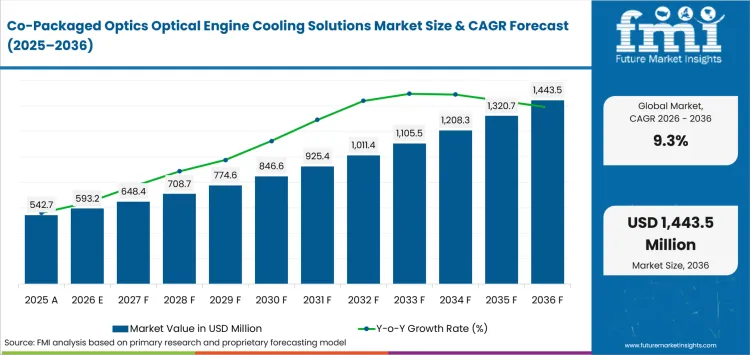
USD 593.2 million in 2026 and USD 1,443.5 million by 2036 at a 9.3% CAGR.
Demand for co-packaged optics optical engine cooling solutions is projected to expand at 9.3% CAGR between 2026 and 2036. Valuation is projected to increase from USD 593.2 million in 2026 to USD 1,443.5 million by 2036 as denser AI fabrics pull thermal design toward optical packages. The International Energy Agency projected global data-center electricity use near 945 TWh by 2030 in April 2025 with AI as the largest growth source. That load concentration raises the value of AI data center liquid cooling systems that remove heat close to high-bandwidth switching hardware.
Cooling hardware reaches qualification after local power and commissioning conditions have narrowed the feasible platform design. Japan is widening data-center siting beyond Tokyo and Osaka as new AI capacity needs additional power-ready locations. USA hyperscale fleets follow repeat platform qualification cycles that favor established service coverage and documented field procedures. METI selected nine data-center aggregation regions in April 2026 under Japan's GX siting process. Package cooling must therefore fit local data center power availability and commissioning schedules instead of assuming one transferable platform design.
Key Takeaways
- Higher switch bandwidth concentrates heat beside optical engines, so cooling qualification enters network-platform design before large AI fabric deployments reach production.
- Based on link speed, 800G is projected to account for 38.0% in 2026 owing to its installed role during migration toward 1.6T links.
- By optical architecture, pluggable optics are estimated to hold 32.0% in 2026 due to field replacement procedures already built into network operations.
- OEM direct is set to lead the route to market with 39.0% share in 2026 attributable to package interfaces fixed during platform qualification.
- Leak control and optical-temperature stability can delay adoption if a cooling loop passes thermal testing but complicates maintenance or commissioning procedures.
- Some of the key players in this market include Eaton, nVent, Ecolab, Vertiv, Schneider Electric, Coherent, Broadcom, and Lumentum.
Analyst Perspective
"The strongest optical-engine cooling designs hold optical temperature within specification and keep fluid service outside routine switch replacement. Commercial value follows after the same qualified loop survives platform revisions without reopening facility plumbing or maintenance procedures."
- Sudip saha, Principal Consultant, Future Market Insights
How is the Co-Packaged Optics Optical Engine Cooling Solutions Market segmented?
The market is segmented by link speed, optical architecture, deployment location, data center type, route to market and region.
Link speed includes 800G, 400G, 1.6T and 3.2T and above. Optical architecture includes pluggable optics, near-packaged optics, co-packaged optics and passive fiber / cabling systems. Deployment includes inter-rack / scale-out, intra-rack / scale-up, spine-leaf fabric and campus / DCI. Data center type includes hyperscale AI, colocation AI, enterprise AI/HPC and research / sovereign compute. Routes include OEM direct, network system integrators, fiber/cabling specialists and test & managed-service providers. Region follows regional taxonomy.
What makes 800G central to the link Speed category?
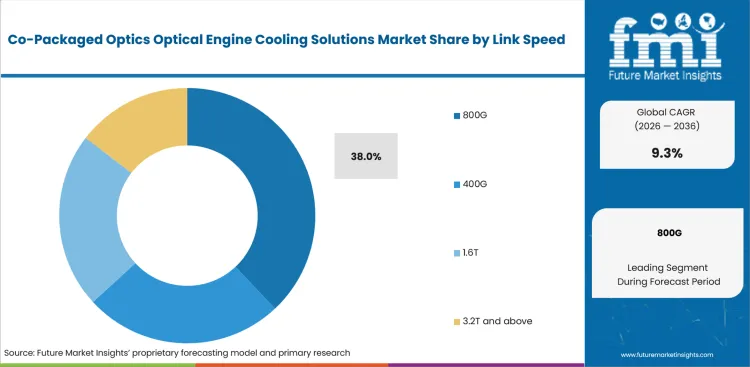
At the current 800G volume step optical endpoint density is high enough to expose package cooling limits as platform teams prepare 1.6T successors. Broadcom announced third-generation 200G/lane CPO technology in May 2025 for AI scale-up and scale-out networks. The release raises the qualification bar for optical transmitter thermal control since each package has less room for temperature drift.
- By link speed, the 800G segment is estimated to hold 38.0% in 2026 owing to broad deployment during the transition toward higher-lane-rate fabrics.
- Cooling teams qualify 800G hardware against pressure drop and optical stability before approving a package interface that must later accommodate 1.6T designs.
Why does Pluggable optics lead the Optical architecture category?
Pluggable optics preserve independent module replacement, which keeps field service familiar during a period of tighter optical integration. In March 2026, Coherent demonstrated 1.6T and 3.2T pluggable technologies spanning several photonic platforms. Those options keep silicon photonics test systems relevant because temperature behavior must pass module testing ahead of dense switch deployment.
- The pluggable optics segment is likely to capture 32.0% share in 2026 attributable to field replacement practices during the architecture transition.
- Operators can isolate a failed optical module without opening a liquid loop. Co-packaged designs continue through platform-level reliability testing without exposing routine service work to the coolant circuit.
How do Inter-rack / scale-out deployments shape the Deployment location category?
Inter-rack fabrics multiply optical endpoints over several switching stages as scale-up optics migrate deeper inside individual racks. Open Compute Project identified cooling and pull-out tray design as reliability issues for CPO clusters in June 2025. The service requirement favors photonics cooling interfaces that can be disconnected without turning routine switch replacement into a facility-loop intervention.
- Inter-rack / scale-out is set to lead the deployment location category with 36.0% share in 2026 due to many thermally sensitive links between rack groups.
- Large fabrics reward repeatable manifolds and accessible connections. A small service penalty becomes costly after the same cooling interface is repeated thousands of times.
What supports Hyperscale AI data centers in the Data center type category?
Hyperscale AI sites concentrate bandwidth and heat density, allowing one operator to standardize liquid interfaces over a large fleet. Eaton completed its acquisition of Boyd Thermal in March 2026, bringing direct liquid cooling into its data-center portfolio. The deal gives high-performance computing operators another qualification route ahead of volume production for optical-engine cooling.
- By data center type, hyperscale AI data centers are forecast to represent 48.0% in 2026, driven by dense accelerator fabrics and centralized thermal architecture decisions.
- Fleet qualification favors cooling hardware with repeatable flow performance and leak controls. One approved package design can then be deployed over many similar switch platforms.
What are the drivers, restraints and opportunities in the Co-Packaged Optics Optical Engine Cooling Solutions Market?
Higher network density raises package heat loads, qualification complexity slows release schedules and modular liquid interfaces offer the clearest route to scalable deployment.
- Driver: Higher switch bandwidth and accelerator density increase heat near optical engines and high-power switching silicon.
- Restraint: Coolant chemistry, leak control and service access must pass platform qualification for production release.
- Opportunity: Modular package-to-rack cooling can reduce redesign work as link speeds and rack densities increase.
AI network platforms now concentrate enough power inside each rack to make cooling architecture part of switch planning. In March 2025, Open Compute Project described the technical challenge of 250kW-plus AI racks and the need to select cooling technologies with rack power infrastructure. That density increases package-level data center liquid cooling demand as optical engines operate beside switching silicon with narrowing thermal margin.
A cooling loop can meet its thermal target yet fail platform qualification if fluid condition or commissioning work is difficult to control. Open Compute Project documented flushing, chemistry testing and operating checks for liquid-cooled data centers in November 2025. Optical-engine programs therefore need coolant procedures beside thermal data since unstable chemistry or flow can expose expensive switching hardware during service.
Revenue is available in interfaces that absorb platform changes without restarting the complete liquid architecture. Schneider Electric launched its Motivair cooling portfolio in September 2025 with CDUs, cold plates and technology cooling loops for high-density AI systems. Modular facility connections let data center chillers and package cooling change on separate engineering cycles after the site-side interface has completed qualification.
Which country CAGRs are profiled in the Co-Packaged Optics Optical Engine Cooling Solutions Market?
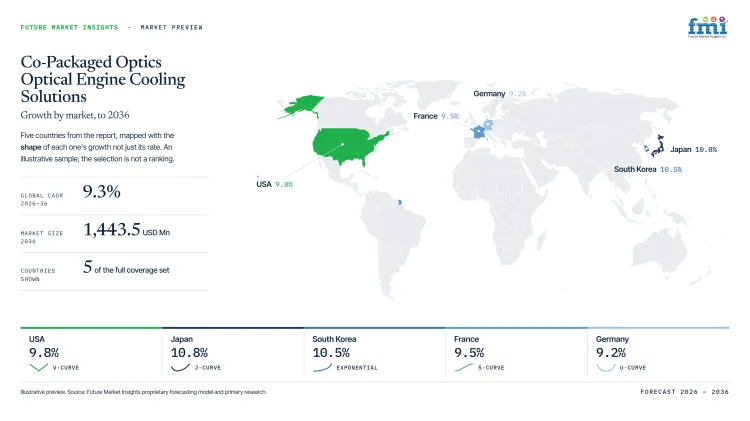
| Country | CAGR |
|---|---|
| Japan | 10.8% |
| South Korea | 10.5% |
| USA | 9.8% |
| France | 9.5% |
| Germany | 9.2% |
How do country-level CAGRs compare in the Co-Packaged Optics Optical Engine Cooling Solutions Market?
The profiled markets span 1.3 percentage points from Japan at 10.8% to France at 9.5%. Japan and South Korea form the upper pair as coordinated AI-compute programs accelerate capacity and UAE follows at 10.2%. USA and France form a lower group where installed bases and project timing temper the forecast pace.
- Japan's GX siting program spreads future data-center capacity into new power-ready regions.
- South Korea shortens technical feedback by linking domestic semiconductor engineering with platform teams.
- USA spans hyperscale and colocation customers that follow separate platform-release and service cycles.
- France advances through individually secured projects instead of nationally coordinated aggregation regions.
- Germany advances through regionally clustered data center projects rather than nationally coordinated aggregation regions.
Comparable CAGRs produce different orders as customer concentration and sequencing differ. The full report provides country-level CAGR analysis across North America, Latin America, Europe, East Asia, South Asia, Oceania and the Middle East and Africa.
Country-wise Analysis
- USA hyperscale operators qualify liquid cooling beside platform roadmaps since one service failure can repeat over thousands of racks and make national service coverage a practical advantage for Eaton, nVent and Vertiv. Co-packaged optics optical engine cooling solutions demand in USA is forecast to rise at 9.8% CAGR over the forecast period, given planned compute growth and the ability of large engineering teams to validate package interfaces at fleet scale. Lawrence Berkeley National Laboratory estimated in June 2026 that data centers could account for 11.8% of USA electricity use by 2030, even as site power upgrades and heat-rejection capacity can delay installation schedules.
- Japan is coordinating data-center locations with electricity infrastructure as additional AI capacity cannot stay concentrated in Tokyo and Osaka, which makes compact cooling systems and local engineering support more valuable during site planning. In June 2025, METI and the Ministry of Internal Affairs and Communications published their Watt-Bit collaboration report to align electricity and telecommunications development for data-center siting despite the longer coordination required before equipment release. In Japan, co-packaged optics optical engine cooling solutions demand is predicted to advance at 10.8% CAGR through 2036 owing to coordinated infrastructure planning that gives cooling companies clearer visibility into locations for new high-density capacity.
- South Korean operators draw on domestic semiconductor engineering as public AI programs concentrate demand for accelerator infrastructure, giving cooling companies access to local platform teams ahead of formal equipment selection. Sales of co-packaged optics optical engine cooling solutions in South Korea are forecast to expand at 10.5% CAGR by 2036, tied to public compute investment even as mixed domestic and global accelerator platforms complicate interface qualification. The Ministry of Science and ICT stated in February 2025 that Korea aims to secure 18,000 high-performance GPUs by the first half of 2026, a target that requires cooling designs to fit domestic AI chips without losing compatibility with global switch architectures.
- French data-center development increasingly begins with power-ready sites since large AI campuses cannot proceed until grid capacity is secured, giving liquid-cooling companies earlier specification access during campus engineering. The January 2026 Economy Ministry update identified 63 sites and five fast-track locations with more than 700 MW of connection potential, although permits and environmental conditions still influence final equipment timing. France is estimated to post 9.5% CAGR over the forecast period, aided by a visible pipeline of power-ready locations that can shorten the route from site selection to cooling specification without removing approval risk during accelerated campus development and equipment release.
- Germany’s procurement is concentrated in major data center hubs such as Frankfurt, Berlin, and emerging secondary locations, where grid constraints and rising AI workloads accelerate equipment decisions once power and construction approvals are secured. Germany’s data center capacity is expanding rapidly, while liquid cooling and high-density infrastructure are increasingly being incorporated to support AI workloads. Co-packaged optics optical engine cooling solutions sales in Germany are forecast to expand at 9.2% CAGR by 2036, supported by AI and HPC deployments that convert a growing pipeline of high-density computing projects into cooling demand as electrical and mechanical specifications are finalized.
Who are the notable companies in the Co-Packaged Optics Optical Engine Cooling Solutions Market?
Eaton, nVent, Ecolab, Vertiv, Schneider Electric, Coherent, Broadcom, and Lumentum are the notable companies serving this market.
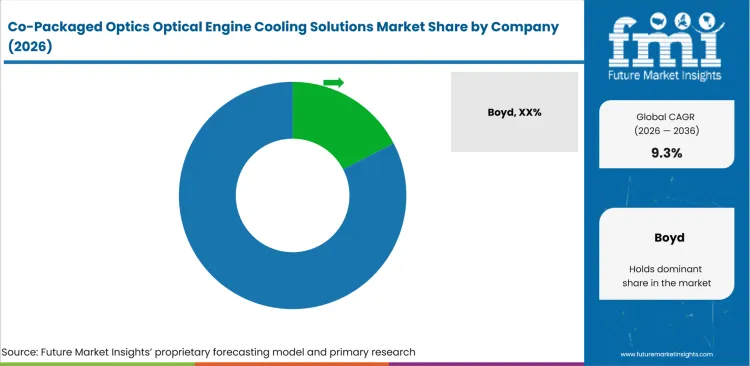
Competition separates companies that own liquid-loop hardware from optical companies that define package temperature limits. Eaton, nVent, Ecolab, Vertiv and Schneider Electric provide direct-cooling hardware or services. Coherent, Broadcom and Lumentum shape optical engines, switch packages and lasers used in optical communication networks. Entry depends on proving that optical transceivers and cooling interfaces can be qualified together without shifting service risk to the operator.
- Eaton, nVent and Ecolab target chip-to-fluid cooling through cold plates, manifolds, CDUs and liquid-loop validation.
- Vertiv and Schneider Electric extend liquid cooling into facility infrastructure, controls and lifecycle service for dense AI data-center deployments.
- Coherent, Broadcom and Lumentum shape optical temperature requirements through CPO lasers, optical engines and integrated switch architectures.
Competitive Benchmarking: Co-Packaged Optics Optical Engine Cooling Solutions Market
| Company | Direct Cooling System Breadth | Optical-Engine Thermal Relevance | Deployment Scale Evidence | Geographic Reach |
|---|---|---|---|---|
| Eaton | High | Medium | High | North America, Europe and Asia |
| nVent | High | Medium | High | Global |
| Ecolab | High | Low | High | Global |
| Vertiv | High | Low | High | Global |
| Schneider Electric | High | Low | High | Global |
| Coherent | Low | High | Medium | Global |
| Broadcom | Low | High | High | Global |
| Lumentum | Low | High | High | Global |
Scoring basis: High direct-cooling breadth requires several documented liquid functions from chip to facility interfaces. Medium covers a narrower liquid role and Low identifies a documented photonics or switch role outside liquid-loop hardware. High optical-engine relevance requires direct CPO or photonics evidence. Medium covers adjacent package influence and Low applies to facility cooling without optical-engine integration. High deployment scale requires documented volume or global production capacity. Medium denotes sampling or transition-stage production and Low denotes limited commercial scale.
Key Developments in the Co-Packaged Optics Optical Engine Cooling Solutions Market
- In July 2026, nVent announced a second Blaine manufacturing site adding 160,000 square feet for data-center liquid cooling. The expansion raises new cooling space above 400,000 square feet in three projects. Platform-specific qualification still governs deployment.
- In September 2025, Coherent launched engineering sampling of 400 mW continuous-wave lasers for co-packaged optics and silicon photonics. Output above 400 mW at 55°C makes thermal control a qualification issue. Platform adoption still depends on integration and reliability testing.
- In August 2025, Lumentum announced a major USA semiconductor capacity expansion for ultra-high-power lasers used in co-packaged optics. The investment expands domestic supply for CPO platforms moving toward higher lane rates. Volume demand still depends on switch-platform release schedules.
Key Players in the Co-Packaged Optics Optical Engine Cooling Solutions Market
Liquid Cooling Hardware and Integration
- Eaton
- nVent
- Ecolab
Data Center Thermal Infrastructure and Services
- Vertiv
- Schneider Electric
CPO Photonics and Switch Platforms
- Coherent
- Broadcom
- Lumentum
Co-Packaged Optics Optical Engine Cooling Solutions Market - Report Scope
| Coverage field | Report scope |
|---|---|
| Market breakdown | By link speed, optical architecture, deployment location, data center type, route to market and region. |
| Quantitative Units | USD Million. |
| Market Definition | Commercial thermal-management hardware and integrated cooling subsystems attributable to optical engines and high-density optical networking assemblies, including package heat extraction, thermal interfaces, manifolds, localized heat exchangers, coolant distribution and related thermal-control hardware. |
| Regions Covered | North America, Latin America, Europe, East Asia, South Asia and Pacific, and Middle East and Africa. |
| Countries Covered | Japan, South Korea, UAE, USA, France, and 20+ countries included in the full report. |
| Key Companies Profiled | Eaton, nVent, Ecolab, Vertiv, Schneider Electric, Coherent, Broadcom, and Lumentum. |
| Forecast Period | 2026 to 2036. |
| Approach | Primary and secondary research with market triangulation. |
Co-Packaged Optics Optical Engine Cooling Solutions Market - Research Methodology
| Method | Approach |
|---|---|
| Primary Research | FMI analysts gathered input from manufacturers, service providers, technology developers, distributors, end users, procurement teams, and subject-matter experts. Interviews examined purchasing decisions, product or service evaluation, adoption barriers, approval requirements, pricing considerations, and expectations for technical or commercial support. Respondents were also asked what evidence is required before a trial, pilot, or initial order develops into regular purchasing. |
| Desk Research | Desk research covered government statistics, regulatory publications, trade data, industry associations, technical literature, standards, company filings, product information, and official corporate announcements. Sources were reviewed for relevance, publication date, geographic coverage, and consistency with the defined market scope. Claims relating to performance, applications, approvals, capacity, investment, and commercial activity were retained only when supported by credible public evidence. |
| Market Sizing and Forecasting | The market model combined the baseline value with historical performance, segment structure, pricing and volume indicators, adoption levels, company participation, and country-level demand conditions. Forecast assumptions considered economic activity, investment trends, regulatory developments, technology adoption, purchasing cycles, supply availability, and barriers to wider market use. Segment and regional estimates were reconciled before the final market total was calculated. |
| Data Validation | Estimates were checked against multiple independent indicators, including public data, company activity, trade patterns, industry developments, and findings from primary interviews. Validation also tested whether products, services, applications, and company revenues fell within the defined market boundaries. Adjacent categories, unsupported claims, overlapping revenues, and activities without direct market relevance were excluded to reduce double counting and maintain consistency across segments and countries. |
Co-Packaged Optics Optical Engine Cooling Solutions Market by Segments
Co-Packaged Optics Optical Engine Cooling Solutions Market segmented by Link Speed:
- 800G
- 400G
- 1.6T
- 3.2T and above
Co-Packaged Optics Optical Engine Cooling Solutions Market segmented by Optical Architecture:
- Pluggable optics
- Near-packaged optics
- Co-packaged optics
- Passive fiber / cabling systems
Co-Packaged Optics Optical Engine Cooling Solutions Market segmented by Deployment Location:
- Inter-rack / scale-out
- Intra-rack / scale-up
- Spine-leaf fabric
- Campus / DCI
Co-Packaged Optics Optical Engine Cooling Solutions Market segmented by Data Center Type:
- Hyperscale AI data centers
- Colocation AI facilities
- Enterprise AI/HPC
- Research / sovereign compute
Co-Packaged Optics Optical Engine Cooling Solutions Market segmented by Route to Market:
- OEM direct
- Network system integrators
- Fiber/cabling specialists
- Test & managed-service providers
Co-Packaged Optics Optical Engine Cooling Solutions Market by Region:
- North America
- United States
- Canada
- Latin America
- Brazil
- Mexico
- Argentina
- Chile
- Europe
- Germany
- France
- United Kingdom
- Italy
- Spain
- Benelux
- Nordics
- Poland
- Czech Republic
- Romania
- Hungary
- East Asia
- China
- Japan
- South Korea
- South Asia and Pacific
- India
- ASEAN
- Australia and New Zealand
- Middle East and Africa
- GCC Countries
- South Africa
- Türkiye
- Israel
Research Sources and Bibliography
- International Energy Agency (2025, April 10). AI is set to drive surging electricity demand from data centres while offering the potential to transform how the energy sector works
- Ministry of Economy, Trade and Industry, Japan (2026, April 24). GX戦略地域制度の有望地域(1次審査通過地域)を選定しました
- Broadcom (2025, May 15). Broadcom Announces Third-Generation Co-Packaged Optics (CPO) Technology with 200G/lane Capability
- Coherent (2026, March 17). Coherent Demonstrates Technologies for Next-Generation Pluggable Transceiver at OFC 2026
- Open Compute Project Foundation (2025, June 10). Building Reliable at Scale AI Clusters with Co-packaged Optics
- Open Compute Project Foundation (2025, March 27). Powering and Cooling Large Scale AI Clusters
- Open Compute Project Foundation (2025, November 13). A Chemical Perspective on Liquid Cooled Data Centers
- Schneider Electric (2025, September 29). Schneider Electric Unveils Liquid Cooling Portfolio with Motivair Featuring Dedicated Solutions and Services for HPC and AI Workloads
- Lawrence Berkeley National Laboratory (2026, June). United States Data Center Energy Usage Report: 2025 Update
- Ministry of Economy, Trade and Industry, Japan (2025, June 12). Report 1.0 of the Public-Private Advisory Council on Watt-Bit Collaboration Published
- Ministry of Science and ICT, Republic of Korea (2025, February 20). Korea to Expand AI Computing Infrastructure to Strengthen National AI Capabilities and Achieve Global Leadership
- Ministry of Economy, Finance and Industrial and Digital Sovereignty, France (2026, January 30). Rencontres des centres de données : la dynamique des projets d’infrastructures numériques se confirme
- Emirates News Agency (2025, October 16). G42 advances construction of Stargate UAE AI Infrastructure Cluster
- nVent (2025, September 3). nVent Expands Data Center Solutions Manufacturing with New USA Production Facility
- Vertiv (2025, February 11). Vertiv announces global launch of liquid cooling services portfolio to support systems for AI and high-density compute applications
- CoolIT Systems (2026, February 25). CoolIT Systems Continues Rapid Growth as it Celebrates 25 Years
- Schneider Electric (2026, January 21). Motivair by Schneider Electric announces new CDU with capability to scale to 10MW and beyond for next-gen AI Factories
- Coherent (2026, March 17). Coherent Demonstrates Multiple Technologies for Co-packaged Optics (CPO) at OFC 2026
- Broadcom (2025, October 8). Broadcom Announces Tomahawk 6 - Davisson, the Industry’s First 102.4-Tbps Ethernet Switch with Co-Packaged Optics
- Lumentum (2026, March 2). NVIDIA Announces Strategic Partnership With Lumentum to Develop State-of-the-Art Optics Technology
- nVent (2026, July 31). nVent Expands Data Center Liquid Cooling Capacity
- Coherent (2025, September 25). Coherent Samples Low-Noise 400 mW CW Lasers for Co-Packaged Optics and Silicon Photonics
- Lumentum (2025, August 7). Lumentum Expands USA Manufacturing for AI-Driven Co-Packaged Optics
- Vertiv (2026, March 4). Vertiv and Generate Capital collaborate to accelerate data center capacity with complete power and cooling infrastructure
- Schneider Electric (2025, September 18). Schneider Electric Announces New Reference Designs, Featuring Integrated Power Management and Liquid Cooling Controls, Supporting NVIDIA Mission Control and NVIDIA GB300 NVL72
- Accelsius (2026, April 20). Accelsius Announces General Availability of NeuCool IR150 and Launches NeuCool HyperStart Program at Data Center World 2026
- LiquidStack (2026, May 21). LiquidStack GigaModular CDU Platform Is Now Commercially Available with Expanded 14 MW Capacity
- nVent (2025, November 17). nVent Unveils New Liquid Cooling and Power Portfolio at SC25
- Vertiv (2025, December 4). Vertiv Completes Acquisition of PurgeRite, Expanding Leadership in Liquid Cooling Services
- Ecolab (2026, July 2). Ecolab Closes CoolIT Acquisition and Expands AI Cooling Platform as Global High Tech Business Targets $4 Billion by 2030
- Schneider Electric (2026, February 18). Schneider Electric launches Motivair liquid cooling solutions factory, to accelerate India’s high-density AI infrastructure
- Coherent (2026, March 2). NVIDIA and Coherent Announce Strategic Partnership to Develop Optics Technology to Scale Next-Generation Data Center Architecture
- Broadcom (2026, March 12). Optical Scale-up Consortium Established to Create an Open Specification for AI Infrastructure
- Lumentum (2026, March 26). Lumentum Announces New USA Manufacturing Facility to Produce Advanced Lasers for the World’s Largest AI Data Centers
- Eaton (2026, March 12). Eaton completes acquisition of leading liquid-cooling solutions provider Boyd Thermal, creating an industry-leading grid-to-chip solution for data centers
- Eaton (2026, August 17). Trane Technologies and Eaton collaborate on industry-first reference design to help boost AI data center efficiency and cut installation costs
- ZutaCore (2025, February 13). UNICOM Engineering and ZutaCore form strategic OEM agreement to deliver warrantied HyperCooled AI servers globally
This bibliography is provided for reader reference and is not exhaustive. The full report contains the complete reference list and detailed citations
This Report Answers
- What is the co-packaged optics optical engine cooling solutions market size in 2026 and what value is forecast by 2036?
- Which thermal pressures increase package-level cooling demand as AI network bandwidth rises?
- Why does 800G hold the largest current share within the link speed category?
- How do pluggable optics affect cooling requirements during the transition toward co-packaged architectures?
- Why do inter-rack / scale-out deployments account for a large share of cooling demand?
- How do Japan, South Korea, UAE, USA and France differ in projected growth and order-conversion conditions?
- Which capabilities separate Eaton, nVent, Ecolab, Vertiv and Schneider Electric from optical-platform companies in this market?
- How do leak control, coolant condition and field service affect platform qualification?
- Which recent company investments are expanding liquid-cooling and CPO manufacturing capacity?
- What should operators verify before selecting an optical-engine cooling architecture?
Frequently Asked Questions
How big is the co-packaged optics optical engine cooling solutions market in 2026?
The co-packaged optics optical engine cooling solutions market is valued at USD 593.2 million in 2026 and is projected to reach USD 1,443.5 million by 2036. Growth follows denser AI fabrics that place more thermal load near optical engines.
What is the CAGR of the co-packaged optics optical engine cooling solutions market from 2026 to 2036?
The co-packaged optics optical engine cooling solutions market is projected to grow at a CAGR of 9.3% between 2026 and 2036. Expansion is supported by higher switching bandwidth and wider use of liquid cooling in dense AI infrastructure.
Which link speed leads the co-packaged optics optical engine cooling solutions market?
The 800G segment is expected to hold 38.0% of the co-packaged optics optical engine cooling solutions market in 2026, driven by broad deployment during migration toward 1.6T fabrics. Its installed volume gives cooling companies a large near-term qualification base for platform programs.
Which data center type holds the largest current share in the co-packaged optics optical engine cooling solutions market?
The hyperscale AI data centers segment is forecast to represent 48.0% of the co-packaged optics optical engine cooling solutions market in 2026, attributable to dense accelerator fabrics. Centralized fleet engineering lets one validated cooling design serve many similar switch platforms.
Which companies are active in the co-packaged optics optical engine cooling solutions market?
Key companies operating in the market include Eaton, nVent, Ecolab, Vertiv, Schneider Electric, Coherent, Broadcom, and Lumentum. Their roles span liquid-loop hardware, data-center thermal infrastructure, photonic components and CPO switch platforms.
Preview the report firsthand - request a free sample
Get SampleGet the brochure for pricing and purchase details.
Get PDFTable of Content
- Key Takeaways
- Market Size and CAGR
- Top Growth Driver
- Fastest Growing Segment
- Leading Region
- Key Companies
- Emerging Opportunities
- Executive Summary
- Global Market Outlook
- Demand-side Trends
- Supply-side Trends
- Technology Roadmap Analysis
- Analysis and Recommendations
- Analyst Perspective (What is happening? Why now? What should investors know?)
- Key Questions Answered
- How large is the market?
- What is the CAGR?
- What are key trends?
- Which region dominates?
- Who are the leaders?
- Market Overview
- Market Coverage / Taxonomy
- Market Definition / Scope / Limitations
- Research Methodology
- Chapter Orientation
- Analytical Lens and Working Hypotheses
- Market Structure, Signals, and Trend Drivers
- Benchmarking and Cross-market Comparability
- Market Sizing, Forecasting, and Opportunity Mapping
- Research Design and Evidence Framework
- Desk Research Programme (Secondary Evidence)
- Expert Input and Fieldwork (Primary Evidence)
- Tooling, Models, and Reference Databases
- Data Engineering and Model Build
- Quality Assurance and Audit Trail
- Market Background
- Market Dynamics (Drivers, Restraints, Opportunity, Trends)
- Scenario Forecast (Optimistic, Likely, Conservative)
- Impact Analysis
- AI Impact
- Sustainability Impact
- Regulatory Impact
- Technology Impact
- Consumer / Buyer Analysis
- Purchase Drivers
- Adoption Barriers
- Buyer Journey
- Opportunity Map Analysis
- Product Life Cycle Analysis
- Supply Chain Analysis
- Investment Feasibility Matrix
- Value Chain Analysis
- PESTLE and Porter's Analysis
- Regulatory Landscape
- Regional Parent Market Outlook
- Production and Consumption Statistics
- Import and Export Statistics
- Global Market Analysis and Forecast, 2021 to 2036
- Historical Market Size Value (USD Million) Analysis, 2021 to 2025
- Current and Future Market Size Value (USD Million) Projections, 2026 to 2036
- Y-o-Y Growth Trend Analysis
- Absolute $ Opportunity Analysis
- Global Market Pricing Analysis, 2021 to 2036
- Global Market Analysis and Forecast, By Link Speed, 2021 to 2036
- Introduction / Key Findings
- Historical Market Size Value (USD Million) Analysis By Link Speed, 2021 to 2025
- Current and Future Market Size Value (USD Million) Analysis and Forecast By Link Speed, 2026 to 2036
- 800G
- 400G
- 1.6T
- 3.2T and above
- 800G
- Y-o-Y Growth Trend Analysis By Link Speed, 2021 to 2025
- Absolute $ Opportunity Analysis By Link Speed, 2026 to 2036
- Global Market Analysis and Forecast, By Optical Architecture, 2021 to 2036
- Introduction / Key Findings
- Historical Market Size Value (USD Million) Analysis By Optical Architecture, 2021 to 2025
- Current and Future Market Size Value (USD Million) Analysis and Forecast By Optical Architecture, 2026 to 2036
- Pluggable optics
- Near-packaged optics
- Co-packaged optics
- Passive fiber / cabling systems
- Pluggable optics
- Y-o-Y Growth Trend Analysis By Optical Architecture, 2021 to 2025
- Absolute $ Opportunity Analysis By Optical Architecture, 2026 to 2036
- Global Market Analysis and Forecast, By Deployment Location, 2021 to 2036
- Introduction / Key Findings
- Historical Market Size Value (USD Million) Analysis By Deployment Location, 2021 to 2025
- Current and Future Market Size Value (USD Million) Analysis and Forecast By Deployment Location, 2026 to 2036
- Inter-rack / scale-out
- Intra-rack / scale-up
- Spine-leaf fabric
- Campus / DCI
- Inter-rack / scale-out
- Y-o-Y Growth Trend Analysis By Deployment Location, 2021 to 2025
- Absolute $ Opportunity Analysis By Deployment Location, 2026 to 2036
- Global Market Analysis and Forecast, By Data Center Type, 2021 to 2036
- Introduction / Key Findings
- Historical Market Size Value (USD Million) Analysis By Data Center Type, 2021 to 2025
- Current and Future Market Size Value (USD Million) Analysis and Forecast By Data Center Type, 2026 to 2036
- Hyperscale AI data centers
- Colocation AI facilities
- Enterprise AI/HPC
- Research / sovereign compute
- Hyperscale AI data centers
- Y-o-Y Growth Trend Analysis By Data Center Type, 2021 to 2025
- Absolute $ Opportunity Analysis By Data Center Type, 2026 to 2036
- Global Market Analysis and Forecast, By Route to Market, 2021 to 2036
- Introduction / Key Findings
- Historical Market Size Value (USD Million) Analysis By Route to Market, 2021 to 2025
- Current and Future Market Size Value (USD Million) Analysis and Forecast By Route to Market, 2026 to 2036
- OEM direct
- Network system integrators
- Fiber/cabling specialists
- Test & managed-service providers
- OEM direct
- Y-o-Y Growth Trend Analysis By Route to Market, 2021 to 2025
- Absolute $ Opportunity Analysis By Route to Market, 2026 to 2036
- Global Market Analysis and Forecast, By Region, 2021 to 2036
- Introduction
- Historical Market Size Value (USD Million) Analysis By Region, 2021 to 2025
- Current Market Size Value (USD Million) Analysis and Forecast By Region, 2026 to 2036
- North America
- Latin America
- Western Europe
- Eastern Europe
- East Asia
- South Asia and Pacific
- Middle East & Africa
- Market Attractiveness Analysis By Region
- North America Market Analysis and Forecast, By Country, 2021 to 2036
- Historical Market Size Value (USD Million) Trend Analysis By Market Taxonomy, 2021 to 2025
- Market Size Value (USD Million) Forecast By Market Taxonomy, 2026 to 2036
- By Country
- USA
- Canada
- By Link Speed
- By Optical Architecture
- By Deployment Location
- By Data Center Type
- By Route to Market
- By Country
- Market Attractiveness Analysis
- By Country
- By Link Speed
- By Optical Architecture
- By Deployment Location
- By Data Center Type
- By Route to Market
- Key Takeaways
- Latin America Market Analysis and Forecast, By Country
- Historical Market Size Value (USD Million) Trend Analysis By Market Taxonomy, 2021 to 2025
- Market Size Value (USD Million) Forecast By Market Taxonomy, 2026 to 2036
- By Country
- Brazil
- Mexico
- Chile
- Rest of Latin America
- By Link Speed
- By Optical Architecture
- By Deployment Location
- By Data Center Type
- By Route to Market
- By Country
- Market Attractiveness Analysis
- By Country
- By Link Speed
- By Optical Architecture
- By Deployment Location
- By Data Center Type
- By Route to Market
- Key Takeaways
- Western Europe Market Analysis and Forecast, By Country
- Historical Market Size Value (USD Million) Trend Analysis By Market Taxonomy, 2021 to 2025
- Market Size Value (USD Million) Forecast By Market Taxonomy, 2026 to 2036
- By Country
- Germany
- UK
- Italy
- Spain
- France
- Nordic
- BENELUX
- Rest of Western Europe
- By Link Speed
- By Optical Architecture
- By Deployment Location
- By Data Center Type
- By Route to Market
- By Country
- Market Attractiveness Analysis
- By Country
- By Link Speed
- By Optical Architecture
- By Deployment Location
- By Data Center Type
- By Route to Market
- Key Takeaways
- Eastern Europe Market Analysis and Forecast, By Country
- Historical Market Size Value (USD Million) Trend Analysis By Market Taxonomy, 2021 to 2025
- Market Size Value (USD Million) Forecast By Market Taxonomy, 2026 to 2036
- By Country
- Russia
- Poland
- Hungary
- Balkan & Baltic
- Rest of Eastern Europe
- By Link Speed
- By Optical Architecture
- By Deployment Location
- By Data Center Type
- By Route to Market
- By Country
- Market Attractiveness Analysis
- By Country
- By Link Speed
- By Optical Architecture
- By Deployment Location
- By Data Center Type
- By Route to Market
- Key Takeaways
- East Asia Market Analysis and Forecast, By Country
- Historical Market Size Value (USD Million) Trend Analysis By Market Taxonomy, 2021 to 2025
- Market Size Value (USD Million) Forecast By Market Taxonomy, 2026 to 2036
- By Country
- China
- Japan
- South Korea
- By Link Speed
- By Optical Architecture
- By Deployment Location
- By Data Center Type
- By Route to Market
- By Country
- Market Attractiveness Analysis
- By Country
- By Link Speed
- By Optical Architecture
- By Deployment Location
- By Data Center Type
- By Route to Market
- Key Takeaways
- South Asia and Pacific Market Analysis and Forecast, By Country
- Historical Market Size Value (USD Million) Trend Analysis By Market Taxonomy, 2021 to 2025
- Market Size Value (USD Million) Forecast By Market Taxonomy, 2026 to 2036
- By Country
- India
- ASEAN
- Australia & New Zealand
- Rest of South Asia and Pacific
- By Link Speed
- By Optical Architecture
- By Deployment Location
- By Data Center Type
- By Route to Market
- By Country
- Market Attractiveness Analysis
- By Country
- By Link Speed
- By Optical Architecture
- By Deployment Location
- By Data Center Type
- By Route to Market
- Key Takeaways
- Middle East & Africa Market Analysis and Forecast, By Country
- Historical Market Size Value (USD Million) Trend Analysis By Market Taxonomy, 2021 to 2025
- Market Size Value (USD Million) Forecast By Market Taxonomy, 2026 to 2036
- By Country
- Kingdom of Saudi Arabia
- Other GCC Countries
- Türkiye
- South Africa
- Other African Union
- Rest of Middle East & Africa
- By Link Speed
- By Optical Architecture
- By Deployment Location
- By Data Center Type
- By Route to Market
- By Country
- Market Attractiveness Analysis
- By Country
- By Link Speed
- By Optical Architecture
- By Deployment Location
- By Data Center Type
- By Route to Market
- Key Takeaways
- Key Countries Market Analysis
- USA
- Pricing Analysis
- Market Share Analysis, 2025
- By Link Speed
- By Optical Architecture
- By Deployment Location
- By Data Center Type
- By Route to Market
- Canada
- Pricing Analysis
- Market Share Analysis, 2025
- By Link Speed
- By Optical Architecture
- By Deployment Location
- By Data Center Type
- By Route to Market
- Mexico
- Pricing Analysis
- Market Share Analysis, 2025
- By Link Speed
- By Optical Architecture
- By Deployment Location
- By Data Center Type
- By Route to Market
- Brazil
- Pricing Analysis
- Market Share Analysis, 2025
- By Link Speed
- By Optical Architecture
- By Deployment Location
- By Data Center Type
- By Route to Market
- Chile
- Pricing Analysis
- Market Share Analysis, 2025
- By Link Speed
- By Optical Architecture
- By Deployment Location
- By Data Center Type
- By Route to Market
- Germany
- Pricing Analysis
- Market Share Analysis, 2025
- By Link Speed
- By Optical Architecture
- By Deployment Location
- By Data Center Type
- By Route to Market
- UK
- Pricing Analysis
- Market Share Analysis, 2025
- By Link Speed
- By Optical Architecture
- By Deployment Location
- By Data Center Type
- By Route to Market
- Italy
- Pricing Analysis
- Market Share Analysis, 2025
- By Link Speed
- By Optical Architecture
- By Deployment Location
- By Data Center Type
- By Route to Market
- Spain
- Pricing Analysis
- Market Share Analysis, 2025
- By Link Speed
- By Optical Architecture
- By Deployment Location
- By Data Center Type
- By Route to Market
- France
- Pricing Analysis
- Market Share Analysis, 2025
- By Link Speed
- By Optical Architecture
- By Deployment Location
- By Data Center Type
- By Route to Market
- India
- Pricing Analysis
- Market Share Analysis, 2025
- By Link Speed
- By Optical Architecture
- By Deployment Location
- By Data Center Type
- By Route to Market
- ASEAN
- Pricing Analysis
- Market Share Analysis, 2025
- By Link Speed
- By Optical Architecture
- By Deployment Location
- By Data Center Type
- By Route to Market
- Australia & New Zealand
- Pricing Analysis
- Market Share Analysis, 2025
- By Link Speed
- By Optical Architecture
- By Deployment Location
- By Data Center Type
- By Route to Market
- China
- Pricing Analysis
- Market Share Analysis, 2025
- By Link Speed
- By Optical Architecture
- By Deployment Location
- By Data Center Type
- By Route to Market
- Japan
- Pricing Analysis
- Market Share Analysis, 2025
- By Link Speed
- By Optical Architecture
- By Deployment Location
- By Data Center Type
- By Route to Market
- South Korea
- Pricing Analysis
- Market Share Analysis, 2025
- By Link Speed
- By Optical Architecture
- By Deployment Location
- By Data Center Type
- By Route to Market
- Russia
- Pricing Analysis
- Market Share Analysis, 2025
- By Link Speed
- By Optical Architecture
- By Deployment Location
- By Data Center Type
- By Route to Market
- Poland
- Pricing Analysis
- Market Share Analysis, 2025
- By Link Speed
- By Optical Architecture
- By Deployment Location
- By Data Center Type
- By Route to Market
- Hungary
- Pricing Analysis
- Market Share Analysis, 2025
- By Link Speed
- By Optical Architecture
- By Deployment Location
- By Data Center Type
- By Route to Market
- Kingdom of Saudi Arabia
- Pricing Analysis
- Market Share Analysis, 2025
- By Link Speed
- By Optical Architecture
- By Deployment Location
- By Data Center Type
- By Route to Market
- Türkiye
- Pricing Analysis
- Market Share Analysis, 2025
- By Link Speed
- By Optical Architecture
- By Deployment Location
- By Data Center Type
- By Route to Market
- South Africa
- Pricing Analysis
- Market Share Analysis, 2025
- By Link Speed
- By Optical Architecture
- By Deployment Location
- By Data Center Type
- By Route to Market
- USA
- Market Structure Analysis
- Competition Dashboard
- Competition Benchmarking
- Market Share Analysis of Top Players
- By Regional
- By Link Speed
- By Optical Architecture
- By Deployment Location
- By Data Center Type
- By Route to Market
- Emerging Startups
- Innovation Benchmarking
- Competition Analysis
- Competition Deep Dive
- Boyd
- Overview
- Product Portfolio
- Profitability by Market Segments
- Sales Footprint
- Strategy Overview
- Marketing Strategy
- Product Strategy
- Channel Strategy
- nVent
- Coherent
- Broadcom
- Boyd
- Case Studies
- Success Stories
- Recent Developments
- Competition Deep Dive
- Assumptions & Acronyms Used


