

- Market Size (2026)
- USD 683.3 Mn
- Forecast (2036)
- USD 2381.9 Mn
- CAGR (2026 to 2036)
- 13.3%
How big is Co-Packaged Optics Thermal Management Systems Market in 2026?
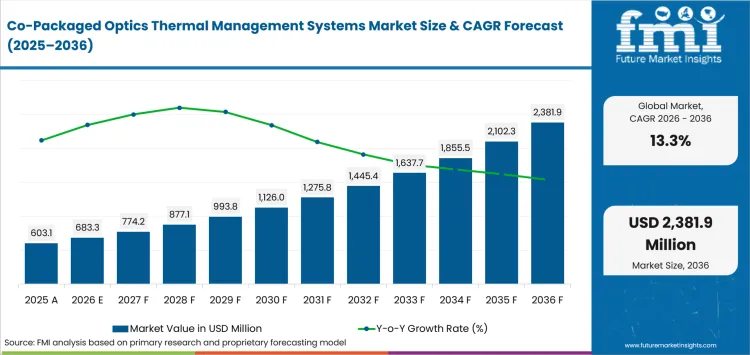
USD 683.3 million in 2026 and USD 2,381.9 million by 2036 at a 13.3% CAGR.
Demand for co-packaged optics thermal management systems is projected to expand at 13.3% CAGR through 2036 and lift valuation from USD 683.3 million to USD 2,381.9 million. AI fabrics place optics nearer switch silicon and concentrate heat inside a smaller package. Broadcom’s May 2025 third-generation CPO announcement moved to 200G per lane and documented changes in thermal design, handling and fiber routing. That engineering work brings AI datacenter liquid cooling into switch qualification before rack layouts are locked.
Country adoption depends on whether sites already have enough electrical and liquid-distribution headroom for dense network hardware. Lawrence Berkeley National Laboratory estimated in June 2026 that USA data centers could consume 11.8% of national electricity by 2030. Higher site loads increase reliance on data center chillers and local liquid loops. Orders follow faster where coolant interfaces fit the switch platform and commissioning does not extend network downtime.
Key Takeaways
- AI fabrics raise thermal-system demand because higher switch throughput concentrates heat near optical engines and forces cooling decisions into switch qualification.
- By link speed, 800G is estimated to hold 38.0% in 2026 owing to mature switch availability and familiar service procedures.
- In 2026, pluggable optics is expected to lead optical architecture with 32.0% share because modular replacement limits maintenance disruption.
- Based on deployment location, inter-rack / scale-out is projected to account for 36.0% in 2026 due to repeated high-port-count links between racks.
- CPO adoption slows if coolant interfaces or optical alignment require platform-specific validation before operators approve repeat deployments.
- Some of the key players in this market include Eaton, Broadcom, nVent, Coherent, Vertiv, Schneider Electric, Ecolab, and ZutaCore.
Analyst Perspective
"Co-packaged optics makes thermal selection part of switch qualification because coolant interfaces affect optical alignment and field access. Programs reach fleet deployment faster once cooling control and replacement procedures are proven on the exact switch platform."
- Sudip saha, Principal Consultant, Future Market Insights
How is the co-packaged optics thermal management systems market segmented?
The market is segmented by link speed, optical architecture, deployment location, data center type, route to market and region.
Link speed covers 400G, 800G, 1.6T and 3.2T and above. Optical architecture covers pluggable optics, near-packaged optics, co-packaged optics and passive fiber / cabling systems. Deployment location includes inter-rack / scale-out, intra-rack / scale-up, spine-leaf fabric and campus / DCI. Data center type covers hyperscale AI data centers, colocation AI facilities, enterprise AI/HPC and research / sovereign compute. Route to market includes OEM direct, network system integrators, fiber / cabling specialists and test & managed-service providers.
What makes 800G central to the Link speed category?
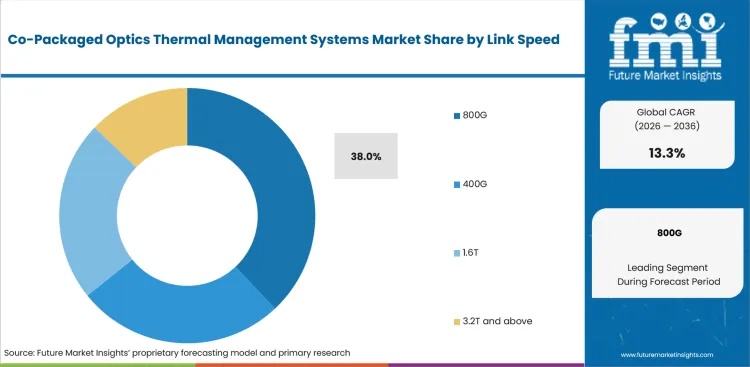
800G occupies the volume transition between mature 400G networks and the first large 1.6T deployments in current AI fabrics. Network teams can source commercially mature optical transceivers and switches without accepting the same qualification burden as newer lane-rate architectures during volume deployment.
- By link speed, 800G is forecast to represent 38.0% in 2026 attributable to deployed hardware depth and familiar maintenance procedures.
- Broadcom expanded its 200G-per-lane DSP portfolio in March 2025 for 800G and 1.6T links. Thermal teams can qualify current 800G platforms against known service procedures and reserve cooling margin for later 1.6T upgrades.
How does Pluggable optics influence selection within the Optical architecture category?
Front-panel pluggables separate optical replacement from switch-board service and keep fault isolation familiar during routine maintenance and planned module swap cycles during fleet service. Emerging silicon photonics CPO designs reduce electrical reach but place optical engines inside a hotter package with different repair procedures.
- Pluggable optics is likely to capture 32.0% share in 2026, driven by modular replacement that limits operating disruption after optical faults.
- Coherent announced 1.6T and 3.2T pluggable demonstrations in March 2026 using several photonic technologies. The range gives operators a higher-speed upgrade path without adopting CPO service procedures on every switch.
What supports Inter-rack / scale-out within the Deployment location category?
Scale-out fabrics multiply switch ports as accelerator clusters extend between racks, so thermal demand repeats at leaf and spine nodes. Each additional optical communication and networking tier repeats the package-cooling problem at more switches and makes rack-to-rack service access a deployment constraint.
- Inter-rack / scale-out is set to lead the deployment location category with 36.0% share in 2026 owing to dense switching nodes at successive fabric tiers.
- Broadcom began shipping its 102.4-Tbps Tomahawk 6 Davisson CPO switch in October 2025 for scale-up and scale-out AI networks. The throughput increase raises package heat at more fabric nodes and increases demand for repeatable switch-to-rack cooling interfaces.
How do Hyperscale AI data centers evaluate the Data center type category?
Hyperscale operators can repeat one qualified cooling architecture over many racks and justify dedicated coolant distribution with central controls. Their high-performance computing clusters also concentrate commissioning risk because one cooling fault can delay a large accelerator block.
- In 2026, hyperscale AI data centers are expected to lead data center type with 48.0% share due to repeated high-density deployments and centralized qualification.
- Boyd launched its 2.3-MW ROL2300 CDU in July 2025 and stated that one unit can cool more than ten NVL72 racks. Large sites can reduce CDU count, though redundancy and service access still require site-level validation before standardization.
What are the drivers, restraints and opportunities in the Co-Packaged Optics Thermal Management Systems Market?
Higher AI switch density raises package heat removal requirements while CPO qualification lengthens design cycles and modular liquid infrastructure supports repeat deployments.
- Driver: Processor and switch power density require thermal teams to remove more heat inside the network platform before rack integration begins.
- Restraint: CPO places optical engines beside hot switch silicon and expands validation work covering temperature control, handling and optical reliability.
- Opportunity: Standardized CDUs, manifolds and controls can reduce commissioning work and preserve service access as CPO programs reach larger volumes.
Higher component heat loads increase direct-liquid cooling demand
The hottest switch and accelerator packages leave less margin for air cooling inside dense racks. CoolIT Systems announced a 4,000-W-ready coldplate in March 2025 that more than doubled its previous single-phase design limit. Higher-capacity data center liquid cooling hardware gives CPO programs more package-level heat-removal headroom. Purchase approval still depends on meeting switch-interface limits and controlling pumping power within the selected rack architecture.
CPO qualification can delay otherwise viable cooling designs
CPO thermal systems must pass optical and mechanical qualification before a network platform reaches volume deployment. Broadcom disclosed one million flap-free CPO 400G-equivalent port-device hours at Meta in October 2025 after validation covered thermal management and monitoring. Platform teams also use silicon photonics and optical I/O test systems to confirm optical behavior. A cooling design that changes alignment or field-service procedures can lengthen qualification even if heat removal is adequate.
Modular liquid distribution reduces redesign between platform generations
Reusable coolant hardware reduces the rack engineering that must be repeated for each platform generation. nVent introduced row and rack CDUs plus manifolds in November 2025 under one control platform that included an OCP Deschutes-based CDU. nVent can carry validated manifolds and service procedures into later CPO programs as switch interfaces change. Immersion cooling uses a separate whole-rack facility architecture with different service procedures and containment requirements.
Which country CAGRs are profiled in the Co-Packaged Optics Thermal Management Systems Market?
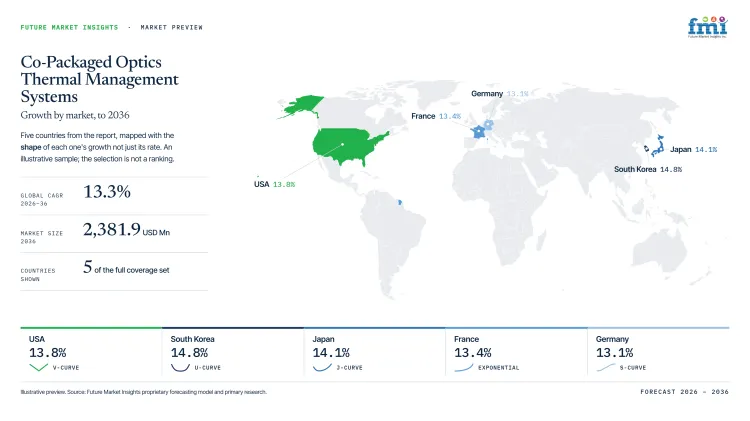
| Country | CAGR |
|---|---|
| South Korea | 14.8% |
| UAE | 14.4% |
| Japan | 14.1% |
| USA | 13.8% |
| France | 13.4% |
| Germany | 13.1% |
How do country-level CAGRs compare in the Co-Packaged Optics Thermal Management Systems Market?
The six forecasts span 1.7 percentage points from South Korea at 14.8% to Germany at 13.1%. South Korea, UAE and Japan form the faster group above 14.0%. USA, France and Germany form a lower band where site constraints can delay orders despite similar AI network requirements during major retrofit programs.
- South Korea concentrates AI capacity through nationally coordinated compute programs.
- UAE greenfield campuses let engineers size liquid loops before racks arrive.
- Japan rewards compact thermal hardware that preserves front and rear service access.
- USA hyperscale clusters sequence cooling work beside major electrical upgrades.
- France offers more greenfield site options than its current metropolitan hubs.
- Germany pairs facility-energy measurement with rack-level thermal performance during design.
Similar CAGRs produce different order timing because infrastructure readiness varies by country. The full report provides country-level CAGR analysis across North America, Latin America, Europe, East Asia, South Asia, Oceania and the Middle East and Africa.
Country-wise Analysis
- South Korean operators are preparing existing data centers for government-backed GPU installations that require extra power and network capacity before equipment arrives. By 2036, South Korea is projected to grow at 14.8% CAGR because concentrated compute procurement shortens the time available for commissioning. The Ministry of Science and ICT announced in May 2025 that 10,000 advanced GPUs would be secured by year-end and required cloud providers to upgrade data-center infrastructure before installation. The procurement program gives integrators a visible pipeline, but late rack-interface changes can disrupt commissioning and increase the commercial value of local engineering support during coolant-control corrections.
- UAE projects increasingly start with large greenfield campuses where cooling redundancy and regional maintenance are specified before compute halls enter service. The May 2025 UAE-US announcement set out a planned 5GW AI campus in Abu Dhabi for hyperscalers and large enterprises. Co-packaged optics thermal management systems demand in UAE is forecast to rise at 14.4% CAGR over the forecast period due to large new-build capacity and high rack density. New construction lets designers size liquid loops early, although high ambient temperatures raise heat-rejection requirements during summer peaks. Order timing will depend on regional service teams expanding quickly enough to maintain redundant coolant systems.
- Japanese data-center projects place a premium on compact equipment and predictable maintenance because urban floor area and service windows are tightly controlled. Local electronics expertise gives operators nearby support for optical and network integration during platform qualification and commissioning. METI selected 24 GENIAC foundation-model development themes for computing-resource support in July 2025, which broadens domestic demand for advanced AI compute beyond hyperscale sites. Adoption of co-packaged optics thermal management systems in Japan is estimated to expand at 14.1% CAGR through 2036 given sustained compute investment. Operators remain cautious about changing cooling interfaces inside installed facilities until vendors can show long qualification histories and practical field replacement.
- USA hyperscale demand concentrates in major regional clusters where electrical capacity and cooling infrastructure must expand alongside large AI network deployments. USA is estimated to post 13.8% CAGR over the forecast period, tied to a mature liquid-cooling vendor base and continued hyperscale investment. USA Energy Information Administration data published in May 2026 show Virginia commercial electricity sales rose nearly 30.0 million MWh from 2019 to 2025 as data-center load climbed. Dense regional clusters support repeat liquid-cooling programs, but brownfield piping and electrical upgrades can delay commissioning and make site engineering a stronger purchase filter during brownfield retrofits at older sites.
- French data-center planning is extending beyond existing metropolitan hubs as authorities identify additional sites for AI capacity. The Ministry of the Economy identified 28 additional candidate data-center sites at Choose France in May 2025 and named four accelerated grid connections for earlier projects. France’s co-packaged optics thermal management systems outlook is anticipated to advance at 13.4% CAGR over the assessment period, aided by a larger greenfield project pipeline. New sites let cooling designers set liquid-loop capacity and service access before rack installation begins. Grid-connection sequencing still controls when thermal hardware is ordered, so local facility integration is more useful than offering cooling capacity without a commissioning plan.
- German operators evaluate high-density cooling against facility-efficiency reporting during retrofit planning and routine operation. The Federal Ministry for Economic Affairs and Energy stated in June 2026 that new data centers would receive four years instead of two to meet PUE requirements. Germany’s co-packaged optics thermal management systems sector is projected to record 13.1% CAGR during the assessment period, shaped by formal efficiency rules and limited retrofit windows. Warm-water designs fit that efficiency focus, but older sites often lack simple piping routes for new coolant loops. Thermal systems that expose usable facility-control data reduce integration work during retrofits and give local engineering teams a clearer commissioning path.
Who are the notable companies in the Co-Packaged Optics Thermal Management Systems Market?
Eaton, Broadcom, nVent, Coherent, Vertiv, Schneider Electric, Ecolab and ZutaCore are the notable companies serving this market.
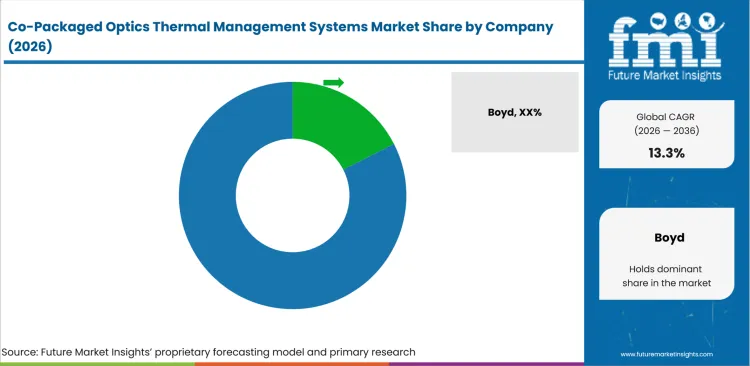
Competition divides between thermal-system manufacturers and technology companies that determine the heat load those systems must control. Eaton, nVent, Vertiv, Schneider Electric, Ecolab and ZutaCore cover liquid-cooling hardware or deployment services for dense AI infrastructure. Broadcom and Coherent define package-level constraints through CPO switching and photonics platforms. Entry depends on proving interface compatibility and field service at the selected network architecture instead of relying on corporate scale.
- Eaton, nVent, Vertiv, Schneider Electric, Ecolab and ZutaCore cover liquid distribution, chip cooling, controls or deployment services.
- Broadcom defines CPO switch-level thermal and reliability requirements through Ethernet platforms with integrated optical engines and monitoring.
- Coherent supplies optical engines and laser technologies that influence package heat placement and field-replacement design for CPO systems.
Competitive Benchmarking: Co-Packaged Optics Thermal Management Systems Market
| Company | Thermal stack breadth | AI platform integration | Serviceability evidence | Geographic reach |
|---|---|---|---|---|
| Eaton | High | High | High | North America, Europe and Asia Pacific |
| Broadcom | Low | High | High | Global |
| nVent | High | High | High | North America, Europe and international cloud programs |
| Coherent | Low | High | Medium | Global photonics markets |
| Vertiv | High | Medium | High | Global |
| Schneider Electric | High | High | High | Global |
| Ecolab | High | High | High | Global |
| ZutaCore | Medium | High | High | North America, Europe and Asia |
Scoring basis: High thermal-stack breadth requires at least three documented hardware or service layers. Medium requires two documented layers and Low requires one documented layer under the same exact-market evidence standard. High AI platform integration requires direct CPO evidence or a named accelerator deployment involving the company’s technology. Medium covers documented AI/HPC integration and Low covers general infrastructure support without named accelerator or CPO evidence. High serviceability evidence requires documented controls plus redundancy or a lifecycle service program for deployed cooling systems. Medium requires one verified service route and Low covers basic operating documentation without broader lifecycle support.
Key Developments in the Co-Packaged Optics Thermal Management Systems Market
- In September 2025, Schneider Electric unveiled its first complete liquid-cooling portfolio with Motivair covering CDUs, cold plates, chillers, software and field services for AI and HPC sites.
- In August 2025, ZutaCore introduced a 240-kW two-phase sidecar that lets hyperscale sites add waterless direct-to-chip cooling beside existing air-cooled infrastructure.
- In June 2025, Vertiv expanded its CoolChip CDU family in EMEA with models ranging from 70 kW to 600 kW for direct-to-chip AI and HPC deployments.
Key Players in the Co-Packaged Optics Thermal Management Systems Market
Liquid-cooling infrastructure and service platforms
- Eaton
- nVent
- Vertiv
- Schneider Electric
Chip-level cooling platforms
- Ecolab
- ZutaCore
CPO switching and photonics platforms
- Broadcom
- Coherent
Co-Packaged Optics Thermal Management Systems Market - Report Scope
| Coverage field | Report scope |
|---|---|
| Market breakdown | By link speed, optical architecture, deployment location, data center type, route to market and region. |
| Quantitative Units | USD Million. |
| Market Definition | Thermal management systems, controls and engineering interfaces used to remove heat from CPO-related switching, optical and high-density AI network platforms. |
| Regions Covered | North America, Latin America, Europe, East Asia, South Asia and Pacific, and Middle East and Africa. |
| Countries Covered | South Korea, UAE, Japan, USA, France, Germany and 20+ countries included in the full report. |
| Key Companies Profiled | Eaton, Broadcom, nVent, Coherent, Vertiv, Schneider Electric, Ecolab and ZutaCore. |
| Forecast Period | 2026 to 2036. |
| Approach | Primary and secondary research with market triangulation. |
Co-Packaged Optics Thermal Management Systems Market - Research Methodology
| Method | Approach |
|---|---|
| Primary Research | FMI analysts gathered input from manufacturers, service providers, technology developers, distributors, end users, procurement teams, and subject-matter experts. Interviews examined purchasing decisions, product or service evaluation, adoption barriers, approval requirements, pricing considerations, and expectations for technical or commercial support. Respondents were also asked what evidence is required before a trial, pilot, or initial order develops into regular purchasing. |
| Desk Research | Desk research covered government statistics, regulatory publications, trade data, industry associations, technical literature, standards, company filings, product information, and official corporate announcements. Sources were reviewed for relevance, publication date, geographic coverage, and consistency with the defined market scope. Claims relating to performance, applications, approvals, capacity, investment, and commercial activity were retained only when supported by credible public evidence. |
| Market Sizing and Forecasting | The market model combined the baseline value with historical performance, segment structure, pricing and volume indicators, adoption levels, company participation, and country-level demand conditions. Forecast assumptions considered economic activity, investment trends, regulatory developments, technology adoption, purchasing cycles, supply availability, and barriers to wider market use. Segment and regional estimates were reconciled before the final market total was calculated. |
| Data Validation | Estimates were checked against multiple independent indicators, including public data, company activity, trade patterns, industry developments, and findings from primary interviews. Validation also tested whether products, services, applications, and company revenues fell within the defined market boundaries. Adjacent categories, unsupported claims, overlapping revenues, and activities without direct market relevance were excluded to reduce double counting and maintain consistency across segments and countries. |
Co-Packaged Optics Thermal Management Systems Market by Segments
By link speed
- 400G
- 800G
- 1.6T
- 3.2T and above
By optical architecture
- Pluggable optics
- Near-packaged optics
- Co-packaged optics
- Passive fiber / cabling systems
By deployment location
- Inter-rack / scale-out
- Intra-rack / scale-up
- Spine-leaf fabric
- Campus / DCI
By data center type
- Hyperscale AI data centers
- Colocation AI facilities
- Enterprise AI/HPC
- Research / sovereign compute
By route to market
- OEM direct
- Network system integrators
- Fiber / cabling specialists
- Test & managed-service providers
Co-Packaged Optics Thermal Management Systems Market by Region:
- North America
- USA
- Canada
- Latin America
- Brazil
- Mexico
- Argentina
- Chile
- Rest of Latin America
- Europe
- Germany
- UK
- France
- Italy
- Spain
- BENELUX
- Nordics
- Russia
- Rest of Europe
- East Asia
- China
- Japan
- South Korea
- South Asia and Pacific
- India
- ASEAN
- Oceania
- Rest of South Asia and Pacific
- Middle East and Africa
- GCC Countries
- Türkiye
- Northern Africa
- South Africa
- Rest of Middle East and Africa
Research Sources and Bibliography
- Broadcom Inc. (2025, May 15). Broadcom Announces Third-Generation Co-Packaged Optics (CPO) Technology with 200G/lane Capability
- Lawrence Berkeley National Laboratory. (2026, June). United States Data Center Energy Usage Report: 2025 Update
- Broadcom Inc. (2025, March 25). Broadcom Extends 200G/lane DSP PHY Leadership for Next-Generation AI Infrastructure
- Coherent Corp. (2026, March 17). Coherent Demonstrates Technologies for Next-Generation Pluggable Transceiver at OFC 2026
- Broadcom Inc. (2025, October 8). Broadcom Announces Tomahawk® 6 - Davisson, the Industry’s First 102.4-Tbps Ethernet Switch with Co-Packaged Optics
- Boyd. (2025, July 8). Boyd Unveils a High-Capacity Coolant Distribution Unit with a 2.3 Megawatt Capacity for AI Liquid Cooling Applications
- CoolIT Systems. (2025, March 13). CoolIT’s 4000W Coldplate Establishes Single-Phase Direct Liquid Cooling Technology Leadership
- Broadcom Inc. (2025, October 1). Broadcom Showcases Industry-Leading Quality and Reliability of Co-Packaged Optics
- nVent Electric plc. (2025, November 17). nVent Unveils New Liquid Cooling and Power Portfolio at SC25
- Ministry of Science and ICT. (2025, May 14). Government Unveils Plan to Secure 10,000 Advanced GPUs and Launch CSP Recruitment
- UAE Embassy in Washington, DC. (2025, May 15). UAE, US Presidents Attend Unveiling of Phase 1 of New 5GW AI Campus in Abu Dhabi
- Ministry of Economy, Trade and Industry. (2025, July 15). 生成AIの開発力強化に向けたプロジェクト「GENIAC」において、新たに計算資源の提供支援を行うAI基盤モデル開発テーマ計24件を採択しました
- USA Energy Information Administration. (2026, May 5). Commercial Electricity Sales Have Soared in Virginia, Driven by Data Centers
- Ministry of the Economy, Finance and Industrial and Digital Sovereignty. (2025, May 20). Sommet Choose France 2025
- Federal Ministry for Economic Affairs and Energy. (2026, June 24). Vereinfachungen umgesetzt und Bürokratie reduziert - Bundeskabinett beschließt Energieeffizienzgesetz
- Schneider Electric. (2025, September 29). Schneider Electric Unveils Liquid Cooling Portfolio with Motivair Featuring Dedicated Solutions and Services for HPC and AI Workloads
- Vertiv. (2025, June 3). Vertiv Expands Liquid Cooling Portfolio with Scalable Solutions for AI And HPC Applications
- ZutaCore. (2025, August 5). ZutaCore Announces the Industry’s First Two-Phase Sidecar Solution at the OCP APAC Summit; Enables 240kW Cooling Power with No Facility Water
- Eaton. (2026, March 12). Eaton completes acquisition of leading liquid-cooling solutions provider Boyd Thermal, creating an industry-leading grid-to-chip solution for data centers
- nVent Electric plc. (2026, July 31). nVent Expands Data Center Liquid Cooling Capacity
- Broadcom Inc. (2026, March 12). Broadcom Showcases Industry-Leading Solutions for Scaling AI Infrastructure at OFC 2026
- Schneider Electric. (2026, January 21). Motivair by Schneider Electric Announces New CDU with Capability to Scale to 10MW and Beyond for Next-Gen AI Factories
- ZutaCore. (2025, February 28). SoftBank Corp., ZutaCore and Foxconn Collaborate on Design and Development of Rack-integrated Solution
- Accelsius. (2025, October 13). Accelsius Introduces NeuCool® MR250, Unlocking At-Scale Two-Phase, Direct-to-Chip Cooling for AI and HPC
- Eaton. (2025, November 3). Eaton signs agreement to acquire Boyd Thermal, expanding solutions for data center customers to include critical liquid cooling technology
- Broadcom Inc. (2026, March 11). Broadcom Delivers Industry’s First 400G/lane Optical DSP for Next-Generation AI Networks
- nVent Electric plc. (2025, September 3). nVent Expands Data Center Solutions Manufacturing with New USA Production Facility
- Coherent Corp. (2026, March 17). Coherent Demonstrates Multiple Technologies for Co-packaged Optics (CPO) at OFC 2026
- Vertiv. (2025, February 11). Vertiv announces global launch of liquid cooling services portfolio to support systems for AI and high-density compute applications
- Schneider Electric. (2025, December 15). Motivair by Schneider Electric Announces New Range of CDUs to Meet the Rising Demands of HPC and AI Workloads
- Ecolab. (2026, July 2). Ecolab Closes CoolIT Acquisition and Expands AI Cooling Platform as Global High Tech Business Targets $4 Billion by 2030
- ZutaCore. (2025, January 6). Valeo Enters Commercial Production with Cooling Distribution Units (CDU) compatible with ZutaCore's Two-Phase Direct-to-Chip Liquid Cooling
This bibliography is provided for reader reference and is not exhaustive. The full report contains the complete reference list and detailed citations
This Report Answers
- What is the 2026 market size and 2036 forecast value?
- Which AI networking conditions increase CPO thermal-management demand?
- Why does 800G lead the link speed category in 2026?
- Why do pluggable optics retain a large current share?
- How does inter-rack scale-out networking change cooling requirements?
- Which profiled countries record the highest CAGRs through 2036?
- What qualification issues delay CPO thermal deployments?
- Which companies compete in CPO thermal management systems?
Frequently Asked Questions
How big is the co-packaged optics thermal management systems market in 2026?
The co-packaged optics thermal management systems market is valued at USD 683.3 million in 2026 and is projected to reach USD 2,381.9 million by 2036. Denser AI switching places thermal qualification inside network design before optical interfaces and rack layouts are finalized.
What is the CAGR of the co-packaged optics thermal management systems market from 2026 to 2036?
The co-packaged optics thermal management systems market is projected to grow at a CAGR of 13.3% between 2026 and 2036. Higher switch throughput concentrates package heat and repeats liquid-cooling qualification in large AI data-center deployments.
Which link speed leads the co-packaged optics thermal management systems market?
The 800G segment is expected to hold 38.0% of the co-packaged optics thermal management systems market in 2026, attributable to deployed switch depth and familiar maintenance procedures. Operators can retain existing service routines as 1.6T links enter early production deployments.
Which optical architecture leads the co-packaged optics thermal management systems market?
The pluggable optics segment is expected to hold 32.0% of the co-packaged optics thermal management systems market in 2026, driven by modular field replacement. Its familiar service model limits maintenance disruption as operators evaluate CPO architectures.
Which countries are projected to record the highest growth in the co-packaged optics thermal management systems market?
South Korea is projected to grow at 14.8% CAGR, followed by UAE at 14.4% and Japan at 14.1% through 2036. Concentrated compute programs and large new infrastructure projects compress commissioning schedules in these faster-growth markets.
Which companies are active in the co-packaged optics thermal management systems market?
Key companies operating in the market include Eaton, Broadcom, nVent, Coherent, Vertiv, Schneider Electric, Ecolab, and ZutaCore. Their roles cover liquid distribution, field service, CPO switching and photonics integration for dense AI networks.
Preview the report firsthand - request a free sample
Get SampleGet the brochure for pricing and purchase details.
Get PDFTable of Content
- Key Takeaways
- Market Size and CAGR
- Top Growth Driver
- Fastest Growing Segment
- Leading Region
- Key Companies
- Emerging Opportunities
- Executive Summary
- Global Market Outlook
- Demand-side Trends
- Supply-side Trends
- Technology Roadmap Analysis
- Analysis and Recommendations
- Analyst Perspective (What is happening? Why now? What should investors know?)
- Key Questions Answered
- How large is the market?
- What is the CAGR?
- What are key trends?
- Which region dominates?
- Who are the leaders?
- Market Overview
- Market Coverage / Taxonomy
- Market Definition / Scope / Limitations
- Research Methodology
- Chapter Orientation
- Analytical Lens and Working Hypotheses
- Market Structure, Signals, and Trend Drivers
- Benchmarking and Cross-market Comparability
- Market Sizing, Forecasting, and Opportunity Mapping
- Research Design and Evidence Framework
- Desk Research Programme (Secondary Evidence)
- Expert Input and Fieldwork (Primary Evidence)
- Tooling, Models, and Reference Databases
- Data Engineering and Model Build
- Quality Assurance and Audit Trail
- Market Background
- Market Dynamics (Drivers, Restraints, Opportunity, Trends)
- Scenario Forecast (Optimistic, Likely, Conservative)
- Impact Analysis
- AI Impact
- Sustainability Impact
- Regulatory Impact
- Technology Impact
- Consumer / Buyer Analysis
- Purchase Drivers
- Adoption Barriers
- Buyer Journey
- Opportunity Map Analysis
- Product Life Cycle Analysis
- Supply Chain Analysis
- Investment Feasibility Matrix
- Value Chain Analysis
- PESTLE and Porter's Analysis
- Regulatory Landscape
- Regional Parent Market Outlook
- Production and Consumption Statistics
- Import and Export Statistics
- Global Market Analysis and Forecast, 2021 to 2036
- Historical Market Size Value (USD Million) Analysis, 2021 to 2025
- Current and Future Market Size Value (USD Million) Projections, 2026 to 2036
- Y-o-Y Growth Trend Analysis
- Absolute $ Opportunity Analysis
- Global Market Pricing Analysis, 2021 to 2036
- Global Market Analysis and Forecast, By Link Speed, 2021 to 2036
- Introduction / Key Findings
- Historical Market Size Value (USD Million) Analysis By Link Speed, 2021 to 2025
- Current and Future Market Size Value (USD Million) Analysis and Forecast By Link Speed, 2026 to 2036
- 800G
- 400G
- 1.6T
- 3.2T and above
- 800G
- Y-o-Y Growth Trend Analysis By Link Speed, 2021 to 2025
- Absolute $ Opportunity Analysis By Link Speed, 2026 to 2036
- Global Market Analysis and Forecast, By Optical Architecture, 2021 to 2036
- Introduction / Key Findings
- Historical Market Size Value (USD Million) Analysis By Optical Architecture, 2021 to 2025
- Current and Future Market Size Value (USD Million) Analysis and Forecast By Optical Architecture, 2026 to 2036
- Pluggable optics
- Near-packaged optics
- Co-packaged optics
- Passive fiber / cabling systems
- Pluggable optics
- Y-o-Y Growth Trend Analysis By Optical Architecture, 2021 to 2025
- Absolute $ Opportunity Analysis By Optical Architecture, 2026 to 2036
- Global Market Analysis and Forecast, By Deployment Location, 2021 to 2036
- Introduction / Key Findings
- Historical Market Size Value (USD Million) Analysis By Deployment Location, 2021 to 2025
- Current and Future Market Size Value (USD Million) Analysis and Forecast By Deployment Location, 2026 to 2036
- Inter-rack / scale-out
- Intra-rack / scale-up
- Spine-leaf fabric
- Campus / DCI
- Inter-rack / scale-out
- Y-o-Y Growth Trend Analysis By Deployment Location, 2021 to 2025
- Absolute $ Opportunity Analysis By Deployment Location, 2026 to 2036
- Global Market Analysis and Forecast, By Data Center Type, 2021 to 2036
- Introduction / Key Findings
- Historical Market Size Value (USD Million) Analysis By Data Center Type, 2021 to 2025
- Current and Future Market Size Value (USD Million) Analysis and Forecast By Data Center Type, 2026 to 2036
- Hyperscale AI data centers
- Colocation AI facilities
- Enterprise AI/HPC
- Research / sovereign compute
- Hyperscale AI data centers
- Y-o-Y Growth Trend Analysis By Data Center Type, 2021 to 2025
- Absolute $ Opportunity Analysis By Data Center Type, 2026 to 2036
- Global Market Analysis and Forecast, By Route to Market, 2021 to 2036
- Introduction / Key Findings
- Historical Market Size Value (USD Million) Analysis By Route to Market, 2021 to 2025
- Current and Future Market Size Value (USD Million) Analysis and Forecast By Route to Market, 2026 to 2036
- OEM direct
- Network system integrators
- Fiber/cabling specialists
- Test & managed-service providers
- OEM direct
- Y-o-Y Growth Trend Analysis By Route to Market, 2021 to 2025
- Absolute $ Opportunity Analysis By Route to Market, 2026 to 2036
- Global Market Analysis and Forecast, By Region, 2021 to 2036
- Introduction
- Historical Market Size Value (USD Million) Analysis By Region, 2021 to 2025
- Current Market Size Value (USD Million) Analysis and Forecast By Region, 2026 to 2036
- North America
- Latin America
- Western Europe
- Eastern Europe
- East Asia
- South Asia and Pacific
- Middle East & Africa
- Market Attractiveness Analysis By Region
- North America Market Analysis and Forecast, By Country, 2021 to 2036
- Historical Market Size Value (USD Million) Trend Analysis By Market Taxonomy, 2021 to 2025
- Market Size Value (USD Million) Forecast By Market Taxonomy, 2026 to 2036
- By Country
- USA
- Canada
- By Link Speed
- By Optical Architecture
- By Deployment Location
- By Data Center Type
- By Route to Market
- By Country
- Market Attractiveness Analysis
- By Country
- By Link Speed
- By Optical Architecture
- By Deployment Location
- By Data Center Type
- By Route to Market
- Key Takeaways
- Latin America Market Analysis and Forecast, By Country
- Historical Market Size Value (USD Million) Trend Analysis By Market Taxonomy, 2021 to 2025
- Market Size Value (USD Million) Forecast By Market Taxonomy, 2026 to 2036
- By Country
- Brazil
- Mexico
- Chile
- Rest of Latin America
- By Link Speed
- By Optical Architecture
- By Deployment Location
- By Data Center Type
- By Route to Market
- By Country
- Market Attractiveness Analysis
- By Country
- By Link Speed
- By Optical Architecture
- By Deployment Location
- By Data Center Type
- By Route to Market
- Key Takeaways
- Western Europe Market Analysis and Forecast, By Country
- Historical Market Size Value (USD Million) Trend Analysis By Market Taxonomy, 2021 to 2025
- Market Size Value (USD Million) Forecast By Market Taxonomy, 2026 to 2036
- By Country
- Germany
- UK
- Italy
- Spain
- France
- Nordic
- BENELUX
- Rest of Western Europe
- By Link Speed
- By Optical Architecture
- By Deployment Location
- By Data Center Type
- By Route to Market
- By Country
- Market Attractiveness Analysis
- By Country
- By Link Speed
- By Optical Architecture
- By Deployment Location
- By Data Center Type
- By Route to Market
- Key Takeaways
- Eastern Europe Market Analysis and Forecast, By Country
- Historical Market Size Value (USD Million) Trend Analysis By Market Taxonomy, 2021 to 2025
- Market Size Value (USD Million) Forecast By Market Taxonomy, 2026 to 2036
- By Country
- Russia
- Poland
- Hungary
- Balkan & Baltic
- Rest of Eastern Europe
- By Link Speed
- By Optical Architecture
- By Deployment Location
- By Data Center Type
- By Route to Market
- By Country
- Market Attractiveness Analysis
- By Country
- By Link Speed
- By Optical Architecture
- By Deployment Location
- By Data Center Type
- By Route to Market
- Key Takeaways
- East Asia Market Analysis and Forecast, By Country
- Historical Market Size Value (USD Million) Trend Analysis By Market Taxonomy, 2021 to 2025
- Market Size Value (USD Million) Forecast By Market Taxonomy, 2026 to 2036
- By Country
- China
- Japan
- South Korea
- By Link Speed
- By Optical Architecture
- By Deployment Location
- By Data Center Type
- By Route to Market
- By Country
- Market Attractiveness Analysis
- By Country
- By Link Speed
- By Optical Architecture
- By Deployment Location
- By Data Center Type
- By Route to Market
- Key Takeaways
- South Asia and Pacific Market Analysis and Forecast, By Country
- Historical Market Size Value (USD Million) Trend Analysis By Market Taxonomy, 2021 to 2025
- Market Size Value (USD Million) Forecast By Market Taxonomy, 2026 to 2036
- By Country
- India
- ASEAN
- Australia & New Zealand
- Rest of South Asia and Pacific
- By Link Speed
- By Optical Architecture
- By Deployment Location
- By Data Center Type
- By Route to Market
- By Country
- Market Attractiveness Analysis
- By Country
- By Link Speed
- By Optical Architecture
- By Deployment Location
- By Data Center Type
- By Route to Market
- Key Takeaways
- Middle East & Africa Market Analysis and Forecast, By Country
- Historical Market Size Value (USD Million) Trend Analysis By Market Taxonomy, 2021 to 2025
- Market Size Value (USD Million) Forecast By Market Taxonomy, 2026 to 2036
- By Country
- Kingdom of Saudi Arabia
- Other GCC Countries
- Türkiye
- South Africa
- Other African Union
- Rest of Middle East & Africa
- By Link Speed
- By Optical Architecture
- By Deployment Location
- By Data Center Type
- By Route to Market
- By Country
- Market Attractiveness Analysis
- By Country
- By Link Speed
- By Optical Architecture
- By Deployment Location
- By Data Center Type
- By Route to Market
- Key Takeaways
- Key Countries Market Analysis
- USA
- Pricing Analysis
- Market Share Analysis, 2025
- By Link Speed
- By Optical Architecture
- By Deployment Location
- By Data Center Type
- By Route to Market
- Canada
- Pricing Analysis
- Market Share Analysis, 2025
- By Link Speed
- By Optical Architecture
- By Deployment Location
- By Data Center Type
- By Route to Market
- Mexico
- Pricing Analysis
- Market Share Analysis, 2025
- By Link Speed
- By Optical Architecture
- By Deployment Location
- By Data Center Type
- By Route to Market
- Brazil
- Pricing Analysis
- Market Share Analysis, 2025
- By Link Speed
- By Optical Architecture
- By Deployment Location
- By Data Center Type
- By Route to Market
- Chile
- Pricing Analysis
- Market Share Analysis, 2025
- By Link Speed
- By Optical Architecture
- By Deployment Location
- By Data Center Type
- By Route to Market
- Germany
- Pricing Analysis
- Market Share Analysis, 2025
- By Link Speed
- By Optical Architecture
- By Deployment Location
- By Data Center Type
- By Route to Market
- UK
- Pricing Analysis
- Market Share Analysis, 2025
- By Link Speed
- By Optical Architecture
- By Deployment Location
- By Data Center Type
- By Route to Market
- Italy
- Pricing Analysis
- Market Share Analysis, 2025
- By Link Speed
- By Optical Architecture
- By Deployment Location
- By Data Center Type
- By Route to Market
- Spain
- Pricing Analysis
- Market Share Analysis, 2025
- By Link Speed
- By Optical Architecture
- By Deployment Location
- By Data Center Type
- By Route to Market
- France
- Pricing Analysis
- Market Share Analysis, 2025
- By Link Speed
- By Optical Architecture
- By Deployment Location
- By Data Center Type
- By Route to Market
- India
- Pricing Analysis
- Market Share Analysis, 2025
- By Link Speed
- By Optical Architecture
- By Deployment Location
- By Data Center Type
- By Route to Market
- ASEAN
- Pricing Analysis
- Market Share Analysis, 2025
- By Link Speed
- By Optical Architecture
- By Deployment Location
- By Data Center Type
- By Route to Market
- Australia & New Zealand
- Pricing Analysis
- Market Share Analysis, 2025
- By Link Speed
- By Optical Architecture
- By Deployment Location
- By Data Center Type
- By Route to Market
- China
- Pricing Analysis
- Market Share Analysis, 2025
- By Link Speed
- By Optical Architecture
- By Deployment Location
- By Data Center Type
- By Route to Market
- Japan
- Pricing Analysis
- Market Share Analysis, 2025
- By Link Speed
- By Optical Architecture
- By Deployment Location
- By Data Center Type
- By Route to Market
- South Korea
- Pricing Analysis
- Market Share Analysis, 2025
- By Link Speed
- By Optical Architecture
- By Deployment Location
- By Data Center Type
- By Route to Market
- Russia
- Pricing Analysis
- Market Share Analysis, 2025
- By Link Speed
- By Optical Architecture
- By Deployment Location
- By Data Center Type
- By Route to Market
- Poland
- Pricing Analysis
- Market Share Analysis, 2025
- By Link Speed
- By Optical Architecture
- By Deployment Location
- By Data Center Type
- By Route to Market
- Hungary
- Pricing Analysis
- Market Share Analysis, 2025
- By Link Speed
- By Optical Architecture
- By Deployment Location
- By Data Center Type
- By Route to Market
- Kingdom of Saudi Arabia
- Pricing Analysis
- Market Share Analysis, 2025
- By Link Speed
- By Optical Architecture
- By Deployment Location
- By Data Center Type
- By Route to Market
- Türkiye
- Pricing Analysis
- Market Share Analysis, 2025
- By Link Speed
- By Optical Architecture
- By Deployment Location
- By Data Center Type
- By Route to Market
- South Africa
- Pricing Analysis
- Market Share Analysis, 2025
- By Link Speed
- By Optical Architecture
- By Deployment Location
- By Data Center Type
- By Route to Market
- USA
- Market Structure Analysis
- Competition Dashboard
- Competition Benchmarking
- Market Share Analysis of Top Players
- By Regional
- By Link Speed
- By Optical Architecture
- By Deployment Location
- By Data Center Type
- By Route to Market
- Emerging Startups
- Innovation Benchmarking
- Competition Analysis
- Competition Deep Dive
- Boyd
- Overview
- Product Portfolio
- Profitability by Market Segments
- Sales Footprint
- Strategy Overview
- Marketing Strategy
- Product Strategy
- Channel Strategy
- Broadcom
- nVent
- Coherent
- Boyd
- Case Studies
- Success Stories
- Recent Developments
- Competition Deep Dive
- Assumptions & Acronyms Used


