

- Market Size (2026)
- USD 738.0 Bn
- Forecast (2036)
- USD 1446.1 Bn
- CAGR (2026 to 2036)
- 7.0%
How big is Consumer Electronics Market in 2026?
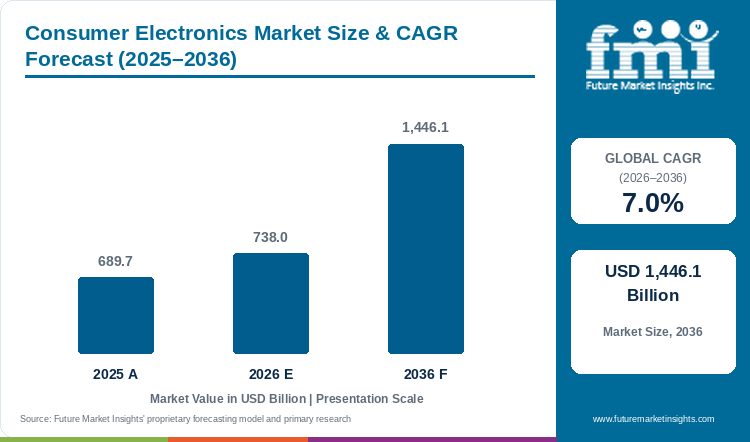
The consumer electronics market is estimated at USD 689.7 billion in 2025 and is expected to reach USD 738 billion in 2026. Sales of consumer electronics are projected to grow at a 7% CAGR between 2026 and 2036 and reach USD 1,446.1 billion by 2036.
Smartphones and laptops account for the largest share of consumer electronics sales, and demand for consumer electronics, estimated at USD 689.7 billion in 2025, is projected to reach USD 738 billion in 2026, then USD 1,446.1 billion by 2036, a 7% CAGR between 2026 and 2036 in FMI's estimate. Behind this growth, owners are replacing phones and computers sooner, as on-device AI needs newer chips. Apple reported iPhone net sales of USD 54.3 billion for the quarter ended 27 June 2026, up from USD 44.6 billion a year earlier, and Mac sales of USD 10.4 billion against USD 8.0 billion.[1] In turn, faster upgrades in the two largest categories set the pace for the whole consumer electronics market.
Phone and laptop owners buy most often, since smartphones and laptops and tablets are expected at an estimated 38.4% and 18.2% of 2026 product type sales and owners replace them every three to four years. By contrast, television, appliance and audio buyers return less often, with purchases spaced across seven to ten years. Retail results show the same split. For instance, Best Buy's US computing and mobile phone sales were USD 4,127 million in the quarter to 1 August 2026, 6.8% above the prior year, and appliance sales slipped 0.4%.[2] So brands are putting launch budgets and trade-in offers behind phones and laptops, leaving slow-cycle categories to compete on price.
Key Market Trends & Insights
- With an estimated 38.4% of product type sales in 2026, smartphones carry nearly double the 18.2% held by laptops and tablets, and televisions follow near 12.6%.
- Within sales channel, online stores are likely to hold 41.6% of 2026 sales and specialty stores about 27.3%. Buyers are moving more purchases to web shops, even at store-based chains. For example, online sales at MediaMarkt and Saturn owner Ceconomy rose 18.3% in the April to June 2026 quarter, reaching 28.2% of the total.[3] Gains of that size at a store-led chain show online will keep gaining share from physical channels.
Regional Highlights
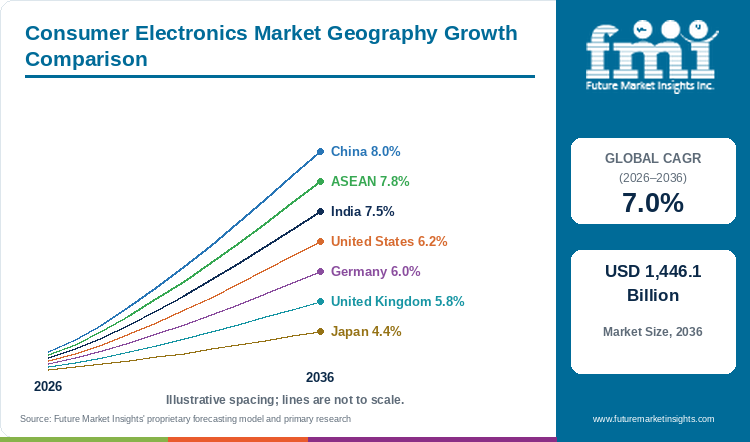
- Growth in China is projected at 8% in the FMI outlook, the fastest of the seven countries and above the 7% global CAGR, as trade-in subsidies keep phone and appliance upgrades flowing.
- Expansion in ASEAN and India, at 7.8% and 7.5%, also outpaces the global figure as young buyers trade up. Growth in the United States (6.2%), Germany (6%) and the United Kingdom (5.8%) is likely to be slower, as most purchases replace existing devices, and Japan is projected lowest at 4.4% with an older population.
- State support is pulling device purchases forward in China. China supported 36.32 million purchases of digital and smart products in January to March 2026 under the consumer goods trade-in programme, the Ministry of Commerce said.[4] Subsidised volume on that scale concentrates phone and smart device sales in programme windows.
Market Size & Forecast
Table 1: Market Size and Forecast for the Consumer Electronics Market (USD billion and percentage), 2025 to 2036
| Metric | Value |
|---|---|
| 2025 Market Size | USD 689.7 billion |
| Estimated Market Size in 2026 | USD 738 billion |
| Projected Market Size by 2036 | USD 1,446.1 billion |
| CAGR, 2026 to 2036 | 7% |
| Added Revenue, 2026 to 2036 | USD 708.1 billion |
| Market Expansion Multiple | 2.0x |
Event-led promotions are pulling TV and cooling appliance sales forward in 2026. For instance, Ceconomy said World Cup marketing pushed up TV sales and a hot summer pushed up fans and air conditioners in the June 2026 quarter, when group sales rose 8%.[3] A sports year therefore brings forward TV replacements, which can leave a softer comparison for 2027. Cost pressure is building on the supply side, however. On the cost side, Sony cited a continued steep rise in memory prices as a key challenge for the Entertainment, Technology and Services segment in FY2026.[5] Higher memory cost per device squeezes margins for brands without long supply contracts and raises shelf prices for consoles and cameras. Display panels set much of the cost of TVs, phones and laptops, and OLED screens are reaching more mid-priced devices as the OLED display market will expand at a 20.1% CAGR. Taken together, FMI expects about USD 708.1 billion of added sales by 2036, close to twice the 2026 size. Even so, memory and chip cost increases are the main near-term risk to prices and unit volumes.
Memory Costs, Trade-in Schemes and Gaming Cycles
Higher memory prices are pushing device prices up. To illustrate, Nintendo announced a Switch 2 price increase in May 2026, and Switch 2 unit sales fell 34.4% to 3.82 million in the April to June 2026 quarter.[6] A one-third fall in units after a price rise shows how sensitive console buyers are to price. Larger groups are better protected. On the other hand, Sony said the company had secured the memory needed for planned PS5 sales in FY2026.[5] So brands with long supply contracts will hold prices longer than smaller rivals.
Government trade-in schemes are moving purchases forward. For example, China allocated 250 billion yuan in ultra-long special treasury bonds to the 2026 programme, and digital and smart product purchases reached 41.08 million units by 12 April 2026.[7] Volume on that scale within four months makes subsidy timing a key driver of phone sales in China. Local production is the second policy lever. Alongside this, India's mobile phone production rose to Rs 6.27 lakh crore in FY2025-26, and phones became the largest export item.[8] Together, subsidies and local production will keep phone volumes high in both countries.
Table 2: Device, Retail and Policy Indicators for the Consumer Electronics Market (sales, units and subsidies), 2026
| Indicator | Data Point | Relevance | Source |
|---|---|---|---|
| Apple iPhone net sales, quarter to June 2026 | USD 54.3 billion; up from USD 44.6 billion | Smartphone upgrade demand | [1] |
| Best Buy computing and mobile phones, Q2 FY2027 | USD 4,127 million; up 6.8% | US retail demand | [2] |
| Ceconomy online share, Q3 2025/26 | 28.2% of sales; online up 18.3% | Online channel growth | [3] |
| Switch 2 units, April to June 2026 | 3.82 million; down 34.4% | Gaming hardware and price effects | [6] |
| Sony ET&S sales, Q1 FY2026 | JPY 543.9 billion; up about 2% | TV, audio and camera demand | [5] |
| China trade-in digital purchases, Q1 2026 | 36.32 million units | Subsidised upgrades | [4] |
| India mobile phone production, FY2025-26 | Rs 6.27 lakh crore | Local device output | [8] |
Analyst Perspective
“On-device AI has given phone and laptop owners a reason to upgrade sooner, and I expect that shorter cycle to carry the consumer electronics market through the next five years. The bigger worry is memory, as higher chip costs are already pushing console and device prices up. Brands that can pass on cost without losing volume will gain share in TVs and gaming, the categories with the longest buying gaps.”
- Rahul Pandita, Principal Consultant, Future Market Insights.
How is the consumer electronics market segmented?
The market is segmented into product type, sales channel, and region. Smartphones are estimated to lead product type with 38.4% share in 2026, and online stores lead sales channel with about 41.6%.
By product type: smartphones, laptops and tablets, televisions, audio devices, wearables, home appliances, and others.
By sales channel: supermarkets and hypermarkets, specialty stores, online, departmental stores, and others.
By region: households and retail buyers in North America, Latin America, Western Europe, Eastern Europe, East Asia, South Asia and Pacific, and Middle East and Africa.
Why do smartphones lead consumer electronics sales by product type?
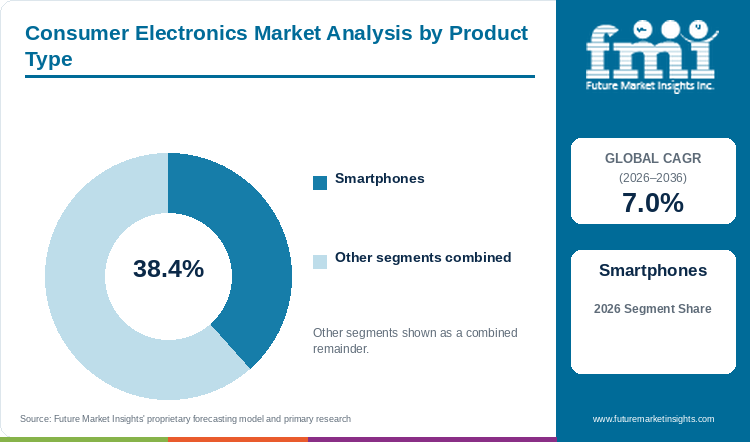
Smartphones are estimated to lead product type sales with 38.4% share in 2026, ahead of laptops and tablets at about 18.2% and televisions at an estimated 12.6%.
Table 3: Product Type Share for the Consumer Electronics Market (percentage share), 2026
| Product Type | Estimated Share (2026) |
|---|---|
| Smartphones | 38.4% |
| Laptops and Tablets | 18.2% |
| Televisions | 12.6% |
| Home Appliances | 11.3% |
| Audio Devices | 7.1% |
| Wearables | 6.3% |
| Others | 6.1% |
| Total | 100.0% |
Table 4: Product Type Leadership and Market Growth for the Consumer Electronics Market (segment and CAGR percentage), 2026 to 2036
| Metric | Value |
|---|---|
| Global CAGR (2026 to 2036) | 7% |
| Leading Segment | Smartphones |
Nearly every adult owns a phone, and most owners buy a new one every three to four years, so smartphones are estimated to lead product type with 38.4% share in 2026. Laptops and tablets, about 18.2%, are replaced less often, though Apple's Mac net sales rose to USD 10.4 billion in the June 2026 quarter from USD 8.0 billion.[1] Mac growth of that pace shows AI-ready laptops are shortening the computer cycle. Longer still, televisions, near 12.6%, are bought once every seven to ten years, and home appliances, an estimated 11.3%, are bought mostly after housing moves and breakdowns. Further down, audio devices at 7.1% and wearables at 6.3% carry lower prices per unit, and others at 6.1% include consoles and cameras. Meanwhile, voice assistants are moving into more devices, and sales in the consumer facing AI products market are projected to rise at a 29% CAGR, which favours phones and speakers with AI features. Over the forecast period, phones will keep the lead as AI functions raise the value of each upgrade.
- Premium flagships, mid-range models and foldable phones make up smartphone sales.
- Premium phones are regaining ground in China. Apple reported Greater China net sales of USD 18.8 billion for the June 2026 quarter, up from USD 15.4 billion.[1] Growth of more than a fifth suggests subsidies are also reaching premium models.
Why do online stores lead consumer electronics sales by sales channel?
Online stores are likely to lead sales channel sales with 41.6% share in 2026, ahead of specialty stores at about 27.3% and supermarkets and hypermarkets near 15.8%.
Table 5: Sales Channel Share for the Consumer Electronics Market (percentage share), 2026
| Sales Channel | Estimated Share (2026) |
|---|---|
| Online | 41.6% |
| Specialty Stores | 27.3% |
| Supermarkets and Hypermarkets | 15.8% |
| Departmental Stores | 8.9% |
| Others | 6.4% |
| Total | 100.0% |
Shoppers compare prices and specifications on screen before buying, so online stores are likely to remain the leading channel in 2026, at 41.6%. Specialty stores, about 27.3%, keep large TV, laptop and appliance sales, as buyers want to see the product and arrange delivery and installation. Even so, Ceconomy, owner of MediaMarkt and Saturn, said online sales reached 28.2% of the group total.[3] Even a store-led chain now sells more than a quarter of goods online, which narrows the gap between the two channels. Beyond these, supermarkets and hypermarkets, near 15.8%, sell accessories, small appliances and entry TVs, and departmental stores at 8.9% focus on premium audio and gifts. Other channels, about 6.4%, include operator shops and brand stores. In the years ahead, online will widen the lead, as retailers blend web orders with store pickup.
- Brand websites, marketplaces and retailer web shops make up online sales.
- Store chains remain profitable as more sales move online. Ceconomy confirmed FY2025/26 guidance of adjusted EBIT of about EUR 500 million in July 2026.[3] Stable earnings guidance gives brands confidence to keep funding specialty shelf space.
What are the drivers, restraints, and opportunities in the consumer electronics market?
On-device AI and trade-in schemes keep phone and laptop owners upgrading. Higher memory and chip costs push prices up, and smart home and gaming devices open new upgrade cycles.
- Driver: AI features that run on the device need newer processors and more memory, which shortens the replacement cycle for phones and laptops.
- Restraint: Rising memory and chip prices raise device costs, and buyers of TVs, consoles and other slow-cycle products delay purchases when prices rise.
- Opportunity: Connected home, audio and wearable devices that link to phones give brands new categories to sell into existing customer bases.
On-device AI Shortens Upgrade Cycles
Consumer preference for AI-ready devices is raising the pace of upgrades. For instance, Apple's June 2026 quarter net sales grew 16% to USD 109.4 billion, with iPhone and Mac the main contributors.[1] Growth of 16% at the largest phone brand points to a strong replacement wave. The effect is reaching retail shelves. In retail, Best Buy's US computing and mobile phone sales rose 6.8% in the quarter to 1 August 2026.[2] As a result, brands that ship AI features first will gain the upgrade buyers, setting off a quicker refresh wave in laptops and phones.
Memory Costs Push Device Prices Up
Rising component costs are squeezing device makers. Among these, Sony cited a steep rise in memory prices as a key challenge for the ET&S segment and higher memory costs in Imaging and Displays.[5] Higher memory costs cut margins on TVs and cameras, categories with little room to raise price. Likewise, Nintendo announced a Switch 2 price increase in May 2026, and the company kept a forecast of 16.5 million units for the year to March 2027.[6] Holding the unit target after a price rise shows Nintendo expects game demand to carry console sales. Over time, price increases will slow unit sales in categories with long replacement gaps.
Connected Home and Wearables Open New Categories
New sales of consumer electronics are expected from connected home, audio and health devices linked to phones. For example, Apple's Wearables, Home and Accessories net sales reached USD 7.9 billion in the June 2026 quarter.[1] Accessory sales near that level show how phone owners add devices within one brand. In addition, voice and hub devices in the smart speaker market and appliances in the smart home market add new reasons to stay within one brand. Therefore, brands with large phone user bases will sell the most connected devices.
Which country CAGRs are profiled in the consumer electronics market?
Table 6: Country CAGR Comparison for the Consumer Electronics Market (CAGR percentage), 2026 to 2036
| Country | CAGR (2026 to 2036) |
|---|---|
| China | 8% |
| ASEAN | 7.8% |
| India | 7.5% |
| United States | 6.2% |
| Germany | 6% |
| United Kingdom | 5.8% |
| Japan | 4.4% |
How do country-level CAGRs compare in the consumer electronics market?
Subsidies are the clearest reason for the gap between China and other countries. Chinese shoppers can claim state subsidies on trading in an old phone, tablet or appliance, and the 2026 programme is funded with 250 billion yuan in special bonds.[7] Consequently, FMI expects sales in China to grow at 8%, 1 point over the global CAGR. ASEAN is projected at 7.8% as young buyers and new phone plants add volume. India, at 7.5%, combines rising incomes with local phone production. By contrast, replacement buying dominates in the United States and Germany, which are projected at 6.2% and 6%, a little below the 7% rate for consumer electronics overall. Japanese demand is the weakest of the seven, at 4.4%, as the population ages. The United Kingdom is expected at 5.8%.
- Subsidies on trade-ins cut the net price of a new phone or appliance in China and pull purchases into programme windows, so brands with wide trade-in networks gain the largest share of upgrades.
- As brands open assembly plants across Vietnam and Indonesia, local prices for mid-range phones fall, opening ASEAN to first-time buyers of better models.
- Domestic phone output is lowering prices for first-time smartphone and laptop buyers in India, and brands assembling locally can price below importers.
- American demand is mostly replacement, so sales rise with each AI-led upgrade cycle and retailers with trade-in and credit offers hold the edge.
- German buyers are moving purchases online at store-led chains, which keeps price competition intense and favours brands with strong web listings.
- British shoppers pay up for premium phones and large TVs, though slow household growth caps volume and leaves retailers competing on financing and trade-in deals.
- An ageing population in Japan buys fewer new devices each year, and console price rises hit unit sales hard, so brands focus on premium replacement buyers.
Full report country CAGRs cover: seven countries split into a faster Asian group of China, ASEAN and India above 7%, a mature group of the United States, Germany and the United Kingdom between 5.8% and 6.2%, and Japan alone at the bottom, plus every other standard country by region.
Country-wise Analysis
China Consumer Electronics Market Outlook (2026 to 2036)
Trade-in subsidies are the main force behind device upgrades in China. China's trade-in programme supported 36.32 million purchases of digital and smart products valued at 109.05 billion yuan in January to March 2026.[4] These subsidies cut the cost of a new phone or laptop for owners who hand in an old one. As a result, sales in China are forecast to rise fastest, at an 8% CAGR, on subsidised upgrades.
Key takeaway: Subsidy windows set the timing of phone and appliance purchases in China.
ASEAN Consumer Electronics Market Outlook (2026 to 2036)
Young buyers in Vietnam, Indonesia and the Philippines are moving from entry phones to mid-range models with better cameras. At the same time, brands are adding assembly plants in the region to serve local and export demand, and FMI estimates a 7.8% CAGR for ASEAN, above the global rate.
Key takeaway: First-time buyers of mid-range phones are the growth pool in ASEAN.
India Consumer Electronics Market Outlook (2026 to 2036)
Phone assembly in India has scaled into an export industry. Mobile phones became the largest export item of India in FY2025-26, with exports of Rs 2.59 lakh crore, KNN reported from government data.[8] Such local production lowers prices for domestic buyers, and sales of consumer electronics in India are forecast at a 7.5% CAGR as incomes rise.
Key takeaway: Cheaper locally made phones widen the buyer base in India.
United States Consumer Electronics Market Outlook (2026 to 2036)
US retail sales are improving on phone and laptop upgrades. Best Buy reported US revenue of USD 9,070 million for the quarter ended 1 August 2026, up from USD 8,698 million.[2] Growth of about 4% at the largest US electronics chain points to a steady replacement market. Likewise, Apple's Americas net sales rose to USD 45.8 billion in the June 2026 quarter.[1] Gains of that size show premium brands capture much of the upturn. Even so, FMI projects US growth at a 6.2% CAGR, as replacement buying dominates.
Key takeaway: American households upgrade phones and laptops on a steady replacement rhythm.
Germany Consumer Electronics Market Outlook (2026 to 2036)
Large chains in Germany are growing by moving sales online. Ceconomy, owner of MediaMarkt and Saturn, reported 5% higher group sales of EUR 18.4 billion for the first nine months of FY2025/26.[3] Within that total, German buyers are shifting more purchases online, and demand for consumer electronics in Germany will grow at a 6% CAGR, close to other mature markets.
Key takeaway: Web sales at store chains set the pace in Germany.
United Kingdom Consumer Electronics Market Outlook (2026 to 2036)
British buyers favour premium phones, laptops and large TVs, and large chains compete on trade-in deals and credit offers. Even so, the United Kingdom, slightly below Germany, will see sales of consumer electronics increase at a 5.8% CAGR as household numbers grow slowly.
Key takeaway: Financing and trade-in offers keep British premium device sales moving.
Japan Consumer Electronics Market Outlook (2026 to 2036)
Premium phone sales are still growing in Japan. Apple's Japan net sales rose to USD 6.6 billion in the June 2026 quarter from USD 5.8 billion.[1] Phone upgrades are holding up, though other categories are weaker. However, Nintendo sold 3.82 million Switch 2 units in April to June 2026, down 34.4% after a price increase.[6] The console drop shows Japanese buyers cut back quickly when prices rise. In FMI's forecast, Japan grows at a 4.4% CAGR, the slowest of the seven countries, as an ageing population buys fewer new devices.
Key takeaway: Fewer young households slow device sales in Japan.
Who are the notable companies in the consumer electronics market?
Samsung Electronics, Apple, LG Electronics, Sony, Panasonic, Huawei, Xiaomi, TCL, Philips, Sharp and Nintendo are the profiled companies.
FMI groups the companies into phone and computer brands, TV and home electronics makers and gaming hardware companies. Scale is concentrated in phones. Among these, Apple put June 2026 quarter net sales at USD 109.4 billion, up 16%.[1] Sales of that size give Apple first claim on chip supply and retail promotion. Gaming is the second profit pool. In gaming, Sony's Game and Network Services segment reported sales of JPY 937.1 billion for April to June 2026.[5] Gaming sales at that level make Sony the main rival for console budgets. Alongside Sony, Nintendo kept a Switch 2 forecast of 16.5 million units for the year to March 2027.[6] A steady target suggests Nintendo expects the installed base to keep growing through 2027. Samsung Electronics, LG Electronics, Panasonic, Huawei, Xiaomi, TCL, Philips and Sharp complete the group.
- Phone and computing brands: Apple, Samsung Electronics, Xiaomi and Huawei.
- TV, audio and home brands: LG Electronics, Sony, Panasonic, TCL, Philips and Sharp.
- Gaming hardware: Nintendo.
Competitive Benchmarking: Consumer Electronics Market
Table 7: Competitive Benchmarking for the Consumer Electronics Market (qualitative ratings), 2026
| Company | Phones and Computers | TV and Audio | Gaming | Recent Activity |
|---|---|---|---|---|
| Apple | High | Low | Low | High |
| Sony | Low | Medium | High | High |
| Nintendo | Low | Low | High | High |
| Samsung Electronics | Medium | Medium | Low | Medium |
| LG Electronics | Low | Medium | Low | Medium |
Ratings compare the companies on phones and computers, TV and audio, gaming and recent activity.
Key Developments in the Consumer Electronics Market
- Best Buy's second-quarter results of 4 September 2026 showed computing and mobile phone sales of USD 4,127 million, a sign that laptop and phone upgrades are reaching US stores.[2]
- In FY2025-26, mobile phones became the largest export item of India, government data published on 14 August 2026 showed, which confirms India as a production base for global phone brands.[8]
- Nintendo sold 3.82 million Switch 2 units in April to June 2026, results covered on 6 August 2026 showed, so the price increase is weighing on console volume.[6]
- In the 31 July 2026 results, Sony flagged higher memory costs for TVs and cameras and kept the FY2026 ET&S sales forecast at JPY 2,250 billion; buyers can expect firmer prices on those lines.[5]
- Apple said on 30 July 2026 that iPhone and Mac drove the strongest June quarter in company history, with net sales of USD 109.4 billion, evidence that AI features are shortening upgrade cycles.[1]
- Ceconomy linked higher TV sales to World Cup marketing as quarterly sales rose 8%, in the update of 30 July 2026, showing how event promotions pull TV purchases forward.[3]
- On 22 April 2026, China counted 41.08 million digital product purchases under the trade-in scheme, keeping subsidised phone volume high into the second quarter.[7]
- On 4 April 2026, the Ministry of Commerce counted 36.32 million digital product trade-in purchases in China for January to March, which gave device makers a strong first quarter.[4]
Key Players in the Consumer Electronics Market
Phone and Computing Brands
- Apple
- Samsung Electronics
- Xiaomi
- Huawei
TV, Audio and Home Brands
- LG Electronics
- Sony
- Panasonic
- TCL
- Philips
- Sharp
Gaming Hardware
- Nintendo
Consumer Electronics Market - Report Scope
Table 8: Report Scope for the Consumer Electronics Market (coverage fields and definitions), 2026 to 2036
| Coverage field | Report scope |
|---|---|
| Market breakdown | Product type; sales channel; region |
| Quantitative units | USD billion |
| Market definition | Electronic devices for personal and household use, including smartphones, laptops, tablets, televisions, audio devices, wearables, home appliances, consoles and smart home hubs, with bundled software recognised at sale. Enterprise computing hardware, industrial electronics and car infotainment are excluded. |
| Regions covered | North America; Latin America; Western Europe; Eastern Europe; East Asia; South Asia and Pacific; Middle East and Africa |
| Countries covered | United States; Canada; Brazil; Mexico; Argentina; Chile; Germany; France; United Kingdom; Italy; Spain; Benelux; Nordics; Poland; Czech Republic; Romania; Hungary; China; Japan; South Korea; India; ASEAN; Australia and New Zealand; GCC Countries; South Africa; Türkiye; Israel |
| Key companies profiled | Samsung Electronics, Apple, LG Electronics, Sony, Panasonic, Huawei, Xiaomi, TCL, Philips, Sharp, Nintendo |
| Forecast period | 2026 to 2036 |
Consumer Electronics Market - Research Methodology
Table 9: Research Methodology for the Consumer Electronics Market (research methods and approach), 2026 edition
| Method | Approach |
|---|---|
| Data Sources | Company results, industry associations, government statistics and trade publications. |
| Desk Research | Desk research covers upgrade cycles, memory costs, retail channels, gaming hardware and subsidy schemes. |
| Market Sizing and Forecasting | Sizing starts from the 2026 base of USD 738 billion and the 7% CAGR for 2026 to 2036. |
| Data Validation | Figures are cross-checked across company, industry and government sources. |
Consumer Electronics Market by Segments
Consumer Electronics Market segmented by Product Type:
- Smartphones
- Laptops and Tablets
- Televisions
- Audio Devices
- Wearables
- Home Appliances
- Others
Consumer Electronics Market segmented by Sales Channel:
- Supermarkets and Hypermarkets
- Specialty Stores
- Online
- Departmental Stores
- Others
Consumer Electronics Market by Region
- North America
- United States
- Canada
- Latin America
- Brazil
- Mexico
- Argentina
- Chile
- Western Europe
- Germany
- France
- United Kingdom
- Italy
- Spain
- Benelux
- Nordics
- Eastern Europe
- Poland
- Czech Republic
- Romania
- Hungary
- East Asia
- China
- Japan
- South Korea
- South Asia and Pacific
- India
- ASEAN
- Australia and New Zealand
- Middle East and Africa
- GCC Countries
- South Africa
- Türkiye
- Israel
Research Sources and Bibliography
- [1] Apple Inc. (2026, July 30). Apple reports third quarter results. Exhibit 99.1 to Form 8-K. https://www.sec.gov/Archives/edgar/data/0000320193/000032019326000018/a8-kex991q3202606272026.htm
- [2] Best Buy Co., Inc. (2026, September 4). Form 10-Q for the quarterly period ended August 1, 2026. https://www.sec.gov/Archives/edgar/data/0000764478/000076447826000042/bby-20260801.htm
- [3] Retail-News. (2026, July 30). MediaMarktSaturn-Mutter CECONOMY wächst weiter profitabel. https://retail-news.de/ceconomy-q3-2026-wachstum-ebit-plattformstrategie/
- [4] China Daily. (2026, April 4). China's consumer goods trade-in program generates sales of 433.17b yuan in Q1. https://global.chinadaily.com.cn/a/202604/04/WS69d0d17da310d6866eb41c1b.html
- [5] Sony Group Corporation. (2026, July 31). Consolidated Financial Results for the First Quarter Ended June 30, 2026. Form 6-K. https://www.sec.gov/Archives/edgar/data/0000313838/000110465926088922/tm2621477d2_6k.htm
- [6] Game Developer. (2026, August 6). Nintendo Switch 2 hardware sales fall 34.4 percent year-on-year. https://www.gamedeveloper.com/business/nintendo-switch-2-unit-sales-are-down-34-4-percent-year-on-year
- [7] TechRadar. (2026, April 22). China says world's largest recycling scheme saw 41 million tech items traded in 2026 for discounts. https://www.techradar.com/pro/china-says-worlds-largest-recycling-scheme-saw-41-million-tech-items-traded-in-2026-for-discounts
- [8] KNN India. (2026, August 14). India's Electronics Exports Surge Over 11-Fold Since FY15, Reach Rs 4.24 Lakh Cr In FY26. https://knnindia.co.in/news/newsdetails/sectors/electronics/indias-electronics-exports-surge-over-11-fold-since-fy15-reach-rs-424-lakh-cr-in-fy26
This bibliography is provided for reader reference. The full report contains the complete reference list and detailed citations.
This Report Answers
- How big is the consumer electronics market during 2026?
- What market size is projected by 2036?
- Which product type holds notable share?
- Which sales channel holds notable share?
- Which countries have notable growth?
- Which companies are notable in the market?
Frequently Asked Questions
How large is the consumer electronics market expected in 2026?
FMI expects the consumer electronics market to reach USD 738 billion in 2026, from an estimated USD 689.7 billion in 2025. Sales of consumer electronics are projected to reach USD 1,446.1 billion by 2036.
What CAGR is projected for the consumer electronics market through 2036?
The consumer electronics market is projected to grow at a 7% CAGR through 2036. Faster phone and laptop upgrades, online buying and trade-in schemes carry that growth.
Which product type holds a notable market share in 2026?
Smartphones lead with an estimated 38.4% share in 2026. Laptops and tablets follow at about 18.2%.
Which sales channel holds a notable market share in 2026?
Online stores are likely to lead with 41.6% share. Specialty stores hold an estimated 27.3%.
Which country has a notable expansion outlook through 2036?
FMI projects China to grow fastest, at an 8% CAGR. ASEAN follows at 7.8%.
Who are the key companies in the consumer electronics market?
Apple, Samsung Electronics, Xiaomi and Huawei lead phones and computing, and LG Electronics, Sony, Panasonic, TCL, Philips and Sharp lead TV, audio and home devices. Nintendo completes the group in gaming hardware.
Preview the report firsthand - request a free sample
Get SampleGet the brochure for pricing and purchase details.
Get PDFTable of Content
- Key Takeaways
- Market Size and CAGR
- Top Growth Driver
- Fastest Growing Segment
- Leading Region
- Key Companies
- Emerging Opportunities
- Executive Summary
- Global Market Outlook
- Demand-side Trends
- Supply-side Trends
- Technology Roadmap Analysis
- Analysis and Recommendations
- Analyst Perspective (What is happening? Why now? What should investors know?)
- Key Questions Answered
- How large is the market?
- What is the CAGR?
- What are key trends?
- Which region dominates?
- Who are the leaders?
- Market Overview
- Market Coverage / Taxonomy
- Market Definition / Scope / Limitations
- Research Methodology
- Chapter Orientation
- Analytical Lens and Working Hypotheses
- Market Structure, Signals, and Trend Drivers
- Benchmarking and Cross-market Comparability
- Market Sizing, Forecasting, and Opportunity Mapping
- Research Design and Evidence Framework
- Desk Research Programme (Secondary Evidence)
- Expert Input and Fieldwork (Primary Evidence)
- Tooling, Models, and Reference Databases
- Data Engineering and Model Build
- Quality Assurance and Audit Trail
- Market Background
- Market Dynamics (Drivers, Restraints, Opportunity, Trends)
- Scenario Forecast (Optimistic, Likely, Conservative)
- Impact Analysis
- AI Impact
- Sustainability Impact
- Regulatory Impact
- Technology Impact
- Consumer / Buyer Analysis
- Purchase Drivers
- Adoption Barriers
- Buyer Journey
- Opportunity Map Analysis
- Product Life Cycle Analysis
- Supply Chain Analysis
- Investment Feasibility Matrix
- Value Chain Analysis
- PESTLE and Porter's Analysis
- Regulatory Landscape
- Regional Parent Market Outlook
- Production and Consumption Statistics
- Import and Export Statistics
- Global Market Analysis and Forecast, 2021 to 2036
- Historical Market Size Value (USD Billion) Analysis, 2021 to 2025
- Current and Future Market Size Value (USD Billion) Projections, 2026 to 2036
- Y-o-Y Growth Trend Analysis
- Absolute $ Opportunity Analysis
- Global Market Pricing Analysis, 2021 to 2036
- Global Market Analysis and Forecast, By Product Type, 2021 to 2036
- Introduction / Key Findings
- Historical Market Size Value (USD Billion) Analysis By Product Type, 2021 to 2025
- Current and Future Market Size Value (USD Billion) Analysis and Forecast By Product Type, 2026 to 2036
- Smartphones
- Laptops and Tablets
- Televisions
- Audio Devices
- Wearables
- Home Appliances
- Others
- Y-o-Y Growth Trend Analysis By Product Type, 2021 to 2025
- Absolute $ Opportunity Analysis By Product Type, 2026 to 2036
- Global Market Analysis and Forecast, By Sales Channel, 2021 to 2036
- Introduction / Key Findings
- Historical Market Size Value (USD Billion) Analysis By Sales Channel, 2021 to 2025
- Current and Future Market Size Value (USD Billion) Analysis and Forecast By Sales Channel, 2026 to 2036
- Supermarkets and Hypermarkets
- Specialty Stores
- Online
- Departmental Stores
- Others
- Y-o-Y Growth Trend Analysis By Sales Channel, 2021 to 2025
- Absolute $ Opportunity Analysis By Sales Channel, 2026 to 2036
- Global Market Analysis and Forecast, By Region, 2021 to 2036
- Introduction
- Historical Market Size Value (USD Billion) Analysis By Region, 2021 to 2025
- Current Market Size Value (USD Billion) Analysis and Forecast By Region, 2026 to 2036
- North America
- Latin America
- Western Europe
- Eastern Europe
- East Asia
- South Asia and Pacific
- Middle East and Africa
- Market Attractiveness Analysis By Region
- North America Market Analysis and Forecast, By Country, 2021 to 2036
- Historical Market Size Value (USD Billion) Trend Analysis By Market Taxonomy, 2021 to 2025
- Market Size Value (USD Billion) Forecast By Market Taxonomy, 2026 to 2036
- By Country
- United States
- Canada
- By Product Type
- By Sales Channel
- By Country
- Market Attractiveness Analysis
- By Country
- By Product Type
- By Sales Channel
- Key Takeaways
- Latin America Market Analysis and Forecast, By Country
- Historical Market Size Value (USD Billion) Trend Analysis By Market Taxonomy, 2021 to 2025
- Market Size Value (USD Billion) Forecast By Market Taxonomy, 2026 to 2036
- By Country
- Brazil
- Mexico
- Argentina
- Chile
- By Product Type
- By Sales Channel
- By Country
- Market Attractiveness Analysis
- By Country
- By Product Type
- By Sales Channel
- Key Takeaways
- Western Europe Market Analysis and Forecast, By Country
- Historical Market Size Value (USD Billion) Trend Analysis By Market Taxonomy, 2021 to 2025
- Market Size Value (USD Billion) Forecast By Market Taxonomy, 2026 to 2036
- By Country
- Germany
- France
- United Kingdom
- Italy
- Spain
- Benelux
- Nordics
- By Product Type
- By Sales Channel
- By Country
- Market Attractiveness Analysis
- By Country
- By Product Type
- By Sales Channel
- Key Takeaways
- Eastern Europe Market Analysis and Forecast, By Country
- Historical Market Size Value (USD Billion) Trend Analysis By Market Taxonomy, 2021 to 2025
- Market Size Value (USD Billion) Forecast By Market Taxonomy, 2026 to 2036
- By Country
- Poland
- Czech Republic
- Romania
- Hungary
- By Product Type
- By Sales Channel
- By Country
- Market Attractiveness Analysis
- By Country
- By Product Type
- By Sales Channel
- Key Takeaways
- East Asia Market Analysis and Forecast, By Country
- Historical Market Size Value (USD Billion) Trend Analysis By Market Taxonomy, 2021 to 2025
- Market Size Value (USD Billion) Forecast By Market Taxonomy, 2026 to 2036
- By Country
- China
- Japan
- South Korea
- By Product Type
- By Sales Channel
- By Country
- Market Attractiveness Analysis
- By Country
- By Product Type
- By Sales Channel
- Key Takeaways
- South Asia and Pacific Market Analysis and Forecast, By Country
- Historical Market Size Value (USD Billion) Trend Analysis By Market Taxonomy, 2021 to 2025
- Market Size Value (USD Billion) Forecast By Market Taxonomy, 2026 to 2036
- By Country
- India
- ASEAN
- Australia and New Zealand
- By Product Type
- By Sales Channel
- By Country
- Market Attractiveness Analysis
- By Country
- By Product Type
- By Sales Channel
- Key Takeaways
- Middle East and Africa Market Analysis and Forecast, By Country
- Historical Market Size Value (USD Billion) Trend Analysis By Market Taxonomy, 2021 to 2025
- Market Size Value (USD Billion) Forecast By Market Taxonomy, 2026 to 2036
- By Country
- GCC Countries
- South Africa
- Türkiye
- Israel
- By Product Type
- By Sales Channel
- By Country
- Market Attractiveness Analysis
- By Country
- By Product Type
- By Sales Channel
- Key Takeaways
- Key Countries Market Analysis
- United States
- Pricing Analysis
- Market Share Analysis, 2025
- By Product Type
- By Sales Channel
- Canada
- Pricing Analysis
- Market Share Analysis, 2025
- By Product Type
- By Sales Channel
- Mexico
- Pricing Analysis
- Market Share Analysis, 2025
- By Product Type
- By Sales Channel
- Brazil
- Pricing Analysis
- Market Share Analysis, 2025
- By Product Type
- By Sales Channel
- Chile
- Pricing Analysis
- Market Share Analysis, 2025
- By Product Type
- By Sales Channel
- Germany
- Pricing Analysis
- Market Share Analysis, 2025
- By Product Type
- By Sales Channel
- United Kingdom
- Pricing Analysis
- Market Share Analysis, 2025
- By Product Type
- By Sales Channel
- Italy
- Pricing Analysis
- Market Share Analysis, 2025
- By Product Type
- By Sales Channel
- Spain
- Pricing Analysis
- Market Share Analysis, 2025
- By Product Type
- By Sales Channel
- France
- Pricing Analysis
- Market Share Analysis, 2025
- By Product Type
- By Sales Channel
- India
- Pricing Analysis
- Market Share Analysis, 2025
- By Product Type
- By Sales Channel
- ASEAN
- Pricing Analysis
- Market Share Analysis, 2025
- By Product Type
- By Sales Channel
- Australia and New Zealand
- Pricing Analysis
- Market Share Analysis, 2025
- By Product Type
- By Sales Channel
- China
- Pricing Analysis
- Market Share Analysis, 2025
- By Product Type
- By Sales Channel
- Japan
- Pricing Analysis
- Market Share Analysis, 2025
- By Product Type
- By Sales Channel
- South Korea
- Pricing Analysis
- Market Share Analysis, 2025
- By Product Type
- By Sales Channel
- Poland
- Pricing Analysis
- Market Share Analysis, 2025
- By Product Type
- By Sales Channel
- Hungary
- Pricing Analysis
- Market Share Analysis, 2025
- By Product Type
- By Sales Channel
- Türkiye
- Pricing Analysis
- Market Share Analysis, 2025
- By Product Type
- By Sales Channel
- South Africa
- Pricing Analysis
- Market Share Analysis, 2025
- By Product Type
- By Sales Channel
- United States
- Market Structure Analysis
- Competition Dashboard
- Competition Benchmarking
- Market Share Analysis of Top Players
- By Regional
- By Product Type
- By Sales Channel
- Emerging Startups
- Innovation Benchmarking
- Competition Analysis
- Competition Deep Dive
- Apple
- Overview
- Product Portfolio
- Profitability by Market Segments
- Sales Footprint
- Strategy Overview
- Marketing Strategy
- Product Strategy
- Channel Strategy
- Sony
- Nintendo
- Samsung Electronics
- LG Electronics
- Xiaomi
- Huawei
- Panasonic
- TCL
- Philips
- Sharp
- Apple
- Case Studies
- Success Stories
- Recent Developments
- Competition Deep Dive
- Assumptions & Acronyms Used


