

- Market Size (2026)
- USD 326.6 Mn
- Forecast (2036)
- USD 809.4 Mn
- CAGR (2026 to 2036)
- 9.5%
How big is Cookie Crumb Bases & Crusts Market in 2026?
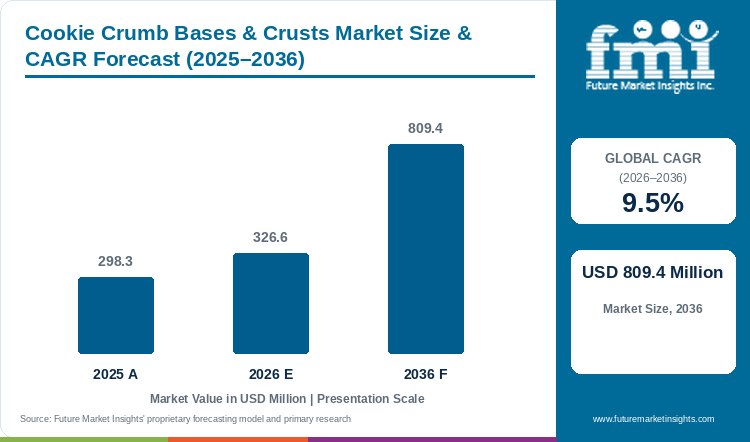
With a valuation of USD 298.3 million in 2025 and moving to USD 326.6 million in 2026, the cookie crumb bases & crusts market is positioned to attain USD 809.4 million by 2036, exhibiting a CAGR of 9.5%.
Future Market Insights estimates the global cookie crumb bases & crusts market at USD 326.6 million in 2026 from USD 298.3 million in 2025 and projects expansion to USD 809.4 million by 2036 at a 9.5% CAGR. Commercial cheesecake factories and sweet-roll plants are switching from crushing whole biscuits in house to buying pre-sieved dry crumbs where chocolate chip is expected to account for a 33.0% product type share in 2026. Ready-to-use dry crumbs remove factory floor grinding labor and keep crust thickness uniform. That production efficiency allows cookie crumb demand to advance at a 9.5% CAGR compared with 5.6% for refrigerated cookie dough because industrial bakeries need consistent particle sizes that press cleanly without sticking to molds. According to Bakels Group (BG) in its December 2025 bakery trends study, consumer interest in crunchy and multi-textured baked goods is projected to rise by 57% over the next two years, which led Fabbri 1905 to introduce moisture-resistant Crumble Black Biscuit bases in January 2026[1]. However, wet dairy and fruit fillings still soften unprotected biscuit bases during chilled storage while strict plant allergen audits slow down supplier switching across foodservice accounts.
Key Market Trends & Insights
- By product type: Chocolate chip is expected to hold a 33.0% share in 2026 because visible cocoa chips and shortbread crunch work across both tart shells and sweet-roll toppings.
- By form: Powder / dry is estimated to capture a 46.0% share in 2026 owing to ambient bulk storage and flexible butter-binding ratios at the factory mixer.
- By application: Bread & rolls is projected to account for a 35.0% share in 2026 driven by high daily production of cinnamon rolls and cookie-topped sweet buns.
- By claim: Conventional is predicted to represent a 55.0% share in 2026 supported by reliable wheat-and-sugar crust cohesion and lower cost per metric ton.
- By sales channel: Direct to industrial bakeries is forecast to record a 47.0% share in 2026 enabled by custom sieve specifications and multi-quarter bulk tote contracts.
Regional Highlights
- Top national expansion: The UAE is projected to lead country growth at a 10.9% CAGR through 2036 supported by hotel pastry commissaries and new restaurant openings in Dubai.
- Broader country progression: Saudi Arabia is forecast to expand at a 10.5% CAGR ahead of South Korea at 10.2% and the USA at 9.9%, while Japan advances at an 8.6% CAGR.
Market Size & Forecast
Table 1: Market Size and Forecast for the Cookie Crumb Bases & Crusts Market (USD million and CAGR percentage), 2025 to 2036
| Metric | Value |
|---|---|
| 2025 Market Size | USD 298.3 million |
| Estimated Market Size in 2026 | USD 326.6 million |
| Projected Market Size by 2036 | USD 809.4 million |
| CAGR, 2026 to 2036 | 9.5% |
| Added Revenue, 2026 to 2036 | USD 482.8 million |
Commercial dessert and sweet-bakery manufacturers face high scrap rates when crushing whole biscuits in house because uneven fines soak up extra melted butter and stick to stamping dies. Pre-sieved cookie crumb bases solve batch variation by setting exact particle sizes and low moisture before shipment. Laboratory trials from the Sanmenxia Biotechnology Research Center published in Food Chemistry X in July 2025 confirmed that milling shortbread biscuit powder to a fine 100-to-300 mesh range improves dough porosity to 46.64% and stabilizes baked texture[2]. Industrial procurement teams are therefore standardizing on pre-milled crumb contracts with chocolate inclusions and decorations to keep crust pressing lines running smoothly.
Industrial-Bakery and Crumb-Tonnage Sizing
Table 2: Industrial-Bakery and Crumb-Tonnage Sizing for the Cookie Crumb Bases & Crusts Market (USD million and operational ranges), 2025 to 2036
| Metric | 2025 | 2026 | 2036 |
|---|---|---|---|
| Market size (USD million) | 298.3 | 326.6 | 809.4 |
| Commercial cookie crumb & crust bases shipped (thousand tonnes) | 89.0 to 97.0 | 96.0 to 105.0 | 212.0 to 232.0 |
| Finished bakery & dessert units using crumb bases (million units) | 1,480.0 to 1,620.0 | 1,600.0 to 1,750.0 | 3,530.0 to 3,860.0 |
| Realized B2B ingredient price per metric ton (USD) | 3,075.0 to 3,350.0 | 3,110.0 to 3,400.0 | 3,480.0 to 3,815.0 |
Operational note: Tonnage and unit-volume ranges apply a 60-gram average crumb-base or inclusion loading across industrial cheesecakes, sweet rolls, and layered pastry shells produced in commercial plants.
High-speed tart and cheesecake lines need even particle packing so pressed crusts do not crack during pan release or blast freezing. Bakery formulators frequently pair dry biscuit bases with confectionery fillings that limit oil and water transfer during frozen and chilled shipping.
Per Plant & Commercial Kitchen Sizing
Table 3: Per Plant and Commercial Kitchen Spending Indicators for the Cookie Crumb Bases & Crusts Market (USD and percentages), 2025 to 2036
| Metric | 2025 | 2026 | 2036 |
|---|---|---|---|
| Commercial bakery & dessert plants globally (thousand) | 168.0 | 172.0 | 210.0 |
| Spend per 1,000 commercial bakery & dessert plants (USD) | 1,775,595.2 | 1,898,837.2 | 3,854,285.7 |
| Annual crumb-base procurement per active industrial account (USD) | 18,500.0 to 22,000.0 | 19,800.0 to 23,500.0 | 36,000.0 to 42,500.0 |
| Direct industrial contract share (%) | 45.0% to 48.0% | 46.0% to 49.0% | 53.0% to 57.0% |
Table 4: Industrial & Foodservice Bakery Indicators for the Cookie Crumb Bases & Crusts Market (USD and percentages), 2026
| Metric | Value | Institutional Reference Basis |
|---|---|---|
| Market size, 2026 | USD 326.6 million | 2026 global B2B ingredient revenue baseline |
| Active industrial & commissary buyer accounts globally | 15,400 accounts | Global industrial bakery & dessert processor registry |
| Average annual crumb spend per buyer account | USD 21,207.8 | Annualized B2B ingredient expenditure |
| Direct to industrial bakeries revenue, 2026 | USD 153.5 million | 47.0% sales channel segment allocation |
Qualification for direct industrial supply contracts requires sieve-size certificates and verified low water activity below 0.35 across bulk tote deliveries. Bakery product developers combine calibrated biscuit crumbs with sugar and chocolate decorations to build layered retail desserts without slowing oven lines.
Analyst Perspective
"Industrial dessert and sweet-goods manufacturers pay a premium for cookie crumb systems only when the particle matrix retains its snap after contact with high-moisture fillings and freeze-thaw cycling. Ingredient suppliers that combine fat-encapsulated dry crumbs with audited allergen segregation will capture multi-year industrial bakery contracts."
- Nandini Roy Choudhury, Principal Analyst at Future Market Insights
How is the cookie crumb bases & crusts market segmented?
The cookie crumb bases & crusts market is segmented by product type, form, application, claim, and sales channel. In 2026, chocolate chip is projected at 33.0%, powder / dry at 46.0%, bread & rolls at 35.0%, conventional at 55.0%, and direct to industrial bakeries at 47.0%.
By product type: Chocolate chip, filled & stuffed, assorted premium, and seasonal & decorated.
By form: Powder / dry, liquid, paste / semi-solid, and granules / pieces.
By application: Bread & rolls, cakes & muffins, biscuits & cookies, viennoiserie & pastry, and other bakery & snacks.
By claim: Conventional, clean label, organic, and non-GMO / identity preserved.
By sales channel: Direct to industrial bakeries, ingredient distributors, foodservice & artisan supply, and online B2B.
Why does Chocolate chip lead the Product Type category?
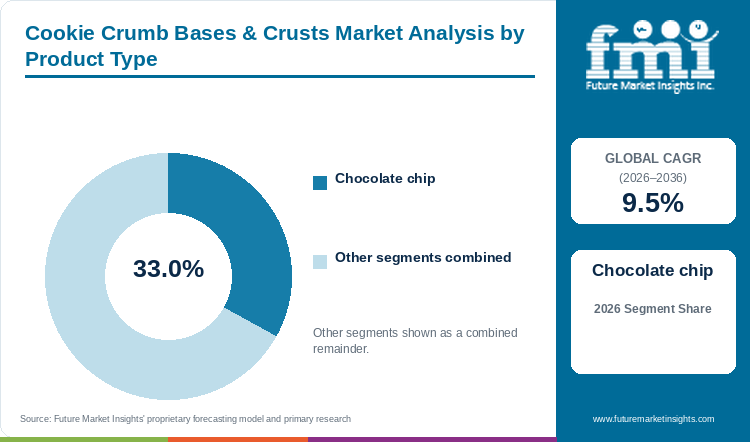
Chocolate chip is expected to hold a 33.0% share of the product type segment in 2026, driven by dual cocoa-and-biscuit textural contrast.
Table 5: Product Type Share for the Cookie Crumb Bases & Crusts Market (percentage share), 2026
| Product Type | Share (2026) |
|---|---|
| Chocolate chip | 33.0% |
| Other Segments Combined* | 67.0% |
| Total | 100.0% |
*Calculated as the balance remaining after deducting the leading segment's reported share from 100.0%.
Table 6: Product Type Leadership and Market Growth for the Cookie Crumb Bases & Crusts Market (segment and CAGR percentage), 2026 to 2036
| Metric | Value |
|---|---|
| Global CAGR (2026 to 2036) | 9.5% |
| Leading Segment | Chocolate chip |
Chocolate-chip cookie crumb blends give bakeries both a toasted shortbread base and visible cocoa specks in a single ingredient for dessert crusts and sweet-roll toppings. Industrial buyers require verified baking safety and fat stability when combining chocolate-chip crumbs with decorations and inclusions.
- Chocolate chip is estimated to hold a 33.0% share of the product type segment in 2026 owing to broad shopper familiarity and compatibility across pies and sweet rolls.
- In April 2026, researchers at the University of Missouri published a study in the Journal of Food Protection confirming that baking high-milk-protein chocolate chip cookies at 176.7 degrees Celsius for 18 minutes achieves a greater than 5-log Salmonella reduction[3].
What makes Powder / dry the preferred Form category?
Powder / dry formulations are projected to account for a 46.0% share of the form segment in 2026, supported by batching precision and ambient shelf stability.
Dry free-flowing biscuit powders let plant engineers meter exact weights through automated screw feeders and adjust butter or oil binder ratios at the mixer. Uniform sieve sizing stops fine dust from separating in pneumatic pipes and works with standard baking ingredients on automated crust lines.
- Powder / dry is predicted to record a 46.0% share of the form segment in 2026 attributable to lower ambient freight costs and adjustable fat-binding ratios.
- An October 2026 study in Food Science & Nutrition showed that fine sieved flour fractions between 90 and 160 micrometers raised bulk density and lifted cookie taste scores to 7.00 compared with 4.00 for coarse 260-to-360-micrometer fractions[4].
How does Bread & rolls retain the leading Application position?
Bread & rolls applications are anticipated to capture a 35.0% share of the application segment in 2026, reinforced by sweet-roll streusel and swirl inclusions.
Commercial bakeries making cinnamon rolls and filled sweet breads dose cookie crumb pastes and streusel pieces to create crunchy inner swirls and toppings. Unlike molded cheesecake pans, high-speed sweet-roll lines need bake-stable biscuit granules that survive dough proofing and tunnel ovens beside dinner rolls.
- Bread & rolls is forecast to register a 35.0% share of the application segment in 2026 linked to high daily production volumes of filled sweet rolls and topped buns.
- In June 2025, Bakels Group documented in Issue 176 of its technical bakery review how ready-to-use Speculoos Crumble adds caramelized biscuit crunch across sweet rolls and filled bakery goods[5].
Why does Conventional account for the largest Claim category?
Conventional claims are expected to hold a 55.0% share of the claim segment in 2026, enabled by economical wheat-and-butter processing tolerances.
Conventional wheat-and-sugar biscuit bases deliver golden browning and a clean bite across industrial ovens while avoiding the higher cost of certified organic or gluten-free flours. Plant managers set oven oxygen and moisture profiles on conventional lines while running separate dedicated batches for allergen-free desserts.
- Conventional is estimated to hold a 55.0% share of the claim segment in 2026 resulting from established wheat-flour supply chains and reliable crust-pressing cohesion across rotary molding and stamping lines.
- An April 2025 study from Tianjin University of Science and Technology in the Journal of Agricultural and Food Chemistry showed that baking butter cookies at 190 degrees Celsius under 5% low oxygen cut acrylamide levels from 95.8 to 58.5 micrograms per kilogram while keeping full butter aroma[6].
What supports Direct to industrial bakeries as the leading Sales Channel?
Direct to industrial bakeries is projected to account for a 47.0% share of the sales channel segment in 2026, driven by custom sieve and binder engineering.
Large frozen-dessert and sweet-bakery plants buy cookie crumb bases directly from ingredient producers in 500-kilogram totes to specify exact particle-size curves and fat-coating levels. Direct technical partnerships also allow joint formulation of structured plant-fat binders that stop oil separation during six-month storage.
- Direct to industrial bakeries is predicted to record a 47.0% share of the sales channel segment in 2026 associated with multi-plant supply contracts and joint R&D qualification.
- A January 2026 study in Foods showed that finely milled cookie fillings made with structured plant fats held a smooth 80-micrometer texture and 121.1 Newton firmness over 180 days of ambient storage[7].
What are the drivers, restraints, and opportunities in the cookie crumb bases & crusts market?
In the cookie crumb bases & crusts market, automated dessert-line standardization and speculoos-style inclusion demand drive purchasing, whereas moisture migration and allergen validation restrain switching, and lipid-encapsulated moisture-barrier crumbs create high-margin opportunities.
- Driver: Industrial bakeries and cheesecake plants replace manual biscuit crushing with pre-sieved crumb systems to cut line downtime and crust cracking.
- Restraint: Moisture seeping from wet fillings softens uncoated crumbs while multi-allergen cross-contact audits slow down new supplier approval.
- Opportunity: Fat-coated and gluten-free crunchy crumb preparations open up multi-day chilled desserts, frozen pastries, and filled sweet rolls.
Growth Analysis and Future Potential: Qualitative Demand Catalysts
Automated cheesecake and sweet-roll manufacturers are moving away from grinding broken cookies in house because uneven dust fines cause crust cracking and variable base thickness. Procurement of pre-sieved dry crumb blends or preformed crusts gives plants predictable butter absorption and clean release from high-speed stamping dies. Future Market Insights notes that standardized dry-base purchasing follows the same factory efficiency model seen in pizza crust mix programs across commercial commissaries. In July 2025, food process engineers published findings in Foods showing that pairing conventional baking with microwave post-drying balanced internal biscuit moisture, cutting crust cracking from 100% in controls to 3.41% and shortening bake time by 14.38%[8]. Industrial bakery buyers therefore sign annual volume contracts with specialist crumb millers that guarantee low breakage and tight moisture limits across every bulk delivery. Standardized particle granulation between 100 and 300 mesh also keeps pneumatic conveying pipes clear of fine dust buildup during continuous three-shift dessert production.
Risk Assessment of the Cookie Crumb Bases & Crusts Market: Operational and Formulation Friction
Moisture seeping from wet dairy or fruit fillings into dry biscuit particles is the main formulation hurdle limiting shelf life in layered bakery products. When an uncoated cookie crumb base sits under cheesecake batter or cream filling with high water content, liquid quickly soaks into the biscuit crumb and turns the crust soggy. In addition, low-moisture cookie crumbs require strict heat-treatment validation and allergen separation for wheat and dairy as well as soy and egg ingredients. In July 2026, thermal-safety research in the Journal of Food Protection showed that heat-inactivation times for Enterococcus faecium in low-moisture cookie dough ranged from 3.14 minutes to 6.30 minutes at 95 degrees Celsius depending on dairy and protein levels[9]. When procurement teams compare pre-blended crumb systems against standard biscuits and crackers, extensive quality paperwork and line-washout downtime delay supplier switching. Ingredient manufacturers shorten this onboarding cycle by supplying lot-specific Salmonella lethality certificates and pre-validated allergen swab documentation with every 500-kilogram tote.
Commercial Opportunity Analysis: Formulation Differentiation and Value-Add Formats
Application of protective cocoa butter or plant waxes and using upcycled oilseed flours provide strong margin expansion opportunities for ingredient suppliers through 2036. Encapsulation of sieved cookie pieces in high-melting-point cocoa butter or plant waxes blocks moisture transfer inside chilled mousses and baked sweet rolls. In August 2026, researchers at Mahidol University reported in Food Chemistry X that replacing up to 50% of butter in cookies with pressed oilseed cake raised biscuit crunch resistance from 2.24 kilograms to 8.92 kilograms while keeping good taste scores[10]. Greater crunch resistance lets thinner pressed crusts and crunchy pieces survive automated depositing and frozen shipping beside basque cheesecake lines without turning soft. Suppliers that pair moisture-shielded dark-cocoa and speculoos crumbs with gluten-free and lactose-free certifications are winning multi-year contracts across dessert makers in Europe and North America. Chilled parfait and mousse co-packers value these coated biscuit granules because the crunch holds up for five to seven days inside refrigerated supermarket grab-and-go cups.
Cookie Crumb Bases & Crusts Market by Country (2026 to 2036)
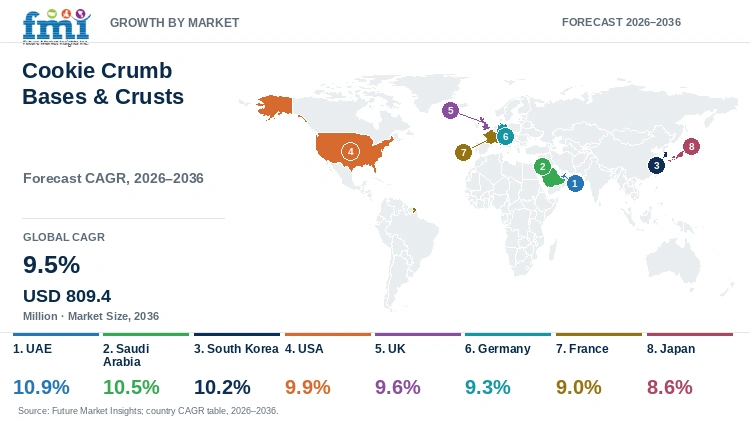
As per FMI, the UAE is projected to lead cookie crumb bases & crusts market expansion at a 10.9% CAGR from 2026 to 2036, whereas Japan is forecast to progress at an 8.6% CAGR. National growth differentials reflect the pace of commercial hotel and café commissary openings in the Gulf as well as craft-bakery consolidation in Western Europe.
Table 7: Country CAGR and Primary Growth Levers for the Cookie Crumb Bases & Crusts Market (CAGR percentage and operational drivers), 2026 to 2036
| Country | CAGR (2026 to 2036) | Primary Growth Lever |
|---|---|---|
| UAE | 10.9% | Rapid Dubai restaurant and hotel pastry commissary openings and imported dry-crumb demand |
| Saudi Arabia | 10.5% | Hospitality foodservice expansion and standardized dessert-base procurement across chains |
| South Korea | 10.2% | High-density coffee-shop network scaling layered cake and speculoos-crumb desserts |
| USA | 9.9% | Direct bulk tote contracts with industrial cheesecake, pie, and sweet-roll plants |
| UK | 9.6% | Food-manufacturing labor and energy cost pressures favoring ready-to-press crumb bases |
| Germany | 9.3% | Craft bakery enterprise consolidation shifting volume to industrial bake-off plants |
| France | 9.0% | Artisanal boulangerie-pâtisserie adoption of crunchy praline and biscuit-inclusion pastes |
| Japan | 8.6% | Precision sieve-calibrated biscuit crumb specifications for chilled convenience desserts |
Source: Future Market Insights analysis
UAE Cookie Crumb Bases & Crusts Market Outlook (2026 to 2036)
The UAE is projected to expand at a leading 10.9% CAGR from 2026 to 2036, propelled by central hotel kitchens and commercial dessert commissaries in Dubai and Abu Dhabi. Unlike mature European markets with domestic biscuit-milling plants, the UAE relies on imported moisture-protected dry crumb bags and crunchy paste inclusions that withstand humid Gulf warehousing. In July 2025, Dubai Municipality reported that approximately 2,336 new food establishments opened during the first half of 2025 while municipal inspectors conducted 34,700 food safety visits[11]. Pastry chefs serving these newly opened restaurants and resort buffets procure ready-to-use digestive and speculoos crumb bases to standardize plated cheesecakes and Ramadan dessert assortments.
Key takeaway: In the UAE, rapid hotel and foodservice establishment openings in Dubai are projected to drive a 10.9% CAGR for imported ready-to-use cookie crumb bases.
Saudi Arabia Cookie Crumb Bases & Crusts Market Outlook (2026 to 2036)
Commercial hospitality groups and quick-service café chains across Riyadh and Jeddah as well as Red Sea tourism resorts anchor demand in Saudi Arabia. The Saudi Arabia cookie crumb bases & crusts market is forecast to register a 10.5% CAGR between 2026 and 2036 across foodservice distributors and industrial bakeries. In December 2025, a formulation study in the International Journal of Food Science showed that nutrient-enriched and gluten-free biscuit bases formulated for specialized consumer groups kept their crisp texture and antioxidant stability across ambient storage[12]. Local bakery compounders and regional foodservice importers must still validate halal conformity certificates and thermal stability across high-temperature road freight corridors.
Key takeaway: In Saudi Arabia, expanding café chains and hospitality commissaries are forecast to support a 10.5% CAGR through 2036.
South Korea Cookie Crumb Bases & Crusts Market Outlook (2026 to 2036)
What distinguishes South Korea from Western industrial crust markets is its dense network of specialty coffee shops that rely on outsourced layered cakes and cookie-stuffed sweet buns. In June 2026, researchers at the National Institute of Crop and Food Science in South Korea published field-trial results in BMC Plant Biology showing that the speed-bred wheat cultivar Irum achieved a 14.6% yield gain and softer crumb texture for domestic baking[13]. Demand in South Korea is anticipated to rise at a 10.2% CAGR from 2026 to 2036, driven by co-packers supplying dark-cocoa and caramelized biscuit crusts to café chains. High butter import costs still push regional bakery commissaries to control crumb dosing.
Key takeaway: In South Korea, outsourced café dessert production and improved domestic baking-wheat cultivars are anticipated to sustain a 10.2% CAGR through 2036.
USA Cookie Crumb Bases & Crusts Market Outlook (2026 to 2036)
Unlike fragmented European patisserie channels, the USA market is anchored by high-throughput frozen cheesecake and sweet-roll plants purchasing bulk totes of graham and chocolate-chip cookie crumbs. According to the USDA Economic Research Service in January 2025, retail price inflation for cereals and bakery products in the USA moderated to 0.5% in 2024, intensifying retailer pressure on bakery manufacturers to control plant conversion costs[14]. The shift away from in-house cookie baking and grinding allows USA dessert processors to reallocate oven capacity and comply with federal sesame and major-allergen segregation rules. Across the USA, the cookie crumb bases & crusts market is estimated to progress at a 9.9% CAGR from 2026 to 2036.
Key takeaway: In the USA, bulk industrial cheesecake and sweet-roll procurement is estimated to drive a 9.9% CAGR through 2036.
UK Cookie Crumb Bases & Crusts Market Outlook (2026 to 2036)
Demand in the UK is predicted to expand at a 9.6% CAGR from 2026 to 2036, underpinned by supermarket private-label chilled cheesecake manufacturing and bakery snack-slice production. Whereas continental European bakers favor pastry shells, UK chilled-dessert manufacturers rely heavily on pressed digestive and oat-biscuit crumb bases for retail desserts. In October 2026, the UK Food Standards Agency reported in its local-authority performance update for 2025/26 that 97% of high-priority A-rated food establishments completed official food-standards compliance interventions while new business registrations rose to a three-year high[15]. Strict allergen audit requirements and elevated factory labor costs push UK dessert makers toward pre-certified, ready-to-bind biscuit crumb blends.
Key takeaway: In the UK, chilled supermarket cheesecake production and strict food-standards compliance are predicted to support a 9.6% CAGR through 2036.
Germany Cookie Crumb Bases & Crusts Market Outlook (2026 to 2036)
Germany is undergoing structural consolidation in its craft baking sector, shifting sweet-goods production toward larger regional commissaries and industrial frozen-cake plants that buy standardized crumb inclusions in bulk. The Germany cookie crumb bases & crusts market is slated to grow at a 9.3% CAGR between 2026 and 2036 across industrial bakery and foodservice accounts. In February 2026, researchers at the Leibniz Institute IPK in Gatersleben reported in Theoretical and Applied Genetics on 13,773 winter wheat genotypes across 95 environments in Germany to stabilize grain protein content for industrial baking[16]. Ready-to-dose dry crumb mixes help commercial multi-branch bakeries in Germany reduce oven energy consumption and manual crust preparation hours.
Key takeaway: In Germany, industrial bakery consolidation and energy-saving dry-mix adoption are slated to drive a 9.3% CAGR through 2036.
France Cookie Crumb Bases & Crusts Market Outlook (2026 to 2036)
Whereas plants in North America buy plain graham or chocolate-wafer powders by the ton, buyers in France prioritize caramelized speculoos and hazelnut-biscuit paste inclusions for entremets and viennoiserie. In July 2025, researchers affiliated with the University of Western Brittany in Brest published a study in the Journal of Food Science showing that 5% soy protein isolate in wholegrain bakery matrices achieved 94.21% emulsion stability and L* crust and crumb values of 39.40 and 45.83[17]. Artisanal boulangeries and industrial patisserie groups in France use fat-coated biscuit crumbs to preserve a distinct crunch beneath fruit compotes and dairy mousses. Supported by premium pastry demand, the France cookie crumb bases & crusts market is projected to advance at a 9.0% CAGR from 2026 to 2036.
Key takeaway: In France, demand for moisture-resistant crunchy inclusions across artisanal and industrial patisserie is projected to support a 9.0% CAGR through 2036.
Japan Cookie Crumb Bases & Crusts Market Outlook (2026 to 2036)
Japan is a technically demanding ingredient market where convenience-store dessert co-packers and souvenir confectioners enforce tight limits on crumb particle size and residual oil freshness during storage. In May 2026, the Ministry of Economy, Trade and Industry published its 2025 Food Business Index analysis detailing how raw-material cost shifts and automation investments are reshaping domestic food manufacturing[18]. To prevent soggy tart rings in chilled convenience-store cases, formulators in Japan specify lipid-coated black-cocoa and butter-biscuit crumbs engineered for 4-degree-Celsius holding. Supported by frequent seasonal dessert launches across convenience chains, the Japan cookie crumb bases & crusts market is forecast to record an 8.6% CAGR from 2026 to 2036.
Key takeaway: In Japan, high-turnover convenience-store chilled dessert launches and strict particle-size calibration are forecast to sustain an 8.6% CAGR through 2036.
Full report country CAGRs cover: North America; Latin America; Western Europe; Eastern Europe; East Asia; South Asia and Pacific; Middle East and Africa.
Who are the notable companies in the cookie crumb bases & crusts market?
Barry Callebaut, Puratos, Dawn Foods, Zeelandia, CSM Ingredients, Bakels, AGRANA, Zentis, Fabbri 1905, and Irca Group are the notable companies covered in the cookie crumb bases & crusts market.
FMI analysis indicates that supplier competition combines dedicated bakery-crumb specialists with multinational bakery-ingredient platforms and fruit-preparation manufacturers. Direct texture specialists supply pre-sieved digestive crumbs and moisture-resistant biscuit pastes for cheesecake bases and layered pastries. Global bakery-formulation groups use extensive R&D application centers and direct industrial distribution networks to bundle cookie-derived inclusions with fillings and mixes.
- Speculoos & Biscuit Crumb Leaders: Bakels and Fabbri 1905 join Irca Group in formulating ready-to-use digestive biscuit crumbs and moisture-resistant crunchy biscuit pastes.
- Industrial Bakery Ingredient & Mix Specialists: Dawn Foods and Zeelandia operate with CSM Ingredients to supply pre-blended crust bases, sweet-bakery mixes, and technical line support.
- Multinational Bakery & Foodservice Platforms: Barry Callebaut and Puratos join AGRANA and Zentis in engineering chocolate-coated biscuit granules and bake-stable inclusions for global industrial accounts.
Competitive Benchmarking: Cookie Crumb Bases & Crusts Market
Table 8: Competitive Benchmarking for the Cookie Crumb Bases & Crusts Market (qualitative capability ratings), 2026
| Company | Verified Crumb Formats | Bakery Process Integration | Customized Industrial Supply | Geographic Reach |
|---|---|---|---|---|
| Barry Callebaut | High | High | High | Americas, Europe, and Asia-Pacific |
| Puratos | Medium | High | High | 87+ countries across global bakery channels |
| Dawn Foods | High | High | High | North America, Europe, and international markets |
| Zeelandia | Medium | High | Medium | Europe and international bakery distribution |
| CSM Ingredients | Medium | High | High | Europe and international ingredient operations |
| Bakels | High | High | High | Europe, Asia-Pacific, Africa, and Americas |
| AGRANA | High | High | High | Europe, Americas, and global industrial accounts |
| Zentis | High | Medium | High | Europe and North America bakery and dairy |
| Fabbri 1905 | High | Medium | Medium | Italy, Europe, and global foodservice |
| Irca Group | High | High | High | Europe, North America, and international patisserie |
Scoring basis: Capability tiers evaluate documented dry biscuit-crumb and crunchy-inclusion portfolios, bake- and freeze-stability engineering, and custom B2B industrial bakery account servicing.
Key Developments in the Cookie Crumb Bases & Crusts Market
- In January 2026, Fabbri 1905 introduced its gluten-free and lactose-free Crumble Black Biscuit crunchy preparations at SIGEP Rimini for chilled pastry and foodservice applications[19].
- In March 2026, Puratos announced a definitive agreement to acquire Dawn Foods, combining Dawn's North America sweet-bakery mix and cookie-base portfolio with Puratos's global fermentation and chocolate R&D network[20].
- In February 2026, Lotus Bakeries reported in its 2025 Annual Results that Group revenue grew 10% to EUR 1,355 million while committing EUR 250 million in 2026-2027 capital expenditures to expand Biscoff cookie and spread capacity[21].
Key Players in the Cookie Crumb Bases & Crusts Market
Speculoos & Biscuit Crumb Leaders
- Bakels
- Fabbri 1905
- Irca Group
Industrial Bakery Ingredient & Mix Specialists
- Dawn Foods
- Zeelandia
- CSM Ingredients
Multinational Bakery & Foodservice Platforms
- Barry Callebaut
- Puratos
- AGRANA
- Zentis
Cookie Crumb Bases & Crusts Market - Report Scope
Table 9: Report Scope for the Cookie Crumb Bases & Crusts Market (coverage fields and definitions), 2026 to 2036
| Coverage field | Report scope |
|---|---|
| Market breakdown | Product Type; Form; Application; Claim; Sales Channel |
| Quantitative Units | USD Million |
| Market Definition | Includes commercial B2B supplier revenue from cookie-derived dry crumb bases, preformed pressed cookie crusts, and identifiable biscuit-crumb paste or particulate inclusions sold in bulk totes, bags, and pails to industrial bakeries, chilled-dessert processors, foodservice commissaries, and ingredient distributors. Excludes finished retail cookies sold directly to consumers, plain unbaked wheat flour, and standalone chocolate chips, nut pastes, or fruit fillings that do not contain a milled cookie-crumb component. |
| Regions Covered | North America; Latin America; Western Europe; Eastern Europe; East Asia; South Asia and Pacific; Middle East and Africa |
| Countries Covered | UAE, Saudi Arabia, South Korea, USA, UK, Germany, France, Japan, and additional countries in the full report |
| Key Companies Covered | Barry Callebaut, Puratos, Dawn Foods, Zeelandia, CSM Ingredients, Bakels, AGRANA, Zentis, Fabbri 1905, Irca Group |
| Forecast Period | 2026 to 2036 |
| Approach | Primary interviews with commercial bakery buyers and ingredient R&D managers combined with secondary government and trade statistical series and bottom-up volume triangulation from 2025 to 2036. |
Cookie Crumb Bases & Crusts Market - Research Methodology
Table 10: Research Methodology for the Cookie Crumb Bases & Crusts Market (research methods and approach), 2026 edition
| Method | Approach |
|---|---|
| Primary Research | Structured interviews with industrial cheesecake and sweet-roll R&D directors, commercial bakery ingredient procurement managers, and B2B foodservice distributors across North America, Europe, Asia-Pacific, and the Middle East. Discussions validated 100-to-300-mesh sieve tolerances, low water-activity thresholds below 0.35, fat-coating ratios, and delivered bulk tote pricing across active plant accounts. |
| Secondary Research | Analysis of peer-reviewed biscuit particle rheology and zero-trans structured-lipid studies indexed in PubMed, USDA Economic Research Service retail bakery price series, UK Food Standards Agency local-authority compliance updates, corporate technical bakery application guides, and audited M&A and capital-expenditure disclosures. |
| Market Sizing and Forecasting | Top-down industrial bakery and chilled-dessert ingredient budgets are reconciled against bottom-up metric tonnage of dry crumb bases and biscuit-inclusion pastes shipped to commercial bakery plants from 2025 to 2036. Analysts cross-check bulk tote realizations against average 60-gram crust and streusel loadings across cheesecakes, sweet rolls, and tarts. |
| Country Forecasting Model | Econometric country projections weight commercial bakery and café commissary expansion with chilled-dessert manufacturing output across eight covered countries. The model also incorporates craft-bakery branch consolidation and national allergen-segregation compliance in each domestic processing market. |
| Operational Benchmark Traceability | Tonnage and per-plant spending indicators in Tables 2, 3, and 4 trace directly to peer-reviewed biscuit mesh-size and thermal-kinetics studies in PubMed as well as USDA ERS food-price series. Operational plant ranges are further checked against UK Food Standards Agency establishment registries and commercial B2B bulk tote pricing. |
| Data Triangulation and Validation | Revenue estimates are cross-checked against B2B bakery-ingredient catalog specifications and active industrial plant counts across North America and Europe as well as Asia-Pacific. Analysts exclude finished consumer biscuits, plain pastry flour, and non-crumb confectionery fillings to prevent double counting. |
Cookie Crumb Bases & Crusts Market by Segments
Cookie Crumb Bases & Crusts Market segmented by Product Type:
- Chocolate chip
- Filled & stuffed
- Assorted premium
- Seasonal & decorated
Cookie Crumb Bases & Crusts Market segmented by Form:
- Powder / dry
- Liquid
- Paste / semi-solid
- Granules / pieces
Cookie Crumb Bases & Crusts Market segmented by Application:
- Bread & rolls
- Cakes & muffins
- Biscuits & cookies
- Viennoiserie & pastry
- Other bakery & snacks
Cookie Crumb Bases & Crusts Market segmented by Claim:
- Conventional
- Clean label
- Organic
- Non-GMO / identity preserved
Cookie Crumb Bases & Crusts Market segmented by Sales Channel:
- Direct to industrial bakeries
- Ingredient distributors
- Foodservice & artisan supply
- Online B2B
Cookie Crumb Bases & Crusts Market by Region
- North America
- United States
- Canada
- Latin America
- Brazil
- Mexico
- Argentina
- Chile
- Western Europe
- Germany
- France
- United Kingdom
- Italy
- Spain
- Benelux
- Nordics
- Eastern Europe
- Poland
- Czech Republic
- Romania
- Hungary
- East Asia
- China
- Japan
- South Korea
- South Asia and Pacific
- India
- ASEAN
- Australia and New Zealand
- Middle East and Africa
- GCC Countries
- South Africa
- Türkiye
- Israel
Research Sources and Bibliography
- [1] Bakels Worldwide. (2025, December 1). Big Bakery Trends for 2026 on Hybrid Crunchy and Gooey Texture Innovation. Bakels Worldwide Market Research.
- [2] Sanmenxia Biotechnology Research Center. (2025, July 5). Effect of particle size of Eucommia ulmoides leaf micro-powder on dough characteristics and biscuit quality of shortbread biscuits. Food Chemistry X, 29, 102715 (PubMed PMID 40686873).
- [3] University of Missouri Division of Food, Nutrition and Exercise Sciences. (2026, April 24). Validation of High Milk Protein Chocolate Chip Cookie Baking Process and Thermal Death Inactivation Parameters of a 4-Serovar Salmonella Cocktail. Journal of Food Protection, 89(6), 100791 (PubMed PMID 42035879).
- [4] Papua New Guinea University of Technology Department of Food Technology. (2026, October 7). Impact of Particle Size on Flour Physicochemical Properties and Cookies Sensory Acceptability Made From Teff. Food Science & Nutrition, 14(10), e72432 (PubMed PMID 42846815).
- [5] Bakels Group. (2025, June 10). Bakels Worldwide Review Issue 176 on Speculoos Crumble and Sweet Bakery Textures. Bakels Group Publication.
- [6] Tianjin University of Science and Technology Research Laboratory of Food Nutrition and Safety. (2025, April 30). Advancing Butter Cookie Quality with Low-Oxygen Baking for Sensory Quality and Acrylamide Reduction. Journal of Agricultural and Food Chemistry, 73(17), 10507-10519 (PubMed PMID 40249853).
- [7] Foods Structured Lipid Research Group. (2026, January 5). Palm Oil-Free Structured Lipids as a Structuring Fat for Sandwich Cookie Fillings. Foods, 15(1), 178 (PubMed PMID 41517243).
- [8] Foods Bakery Processing Research Group. (2025, July 30). Application of Microwaves to Reduce Checking in Low-Fat Biscuits and Impact on Sensory Characteristics and Energy Consumption. Foods, 14(15), 2693 (PubMed PMID 40807630).
- [9] Low-Moisture Cookie Dough Thermal Kinetics Group. (2026, July 28). The Effect of Inoculated Ingredient on the Thermal Resistance of Enterococcus faecium in a Multi-ingredient Model Cookie Dough. Journal of Food Protection, 89(8), 100876 (PubMed PMID 42508534).
- [10] Mahidol University Frontier Research Facility. (2026, August 27). Physicochemical and structural properties of dough and cookies formulated with Hodgsonia heteroclita oilseed cake as a functional fat replacer. Food Chemistry X, 39, 104369 (PubMed PMID 42712956).
- [11] Dubai Municipality. (2025, July 30). Over 34,000 food inspections conducted in first half of 2025 as 2,336 new food establishments open in Dubai. Government of Dubai Official Release.
- [12] International Journal of Food Science Biscuit Formulation Group. (2025, December 11). Development and Characterization of High-Nutrient Biscuits for Specialized Consumer Groups. International Journal of Food Science, 2025, 8042259 (PubMed PMID 41393068).
- [13] National Institute of Crop and Food Science, Rural Development Administration, Republic of Korea. (2026, June 8). Accelerated cultivar release via integrated speed breeding framework in wheat (Triticum aestivum L.). BMC Plant Biology, 26(1), 1364 (PubMed PMID 42252417).
- [14] U.S. Department of Agriculture, Economic Research Service. (2025, January 30). Retail food price inflation subsided across most categories in 2024 including cereals and bakery products. USDA Economic Research Service Charts of Note.
- [15] United Kingdom Food Standards Agency. (2026, October 19). Local authority performance update for the Food Standards Agency September 2026 Board Meeting. GOV.UK Official Publication.
- [16] Leibniz Institute of Plant Genetics and Crop Plant Research (IPK) Gatersleben. (2026, February 13). Integrating genomic predictions into an applied Central European wheat breeding program. Theoretical and Applied Genetics, 139(2), 69 (PubMed PMID 41686243).
- [17] University of Western Brittany and University of Manitoba. (2025, July 1). Developing Protein-Enriched Wholegrain Bread With Different Plant Protein Isolates. Journal of Food Science, 90(7), e70362 (PubMed PMID 40610202).
- [18] Ministry of Economy, Trade and Industry, Japan. (2026, May 27). Food Business Index structural trends and processing cost analysis in 2025. METI Industrial Statistics Archive.
- [19] Fabbri 1905 S.p.A. (2026, January 16). Fabbri 1905 entra nel mondo dello street food e ridefinisce il fuoricasa Made in Italy con la linea Crumble a SIGEP 2026. Fabbri 1905 Area Stampa.
- [20] North, A. (2026, March 11). Puratos to acquire Dawn Foods in landmark deal. British Baker.
- [21] Lotus Bakeries NV. (2026, February 6). Annual Results 2025 and EUR 250 Million 2026-2027 Capacity Investment Program. Lotus Bakeries Regulated Financial Release.
- [22] Lotus Bakeries NV. (2026, June 30). Half-Year Results 2026 and Thailand Biscoff Facility Startup. Lotus Bakeries Corporate Filing.
- [23] Universidade Estadual de Campinas Faculty of Food Engineering. (2025, August 19). Enzymatic interesterification of palm olein and hydrogenated palm oil and effects on physicochemical properties. Food Research International, 221(Pt 3), 117369 (PubMed PMID 41215001).
This bibliography is provided for reader reference and is not exhaustive. The full report contains the complete reference list and detailed citations.
This Report Answers
- How large is the cookie crumb bases & crusts market in 2026 and what is forecast for 2036?
- Which industrial dosing and texture-stability factors drive demand for cookie crumb bases?
- Why does Chocolate chip lead the product type segment?
- Why does Powder / dry lead the form segment globally?
- How do growth rates compare across the UAE and Saudi Arabia as well as South Korea and the USA?
- Which leading ingredient suppliers offer calibrated biscuit crumbs and moisture-barrier inclusions?
- What technical and allergen hurdles delay supplier qualification in industrial bakeries?
- What sieve and water-activity specifications should buyers test before ordering bulk cookie crumb bases?
Frequently Asked Questions
How big is the cookie crumb bases & crusts market in 2026, and what is forecast for 2036?
According to FMI, the global cookie crumb bases & crusts market is estimated to reach USD 326.6 million in 2026 from USD 298.3 million in 2025. Market value is forecast to reach USD 809.4 million by 2036 as industrial bakeries and dessert commissaries replace in-house biscuit grinding with pre-sieved crumb systems in 500-kilogram totes.
What is the CAGR for the cookie crumb bases & crusts market from 2026 to 2036?
Future Market Insights projects a 9.5% compound annual growth rate from 2026 to 2036, generating USD 482.8 million in incremental revenue across industrial bakery and foodservice accounts. Volume expansion is driven by automated cheesecake and sweet-roll plants switching from in-house biscuit crushing to calibrated bulk totes.
Which product type segment leads the cookie crumb bases & crusts market?
Chocolate chip is expected to hold a 33.0% share of the product type segment in 2026 because it combines a recognizable cookie crumb structure with visible cocoa particulate contrast. Commercial bakeries use chocolate-chip crumb blends across both pressed pie shells and sweet-roll streusel toppings.
Which form segment leads the cookie crumb bases & crusts market?
Powder / dry is estimated to hold a 46.0% share of the form segment in 2026 owing to ambient bulk storage and adjustable fat-binding ratios at the mixer. Dry free-flowing biscuit powders let industrial cheesecake and tart plants meter exact batch weights through automated screw feeders without cold-chain freight costs.
Which country has a notable growth outlook during the assessment period?
The UAE leads country growth at a 10.9% CAGR from 2026 to 2036, followed by Saudi Arabia at 10.5% and South Korea at 10.2% due to rapid hotel commissary and coffee-shop dessert expansion. Central pastry kitchens across Dubai and Riyadh as well as Seoul rely on imported ready-to-use digestive and speculoos crumb bases to standardize chilled cheesecakes.
Who are the key players in the market?
Barry Callebaut and Puratos lead global supply with Dawn Foods and Zeelandia as well as CSM Ingredients across industrial bakery and foodservice accounts. Bakels and AGRANA join Zentis and Fabbri 1905 with Irca Group in supplying pre-sieved dry crumb mixes, caramelized speculoos crumbles, and moisture-resistant biscuit paste inclusions.
Preview the report firsthand - request a free sample
Get SampleGet the brochure for pricing and purchase details.
Get PDFTable of Content
- Key Takeaways
- Market Size and CAGR
- Top Growth Driver
- Fastest Growing Segment
- Leading Region
- Key Companies
- Emerging Opportunities
- Executive Summary
- Global Market Outlook
- Demand-side Trends
- Supply-side Trends
- Technology Roadmap Analysis
- Analysis and Recommendations
- Analyst Perspective (What is happening? Why now? What should investors know?)
- Key Questions Answered
- How large is the market?
- What is the CAGR?
- What are key trends?
- Which region dominates?
- Who are the leaders?
- Market Overview
- Market Coverage / Taxonomy
- Market Definition / Scope / Limitations
- Research Methodology
- Chapter Orientation
- Analytical Lens and Working Hypotheses
- Market Structure, Signals, and Trend Drivers
- Benchmarking and Cross-market Comparability
- Market Sizing, Forecasting, and Opportunity Mapping
- Research Design and Evidence Framework
- Desk Research Programme (Secondary Evidence)
- Expert Input and Fieldwork (Primary Evidence)
- Tooling, Models, and Reference Databases
- Data Engineering and Model Build
- Quality Assurance and Audit Trail
- Market Background
- Market Dynamics (Drivers, Restraints, Opportunity, Trends)
- Scenario Forecast (Optimistic, Likely, Conservative)
- Impact Analysis
- AI Impact
- Sustainability Impact
- Regulatory Impact
- Technology Impact
- Consumer / Buyer Analysis
- Purchase Drivers
- Adoption Barriers
- Buyer Journey
- Opportunity Map Analysis
- Product Life Cycle Analysis
- Supply Chain Analysis
- Investment Feasibility Matrix
- Value Chain Analysis
- PESTLE and Porter's Analysis
- Regulatory Landscape
- Regional Parent Market Outlook
- Production and Consumption Statistics
- Import and Export Statistics
- Global Market Analysis and Forecast, 2021 to 2036
- Historical Market Size Value (USD Million) Analysis, 2021 to 2025
- Current and Future Market Size Value (USD Million) Projections, 2026 to 2036
- Y-o-Y Growth Trend Analysis
- Absolute $ Opportunity Analysis
- Global Market Pricing Analysis, 2021 to 2036
- Global Market Analysis and Forecast, By Product Type, 2021 to 2036
- Introduction / Key Findings
- Historical Market Size Value (USD Million) Analysis By Product Type, 2021 to 2025
- Current and Future Market Size Value (USD Million) Analysis and Forecast By Product Type, 2026 to 2036
- Chocolate chip
- Filled & stuffed
- Assorted premium
- Seasonal & decorated
- Y-o-Y Growth Trend Analysis By Product Type, 2021 to 2025
- Absolute $ Opportunity Analysis By Product Type, 2026 to 2036
- Global Market Analysis and Forecast, By Form, 2021 to 2036
- Introduction / Key Findings
- Historical Market Size Value (USD Million) Analysis By Form, 2021 to 2025
- Current and Future Market Size Value (USD Million) Analysis and Forecast By Form, 2026 to 2036
- Powder / dry
- Liquid
- Paste / semi-solid
- Granules / pieces
- Y-o-Y Growth Trend Analysis By Form, 2021 to 2025
- Absolute $ Opportunity Analysis By Form, 2026 to 2036
- Global Market Analysis and Forecast, By Application, 2021 to 2036
- Introduction / Key Findings
- Historical Market Size Value (USD Million) Analysis By Application, 2021 to 2025
- Current and Future Market Size Value (USD Million) Analysis and Forecast By Application, 2026 to 2036
- Bread & rolls
- Cakes & muffins
- Biscuits & cookies
- Viennoiserie & pastry
- Other bakery & snacks
- Y-o-Y Growth Trend Analysis By Application, 2021 to 2025
- Absolute $ Opportunity Analysis By Application, 2026 to 2036
- Global Market Analysis and Forecast, By Claim, 2021 to 2036
- Introduction / Key Findings
- Historical Market Size Value (USD Million) Analysis By Claim, 2021 to 2025
- Current and Future Market Size Value (USD Million) Analysis and Forecast By Claim, 2026 to 2036
- Conventional
- Clean label
- Organic
- Non-GMO / identity preserved
- Y-o-Y Growth Trend Analysis By Claim, 2021 to 2025
- Absolute $ Opportunity Analysis By Claim, 2026 to 2036
- Global Market Analysis and Forecast, By Sales Channel, 2021 to 2036
- Introduction / Key Findings
- Historical Market Size Value (USD Million) Analysis By Sales Channel, 2021 to 2025
- Current and Future Market Size Value (USD Million) Analysis and Forecast By Sales Channel, 2026 to 2036
- Direct to industrial bakeries
- Ingredient distributors
- Foodservice & artisan supply
- Online B2B
- Y-o-Y Growth Trend Analysis By Sales Channel, 2021 to 2025
- Absolute $ Opportunity Analysis By Sales Channel, 2026 to 2036
- Global Market Analysis and Forecast, By Region, 2021 to 2036
- Introduction
- Historical Market Size Value (USD Million) Analysis By Region, 2021 to 2025
- Current Market Size Value (USD Million) Analysis and Forecast By Region, 2026 to 2036
- North America
- Latin America
- Western Europe
- Eastern Europe
- East Asia
- South Asia and Pacific
- Middle East and Africa
- Market Attractiveness Analysis By Region
- North America Market Analysis and Forecast, By Country, 2021 to 2036
- Historical Market Size Value (USD Million) Trend Analysis By Market Taxonomy, 2021 to 2025
- Market Size Value (USD Million) Forecast By Market Taxonomy, 2026 to 2036
- By Country
- United States
- Canada
- By Product Type
- By Form
- By Application
- By Claim
- By Sales Channel
- By Country
- Market Attractiveness Analysis
- By Country
- By Product Type
- By Form
- By Application
- By Claim
- By Sales Channel
- Key Takeaways
- Latin America Market Analysis and Forecast, By Country
- Historical Market Size Value (USD Million) Trend Analysis By Market Taxonomy, 2021 to 2025
- Market Size Value (USD Million) Forecast By Market Taxonomy, 2026 to 2036
- By Country
- Brazil
- Mexico
- Argentina
- Chile
- By Product Type
- By Form
- By Application
- By Claim
- By Sales Channel
- By Country
- Market Attractiveness Analysis
- By Country
- By Product Type
- By Form
- By Application
- By Claim
- By Sales Channel
- Key Takeaways
- Western Europe Market Analysis and Forecast, By Country
- Historical Market Size Value (USD Million) Trend Analysis By Market Taxonomy, 2021 to 2025
- Market Size Value (USD Million) Forecast By Market Taxonomy, 2026 to 2036
- By Country
- Germany
- France
- United Kingdom
- Italy
- Spain
- Benelux
- Nordics
- By Product Type
- By Form
- By Application
- By Claim
- By Sales Channel
- By Country
- Market Attractiveness Analysis
- By Country
- By Product Type
- By Form
- By Application
- By Claim
- By Sales Channel
- Key Takeaways
- Eastern Europe Market Analysis and Forecast, By Country
- Historical Market Size Value (USD Million) Trend Analysis By Market Taxonomy, 2021 to 2025
- Market Size Value (USD Million) Forecast By Market Taxonomy, 2026 to 2036
- By Country
- Poland
- Czech Republic
- Romania
- Hungary
- By Product Type
- By Form
- By Application
- By Claim
- By Sales Channel
- By Country
- Market Attractiveness Analysis
- By Country
- By Product Type
- By Form
- By Application
- By Claim
- By Sales Channel
- Key Takeaways
- East Asia Market Analysis and Forecast, By Country
- Historical Market Size Value (USD Million) Trend Analysis By Market Taxonomy, 2021 to 2025
- Market Size Value (USD Million) Forecast By Market Taxonomy, 2026 to 2036
- By Country
- China
- Japan
- South Korea
- By Product Type
- By Form
- By Application
- By Claim
- By Sales Channel
- By Country
- Market Attractiveness Analysis
- By Country
- By Product Type
- By Form
- By Application
- By Claim
- By Sales Channel
- Key Takeaways
- South Asia and Pacific Market Analysis and Forecast, By Country
- Historical Market Size Value (USD Million) Trend Analysis By Market Taxonomy, 2021 to 2025
- Market Size Value (USD Million) Forecast By Market Taxonomy, 2026 to 2036
- By Country
- India
- ASEAN
- Australia and New Zealand
- By Product Type
- By Form
- By Application
- By Claim
- By Sales Channel
- By Country
- Market Attractiveness Analysis
- By Country
- By Product Type
- By Form
- By Application
- By Claim
- By Sales Channel
- Key Takeaways
- Middle East and Africa Market Analysis and Forecast, By Country
- Historical Market Size Value (USD Million) Trend Analysis By Market Taxonomy, 2021 to 2025
- Market Size Value (USD Million) Forecast By Market Taxonomy, 2026 to 2036
- By Country
- GCC Countries
- South Africa
- Türkiye
- Israel
- By Product Type
- By Form
- By Application
- By Claim
- By Sales Channel
- By Country
- Market Attractiveness Analysis
- By Country
- By Product Type
- By Form
- By Application
- By Claim
- By Sales Channel
- Key Takeaways
- Key Countries Market Analysis
- United States
- Pricing Analysis
- Market Share Analysis, 2025
- By Product Type
- By Form
- By Application
- By Claim
- By Sales Channel
- Canada
- Pricing Analysis
- Market Share Analysis, 2025
- By Product Type
- By Form
- By Application
- By Claim
- By Sales Channel
- Mexico
- Pricing Analysis
- Market Share Analysis, 2025
- By Product Type
- By Form
- By Application
- By Claim
- By Sales Channel
- Brazil
- Pricing Analysis
- Market Share Analysis, 2025
- By Product Type
- By Form
- By Application
- By Claim
- By Sales Channel
- Chile
- Pricing Analysis
- Market Share Analysis, 2025
- By Product Type
- By Form
- By Application
- By Claim
- By Sales Channel
- Germany
- Pricing Analysis
- Market Share Analysis, 2025
- By Product Type
- By Form
- By Application
- By Claim
- By Sales Channel
- United Kingdom
- Pricing Analysis
- Market Share Analysis, 2025
- By Product Type
- By Form
- By Application
- By Claim
- By Sales Channel
- Italy
- Pricing Analysis
- Market Share Analysis, 2025
- By Product Type
- By Form
- By Application
- By Claim
- By Sales Channel
- Spain
- Pricing Analysis
- Market Share Analysis, 2025
- By Product Type
- By Form
- By Application
- By Claim
- By Sales Channel
- France
- Pricing Analysis
- Market Share Analysis, 2025
- By Product Type
- By Form
- By Application
- By Claim
- By Sales Channel
- India
- Pricing Analysis
- Market Share Analysis, 2025
- By Product Type
- By Form
- By Application
- By Claim
- By Sales Channel
- ASEAN
- Pricing Analysis
- Market Share Analysis, 2025
- By Product Type
- By Form
- By Application
- By Claim
- By Sales Channel
- Australia and New Zealand
- Pricing Analysis
- Market Share Analysis, 2025
- By Product Type
- By Form
- By Application
- By Claim
- By Sales Channel
- China
- Pricing Analysis
- Market Share Analysis, 2025
- By Product Type
- By Form
- By Application
- By Claim
- By Sales Channel
- Japan
- Pricing Analysis
- Market Share Analysis, 2025
- By Product Type
- By Form
- By Application
- By Claim
- By Sales Channel
- South Korea
- Pricing Analysis
- Market Share Analysis, 2025
- By Product Type
- By Form
- By Application
- By Claim
- By Sales Channel
- Poland
- Pricing Analysis
- Market Share Analysis, 2025
- By Product Type
- By Form
- By Application
- By Claim
- By Sales Channel
- Hungary
- Pricing Analysis
- Market Share Analysis, 2025
- By Product Type
- By Form
- By Application
- By Claim
- By Sales Channel
- Türkiye
- Pricing Analysis
- Market Share Analysis, 2025
- By Product Type
- By Form
- By Application
- By Claim
- By Sales Channel
- South Africa
- Pricing Analysis
- Market Share Analysis, 2025
- By Product Type
- By Form
- By Application
- By Claim
- By Sales Channel
- UAE
- Pricing Analysis
- Market Share Analysis, 2025
- By Product Type
- By Form
- By Application
- By Claim
- By Sales Channel
- Saudi Arabia
- Pricing Analysis
- Market Share Analysis, 2025
- By Product Type
- By Form
- By Application
- By Claim
- By Sales Channel
- United States
- Market Structure Analysis
- Competition Dashboard
- Competition Benchmarking
- Market Share Analysis of Top Players
- By Regional
- By Product Type
- By Form
- By Application
- By Claim
- By Sales Channel
- Emerging Startups
- Innovation Benchmarking
- Competition Analysis
- Competition Deep Dive
- Barry Callebaut
- Overview
- Product Portfolio
- Profitability by Market Segments
- Sales Footprint
- Strategy Overview
- Marketing Strategy
- Product Strategy
- Channel Strategy
- Puratos
- Dawn Foods
- Zeelandia
- CSM Ingredients
- Bakels
- AGRANA
- Zentis
- Fabbri 1905
- Irca Group
- Barry Callebaut
- Case Studies
- Success Stories
- Recent Developments
- Competition Deep Dive
- Assumptions & Acronyms Used


