

- Market Size (2026)
- USD 860.7 Mn
- Forecast (2036)
- USD 1585.6 Mn
- CAGR (2026 to 2036)
- 6.3%
How big is Crane Load Indicators Market in 2026?
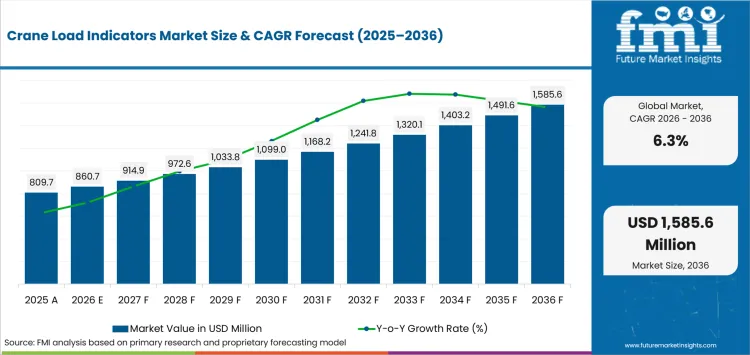
USD 860.7 million in 2026 and USD 1,585.6 million by 2036 at a 6.3% CAGR.
Crane load indicators market value increased from USD 809.7 million in 2025 to USD 860.7 million in 2026. It is projected to reach USD 1,585.6 million by 2036 at a 6.3% CAGR as overload control becomes part of crane commissioning and safe operation. PALFINGER documented that link in February 2025 after the serial PFM 2100 passed a Factory Acceptance Test covering functional and overload testing. The test ties load-state verification to machine readiness and supports replacement if safety electronics cannot be qualified for continued service.
Regional purchase timing depends on technician coverage and operator assistance levels, with Japan illustrating the labor side of that divergence. MLIT's 2025 white paper projects construction engineers to decline about 1.5% to 3.0% every five years and skilled construction workers about 7% to 8% over the same interval. Clearer operator aids gain value in Japan although documentation and service quality still govern replacement. UAE and Saudi Arabia face project pipelines in which commissioning capacity matters more than labor substitution.
Key Takeaways
- Crane safety obligations and equipment uptime tie overload indication to replacement decisions once a display or control unit becomes unreliable.
- By system type, load moment indicators are estimated to hold 31.0% in 2026 owing to capacity calculations that follow changing radius and boom geometry.
- In 2026, mobile cranes are expected to lead crane type with 28.0% share because frequent setup changes alter rated-capacity information during field operation.
- Load pins are projected to hold 27.0% share in 2026 owing to direct force measurement suited to rugged assemblies and wired or wireless instrumentation.
- Retrofit demand slows if older cranes need sensor adaptation and load-chart mapping prior to calibration and release of a replacement system.
- Some of the key players in this market include PALFINGER, Tadano, Manitowoc, Liebherr, Hiab, Weite Technologies, Konecranes, and Terex Utilities.
Analyst Perspective
"Crane load indicators deserve evaluation against the machine load chart and field-service route instead of unit price alone. The stronger offer shortens commissioning work while preserving calibrated overload protection on productive cranes that cannot stay idle during lengthy retrofit work."
- Nikhil Kaitwade, Principal Consultant, Future Market Insights
How is the crane load indicators market segmented?
The market is segmented by system type, crane type, sensor type, end use, sales channel and region.
System types are load moment indicators, rated capacity indicators, wireless load indicators, anti-two-block systems and integrated safe load systems. Crane types are mobile cranes, tower, crawler, overhead and marine/offshore cranes, while sensors are load pins, pressure transducers, tensiometers, angle sensors and wireless dynamometers. End uses are construction, ports, oil & gas, mining and industrial plants, while sales channels are crane OEMs, retrofit installers, industrial distributors and inspection service providers.
Why do crane OEMs lead the sales channel category?
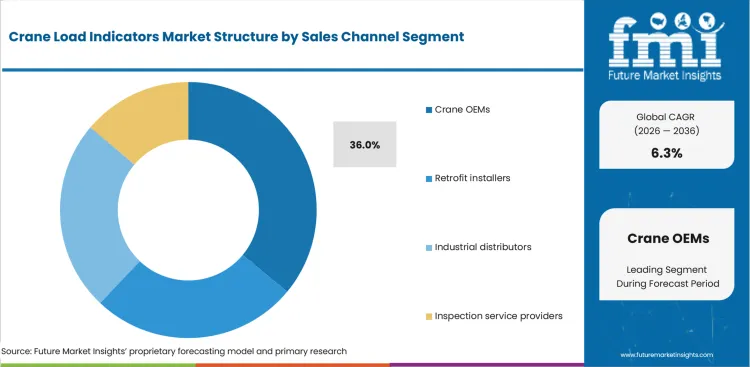
Factory integration on truck-mounted cranes gives engineers direct access to sensor placement and load charts during original machine design prior to commissioning. That timing reduces adaptation work faced by retrofit installers on older cranes with mixed control architectures and incomplete documentation.
- By sales channel, crane OEMs are forecast to represent 36.0% in 2026 driven by indicator configuration completed with the machine control system prior to deployment.
- Manitowoc's November 2025 MCR 505 J25 launch directly illustrates the factory-integration advantage. Its control system optimizes load curves while VISU+ provides real-time performance information and built-in operation logging from the original crane architecture.
Why do load moment indicators lead the system type category?
Load moment indicators compare measured force with boom geometry and the rated-capacity curve assigned to the active configuration during lifting. Related machine control systems matter most on cranes whose allowable capacity changes as boom angle or radius changes.
- By system type, load moment indicators are estimated to hold 31.0% in 2026 owing to control logic that translates changing geometry into an operator-facing capacity decision.
- PALFINGER showed the same control logic on Korea's first locally built crew transfer vessel in June 2026. Its PAL40 system restricts load-moment-increasing functions during overload conditions while preserving corrective movement for recovery.
Why do mobile cranes lead the crane type category?
Telescopic crane platforms change boom angle and support configuration between jobs on the same machine. Variable geometry makes load-chart logic more useful than a fixed alarm threshold during repeated site deployment. Operators also need clear mode confirmation once outriggers or counterweights change between successive lifting configurations.
- Mobile cranes are set to lead the crane type with 28.0% share in 2026 due to rated-capacity information that must follow each working configuration.
- Tadano reinforced that requirement in September 2025 with the GTC-600-2 and its AML-C Rated Capacity Indicator. Automatic switching among out-of-level load charts keeps the indicated limit aligned with the crane's actual position.
Why does construction lead the end use category?
Construction sites using tower crane platforms expose cranes to short lift sequences and changing access conditions that make setup errors expensive to correct. Contractors need safety systems that preserve machine availability on tightly scheduled sites during handover and fault diagnosis.
- Based on end use, construction is projected to account for 34.0% in 2026 due to frequent lifting work that makes overload visibility an operating requirement.
- Manitowoc launched the Potain Igo T 139 in April 2025 for shorter-term jobsites. The crane carries a full-graphic control interface and Potain CONNECT for troubleshooting and fleet management during active project use.
What are the drivers, restraints and opportunities in the Crane Load Indicators Market?
Safety duties sustain demand while crane-specific configuration slows retrofits and modular digital controls reduce installation work on older fleets.
- Driver: Crane owners replace unreliable load-state electronics to restore overload protection and rated-capacity visibility inside the crane's operating safety circuit.
- Restraint: Legacy cranes can require sensor adaptation and load-chart mapping before an indicator is calibrated against the machine configuration.
- Opportunity: Modular electronic controls and wireless interfaces reduce cabling while preserving crane-specific limits and operator feedback.
Safety Rules Tie Overload Visibility to the Operating Circuit
Operators in jib crane applications need load-state information near configured limits because missing overload visibility becomes an immediate operating problem. Konecranes specified overload protection with a digital load display on the 170-tonne bridge crane ordered for Hafslund Kraft in May 2026. That specification places indication inside the control package and explains why owners replace unreliable electronics prior to losing a verified protective function.
Crane-Specific Configuration Slows Retrofit Approval
Retrofit approval slows if a replacement indicator must match crane geometry plus support position and operating mode prior to calibration. Liebherr described a July 2025 floating-operation mode that uses separate load curves for 0°, 1°, 2°, and 3° inclinations under load-moment limitation. Older cranes require installers to map the correct load data and preserve protective responses prior to returning productive equipment safely to service.
Modular Digital Controls Reduce Installation Friction
Digital control packages reduce field work by concentrating feedback and diagnostics in a configurable electronic interface that technicians can replace without major rewiring. Terex Utilities introduced Flex Pro controls in January 2025 with LCD feedback and multiple radio-remote arrangements for digger derricks. Single electronic connectors shorten installation work while the crane aftermarket rewards specialists that preserve machine-specific limits and operator feedback on older equipment.
Which country CAGRs are profiled in the Crane Load Indicators Market?
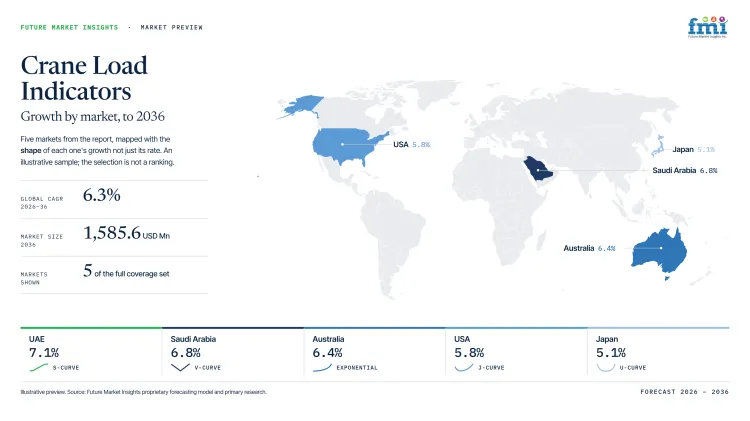
| Country | CAGR |
|---|---|
| UAE | 7.1% |
| Saudi Arabia | 6.8% |
| Australia | 6.4% |
| Brazil | 6.1% |
| USA | 5.8% |
How do country-level CAGRs compare in the Crane Load Indicators Market?
The CAGRs span 1.3 percentage points from UAE at 7.1% to USA at 5.8%. UAE and Saudi Arabia form the upper band while Australia and Brazil occupy the middle. USA closes the range within a mature fleet environment where project intensity and replacement timing matter more than absolute market size.
- UAE project turnover raises demand for commissioning on construction and port fleets.
- Saudi rental costs make downtime control central to replacement economics for contractors.
- Australia rewards service networks that reach distant engineering projects without repeat travel.
- Brazil needs local spares since regional service depth affects electronics repair timing.
- USA replacement decisions depend on compatibility with diverse legacy controls and fleets.
Different service conditions require distinct channel models despite comparable country growth rates. The full report provides country-level CAGR analysis across North America, Latin America, Europe, East Asia, South Asia, Oceania and the Middle East and Africa.
Country-wise Analysis
- UAE crane fleets move between high-rise projects and port or offshore crane systems during active project turnover. Commissioning teams must adapt instruments to several crane geometries and duty cycles during equipment redeployment. The Ministry of Economy and Tourism documented 7.0% first-quarter construction growth for the UAE in September 2025. Crane load indicator demand in the UAE is projected to grow at 7.1% CAGR through 2036 given the cost of calibration downtime during short project cycles. Heat exposure and mixed imported specifications make load-chart setup a material hurdle during urgent replacements. Installers with stocked sensors and local calibration support can win work that cannot wait for overseas parts or engineering review.
- Saudi crane rental fleets redeploy equipment between major construction sites and industrial zones during intensive project schedules. GASTAT recorded a 2.5% year-over-year increase in equipment and machinery rental prices for June 2025. Crane load indicator demand in Saudi Arabia is forecast to advance at 6.8% CAGR through 2036 aided by active project fleets and local parts inventory. Higher rental costs make first-visit commissioning more valuable for contractors managing shared machines under tight project schedules. Mixed imported crane models can extend technician time outside main service centers during urgent replacements. That service constraint limits replacement speed despite high project demand and equipment utilization in major corridors.
- Australian crane operators work in metropolitan construction and remote engineering projects that put service distance directly into replacement planning decisions for field service. Crane load indicator sales are forecast to expand at 6.4% CAGR through 2036 reflecting mobile and industrial crane use beyond major coastal service centers. In June 2026, the Australian Bureau of Statistics documented a 7.1% quarterly rise in seasonally adjusted engineering construction work. Remote project locations make repeated calibration travel a structural cost even for dealers holding replacement sensors. Dealer coverage beyond the largest coastal cities and mining districts therefore forms part of the purchase case for crane operators.
- In Brazil, construction and mining fleets often retain older machines while imported electronics lengthen repair cycles outside major service hubs during active project work cycles. Crane load indicator sales in Brazil are estimated to rise at 6.1% CAGR through 2036 supported by heavy-equipment activity and distributor-held inventory near industrial centers. Construction grew 4.3% in 2024 according to Brazil's Central Bank March 2025 Monetary Policy Report. Older machines require correct crane geometry and manufacturer load charts prior to release back into active service. Distributors holding model-specific spares gain an advantage over import-only channels in regions far from major parts centers.
- Maintaining older crane electronics in the USA turns many display replacements into model-specific engineering work despite broad dealer coverage and mature inspection practices. About 59,000 crane and tower operators were counted in 2025 by the Bureau of Labor Statistics February 2026 annual averages. A sizable operating workforce keeps replacement demand distributed among many local fleets and service territories nationwide. Crane load indicator demand is anticipated to grow at 5.8% CAGR through 2036 tied to steady replacement activity and mature service networks. Legacy sensor compatibility is expected to make field engineering central for fleets that retain proprietary load charts and aging control hardware.
Who are the notable companies in the Crane Load Indicators Market?
PALFINGER, Tadano, Manitowoc, Liebherr, Hiab, Weite Technologies, Konecranes, and Terex Utilities are the notable companies serving this market.
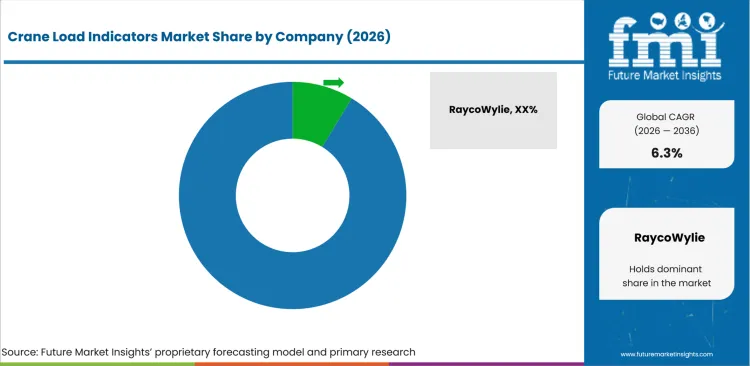
Current smart construction equipment practice makes crane-level integration a more useful competitive test than corporate scale. PALFINGER, Tadano, Manitowoc, Liebherr and Hiab embed load logic in crane platforms sold with wider service networks. Weite Technologies focuses on dedicated overload and load-moment systems while Konecranes addresses industrial modernization. Terex Utilities serves utility lifting with configurable electronic controls and installation support.
- Integrated crane platforms: PALFINGER, Tadano, Manitowoc, Liebherr and Hiab design load logic with the crane control architecture for factory-integrated lifting systems.
- Dedicated and industrial systems: Weite Technologies and Konecranes address overload indication within specialized lifting or plant-crane applications.
- Configurable utility controls: Terex Utilities serves crews that value electronic feedback and adaptable control positions on mobile utility lifting equipment.
Competitive Benchmarking: Crane Load Indicators Market
| Company | Load-Control Integration | Digital Load Visibility | Service & Retrofit Support | Geographic Reach |
|---|---|---|---|---|
| PALFINGER | High | High | High | Global |
| Tadano | High | High | High | Global |
| Manitowoc | High | High | Medium | Global |
| Liebherr | High | Medium | High | Global |
| Hiab | High | Medium | High | Global |
| Weite Technologies | High | High | Medium | Asia and Africa with international project supply |
| Konecranes | High | Medium | High | Global industrial and port markets |
| Terex Utilities | Medium | Medium | Medium | North America |
Scoring basis: High load-control integration requires direct overload or rated-capacity logic in multiple crane uses. Medium requires one documented crane use while Low covers adjacent controls without direct capacity logic. High digital visibility requires real-time load information plus connected data while Medium is limited to local display and Low lacks documented live load-data visibility. High service and retrofit support requires current modernization or field-service evidence covering installed crane fleets. Medium confirms support without broad retrofit proof while Low mainly reflects factory integration.
Key Developments in the Crane Load Indicators Market
- In October 2025, Weite Technologies reported that Saipem Nigeria signed an agreement to purchase a WTAU load moment indicator system for lifting safety applications.
- In January 2025, PALFINGER introduced a tiltable crane fork that integrates with TEC loader-crane overload control and permits only load-moment-reducing movement during overload.
- In March 2026, Liebherr handed over five all-terrain cranes to Bragg Companies at ConExpo with LICCON3 included on two delivered models.
Key Players in the Crane Load Indicators Market
Integrated Crane and Load-Control Platforms
- PALFINGER
- Tadano
- Manitowoc
- Liebherr
- Hiab
Industrial and Dedicated Load-Safety Systems
- Weite Technologies
- Konecranes
Utility Lifting Control Platforms
- Terex Utilities
Crane Load Indicators Market - Report Scope
| Coverage field | Report scope |
|---|---|
| Market breakdown | By system type, crane type, sensor type, end use, sales channel and region. |
| Quantitative Units | USD million. |
| Market Definition | Revenue includes dedicated crane load indication, rated-capacity monitoring, overload protection and integrated safe-load systems within the stated segmentation scope. |
| Regions Covered | North America, Latin America, Western Europe, Eastern Europe, East Asia, South Asia and Pacific, and Middle East and Africa. |
| Countries Covered | UAE, Saudi Arabia, Australia, Brazil, USA, and 25+ countries included in the full report. |
| Key Companies Profiled | PALFINGER, Tadano, Manitowoc, Liebherr, Hiab, Weite Technologies, Konecranes, and Terex Utilities. |
| Forecast Period | 2026 to 2036. |
| Approach | Primary and secondary research with market triangulation. |
Crane Load Indicators Market - Research Methodology
| Method | Approach |
|---|---|
| Primary Research | FMI analysts gathered input from manufacturers, service providers, technology developers, distributors, end users, procurement teams, and subject-matter experts. Interviews examined purchasing decisions, product or service evaluation, adoption barriers, approval requirements, pricing considerations, and expectations for technical or commercial support. Respondents were also asked what evidence is required before a trial, pilot, or initial order develops into regular purchasing. |
| Desk Research | Desk research covered government statistics, regulatory publications, trade data, industry associations, technical literature, standards, company filings, product information, and official corporate announcements. Sources were reviewed for relevance, publication date, geographic coverage, and consistency with the defined market scope. Claims relating to performance, applications, approvals, capacity, investment, and commercial activity were retained only when supported by credible public evidence. |
| Market Sizing and Forecasting | The market model combined the baseline value with historical performance, segment structure, pricing and volume indicators, adoption levels, company participation, and country-level demand conditions. Forecast assumptions considered economic activity, investment trends, regulatory developments, technology adoption, purchasing cycles, supply availability, and barriers to wider market use. Segment and regional estimates were reconciled before the final market total was calculated. |
| Data Validation | Estimates were checked against multiple independent indicators, including public data, company activity, trade patterns, industry developments, and findings from primary interviews. Validation also tested whether products, services, applications, and company revenues fell within the defined market boundaries. Adjacent categories, unsupported claims, overlapping revenues, and activities without direct market relevance were excluded to reduce double counting and maintain consistency across segments and countries. |
Crane Load Indicators Market by Segments
Crane Load Indicators Market segmented by System Type:
- Load Moment Indicators
- Rated Capacity Indicators
- Wireless Load Indicators
- Anti-Two Block Systems
- Integrated Safe Load Systems
Crane Load Indicators Market segmented by Crane Type:
- Mobile Cranes
- Tower Cranes
- Crawler Cranes
- Overhead Cranes
- Marine / Offshore Cranes
Crane Load Indicators Market segmented by Sensor Type:
- Load Pins
- Pressure Transducers
- Tensiometers
- Angle Sensors
- Wireless Dynamometers
Crane Load Indicators Market segmented by End Use:
- Construction
- Ports
- Oil & Gas
- Mining
- Industrial Plants
Crane Load Indicators Market segmented by Sales Channel:
- Crane OEMs
- Retrofit Installers
- Industrial Distributors
- Inspection Service Providers
Crane Load Indicators Market by Region:
- North America
- United States
- Canada
- Latin America
- Brazil
- Mexico
- Argentina
- Chile
- Western Europe
- Germany
- France
- United Kingdom
- Italy
- Spain
- Benelux
- Nordics
- Eastern Europe
- Poland
- Czech Republic
- Romania
- Hungary
- East Asia
- China
- Japan
- South Korea
- South Asia and Pacific
- India
- ASEAN
- Australia and New Zealand
- Middle East and Africa
- GCC Countries
- South Africa
- Türkiye
- Israel
Research Sources and Bibliography
- PALFINGER. (2025, February 23). Major Milestone Achieved: First PFM 2100 Crane Passes FAT.
- Ministry of Land, Infrastructure, Transport and Tourism, Japan. (2025, June 24). Summary of the White Paper on Land, Infrastructure, Transport and Tourism in Japan, 2025.
- PALFINGER. (2026, June 15). PALFINGER Equips Korea’s First Locally Built Crew Transfer Vessel.
- Tadano. (2025, September 22). Tadano Upgrades its Telescopic Boom Crawler Crane Lineup with the New GTC-600-2.
- Manitowoc. (2025, April 7). Potain introduces largest Igo T self-erecting crane at bauma 2025.
- Manitowoc. (2025, November 25). Potain Launches MCR 505 J25 Luffing Jib Tower Crane.
- Konecranes. (2026, May 18). Konecranes to supply 170-tonne crane for Hafslund Kraft's Hemsil 3 hydropower expansion in Norway.
- Liebherr. (2025, July 30). Maximum safety and efficiency for demanding crane applications.
- Terex Utilities. (2025, January 23). New Flex Pro Digger Derrick Controls Provide Powerful Precision.
- UAE Ministry of Economy and Tourism. (2025, September 7). UAE economy records 5.3% growth in non-oil activities.
- General Authority for Statistics, Saudi Arabia. (2025, July 24). GASTAT publishes the Construction Cost Index in the Kingdom for June 2025.
- Australian Bureau of Statistics. (2026, June 24). Engineering Construction Activity, Australia, March 2026.
- Banco Central do Brasil. (2025, March 27). Revision of the 2025 GDP projection.
- USA Bureau of Labor Statistics. (2026, February 20). Employed people by detailed occupation, sex, race, and Hispanic or Latino ethnicity.
- Weite Technologies. (2025, October 27). China's Smart Manufacturing Empowers West African Infrastructure: Saipem Nigeria LTD Signs Contract with WTAU for Load Moment Indicator System.
- PALFINGER. (2025, January 22). Europe-Wide Innovation: The Tiltable Crane Fork by PALFINGER.
- Liebherr. (2026, March 18). Bragg Companies receives handover of five all-terrain cranes at Conexpo 2026.
- Tadano. (2026, March 3). Tadano at ConExpo 2026.
- Konecranes. (2026, May 20). Konecranes delivers automated gantry travel for A-RTGs, enabling mixed-traffic yard operations without redesign.
- Weite Technologies. (2026, March 11). WTAU's WTL-A700 Hydraulic LMI System has been successfully Adapted to a Kobelco RK450 Crane and has received High Praise from Malaysian Client.
- PALFINGER. (2025, May 4). Smart Operations Planning with the PALFINGER Job Planner.
- Hiab. (2025, July 23). Hiab secures a significant frame agreement for loader cranes used in offshore wind parks.
- PALFINGER. (2025, March 10). PALFINGER: Service as the Key for Maximum Performance.
- Tadano. (2025, September 10). Mountain Crane Becomes Tadano Distributor for Pacific Northwest.
- Manitowoc. (2026, March 5). New load management system from Grove allows owners to upgrade older mobile cranes.
- Liebherr. (2025, January 28). Guindastes Tatuapé expands fleet: First LTM 1110-5.2 with LICCON3 in Brazil.
- Hiab. (2026, April 24). Hiab's interim report January-March 2026: Organic orders received increased by 7 percent.
- Weite Technologies. (2025, March 17). Weite's Products Help Dalian HuaRui Large Portal Cranes Operate Safely..
- Konecranes. (2026, July 15). Konecranes to modernize cranes at two AXIA Energia hydropower plants in Brazil.
- Terex Utilities. (2025, June 2). Terex Utilities Announces Expansion of Install Capacity.
This bibliography is provided for reader reference and is not exhaustive. The full report contains the complete reference list and detailed citations.
This Report Answers
- How large is the crane load indicators market in 2026 and 2036?
- Which operating conditions tie overload indication to crane replacement decisions?
- Why do load moment indicators hold the leading position within system type?
- Why do mobile cranes account for the largest crane-type share?
- How do country growth rates differ among the five profiled markets?
- How much value does the market add between 2026 and 2036?
- Which companies supply integrated crane controls or dedicated load-safety systems?
- What slows replacement on cranes with legacy sensors and load charts?
- Which service and retrofit capabilities matter when fleets compare competing systems?
Frequently Asked Questions
How big is the Crane Load Indicators Market in 2026?
The crane load indicators market is valued at USD 860.7 million in 2026 and is projected to reach USD 1,585.6 million by 2036. Growth is tied to overload protection and replacement of aging crane safety electronics in active fleets.
What is the CAGR of the Crane Load Indicators Market from 2026 to 2036?
The crane load indicators market is projected to grow at a CAGR of 6.3% between 2026 and 2036. Expansion is supported by overload-control requirements and replacement of obsolete displays or control units already in service.
Which system type leads the Crane Load Indicators Market?
The load moment indicators segment is expected to hold 31.0% of the crane load indicators market in 2026, driven by configuration-specific capacity calculations for changing radius and geometry. Its control logic gives operators a direct rated-capacity decision as boom geometry changes during active lifting.
Which crane type leads the Crane Load Indicators Market?
The mobile cranes segment is expected to hold 28.0% of the crane load indicators market in 2026, attributable to frequent setup changes that require configuration-specific rated-capacity information. Variable boom and support geometry keeps real-time load-state interpretation central to safe field operation and repeated setup.
Which companies are active in the Crane Load Indicators Market?
Key companies operating in the market include PALFINGER, Tadano, Manitowoc, Liebherr, Hiab, Weite Technologies, Konecranes, and Terex Utilities. These companies compete on load-control integration plus digital visibility and service coverage for new or existing crane fleets.
Preview the report firsthand - request a free sample
Get SampleGet the brochure for pricing and purchase details.
Get PDFTable of Content
- Key Takeaways
- Market Size and CAGR
- Top Growth Driver
- Fastest Growing Segment
- Leading Region
- Key Companies
- Emerging Opportunities
- Executive Summary
- Global Market Outlook
- Demand-side Trends
- Supply-side Trends
- Technology Roadmap Analysis
- Analysis and Recommendations
- Analyst Perspective (What is happening? Why now? What should investors know?)
- Key Questions Answered
- How large is the market?
- What is the CAGR?
- What are key trends?
- Which region dominates?
- Who are the leaders?
- Market Overview
- Market Coverage / Taxonomy
- Market Definition / Scope / Limitations
- Research Methodology
- Chapter Orientation
- Analytical Lens and Working Hypotheses
- Market Structure, Signals, and Trend Drivers
- Benchmarking and Cross-market Comparability
- Market Sizing, Forecasting, and Opportunity Mapping
- Research Design and Evidence Framework
- Desk Research Programme (Secondary Evidence)
- Expert Input and Fieldwork (Primary Evidence)
- Tooling, Models, and Reference Databases
- Data Engineering and Model Build
- Quality Assurance and Audit Trail
- Market Background
- Market Dynamics (Drivers, Restraints, Opportunity, Trends)
- Scenario Forecast (Optimistic, Likely, Conservative)
- Impact Analysis
- AI Impact
- Sustainability Impact
- Regulatory Impact
- Technology Impact
- Consumer / Buyer Analysis
- Purchase Drivers
- Adoption Barriers
- Buyer Journey
- Opportunity Map Analysis
- Product Life Cycle Analysis
- Supply Chain Analysis
- Investment Feasibility Matrix
- Value Chain Analysis
- PESTLE and Porter's Analysis
- Regulatory Landscape
- Regional Parent Market Outlook
- Production and Consumption Statistics
- Import and Export Statistics
- Global Market Analysis and Forecast, 2021 to 2036
- Historical Market Size Value (USD Million) Analysis, 2021 to 2025
- Current and Future Market Size Value (USD Million) Projections, 2026 to 2036
- Y-o-Y Growth Trend Analysis
- Absolute $ Opportunity Analysis
- Global Market Pricing Analysis, 2021 to 2036
- Global Market Analysis and Forecast, By System Type, 2021 to 2036
- Introduction / Key Findings
- Historical Market Size Value (USD Million) Analysis By System Type, 2021 to 2025
- Current and Future Market Size Value (USD Million) Analysis and Forecast By System Type, 2026 to 2036
- Load moment indicators
- Rated capacity indicators
- Wireless load indicators
- Anti-two block systems
- Integrated safe load systems
- Load moment indicators
- Y-o-Y Growth Trend Analysis By System Type, 2021 to 2025
- Absolute $ Opportunity Analysis By System Type, 2026 to 2036
- Global Market Analysis and Forecast, By Crane Type, 2021 to 2036
- Introduction / Key Findings
- Historical Market Size Value (USD Million) Analysis By Crane Type, 2021 to 2025
- Current and Future Market Size Value (USD Million) Analysis and Forecast By Crane Type, 2026 to 2036
- Mobile cranes
- Tower cranes
- Crawler cranes
- Overhead cranes
- Marine / offshore cranes
- Mobile cranes
- Y-o-Y Growth Trend Analysis By Crane Type, 2021 to 2025
- Absolute $ Opportunity Analysis By Crane Type, 2026 to 2036
- Global Market Analysis and Forecast, By Sensor Type, 2021 to 2036
- Introduction / Key Findings
- Historical Market Size Value (USD Million) Analysis By Sensor Type, 2021 to 2025
- Current and Future Market Size Value (USD Million) Analysis and Forecast By Sensor Type, 2026 to 2036
- Load pins
- Pressure transducers
- Tensiometers
- Angle sensors
- Wireless dynamometers
- Load pins
- Y-o-Y Growth Trend Analysis By Sensor Type, 2021 to 2025
- Absolute $ Opportunity Analysis By Sensor Type, 2026 to 2036
- Global Market Analysis and Forecast, By End Use, 2021 to 2036
- Introduction / Key Findings
- Historical Market Size Value (USD Million) Analysis By End Use, 2021 to 2025
- Current and Future Market Size Value (USD Million) Analysis and Forecast By End Use, 2026 to 2036
- Construction
- Ports
- Oil & gas
- Mining
- Industrial plants
- Construction
- Y-o-Y Growth Trend Analysis By End Use, 2021 to 2025
- Absolute $ Opportunity Analysis By End Use, 2026 to 2036
- Global Market Analysis and Forecast, By Sales Channel, 2021 to 2036
- Introduction / Key Findings
- Historical Market Size Value (USD Million) Analysis By Sales Channel, 2021 to 2025
- Current and Future Market Size Value (USD Million) Analysis and Forecast By Sales Channel, 2026 to 2036
- Crane OEMs
- Retrofit installers
- Industrial distributors
- Inspection service providers
- Crane OEMs
- Y-o-Y Growth Trend Analysis By Sales Channel, 2021 to 2025
- Absolute $ Opportunity Analysis By Sales Channel, 2026 to 2036
- Global Market Analysis and Forecast, By Region, 2021 to 2036
- Introduction
- Historical Market Size Value (USD Million) Analysis By Region, 2021 to 2025
- Current Market Size Value (USD Million) Analysis and Forecast By Region, 2026 to 2036
- North America
- Latin America
- Western Europe
- Eastern Europe
- East Asia
- South Asia and Pacific
- Middle East & Africa
- Market Attractiveness Analysis By Region
- North America Market Analysis and Forecast, By Country, 2021 to 2036
- Historical Market Size Value (USD Million) Trend Analysis By Market Taxonomy, 2021 to 2025
- Market Size Value (USD Million) Forecast By Market Taxonomy, 2026 to 2036
- By Country
- USA
- Canada
- By System Type
- By Crane Type
- By Sensor Type
- By End Use
- By Sales Channel
- By Country
- Market Attractiveness Analysis
- By Country
- By System Type
- By Crane Type
- By Sensor Type
- By End Use
- By Sales Channel
- Key Takeaways
- Latin America Market Analysis and Forecast, By Country
- Historical Market Size Value (USD Million) Trend Analysis By Market Taxonomy, 2021 to 2025
- Market Size Value (USD Million) Forecast By Market Taxonomy, 2026 to 2036
- By Country
- Brazil
- Mexico
- Chile
- Rest of Latin America
- By System Type
- By Crane Type
- By Sensor Type
- By End Use
- By Sales Channel
- By Country
- Market Attractiveness Analysis
- By Country
- By System Type
- By Crane Type
- By Sensor Type
- By End Use
- By Sales Channel
- Key Takeaways
- Western Europe Market Analysis and Forecast, By Country
- Historical Market Size Value (USD Million) Trend Analysis By Market Taxonomy, 2021 to 2025
- Market Size Value (USD Million) Forecast By Market Taxonomy, 2026 to 2036
- By Country
- Germany
- UK
- Italy
- Spain
- France
- Nordic
- BENELUX
- Rest of Western Europe
- By System Type
- By Crane Type
- By Sensor Type
- By End Use
- By Sales Channel
- By Country
- Market Attractiveness Analysis
- By Country
- By System Type
- By Crane Type
- By Sensor Type
- By End Use
- By Sales Channel
- Key Takeaways
- Eastern Europe Market Analysis and Forecast, By Country
- Historical Market Size Value (USD Million) Trend Analysis By Market Taxonomy, 2021 to 2025
- Market Size Value (USD Million) Forecast By Market Taxonomy, 2026 to 2036
- By Country
- Russia
- Poland
- Hungary
- Balkan & Baltic
- Rest of Eastern Europe
- By System Type
- By Crane Type
- By Sensor Type
- By End Use
- By Sales Channel
- By Country
- Market Attractiveness Analysis
- By Country
- By System Type
- By Crane Type
- By Sensor Type
- By End Use
- By Sales Channel
- Key Takeaways
- East Asia Market Analysis and Forecast, By Country
- Historical Market Size Value (USD Million) Trend Analysis By Market Taxonomy, 2021 to 2025
- Market Size Value (USD Million) Forecast By Market Taxonomy, 2026 to 2036
- By Country
- China
- Japan
- South Korea
- By System Type
- By Crane Type
- By Sensor Type
- By End Use
- By Sales Channel
- By Country
- Market Attractiveness Analysis
- By Country
- By System Type
- By Crane Type
- By Sensor Type
- By End Use
- By Sales Channel
- Key Takeaways
- South Asia and Pacific Market Analysis and Forecast, By Country
- Historical Market Size Value (USD Million) Trend Analysis By Market Taxonomy, 2021 to 2025
- Market Size Value (USD Million) Forecast By Market Taxonomy, 2026 to 2036
- By Country
- India
- ASEAN
- Australia & New Zealand
- Rest of South Asia and Pacific
- By System Type
- By Crane Type
- By Sensor Type
- By End Use
- By Sales Channel
- By Country
- Market Attractiveness Analysis
- By Country
- By System Type
- By Crane Type
- By Sensor Type
- By End Use
- By Sales Channel
- Key Takeaways
- Middle East & Africa Market Analysis and Forecast, By Country
- Historical Market Size Value (USD Million) Trend Analysis By Market Taxonomy, 2021 to 2025
- Market Size Value (USD Million) Forecast By Market Taxonomy, 2026 to 2036
- By Country
- Kingdom of Saudi Arabia
- Other GCC Countries
- Türkiye
- South Africa
- Other African Union
- Rest of Middle East & Africa
- By System Type
- By Crane Type
- By Sensor Type
- By End Use
- By Sales Channel
- By Country
- Market Attractiveness Analysis
- By Country
- By System Type
- By Crane Type
- By Sensor Type
- By End Use
- By Sales Channel
- Key Takeaways
- Key Countries Market Analysis
- USA
- Pricing Analysis
- Market Share Analysis, 2025
- By System Type
- By Crane Type
- By Sensor Type
- By End Use
- By Sales Channel
- Canada
- Pricing Analysis
- Market Share Analysis, 2025
- By System Type
- By Crane Type
- By Sensor Type
- By End Use
- By Sales Channel
- Mexico
- Pricing Analysis
- Market Share Analysis, 2025
- By System Type
- By Crane Type
- By Sensor Type
- By End Use
- By Sales Channel
- Brazil
- Pricing Analysis
- Market Share Analysis, 2025
- By System Type
- By Crane Type
- By Sensor Type
- By End Use
- By Sales Channel
- Chile
- Pricing Analysis
- Market Share Analysis, 2025
- By System Type
- By Crane Type
- By Sensor Type
- By End Use
- By Sales Channel
- Germany
- Pricing Analysis
- Market Share Analysis, 2025
- By System Type
- By Crane Type
- By Sensor Type
- By End Use
- By Sales Channel
- UK
- Pricing Analysis
- Market Share Analysis, 2025
- By System Type
- By Crane Type
- By Sensor Type
- By End Use
- By Sales Channel
- Italy
- Pricing Analysis
- Market Share Analysis, 2025
- By System Type
- By Crane Type
- By Sensor Type
- By End Use
- By Sales Channel
- Spain
- Pricing Analysis
- Market Share Analysis, 2025
- By System Type
- By Crane Type
- By Sensor Type
- By End Use
- By Sales Channel
- France
- Pricing Analysis
- Market Share Analysis, 2025
- By System Type
- By Crane Type
- By Sensor Type
- By End Use
- By Sales Channel
- India
- Pricing Analysis
- Market Share Analysis, 2025
- By System Type
- By Crane Type
- By Sensor Type
- By End Use
- By Sales Channel
- ASEAN
- Pricing Analysis
- Market Share Analysis, 2025
- By System Type
- By Crane Type
- By Sensor Type
- By End Use
- By Sales Channel
- Australia & New Zealand
- Pricing Analysis
- Market Share Analysis, 2025
- By System Type
- By Crane Type
- By Sensor Type
- By End Use
- By Sales Channel
- China
- Pricing Analysis
- Market Share Analysis, 2025
- By System Type
- By Crane Type
- By Sensor Type
- By End Use
- By Sales Channel
- Japan
- Pricing Analysis
- Market Share Analysis, 2025
- By System Type
- By Crane Type
- By Sensor Type
- By End Use
- By Sales Channel
- South Korea
- Pricing Analysis
- Market Share Analysis, 2025
- By System Type
- By Crane Type
- By Sensor Type
- By End Use
- By Sales Channel
- Russia
- Pricing Analysis
- Market Share Analysis, 2025
- By System Type
- By Crane Type
- By Sensor Type
- By End Use
- By Sales Channel
- Poland
- Pricing Analysis
- Market Share Analysis, 2025
- By System Type
- By Crane Type
- By Sensor Type
- By End Use
- By Sales Channel
- Hungary
- Pricing Analysis
- Market Share Analysis, 2025
- By System Type
- By Crane Type
- By Sensor Type
- By End Use
- By Sales Channel
- Kingdom of Saudi Arabia
- Pricing Analysis
- Market Share Analysis, 2025
- By System Type
- By Crane Type
- By Sensor Type
- By End Use
- By Sales Channel
- Türkiye
- Pricing Analysis
- Market Share Analysis, 2025
- By System Type
- By Crane Type
- By Sensor Type
- By End Use
- By Sales Channel
- South Africa
- Pricing Analysis
- Market Share Analysis, 2025
- By System Type
- By Crane Type
- By Sensor Type
- By End Use
- By Sales Channel
- USA
- Market Structure Analysis
- Competition Dashboard
- Competition Benchmarking
- Market Share Analysis of Top Players
- By Regional
- By System Type
- By Crane Type
- By Sensor Type
- By End Use
- By Sales Channel
- Emerging Startups
- Innovation Benchmarking
- Competition Analysis
- Competition Deep Dive
- RaycoWylie
- Overview
- Product Portfolio
- Profitability by Market Segments
- Sales Footprint
- Strategy Overview
- Marketing Strategy
- Product Strategy
- Channel Strategy
- PAT-Krüger / Hirschmann
- Trimble
- TWG / Greer
- Robway Safety
- Wika Mobile Control
- Load Systems International
- Crane Warning Systems Atlanta
- Weite Technologies
- Scale and Control
- RaycoWylie
- Case Studies
- Success Stories
- Recent Developments
- Competition Deep Dive
- Assumptions & Acronyms Used


