

- Market Size (2026)
- USD 83.6 Mn
- Forecast (2036)
- USD 190.8 Mn
- CAGR (2026 to 2036)
- 8.6%
How big is Cricket Flour Market in 2026?
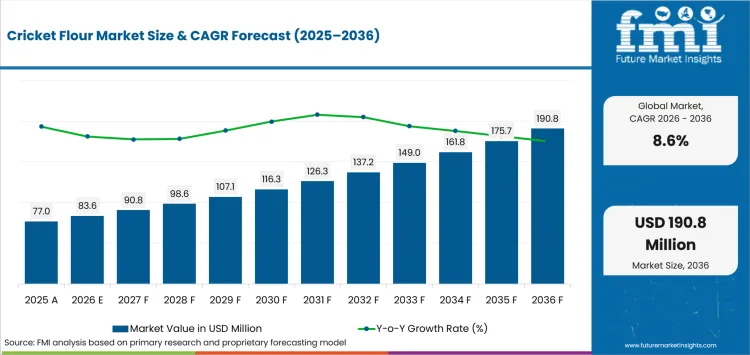
USD 83.6 Million in 2026 and USD 190.8 Million by 2036 at an 8.6% CAGR.
Demand for cricket flour is projected to expand at 8.6% CAGR between 2026 and 2036, increasing valuation from USD 83.6 million in 2026 to USD 190.8 million by 2036. Industrial uptake depends on powders that stay consistent after drying and milling before bakery formulation work begins. A USDA National Institute of Food and Agriculture project reported an active USD 650,000 award in August 2026 for cricket protein powder development. Its work on sensory performance and production cost addresses two conditions that influence whether bakery trials become repeat orders.
Country conversion depends on the local route for registering and moving novel food ingredients rather than protein interest alone. Dubai Municipality cleared 173,775 food shipments during the first half of 2025 and showed the documentation scale imported ingredients must pass. Gulf markets therefore reward local regulatory execution, while South Korea offers a clearer edible-insect ingredient base and Western markets retain stronger consumer-acceptance friction.
Key Takeaways of Cricket Flour Market
- Demand is supported by food manufacturers seeking insect protein differentiation that can pass established bakery handling and food-safety controls.
- In 2026, standard milling grade is expected to lead grade with 38.0% share because broad specifications reduce claim-specific segregation during bakery qualification.
- By form, powder - dry is forecast to represent 41.0% in 2026 driven by storage and metering compatibility with established dry-ingredient systems.
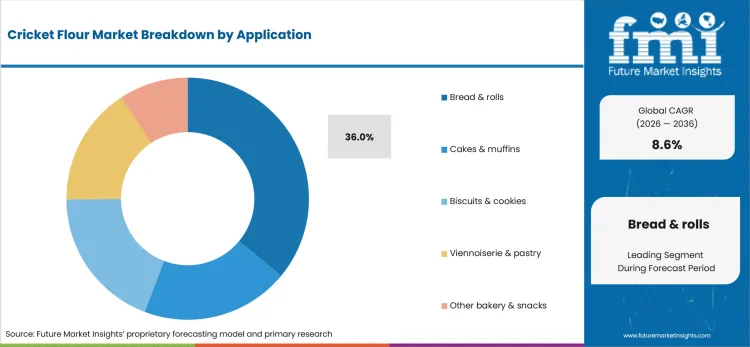
- Bread & rolls are projected to hold 36.0% share in 2026 owing to repeated production cycles that expose hydration and dough-performance variation quickly.
- Sensory hesitation and allergen management can extend qualification cycles even after a cricket ingredient has a legal food-use route.
- Some of the key players in this market include Entomo Farms, Aspire Food Group, Cricket One, Global Bugs Asia, JR Unique Foods, All Things Bugs, Protanica, and Thai Ento Food.
Analyst Perspective
"Cricket flour earns repeat bakery orders when particle size and moisture stay consistent across production lots and flavor remains controlled. Producers that document food-safety controls and help bakeries tune hydration can shorten qualification without weakening allergen or sensory review."
- Nandini Roy Choudhury, Principal Consultant, Future Market Insights
How is the Cricket Flour Market segmented?
The cricket flour market is segmented by grade, form, application, claim, sales channel and region.
Grade covers standard milling grade, fine / patisserie grade, organic certified and identity-preserved specialty products. Form includes powder - dry, liquid, paste / semi-solid and granules / pieces. Applications cover bread & rolls, cakes & muffins, biscuits & cookies, viennoiserie & pastry and other insect-based snacks. Claims include conventional, clean label, organic and non-GMO / identity preserved. Sales channels include direct to industrial bakeries, ingredient distributors, foodservice & artisan supply and online B2B.
How do bread & rolls anchor the application category?
Bread lines expose small changes in water absorption and dough development across repeated bakery production. The Food Standards Agency reported in June 2026 that house cricket products remained in Great Britain under transitional novel-food arrangements while authorisation decisions were pending.
- Bread & rolls are set to lead the application category with 36.0% share in 2026 due to repeated production cycles rewarding consistent hydration performance.
- Industrial bakeries test dough tolerance during scale-up before judging crumb quality and flavor against established recipes. Repeated batches make functional drift commercially visible quickly.
What makes standard milling grade central to the grade category?
Standard milling grade gives bakery formulators a broad specification for initial trials without adding claim-specific segregation during routine product development. South Korea’s Rural Development Administration reported in June 2026 that two-spotted cricket remained among the country’s ten recognized edible insects.
- Based on grade, standard milling grade is projected to account for 38.0% in 2026 due to broad specifications that suit routine bakery qualification.
- Manufacturers can qualify particle size and moisture first. They can then test flavor and microbiological performance before committing to narrower certified grades at commercial scale.
Why does powder - dry lead the form category?
Dry powder fits flour receiving and metering systems already used across industrial bakery plants. FDA’s August 2026 Import Alert 99-43 includes milled edible insect products and edible insect bakery products under Salmonella-related detention controls. The controls apply during recurring commercial formulation trials.
- By form, powder - dry is estimated to hold 41.0% in 2026 owing to straightforward storage and repeatable dosing across existing dry-ingredient systems.
- Bakeries can preblend powder with dry components before line testing. Liquid and paste formats require different shelf-life and handling controls during routine production at scale.
What drives direct to industrial bakeries within the sales channel category?
Direct technical selling gives cricket flour producers immediate formulation feedback before a bakery commits recurring commercial volume. Dubai Municipality reported in February 2025 that it inspected 461,875 food containers during 2024. The figure shows the regulatory workload facing import teams before unfamiliar ingredients reach commercial users.
- The direct to industrial bakeries segment is likely to capture 48.0% share in 2026 attributable to direct formulation and quality coordination.
- Direct accounts resolve specifications and labeling questions during scale-up. Distributors remain practical for smaller customers that need local inventory and regulatory support.
What are the drivers, restraints and opportunities in the Cricket Flour Market?
Defined food-use pathways support evaluation while sensory and food-safety risks slow conversion. Regulatory guidance can reduce rework during qualification.
- Driver: Clearer novel-food procedures give food developers a defined approval route before they commit formulation budgets to cricket-derived ingredients.
- Restraint: Allergen risk and microbiological control increase qualification work before a bakery can approve cricket flour for recurring commercial production.
- Opportunity: Producers that align regulatory dossiers with application data can answer compliance and formulation questions within the same commercial trial program.
Regulatory Clarity Narrows the First Approval Question
Clear novel-food rules reduce wasted formulation work by showing companies which evidence is required before commercial launch. In December 2025 SFDA said it was building an integrated novel-food regulatory framework with clearer pathways. Earlier screening lets cricket flour producers focus technical work on recipes that have a viable approval route.
Food-Safety and Sensory Risk Extend Qualification
Cricket flour requires food-safety and sensory checks alongside normal bakery qualification before production can move into recurring commercial orders. The Food Standards Agency reported in June 2026 that edible insects require allergen information and hygiene controls because cross-reactivity remains a relevant risk. Producers therefore need clear labels and validated microbiological controls before repeat orders.
Application Support Can Convert Trials into Recurring Supply
Application support reduces the work between sample receipt and approved commercial use across recurring industrial bakery programs. The Food Standards Agency launched its Innovative Food Guidance Hub in June 2026 with market-authorisation support that includes edible insects. Producers that align regulatory dossiers with formulation data can address compliance and bakery questions during the same qualification cycle.
Which country CAGRs are profiled in the Cricket Flour Market?
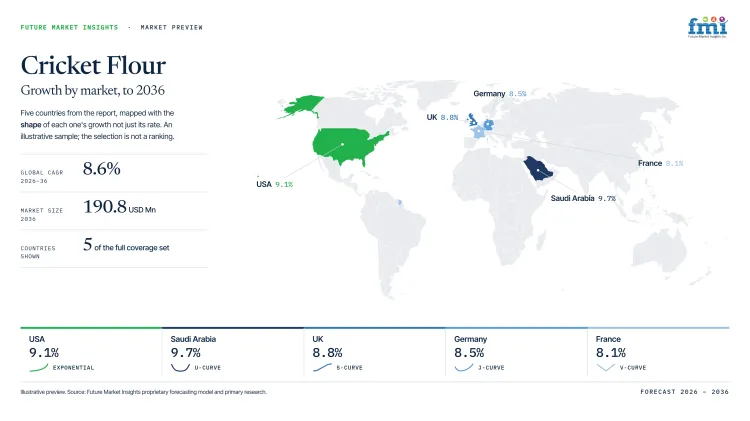
| Country | CAGR |
|---|---|
| UAE | 10.1% |
| Saudi Arabia | 9.7% |
| South Korea | 9.4% |
| USA | 9.1% |
| UK | 8.8% |
How do country-level CAGRs compare in the Cricket Flour Market?
The country spread is 1.3 percentage points from the UAE at 10.1% to the UK at 8.8%. Gulf markets form the upper group as import registration affects entry speed. South Korea and the USA occupy the middle range while UK growth depends more directly on changing authorisation rules.
- The UAE rewards registration expertise that keeps imported trials moving through high-volume clearance.
- Saudi Arabia places dossier quality early because novel imports face active enforcement.
- South Korea gives recognized cricket ingredients a clearer route into local food trials.
- USA bakery channels support trials but Salmonella controls extend specialty-ingredient review.
- UK bakery ingredients can require product-file revisions before edible-insect launches.
Similar CAGRs therefore mask different compliance costs and approval routes. The full report provides country-level CAGR analysis across North America, Latin America, Europe, East Asia, South Asia, Oceania and the Middle East and Africa.
Country-wise Analysis
- Dubai’s imported-food system gives cricket flour producers access to dense hospitality and manufacturing accounts while product registration still controls trial speed across major commercial channels serving imported food programs. Dubai Municipality reported in January 2026 that it inspected 579,913 food consignments containing about 1.95 million products during 2025 and showed the operating scale local import-control systems must absorb. Cricket flour demand in the UAE is forecast to rise at 10.1% CAGR through 2036 because experienced distributors can move samples into bakery trials quickly, but producers need complete registration records and stable specifications before those trials become recurring commercial orders.
- Imported novel ingredients enter an approval-led commercial sequence because distributors need complete technical files before broad bakery account development becomes economical across recurring industrial food programs and large national bakery accounts. Cricket flour demand in Saudi Arabia is projected to record 9.7% CAGR during the assessment period, supported by specialist import channels that understand food-clearance requirements and local documentation routines. SFDA reported 17,096 inspection visits in the second quarter of 2026 plus more than 301 tonnes of intercepted non-compliant food products and these enforcement volumes make early dossier review critical before bakery trial budgets are committed.
- Food developers work from an established edible-insect base that lowers the first classification barrier for cricket powder in bakery and snack applications across domestic food programs. The Rural Development Administration selected the consumer-facing name Power Protein-I for insect protein in December 2025 after preference research, yet consumer framing still affects how unfamiliar ingredients move beyond specialist nutrition products. South Korea is estimated to post 9.4% CAGR over the forecast period because recognized insect ingredients give formulators a clearer starting point for testing, while producers that localize flavor and familiar home baking formats have a better route into repeat mainstream retail orders.
- Industrial bakeries offer deep formulation capacity while cricket powder still enters quality review as a specialty ingredient that requires stable microbiological and lot-performance records across commercial production runs. The Food and Drug Administration’s August 2026 Import Alert 99-43 includes milled edible insect products and edible insect bakery products within Salmonella-related detention controls, reinforcing the need for documented process hygiene. Demand for cricket flour in the USA is forecast to expand at 9.1% CAGR by 2036 because established bakery development channels support repeated trials, but companies with inconsistent specifications face longer approval cycles and greater sensory risk during commercial scale-up.
- British product developers can work with established food-innovation channels but commercial planning now needs to account for another change in novel-food rules affecting edible-insect portfolios and national launch calendars. Adoption of cricket flour in the UK is estimated to expand at 8.8% CAGR through 2036 because controlled bakery trials can proceed before wider national distribution. UK government guidance updated in July 2026 says Great Britain intends to align certain food rules with the EU from mid-2027, so producers need to track authorisation status and adjust product files early enough to avoid stranded inventory or delayed major national retail launches.
Who are the notable companies in the Cricket Flour Market?
Entomo Farms, Aspire Food Group, Cricket One, Global Bugs Asia, JR Unique Foods, All Things Bugs, Protanica, and Thai Ento Food are the notable companies profiled in this market.
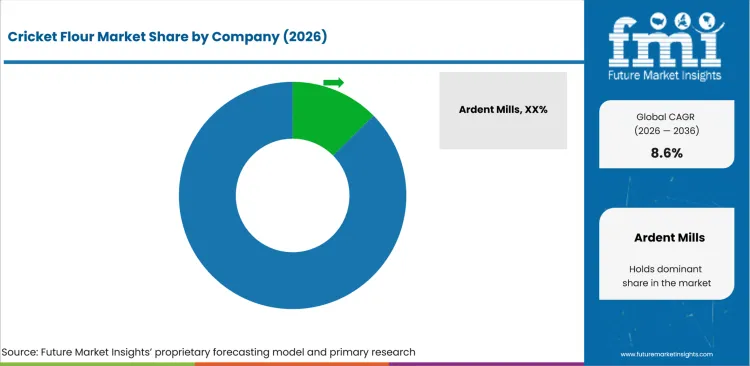
Cricket flour competition remains fragmented across farm-integrated producers and ingredient processors that differ in their control of rearing, milling and customer qualification. Entry barriers arise from food-safety documentation and repeatable powder specifications rather than corporate scale alone. Farm-integrated producers can control species and feed inputs closely. Application specialists can shorten formulation work by supplying stable specifications and technical support.
- Entomo Farms and Aspire Food Group bring vertically integrated cricket production with North American processing capacity.
- Cricket One, Global Bugs Asia and JR Unique Foods operate export-oriented cricket processing networks with documented food-safety controls across Asian production bases.
- All Things Bugs, Protanica and Thai Ento Food focus on ingredient processing and customer-specific formulation support for food manufacturers.
Competitive Benchmarking: Cricket Flour Market
| Company | Production Control | Food-Safety & Quality Systems | Application & Customer Support | Geographic Reach |
|---|---|---|---|---|
| Entomo Farms | High | High | Medium | North America and export markets |
| Aspire Food Group | High | Medium | Medium | Canada and North America |
| Cricket One | High | High | High | Asia, Europe and North America |
| Global Bugs Asia | Medium | High | Medium | Asia and international markets |
| JR Unique Foods | Medium | High | Medium | Thailand and international markets |
| All Things Bugs | Medium | Medium | High | United States and international B2B |
| Protanica | Medium | High | High | Thailand and international OEM markets |
| Thai Ento Food | Medium | High | High | Thailand and international markets |
Key Developments in the Cricket Flour Market
- In September 2025, Aspire Food Group moved to new ownership after an Ontario court approved an asset purchase agreement with Halali Group Holdings and issued a vesting order.
- In March 2025, Altimate Nutrition launched its first two cricket-protein bar flavours in Singapore and prepared retailer distribution for the new range.
- In September 2025, Entomo Farms restored its 113-gram cricket powder to Amazon in Canada and the USA after a period of limited marketplace availability.
Key Players in the Cricket Flour Market
Integrated Cricket Farming and Processing
- Entomo Farms
- Aspire Food Group
- Cricket One
Export-Oriented Cricket Ingredient Producers
- Global Bugs Asia
- JR Unique Foods
Application and OEM Specialists
- All Things Bugs
- Protanica
- Thai Ento Food
Cricket Flour Market - Report Scope
| Coverage field | Report scope |
|---|---|
| Market breakdown | By grade, form, application, claim, sales channel and region. |
| Quantitative Units | Revenue in USD million and CAGR in %. |
| Market Definition | Revenue from cricket-derived ingredient powders within the defined taxonomy. Finished foods, whole insects, grain flours, plant proteins and non-cricket insect meals are excluded. |
| Regions Covered | North America, Latin America, Western Europe, Eastern Europe, East Asia, South Asia and Pacific and Middle East and Africa. |
| Countries Covered | UAE, Saudi Arabia, South Korea, USA, UK, and 20+ countries included in the full report. |
| Key Companies Profiled | Entomo Farms, Aspire Food Group, Cricket One, Global Bugs Asia, JR Unique Foods, All Things Bugs, Protanica, and Thai Ento Food. |
| Forecast Period | 2026 to 2036. |
| Approach | Primary and secondary research with market triangulation. |
Cricket Flour Market - Research Methodology
| Method | Approach |
|---|---|
| Primary Research | FMI analysts gathered input from manufacturers, service providers, technology developers, distributors, end users, procurement teams, and subject-matter experts. Interviews examined purchasing decisions, product or service evaluation, adoption barriers, approval requirements, pricing considerations, and expectations for technical or commercial support. Respondents were also asked what evidence is required before a trial, pilot, or initial order develops into regular purchasing. |
| Desk Research | Desk research covered government statistics, regulatory publications, trade data, industry associations, technical literature, standards, company filings, product information, and official corporate announcements. Sources were reviewed for relevance, publication date, geographic coverage, and consistency with the defined market scope. Claims relating to performance, applications, approvals, capacity, investment, and commercial activity were retained only when supported by credible public evidence. |
| Market Sizing and Forecasting | The market model combined the baseline value with historical performance, segment structure, pricing and volume indicators, adoption levels, company participation, and country-level demand conditions. Forecast assumptions considered economic activity, investment trends, regulatory developments, technology adoption, purchasing cycles, supply availability, and barriers to wider market use. Segment and regional estimates were reconciled before the final market total was calculated. |
| Data Validation | Estimates were checked against multiple independent indicators, including public data, company activity, trade patterns, industry developments, and findings from primary interviews. Validation also tested whether products, services, applications, and company revenues fell within the defined market boundaries. Adjacent categories, unsupported claims, overlapping revenues, and activities without direct market relevance were excluded to reduce double counting and maintain consistency across segments and countries. |
Cricket Flour Market by Segments
Cricket Flour Market segmented by Grade:
- Standard milling grade
- Fine / patisserie grade
- Organic certified
- Identity-preserved specialty
Cricket Flour Market segmented by Form:
- Powder - dry
- Liquid
- Paste / semi-solid
- Granules / pieces
Cricket Flour Market segmented by Application:
- Bread & rolls
- Cakes & muffins
- Biscuits & cookies
- Viennoiserie & pastry
- Other bakery & snacks
Cricket Flour Market segmented by Claim:
- Conventional
- Clean label
- Organic
- Non-GMO / identity preserved
Cricket Flour Market segmented by Sales Channel:
- Direct to industrial bakeries
- Ingredient distributors
- Foodservice & artisan supply
- Online B2B
Cricket Flour Market by Region:
- North America
- United States
- Canada
- Latin America
- Brazil
- Mexico
- Argentina
- Chile
- Western Europe
- Germany
- France
- United Kingdom
- Italy
- Spain
- Benelux
- Nordics
- Eastern Europe
- Poland
- Czech Republic
- Romania
- Hungary
- East Asia
- China
- Japan
- South Korea
- South Asia and Pacific
- India
- ASEAN
- Australia and New Zealand
- Middle East and Africa
- GCC Countries
- South Africa
- Türkiye
- Israel
Research Sources and Bibliography
- USA Department of Agriculture, National Institute of Food and Agriculture. (2026, August 17). Developing Pre-Consumer Waste as Low-Cost Cricket Feed for Small Farming Operations
- Dubai Municipality. (2025, July 30). Over 34,000 food inspections conducted in first half of 2025
- Rural Development Administration. (2026, June 4). 농촌진흥청-식품의약품안전처, 풀무치 10번째 식용곤충 등재
- Food Standards Agency. (2026, June 25). Top emerging UK food innovations: 2025-2035
- Dubai Municipality. (2025, February 17). Latest digital food safety services showcased at Gulfood 2025
- Saudi Food and Drug Authority. (2025, December 22). SFDA Drives Food Innovation and Biotechnology Advancement in Saudi Arabia
- Food Standards Agency. (2026, June 25). Thematic report on emerging food innovations in the UK
- Food Standards Agency. (2026, June 25). Innovative Food Guidance Hub
- Dubai Municipality. (2026, January 26). Innovative digital food safety services at Gulfood 2026
- Saudi Food and Drug Authority. (2026, July 23). SFDA Intercepts Over 301 Tons of Non-Compliant Food Products in Q2 2026
- Rural Development Administration. (2025, December 8). ‘곤충단백질’ 새 이름 ‘파워프로틴-아이(I)’ 선정
- USA Food and Drug Administration. (2026, August 6). Import Alert 99-43
- Department for Environment, Food & Rural Affairs. (2026, July 30). Food manufacturing, processing and standards: preparing your business
- Entomo Farms. (2025, April). April 2025
- Aspire Food Group. (n.d.). Cricket Protein Farming For Cricket Powder Production Retrieved August 17, 2026.
- Cricket One. (n.d.). Home Retrieved August 17, 2026.
- Global Bugs Asia. (n.d.). Global Bugs Retrieved August 17, 2026.
- JR Unique Foods Ltd. (n.d.). Your trusted source of cricket powder and edible insects Retrieved August 17, 2026.
- All Things Bugs LLC. (n.d.). All Things Bugs Retrieved August 17, 2026.
- Protanica. (n.d.). Cricket Protein Ingredients & OEM Solutions Retrieved August 17, 2026.
- Thai Ento Food. (n.d.). Company Retrieved August 17, 2026.
- FTI Consulting Canada Inc. (2025, September 23). Aspire Food Group Limited - Court Orders
- Entomo Farms. (2025, September). September 2025
- Entomo Farms. (2025, May). May 2025
- Intellectual Property Office of Singapore. (2025, March 25). Altimate Nutrition
This bibliography is provided for reader reference and is not exhaustive. The full report contains the complete reference list and detailed citations
This Report Answers
- What is the cricket flour market size in 2026 and what value is forecast for 2036?
- Which regulatory and technical conditions are converting cricket powder trials into recurring industrial orders?
- Why does standard milling grade hold the leading position within the grade category?
- How does powder - dry form influence dosing, storage and downstream bakery formulation?
- Why do bread & rolls hold the leading position within the application category?
- How do growth rates differ across UAE, Saudi Arabia, South Korea, USA and UK?
- Which operating factors separate the eight profiled cricket flour companies?
- What limits adoption when sensory response, allergen control and food-safety testing remain unresolved?
- What should industrial bakeries evaluate before approving cricket flour for recurring use?
Frequently Asked Questions
How big is the Cricket Flour Market in 2026?
The cricket flour market is expected to be valued at USD 83.6 million in 2026. Demand depends on producers delivering repeatable food-grade powder that can pass bakery formulation and safety qualification.
What is the CAGR of the Cricket Flour Market from 2026 to 2036?
The cricket flour market is projected to grow at 8.6% CAGR between 2026 and 2036. Regulatory clarity supports expansion while sensory acceptance and allergen management keep commercial qualification selective.
Which grade leads the Cricket Flour Market?
The standard milling grade segment is expected to hold 38.0% of the cricket flour market in 2026, supported by broad industrial usability. Lower claim-specific controls make this grade practical for commercial bakery qualification work.
Which sales channel holds the largest share of the Cricket Flour Market?
The direct to industrial bakeries segment is forecast to hold 48.0% of the cricket flour market in 2026, supported by close formulation and quality coordination. Direct account work helps resolve specifications and labeling questions during scale-up.
Which companies are active in the Cricket Flour Market?
Key companies in the cricket flour market include Entomo Farms, Aspire Food Group, Cricket One, Global Bugs Asia, JR Unique Foods, All Things Bugs, Protanica and Thai Ento Food. They differ in farming control plus food-safety systems and bakery application support.
Preview the report firsthand - request a free sample
Get SampleGet the brochure for pricing and purchase details.
Get PDFTable of Content
- Key Takeaways
- Market Size and CAGR
- Top Growth Driver
- Fastest Growing Segment
- Leading Region
- Key Companies
- Emerging Opportunities
- Executive Summary
- Global Market Outlook
- Demand-side Trends
- Supply-side Trends
- Technology Roadmap Analysis
- Analysis and Recommendations
- Analyst Perspective (What is happening? Why now? What should investors know?)
- Key Questions Answered
- How large is the market?
- What is the CAGR?
- What are key trends?
- Which region dominates?
- Who are the leaders?
- Market Overview
- Market Coverage / Taxonomy
- Market Definition / Scope / Limitations
- Research Methodology
- Chapter Orientation
- Analytical Lens and Working Hypotheses
- Market Structure, Signals, and Trend Drivers
- Benchmarking and Cross-market Comparability
- Market Sizing, Forecasting, and Opportunity Mapping
- Research Design and Evidence Framework
- Desk Research Programme (Secondary Evidence)
- Expert Input and Fieldwork (Primary Evidence)
- Tooling, Models, and Reference Databases
- Data Engineering and Model Build
- Quality Assurance and Audit Trail
- Market Background
- Market Dynamics (Drivers, Restraints, Opportunity, Trends)
- Scenario Forecast (Optimistic, Likely, Conservative)
- Impact Analysis
- AI Impact
- Sustainability Impact
- Regulatory Impact
- Technology Impact
- Consumer / Buyer Analysis
- Purchase Drivers
- Adoption Barriers
- Buyer Journey
- Opportunity Map Analysis
- Product Life Cycle Analysis
- Supply Chain Analysis
- Investment Feasibility Matrix
- Value Chain Analysis
- PESTLE and Porter's Analysis
- Regulatory Landscape
- Regional Parent Market Outlook
- Production and Consumption Statistics
- Import and Export Statistics
- Global Market Analysis and Forecast, 2021 to 2036
- Historical Market Size Value (USD Million) Analysis, 2021 to 2025
- Current and Future Market Size Value (USD Million) Projections, 2026 to 2036
- Y-o-Y Growth Trend Analysis
- Absolute $ Opportunity Analysis
- Global Market Pricing Analysis, 2021 to 2036
- Global Market Analysis and Forecast, By Grade, 2021 to 2036
- Introduction / Key Findings
- Historical Market Size Value (USD Million) Analysis By Grade, 2021 to 2025
- Current and Future Market Size Value (USD Million) Analysis and Forecast By Grade, 2026 to 2036
- Standard milling grade
- Fine / patisserie grade
- Organic certified
- Identity-preserved specialty
- Standard milling grade
- Y-o-Y Growth Trend Analysis By Grade, 2021 to 2025
- Absolute $ Opportunity Analysis By Grade, 2026 to 2036
- Global Market Analysis and Forecast, By Form, 2021 to 2036
- Introduction / Key Findings
- Historical Market Size Value (USD Million) Analysis By Form, 2021 to 2025
- Current and Future Market Size Value (USD Million) Analysis and Forecast By Form, 2026 to 2036
- Powder / dry
- Liquid
- Paste / semi-solid
- Granules / pieces
- Powder / dry
- Y-o-Y Growth Trend Analysis By Form, 2021 to 2025
- Absolute $ Opportunity Analysis By Form, 2026 to 2036
- Global Market Analysis and Forecast, By Application, 2021 to 2036
- Introduction / Key Findings
- Historical Market Size Value (USD Million) Analysis By Application, 2021 to 2025
- Current and Future Market Size Value (USD Million) Analysis and Forecast By Application, 2026 to 2036
- Bread & rolls
- Cakes & muffins
- Biscuits & cookies
- Viennoiserie & pastry
- Other bakery & snacks
- Bread & rolls
- Y-o-Y Growth Trend Analysis By Application, 2021 to 2025
- Absolute $ Opportunity Analysis By Application, 2026 to 2036
- Global Market Analysis and Forecast, By Claim, 2021 to 2036
- Introduction / Key Findings
- Historical Market Size Value (USD Million) Analysis By Claim, 2021 to 2025
- Current and Future Market Size Value (USD Million) Analysis and Forecast By Claim, 2026 to 2036
- Conventional
- Clean label
- Organic
- Non-GMO / identity preserved
- Conventional
- Y-o-Y Growth Trend Analysis By Claim, 2021 to 2025
- Absolute $ Opportunity Analysis By Claim, 2026 to 2036
- Global Market Analysis and Forecast, By Sales Channel, 2021 to 2036
- Introduction / Key Findings
- Historical Market Size Value (USD Million) Analysis By Sales Channel, 2021 to 2025
- Current and Future Market Size Value (USD Million) Analysis and Forecast By Sales Channel, 2026 to 2036
- Direct to industrial bakeries
- Ingredient distributors
- Foodservice & artisan supply
- Online B2B
- Direct to industrial bakeries
- Y-o-Y Growth Trend Analysis By Sales Channel, 2021 to 2025
- Absolute $ Opportunity Analysis By Sales Channel, 2026 to 2036
- Global Market Analysis and Forecast, By Region, 2021 to 2036
- Introduction
- Historical Market Size Value (USD Million) Analysis By Region, 2021 to 2025
- Current Market Size Value (USD Million) Analysis and Forecast By Region, 2026 to 2036
- North America
- Latin America
- Western Europe
- Eastern Europe
- East Asia
- South Asia and Pacific
- Middle East & Africa
- Market Attractiveness Analysis By Region
- North America Market Analysis and Forecast, By Country, 2021 to 2036
- Historical Market Size Value (USD Million) Trend Analysis By Market Taxonomy, 2021 to 2025
- Market Size Value (USD Million) Forecast By Market Taxonomy, 2026 to 2036
- By Country
- USA
- Canada
- By Grade
- By Form
- By Application
- By Claim
- By Sales Channel
- By Country
- Market Attractiveness Analysis
- By Country
- By Grade
- By Form
- By Application
- By Claim
- By Sales Channel
- Key Takeaways
- Latin America Market Analysis and Forecast, By Country
- Historical Market Size Value (USD Million) Trend Analysis By Market Taxonomy, 2021 to 2025
- Market Size Value (USD Million) Forecast By Market Taxonomy, 2026 to 2036
- By Country
- Brazil
- Mexico
- Chile
- Rest of Latin America
- By Grade
- By Form
- By Application
- By Claim
- By Sales Channel
- By Country
- Market Attractiveness Analysis
- By Country
- By Grade
- By Form
- By Application
- By Claim
- By Sales Channel
- Key Takeaways
- Western Europe Market Analysis and Forecast, By Country
- Historical Market Size Value (USD Million) Trend Analysis By Market Taxonomy, 2021 to 2025
- Market Size Value (USD Million) Forecast By Market Taxonomy, 2026 to 2036
- By Country
- Germany
- UK
- Italy
- Spain
- France
- Nordic
- BENELUX
- Rest of Western Europe
- By Grade
- By Form
- By Application
- By Claim
- By Sales Channel
- By Country
- Market Attractiveness Analysis
- By Country
- By Grade
- By Form
- By Application
- By Claim
- By Sales Channel
- Key Takeaways
- Eastern Europe Market Analysis and Forecast, By Country
- Historical Market Size Value (USD Million) Trend Analysis By Market Taxonomy, 2021 to 2025
- Market Size Value (USD Million) Forecast By Market Taxonomy, 2026 to 2036
- By Country
- Russia
- Poland
- Hungary
- Balkan & Baltic
- Rest of Eastern Europe
- By Grade
- By Form
- By Application
- By Claim
- By Sales Channel
- By Country
- Market Attractiveness Analysis
- By Country
- By Grade
- By Form
- By Application
- By Claim
- By Sales Channel
- Key Takeaways
- East Asia Market Analysis and Forecast, By Country
- Historical Market Size Value (USD Million) Trend Analysis By Market Taxonomy, 2021 to 2025
- Market Size Value (USD Million) Forecast By Market Taxonomy, 2026 to 2036
- By Country
- China
- Japan
- South Korea
- By Grade
- By Form
- By Application
- By Claim
- By Sales Channel
- By Country
- Market Attractiveness Analysis
- By Country
- By Grade
- By Form
- By Application
- By Claim
- By Sales Channel
- Key Takeaways
- South Asia and Pacific Market Analysis and Forecast, By Country
- Historical Market Size Value (USD Million) Trend Analysis By Market Taxonomy, 2021 to 2025
- Market Size Value (USD Million) Forecast By Market Taxonomy, 2026 to 2036
- By Country
- India
- ASEAN
- Australia & New Zealand
- Rest of South Asia and Pacific
- By Grade
- By Form
- By Application
- By Claim
- By Sales Channel
- By Country
- Market Attractiveness Analysis
- By Country
- By Grade
- By Form
- By Application
- By Claim
- By Sales Channel
- Key Takeaways
- Middle East & Africa Market Analysis and Forecast, By Country
- Historical Market Size Value (USD Million) Trend Analysis By Market Taxonomy, 2021 to 2025
- Market Size Value (USD Million) Forecast By Market Taxonomy, 2026 to 2036
- By Country
- Kingdom of Saudi Arabia
- Other GCC Countries
- Türkiye
- South Africa
- Other African Union
- Rest of Middle East & Africa
- By Grade
- By Form
- By Application
- By Claim
- By Sales Channel
- By Country
- Market Attractiveness Analysis
- By Country
- By Grade
- By Form
- By Application
- By Claim
- By Sales Channel
- Key Takeaways
- Key Countries Market Analysis
- USA
- Pricing Analysis
- Market Share Analysis, 2025
- By Grade
- By Form
- By Application
- By Claim
- By Sales Channel
- Canada
- Pricing Analysis
- Market Share Analysis, 2025
- By Grade
- By Form
- By Application
- By Claim
- By Sales Channel
- Mexico
- Pricing Analysis
- Market Share Analysis, 2025
- By Grade
- By Form
- By Application
- By Claim
- By Sales Channel
- Brazil
- Pricing Analysis
- Market Share Analysis, 2025
- By Grade
- By Form
- By Application
- By Claim
- By Sales Channel
- Chile
- Pricing Analysis
- Market Share Analysis, 2025
- By Grade
- By Form
- By Application
- By Claim
- By Sales Channel
- Germany
- Pricing Analysis
- Market Share Analysis, 2025
- By Grade
- By Form
- By Application
- By Claim
- By Sales Channel
- UK
- Pricing Analysis
- Market Share Analysis, 2025
- By Grade
- By Form
- By Application
- By Claim
- By Sales Channel
- Italy
- Pricing Analysis
- Market Share Analysis, 2025
- By Grade
- By Form
- By Application
- By Claim
- By Sales Channel
- Spain
- Pricing Analysis
- Market Share Analysis, 2025
- By Grade
- By Form
- By Application
- By Claim
- By Sales Channel
- France
- Pricing Analysis
- Market Share Analysis, 2025
- By Grade
- By Form
- By Application
- By Claim
- By Sales Channel
- India
- Pricing Analysis
- Market Share Analysis, 2025
- By Grade
- By Form
- By Application
- By Claim
- By Sales Channel
- ASEAN
- Pricing Analysis
- Market Share Analysis, 2025
- By Grade
- By Form
- By Application
- By Claim
- By Sales Channel
- Australia & New Zealand
- Pricing Analysis
- Market Share Analysis, 2025
- By Grade
- By Form
- By Application
- By Claim
- By Sales Channel
- China
- Pricing Analysis
- Market Share Analysis, 2025
- By Grade
- By Form
- By Application
- By Claim
- By Sales Channel
- Japan
- Pricing Analysis
- Market Share Analysis, 2025
- By Grade
- By Form
- By Application
- By Claim
- By Sales Channel
- South Korea
- Pricing Analysis
- Market Share Analysis, 2025
- By Grade
- By Form
- By Application
- By Claim
- By Sales Channel
- Russia
- Pricing Analysis
- Market Share Analysis, 2025
- By Grade
- By Form
- By Application
- By Claim
- By Sales Channel
- Poland
- Pricing Analysis
- Market Share Analysis, 2025
- By Grade
- By Form
- By Application
- By Claim
- By Sales Channel
- Hungary
- Pricing Analysis
- Market Share Analysis, 2025
- By Grade
- By Form
- By Application
- By Claim
- By Sales Channel
- Kingdom of Saudi Arabia
- Pricing Analysis
- Market Share Analysis, 2025
- By Grade
- By Form
- By Application
- By Claim
- By Sales Channel
- Türkiye
- Pricing Analysis
- Market Share Analysis, 2025
- By Grade
- By Form
- By Application
- By Claim
- By Sales Channel
- South Africa
- Pricing Analysis
- Market Share Analysis, 2025
- By Grade
- By Form
- By Application
- By Claim
- By Sales Channel
- USA
- Market Structure Analysis
- Competition Dashboard
- Competition Benchmarking
- Market Share Analysis of Top Players
- By Regional
- By Grade
- By Form
- By Application
- By Claim
- By Sales Channel
- Emerging Startups
- Innovation Benchmarking
- Competition Analysis
- Competition Deep Dive
- Ardent Mills
- Overview
- Product Portfolio
- Profitability by Market Segments
- Sales Footprint
- Strategy Overview
- Marketing Strategy
- Product Strategy
- Channel Strategy
- ADM
- Bay State Milling
- Limagrain Ingredients
- GoodMills Group
- King Arthur Baking
- Bob's Red Mill
- Doves Farm
- Manildra Group
- Scoular
- Ardent Mills
- Case Studies
- Success Stories
- Recent Developments
- Competition Deep Dive
- Assumptions & Acronyms Used


