

- Market Size (2026)
- USD 4.9 Bn
- Forecast (2036)
- USD 9.8 Bn
- CAGR (2026 to 2036)
- 7.2%
How big is Critical Limb Ischemia Treatment Market in 2026?
USD 4.9 billion in 2026 and USD 9.8 billion by 2036 at a 7.2% CAGR.
Critical limb ischemia treatment demand is projected to expand at 7.2% CAGR through 2036, increasing valuation from USD 4.9 billion in 2026 to USD 9.8 billion by 2036. Clinical demand for revascularization procedures remains a key driver of investment in critical limb ischemia treatment technologies. The National Vascular Registry reported 16,618 lower-limb revascularizations across United Kingdom hospitals in November 2025 based on procedures completed during 2024. That treated population shows why endovascular therapy devices require reliable referral and outcome tracking across complex ischemic cases. Hospital spending becomes defensible through sustained perfusion and wound healing instead of procedure counts that do not show durable limb preservation.
Treatment choice changes with lesion location and calcification plus wound status and surgical risk across each patient pathway. The American Heart Association explained in February 2025 that peripheral artery disease pain and clinical risk profiles vary across the disease spectrum. The statement supports treatment assessment that separates ischemic rest pain from other pain patterns ahead of revascularization planning. Chronic wound care remains essential because restored blood flow does not resolve infection or tissue loss without continued surveillance. The commercial pathway therefore joins vascular intervention with wound follow-up and clearly assigns responsibility for recurring clinical complications across the complete recovery period.
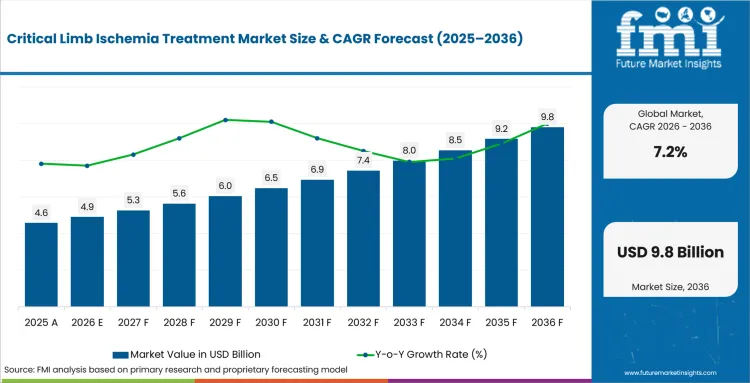
Key Takeaways of Critical Limb Ischemia Treatment Market
- Severe peripheral artery disease and diabetic tissue loss create recurring need for urgent perfusion assessment across coordinated limb-salvage pathways.
- Endovascular therapy is projected to hold 41.0% share in 2026, supported by catheter-based access across patients whose anatomy permits minimally invasive revascularization.
- Peripheral artery disease is estimated to account for 44.0% by application in 2026, reflecting its direct relationship with ischemic rest pain and tissue loss.
- Hospitals are forecast to represent 46.0% share in 2026, underpinned by multidisciplinary staff and complex intervention infrastructure across limb-salvage programs.
- Delayed referral and calcified below-the-knee anatomy reduce salvage potential through narrower treatment windows and greater repeat-intervention risk.
- Abbott Laboratories, Boston Scientific Corporation, Medtronic plc, Terumo Corporation, Becton, Dickinson and Company, Cook Medical LLC, Cordis, and Koninklijke Philips N.V. compete through distinct revascularization and imaging roles.
Analyst Perspective
"Critical limb ischemia programs create value through timely referral and durable tissue recovery rather than procedure volume alone. Hospitals need device evidence beside wound-care capacity and coordinated follow-up across the complete salvage pathway. Companies earn repeat use through technologies that fit difficult anatomy and support measurable healing without adding unnecessary inventory or training burdens."
- Anurag Sharma, Principal Analyst, Future Market Insights
How is the Critical Limb Ischemia Treatment Market segmented?
The critical limb ischemia treatment industry is segmented by treatment type, application, end user, distribution channel, device type, and region.
The segmentation separates treatment type, application, end user, distribution channel, device type, and region to define the complete market boundary. Treatment type distinguishes catheter-based revascularization from surgical and adjunctive approaches used across medically complex ischemic cases. Application identifies the vascular condition or care pathway that creates each defined treatment requirement for patients. End user separates hospitals from outpatient settings according to intervention capacity and coordinated wound-care support. Distribution channel explains whether manufacturers or intermediaries manage clinical education and inventory access across treatment centers. Device type compares balloons with stents and plaque-removal systems used during peripheral intervention for difficult lesions. Regional analysis examines approval routes and service conditions, and the wider peripheral vascular devices field provides context without changing the market boundary.
What supports endovascular therapy within the treatment type category?
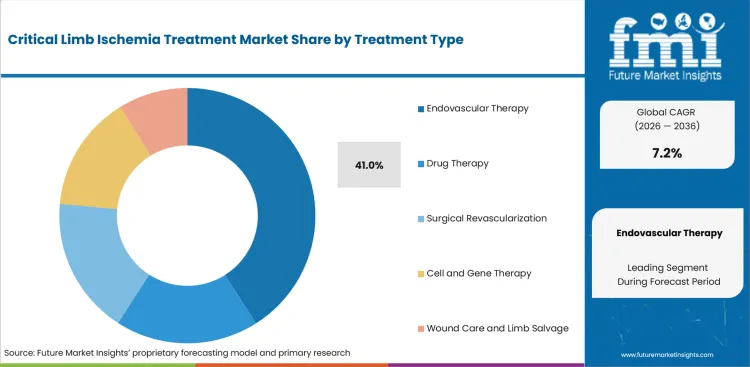
Endovascular therapy restores limb perfusion through catheter-based treatment that can preserve surgical options for selected patients. The National Vascular Registry recorded 9,636 endovascular lower-limb procedures across United Kingdom hospitals in November 2025 based on 2024 activity. The figure confirms a substantial operating base for imaging and lesion-crossing systems used during peripheral intervention. Interventional cardiology devices add support through imaging and access tools that help vascular teams plan complex treatment routes. Hospitals assess anatomy coverage and follow-up requirements ahead of expanding catheter-based capacity across complex peripheral intervention programs.
- Endovascular therapy is projected to hold 41.0% share in 2026, supported by its ability to treat selected high-risk patients through catheter-based access. The position reflects procedure suitability and established hospital capability rather than universal superiority over surgical bypass. Vascular teams compare lesion coverage and follow-up outcomes before extending the approach across difficult below-the-knee cases.
- Hospital adoption expands through endovascular programs that document perfusion and wound recovery across routine practice. Diffuse calcification and long occlusions can weaken patency even after technical success during the initial procedure. Treatment centers therefore need imaging support and lesion-preparation options that match local case mix without creating excessive inventory or training burdens.
Which buying mechanism supports peripheral artery disease within the application category?
Peripheral artery disease creates the clinical pathway for rest pain and tissue-loss cases that require urgent perfusion assessment. Wound severity and arterial obstruction determine whether intervention can preserve tissue ahead of infection or necrosis progression. Peripheral angioplasty options convert treatable occlusions into defined catheter procedures through balloons and supporting devices. Delayed referral can reduce salvage potential ahead of specialist evaluation and narrow the range of practical revascularization choices.
- The application category is forecast to be led by peripheral artery disease at 44.0% share in 2026, attributable to its direct connection with ischemic rest pain and tissue loss. The position represents a defined disease pathway rather than the full range of peripheral vascular procedures performed in hospitals. Vascular teams assess wound severity and perfusion status ahead of selecting a revascularization route for each salvageable limb.
- The National Vascular Registry reported in November 2025 that diabetes was present among 62.7% of patients undergoing major lower-limb amputation during 2024. The patient mix explains why peripheral artery disease pathways must connect perfusion assessment with infection control and wound follow-up. Earlier referral can preserve more treatment choices across patients with threatened tissue and progressive limb damage.
What supports the position of hospitals within the end user category?
Hospitals remain central because severe ischemia often requires imaging and revascularization beside coordinated wound management. The Australian Institute of Health and Welfare reported 7,000 lower-limb amputation hospitalizations among people with type 2 diabetes in May 2026 based on 2023-24 records. Diabetic foot care strengthens the hospital pathway through infection control and tissue-preservation services across coordinated limb-salvage programs. Ambulatory sites receive narrower cases that do not require intensive perioperative support or prolonged multidisciplinary monitoring.
- By end user, hospitals are forecast to represent 46.0% in 2026 and their position is supported by multidisciplinary staffing and advanced intervention infrastructure. The share reflects institutional capacity for complex cases without implying a preference for longer inpatient stays. Hospital purchasing combines device performance with anesthesia access and wound-management capacity across the complete treatment pathway.
- Hospital use expands through vascular and wound teams that follow patients beyond discharge and document tissue recovery. Limited catheterization capacity plus fragmented referrals can delay treatment despite available equipment and experienced specialists. Program expansion depends on scheduling discipline and outpatient follow-up that converts procedural success into measurable limb-salvage outcomes across each hospital program.
Why does direct sales lead the distribution channel category?
Direct sales places manufacturers near vascular teams that require product training and inventory support across complex procedures. Balloons and stents need case planning and replenishment that vary by lesion anatomy and hospital policy. Peripheral vascular stents often require clinical education beside consignment inventory and procedure support across complex hospital accounts. The model carries higher service costs across smaller hospitals and distant treatment centers with limited procedure volumes.
- In 2026, direct sales is expected to lead distribution channel with 49.0% share through procedural training and managed inventory support. The service-intensive model retains qualified distributors for smaller accounts and remote treatment centers with lower procedure volumes. Manufacturers retain direct control across hospitals whose case volume supports dedicated coverage and consigned stock.
- Koninklijke Philips N.V. launched the Arterial IVUS Tutor application in the United States in March 2026 with ten introductory modules and forty clinical cases. The program gives vascular teams structured imaging education that extends beyond limited in-person visits and scheduled classroom sessions. Direct manufacturer support can strengthen complex procedure adoption, but remote hospitals still need local inventory and rapid technical response from qualified distributors.
How do angioplasty balloons shape demand within the device type category?
Angioplasty balloons create the initial vessel-opening step across many endovascular strategies and can work beside stents or plaque modification. Severe calcification can limit expansion and increase the need for adjunct devices during complex procedures. Cordis reported in April 2025 that its SUCCESS study achieved 90.3% freedom from clinically driven target-lesion revascularization among CLTI patients at twelve months. Balloon catheters therefore require lesion-specific evidence rather than broad familiarity alone across hospital purchasing reviews.
- Angioplasty balloons are set to lead the device type category with 37.0% share in 2026, owing to broad procedural use and varied lesion-specific configurations. The position does not imply equal clinical performance across every lesion anatomy or patient risk profile. Hospitals compare crossing profile and diameter range with drug-delivery evidence before standardizing balloon inventory across intervention centers.
- Treatment centers favor angioplasty balloons that cross difficult lesions and fit established inventory across several vessel sizes. Repeat use depends on patency evidence because a low initial price cannot offset avoidable reintervention costs. Adoption strengthens through products that work with lesion preparation and preserve clear escalation routes for resistant calcification.
What are the drivers, restraints, and opportunities in the Critical Limb Ischemia Treatment Market?
Demand receives support from diabetes-related vascular disease and coordinated limb-salvage pathways. Delayed referral and calcified below-the-knee anatomy remain material restraints. Integrated foot assessment and vascular referral create the clearest commercial opening.
- Driver: Diabetes-related vascular disease creates recurring need for revascularization that restores perfusion and supports wound healing across limb-salvage programs.
- Restraint: Delayed referral and complex calcification narrow treatment options while raising procedural difficulty and repeat-intervention risk across advanced cases.
- Opportunity: Integrated vascular and diabetic-foot pathways can shorten recognition-to-treatment intervals and produce measurable tissue-recovery outcomes across participating hospitals.
Diabetes-related vascular disease creates sustained demand because poor perfusion and impaired wound healing develop within the same limb-salvage pathway. The National Vascular Registry reported diabetes among 50.6% of lower-limb revascularization patients in November 2025 based on 2024 procedures. Atherectomy devices become relevant across calcified lesions that resist straightforward balloon expansion, so hospitals evaluate equipment beside referral capacity and wound services that influence tissue recovery throughout each treatment episode.
Treatment delay remains a direct restraint because ischemic tissue can deteriorate during the interval preceding vascular intervention. The National Vascular Registry reported in November 2025 that 49% of emergency CLTI patients received revascularization within five days during 2024. The same report recorded a six-day median interval across emergency cases, confirming that device availability cannot remove this friction without coordinated scheduling and referral capacity. Commercial expansion therefore depends on pathways that reduce avoidable waiting time ahead of advanced tissue loss.
Integrated foot assessment creates a practical opening for identifying neuropathy and perfusion loss ahead of advanced tissue damage. Brazil’s Ministry of Health published a primary-care methodology in September 2025 that includes foot evaluation within longitudinal diabetes management. The defined route can connect early wound recognition with specialist vascular referral across participating health services. Manufacturers can support these programs through clinical education and standardized evidence tools instead of isolated product promotion. Commercial value develops through linked recognition and treatment access that includes documented wound follow-up across participating care networks.
Which country CAGRs are profiled in the Critical Limb Ischemia Treatment Market?
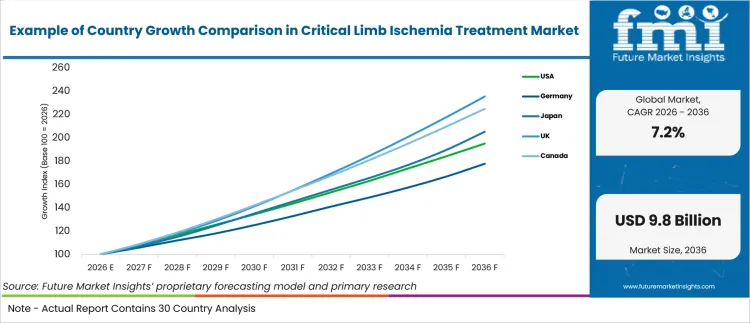
| Country | CAGR |
|---|---|
| UK | 8.9% |
| Canada | 8.4% |
| Brazil | 7.8% |
| Japan | 7.4% |
| USA | 6.9% |
| Germany | 5.9% |
| Australia | 5.3% |
How do country-level CAGRs compare in the Critical Limb Ischemia Treatment Market?
The country forecasts form a gradual progression rather than separate commercial tiers across national treatment systems. A 3.6 percentage-point range separates the United Kingdom at 8.9% CAGR from Australia at 5.3% CAGR across the approved outlook. The upper forecasts combine audited care pathways or concentrated specialist capacity with established endovascular access. Middle forecasts reflect regulated device routes combined with different reimbursement rules and service requirements across national treatment systems. Similar growth rates can therefore produce different commercial conditions through referral timing and local procedural support.
- The United Kingdom combines national audit visibility with established vascular networks, yet uneven admission-to-procedure timing makes local capacity decisive for market entry.
- Canada concentrates complex care in provincial tertiary centers, yet distance and formulary review shape product coverage beyond major urban regions.
- Brazil gains an early-referral route through diabetic-foot prevention activity, but import costs and uneven specialist access constrain complex treatment outside metropolitan hospitals.
- Japan offers a precise regulatory pathway for peripheral devices, yet labeling discipline and local training extend evaluation across specialist centers.
- The United States combines broad intervention infrastructure with defined Medicare coverage, but site requirements and payment differences affect program economics.
- Germany applies formal evidence assessment to emerging procedures, and discontinued review routes can limit reimbursement across narrowly defined patient groups.
- Australia concentrates advanced vascular care in metropolitan centers, but wide service distances increase inventory and technical-support requirements across regional facilities.
Country selection should balance forecast momentum with treatment access and local service requirements across each commercial entry plan. A higher rate cannot compensate for weak specialist coverage or unreliable inventory across a defined treatment network. The full report provides country-level CAGR analysis across North America, Latin America, Europe, East Asia, South Asia, Oceania and the Middle East and Africa.
Country-wise Analysis
- United Kingdom vascular purchasing operates through NHS networks that compare treatment timing and outcomes across specialist centers. The National Vascular Registry recorded 11,190 CLTI revascularizations and 5,182 emergency admissions during 2024 in its November 2025 report. Critical limb ischemia treatment demand in the United Kingdom is forecast to rise at 8.9% CAGR over the forecast period, supported by audited care pathways and established endovascular capacity. National audit data gives manufacturers a route for evidence development through centers already measuring treatment delays. Uneven specialist capacity remains a material friction across local vascular units with constrained urgent-care schedules. Commercial plans need training and service coverage that support urgent cases without adding delays to constrained pathways.
- Canadian hospital programs operate across wide service areas that make coordinated referral and follow-up difficult outside major centers. By 2036, the Canadian critical limb ischemia treatment market is projected to grow at 8.4% CAGR. National diabetes-related amputation data reinforce the need for earlier vascular assessment across provincial care pathways. The Public Health Agency of Canada reported in November 2025 that about 7,605 adults with diabetes were hospitalized for lower-limb amputation during 2023-24. Provincial specialist centers provide a direct treatment route for patients referred ahead of extensive tissue deterioration. Long travel distances and uneven wound-care access remain material frictions for follow-up and repeated intervention outside major cities.
- Brazilian treatment access combines the public health system with private hospitals and distributor-led support across a large territory. Brazil’s Ministry of Health launched the Lava-Pés campaign in March 2026 with foot assessments and prevention activity scheduled during early April. Primary-care screening can improve referral timing and increase the number of salvageable patients reaching vascular centers. Brazil’s critical limb ischemia treatment market is estimated to post 7.8% CAGR over the forecast period, aided by stronger diabetic-foot prevention activity. Import costs and uneven specialist access remain material frictions for complex treatment outside metropolitan hospital networks. Manufacturers need trained distributors and dependable replenishment systems that support national expansion without widening procedure delays.
- Japanese hospitals adopt vascular devices through PMDA approval and detailed clinical evaluation across specialist treatment centers. PMDA approved Abbott Medical Japan's peripheral orbital atherectomy system on May 19, 2026 within the domestic device route. The Japanese critical limb ischemia treatment sector is projected to record 7.4% CAGR during the assessment period. Precise device introduction and established specialist care support that outlook through a regulated lesion-preparation option for calcified peripheral arteries. Exact labeling requirements and local training remain material frictions beyond experienced vascular centers in major cities. Manufacturers need Japanese clinical support and maintenance coverage throughout each hospital evaluation cycle and early commercial rollout.
- United States treatment operates through broad hospital capacity and payer-specific coverage requirements across diverse vascular programs. CMS made its lower-extremity endovascular coverage determination effective for covered services beginning April 12, 2026. The United States critical limb ischemia treatment outlook is anticipated to advance at 6.9% CAGR over the assessment period. Established intervention infrastructure supports that outlook through a defined payment route for eligible covered peripheral procedures. Office settings using conscious sedation face state or national accreditation requirements that can limit site participation. Manufacturers need education and inventory support aligned with each facility’s coverage model and local documentation requirements across every eligible treatment setting.
- German hospital purchasing operates through statutory insurance rules and formal evidence assessment for emerging procedures. The Federal Joint Committee discontinued its deep-vein arterialization assessment on June 18, 2026 following an earlier consultation process. The decision confirms a material reimbursement friction for no-option treatments that lack an accepted evidence route. In Germany, critical limb ischemia treatment demand is predicted to advance at 5.9% CAGR through 2036. Specialist capacity and evidence-led access support approved revascularization devices across established vascular centers throughout Germany. Companies need local clinical partners that support evidence generation and regional service coverage without treating an abandoned procedure review as active coverage.
- Australian vascular care concentrates complex intervention in metropolitan specialist centers that serve patients across wide distances. Adoption of critical limb ischemia treatment in Australia is estimated to expand at 5.3% CAGR through 2036. The Australian Government launched the Chronic Wound Consumables Scheme in June 2025 for eligible older people with diabetes and chronic wounds. Trained health professionals can order subsidized dressings for delivery to patients or clinical practices through the national program. The scheme directly strengthens wound follow-up after revascularization among patients who meet its eligibility conditions. Regional distance remains a material friction for inventory access and technical support beyond major cities. Manufacturers need distributor stock and remote education that protects procedure readiness across scheduled regional cases.
Who are the notable companies in the Critical Limb Ischemia Treatment Market?
Abbott Laboratories, Boston Scientific Corporation, Medtronic plc, Terumo Corporation, Becton, Dickinson and Company, Cook Medical LLC, Cordis, and Koninklijke Philips N.V. are the notable companies shaping this market.
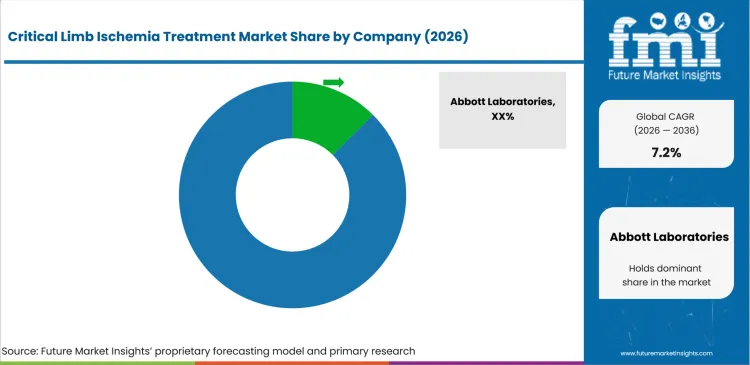
Competition separates companies with broad revascularization portfolios from specialists focused on lesion treatment or intravascular imaging. Abbott and Boston Scientific combine peripheral therapeutic platforms with current below-the-knee programs across selected indications. Koninklijke Philips N.V. competes through arterial imaging while Becton, Dickinson and Company adds plaque and thrombus removal capability. Cook Medical reported in March 2025 that Zilver PTX evidence included real-world results from eight Japanese hospitals. Thrombectomy systems strengthen portfolios that address mixed lesion morphology and acute thrombotic burden during complex peripheral interventions. Hospital selection depends on evidence depth and field support beside compatibility with established intervention workflows.
- Companies such as Abbott Laboratories, Boston Scientific Corporation and Medtronic plc provide broad peripheral revascularization portfolios across balloons and vessel-support technologies. Their commercial test requires below-the-knee evidence beside dependable procedure training and national service coverage across hospital networks. Hospital use expands through portfolios that address several lesion classes without fragmenting inventory across unrelated systems.
- Terumo Corporation, Becton, Dickinson and Company, and Cordis compete through access platforms and lesion-specific peripheral technologies. Hospitals compare training depth and outcome evidence through structured clinical review ahead of expanded use. Their position depends on matching device capability with each center’s established route for lesion crossing and preparation.
- Cook Medical LLC and Koninklijke Philips N.V. provide focused vascular treatment or imaging capabilities across specialist workflows. Cook contributes drug-eluting stent evidence, and Philips supports lesion assessment plus procedural education across specialist vascular programs. Their commercial position depends on integration with existing device inventory and reliable technical support across complex peripheral cases.
Competitive Benchmarking: Critical Limb Ischemia Treatment Market
| Company | Revascularization Portfolio | Lesion Preparation and Imaging | Below-the-Knee and CLTI Evidence | Geographic Reach |
|---|---|---|---|---|
| Abbott Laboratories | High | Medium | High | Global |
| Boston Scientific Corporation | High | High | Medium | Global |
| Medtronic plc | High | High | Medium | Global |
| Terumo Corporation | High | Medium | Medium | Global |
| Becton, Dickinson and Company | High | High | Medium | Global |
| Cook Medical LLC | Medium | Low | Low | Global |
| Cordis | Medium | Low | High | Global |
| Koninklijke Philips N.V. | Medium | High | Medium | Global |
Key Developments in the Critical Limb Ischemia Treatment Market
- In April 2025, Boston Scientific completed its acquisition of Bolt Medical and added an intravascular lithotripsy platform under development for coronary and peripheral artery disease. The transaction expanded its calcium-modification pipeline for difficult calcified lesions across complex peripheral intervention programs. Commercial relevance for critical limb ischemia depends on regulatory progress and integration with the company’s peripheral portfolio across highly calcified lesions ahead of routine hospital use.
- In August 2025, Abbott received CE Mark for the Esprit BTK everolimus-eluting resorbable scaffold for severe below-the-knee peripheral artery disease. The approval added a temporary scaffold option designed to restore blood flow without a permanent metal implant. European vascular programs can evaluate the technology across selected CLTI cases through controlled introduction programs as patient selection and long-term outcomes shape wider use.
- In October 2025, BD enrolled the first patient in the XTRACT registry for the Rotarex catheter system. The registry is expected to include as many as 600 patients across one hundred United States clinical sites. The program can clarify performance across varied peripheral lesions and give hospitals broader evidence for thrombectomy and atherectomy decisions across everyday peripheral practice and complex hospital case mixes.
- In April 2026, Cordis launched the SELUTION SLR PTA drug-eluting balloon in Japan and made it available for peripheral artery disease treatment. The launch added the country’s first approved sirolimus-eluting balloon for peripheral artery disease within a regulated commercial route. Japanese specialist centers gained a new lesion-treatment option for complex cases, although local training and post-launch evidence remain necessary across chronic limb-threatening ischemia programs.
Critical Limb Ischemia Treatment Market - Report Scope
| Coverage field | Report scope |
|---|---|
| Market breakdown | Treatment Type, Application, End User, Distribution Channel, Device Type, and Region. |
| Quantitative Units | USD Billion |
| Market Definition | Devices, therapies, procedures, and coordinated care pathways used to restore limb perfusion or support tissue preservation in chronic limb-threatening ischemia. |
| Regions Covered | North America, Latin America, Europe, East Asia, South Asia, Oceania, and Middle East and Africa. |
| Countries Covered | UK, Canada, Brazil, Japan, USA, Germany, and Australia, with more than 30 additional countries covered in the full report. |
| Key Companies Profiled | Abbott Laboratories, Boston Scientific Corporation, Medtronic plc, Terumo Corporation, Becton, Dickinson and Company, Cook Medical LLC, Cordis, and Koninklijke Philips N.V. |
| Forecast Period | 2026 to 2036. |
| Approach | Hybrid bottom-up and top-down market sizing supported by primary interviews and official desk research. |
Critical Limb Ischemia Treatment Market - Research Methodology
| Method | Approach |
|---|---|
| Primary Research | FMI analysts gathered input from manufacturers, service providers, technology developers, distributors, end users, procurement teams, and subject-matter experts. Interviews examined purchasing decisions, product or service evaluation, adoption barriers, approval requirements, pricing considerations, and expectations for technical or commercial support. Respondents were also asked what evidence is required before a trial, pilot, or initial order develops into regular purchasing. |
| Desk Research | Desk research covered government statistics, regulatory publications, trade data, industry associations, technical literature, standards, company filings, product information, and official corporate announcements. Sources were reviewed for relevance, publication date, geographic coverage, and consistency with the defined market scope. Claims relating to performance, applications, approvals, capacity, investment, and commercial activity were retained only when supported by credible public evidence. |
| Market Sizing and Forecasting | The market model combined the baseline value with historical performance, segment structure, pricing and volume indicators, adoption levels, company participation, and country-level demand conditions. Forecast assumptions considered economic activity, investment trends, regulatory developments, technology adoption, purchasing cycles, supply availability, and barriers to wider market use. Segment and regional estimates were reconciled before the final market total was calculated. |
| Data Validation | Estimates were checked against multiple independent indicators, including public data, company activity, trade patterns, industry developments, and findings from primary interviews. Validation also tested whether products, services, applications, and company revenues fell within the defined market boundaries. Adjacent categories, unsupported claims, overlapping revenues, and activities without direct market relevance were excluded to reduce double counting and maintain consistency across segments and countries. |
Critical Limb Ischemia Treatment Market by Segments
Critical Limb Ischemia Treatment Market segmented by Treatment Type:
- Endovascular Therapy
- Drug Therapy
- Surgical Revascularization
- Cell and Gene Therapy
- Wound Care and Limb Salvage
Critical Limb Ischemia Treatment Market segmented by Application:
- Peripheral Artery Disease
- Diabetic Foot Ulcers
- Critical Limb Salvage
- Chronic Limb Ischemia Management
- Post-Revascularization Care
Critical Limb Ischemia Treatment Market segmented by End User:
- Hospitals
- Ambulatory Surgical Centers
- Specialty Clinics
- Rehabilitation Centers
- Home Healthcare
Critical Limb Ischemia Treatment Market segmented by Distribution Channel:
- Direct Sales
- Medical Device Distributors
- Retail Pharmacies
- Online Healthcare Platforms
- Specialty Healthcare Suppliers
Critical Limb Ischemia Treatment Market segmented by Device Type:
- Angioplasty Balloons
- Vascular Stents
- Atherectomy Devices
- Embolic Protection Devices
- Thrombectomy Devices
Critical Limb Ischemia Treatment Market by Region:
- North America
- USA
- Canada
- Latin America
- Brazil
- Mexico
- Argentina
- Chile
- Western Europe
- Germany
- France
- UK
- Italy
- Spain
- Benelux
- Nordics
- Eastern Europe
- Poland
- Czech Republic
- Romania
- Hungary
- East Asia
- China
- Japan
- South Korea
- South Asia and Pacific
- India
- ASEAN
- Australia and New Zealand
- Middle East and Africa
- GCC Countries
- South Africa
- Turkiye
- Israel
Research Sources and Bibliography
- Vascular Services Quality Improvement Programme. (2025, November 13). 2025 NVR State of the Nation Report - HTML.
- American Heart Association. (2025, February 10). Top Things to Know: Understanding the Pain Experience and Treatment Considerations Along the Spectrum of Peripheral Artery Disease.
- Public Health Agency of Canada. (2025, November 20). Diabetes in Canada: An interactive report on key statistics: Outcomes.
- Ministério da Saúde. (2025, September 23). Nota Metodológica C4 - Cuidado da pessoa com diabetes.
- Ministério da Saúde. (2026, March 30). Campanha Lava-Pés mobiliza o país para prevenir complicações da diabetes e fortalecer o cuidado na Atenção Primária.
- Pharmaceuticals and Medical Devices Agency. (2026, May 19). Review Summary: Peripheral Orbital Atherectomy System.
- Centers for Medicare & Medicaid Services. (2026, February 20). Endovascular Management for Peripheral Arterial Disease of the Upper and Lower Extremities (L40228).
- Gemeinsamer Bundesausschuss. (2026, June 18). Endovaskuläre Arterialisierung tiefer Venen bei peripherer arterieller Verschlusskrankheit (§ 137e SGB V).
- Australian Institute of Health and Welfare. (2026, May 27). Diabetes: Australian facts, Hospitalisations.
- Australian Government Department of Health, Disability and Ageing. (2025, June 18). Free Medicare chronic wound care scheme starts.
- Cordis. (2025, April 24). Cordis Announces Positive Results from Two Major Clinical Studies.
- Cordis. (2026, April 28). SELUTION SLR PTA Drug-Eluting Balloon in Japan.
- Cook Medical. (2025, March 27). Real-world data shows Cook’s Zilver PTX leads to lower rates of in-stent occlusion than Boston Scientific’s Eluvia.
- Boston Scientific Corporation. (2025, April 23). Interested in our Q1 2025 earnings?
- Abbott. (2025, August 25). Abbott's Dissolving Stent Receives CE Mark, Pioneering a New Era in Peripheral Vascular Treatment.
- Becton, Dickinson and Company. (2025, October 9). BD Reaches Major Milestone for Rotarex™ Catheter System with First Patient Enrolled in XTRACT™ Registry to Advance Real-World Evidence in Peripheral Artery Disease.
- Philips. (2026, March 3). Arterial IVUS Tutor app launched in the US to support IVUS training.
- Abbott Laboratories. (2026, February 20). Annual report for the fiscal year ended December 31, 2025.
- Boston Scientific Corporation. (2026, February 17). Annual report for the fiscal year ended December 31, 2025.
- Medtronic plc. (2026, June 18). Annual report for the fiscal year ended April 24, 2026.
- Terumo Corporation. (2025). Terumo Report 2025 (online version).
- Becton, Dickinson and Company. (2025, November 25). Annual report for the fiscal year ended September 30, 2025.
- Royal Philips. (2026, February 19). Philips publishes its Annual Report 2025.
This bibliography is provided for reader reference and is not exhaustive. The full report contains the complete reference list and detailed citations
This Report Answers
- How large is the critical limb ischemia treatment market in 2026 and 2036?
- Which clinical conditions support demand for coordinated limb-salvage pathways?
- Why does endovascular therapy hold the selected treatment type share in 2026?
- How does peripheral artery disease influence application-level treatment demand?
- Why do hospitals represent the selected end user share in 2026?
- How do country growth rates differ across the profiled treatment markets?
- Which companies provide broad revascularization portfolios or focused lesion-treatment capabilities?
- What limits adoption across calcified below-the-knee lesions and delayed referral pathways?
- How can integrated vascular and diabetic-foot services improve treatment outcomes?
Frequently Asked Questions
How big is the Critical Limb Ischemia Treatment Market in 2026?
The critical limb ischemia treatment market is valued at USD 4.9 billion in 2026 and is forecast to reach USD 9.8 billion by 2036. Growth is supported by rising clinical demand for revascularization procedures that restore perfusion and support durable limb preservation across coordinated hospital treatment pathways.
What is the CAGR of the Critical Limb Ischemia Treatment Market from 2026 to 2036?
The critical limb ischemia treatment market grows at a CAGR of 7.2% between 2026 and 2036, supported by diabetes-related vascular disease that creates recurring need for revascularization to restore perfusion and support wound healing across limb-salvage programs.
Which treatment type leads the Critical Limb Ischemia Treatment Market?
Endovascular therapy accounts for 41.0% of the critical limb ischemia treatment market by treatment type in 2026, driven by catheter-based access that treats selected high-risk patients while preserving surgical options across established hospital revascularization programs.
How much will the Critical Limb Ischemia Treatment Market add between 2026 and 2036?
The critical limb ischemia treatment market is set to add USD 4.9 billion between 2026 and 2036, growing from USD 4.9 billion to USD 9.8 billion as integrated vascular and diabetic-foot pathways shorten recognition-to-treatment intervals and expand device adoption across hospital networks.
Who are the leading companies in the Critical Limb Ischemia Treatment Market?
Eight companies lead the critical limb ischemia treatment market, including Abbott Laboratories, Boston Scientific, Medtronic, Terumo Corporation, Becton Dickinson, Cook Medical, Cordis, and Koninklijke Philips, competing through revascularization portfolios, lesion-preparation devices, intravascular imaging, and below-the-knee CLTI clinical evidence across global hospital networks.
Preview the report firsthand - request a free sample
Get SampleGet the brochure for pricing and purchase details.
Get PDFTable of Content
- Key Takeaways
- Market Size and CAGR
- Top Growth Driver
- Fastest Growing Segment
- Leading Region
- Key Companies
- Emerging Opportunities
- Executive Summary
- Global Market Outlook
- Demand-side Trends
- Supply-side Trends
- Technology Roadmap Analysis
- Analysis and Recommendations
- Analyst Perspective (What is happening? Why now? What should investors know?)
- Key Questions Answered
- How large is the market?
- What is the CAGR?
- What are key trends?
- Which region dominates?
- Who are the leaders?
- Market Overview
- Market Coverage / Taxonomy
- Market Definition / Scope / Limitations
- Research Methodology
- Chapter Orientation
- Analytical Lens and Working Hypotheses
- Market Structure, Signals, and Trend Drivers
- Benchmarking and Cross-market Comparability
- Market Sizing, Forecasting, and Opportunity Mapping
- Research Design and Evidence Framework
- Desk Research Programme (Secondary Evidence)
- Expert Input and Fieldwork (Primary Evidence)
- Tooling, Models, and Reference Databases
- Data Engineering and Model Build
- Quality Assurance and Audit Trail
- Market Background
- Market Dynamics (Drivers, Restraints, Opportunity, Trends)
- Scenario Forecast (Optimistic, Likely, Conservative)
- Impact Analysis
- AI Impact
- Sustainability Impact
- Regulatory Impact
- Technology Impact
- Consumer / Buyer Analysis
- Purchase Drivers
- Adoption Barriers
- Buyer Journey
- Opportunity Map Analysis
- Product Life Cycle Analysis
- Supply Chain Analysis
- Investment Feasibility Matrix
- Value Chain Analysis
- PESTLE and Porter's Analysis
- Regulatory Landscape
- Regional Parent Market Outlook
- Production and Consumption Statistics
- Import and Export Statistics
- Global Market Analysis and Forecast, 2021 to 2036
- Historical Market Size Value (USD Billion) Analysis, 2021 to 2025
- Current and Future Market Size Value (USD Billion) Projections, 2026 to 2036
- Y-o-Y Growth Trend Analysis
- Absolute $ Opportunity Analysis
- Global Market Pricing Analysis, 2021 to 2036
- Global Market Analysis and Forecast, By Treatment Type, 2021 to 2036
- Introduction / Key Findings
- Historical Market Size Value (USD Billion) Analysis By Treatment Type, 2021 to 2025
- Current and Future Market Size Value (USD Billion) Analysis and Forecast By Treatment Type, 2026 to 2036
- Endovascular Therapy
- Angioplasty
- Stent Placement
- Drug Therapy
- Antiplatelet Therapy
- Anticoagulant Therapy
- Surgical Revascularization
- Bypass Surgery
- Endarterectomy
- Cell and Gene Therapy
- Stem Cell Therapy
- Gene Therapy
- Wound Care and Limb Salvage
- Advanced Wound Dressings
- Negative Pressure Wound Therapy
- Endovascular Therapy
- Y-o-Y Growth Trend Analysis By Treatment Type, 2021 to 2025
- Absolute $ Opportunity Analysis By Treatment Type, 2026 to 2036
- Global Market Analysis and Forecast, By Application, 2021 to 2036
- Introduction / Key Findings
- Historical Market Size Value (USD Billion) Analysis By Application, 2021 to 2025
- Current and Future Market Size Value (USD Billion) Analysis and Forecast By Application, 2026 to 2036
- Peripheral Artery Disease
- Atherosclerotic Peripheral Artery Disease
- Diabetic Peripheral Artery Disease
- Diabetic Foot Ulcers
- Ischemic Foot Ulcers
- Neuroischemic Ulcers
- Critical Limb Salvage
- Tissue Preservation
- Wound Healing
- Chronic Limb Ischemia Management
- Pain Management
- Functional Recovery
- Post-Revascularization Care
- Follow-Up Monitoring
- Rehabilitation
- Peripheral Artery Disease
- Y-o-Y Growth Trend Analysis By Application, 2021 to 2025
- Absolute $ Opportunity Analysis By Application, 2026 to 2036
- Global Market Analysis and Forecast, By End User, 2021 to 2036
- Introduction / Key Findings
- Historical Market Size Value (USD Billion) Analysis By End User, 2021 to 2025
- Current and Future Market Size Value (USD Billion) Analysis and Forecast By End User, 2026 to 2036
- Hospitals
- Tertiary Care Hospitals
- Specialty Vascular Centers
- Ambulatory Surgical Centers
- Outpatient Surgical Centers
- Day Care Centers
- Specialty Clinics
- Vascular Clinics
- Cardiology Clinics
- Rehabilitation Centers
- Physical Rehabilitation Centers
- Postoperative Care Centers
- Home Healthcare
- Home Nursing Services
- Remote Patient Monitoring
- Hospitals
- Y-o-Y Growth Trend Analysis By End User, 2021 to 2025
- Absolute $ Opportunity Analysis By End User, 2026 to 2036
- Global Market Analysis and Forecast, By Distribution Channel, 2021 to 2036
- Introduction / Key Findings
- Historical Market Size Value (USD Billion) Analysis By Distribution Channel, 2021 to 2025
- Current and Future Market Size Value (USD Billion) Analysis and Forecast By Distribution Channel, 2026 to 2036
- Direct Sales
- Hospital Procurement
- Group Purchasing Organizations
- Medical Device Distributors
- National Distributors
- Regional Distributors
- Retail Pharmacies
- Hospital Pharmacies
- Independent Pharmacies
- Online Healthcare Platforms
- E-Commerce Medical Supplies
- Digital Pharmacy Platforms
- Specialty Healthcare Suppliers
- Vascular Care Suppliers
- Wound Care Distributors
- Direct Sales
- Y-o-Y Growth Trend Analysis By Distribution Channel, 2021 to 2025
- Absolute $ Opportunity Analysis By Distribution Channel, 2026 to 2036
- Global Market Analysis and Forecast, By Device Type, 2021 to 2036
- Introduction / Key Findings
- Historical Market Size Value (USD Billion) Analysis By Device Type, 2021 to 2025
- Current and Future Market Size Value (USD Billion) Analysis and Forecast By Device Type, 2026 to 2036
- Angioplasty Balloons
- Drug-Coated Balloons
- Standard Balloon Catheters
- Vascular Stents
- Bare Metal Stents
- Drug-Eluting Stents
- Atherectomy Devices
- Directional Atherectomy Systems
- Rotational Atherectomy Systems
- Embolic Protection Devices
- Distal Filter Devices
- Proximal Occlusion Devices
- Thrombectomy Devices
- Mechanical Thrombectomy Devices
- Aspiration Thrombectomy Devices
- Angioplasty Balloons
- Y-o-Y Growth Trend Analysis By Device Type, 2021 to 2025
- Absolute $ Opportunity Analysis By Device Type, 2026 to 2036
- Global Market Analysis and Forecast, By Region, 2021 to 2036
- Introduction
- Historical Market Size Value (USD Billion) Analysis By Region, 2021 to 2025
- Current Market Size Value (USD Billion) Analysis and Forecast By Region, 2026 to 2036
- North America
- Latin America
- Western Europe
- Eastern Europe
- East Asia
- South Asia and Pacific
- Middle East & Africa
- Market Attractiveness Analysis By Region
- North America Market Analysis and Forecast, By Country, 2021 to 2036
- Historical Market Size Value (USD Billion) Trend Analysis By Market Taxonomy, 2021 to 2025
- Market Size Value (USD Billion) Forecast By Market Taxonomy, 2026 to 2036
- By Country
- USA
- Canada
- By Treatment Type
- By Application
- By End User
- By Distribution Channel
- By Device Type
- By Country
- Market Attractiveness Analysis
- By Country
- By Treatment Type
- By Application
- By End User
- By Distribution Channel
- By Device Type
- Key Takeaways
- Latin America Market Analysis and Forecast, By Country
- Historical Market Size Value (USD Billion) Trend Analysis By Market Taxonomy, 2021 to 2025
- Market Size Value (USD Billion) Forecast By Market Taxonomy, 2026 to 2036
- By Country
- Brazil
- Mexico
- Chile
- Rest of Latin America
- By Treatment Type
- By Application
- By End User
- By Distribution Channel
- By Device Type
- By Country
- Market Attractiveness Analysis
- By Country
- By Treatment Type
- By Application
- By End User
- By Distribution Channel
- By Device Type
- Key Takeaways
- Western Europe Market Analysis and Forecast, By Country
- Historical Market Size Value (USD Billion) Trend Analysis By Market Taxonomy, 2021 to 2025
- Market Size Value (USD Billion) Forecast By Market Taxonomy, 2026 to 2036
- By Country
- Germany
- UK
- Italy
- Spain
- France
- Nordic
- BENELUX
- Rest of Western Europe
- By Treatment Type
- By Application
- By End User
- By Distribution Channel
- By Device Type
- By Country
- Market Attractiveness Analysis
- By Country
- By Treatment Type
- By Application
- By End User
- By Distribution Channel
- By Device Type
- Key Takeaways
- Eastern Europe Market Analysis and Forecast, By Country
- Historical Market Size Value (USD Billion) Trend Analysis By Market Taxonomy, 2021 to 2025
- Market Size Value (USD Billion) Forecast By Market Taxonomy, 2026 to 2036
- By Country
- Russia
- Poland
- Hungary
- Balkan & Baltic
- Rest of Eastern Europe
- By Treatment Type
- By Application
- By End User
- By Distribution Channel
- By Device Type
- By Country
- Market Attractiveness Analysis
- By Country
- By Treatment Type
- By Application
- By End User
- By Distribution Channel
- By Device Type
- Key Takeaways
- East Asia Market Analysis and Forecast, By Country
- Historical Market Size Value (USD Billion) Trend Analysis By Market Taxonomy, 2021 to 2025
- Market Size Value (USD Billion) Forecast By Market Taxonomy, 2026 to 2036
- By Country
- China
- Japan
- South Korea
- By Treatment Type
- By Application
- By End User
- By Distribution Channel
- By Device Type
- By Country
- Market Attractiveness Analysis
- By Country
- By Treatment Type
- By Application
- By End User
- By Distribution Channel
- By Device Type
- Key Takeaways
- South Asia and Pacific Market Analysis and Forecast, By Country
- Historical Market Size Value (USD Billion) Trend Analysis By Market Taxonomy, 2021 to 2025
- Market Size Value (USD Billion) Forecast By Market Taxonomy, 2026 to 2036
- By Country
- India
- ASEAN
- Australia & New Zealand
- Rest of South Asia and Pacific
- By Treatment Type
- By Application
- By End User
- By Distribution Channel
- By Device Type
- By Country
- Market Attractiveness Analysis
- By Country
- By Treatment Type
- By Application
- By End User
- By Distribution Channel
- By Device Type
- Key Takeaways
- Middle East & Africa Market Analysis and Forecast, By Country
- Historical Market Size Value (USD Billion) Trend Analysis By Market Taxonomy, 2021 to 2025
- Market Size Value (USD Billion) Forecast By Market Taxonomy, 2026 to 2036
- By Country
- Kingdom of Saudi Arabia
- Other GCC Countries
- Türkiye
- South Africa
- Other African Union
- Rest of Middle East & Africa
- By Treatment Type
- By Application
- By End User
- By Distribution Channel
- By Device Type
- By Country
- Market Attractiveness Analysis
- By Country
- By Treatment Type
- By Application
- By End User
- By Distribution Channel
- By Device Type
- Key Takeaways
- Key Countries Market Analysis
- USA
- Pricing Analysis
- Market Share Analysis, 2025
- By Treatment Type
- By Application
- By End User
- By Distribution Channel
- By Device Type
- Canada
- Pricing Analysis
- Market Share Analysis, 2025
- By Treatment Type
- By Application
- By End User
- By Distribution Channel
- By Device Type
- Mexico
- Pricing Analysis
- Market Share Analysis, 2025
- By Treatment Type
- By Application
- By End User
- By Distribution Channel
- By Device Type
- Brazil
- Pricing Analysis
- Market Share Analysis, 2025
- By Treatment Type
- By Application
- By End User
- By Distribution Channel
- By Device Type
- Chile
- Pricing Analysis
- Market Share Analysis, 2025
- By Treatment Type
- By Application
- By End User
- By Distribution Channel
- By Device Type
- Germany
- Pricing Analysis
- Market Share Analysis, 2025
- By Treatment Type
- By Application
- By End User
- By Distribution Channel
- By Device Type
- UK
- Pricing Analysis
- Market Share Analysis, 2025
- By Treatment Type
- By Application
- By End User
- By Distribution Channel
- By Device Type
- Italy
- Pricing Analysis
- Market Share Analysis, 2025
- By Treatment Type
- By Application
- By End User
- By Distribution Channel
- By Device Type
- Spain
- Pricing Analysis
- Market Share Analysis, 2025
- By Treatment Type
- By Application
- By End User
- By Distribution Channel
- By Device Type
- France
- Pricing Analysis
- Market Share Analysis, 2025
- By Treatment Type
- By Application
- By End User
- By Distribution Channel
- By Device Type
- India
- Pricing Analysis
- Market Share Analysis, 2025
- By Treatment Type
- By Application
- By End User
- By Distribution Channel
- By Device Type
- ASEAN
- Pricing Analysis
- Market Share Analysis, 2025
- By Treatment Type
- By Application
- By End User
- By Distribution Channel
- By Device Type
- Australia & New Zealand
- Pricing Analysis
- Market Share Analysis, 2025
- By Treatment Type
- By Application
- By End User
- By Distribution Channel
- By Device Type
- China
- Pricing Analysis
- Market Share Analysis, 2025
- By Treatment Type
- By Application
- By End User
- By Distribution Channel
- By Device Type
- Japan
- Pricing Analysis
- Market Share Analysis, 2025
- By Treatment Type
- By Application
- By End User
- By Distribution Channel
- By Device Type
- South Korea
- Pricing Analysis
- Market Share Analysis, 2025
- By Treatment Type
- By Application
- By End User
- By Distribution Channel
- By Device Type
- Russia
- Pricing Analysis
- Market Share Analysis, 2025
- By Treatment Type
- By Application
- By End User
- By Distribution Channel
- By Device Type
- Poland
- Pricing Analysis
- Market Share Analysis, 2025
- By Treatment Type
- By Application
- By End User
- By Distribution Channel
- By Device Type
- Hungary
- Pricing Analysis
- Market Share Analysis, 2025
- By Treatment Type
- By Application
- By End User
- By Distribution Channel
- By Device Type
- Kingdom of Saudi Arabia
- Pricing Analysis
- Market Share Analysis, 2025
- By Treatment Type
- By Application
- By End User
- By Distribution Channel
- By Device Type
- Türkiye
- Pricing Analysis
- Market Share Analysis, 2025
- By Treatment Type
- By Application
- By End User
- By Distribution Channel
- By Device Type
- South Africa
- Pricing Analysis
- Market Share Analysis, 2025
- By Treatment Type
- By Application
- By End User
- By Distribution Channel
- By Device Type
- USA
- Market Structure Analysis
- Competition Dashboard
- Competition Benchmarking
- Market Share Analysis of Top Players
- By Regional
- By Treatment Type
- By Application
- By End User
- By Distribution Channel
- By Device Type
- Emerging Startups
- Innovation Benchmarking
- Competition Analysis
- Competition Deep Dive
- Abbott Laboratories
- Overview
- Product Portfolio
- Profitability by Market Segments
- Sales Footprint
- Strategy Overview
- Marketing Strategy
- Product Strategy
- Channel Strategy
- Boston Scientific Corporation
- Medtronic plc
- Terumo Corporation
- Becton Dickinson and Company
- Cook Medical
- Cordis
- Philips Healthcare
- B. Braun SE
- LimFlow SA
- Abbott Laboratories
- Case Studies
- Success Stories
- Recent Developments
- Competition Deep Dive
- Assumptions & Acronyms Used


