

- Market Size (2026)
- USD 2.5 Bn
- Forecast (2036)
- USD 4.1 Bn
- CAGR (2026 to 2036)
- 5.3%
How big is CVT Drive Belt Market in 2026?
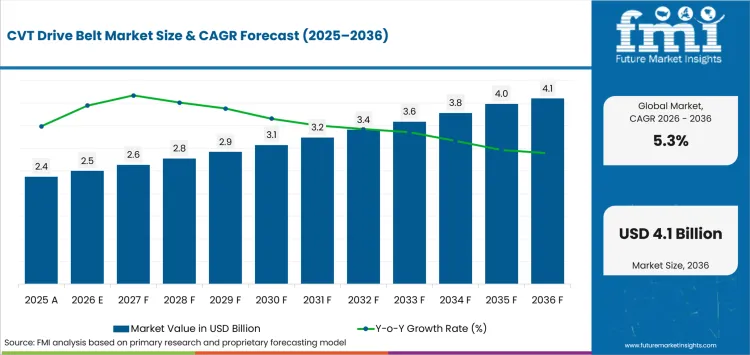
USD 2.5 billion in 2026 and USD 4.1 billion by 2036 at a 5.3% CAGR.
Demand in the CVT drive belt market is projected to rise from USD 2.5 billion in 2026 to USD 4.1 billion by 2036 at a 5.3% CAGR. Original fitment places the belt inside the automotive transmission purchase while later wear transfers revenue toward replacement channels. The Motorcycle Industry Council estimated 1,261,300 new powersports retail sales in the United States during 2025. Each new machine enlarges the service population that can require model-specific belts later in its operating life.
National revenue does not follow vehicle stock mechanically because belt-based CVT penetration differs by country and platform. Statistics Canada reported 26.8 million registered road vehicles during 2024 in its October 2025 release. Mexico carries stronger manufacturing exposure while Italy has a denser conventional scooters use case. Large vehicle populations support replacement potential only after catalog coverage confirms that each platform uses an addressable CVT architecture.
Key Takeaways of CVT Drive Belt Market
- CVT drive belt demand comes from original fitment and later replacement as heat, bending cycles and service wear move belts toward inspection thresholds.
- In 2026, rubber CVT belts are projected to account for 34.0% by belt type because flexible constructions fit high-volume scooter and powersports use.
- By vehicle type, passenger cars are estimated to hold 31.0% in 2026 owing to qualified belt-based CVT architectures on major automotive platforms.
- Aftermarket replacement is anticipated to represent 46.0% by sales channel in 2026 because worn belts return through dealers and parts distribution.
- Fitment errors can shorten service life because small differences in effective length, belt width or clutch condition alter CVT engagement under load.
- Some of the key players in this market include Gates, Continental, Bando Chemical, Mitsuboshi Belting, Dayco, Bosch, Malossi, and Polini.
Analyst Perspective
"CVT belt offers should be judged against validated fitment and expected thermal load before unit price enters the comparison. Commercial value comes from reducing wrong-part returns and keeping replacement references available for machines already in service."
- Nikhil Kaitwade, Principal Consultant, Future Market Insights
How is the CVT Drive Belt Market segmented?
The market is segmented by belt type, vehicle type, sales channel, material and application.
Belt type covers rubber CVT belts, metal push belts, aramid-reinforced belts, high-performance ATV belts and snowmobile CVT belts. Vehicle type includes passenger cars, scooters, ATVs/UTVs, industrial variable drives and snowmobiles. Sales channels include aftermarket replacement, OEM direct, powersports dealers and online/catalog routes. Material covers EPDM rubber, aramid or carbon reinforcement, chloroprene rubber and segmented steel. Applications include primary drive transmission, powersports drive, scooter drive and industrial CVT drive.
How does Aftermarket replacement lead the Sales channel category?
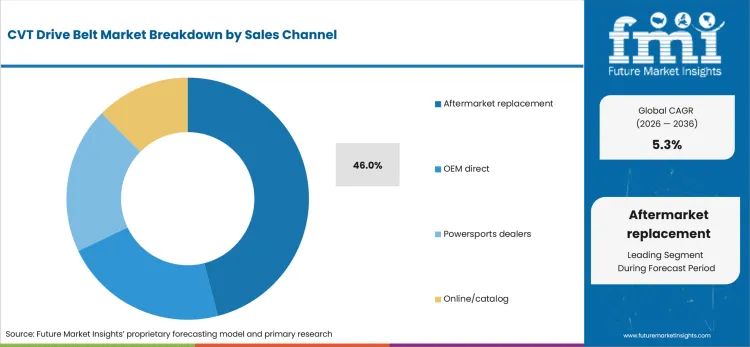
Aftermarket replacement converts an installed scooter or powersports fleet into repeat orders after belts develop wear or reach service intervals. The April 2026 JAMA motorcycle survey found 53% of surveyed purchases were replacements. That behavior supports a two-wheeler aftermarket where part availability matters after the original vehicle transaction has ended.
- In 2026, aftermarket replacement is expected to lead the sales channel category with 46.0% share because belt wear returns customers to service and parts outlets.
- Replacement conversion depends on cross-reference accuracy and stock depth for each vehicle platform. Dealers lose the sale if the correct width or effective length is unavailable at the service event.
What makes Rubber CVT belts central to the Belt type category?
Rubber CVT belts remain practical for pulley systems that need continuous flexing and a replaceable wear component under changing ratios. Scooter service demand gives this format a large addressable pool because many automotive belts in these drivetrains must retain both tensile strength and controlled friction.
- By belt type, rubber CVT belts are estimated to hold 34.0% in 2026 owing to broad scooter and powersports fitment plus routine replacement channels.
- ANCMA documented 167,339 scooter registrations above 50 cc during January to September 2025 in its October release. That volume keeps model-level belt references commercially relevant for Italian and wider European scooter channels.
Why do Passenger cars lead the Vehicle type category?
Passenger-car CVTs use tightly specified transmission components that must pass platform qualification before volume production begins. INEGI recorded 1.37 million light-vehicle sales in Mexico from January through November 2025. That scale keeps vehicle-platform qualification commercially important even though only the CVT-equipped portion becomes addressable belt demand.
- Passenger cars account for 31.0% of the market by vehicle type in 2026 because qualified pushbelt and belt-CVT programs carry higher value per fitted transmission.
- Automotive programs require repeatable geometry and material control before a belt enters series production. Qualification narrows acceptable substitutes and protects approved references during a platform life cycle.
What supports EPDM rubber in the Material category?
EPDM rubber suits CVT belts that must flex around pulleys and resist heat generated during torque transfer. Aramid reinforcement raises load tolerance without abandoning the flexible elastomer architecture used in compact CVT pulley systems. That balance makes material selection relevant in high-output scooters, ATVs and snowmobiles.
- EPDM rubber is forecast to represent 33.0% of the market by material in 2026 driven by thermal resistance and compatibility with tensile reinforcement.
- Dayco announced a new snowmobile and ATV belt range at EICMA in November 2025 using EPDM construction with embedded aramid cord. The development targets severe heat and wear under demanding duty cycles.
What are the drivers, restraints and opportunities in the CVT Drive Belt Market?
Replacement cycles expand service demand, exact fitment constrains conversion and reinforced constructions provide a higher-value route for severe-duty applications.
- Driver: Installed scooters and powersports vehicles return to dealers for belt replacement after heat and wear change effective transmission performance.
- Restraint: Incorrect belt dimensions or clutch condition can cause slip, poor engagement and premature wear before the expected service interval.
- Opportunity: Reinforced elastomer belts can capture higher-output scooter, ATV and snowmobile applications that expose ordinary constructions to greater thermal stress.
Installed vehicle populations sustain replacement demand even during years when new-model growth slows. FHWA counted 9,261,249 registered motorcycles in the United States for 2024 in statistics released during 2026. That fleet supports service activity beyond the first sale and strengthens the commercial logic for broad power sports application catalogs. Revenue still depends on whether each registered machine uses an addressable belt-based CVT.
Fitment sensitivity limits conversion because a CVT belt must reproduce the intended effective length and contact geometry under load. Dayco explained in March 2025 that powersports CVT service requires clutch alignment plus controlled belt break-in before normal loading. Incorrect installation can therefore turn genuine demand into returns or early failures. Manufacturers need application data and installer guidance that reduce mismatch before the belt enters service.
Higher-load applications offer room for belts that tolerate more heat without losing dimensional control during repeated acceleration. Bando added new application examples to its technical information site in July 2026 and maintains dedicated CVT material for motorcycle plus electric-vehicle transmission uses. That technical focus supports premium development where automotive performance parts must carry more torque within limited package space. Application qualification still determines whether a stronger construction reaches commercial sale on the intended vehicle or equipment platform.
Which country CAGRs are profiled in the CVT Drive Belt Market?
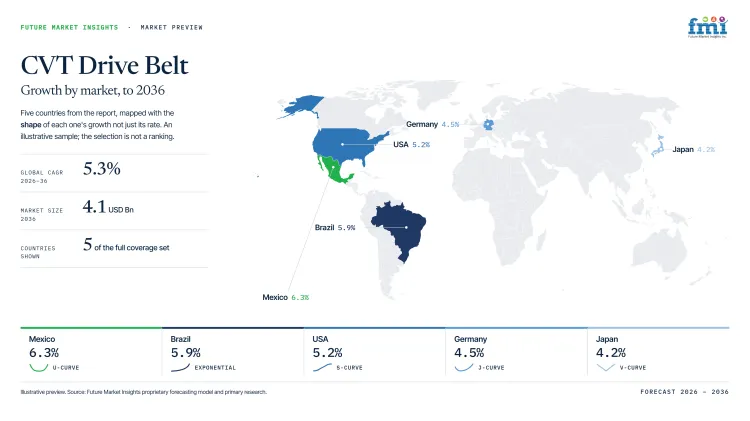
| Country | CAGR |
|---|---|
| Mexico | 6.3% |
| Brazil | 5.9% |
| Italy | 5.6% |
| USA | 5.2% |
| Canada | 4.9% |
| Germany | 4.5% |
| Japan | 4.2% |
How do country-level CAGRs compare in the CVT Drive Belt Market?
The forecasts span 2.1 percentage points from Mexico at 6.3% to Japan at 4.2%. Mexico and Brazil form the faster group because vehicle production and two-wheeler activity supply both first-fit and replacement channels. Italy and the USA occupy the middle band. Canada, Germany and Japan depend more heavily on mature installed bases.
- Mexico and Brazil justify broader distributor coverage because vehicle and motorcycle production keeps new references entering service channels.
- Italy and the USA support different replacement pools through scooters in Italy and diversified powersports use in the USA.
- Canada requires seasonal inventory planning because recreation demand and cold-weather use concentrate replacement activity during shorter service windows.
- Germany and Japan reward OE-equivalent fitment because mature fleets and disciplined service networks raise the cost of wrong references.
- The full report provides country-level CAGR analysis across North America, Latin America, Europe, East Asia, South Asia, Oceania and the Middle East and Africa.
Country-wise Analysis
- Mexico pairs large light-vehicle production with dense parts distribution into the United States and domestic service channels for replacement components nationwide. CVT drive belt demand in Mexico is forecast to rise at 6.3% CAGR over the forecast period owing to growing vehicle turnover and two-wheeler service activity. INEGI documented 3.71 million light vehicles produced from January through November 2025. Local manufacturing gives distributors earlier visibility into platform changes, yet imported models widen the cross-reference burden. Companies entering Mexico need commercially accurate application coverage first because low-priced generic references can generate returns if effective belt length differs from the original specification.
- Brazilian motorcycle workshops serve high-utilization commuter fleets that expose drive components to frequent start-stop cycles and regular scheduled maintenance work locally. Abraciclo recorded 184,443 motorcycles produced in January 2026 and reported double-digit year-over-year growth for the month. Brazil is estimated to post 5.9% CAGR nationally over the forecast period supported by expanding two-wheeler throughput and a broad dealer network. Strong local production shortens replenishment routes for high-volume models, though price sensitivity limits premiums on replacement parts. Manufacturers serving two-wheeler accessories channels gain a clearer route to higher-value references after they document service life against common commuter duty cycles.
- Italian replacement demand is concentrated in scooters that operate frequently in urban traffic and return to specialist workshops for transmission service. Adoption of CVT drive belts in Italy is estimated to expand at 5.6% CAGR through 2036 aided by dense scooter use and strong electric scooters dealer knowledge. ANCMA recorded 282,391 new registrations above 50 cc during January to September 2025. Workshop familiarity supports rapid diagnosis and parts turnover, but the number of models and displacement classes makes catalog depth expensive to maintain. Brands that replenish fast-moving references quickly can compete without carrying every specialist performance belt in local stock.
- The United States spreads CVT belt demand between road motorcycles, ATVs, side-by-sides and snowmobiles that operate under very different thermal loads. The Motorcycle Industry Council counted 10,690 powersports retailers in its 2025 economic-impact profile. That dealer footprint gives manufacturers many replacement outlets but also fragments inventory by region and season. The USA CVT drive belt sector is projected to record 5.2% CAGR during the assessment period tied to a large installed base and continued automotive bearing aftermarket service activity. Severe-duty applications justify reinforced references, whereas ordinary commuter belts face stronger price comparison. Geographic breadth therefore rewards national catalog systems more than one-size inventory strategies.
- Canadian demand has a large light-duty vehicle base plus snowmobile and recreational applications that produce sharply seasonal replacement-parts requirements nationwide. Statistics Canada reported that 24.6 million light-duty vehicles were registered in 2024 and published the figure in October 2025. Canada is estimated to post 4.9% CAGR during the forecast period because mature vehicle ownership supports replacement demand as recreation adds severe-duty belt use. National distributors can consolidate stock efficiently, though long service distances raise the cost of carrying slow-moving references. The main constraint is inventory balance rather than basic access because winter demand can concentrate failures in short regional selling windows.
- Germany has a mature passenger-car and motorcycle service network where replacement selection is closely tied to original fitment records and workshop data. CVT drive belt sales in Germany are forecast to expand at 4.5% CAGR by 2036 given replacement demand in existing vehicles despite passenger-car electrification. The German motorcycle industry association recorded 158,944 motorcycles and scooters registered during 2025 after a distorted Euro 5 transition year. Technical service depth supports premium OE-equivalent references, but drivetrain substitution limits growth in conventional passenger-car CVT applications. Companies therefore need to protect profitable replacement coverage without building excess inventory for platforms leaving the fleet.
- Japan pairs demanding OEM qualification with a mature motorcycle replacement environment and strong domestic transmission engineering. JAMA reported in April 2026 that surveyed motorcycle users rode an average 3.2 days each week. Frequent use keeps service relevance visible even though the national market is not expanding quickly. By 2036, Japan is projected to grow at 4.2% CAGR tied to replacement behavior and technically disciplined dealer service. Domestic brands have strong reference knowledge, which raises the entry threshold for unfamiliar aftermarket names. New entrants gain more from exact OE-equivalent specifications and consistent availability than from broad catalog breadth without local validation.
Who are the notable companies in the CVT Drive Belt Market?
Gates, Continental, Bando Chemical, Mitsuboshi Belting, Dayco, Bosch, Malossi, and Polini are the notable companies serving this market.
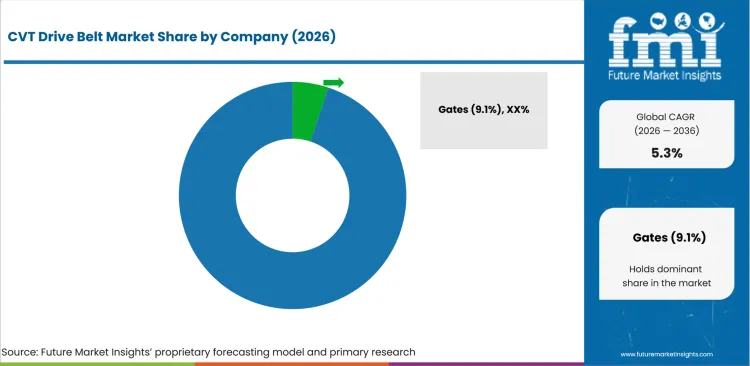
Competition separates into broad belt manufacturers, automotive transmission specialists and scooter performance companies. Gates, Continental, Bando Chemical and Mitsuboshi Belting operate wider industrial V belts portfolios that provide materials and manufacturing depth. Dayco and Bosch bring automotive qualification experience while Malossi and Polini compete closest to scooter service and performance channels. Entry barriers come from application evidence and channel coverage because replacement references must reproduce the original CVT operating geometry.
- Broad belt manufacturers include Gates, Continental, Bando Chemical and Mitsuboshi Belting with global or multi-region power-transmission manufacturing footprints.
- Dayco and Bosch serve transmission-related applications where dimensional control and automotive qualification determine whether a belt or pushbelt reaches series production.
- Malossi and Polini focus more heavily on scooter transmission tuning plus model-specific replacement parts for enthusiast and specialist dealer channels.
Competitive Benchmarking: CVT Drive Belt Market
| Company | Model Fitment Depth | High-Heat / Reinforced Capability | CVT Application Breadth | Geographic Reach |
|---|---|---|---|---|
| Gates | High | High | High | Global |
| Continental | Medium | Medium | Medium | Global |
| Bando Chemical | Medium | High | High | Asia, Europe and North America |
| Mitsuboshi Belting | Medium | Medium | Medium | Asia, Europe and North America |
| Dayco | High | High | High | Global |
| Bosch | High | High | Medium | Global |
| Malossi | High | Medium | Medium | Europe and international scooter aftermarket |
| Polini | High | Medium | Medium | Europe and international scooter aftermarket |
Scoring basis: High model fitment depth requires documented platform references or OEM qualification evidence. Medium covers a narrower documented set and Low identifies one fitment route. High reinforcement requires direct proof of aramid, carbon, steel pushbelt or comparable severe-duty construction. Medium confirms documented thermal engineering and Low marks basic construction with limited severe-duty evidence. High application breadth covers at least three CVT end uses, compared with two for Medium and one for Low.
Key Developments in the CVT Drive Belt Market
- In February 2025, Polini introduced an Original drive belt for the Honda PCX 125 E5, expanding its model-specific replacement belt portfolio for scooter CVT applications.
- In May 2025, Mitsuboshi Belting established a sales company in Dubai serving the Middle East and Africa, strengthening its regional sales and technical support capabilities for power transmission products, including belts.
- In November 2025, Malossi presented its 2026 Racing Academy Dragster 300 cc package, featuring a complete transmission assembly and drive belt, supporting its performance-oriented CVT component portfolio for high-performance scooters.
Key Players in the CVT Drive Belt Market
Broad Engineered-Belt Manufacturers
- Gates
- Continental
- Bando Chemical
- Mitsuboshi Belting
Transmission and Multi-Application Suppliers
- Dayco
- Bosch
Scooter and Powersports Aftermarket Specialists
- Malossi
- Polini
CVT Drive Belt Market - Report Scope
| Coverage field | Report scope |
|---|---|
| Market breakdown | By belt type, vehicle type, sales channel, material, application and region. |
| Quantitative Units | USD Billion. |
| Market Definition | Revenue includes CVT drive belts and steel pushbelts sold as OEM or replacement products for passenger cars, scooters, ATVs/UTVs, industrial variable drives and snowmobiles. Complete transmissions, vehicles, service labor, pulleys or clutches sold separately and adjacent timing or accessory-drive belts are excluded. |
| Regions Covered | North America, Latin America, Europe, East Asia, South Asia and Pacific, and Middle East and Africa. |
| Countries Covered | Mexico, Brazil, Italy, USA, Canada, Germany, Japan and more than twenty additional countries in the full report. |
| Key Companies Profiled | Gates, Continental, Bando Chemical, Mitsuboshi Belting, Dayco, Bosch, Malossi, Polini. |
| Forecast Period | 2026 to 2036. |
| Approach | Primary and secondary research with market triangulation. |
CVT Drive Belt Market - Research Methodology
| Method | Approach |
|---|---|
| Primary Research | FMI analysts gathered input from manufacturers, service providers, technology developers, distributors, end users, procurement teams, and subject-matter experts. Interviews examined purchasing decisions, product or service evaluation, adoption barriers, approval requirements, pricing considerations, and expectations for technical or commercial support. Respondents were also asked what evidence is required before a trial, pilot, or initial order develops into regular purchasing. |
| Desk Research | Desk research covered government statistics, regulatory publications, trade data, industry associations, technical literature, standards, company filings, product information, and official corporate announcements. Sources were reviewed for relevance, publication date, geographic coverage, and consistency with the defined market scope. Claims relating to performance, applications, approvals, capacity, investment, and commercial activity were retained only when supported by credible public evidence. |
| Market Sizing and Forecasting | The market model combined the baseline value with historical performance, segment structure, pricing and volume indicators, adoption levels, company participation, and country-level demand conditions. Forecast assumptions considered economic activity, investment trends, regulatory developments, technology adoption, purchasing cycles, supply availability, and barriers to wider market use. Segment and regional estimates were reconciled before the final market total was calculated. |
| Data Validation | Estimates were checked against multiple independent indicators, including public data, company activity, trade patterns, industry developments, and findings from primary interviews. Validation also tested whether products, services, applications, and company revenues fell within the defined market boundaries. Adjacent categories, unsupported claims, overlapping revenues, and activities without direct market relevance were excluded to reduce double counting and maintain consistency across segments and countries. |
CVT Drive Belt Market by Segments
CVT Drive Belt Market segmented by Belt Type:
- Rubber CVT belts
- Metal push belts
- Aramid-reinforced belts
- High-performance ATV belts
- Snowmobile CVT belts
CVT Drive Belt Market segmented by Vehicle Type:
- Passenger cars
- Scooters
- ATVs/UTVs
- Industrial variable drives
- Snowmobiles
CVT Drive Belt Market segmented by Sales Channel:
- Aftermarket replacement
- OEM direct
- Powersports dealers
- Online/catalog
CVT Drive Belt Market segmented by Material:
- EPDM rubber
- Aramid / carbon reinforced
- Chloroprene rubber
- Steel segmented
CVT Drive Belt Market segmented by Application:
- Primary drive transmission
- Powersports drive
- Scooter drive
- Industrial CVT drive
CVT Drive Belt Market by Region:
- North America
- United States
- Canada
- Latin America
- Brazil
- Mexico
- Argentina
- Chile
- Western Europe
- Germany
- France
- United Kingdom
- Italy
- Spain
- Benelux
- Nordics
- Eastern Europe
- Poland
- Czech Republic
- Romania
- Hungary
- East Asia
- China
- Japan
- South Korea
- South Asia and Pacific
- India
- ASEAN
- Australia and New Zealand
- Middle East and Africa
- GCC Countries
- South Africa
- Türkiye
- Israel
Research Sources and Bibliography
- Motorcycle Industry Council. (2025). Powersports industry: 2025 economic impact in USA total.
- Statistics Canada. (2025, October 17). Vehicle registrations, 2024.
- Associazione Nazionale Ciclo Motociclo Accessori. (2025, October). Moto settembre 2025: new registrations of vehicles over 50 cc.
- Instituto Nacional de Estadística y Geografía. (2025, December 3). Avance de resultados del Registro Administrativo de la Industria Automotriz de Vehículos Ligeros, noviembre de 2025.
- Japan Automobile Manufacturers Association. (2026, April 14). 2025
- Dayco. (2025, November 4). Dayco takes centre stage at EICMA in Milan.
- Federal Highway Administration. (2026, January). Highway Statistics 2024, Table MV-1: State motor-vehicle registrations.
- Dayco. (2025, March 3). CVT belt installation and break-in.
- Bando Chemical Industries, Ltd. (2026, July 29). New application examples added.
- Associação Brasileira dos Fabricantes de Motocicletas, Ciclomotores, Motonetas, Bicicletas e Similares. (2026, February). Janeiro registra maior produção de motocicletas desde 2008.
- Industrie-Verband Motorrad Deutschland. (2026). Annual report 2025.
- Polini Motori. (2025, February 10). Polini Original belt for Honda PCX 125 E5.
- Mitsuboshi Belting Ltd. (2025, May 1). Established a new company in Dubai.
- Malossi S.p.A. (2025, November 13). EICMA 2025 & Malossi: that’s amore.
- Gates Industrial Corporation plc. (2026, May 1). Gates Corporation to expand North American power transmission business with acquisition.
- Dayco. (2025, February 11). Dayco and Honda LCR, together in the 2025 MotoGP season.
- Continental AG. (2025, September 10). ContiTech launches Thunderbolt SilentSync composite sprockets to help customers optimize drive performance and reduce system costs.
- Bando Chemical Industries, Ltd. (2026, May 14). Consolidated financial results for the fiscal year ended March 31, 2026.
- Mitsuboshi Belting Ltd. (2026, February 16). Established a branch office in the Philippines.
- Robert Bosch GmbH. (2026, April 16). Strategy 2030: Bosch plays to its innovative strengths.
- Polini Motori. (2025, February 25). Polini Evolution clutch bell for Peugeot Metropolis 400 4T.
- Mitsuboshi Belting Ltd. (2025). Integrated Report 2025.
This bibliography is provided for reader reference and is not exhaustive. The full report contains the complete reference list and detailed citations
This Report Answers
- How large is the cvt drive belt market in 2026 and what value is forecast for 2036?
- Which operating conditions sustain cvt drive belt replacement after the original vehicle sale?
- Why do rubber CVT belts hold the largest belt type share in 2026?
- How does passenger-car qualification influence the value of automotive CVT belt programs?
- Why does aftermarket replacement represent the largest sales channel share in 2026?
- How do approved country CAGRs differ between Mexico, Brazil, Italy, USA, Canada, Germany and Japan?
- Which companies serve broad belt portfolios, automotive pushbelts and specialist scooter transmission applications?
- Which fitment and thermal conditions can shorten belt life or increase warranty exposure?
Frequently Asked Questions
How big is the cvt drive belt market in 2026?
The cvt drive belt market is valued at USD 2.5 billion in 2026 and is projected to reach USD 4.1 billion by 2036. Growth follows original fitment plus replacement purchases from scooters, powersports machines and passenger-car CVT applications.
What is the CAGR of the cvt drive belt market from 2026 to 2036?
The cvt drive belt market is projected to grow at a CAGR of 5.3% between 2026 and 2036. Expansion is supported by the installed vehicle base and repeated belt service after heat or wear reaches replacement thresholds.
Which belt type leads the cvt drive belt market?
The rubber CVT belts segment is expected to hold 34.0% of the cvt drive belt market in 2026 because flexible constructions fit high-volume scooter and powersports transmissions. Reinforced variants extend the format into higher thermal and torque loads.
Which sales channel leads the cvt drive belt market?
The aftermarket replacement segment is anticipated to represent 46.0% of the cvt drive belt market in 2026 because belts return through service channels after wear develops. Accurate cross-references decide whether that service event converts into the correct replacement sale.
Which companies are active in the cvt drive belt market?
Key companies operating in the cvt drive belt market include Gates, Continental, Bando Chemical, Mitsuboshi Belting, Dayco, Bosch, Malossi, and Polini. Their positions differ through manufacturing scale, automotive qualification, model-level fitment depth and specialist scooter transmission coverage.
Preview the report firsthand - request a free sample
Get SampleGet the brochure for pricing and purchase details.
Get PDFTable of Content
- Key Takeaways
- Market Size and CAGR
- Top Growth Driver
- Fastest Growing Segment
- Leading Region
- Key Companies
- Emerging Opportunities
- Executive Summary
- Global Market Outlook
- Demand-side Trends
- Supply-side Trends
- Technology Roadmap Analysis
- Analysis and Recommendations
- Analyst Perspective (What is happening? Why now? What should investors know?)
- Key Questions Answered
- How large is the market?
- What is the CAGR?
- What are key trends?
- Which region dominates?
- Who are the leaders?
- Market Overview
- Market Coverage / Taxonomy
- Market Definition / Scope / Limitations
- Research Methodology
- Chapter Orientation
- Analytical Lens and Working Hypotheses
- Market Structure, Signals, and Trend Drivers
- Benchmarking and Cross-market Comparability
- Market Sizing, Forecasting, and Opportunity Mapping
- Research Design and Evidence Framework
- Desk Research Programme (Secondary Evidence)
- Expert Input and Fieldwork (Primary Evidence)
- Tooling, Models, and Reference Databases
- Data Engineering and Model Build
- Quality Assurance and Audit Trail
- Market Background
- Market Dynamics (Drivers, Restraints, Opportunity, Trends)
- Scenario Forecast (Optimistic, Likely, Conservative)
- Impact Analysis
- AI Impact
- Sustainability Impact
- Regulatory Impact
- Technology Impact
- Consumer / Buyer Analysis
- Purchase Drivers
- Adoption Barriers
- Buyer Journey
- Opportunity Map Analysis
- Product Life Cycle Analysis
- Supply Chain Analysis
- Investment Feasibility Matrix
- Value Chain Analysis
- PESTLE and Porter's Analysis
- Regulatory Landscape
- Regional Parent Market Outlook
- Production and Consumption Statistics
- Import and Export Statistics
- Global Market Analysis and Forecast, 2021 to 2036
- Historical Market Size Value (USD Billion) Analysis, 2021 to 2025
- Current and Future Market Size Value (USD Billion) Projections, 2026 to 2036
- Y-o-Y Growth Trend Analysis
- Absolute $ Opportunity Analysis
- Global Market Pricing Analysis, 2021 to 2036
- Global Market Analysis and Forecast, By Belt Type, 2021 to 2036
- Introduction / Key Findings
- Historical Market Size Value (USD Billion) Analysis By Belt Type, 2021 to 2025
- Current and Future Market Size Value (USD Billion) Analysis and Forecast By Belt Type, 2026 to 2036
- Rubber CVT belts
- Metal push belts
- Aramid-reinforced belts
- High-performance ATV belts
- Snowmobile CVT belts
- Rubber CVT belts
- Y-o-Y Growth Trend Analysis By Belt Type, 2021 to 2025
- Absolute $ Opportunity Analysis By Belt Type, 2026 to 2036
- Global Market Analysis and Forecast, By Vehicle Type, 2021 to 2036
- Introduction / Key Findings
- Historical Market Size Value (USD Billion) Analysis By Vehicle Type, 2021 to 2025
- Current and Future Market Size Value (USD Billion) Analysis and Forecast By Vehicle Type, 2026 to 2036
- Passenger cars
- Scooters
- ATVs/UTVs
- Industrial variable drives
- Snowmobiles
- Passenger cars
- Y-o-Y Growth Trend Analysis By Vehicle Type, 2021 to 2025
- Absolute $ Opportunity Analysis By Vehicle Type, 2026 to 2036
- Global Market Analysis and Forecast, By Sales Channel, 2021 to 2036
- Introduction / Key Findings
- Historical Market Size Value (USD Billion) Analysis By Sales Channel, 2021 to 2025
- Current and Future Market Size Value (USD Billion) Analysis and Forecast By Sales Channel, 2026 to 2036
- Aftermarket replacement
- OEM direct
- Powersports dealers
- Online/catalog
- Aftermarket replacement
- Y-o-Y Growth Trend Analysis By Sales Channel, 2021 to 2025
- Absolute $ Opportunity Analysis By Sales Channel, 2026 to 2036
- Global Market Analysis and Forecast, By Material, 2021 to 2036
- Introduction / Key Findings
- Historical Market Size Value (USD Billion) Analysis By Material, 2021 to 2025
- Current and Future Market Size Value (USD Billion) Analysis and Forecast By Material, 2026 to 2036
- EPDM rubber
- Aramid / carbon reinforced
- Chloroprene rubber
- Steel segmented
- EPDM rubber
- Y-o-Y Growth Trend Analysis By Material, 2021 to 2025
- Absolute $ Opportunity Analysis By Material, 2026 to 2036
- Global Market Analysis and Forecast, By Application, 2021 to 2036
- Introduction / Key Findings
- Historical Market Size Value (USD Billion) Analysis By Application, 2021 to 2025
- Current and Future Market Size Value (USD Billion) Analysis and Forecast By Application, 2026 to 2036
- Primary drive transmission
- Powersports drive
- Scooter drive
- Industrial CVT drive
- Primary drive transmission
- Y-o-Y Growth Trend Analysis By Application, 2021 to 2025
- Absolute $ Opportunity Analysis By Application, 2026 to 2036
- Global Market Analysis and Forecast, By Region, 2021 to 2036
- Introduction
- Historical Market Size Value (USD Billion) Analysis By Region, 2021 to 2025
- Current Market Size Value (USD Billion) Analysis and Forecast By Region, 2026 to 2036
- North America
- Latin America
- Western Europe
- Eastern Europe
- East Asia
- South Asia and Pacific
- Middle East & Africa
- Market Attractiveness Analysis By Region
- North America Market Analysis and Forecast, By Country, 2021 to 2036
- Historical Market Size Value (USD Billion) Trend Analysis By Market Taxonomy, 2021 to 2025
- Market Size Value (USD Billion) Forecast By Market Taxonomy, 2026 to 2036
- By Country
- USA
- Canada
- By Belt Type
- By Vehicle Type
- By Sales Channel
- By Material
- By Application
- By Country
- Market Attractiveness Analysis
- By Country
- By Belt Type
- By Vehicle Type
- By Sales Channel
- By Material
- By Application
- Key Takeaways
- Latin America Market Analysis and Forecast, By Country
- Historical Market Size Value (USD Billion) Trend Analysis By Market Taxonomy, 2021 to 2025
- Market Size Value (USD Billion) Forecast By Market Taxonomy, 2026 to 2036
- By Country
- Brazil
- Mexico
- Chile
- Rest of Latin America
- By Belt Type
- By Vehicle Type
- By Sales Channel
- By Material
- By Application
- By Country
- Market Attractiveness Analysis
- By Country
- By Belt Type
- By Vehicle Type
- By Sales Channel
- By Material
- By Application
- Key Takeaways
- Western Europe Market Analysis and Forecast, By Country
- Historical Market Size Value (USD Billion) Trend Analysis By Market Taxonomy, 2021 to 2025
- Market Size Value (USD Billion) Forecast By Market Taxonomy, 2026 to 2036
- By Country
- Germany
- UK
- Italy
- Spain
- France
- Nordic
- BENELUX
- Rest of Western Europe
- By Belt Type
- By Vehicle Type
- By Sales Channel
- By Material
- By Application
- By Country
- Market Attractiveness Analysis
- By Country
- By Belt Type
- By Vehicle Type
- By Sales Channel
- By Material
- By Application
- Key Takeaways
- Eastern Europe Market Analysis and Forecast, By Country
- Historical Market Size Value (USD Billion) Trend Analysis By Market Taxonomy, 2021 to 2025
- Market Size Value (USD Billion) Forecast By Market Taxonomy, 2026 to 2036
- By Country
- Russia
- Poland
- Hungary
- Balkan & Baltic
- Rest of Eastern Europe
- By Belt Type
- By Vehicle Type
- By Sales Channel
- By Material
- By Application
- By Country
- Market Attractiveness Analysis
- By Country
- By Belt Type
- By Vehicle Type
- By Sales Channel
- By Material
- By Application
- Key Takeaways
- East Asia Market Analysis and Forecast, By Country
- Historical Market Size Value (USD Billion) Trend Analysis By Market Taxonomy, 2021 to 2025
- Market Size Value (USD Billion) Forecast By Market Taxonomy, 2026 to 2036
- By Country
- China
- Japan
- South Korea
- By Belt Type
- By Vehicle Type
- By Sales Channel
- By Material
- By Application
- By Country
- Market Attractiveness Analysis
- By Country
- By Belt Type
- By Vehicle Type
- By Sales Channel
- By Material
- By Application
- Key Takeaways
- South Asia and Pacific Market Analysis and Forecast, By Country
- Historical Market Size Value (USD Billion) Trend Analysis By Market Taxonomy, 2021 to 2025
- Market Size Value (USD Billion) Forecast By Market Taxonomy, 2026 to 2036
- By Country
- India
- ASEAN
- Australia & New Zealand
- Rest of South Asia and Pacific
- By Belt Type
- By Vehicle Type
- By Sales Channel
- By Material
- By Application
- By Country
- Market Attractiveness Analysis
- By Country
- By Belt Type
- By Vehicle Type
- By Sales Channel
- By Material
- By Application
- Key Takeaways
- Middle East & Africa Market Analysis and Forecast, By Country
- Historical Market Size Value (USD Billion) Trend Analysis By Market Taxonomy, 2021 to 2025
- Market Size Value (USD Billion) Forecast By Market Taxonomy, 2026 to 2036
- By Country
- Kingdom of Saudi Arabia
- Other GCC Countries
- Türkiye
- South Africa
- Other African Union
- Rest of Middle East & Africa
- By Belt Type
- By Vehicle Type
- By Sales Channel
- By Material
- By Application
- By Country
- Market Attractiveness Analysis
- By Country
- By Belt Type
- By Vehicle Type
- By Sales Channel
- By Material
- By Application
- Key Takeaways
- Key Countries Market Analysis
- USA
- Pricing Analysis
- Market Share Analysis, 2025
- By Belt Type
- By Vehicle Type
- By Sales Channel
- By Material
- By Application
- Canada
- Pricing Analysis
- Market Share Analysis, 2025
- By Belt Type
- By Vehicle Type
- By Sales Channel
- By Material
- By Application
- Mexico
- Pricing Analysis
- Market Share Analysis, 2025
- By Belt Type
- By Vehicle Type
- By Sales Channel
- By Material
- By Application
- Brazil
- Pricing Analysis
- Market Share Analysis, 2025
- By Belt Type
- By Vehicle Type
- By Sales Channel
- By Material
- By Application
- Chile
- Pricing Analysis
- Market Share Analysis, 2025
- By Belt Type
- By Vehicle Type
- By Sales Channel
- By Material
- By Application
- Germany
- Pricing Analysis
- Market Share Analysis, 2025
- By Belt Type
- By Vehicle Type
- By Sales Channel
- By Material
- By Application
- UK
- Pricing Analysis
- Market Share Analysis, 2025
- By Belt Type
- By Vehicle Type
- By Sales Channel
- By Material
- By Application
- Italy
- Pricing Analysis
- Market Share Analysis, 2025
- By Belt Type
- By Vehicle Type
- By Sales Channel
- By Material
- By Application
- Spain
- Pricing Analysis
- Market Share Analysis, 2025
- By Belt Type
- By Vehicle Type
- By Sales Channel
- By Material
- By Application
- France
- Pricing Analysis
- Market Share Analysis, 2025
- By Belt Type
- By Vehicle Type
- By Sales Channel
- By Material
- By Application
- India
- Pricing Analysis
- Market Share Analysis, 2025
- By Belt Type
- By Vehicle Type
- By Sales Channel
- By Material
- By Application
- ASEAN
- Pricing Analysis
- Market Share Analysis, 2025
- By Belt Type
- By Vehicle Type
- By Sales Channel
- By Material
- By Application
- Australia & New Zealand
- Pricing Analysis
- Market Share Analysis, 2025
- By Belt Type
- By Vehicle Type
- By Sales Channel
- By Material
- By Application
- China
- Pricing Analysis
- Market Share Analysis, 2025
- By Belt Type
- By Vehicle Type
- By Sales Channel
- By Material
- By Application
- Japan
- Pricing Analysis
- Market Share Analysis, 2025
- By Belt Type
- By Vehicle Type
- By Sales Channel
- By Material
- By Application
- South Korea
- Pricing Analysis
- Market Share Analysis, 2025
- By Belt Type
- By Vehicle Type
- By Sales Channel
- By Material
- By Application
- Russia
- Pricing Analysis
- Market Share Analysis, 2025
- By Belt Type
- By Vehicle Type
- By Sales Channel
- By Material
- By Application
- Poland
- Pricing Analysis
- Market Share Analysis, 2025
- By Belt Type
- By Vehicle Type
- By Sales Channel
- By Material
- By Application
- Hungary
- Pricing Analysis
- Market Share Analysis, 2025
- By Belt Type
- By Vehicle Type
- By Sales Channel
- By Material
- By Application
- Kingdom of Saudi Arabia
- Pricing Analysis
- Market Share Analysis, 2025
- By Belt Type
- By Vehicle Type
- By Sales Channel
- By Material
- By Application
- Türkiye
- Pricing Analysis
- Market Share Analysis, 2025
- By Belt Type
- By Vehicle Type
- By Sales Channel
- By Material
- By Application
- South Africa
- Pricing Analysis
- Market Share Analysis, 2025
- By Belt Type
- By Vehicle Type
- By Sales Channel
- By Material
- By Application
- USA
- Market Structure Analysis
- Competition Dashboard
- Competition Benchmarking
- Market Share Analysis of Top Players
- By Regional
- By Belt Type
- By Vehicle Type
- By Sales Channel
- By Material
- By Application
- Emerging Startups
- Innovation Benchmarking
- Competition Analysis
- Competition Deep Dive
- Gates (9.1%)
- Overview
- Product Portfolio
- Profitability by Market Segments
- Sales Footprint
- Strategy Overview
- Marketing Strategy
- Product Strategy
- Channel Strategy
- Continental
- Bando Chemical
- Mitsuboshi Belting
- Dayco
- Bosch
- Malossi
- Polini
- EPI Performance
- GBoost Technology
- Gates (9.1%)
- Case Studies
- Success Stories
- Recent Developments
- Competition Deep Dive
- Assumptions & Acronyms Used


