

- Market Size (2026)
- USD 1007.6 Mn
- Forecast (2036)
- USD 3390.2 Mn
- CAGR (2026 to 2036)
- 12.9%
How big is Date Paste Market in 2026?
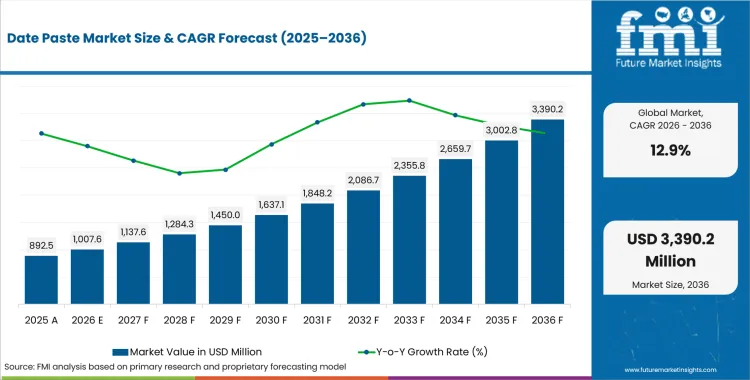
USD 1,007.6 million in 2026 and USD 3,390.2 million by 2036 at a 12.9% CAGR.
Demand for date paste is projected to expand at 12.9% CAGR from USD 1,007.6 million in 2026 to USD 3,390.2 million by 2036. Industrial bakeries reorder qualified bakery ingredients after moisture and fruit-solid performance remain stable during commercial line trials. In April 2026 Emirates News Agency documented 100,000 tonnes of annual capacity at Al Barakah Dates Factory, a scale suited to larger contracts.
Raw-date processing hubs hold a sourcing advantage over import-dependent markets that face longer documentation and replenishment routes. Saudi Press Agency reported in April 2026 that 2025 date production exceeded 1.9 million tons with exports to over 125 countries. Domestic processors start with crop access advantages over manufacturers relying on imported fruit and vegetable ingredients.
Key Takeaways of Date Paste Market
- Industrial bakeries repeat date paste orders once fruit solids and sweetness perform consistently on production lines.
- By product type, date paste is estimated to hold 36.0% in 2026 owing to semi-solid handling suited to bakery fillings.
- In 2026, powder - dry is expected to lead form with 38.0% share because dry dosing separates hydration control.
- Bread & rolls are projected to hold 37.0% share in 2026 due to specification sensitivity on high-throughput lines.
- Moisture variation raises qualification costs as bakeries confirm browning and shelf behavior before industrial approval.
- Some of the key players in this market include Agthia Group PJSC, Al Barakah Dates Factory LLC, Boudjebel VACPA, Suhana Dates Factory, Horchani Dattes International, Al-Ahsa Food Industries Company, Sharmeen Foods Pvt Ltd, and GNS Pakistan Dates Factory.
Analyst Perspective
"Industrial buyers should compare moisture range, Brix control, and microbial limits before approving date paste. Repeatable grades earn better margins when technical records shorten bakery trials without forcing plant adjustments."
- Nandini Roy Choudhury, Principal Consultant, Future Market Insights
How is the Date Paste Market segmented?
The market is segmented by product type, form, application, claim and sales channel; region is reported separately.
Product type includes date paste, date syrup blends, diced & macerated dates and organic lines. Form covers powder - dry, liquid, paste / semi-solid and granules / pieces. Application includes bread & rolls, cakes & muffins, biscuits & cookies, viennoiserie & pastry and other bakery & snacks. Claim covers conventional, clean label, organic and non-GMO / identity preserved. Sales channel covers direct to industrial bakeries, ingredient distributors, foodservice & artisan supply and online B2B.
What makes Date paste central to the Product type category?
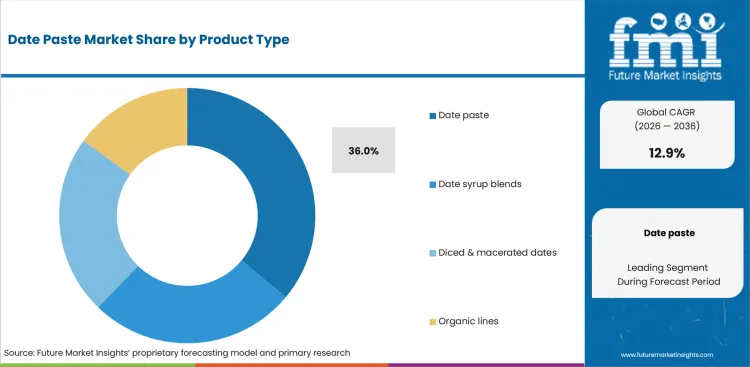
Date paste gives formulators fruit solids and sweetness for fillings and dough systems without whole-date processing. Emirates News Agency documented in June 2025 that Al Barakah produces paste and date derivatives for multinational food manufacturers. The source places date paste within naturally derived sweeteners because manufacturers buy grades with controlled moisture and lot specifications.
- By product type, date paste is estimated to hold 36.0% in 2026 owing to semi-solid handling that fits sweetening and filling operations.
- Industrial bakeries test viscosity and moisture during qualification since depositing behavior must remain stable between production lots and scheduled bakery runs.
Why does Powder - dry lead the Form category?
Powder - dry formats suit plants that meter flour and bakery mixes by weight before liquid addition. Pakistan Horticulture Development and Export Company listed date powder with paste and pitted-date formats for GNS Pakistan Dates Factory in its FoodAg 2025 directory. Dry grades therefore use the same manufacturer-ready ingredient route while allowing bakeries to control hydration separately.
- In 2026, powder - dry is expected to lead form with 38.0% share because separate hydration control reduces batch adjustments.
- Bakeries qualify dry date grades through flow and dispersion tests because clumping or particle drift changes dough consistency during production.
How do Bread & Rolls anchor the Application category?
Bread and roll lines expose formulation errors quickly because small water-balance changes affect large production runs. In May 2025 dsm-firmenich opened its Princeton Baking Innovation Center with equipment for breads and rolls. The investment demonstrates why food texturing agents and sweetening ingredients require full-line trials before purchasing teams approve routine production volume at commercial scale.
- Bread & rolls are projected to hold 37.0% share in 2026 owing to high-throughput lines that expose inconsistent dough behavior quickly.
- Date paste gains repeat orders once trials confirm acceptable browning and softness without costly fermentation or proofing changes on production lines.
What supports Conventional in the Claim category?
Conventional grades keep purchasing focused on food safety and application performance without an organic certification route for every lot. Boudjebel VACPA presented certified organic date ingredients at BIOFACH 2026 during the February exhibition in Nuremberg. The separate effort shows why clean-label ingredients and organic programs require dedicated documentation before displacing standard industrial supply routinely.
- Based on claim, conventional is projected to account for 54.0% in 2026 due to easier qualification without organic segregation requirements.
- Premium claims expand if customers recover certification costs and maintain segregated records without narrowing approved ingredient sources for routine commercial production.
What are the drivers, restraints and opportunities in the Date Paste Market?
Bakery reformulation supports demand because application-ready grades reduce trial burden, while recipe-specific validation limits substitution.
- Driver: Date paste becomes commercially relevant where one ingredient supplies sweetness and fruit solids without sacrificing line performance.
- Restraint: Water activity and browning change with formulation, which raises trial costs before an industrial bakery approves repeat purchasing.
- Opportunity: Processors can win larger accounts by standardizing moisture and particle specifications for direct bakery qualification programs.
Bakery reformulation broadens the trial pipeline
Industrial bakeries revisit sweetening systems when nutrition targets change because texture losses can erase savings from lower-sugar recipes. Cargill introduced bake-stable fillings and bakery blends at AAHAR in March 2025 for manufacturers testing formulation performance on commercial lines. Date paste enters similar flour improver briefs only if fruit solids and moisture behavior fit existing dough processes without repeated batch correction.
Scale-up exposes the real substitution cost
Date paste alters dough water and reducing-sugar behavior at full line speed, so industrial approval depends on recipe-specific trials before routine production. Germany's federal food ministry stated in March 2025 that reformulation targets require product-level assessment because technical and sensory requirements differ by application. Nutritive sweeteners and date paste therefore compete on browning and texture economics as well as sweetness during commercial qualification.
Application partnerships can convert crop depth into ingredient revenue
Processors capture more value from raw dates if technical work turns fruit into grades food manufacturers can qualify without repeated plant troubleshooting. Boudjebel VACPA announced a January 2025 partnership with ESIAT covering post-harvest processing and industry technology for commercial date applications. The work gives dietary fiber and date-paste programs a clearer route to controlled moisture and particle behavior during scheduled production runs.
How do country-level CAGRs compare in the Date Paste Market?
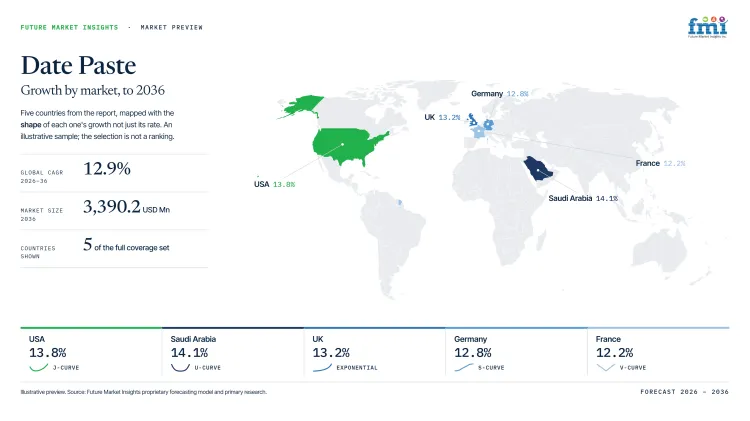
| Country | CAGR |
|---|---|
| UAE | 14.4% |
| Saudi Arabia | 14.1% |
| USA | 13.8% |
| South Korea | 13.5% |
| UK | 13.2% |
| Germany | 12.8% |
| Japan | 12.5% |
| France | 12.2% |
The eight profiled countries span 2.2 percentage points from UAE at 14.4% to France at 12.2%. UAE and Saudi Arabia form the upper Gulf band because crop access shortens sourcing before conversion. USA and South Korea follow through large processed-food channels. European markets and Japan depend more heavily on import qualification before industrial bakery approval.
- UAE processors use Dubai logistics to replenish Gulf bakery accounts without long inbound fruit routes.
- Saudi processors allocate seasonal fruit between premium table dates and derivative manufacturing inside large production clusters.
- US manufacturers can source California dates locally and national bakeries also qualify imported ingredient grades for standardized production programs.
- South Korean importers coordinate documents before local food manufacturers begin formulation trials with new date sources.
- UK distributors position date ingredients beside familiar sweetener systems during industrial bakery qualification programs nationwide.
- German bakeries face higher switching costs because standardized lines and long sugar contracts favor familiar inputs.
- Japanese importers require lot consistency and controlled documentation before overseas fruit ingredients enter bakery formulas.
- French bakers must preserve nutrition scores and sensory expectations before retailers accept reformulated products nationally.
Comparable CAGRs conceal different entry conditions because crop hubs and import markets carry different approval and replenishment costs. The full report provides country-level CAGR analysis across North America, Latin America, Europe, East Asia, South Asia, Oceania and the Middle East and Africa.
Country-wise Analysis
- UAE processors work close to domestic date farms and Dubai logistics, which shortens fruit handling before ingredient conversion for Gulf bakery accounts. Abu Dhabi Agriculture and Food Safety Authority issued a July 2025 guide covering 61 varieties, giving processors a formal reference for cultivar selection and production traits. By 2036 UAE is projected to grow at 14.4% CAGR because one processing base can serve domestic manufacturers and export accounts with shorter replenishment cycles. Cultivar breadth widens formulation choice but raises lot variability, so new entrants need blending rules and application records that hold moisture and color within industrial specifications consistently.
- Saudi date processors source from production clusters that feed domestic consumption and derivative manufacturing through the same seasonal intake. Adoption of date paste in Saudi Arabia is estimated to expand at 14.1% CAGR through 2036 given local processing depth. Saudi Press Agency documented in March 2026 that the Eastern Region had more than 26,000 farms and about 32 date-processing plants. Local crop access lowers sourcing risk but seasonal intake requires storage and blending discipline before bakeries approve repeat lots. Processors differentiate through industrial specifications and application support because abundant raw dates do not guarantee consistent bakery performance at commercial scale.
- US date paste demand comes from industrial bakeries that can source California dates locally and still qualify imported ingredient grades for national product lines. The FDA confirmed in February 2025 that its updated healthy nutrient-content rule took effect on April 28 2025, making added-sugar calculations more visible during reformulation. Date paste demand in USA is forecast to rise at 13.8% CAGR over the forecast period tied to bakery programs requiring tighter label review. Local fruit access eases sourcing but does not secure approval, so processors need trial data separating fruit-origin messaging from finished-product nutrition and commercial line behavior at scale.
- South Korean food manufacturers rely on imported date ingredients and local importers coordinate documentation before formulation begins. The Ministry of Food and Drug Safety amended food labeling standards in April 2025 and expanded mandatory nutrition labeling from January 2026. The amendment permits Korean stickers on certain foreign-language export foods, which can reduce preparation work for compliant shipments. In South Korea date paste demand is predicted to advance at 13.5% CAGR through 2036 helped by processed-food channels and clearer labeling procedures. Industrial customers still require detailed specifications and responsive local partners before approving deviations or repeat orders from a new processor.
- UK bakery manufacturers buy date paste through ingredient distributors, where sweetening claims compete directly with cost targets and finished-product advertising rules. Department of Health and Social Care guidance updated in June 2025 confirmed restrictions on paid online advertising and pre-9pm television advertising from January 5 2026. Date paste sales in UK are forecast to expand at 13.2% CAGR by 2036 because reformulation keeps alternative sweetening systems under review. Distributor access shortens commercial trials but health positioning remains constrained, so processors need documented bakery performance before new grades enter national product lines and secure repeat contracts with large national bakery accounts.
- German industrial bakers run standardized lines where ingredient changes must fit existing dough systems and documented quality procedures. Germany's federal food ministry published 2025 reduction targets in March and set an average salt target of 1.1 grams per 100 grams for packaged baked goods. Germany's date paste outlook is anticipated to advance at 12.8% CAGR over the assessment period attributable to packaged-bakery reformulation. Recipe targets increase trial activity but date paste needs stable hydration and browning performance before repeat orders begin. Local sugar suppliers retain an advantage if alternatives require excessive plant trials or line adjustments for large industrial bakeries.
- Japanese importers screen food ingredients through formal notification and inspection procedures before those materials reach industrial bakery customers. Japan's Ministry of Health Labour and Welfare issued its imported foods monitoring plan for fiscal 2025 on March 28 2025, defining the inspection route for imported foods. The Japan date paste sector is projected to record 12.5% CAGR during the assessment period since compliant fruit ingredients can enter premium bakery formats through established import procedures. Documentation gaps can delay performance trials, so competitive processors need import-ready records and consistent lots before sensory advantages influence commercial bakery selection during successful national product launches.
- French bakery demand pairs product differentiation with front-of-pack nutrition assessment that makes formulation changes visible to retailers and consumers. A March 2025 decree adopted the revised Nutri-Score presentation and calculation method with effect from March 16 2025. Date paste contributes fruit solids and sweetness but can also change total sugars and energy values in finished recipes. France is estimated to post 12.2% CAGR over the forecast period reflecting steady reformulation activity under tighter nutrition review. Processors entering France need formulation evidence that survives nutrition scoring and sensory review because ingredient origin alone cannot secure retailer acceptance at national commercial scale.
Who are the notable companies in the Date Paste Market?
Agthia Group PJSC, Al Barakah Dates Factory LLC, Boudjebel VACPA, Suhana Dates Factory, Horchani Dattes International, Al-Ahsa Food Industries Company, Sharmeen Foods Pvt Ltd, and GNS Pakistan Dates Factory.
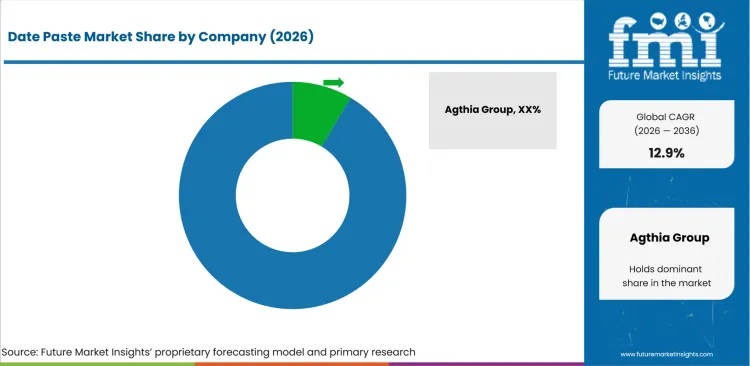
Competition centers on processors controlling date sourcing because industrial bakeries require specifications and process evidence before repeat production.
- Agthia Group PJSC and Al Barakah Dates Factory LLC pair Gulf processing bases with international distribution.
- Boudjebel VACPA, Horchani Dattes International and Suhana Dates Factory process specialized date ingredients under documented controls.
- Al-Ahsa Food Industries Company, Sharmeen Foods Pvt Ltd and GNS Pakistan Dates Factory operate integrated date-processing routes.
Competitive Benchmarking: Date Paste Market
| Company | Date-Derived Portfolio Breadth | Processing & Quality Control | Industrial Supply Reach | Geographic Reach |
|---|---|---|---|---|
| Agthia Group PJSC | High | High | High | Middle East and 45+ markets |
| Al Barakah Dates Factory LLC | High | High | High | UAE and 90+ export markets |
| Boudjebel VACPA | High | High | High | Tunisia and international markets |
| Suhana Dates Factory | High | High | High | Middle East, Europe, North America and Asia |
| Horchani Dattes International | High | High | High | Tunisia and 50+ export markets |
| Al-Ahsa Food Industries Company | Medium | High | Medium | Saudi Arabia and regional customers |
| Sharmeen Foods Pvt Ltd | High | High | High | Pakistan and 20+ export markets |
| GNS Pakistan Dates Factory | High | High | High | Pakistan and international customers |
Scoring basis: Portfolio breadth is High with paste plus three derivatives, Medium with two formats and Low with one route. Processing control is High with owned assets and quality-system evidence, Medium with one element and Low with outsourced conversion. Industrial reach is High for international B2B supply, Medium for selected export markets and Low for limited distribution.
Key Developments in the Date Paste Market
- In June 2026, Boudjebel VACPA completed a three-day SMETA audit with two minor non-conformities and gave manufacturers current ethical-sourcing evidence for bakery qualification.
- In February 2026, Al Barakah Dates Factory secured a commercial supply contract with Indonesia’s PT Savani Indo Makmur, expanding its date-syrup presence in the country’s beverage sector.
- In May 2026, Agthia Group PJSC reported that Al Foah broadened its Zadina portfolio during Q1 2026 with date-sweetened truffles and choco-dates, expanding its value-added date product range.
Key Players in the Date Paste Market
Integrated Gulf Date Processing Platforms
- Agthia Group PJSC
- Al Barakah Dates Factory LLC
- Al-Ahsa Food Industries Company
Date Ingredient Specialists
- Boudjebel VACPA
- Suhana Dates Factory
- Horchani Dattes International
Pakistan Date Processors
- Sharmeen Foods Pvt Ltd
- GNS Pakistan Dates Factory
Date Paste Market - Report Scope
| Coverage field | Report scope |
|---|---|
| Market breakdown | By product type, form, application, claim, sales channel and region. |
| Quantitative Units | USD Million. |
| Market Definition | Commercial date paste and the specified date-derived ingredient formats sold through qualified food-industry supply routes. Downstream finished-food revenue and substitute sweetener revenue are excluded. |
| Regions Covered | North America, Latin America, Western Europe, Eastern Europe, East Asia, South Asia and Pacific and Middle East and Africa. |
| Countries Covered | UAE, Saudi Arabia, USA, South Korea, UK, Germany, Japan, France, and 20+ countries included in the full report. |
| Key Companies Profiled | Agthia Group PJSC, Al Barakah Dates Factory LLC, Boudjebel VACPA, Suhana Dates Factory, Horchani Dattes International, Al-Ahsa Food Industries Company, Sharmeen Foods Pvt Ltd, and GNS Pakistan Dates Factory. |
| Forecast Period | 2026 to 2036. |
| Approach | Primary and secondary research with market triangulation. |
Date Paste Market - Research Methodology
| Method | Approach |
|---|---|
| Primary Research | FMI analysts gathered input from manufacturers, service providers, technology developers, distributors, end users, procurement teams, and subject-matter experts. Interviews examined purchasing decisions, product or service evaluation, adoption barriers, approval requirements, pricing considerations, and expectations for technical or commercial support. Respondents were also asked what evidence is required before a trial, pilot, or initial order develops into regular purchasing. |
| Desk Research | Desk research covered government statistics, regulatory publications, trade data, industry associations, technical literature, standards, company filings, product information, and official corporate announcements. Sources were reviewed for relevance, publication date, geographic coverage, and consistency with the defined market scope. Claims relating to performance, applications, approvals, capacity, investment, and commercial activity were retained only when supported by credible public evidence. |
| Market Sizing and Forecasting | The market model combined the baseline value with historical performance, segment structure, pricing and volume indicators, adoption levels, company participation, and country-level demand conditions. Forecast assumptions considered economic activity, investment trends, regulatory developments, technology adoption, purchasing cycles, supply availability, and barriers to wider market use. Segment and regional estimates were reconciled before the final market total was calculated. |
| Data Validation | Estimates were checked against multiple independent indicators, including public data, company activity, trade patterns, industry developments, and findings from primary interviews. Validation also tested whether products, services, applications, and company revenues fell within the defined market boundaries. Adjacent categories, unsupported claims, overlapping revenues, and activities without direct market relevance were excluded to reduce double counting and maintain consistency across segments and countries. |
Date Paste Market by Segments
Date Paste Market segmented by Product Type:
- Date paste
- Date syrup blends
- Diced & macerated dates
- Organic lines
Date Paste Market segmented by Form:
- Powder - dry
- Liquid
- Paste / semi-solid
- Granules / pieces
Date Paste Market segmented by Application:
- Bread & rolls
- Cakes & muffins
- Biscuits & cookies
- Viennoiserie & pastry
- Other bakery & snacks
Date Paste Market segmented by Claim:
- Conventional
- Clean label
- Organic
- Non-GMO / identity preserved
Date Paste Market segmented by Sales Channel:
- Direct to industrial bakeries
- Ingredient distributors
- Foodservice & artisan supply
- Online B2B
Date Paste Market by Region:
- North America
- United States
- Canada
- Latin America
- Brazil
- Mexico
- Chile
- Rest of Latin America
- Western Europe
- Germany
- United Kingdom
- Italy
- Spain
- France
- Nordics
- Benelux
- Rest of Western Europe
- Eastern Europe
- Russia
- Poland
- Hungary
- Balkan and Baltic States
- Rest of Eastern Europe
- East Asia
- China
- Japan
- South Korea
- South Asia and Pacific
- India
- ASEAN
- Australia and New Zealand
- Rest of South Asia and Pacific
- Middle East and Africa
- Kingdom of Saudi Arabia
- Other GCC Countries
- Türkiye
- South Africa
- Other African Union Countries
- Rest of Middle East and Africa
Research Sources and Bibliography
- Emirates News Agency. (2026, April 27). Mohammed bin Rashid visits world's largest privately owned dates factory at Dubai Industrial City
- Saudi Press Agency. (2026, April 25). Saudi date exports hit record SAR1.9 billion in 2025, up 14.3%
- Emirates News Agency. (2025, June 22). With exports to more than 90 countries, Al Barakah Dates Factory serves as leading model for growth, expansion of innovative food industries in Dubai
- Pakistan Horticulture Development & Export Company. (2025, November). FoodAg Pakistan 2025 exhibitors directory for horticulture sector
- dsm-firmenich. (2025, May 20). On the rise: dsm-firmenich opens state-of-the-art Princeton Baking Innovation Center in Princeton, NJ
- Boudjebel VACPA. (2026, April 10). BIOFACH 2026: Showcasing our organic date ingredients expertise
- Cargill. (2025, March 4). Cargill showcases food innovation at AAHAR 2025
- Federal Ministry of Food and Agriculture, Germany. (2025, March 24). Fragen und Antworten zur Nationalen Reduktions- und Innovationsstrategie
- Boudjebel VACPA. (2025, January 28). Boudjebel and ESIAT unite to elevate Tunisia's date industry
- Abu Dhabi Media Office. (2025, July 24). Abu Dhabi Agriculture and Food Safety Authority issues scientific and practical guide on date varieties in the emirate
- Saudi Press Agency. (2026, March 7). Palm trees and dates: 16 Eastern Region varieties dominate markets during Ramadan
- USA Food and Drug Administration. (2025, February 24). FDA finalizes updated 'Healthy' nutrient content claim
- Ministry of Food and Drug Safety, South Korea. (2025, April 21). Partial amendment to Food Labeling Standards, Notice No. 2025-27
- Department of Health and Social Care, United Kingdom. (2025, June 4). Restricting advertising of less healthy food or drink on TV and online: products in scope
- Federal Ministry of Food and Agriculture, Germany. (2025, March 24). Nationale Reduktions- und Innovationsstrategie für Zucker, Fette und Salz in Fertigprodukten
- Ministry of Health, Labour and Welfare, Japan. (2025, March 28). Imported Foods Monitoring Plan for FY 2025
- Légifrance. (2025, March 14). Arrêté du 14 mars 2025 fixant la forme de présentation complémentaire à la déclaration nutritionnelle recommandée par l'Etat
- Boudjebel VACPA. (2026, June 18). Boudjebel successfully completes SMETA audit with outstanding results
- Emirates News Agency. (2026, February 13). Dubai Chamber of Commerce supports Al Barakah Dates expansion in Indonesia
- Pakistan Horticulture Development & Export Company. (2025, November). Product-Wise Horticulture Companies Directory for FoodAg 2025
- Agthia Group PJSC. (2026, April). Agthia Integrated Report 2025
- Horchani Group. (2025, August). Tunisian date crop report 2024-2025
- Saudi Exchange. (2025, May 11). Ayyan Investment Company condensed consolidated interim financial statements for the three months ended March 31, 2025
- Tate & Lyle. (2026, February 23). Introducing Yume: A new standard for sweetness
- BENEO. (2025, September 18). BENEO secures first-ever Thai FDA approval for exclusive prebiotic claim
- Roquette. (2025, October 31). AMYSTA L 123, the new label-friendly soluble pea starch
- Kerry. (2025, September 30). Kerry launches Smart Taste to help customers navigate market complexities without compromising on taste
- Corbion. (2025, April 21). Corbion unveils Verdad Essence WH100: Redefining natural mold inhibition for bakers
- Ingredion. (2025, April 29). PureCircle by Ingredion first to achieve Farm Sustainability Assessment Silver performance level for 100% of stevia supply
- IFF. (2025, August 13). IFF launches POWERFRESH ACE 2000, a bread fresh-keeping solution that 'aces' the shelf-life test
- Puratos. (2025, May 7). Puratos brings a trio of transformative innovations to iba 2025
- Agthia Group PJSC. (2026, May). Q1 2026 management discussion and analysis report
This bibliography is provided for reader reference and is not exhaustive. The full report contains the complete reference list and detailed citations.
This Report Answers
- What is the 2026 and 2036 date paste market size?
- What converts date paste trials into repeat orders?
- Why does date paste lead product type?
- Why does powder - dry lead form?
- Why do bread & rolls lead application?
- How do profiled country growth rates differ?
- Which companies process date paste ingredients?
- What limits direct sweetener substitution?
Frequently Asked Questions
How big is the date paste market in 2026?
The date paste market is valued at USD 1,007.6 million in 2026 and is projected to reach USD 3,390.2 million by 2036. Bakery reformulation supports growth once industrial grades maintain moisture control and line performance.
What is the CAGR of the date paste market from 2026 to 2036?
The date paste market is projected to grow at a CAGR of 12.9% between 2026 and 2036. Bakery trials support expansion once manufacturers confirm moisture control and repeatable process behavior.
Which product type leads the date paste market?
The date paste segment is expected to hold 36.0% of the date paste market in 2026, driven by semi-solid handling suited to sweetening and filling applications. Stable depositing behavior supports repeat industrial use after bakery qualification confirms commercial line performance reliably.
Which countries are projected to record the highest growth in the date paste market?
UAE is projected to grow at 14.4% CAGR, followed by Saudi Arabia at 14.1% and USA at 13.8% through 2036. Raw-date access and import qualification produce different routes into repeat bakery orders.
Which companies are active in the date paste market?
Key companies operating in the date paste market include Agthia Group PJSC, Al Barakah Dates Factory LLC, Boudjebel VACPA, Suhana Dates Factory, Horchani Dattes International, Al-Ahsa Food Industries Company, Sharmeen Foods Pvt Ltd, and GNS Pakistan Dates Factory. Processing controls and export reach distinguish them.
Preview the report firsthand - request a free sample
Get SampleGet the brochure for pricing and purchase details.
Get PDFTable of Content
- Key Takeaways
- Market Size and CAGR
- Top Growth Driver
- Fastest Growing Segment
- Leading Region
- Key Companies
- Emerging Opportunities
- Executive Summary
- Global Market Outlook
- Demand-side Trends
- Supply-side Trends
- Technology Roadmap Analysis
- Analysis and Recommendations
- Analyst Perspective (What is happening? Why now? What should investors know?)
- Key Questions Answered
- How large is the market?
- What is the CAGR?
- What are key trends?
- Which region dominates?
- Who are the leaders?
- Market Overview
- Market Coverage / Taxonomy
- Market Definition / Scope / Limitations
- Research Methodology
- Chapter Orientation
- Analytical Lens and Working Hypotheses
- Market Structure, Signals, and Trend Drivers
- Benchmarking and Cross-market Comparability
- Market Sizing, Forecasting, and Opportunity Mapping
- Research Design and Evidence Framework
- Desk Research Programme (Secondary Evidence)
- Expert Input and Fieldwork (Primary Evidence)
- Tooling, Models, and Reference Databases
- Data Engineering and Model Build
- Quality Assurance and Audit Trail
- Market Background
- Market Dynamics (Drivers, Restraints, Opportunity, Trends)
- Scenario Forecast (Optimistic, Likely, Conservative)
- Impact Analysis
- AI Impact
- Sustainability Impact
- Regulatory Impact
- Technology Impact
- Consumer / Buyer Analysis
- Purchase Drivers
- Adoption Barriers
- Buyer Journey
- Opportunity Map Analysis
- Product Life Cycle Analysis
- Supply Chain Analysis
- Investment Feasibility Matrix
- Value Chain Analysis
- PESTLE and Porter's Analysis
- Regulatory Landscape
- Regional Parent Market Outlook
- Production and Consumption Statistics
- Import and Export Statistics
- Global Market Analysis and Forecast, 2021 to 2036
- Historical Market Size Value (USD Million) Analysis, 2021 to 2025
- Current and Future Market Size Value (USD Million) Projections, 2026 to 2036
- Y-o-Y Growth Trend Analysis
- Absolute $ Opportunity Analysis
- Global Market Pricing Analysis, 2021 to 2036
- Global Market Analysis and Forecast, By Product Type, 2021 to 2036
- Introduction / Key Findings
- Historical Market Size Value (USD Million) Analysis By Product Type, 2021 to 2025
- Current and Future Market Size Value (USD Million) Analysis and Forecast By Product Type, 2026 to 2036
- Date paste
- Date syrup blends
- Diced & macerated dates
- Organic lines
- Date paste
- Y-o-Y Growth Trend Analysis By Product Type, 2021 to 2025
- Absolute $ Opportunity Analysis By Product Type, 2026 to 2036
- Global Market Analysis and Forecast, By Form, 2021 to 2036
- Introduction / Key Findings
- Historical Market Size Value (USD Million) Analysis By Form, 2021 to 2025
- Current and Future Market Size Value (USD Million) Analysis and Forecast By Form, 2026 to 2036
- Powder / dry
- Liquid
- Paste / semi-solid
- Granules / pieces
- Powder / dry
- Y-o-Y Growth Trend Analysis By Form, 2021 to 2025
- Absolute $ Opportunity Analysis By Form, 2026 to 2036
- Global Market Analysis and Forecast, By Application, 2021 to 2036
- Introduction / Key Findings
- Historical Market Size Value (USD Million) Analysis By Application, 2021 to 2025
- Current and Future Market Size Value (USD Million) Analysis and Forecast By Application, 2026 to 2036
- Bread & rolls
- Cakes & muffins
- Biscuits & cookies
- Viennoiserie & pastry
- Other bakery & snacks
- Bread & rolls
- Y-o-Y Growth Trend Analysis By Application, 2021 to 2025
- Absolute $ Opportunity Analysis By Application, 2026 to 2036
- Global Market Analysis and Forecast, By Claim, 2021 to 2036
- Introduction / Key Findings
- Historical Market Size Value (USD Million) Analysis By Claim, 2021 to 2025
- Current and Future Market Size Value (USD Million) Analysis and Forecast By Claim, 2026 to 2036
- Conventional
- Clean label
- Organic
- Non-GMO / identity preserved
- Conventional
- Y-o-Y Growth Trend Analysis By Claim, 2021 to 2025
- Absolute $ Opportunity Analysis By Claim, 2026 to 2036
- Global Market Analysis and Forecast, By Sales Channel, 2021 to 2036
- Introduction / Key Findings
- Historical Market Size Value (USD Million) Analysis By Sales Channel, 2021 to 2025
- Current and Future Market Size Value (USD Million) Analysis and Forecast By Sales Channel, 2026 to 2036
- Direct to industrial bakeries
- Ingredient distributors
- Foodservice & artisan supply
- Online B2B
- Direct to industrial bakeries
- Y-o-Y Growth Trend Analysis By Sales Channel, 2021 to 2025
- Absolute $ Opportunity Analysis By Sales Channel, 2026 to 2036
- Global Market Analysis and Forecast, By Region, 2021 to 2036
- Introduction
- Historical Market Size Value (USD Million) Analysis By Region, 2021 to 2025
- Current Market Size Value (USD Million) Analysis and Forecast By Region, 2026 to 2036
- North America
- Latin America
- Western Europe
- Eastern Europe
- East Asia
- South Asia and Pacific
- Middle East & Africa
- Market Attractiveness Analysis By Region
- North America Market Analysis and Forecast, By Country, 2021 to 2036
- Historical Market Size Value (USD Million) Trend Analysis By Market Taxonomy, 2021 to 2025
- Market Size Value (USD Million) Forecast By Market Taxonomy, 2026 to 2036
- By Country
- USA
- Canada
- By Product Type
- By Form
- By Application
- By Claim
- By Sales Channel
- By Country
- Market Attractiveness Analysis
- By Country
- By Product Type
- By Form
- By Application
- By Claim
- By Sales Channel
- Key Takeaways
- Latin America Market Analysis and Forecast, By Country
- Historical Market Size Value (USD Million) Trend Analysis By Market Taxonomy, 2021 to 2025
- Market Size Value (USD Million) Forecast By Market Taxonomy, 2026 to 2036
- By Country
- Brazil
- Mexico
- Chile
- Rest of Latin America
- By Product Type
- By Form
- By Application
- By Claim
- By Sales Channel
- By Country
- Market Attractiveness Analysis
- By Country
- By Product Type
- By Form
- By Application
- By Claim
- By Sales Channel
- Key Takeaways
- Western Europe Market Analysis and Forecast, By Country
- Historical Market Size Value (USD Million) Trend Analysis By Market Taxonomy, 2021 to 2025
- Market Size Value (USD Million) Forecast By Market Taxonomy, 2026 to 2036
- By Country
- Germany
- UK
- Italy
- Spain
- France
- Nordic
- BENELUX
- Rest of Western Europe
- By Product Type
- By Form
- By Application
- By Claim
- By Sales Channel
- By Country
- Market Attractiveness Analysis
- By Country
- By Product Type
- By Form
- By Application
- By Claim
- By Sales Channel
- Key Takeaways
- Eastern Europe Market Analysis and Forecast, By Country
- Historical Market Size Value (USD Million) Trend Analysis By Market Taxonomy, 2021 to 2025
- Market Size Value (USD Million) Forecast By Market Taxonomy, 2026 to 2036
- By Country
- Russia
- Poland
- Hungary
- Balkan & Baltic
- Rest of Eastern Europe
- By Product Type
- By Form
- By Application
- By Claim
- By Sales Channel
- By Country
- Market Attractiveness Analysis
- By Country
- By Product Type
- By Form
- By Application
- By Claim
- By Sales Channel
- Key Takeaways
- East Asia Market Analysis and Forecast, By Country
- Historical Market Size Value (USD Million) Trend Analysis By Market Taxonomy, 2021 to 2025
- Market Size Value (USD Million) Forecast By Market Taxonomy, 2026 to 2036
- By Country
- China
- Japan
- South Korea
- By Product Type
- By Form
- By Application
- By Claim
- By Sales Channel
- By Country
- Market Attractiveness Analysis
- By Country
- By Product Type
- By Form
- By Application
- By Claim
- By Sales Channel
- Key Takeaways
- South Asia and Pacific Market Analysis and Forecast, By Country
- Historical Market Size Value (USD Million) Trend Analysis By Market Taxonomy, 2021 to 2025
- Market Size Value (USD Million) Forecast By Market Taxonomy, 2026 to 2036
- By Country
- India
- ASEAN
- Australia & New Zealand
- Rest of South Asia and Pacific
- By Product Type
- By Form
- By Application
- By Claim
- By Sales Channel
- By Country
- Market Attractiveness Analysis
- By Country
- By Product Type
- By Form
- By Application
- By Claim
- By Sales Channel
- Key Takeaways
- Middle East & Africa Market Analysis and Forecast, By Country
- Historical Market Size Value (USD Million) Trend Analysis By Market Taxonomy, 2021 to 2025
- Market Size Value (USD Million) Forecast By Market Taxonomy, 2026 to 2036
- By Country
- Kingdom of Saudi Arabia
- Other GCC Countries
- Türkiye
- South Africa
- Other African Union
- Rest of Middle East & Africa
- By Product Type
- By Form
- By Application
- By Claim
- By Sales Channel
- By Country
- Market Attractiveness Analysis
- By Country
- By Product Type
- By Form
- By Application
- By Claim
- By Sales Channel
- Key Takeaways
- Key Countries Market Analysis
- USA
- Pricing Analysis
- Market Share Analysis, 2025
- By Product Type
- By Form
- By Application
- By Claim
- By Sales Channel
- Canada
- Pricing Analysis
- Market Share Analysis, 2025
- By Product Type
- By Form
- By Application
- By Claim
- By Sales Channel
- Mexico
- Pricing Analysis
- Market Share Analysis, 2025
- By Product Type
- By Form
- By Application
- By Claim
- By Sales Channel
- Brazil
- Pricing Analysis
- Market Share Analysis, 2025
- By Product Type
- By Form
- By Application
- By Claim
- By Sales Channel
- Chile
- Pricing Analysis
- Market Share Analysis, 2025
- By Product Type
- By Form
- By Application
- By Claim
- By Sales Channel
- Germany
- Pricing Analysis
- Market Share Analysis, 2025
- By Product Type
- By Form
- By Application
- By Claim
- By Sales Channel
- UK
- Pricing Analysis
- Market Share Analysis, 2025
- By Product Type
- By Form
- By Application
- By Claim
- By Sales Channel
- Italy
- Pricing Analysis
- Market Share Analysis, 2025
- By Product Type
- By Form
- By Application
- By Claim
- By Sales Channel
- Spain
- Pricing Analysis
- Market Share Analysis, 2025
- By Product Type
- By Form
- By Application
- By Claim
- By Sales Channel
- France
- Pricing Analysis
- Market Share Analysis, 2025
- By Product Type
- By Form
- By Application
- By Claim
- By Sales Channel
- India
- Pricing Analysis
- Market Share Analysis, 2025
- By Product Type
- By Form
- By Application
- By Claim
- By Sales Channel
- ASEAN
- Pricing Analysis
- Market Share Analysis, 2025
- By Product Type
- By Form
- By Application
- By Claim
- By Sales Channel
- Australia & New Zealand
- Pricing Analysis
- Market Share Analysis, 2025
- By Product Type
- By Form
- By Application
- By Claim
- By Sales Channel
- China
- Pricing Analysis
- Market Share Analysis, 2025
- By Product Type
- By Form
- By Application
- By Claim
- By Sales Channel
- Japan
- Pricing Analysis
- Market Share Analysis, 2025
- By Product Type
- By Form
- By Application
- By Claim
- By Sales Channel
- South Korea
- Pricing Analysis
- Market Share Analysis, 2025
- By Product Type
- By Form
- By Application
- By Claim
- By Sales Channel
- Russia
- Pricing Analysis
- Market Share Analysis, 2025
- By Product Type
- By Form
- By Application
- By Claim
- By Sales Channel
- Poland
- Pricing Analysis
- Market Share Analysis, 2025
- By Product Type
- By Form
- By Application
- By Claim
- By Sales Channel
- Hungary
- Pricing Analysis
- Market Share Analysis, 2025
- By Product Type
- By Form
- By Application
- By Claim
- By Sales Channel
- Kingdom of Saudi Arabia
- Pricing Analysis
- Market Share Analysis, 2025
- By Product Type
- By Form
- By Application
- By Claim
- By Sales Channel
- Türkiye
- Pricing Analysis
- Market Share Analysis, 2025
- By Product Type
- By Form
- By Application
- By Claim
- By Sales Channel
- South Africa
- Pricing Analysis
- Market Share Analysis, 2025
- By Product Type
- By Form
- By Application
- By Claim
- By Sales Channel
- USA
- Market Structure Analysis
- Competition Dashboard
- Competition Benchmarking
- Market Share Analysis of Top Players
- By Regional
- By Product Type
- By Form
- By Application
- By Claim
- By Sales Channel
- Emerging Startups
- Innovation Benchmarking
- Competition Analysis
- Competition Deep Dive
- Agthia Group
- Overview
- Product Portfolio
- Profitability by Market Segments
- Sales Footprint
- Strategy Overview
- Marketing Strategy
- Product Strategy
- Channel Strategy
- Tate & Lyle
- Ingredion
- Roquette
- BENEO
- Sudzucker
- Nordzucker
- ASR Group
- Cargill
- Ragus
- Agthia Group
- Case Studies
- Success Stories
- Recent Developments
- Competition Deep Dive
- Assumptions & Acronyms Used


