

- Market Size (2026)
- USD 194.2 Mn
- Forecast (2036)
- USD 396.5 Mn
- CAGR (2026 to 2036)
- 7.4%
How big is Deactivated Yeast Market in 2026?
USD 194.2 million in 2026 and USD 396.5 million by 2036 at a 7.4% CAGR.
The deactivated yeast market is projected to expand from USD 194.2 million in 2026 to USD 396.5 million by 2036 at 7.4% CAGR. Industrial bakeries assign value to industrial bakery ingredients that keep sheeting and molding behavior inside a stable operating window. In June 2025, Lesaffre and MicroBioGen established a worldwide yeast-technology partnership focused initially on baking, food and biochemicals. The agreement gives Lesaffre access to additional strain-development work for bakery applications and broadens the technical base behind yeast-derived functional ingredients.
Import dependence changes how the technical case converts into orders because local stock and service determine replenishment risk. UAE is forecast at 8.8% CAGR while UK is projected at 7.5% during the 2026-2036 period. USDA Foreign Agricultural Service documented in April 2025 that UAE strategic grain reserves cover three to six months of basic food commodities. The reserve policy makes local inventory more valuable for commercial yeast products while mature UK bakeries face stricter cost comparisons.
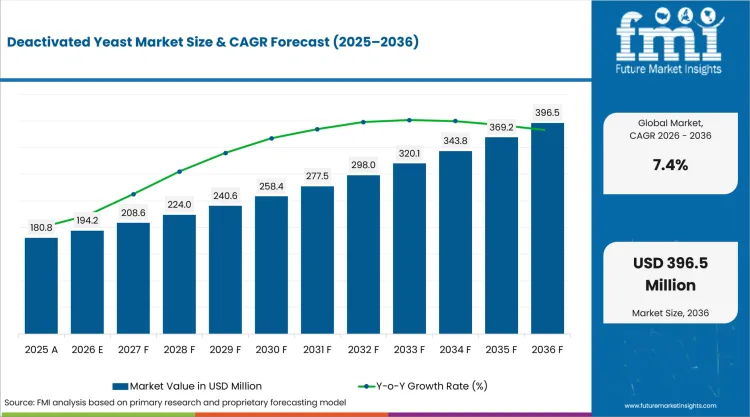
Key Takeaways of Deactivated Yeast Market
- Industrial bakeries use deactivated yeast where controlled gluten reduction improves dough handling without introducing additional fermentative lift during processing.
- Based on type, cream - liquid yeast is projected to account for 35.0% in 2026 due to pumpable dosing on larger industrial bakery lines.
- By form, powder - dry is estimated to hold 40.0% in 2026 owing to longer storage and simpler distribution between production sites.
- Bread & rolls is set to lead the application category with 35.0% share in 2026 due to repeated dough-handling steps on mechanized lines.
- Formulation sensitivity slows switching because excessive reducing action can weaken dough structure and extend plant qualification before routine purchasing begins.
- Some of the key players in this market include Lesaffre, Lallemand Inc., AB Mauri, Angel Yeast Co., Ltd., Puratos Group, dsm-firmenich, ICL Food Specialties, and Jungbunzlauer.
Analyst Perspective
"Industrial bakeries should judge deactivated yeast by how consistently it changes dough resistance under the flour lots used in normal production. The commercial test is whether a validated dose reduces handling variation without weakening structure or raising total formulation cost after qualification."
- Nandini Roy Choudhury, Principal Consultant, Future Market Insights
How is the Deactivated Yeast Market segmented?
The deactivated yeast market is segmented by type, form, application, claim, sales channel and region.
The deactivated yeast market is segmented by type, form, application, claim and sales channel within the regional analysis. Type includes cream - liquid yeast, compressed, active dry and specialty strains, while form covers powder - dry, liquid, paste / semi-solid and granules / pieces. Application coverage includes bread & rolls, cakes & muffins, biscuits & cookies, viennoiserie & pastry and other bakery & snacks. Claim covers conventional, clean label, organic and non-GMO / identity preserved, while sales channels include direct industrial sales, distributors, foodservice supply and online B2B.
Why does Powder - Dry lead demand within the Form category?
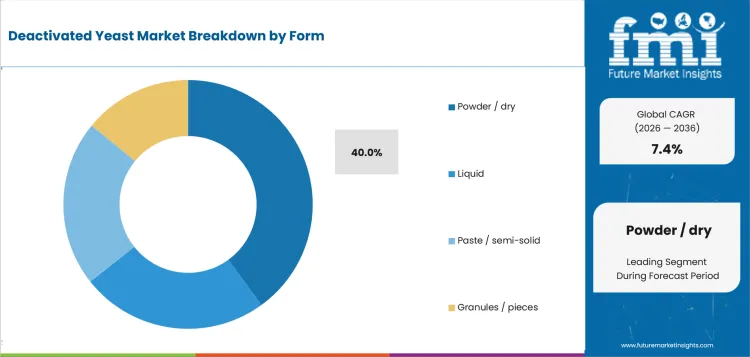
Powder - dry formats suit accounts that need longer storage windows and simpler transfers between warehouses or production sites. The format also fits weighed dry-ingredient systems that avoid dedicated liquid handling equipment and use one central ingredient warehouse efficiently for regional accounts.
- By form, powder - dry is forecast to represent 40.0% in 2026 driven by longer storage and simpler transfers between production sites.
- ISO published ISO 23983:2025 in September 2025 covering fresh and dry baker's yeast characteristics. The standard gives organic yeast producers a current operating reference for dry-format properties without proving the modelled deactivated-yeast share.
Why does Cream - liquid yeast lead demand within the Type category?
Cream - liquid yeast fits plants that automate ingredient transfer and require uniform mixer dosing during long production runs. Refrigerated delivery narrows the practical service radius from regional yeast plants serving distant industrial bakery customers. Specialty yeast products compete for the same technical service resources inside large fermentation portfolios serving industrial bakeries during routine qualification.
- Based on type, cream - liquid yeast is projected to account for 35.0% in 2026 due to automated dosing on high-volume bakery lines.
- Angel Yeast presented its proprietary Liquid Yeast technology at Bakery China in May 2025, confirming current industrial interest in pumpable yeast handling for bakery applications.
Why do Bread & Rolls lead demand within the Application category?
Bread lines expose elasticity problems repeatedly because dividing and molding occur at industrial cadence during every production shift. Deactivated yeast can be tested against measurable line behavior under the same flour and process settings used for competing improvers during routine plant qualification at scale.
- In 2026, bread & rolls is expected to lead application with 35.0% share because industrial lines compare bread improvers and yeast-derived conditioners during repeated dough-handling steps.
- AB Mauri described the launch of its INNOVA 360° BIENESTAR bread premix range in its 2025 annual-report material, confirming continued product development for industrial bread formulations.
Why does Direct to Industrial bakeries lead demand within the Sales Channel category?
Direct technical selling fits deactivated yeast because commercial orders follow a dose trial under the bakery's own flour and line settings. Large bakeries expect a clear route from laboratory screening to plant troubleshooting before quality and R&D staff approve a specification for routine purchasing.
- Direct to industrial bakeries is estimated to hold 58.0% of sales channel in 2026 owing to trial support and specification work before routine replenishment.
- In May 2025, dsm-firmenich opened its Princeton Baking Innovation Center to place bakery application work closer to North American customers. The investment confirms bakery enzymes and other functional systems compete on application support near industrial customers.
What are the drivers, restraints and opportunities in the Deactivated Yeast Market?
Industrial bakeries need controlled dough relaxation, formulation variability extends qualification, and broader bakery application support can convert successful trials into routine industrial orders.
- Driver: High-throughput bread plants value ingredients that reduce excessive dough resistance without changing the leavening culture used for fermentation.
- Restraint: Flour variation and dose sensitivity can extend qualification because excessive reducing action weakens structure instead of improving machinability.
- Opportunity: Companies with bakery laboratories and local technical teams can turn formulation trials into repeat purchasing for defined industrial recipes.
Flour variability makes dough-conditioning performance a plant-level question because the same dose can behave differently as crop characteristics change. In June 2026, Puratos opened a Flour Competence Center to analyze crop-related changes that alter dough behavior and process stability. The facility gives flour improver systems and deactivated yeast a stronger trial basis by separating flour variation from ingredient performance before recipe approval.
Cost pressure already narrows tolerance for formulation changes, and USDA Foreign Agricultural Service documented continuing UK processor cost and sourcing pressure in March 2026. Deactivated yeast must therefore improve line handling without adding a premium that finished-product economics cannot recover. Qualification slows if dough improver formulations cannot protect throughput and finished quality under the plant's normal flour and operating conditions.
Industrial bakeries assign one formulation budget to several ingredients that can alter dough behavior or finished-product consistency. Application teams gain room to sell deactivated yeast once trials isolate a line problem against competing conditioners. ICL reported in May 2026 that its January Bartek acquisition expanded food-grade acidulant exposure to bakery customers. The overlap means clean-label ingredients and yeast-derived conditioners must each document a line-level advantage before winning formulation attention.
Which country CAGRs are profiled in the Deactivated Yeast Market?
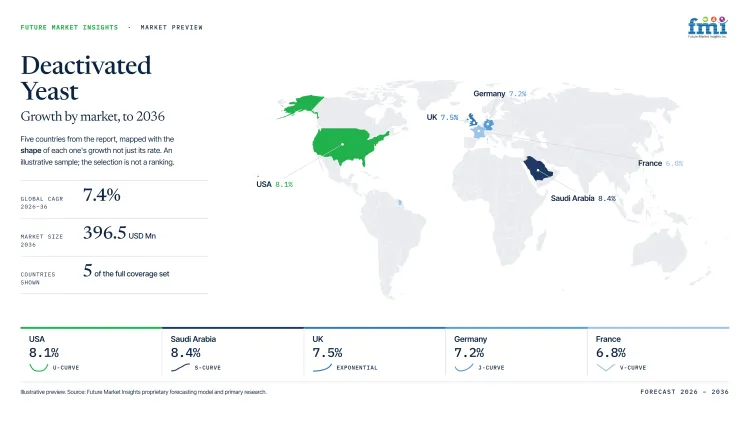
| Country | CAGR |
|---|---|
| Saudi Arabia | 8.4% |
| USA | 8.1% |
| UK | 7.5% |
| Germany | 7.2% |
| France | 6.8% |
How do country-level CAGRs compare in the Deactivated Yeast Market?
The profiled countries occupy a 1.6-point band between Saudi Arabia at 8.4% and France at 6.8%. Saudi Arabia and the USA form the upper pair, while the UK and Germany occupy the lower-middle range. France marks the lower edge, making service distance, market access, and qualification costs more decisive during early commercial country selection.
- Saudi Arabia favors agent-led entry as registration work and regional inventory shape bakery ingredient qualification.
- USA makes plant economics decisive because familiar conditioner options give bakery teams several trial benchmarks.
- UK bakery groups test cost-in-use as retailer pressure forces bakery ingredient systems to justify production savings.
- Germany emphasizes importer documentation since food-safety and compliance records are important for traceable qualification of deactivated yeast ingredients.
- France yeast ingredient suppliers compete on sourcing efficiency as bakery applications require consistent ingredient performance and supply economics.
The full report provides country-level CAGR analysis across North America, Latin America, Europe, East Asia, South Asia, Oceania and the Middle East and Africa.
Country-wise Analysis
- Saudi industrial bakeries often qualify imported functional ingredients through local agents that manage registration records and replenishment for production sites. General Authority for Statistics recorded a 12.9% annual increase in food-product manufacturing during September 2025, confirming stronger domestic processing activity. Saudi Arabia is estimated to post 8.4% CAGR over the forecast period aided by processing growth and established import routes for food ingredients. Registration work and uneven regional inventory can extend qualification, so manufacturers need local partners that can protect supply while technical trials are underway. The fastest conversions should come from accounts where the agent can coordinate documentation and bakery application support in one commercial route directly.
- USA industrial bakeries test yeast-derived conditioners against mature reducing-agent and enzyme systems under normal line conditions before changing a current product specification. USDA National Agricultural Statistics Service recorded 222 million bushels of wheat ground for flour during the first quarter of 2026. Deactivated yeast demand in USA is forecast to rise at 8.1% CAGR over the forecast period shaped by large flour throughput and extensive bakery technical-service networks. Familiar alternatives keep cost-in-use scrutiny high, which means a new yeast-derived conditioner must justify dose efficiency and repeatable line behavior during trials. Plant qualification therefore depends on measured production evidence instead of broad ingredient positioning or corporate scale alone.
- UK industrial bakeries operate under retailer-led reformulation pressure while manufacturers defend margin against higher labor and ingredient costs in bread production. The UK deactivated yeast sector is anticipated to advance at 7.5% CAGR over the assessment period attributable to continuing reformulation work and strong bakery technical capability. USDA Foreign Agricultural Service projected food-manufacturing cost increases of 2.9% for 2025 in its March report. Tight cost hurdles mean functional ingredients must recover any premium through fewer handling losses or another measurable production benefit. Companies with application laboratories can therefore defend deactivated yeast more effectively than firms relying on ingredient claims alone during qualification.
- German processors rely on imported food inputs and ingredient distributors that manage customs records, labeling requirements and technical communication with bakery manufacturers. Germany is projected to record 7.2% CAGR during the assessment period, supported by its mature food-processing base and established ingredient distribution channels. Deactivated yeast suppliers must address strict product documentation and traceability expectations before bakery manufacturers approve new functional ingredients. Detailed origin records, specifications and application data can lengthen qualification, where customers require consistent sourcing. Growth therefore depends not only on bakery demand but also on distributors that can coordinate compliance documentation and technical support efficiently throughout customer formulation trials and specification reviews for customers.
- French industrial bakeries operate under cost and reformulation pressure while manufacturers balance ingredient performance with retailer expectations for bread quality. The France deactivated yeast sector is anticipated to advance at 6.8% CAGR over the assessment period, supported by established bakery production and ingredient optimization. Functional ingredients must demonstrate reliable performance and justify any premium through dose efficiency, process stability or reduced production losses. Established alternatives keep qualification standards high, so suppliers need application data that shows measurable benefits under line conditions. Companies with local technical support can therefore position deactivated yeast more effectively than firms relying on ingredient claims alone during trials.
Who are the notable companies in the Deactivated Yeast Market?
Lesaffre, Lallemand Inc., AB Mauri, Angel Yeast Co., Ltd., Puratos Group, dsm-firmenich, ICL Food Specialties, and Jungbunzlauer serve the deactivated yeast and competing bakery-conditioning field.
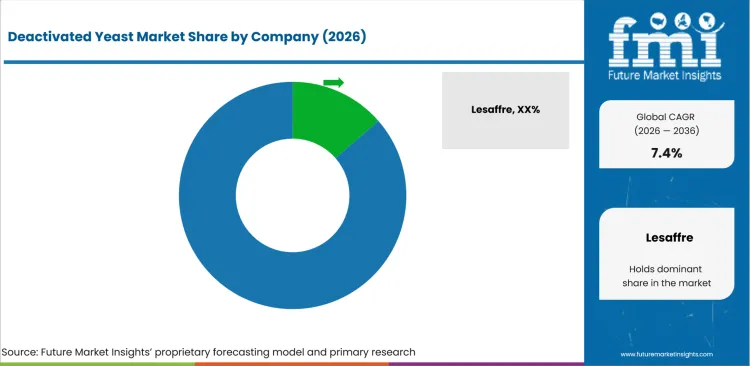
The competitive outlook separates direct yeast platforms from companies selling functional bakery ingredients against the same dough-performance budget. Lesaffre, Lallemand Inc., AB Mauri and Angel Yeast control fermentation assets and bakery application knowledge. Puratos Group and dsm-firmenich compete through application centers and broader formulation systems that address flour and dough performance. ICL Food Specialties and Jungbunzlauer remain adjacent competitors because their acidulants, minerals and texturants enter industrial bakery qualification. Entry therefore depends on evidence from plant trials and commercial service coverage instead of company scale alone.
- Yeast-centered platforms: Lesaffre, Lallemand Inc., AB Mauri and Angel Yeast Co., Ltd. pair fermentation scale with yeast-derived ingredients and direct bakery relationships.
- Bakery application specialists: Puratos Group and dsm-firmenich compete where formulation support and technical centers influence trial conversion.
- Adjacent functional-ingredient specialists: ICL Food Specialties and Jungbunzlauer compete for bakery formulation budgets through acids, minerals and texturants.
Competitive Benchmarking: Deactivated Yeast Market
| Company | Yeast & Fermentation Position | Bakery Application Support | Functional Ingredient Breadth | Geographic Reach |
|---|---|---|---|---|
| Lesaffre | High | High | High | Global |
| Lallemand Inc. | High | High | High | Global |
| AB Mauri | High | High | High | Global |
| Angel Yeast Co., Ltd. | High | High | Medium | Asia-led with global sales |
| Puratos Group | Low | High | High | Global |
| dsm-firmenich | Low | High | High | Global |
| ICL Food Specialties | Low | Medium | High | Global |
| Jungbunzlauer | Low | Medium | High | Europe and North America with international sales |
Scoring basis: High yeast position requires a directly documented yeast platform with multiple commercial routes serving current bakery customers. Medium requires one substantial yeast route while Low identifies an adjacent non-yeast platform serving the same bakery problem. High bakery support requires dedicated baking laboratories or business units with documented plant-relevant testing for commercial bakery customers. Medium bakery support requires documented food application support while Low identifies one narrow bakery application route. High functional breadth requires at least three relevant ingredient groups serving industrial bakery applications directly. Medium breadth requires two documented groups while Low identifies one group with a narrow bakery route. Geographic reach describes documented commercial orientation and customer coverage instead of an estimate of market share.
Key Developments in the Deactivated Yeast Market
- In June 2025, Lallemand Inc. completed its acquisition of AIT Ingredients effective June 26 and integrated the business into Lallemand Baking Solutions, expanding application knowledge in bakery and flour milling.
- In May 2025, Lesaffre and Citra Bonang signed an investment agreement for a yeast manufacturing facility in Malang in Indonesia. The planned site targets lower import dependence and stronger regional supply for baker's yeast customers.
- In April 2025, Angel Yeast Co., Ltd. reported that its Dehong yeast facility received a Class I three-star Zero-Carbon Factory designation from the China Quality Certification Center.
Key Players in the Deactivated Yeast Market
Yeast and Fermentation Platforms
- Lesaffre
- Lallemand Inc.
- AB Mauri
- Angel Yeast Co., Ltd.
Bakery Application and Formulation Specialists
- Puratos Group
- dsm-firmenich
Adjacent Functional Ingredient Specialists
- ICL Food Specialties
- Jungbunzlauer
Deactivated Yeast Market - Report Scope
| Coverage field | Report scope |
|---|---|
| Market breakdown | type, form, application, claim, sales channel and region. |
| Quantitative Units | USD Million. |
| Market Definition | Commercial deactivated yeast ingredients used principally for bakery dough conditioning within the defined segmentation. Live leavening yeast, yeast extracts, finished bakery products and unrelated nutritional yeast products are excluded. |
| Regions Covered | North America, Latin America, Europe, East Asia, South Asia and Pacific, and Middle East and Africa. |
| Countries Covered | UAE, Saudi Arabia, USA, South Korea, UK, and 20+ countries included in the full report. |
| Key Companies Profiled | Lesaffre, Lallemand Inc., AB Mauri, Angel Yeast Co., Ltd., Puratos Group, dsm-firmenich, ICL Food Specialties, Jungbunzlauer. |
| Forecast Period | 2026 to 2036. |
| Approach | Primary and secondary research with market triangulation. |
Deactivated Yeast Market - Research Methodology
| Method | Approach |
|---|---|
| Primary Research | FMI analysts gathered input from manufacturers, service providers, technology developers, distributors, end users, procurement teams, and subject-matter experts. Interviews examined purchasing decisions, product or service evaluation, adoption barriers, approval requirements, pricing considerations, and expectations for technical or commercial support. Respondents were also asked what evidence is required before a trial, pilot, or initial order develops into regular purchasing. |
| Desk Research | Desk research covered government statistics, regulatory publications, trade data, industry associations, technical literature, standards, company filings, product information, and official corporate announcements. Sources were reviewed for relevance, publication date, geographic coverage, and consistency with the defined market scope. Claims relating to performance, applications, approvals, capacity, investment, and commercial activity were retained only when supported by credible public evidence. |
| Market Sizing and Forecasting | The market model combined the baseline value with historical performance, segment structure, pricing and volume indicators, adoption levels, company participation, and country-level demand conditions. Forecast assumptions considered economic activity, investment trends, regulatory developments, technology adoption, purchasing cycles, supply availability, and barriers to wider market use. Segment and regional estimates were reconciled before the final market total was calculated. |
| Data Validation | Estimates were checked against multiple independent indicators, including public data, company activity, trade patterns, industry developments, and findings from primary interviews. Validation also tested whether products, services, applications, and company revenues fell within the defined market boundaries. Adjacent categories, unsupported claims, overlapping revenues, and activities without direct market relevance were excluded to reduce double counting and maintain consistency across segments and countries. |
Deactivated Yeast Market by Segments
Deactivated Yeast Market segmented by Type:
- Cream - liquid yeast
- Compressed
- Active dry
- Specialty strains
Deactivated Yeast Market segmented by Form:
- Powder - dry
- Liquid
- Paste / semi-solid
- Granules / pieces
Deactivated Yeast Market segmented by Application:
- Bread & rolls
- Cakes & muffins
- Biscuits & cookies
- Viennoiserie & pastry
- Other bakery & snacks
Deactivated Yeast Market segmented by Claim:
- Conventional
- Clean label
- Organic
- Non-GMO / identity preserved
Deactivated Yeast Market segmented by Sales Channel:
- Direct to industrial bakeries
- Ingredient distributors
- Foodservice & artisan supply
- Online B2B
Deactivated Yeast Market by Region:
- North America
- United States
- Canada
- Latin America
- Brazil
- Mexico
- Argentina
- Chile
- Western Europe
- Germany
- France
- United Kingdom
- Italy
- Spain
- Benelux
- Nordics
- Eastern Europe
- Poland
- Czech Republic
- Romania
- Hungary
- East Asia
- China
- Japan
- South Korea
- South Asia and Pacific
- India
- ASEAN
- Australia and New Zealand
- Middle East and Africa
- GCC Countries
- South Africa
- Türkiye
- Israel
Research Sources and Bibliography
- Lesaffre. (2025, June 12). MicroBioGen and Lesaffre establish exclusive global partnership to provide innovative yeast solutions for the global Baking, Food, and Biochemicals markets.
- USA Department of Agriculture, Foreign Agricultural Service. (2025, April 18). Grain and Feed Annual.
- Angel Yeast Co., Ltd. (2025, May 19). Angel Yeast Showcases Innovations at 27th Bakery China Expo.
- International Organization for Standardization. (2025, September 1). ISO 23983:2025 Food products - Characteristics of fresh and dry baker’s yeast.
- Associated British Foods plc. (2025). AB Mauri: Championing health and wellness in bakery.
- dsm-firmenich. (2025, May 20). On the rise: dsm-firmenich opens state-of-the-art Princeton Baking Innovation Center in Princeton, NJ.
- Puratos Group. (2026, June 16). Puratos Opens Flour Competence Center to Address Flour Variability.
- USA Department of Agriculture, Foreign Agricultural Service. (2026, March 24). Food Processing Ingredients Annual.
- ICL Group Ltd. (2026, May 13). ICL Reports First Quarter 2026 Results.
- USA Department of Agriculture, Foreign Agricultural Service. (2025, June 9). Food Processing Ingredients Annual.
- General Authority for Statistics. (2025, November 10). Industrial Production Index- September 2025.
- USA Department of Agriculture, National Agricultural Statistics Service. (2026, May 1). Flour Milling Products.
- USA Department of Agriculture, Foreign Agricultural Service. (2026, May 7). FAIRS Country Report Annual.
- USA Department of Agriculture, Foreign Agricultural Service. (2025, March 31). Food Processing Ingredients Annual.
- Lallemand Inc. (2025, July 4). Lallemand Acquires AIT Ingredients.
- Lesaffre. (2025, June 4). Lesaffre and its long-standing partner Citra Bonang signed an investment agreement in the presence of Emmanuel Macron, President of the French Republic, and Prabowo Subianto, President of the Republic of Indonesia.
- Angel Yeast Co., Ltd. (2025, April 22). Celebrate Earth Day with Angel Yeast: Leading the Green Production Revolution with a Zero-Carbon Factory.
- Lesaffre. (2025, June 2). Lesaffre and Zilor enter a joint venture.
- Lallemand Inc. (2025, July 17). Lallemand acquires enzyme specialist Solyve.
- Puratos Group. (2025, September 12). Puratos and Guelph Announced Strategic Joint Venture to Ignite a New Chapter for Asia Pacific Bakery Industry.
- dsm-firmenich. (2025, October 2). dsm-firmenich opens global food innovation center in Delft, the Netherlands to accelerate diet transformation.
- ICL Group Ltd. (2026, March 11). ICL Files 2025 Annual Report on Form 20-F.
- Jungbunzlauer. (2025, November 6). Jungbunzlauer closes acquisition of Illinois facility to launch USA manufacturing operations.
- Novonesis. (2025, June 11). Novonesis launches Optiva® LS Prime, helping bakers cut up to 50% added sugar and create more cost-effective baked goods.
- Corbion. (2025, April 21). Corbion Unveils Verdad® Essence WH100: Redefining Natural Mold Inhibition for Bakers.
- IFF. (2025, August 13). IFF Launches POWERFRESH® ACE 2000, a Bread Fresh-Keeping Solution That ‘Aces’ the Shelf-Life Test.
This bibliography is provided for reader reference and is not exhaustive. The full report contains the complete reference list and detailed citations.
This Report Answers
- How large is the deactivated yeast market in 2026 and what value is forecast for 2036?
- Which bakery operating problems support demand for deactivated yeast as a dough-conditioning ingredient?
- Why does cream - liquid yeast hold the leading position within the type category?
- How does powder - dry influence storage and dosing within industrial bakery operations?
- Why do bread & rolls account for the leading application share in 2026?
- How do growth rates differ among UAE, Saudi Arabia, USA, South Korea and UK?
- Which companies provide direct yeast platforms and which compete through adjacent bakery formulation systems?
- What qualification frictions can delay conversion from a plant trial to routine purchasing?
- What should bakery R&D teams compare before approving a deactivated yeast formulation?
Frequently Asked Questions
How big is the deactivated yeast market in 2026?
The deactivated yeast market is valued at USD 194.2 million in 2026 and is projected to reach USD 396.5 million by 2036. Growth is supported by industrial bakery demand for more controllable dough handling on mechanized lines.
What is the CAGR of the deactivated yeast market from 2026 to 2036?
The deactivated yeast market is projected to grow at a CAGR of 7.4% between 2026 and 2036. Expansion depends on bakery plants proving dough-relaxation benefits against formulation cost and available conditioner alternatives.
Which type leads the deactivated yeast market?
The cream - liquid yeast segment is expected to hold 35.0% of the deactivated yeast market in 2026, driven by automated dosing at larger bakery plants. Regional production and refrigerated delivery remain important because cream yeast carries tighter storage and replenishment requirements than dry formats.
Which form leads the deactivated yeast market?
The powder - dry segment is estimated to hold 40.0% of the deactivated yeast market in 2026, attributable to longer storage and simpler distribution. Manufacturers still need reliable dispersion during commercial mixing before approving a dry format for routine plant use.
How much value will the deactivated yeast market add between 2026 and 2036?
The deactivated yeast market is expected to add USD 202.3 million in value between 2026 and 2036. The increase depends on wider industrial use after bakeries validate dose response and line behavior.
Which countries are projected to record the highest growth in the deactivated yeast market?
UAE is projected to grow at 8.8% CAGR, followed by Saudi Arabia at 8.4% and USA at 8.1% through 2036. Growth in the deactivated yeast market is strongest where industrial bakery activity is paired with workable ingredient import and technical-service routes.
Which companies are active in the deactivated yeast market?
Key companies operating in the deactivated yeast market include Lesaffre, Lallemand Inc., AB Mauri, Angel Yeast Co., Ltd., Puratos Group, dsm-firmenich, ICL Food Specialties, and Jungbunzlauer. These companies compete through fermentation assets, bakery application support or adjacent functional-ingredient portfolios that address the same production problem.
Preview the report firsthand - request a free sample
Get SampleGet the brochure for pricing and purchase details.
Get PDFTable of Content
- Key Takeaways
- Market Size and CAGR
- Top Growth Driver
- Fastest Growing Segment
- Leading Region
- Key Companies
- Emerging Opportunities
- Executive Summary
- Global Market Outlook
- Demand-side Trends
- Supply-side Trends
- Technology Roadmap Analysis
- Analysis and Recommendations
- Analyst Perspective (What is happening? Why now? What should investors know?)
- Key Questions Answered
- How large is the market?
- What is the CAGR?
- What are key trends?
- Which region dominates?
- Who are the leaders?
- Market Overview
- Market Coverage / Taxonomy
- Market Definition / Scope / Limitations
- Research Methodology
- Chapter Orientation
- Analytical Lens and Working Hypotheses
- Market Structure, Signals, and Trend Drivers
- Benchmarking and Cross-market Comparability
- Market Sizing, Forecasting, and Opportunity Mapping
- Research Design and Evidence Framework
- Desk Research Programme (Secondary Evidence)
- Expert Input and Fieldwork (Primary Evidence)
- Tooling, Models, and Reference Databases
- Data Engineering and Model Build
- Quality Assurance and Audit Trail
- Market Background
- Market Dynamics (Drivers, Restraints, Opportunity, Trends)
- Scenario Forecast (Optimistic, Likely, Conservative)
- Impact Analysis
- AI Impact
- Sustainability Impact
- Regulatory Impact
- Technology Impact
- Consumer / Buyer Analysis
- Purchase Drivers
- Adoption Barriers
- Buyer Journey
- Opportunity Map Analysis
- Product Life Cycle Analysis
- Supply Chain Analysis
- Investment Feasibility Matrix
- Value Chain Analysis
- PESTLE and Porter's Analysis
- Regulatory Landscape
- Regional Parent Market Outlook
- Production and Consumption Statistics
- Import and Export Statistics
- Global Market Analysis and Forecast, 2021 to 2036
- Historical Market Size Value (USD Million) Analysis, 2021 to 2025
- Current and Future Market Size Value (USD Million) Projections, 2026 to 2036
- Y-o-Y Growth Trend Analysis
- Absolute $ Opportunity Analysis
- Global Market Pricing Analysis, 2021 to 2036
- Global Market Analysis and Forecast, By Type, 2021 to 2036
- Introduction / Key Findings
- Historical Market Size Value (USD Million) Analysis By Type, 2021 to 2025
- Current and Future Market Size Value (USD Million) Analysis and Forecast By Type, 2026 to 2036
- Cream / liquid yeast
- Compressed
- Active dry
- Specialty strains
- Cream / liquid yeast
- Y-o-Y Growth Trend Analysis By Type, 2021 to 2025
- Absolute $ Opportunity Analysis By Type, 2026 to 2036
- Global Market Analysis and Forecast, By Form, 2021 to 2036
- Introduction / Key Findings
- Historical Market Size Value (USD Million) Analysis By Form, 2021 to 2025
- Current and Future Market Size Value (USD Million) Analysis and Forecast By Form, 2026 to 2036
- Powder / dry
- Liquid
- Paste / semi-solid
- Granules / pieces
- Powder / dry
- Y-o-Y Growth Trend Analysis By Form, 2021 to 2025
- Absolute $ Opportunity Analysis By Form, 2026 to 2036
- Global Market Analysis and Forecast, By Application, 2021 to 2036
- Introduction / Key Findings
- Historical Market Size Value (USD Million) Analysis By Application, 2021 to 2025
- Current and Future Market Size Value (USD Million) Analysis and Forecast By Application, 2026 to 2036
- Bread & rolls
- Cakes & muffins
- Biscuits & cookies
- Viennoiserie & pastry
- Other bakery & snacks
- Bread & rolls
- Y-o-Y Growth Trend Analysis By Application, 2021 to 2025
- Absolute $ Opportunity Analysis By Application, 2026 to 2036
- Global Market Analysis and Forecast, By Claim, 2021 to 2036
- Introduction / Key Findings
- Historical Market Size Value (USD Million) Analysis By Claim, 2021 to 2025
- Current and Future Market Size Value (USD Million) Analysis and Forecast By Claim, 2026 to 2036
- Conventional
- Clean label
- Organic
- Non-GMO / identity preserved
- Conventional
- Y-o-Y Growth Trend Analysis By Claim, 2021 to 2025
- Absolute $ Opportunity Analysis By Claim, 2026 to 2036
- Global Market Analysis and Forecast, By Sales Channel, 2021 to 2036
- Introduction / Key Findings
- Historical Market Size Value (USD Million) Analysis By Sales Channel, 2021 to 2025
- Current and Future Market Size Value (USD Million) Analysis and Forecast By Sales Channel, 2026 to 2036
- Direct to industrial bakeries
- Ingredient distributors
- Foodservice & artisan supply
- Online B2B
- Direct to industrial bakeries
- Y-o-Y Growth Trend Analysis By Sales Channel, 2021 to 2025
- Absolute $ Opportunity Analysis By Sales Channel, 2026 to 2036
- Global Market Analysis and Forecast, By Region, 2021 to 2036
- Introduction
- Historical Market Size Value (USD Million) Analysis By Region, 2021 to 2025
- Current Market Size Value (USD Million) Analysis and Forecast By Region, 2026 to 2036
- North America
- Latin America
- Western Europe
- Eastern Europe
- East Asia
- South Asia and Pacific
- Middle East & Africa
- Market Attractiveness Analysis By Region
- North America Market Analysis and Forecast, By Country, 2021 to 2036
- Historical Market Size Value (USD Million) Trend Analysis By Market Taxonomy, 2021 to 2025
- Market Size Value (USD Million) Forecast By Market Taxonomy, 2026 to 2036
- By Country
- USA
- Canada
- By Type
- By Form
- By Application
- By Claim
- By Sales Channel
- By Country
- Market Attractiveness Analysis
- By Country
- By Type
- By Form
- By Application
- By Claim
- By Sales Channel
- Key Takeaways
- Latin America Market Analysis and Forecast, By Country
- Historical Market Size Value (USD Million) Trend Analysis By Market Taxonomy, 2021 to 2025
- Market Size Value (USD Million) Forecast By Market Taxonomy, 2026 to 2036
- By Country
- Brazil
- Mexico
- Chile
- Rest of Latin America
- By Type
- By Form
- By Application
- By Claim
- By Sales Channel
- By Country
- Market Attractiveness Analysis
- By Country
- By Type
- By Form
- By Application
- By Claim
- By Sales Channel
- Key Takeaways
- Western Europe Market Analysis and Forecast, By Country
- Historical Market Size Value (USD Million) Trend Analysis By Market Taxonomy, 2021 to 2025
- Market Size Value (USD Million) Forecast By Market Taxonomy, 2026 to 2036
- By Country
- Germany
- UK
- Italy
- Spain
- France
- Nordic
- BENELUX
- Rest of Western Europe
- By Type
- By Form
- By Application
- By Claim
- By Sales Channel
- By Country
- Market Attractiveness Analysis
- By Country
- By Type
- By Form
- By Application
- By Claim
- By Sales Channel
- Key Takeaways
- Eastern Europe Market Analysis and Forecast, By Country
- Historical Market Size Value (USD Million) Trend Analysis By Market Taxonomy, 2021 to 2025
- Market Size Value (USD Million) Forecast By Market Taxonomy, 2026 to 2036
- By Country
- Russia
- Poland
- Hungary
- Balkan & Baltic
- Rest of Eastern Europe
- By Type
- By Form
- By Application
- By Claim
- By Sales Channel
- By Country
- Market Attractiveness Analysis
- By Country
- By Type
- By Form
- By Application
- By Claim
- By Sales Channel
- Key Takeaways
- East Asia Market Analysis and Forecast, By Country
- Historical Market Size Value (USD Million) Trend Analysis By Market Taxonomy, 2021 to 2025
- Market Size Value (USD Million) Forecast By Market Taxonomy, 2026 to 2036
- By Country
- China
- Japan
- South Korea
- By Type
- By Form
- By Application
- By Claim
- By Sales Channel
- By Country
- Market Attractiveness Analysis
- By Country
- By Type
- By Form
- By Application
- By Claim
- By Sales Channel
- Key Takeaways
- South Asia and Pacific Market Analysis and Forecast, By Country
- Historical Market Size Value (USD Million) Trend Analysis By Market Taxonomy, 2021 to 2025
- Market Size Value (USD Million) Forecast By Market Taxonomy, 2026 to 2036
- By Country
- India
- ASEAN
- Australia & New Zealand
- Rest of South Asia and Pacific
- By Type
- By Form
- By Application
- By Claim
- By Sales Channel
- By Country
- Market Attractiveness Analysis
- By Country
- By Type
- By Form
- By Application
- By Claim
- By Sales Channel
- Key Takeaways
- Middle East & Africa Market Analysis and Forecast, By Country
- Historical Market Size Value (USD Million) Trend Analysis By Market Taxonomy, 2021 to 2025
- Market Size Value (USD Million) Forecast By Market Taxonomy, 2026 to 2036
- By Country
- Kingdom of Saudi Arabia
- Other GCC Countries
- Türkiye
- South Africa
- Other African Union
- Rest of Middle East & Africa
- By Type
- By Form
- By Application
- By Claim
- By Sales Channel
- By Country
- Market Attractiveness Analysis
- By Country
- By Type
- By Form
- By Application
- By Claim
- By Sales Channel
- Key Takeaways
- Key Countries Market Analysis
- USA
- Pricing Analysis
- Market Share Analysis, 2025
- By Type
- By Form
- By Application
- By Claim
- By Sales Channel
- Canada
- Pricing Analysis
- Market Share Analysis, 2025
- By Type
- By Form
- By Application
- By Claim
- By Sales Channel
- Mexico
- Pricing Analysis
- Market Share Analysis, 2025
- By Type
- By Form
- By Application
- By Claim
- By Sales Channel
- Brazil
- Pricing Analysis
- Market Share Analysis, 2025
- By Type
- By Form
- By Application
- By Claim
- By Sales Channel
- Chile
- Pricing Analysis
- Market Share Analysis, 2025
- By Type
- By Form
- By Application
- By Claim
- By Sales Channel
- Germany
- Pricing Analysis
- Market Share Analysis, 2025
- By Type
- By Form
- By Application
- By Claim
- By Sales Channel
- UK
- Pricing Analysis
- Market Share Analysis, 2025
- By Type
- By Form
- By Application
- By Claim
- By Sales Channel
- Italy
- Pricing Analysis
- Market Share Analysis, 2025
- By Type
- By Form
- By Application
- By Claim
- By Sales Channel
- Spain
- Pricing Analysis
- Market Share Analysis, 2025
- By Type
- By Form
- By Application
- By Claim
- By Sales Channel
- France
- Pricing Analysis
- Market Share Analysis, 2025
- By Type
- By Form
- By Application
- By Claim
- By Sales Channel
- India
- Pricing Analysis
- Market Share Analysis, 2025
- By Type
- By Form
- By Application
- By Claim
- By Sales Channel
- ASEAN
- Pricing Analysis
- Market Share Analysis, 2025
- By Type
- By Form
- By Application
- By Claim
- By Sales Channel
- Australia & New Zealand
- Pricing Analysis
- Market Share Analysis, 2025
- By Type
- By Form
- By Application
- By Claim
- By Sales Channel
- China
- Pricing Analysis
- Market Share Analysis, 2025
- By Type
- By Form
- By Application
- By Claim
- By Sales Channel
- Japan
- Pricing Analysis
- Market Share Analysis, 2025
- By Type
- By Form
- By Application
- By Claim
- By Sales Channel
- South Korea
- Pricing Analysis
- Market Share Analysis, 2025
- By Type
- By Form
- By Application
- By Claim
- By Sales Channel
- Russia
- Pricing Analysis
- Market Share Analysis, 2025
- By Type
- By Form
- By Application
- By Claim
- By Sales Channel
- Poland
- Pricing Analysis
- Market Share Analysis, 2025
- By Type
- By Form
- By Application
- By Claim
- By Sales Channel
- Hungary
- Pricing Analysis
- Market Share Analysis, 2025
- By Type
- By Form
- By Application
- By Claim
- By Sales Channel
- Kingdom of Saudi Arabia
- Pricing Analysis
- Market Share Analysis, 2025
- By Type
- By Form
- By Application
- By Claim
- By Sales Channel
- Türkiye
- Pricing Analysis
- Market Share Analysis, 2025
- By Type
- By Form
- By Application
- By Claim
- By Sales Channel
- South Africa
- Pricing Analysis
- Market Share Analysis, 2025
- By Type
- By Form
- By Application
- By Claim
- By Sales Channel
- USA
- Market Structure Analysis
- Competition Dashboard
- Competition Benchmarking
- Market Share Analysis of Top Players
- By Regional
- By Type
- By Form
- By Application
- By Claim
- By Sales Channel
- Emerging Startups
- Innovation Benchmarking
- Competition Analysis
- Competition Deep Dive
- Lesaffre
- Overview
- Product Portfolio
- Profitability by Market Segments
- Sales Footprint
- Strategy Overview
- Marketing Strategy
- Product Strategy
- Channel Strategy
- AB Mauri
- Lallemand
- Oriental Yeast
- Pakmaya
- DSM-Firmenich
- ICL Food Specialties
- Budenheim
- Jungbunzlauer
- Kudos Blends
- Lesaffre
- Case Studies
- Success Stories
- Recent Developments
- Competition Deep Dive
- Assumptions & Acronyms Used


