

- Industry Size (2025)
- USD 2.2 Bn
- Forecast (2035)
- USD 3.4 Bn
- CAGR (2025 - 2035)
- 4.3%
Direct Thermal Linerless Labels Market Size, Market Forecast and Outlook By FMI
The direct thermal linerless labels market is expected to expand from USD 2.3 billion in 2026 to USD 3.5 billion by 2036. The market is anticipated to register a 4.3% CAGR during the forecast period. Flexo printing is likely to lead with a 42.0% share, and food and beverage industry is projected to account for 28.0% of end-use demand in 2026.
Summary of the Direct Thermal Linerless Labels Market
- Demand and Growth Drivers
- Linerless label adoption is expected to rise as brands reduce release liner waste across packaging operations.
- Retailers and food processors are likely to prefer labels offering faster application with reduced roll change frequency.
- E-commerce packaging needs are anticipated to increase demand for barcode-readable labels with reliable surface performance.
- Product and Segment View
- Flexo printing is expected to lead printing technology demand through high-speed output and strong barcode readability.
- Food and beverage industry is likely to stay the leading end use as traceability rules increase labeling needs.
- Digital printing is anticipated to gain attention as SKU variation increases across retail and delivery packaging.
- Geography and Competitive Outlook
- North America is expected to see steady adoption as retailers invest in automation-ready labeling formats.
- Asia-Pacific is likely to record higher usage through expanding e-commerce packaging and supermarket labeling needs.
- Companies with strong adhesive coating expertise are anticipated to gain preference among large packaging converters.
- Analyst Opinion
- Ismail Sutaria, Principal Consultant for Packaging at FMI, suggests, “The direct thermal linerless labels market is expected to benefit from buyers seeking lower waste and better line efficiency. Label suppliers with strong coating control and printer compatibility are likely to gain preference among food retail and logistics users.”
- Direct Thermal Linerless Labels Market Value Analysis
- Direct thermal linerless labels are shifting from a cost-saving format into a mainstream packaging efficiency tool.
- Demand is likely to rise as food companies need labels with reliable adhesion and readable thermal output.
- Adoption is expected to increase as retailers reduce liner disposal costs and improve workplace safety.
- Spending is anticipated to be backed by e-commerce packaging needs and investment in linerless-compatible printers.
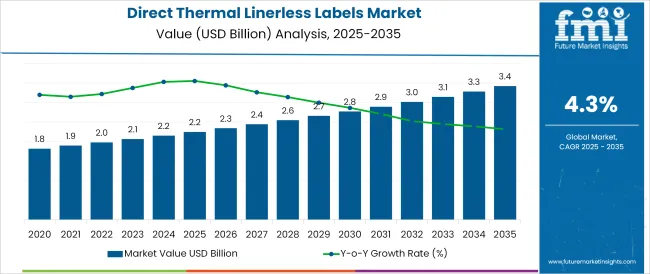
Key Takeaways, Market Size, and Forecast
| Metric | Value |
|---|---|
| Market Size (2026) | USD 2.3 Billion |
| Market Size (2036) | USD 3.5 Billion |
| CAGR (2026–2036) | 4.3% |
| Leading Printing Technology (2026) | Flexo Printing |
| Flexo Printing Share (2026) | 42.0% |
| Leading End-Use (2026) | Food And Beverage Industry |
| Food And Beverage Industry Share (2026) | 28.0% |
| Highlight | North America is projected to record strong adoption through 2036, helped by retail automation and packaging waste reduction |
Rationale for Segmental Growth in the Direct Thermal Linerless Labels Market
Market Overview
The direct thermal linerless labels market is experiencing notable growth, supported by increasing demand for waste reduction, automation compatibility, and eco-efficient packaging solutions. Unlike traditional labels, linerless variants eliminate the need for backing liners, thereby reducing material usage, storage costs, and production waste. Regulatory shifts promoting recyclable and low-footprint packaging are encouraging adoption across food, logistics, and retail industries.
Enhanced printing technologies, along with advancements in adhesive coatings and face-stock materials, have improved the print clarity, durability, and shelf-readiness of these labels. As e-commerce and cold chain distribution expand, the need for durable, smudge-resistant labeling has become more pronounced. Industry players are also investing in machinery retrofits and linerless-compatible printers to support large-scale implementation.
With the dual benefits of cost efficiency and environmental compliance, linerless labeling is being positioned as a strategic component of next-generation packaging systems.
Segmental Analysis
The market is segmented by Printing Technology and End Use and region. By Printing Technology, the market is divided into Flexo Printing, Digital Printing, and Offset Printing. In terms of End Use, the market is classified into Food and Beverage Industry, Retail, Transport and Logistics, Warehouse and Distribution, Healthcare Industry, Industrial Manufacturing, and Electronic Industry.
Regionally, the market is classified into North America, Latin America, Western Europe, Eastern Europe, Balkan & Baltic Countries, Russia & Belarus, Central Asia, East Asia, South Asia & Pacific, and the Middle East & Africa.
Insights into the Flexo Printing Technology Segment
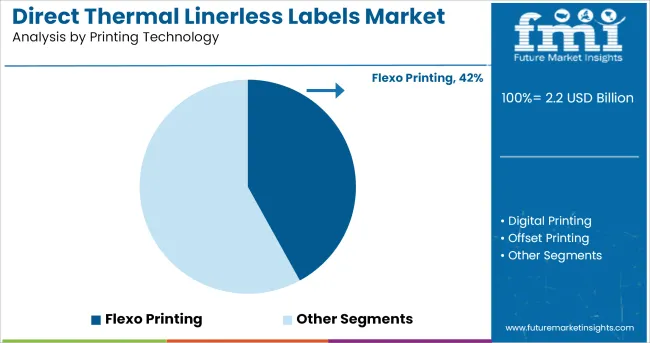
Flexo printing is projected to hold a 42.0% share of the total revenue in the direct thermal linerless labels market by 2025, making it the leading printing technology. This leadership is being driven by its ability to produce high-resolution, continuous print runs at high speeds, which aligns with the demands of linerless labeling lines.
Flexographic systems are compatible with a broad range of substrates and inks, including UV-curable and water-based formulations, enabling sharp, smudge-resistant label impressions.
The flexibility to print on pressure-sensitive and thermal-reactive coatings with minimal setup time has enhanced its adoption in high-volume packaging lines. In addition, improvements in plate-making automation and inline finishing options are making flexo systems more efficient and cost-effective.
As sustainability goals pressure brands to reduce waste and increase print speed-to-market ratios, flexo printing continues to serve as the dominant choice for producing linerless labels at industrial scale.
Insights into the Food and Beverage Industry End Use Segment
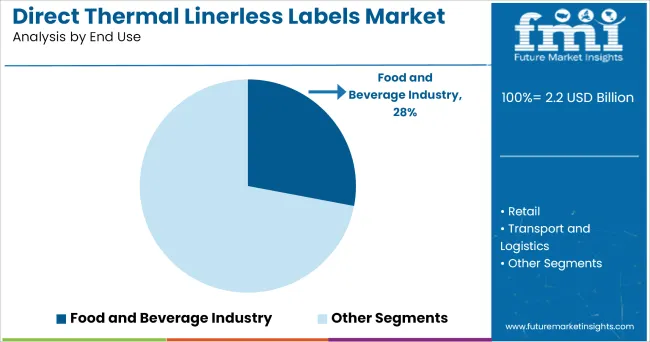
The food and beverage industry is expected to account for 28.0% of the revenue in the direct thermal linerless labels market by 2025, making it the leading end-use segment. This dominance is being attributed to the sector’s high packaging turnover, regulatory labeling requirements, and need for traceability and freshness indicators.
Direct thermal linerless labels support fast application speeds and reliable adhesion on various packaging materials including paperboard, plastic, and flexible film, which are widely used in food processing. Their resistance to moisture and temperature variation makes them ideal for cold chain logistics and refrigerated storage conditions.
Additionally, linerless formats contribute to packaging waste reduction and operational efficiency, both of which are top priorities for food manufacturers under growing sustainability pressure. With increasing SKU variation and demand for real-time printing and product tracking, the food and beverage industry continues to invest in linerless solutions to meet speed, compliance, and sustainability goals.
Direct Thermal Linerless Labels Market: Market Outlook
The world is switching over towards the biodegradable and environment-friendly packaging solution, and the trend towards flexible packaging and labelling is proliferating. Direct thermal linerless labels are considered the most economical and sustainable packaging solution.
The direct thermal linerless labels are simple and pressure-sensitive labels without liner. They are adhesive stickers made with a special realizing coating used to the face of the label, which helps to protect a roll without the adhesive stick to the label.
These release coating on the label surface creates barrier protection against the UV rays, chemicals, light, moisture, abrasion, and other harmful environmental conditions. These labels are the more innovative, better, and greener solution by reducing the waste creates a favourable environmental impact.
By eliminating the liners, the customer gets more labels per roll, requires fewer roll changes, and reduces the time to remove and dispose of the liners. Thus, the technological advancement for direct thermal linerless labels with solid self-adhesive, fast and clear printing creates a substantial demand.
What Are the Key Market Drivers Impacting the Growth of Direct Thermal Linerless Labels Market?
The world is switching over towards the biodegradable and environment-friendly packaging solution, and the trend towards flexible packaging and labelling is proliferating. Direct thermal linerless labels are considered the most economical and sustainable packaging solution.
The direct thermal linerless labels are simple and pressure-sensitive labels without liner. They are adhesive stickers made with a special realizing coating used to the face of the label, which helps to protect a roll without the adhesive stick to the label.
These release coating on the label surface creates barrier protection against the UV rays, chemicals, light, moisture, abrasion, and other harmful environmental conditions. These labels are the more innovative, better, and greener solution by reducing the waste creates a favourable environmental impact.
By eliminating the liners, the customer gets more labels per roll, requires fewer roll changes, and reduces the time to remove and dispose of the liners. Thus, the technological advancement for direct thermal linerless labels with solid self-adhesive, fast and clear printing creates a substantial demand.
What Are the Key Market Drivers Impacting the Growth of Direct Thermal Linerless Labels Market?
The direct thermal linerless labels are eco-friendly packaging due to less waste disposal translates into lower carbon emission and supports the lower carbon footprint. It reduces solid waste dumping by eliminating silicone dumping in the landfills and sustaining the “Green” zero waste initiative.
As the linerless labels do not comprise a liner at the back, it reduces industrial waste disposal, reduces the disposal cost, and increases productivity and safety at the workplace by removing the hazard of slippery silicone-based liners.
The direct thermal linerless labels positively impact the business operations by reducing the material cost, labour, and transportation saving, reducing the freight cost, reducing the storage space, and increasing operational efficiency. Thus the cost-effective, sustainable, convenient direct thermal linerless labels could generate considerable growth.
What is the Key Trend Increasing Sales of Direct Thermal Linerless Labels Market?
Increase in e-commerce business strongly driven by increase online shopping trend of consumers. The e-commerce packaging requires consignor and consignee details with the tracking system to safeguard the product during shipping.
The direct thermal linerless labels are barcode readable, scratch proof, waterproof, and the release coating creates barrier protection against harmful environmental factors. As the direct thermal linerless labels are convenient, easy to use, and effective packaging, it is beneficial in e-commerce packaging.
The rising supermarkets and hypermarkets create substantial demand for the direct thermal linerless labels while packaging the products containing the product’s information, manufacturing date, expiry date, and price tags. Even it is also helpful for inventory management for tagging the details of the products. Hence, the demand for direct thermal linerless labels could augment the market growth.
How will the Constantly Evolving Flexo Printing Technology Create Opportunity for Direct Thermal Linerless Labels?
The direct thermal linerless labels, with their excellent resolution for barcode scanning and readability saving in waste disposal, greater operation efficiencies, create growth opportunities. By use of flexographic printing technology, the direct thermal linerless labels could expect high demand.
Flexo printing is the preferred process for direct thermal linerless label printing due to its vibrant specialties like higher production speed, excellent print quality, and quick job change-over. Flexo printing is a fast process due to the inks used are fast-drying water-based paints, not oil-based.
Additionally, flexographic printing is the most cost-effective, versatile, and efficient printing used on direct thermal linerless labels applied to cardboard boxes, packets, envelopes, price tags, product details, and consignor and consignee details during transportation.
Competitive Landscape
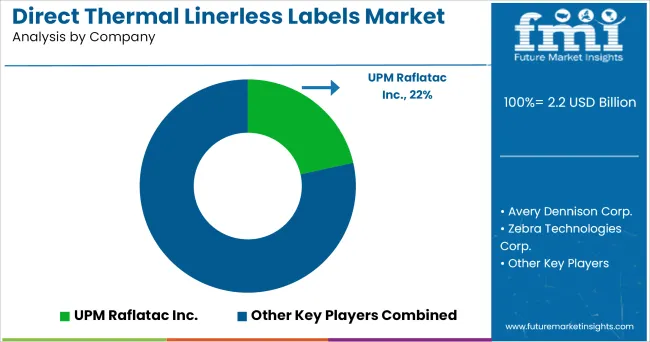
Key players such as
- UPM Raflatac Inc.
- Avery Dennison Corp.
- Zebra Technologies Corp.
- SATO Holdings Corporation
- Reflex Labels Ltd.
- DYKAM A.C.A. LTD
- HERMA GmbH
- Others
Key Asian players such as
- Yupo Corporation
- Bostik (Shanghai) Management Co., Ltd.
- Skanem Bangkok Co. Ltd.
- Teraoka Seiko Co., Ltd.
- Shenzhen Likexin Industrial Co., Ltd.
- Others
are actively involved in direct thermal linerless labels market for different applications.
What are Strategies Adopted by Direct Thermal Linerless Labels Companies to Gain Competitive edge?
The manufacturers involved in manufacturing direct thermal linerless labels adopt various strategies such as innovation and product launch to serve the increasing demand for the direct thermal linerless labels market.
In January 2024, UPM Raflatac Inc. developed Linerless Opticut technology for each direct thermal linerless labels end use such as logistics, retailing, takeaway restaurants, etc. It provides excellent adhesives on the package and minimizes service time.
Why is India a Big Market for the Direct Thermal Linerless Labels Market?
The direct thermal linerless labels are witnessing a growing preference in India due to the gradual shift of the manufacturers from conventional labels due to the saving in cost and increasing productivity. Many companies print the valuable information on the labels, which is helpful to the consumers for selection of the product could boost the sales of direct thermal linerless labels.
With the rising technological advancement in the printing technology in India, such as flexographic printing, screen printing, offset printing, digital printing, the direct thermal lineless labels expect substantial growth. Due to the rising trend of e-commerce and digitalization the online purchasing is grown extensively in India. Therefore, the direct thermal liners labels played a magnificent role in fast, secure, safe, easy, and convenient packaging delivery to the consumers.
Key Segments of Direct Thermal Linerless Labels Market Covered in the Report
By Printing Technology:
- Flexo Printing
- Digital Printing
- Offset Printing
By End Use:
- Retail
- Food and Beverage Industry
- Industrial Manufacturing
- Healthcare Industry
- Warehouse and Distribution
- Transport and Logistics
- Electronic Industry
By the Region:
- North America
- Latin America
- Europe
- South Asia
- East Asia
- Oceania
- Middle East & Africa
Frequently Asked Questions
How big is the direct thermal linerless labels market in 2025?
The global direct thermal linerless labels market is estimated to be valued at USD 2.2 billion in 2025.
What will be the size of direct thermal linerless labels market in 2035?
The market size for the direct thermal linerless labels market is projected to reach USD 3.4 billion by 2035.
How much will be the direct thermal linerless labels market growth between 2025 and 2035?
The direct thermal linerless labels market is expected to grow at a 4.3% CAGR between 2025 and 2035.
What are the key product types in the direct thermal linerless labels market?
The key product types in direct thermal linerless labels market are flexo printing, digital printing and offset printing.
Which end use segment to contribute significant share in the direct thermal linerless labels market in 2025?
In terms of end use, food and beverage industry segment to command 28.0% share in the direct thermal linerless labels market in 2025.
Preview the report firsthand - request a free sample
Get SampleGet the brochure for pricing and purchase details.
Get PDFTable of Content
- Executive Summary
- Global Market Outlook
- Demand-side Trends
- Supply-side Trends
- Technology Roadmap Analysis
- Analysis and Recommendations
- Market Overview
- Market Coverage / Taxonomy
- Market Definition / Scope / Limitations
- Market Background
- Market Dynamics
- Drivers
- Restraints
- Opportunity
- Trends
- Scenario Forecast
- Demand in Optimistic Scenario
- Demand in Likely Scenario
- Demand in Conservative Scenario
- Opportunity Map Analysis
- Product Life Cycle Analysis
- Supply Chain Analysis
- Investment Feasibility Matrix
- Value Chain Analysis
- PESTLE and Porter’s Analysis
- Regulatory Landscape
- Regional Parent Market Outlook
- Production and Consumption Statistics
- Import and Export Statistics
- Market Dynamics
- Global Market Analysis 2020 to 2024 and Forecast, 2025 to 2035
- Historical Market Size Value (USD Million) Analysis, 2020 to 2024
- Current and Future Market Size Value (USD Million) Projections, 2025 to 2035
- Y-o-Y Growth Trend Analysis
- Absolute $ Opportunity Analysis
- Global Market Pricing Analysis 2020 to 2024 and Forecast 2025 to 2035
- Global Market Analysis 2020 to 2024 and Forecast 2025 to 2035, By Printing Technology
- Introduction / Key Findings
- Historical Market Size Value (USD Million) Analysis By Printing Technology , 2020 to 2024
- Current and Future Market Size Value (USD Million) Analysis and Forecast By Printing Technology , 2025 to 2035
- Flexo Printing
- Digital Printing
- Offset Printing
- Y-o-Y Growth Trend Analysis By Printing Technology , 2020 to 2024
- Absolute $ Opportunity Analysis By Printing Technology , 2025 to 2035
- Global Market Analysis 2020 to 2024 and Forecast 2025 to 2035, By End Use
- Introduction / Key Findings
- Historical Market Size Value (USD Million) Analysis By End Use, 2020 to 2024
- Current and Future Market Size Value (USD Million) Analysis and Forecast By End Use, 2025 to 2035
- Food and Beverage Industry
- Retail
- Transport and Logistics
- Warehouse and Distribution
- Healthcare Industry
- Industrial Manufacturing
- Electronic Industry
- Y-o-Y Growth Trend Analysis By End Use, 2020 to 2024
- Absolute $ Opportunity Analysis By End Use, 2025 to 2035
- Global Market Analysis 2020 to 2024 and Forecast 2025 to 2035, By Region
- Introduction
- Historical Market Size Value (USD Million) Analysis By Region, 2020 to 2024
- Current Market Size Value (USD Million) Analysis and Forecast By Region, 2025 to 2035
- North America
- Latin America
- Western Europe
- Eastern Europe
- East Asia
- South Asia and Pacific
- Middle East & Africa
- Market Attractiveness Analysis By Region
- North America Market Analysis 2020 to 2024 and Forecast 2025 to 2035, By Country
- Historical Market Size Value (USD Million) Trend Analysis By Market Taxonomy, 2020 to 2024
- Market Size Value (USD Million) Forecast By Market Taxonomy, 2025 to 2035
- By Country
- USA
- Canada
- Mexico
- By Printing Technology
- By End Use
- By Country
- Market Attractiveness Analysis
- By Country
- By Printing Technology
- By End Use
- Key Takeaways
- Latin America Market Analysis 2020 to 2024 and Forecast 2025 to 2035, By Country
- Historical Market Size Value (USD Million) Trend Analysis By Market Taxonomy, 2020 to 2024
- Market Size Value (USD Million) Forecast By Market Taxonomy, 2025 to 2035
- By Country
- Brazil
- Chile
- Rest of Latin America
- By Printing Technology
- By End Use
- By Country
- Market Attractiveness Analysis
- By Country
- By Printing Technology
- By End Use
- Key Takeaways
- Western Europe Market Analysis 2020 to 2024 and Forecast 2025 to 2035, By Country
- Historical Market Size Value (USD Million) Trend Analysis By Market Taxonomy, 2020 to 2024
- Market Size Value (USD Million) Forecast By Market Taxonomy, 2025 to 2035
- By Country
- Germany
- UK
- Italy
- Spain
- France
- Nordic
- BENELUX
- Rest of Western Europe
- By Printing Technology
- By End Use
- By Country
- Market Attractiveness Analysis
- By Country
- By Printing Technology
- By End Use
- Key Takeaways
- Eastern Europe Market Analysis 2020 to 2024 and Forecast 2025 to 2035, By Country
- Historical Market Size Value (USD Million) Trend Analysis By Market Taxonomy, 2020 to 2024
- Market Size Value (USD Million) Forecast By Market Taxonomy, 2025 to 2035
- By Country
- Russia
- Poland
- Hungary
- Balkan & Baltic
- Rest of Eastern Europe
- By Printing Technology
- By End Use
- By Country
- Market Attractiveness Analysis
- By Country
- By Printing Technology
- By End Use
- Key Takeaways
- East Asia Market Analysis 2020 to 2024 and Forecast 2025 to 2035, By Country
- Historical Market Size Value (USD Million) Trend Analysis By Market Taxonomy, 2020 to 2024
- Market Size Value (USD Million) Forecast By Market Taxonomy, 2025 to 2035
- By Country
- China
- Japan
- South Korea
- By Printing Technology
- By End Use
- By Country
- Market Attractiveness Analysis
- By Country
- By Printing Technology
- By End Use
- Key Takeaways
- South Asia and Pacific Market Analysis 2020 to 2024 and Forecast 2025 to 2035, By Country
- Historical Market Size Value (USD Million) Trend Analysis By Market Taxonomy, 2020 to 2024
- Market Size Value (USD Million) Forecast By Market Taxonomy, 2025 to 2035
- By Country
- India
- ASEAN
- Australia & New Zealand
- Rest of South Asia and Pacific
- By Printing Technology
- By End Use
- By Country
- Market Attractiveness Analysis
- By Country
- By Printing Technology
- By End Use
- Key Takeaways
- Middle East & Africa Market Analysis 2020 to 2024 and Forecast 2025 to 2035, By Country
- Historical Market Size Value (USD Million) Trend Analysis By Market Taxonomy, 2020 to 2024
- Market Size Value (USD Million) Forecast By Market Taxonomy, 2025 to 2035
- By Country
- Kingdom of Saudi Arabia
- Other GCC Countries
- Turkiye
- South Africa
- Other African Union
- Rest of Middle East & Africa
- By Printing Technology
- By End Use
- By Country
- Market Attractiveness Analysis
- By Country
- By Printing Technology
- By End Use
- Key Takeaways
- Key Countries Market Analysis
- USA
- Pricing Analysis
- Market Share Analysis, 2024
- By Printing Technology
- By End Use
- Canada
- Pricing Analysis
- Market Share Analysis, 2024
- By Printing Technology
- By End Use
- Mexico
- Pricing Analysis
- Market Share Analysis, 2024
- By Printing Technology
- By End Use
- Brazil
- Pricing Analysis
- Market Share Analysis, 2024
- By Printing Technology
- By End Use
- Chile
- Pricing Analysis
- Market Share Analysis, 2024
- By Printing Technology
- By End Use
- Germany
- Pricing Analysis
- Market Share Analysis, 2024
- By Printing Technology
- By End Use
- UK
- Pricing Analysis
- Market Share Analysis, 2024
- By Printing Technology
- By End Use
- Italy
- Pricing Analysis
- Market Share Analysis, 2024
- By Printing Technology
- By End Use
- Spain
- Pricing Analysis
- Market Share Analysis, 2024
- By Printing Technology
- By End Use
- France
- Pricing Analysis
- Market Share Analysis, 2024
- By Printing Technology
- By End Use
- India
- Pricing Analysis
- Market Share Analysis, 2024
- By Printing Technology
- By End Use
- ASEAN
- Pricing Analysis
- Market Share Analysis, 2024
- By Printing Technology
- By End Use
- Australia & New Zealand
- Pricing Analysis
- Market Share Analysis, 2024
- By Printing Technology
- By End Use
- China
- Pricing Analysis
- Market Share Analysis, 2024
- By Printing Technology
- By End Use
- Japan
- Pricing Analysis
- Market Share Analysis, 2024
- By Printing Technology
- By End Use
- South Korea
- Pricing Analysis
- Market Share Analysis, 2024
- By Printing Technology
- By End Use
- Russia
- Pricing Analysis
- Market Share Analysis, 2024
- By Printing Technology
- By End Use
- Poland
- Pricing Analysis
- Market Share Analysis, 2024
- By Printing Technology
- By End Use
- Hungary
- Pricing Analysis
- Market Share Analysis, 2024
- By Printing Technology
- By End Use
- Kingdom of Saudi Arabia
- Pricing Analysis
- Market Share Analysis, 2024
- By Printing Technology
- By End Use
- Turkiye
- Pricing Analysis
- Market Share Analysis, 2024
- By Printing Technology
- By End Use
- South Africa
- Pricing Analysis
- Market Share Analysis, 2024
- By Printing Technology
- By End Use
- USA
- Market Structure Analysis
- Competition Dashboard
- Competition Benchmarking
- Market Share Analysis of Top Players
- By Regional
- By Printing Technology
- By End Use
- Competition Analysis
- Competition Deep Dive
- UPM Raflatac Inc.
- Overview
- Product Portfolio
- Profitability by Market Segments (Product/Age /Sales Channel/Region)
- Sales Footprint
- Strategy Overview
- Marketing Strategy
- Product Strategy
- Channel Strategy
- Avery Dennison Corp.
- Zebra Technologies Corp.
- SATO Holdings Corporation
- Reflex Labels Ltd.
- DYKAM A.C.A. LTD
- HERMA GmbH
- UPM Raflatac Inc.
- Competition Deep Dive
- Assumptions & Acronyms Used
- Research Methodology


