

- Market Size (2026)
- USD 534.2 Mn
- Forecast (2036)
- USD 870.1 Mn
- CAGR (2026 to 2036)
- 5.0%
How big is Dry Sump Oil Tanks Market in 2026?
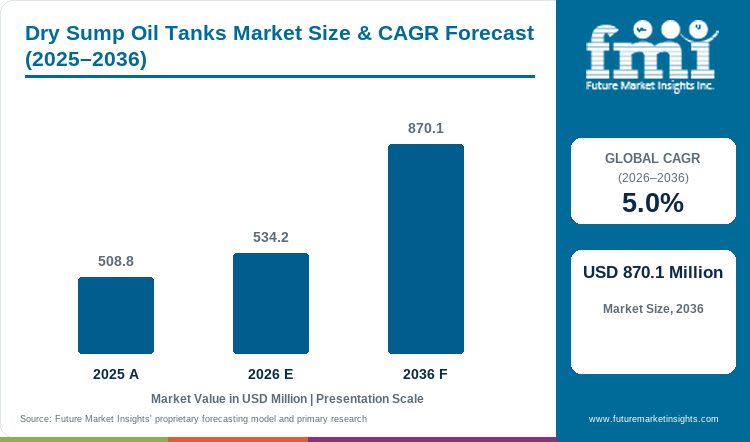
USD 534.2 million in 2026 and USD 870.1 million by 2036, expanding at 5.0% CAGR.
Demand for dry sump oil tanks is projected to expand at 5.0% CAGR from 2026 to 2036. Valuation grows from USD 508.8 million in 2025 to USD 534.2 million in 2026 and reaches USD 870.1 million by 2036. Race engines use remote tanks to keep oil moving during hard braking and cornering. In June 2026, Moroso explained that scavenge pumps send oil back to an external tank. Specialist performance parts channels sell tanks, pumps and fittings. Builders need to know that a tank holds enough oil, removes trapped air and fits the car. Clear dimensions and port locations help prevent rework during an engine build.
South Korea is forecast to grow at 6.3% CAGR, compared with 4.3% for Japan. South Korea is making team registration more formal. Japan already has a large licensed racing base. In March 2026, JAF reported 70,773 motorsport licenses for 2025. That base keeps service and replacement work active. Korean teams need stronger distributor support. Japanese teams need exact automotive oil system fit.
Key Takeaways
- Race engines need steady external oil storage because hard acceleration and cornering can expose a wet-sump pickup.
- By tank type, cylindrical tanks are projected to account for 31.0% in 2026, supported by compact mounting and controlled oil return.
- In 2026, aluminum is expected to lead the material category with 56.0% share, influenced by low weight and easy fabrication.
- Motorsport is set to lead end use with 47.0% share in 2026, attributable to severe oil-control and space needs.
- Fitment, vent routing, line size and service access can delay adoption. An engine may still clearly need dry-sump protection.
- Some of the key players in this market include Armstrong Race Engineering (ARE Dry Sump Systems), Peterson Fluid Systems, Dailey Engineering, Aviaid, OBP Motorsport, Moroso, Canton Racing Products, Barnes Systems, Setrab and Think Automotive (Mocal).
Analyst Perspective
"Tank suppliers earn repeat orders when reservoirs protect oil delivery without forcing chassis changes. Engine builders compare capacity, port location and service access before they approve a tank."
- Nikhil Kaitwade, Principal Consultant, Future Market Insights
How is the dry sump oil tanks market segmented?
The dry sump oil tanks market is segmented by Tank Type, Material, End Use, Capacity, Sales Channel and Region.
The dry sump oil tanks market is segmented by tank type, material, end use, capacity, sales channel and region. Tank type covers cylindrical, rectangular or square, integrated breather and custom tanks. Materials include aluminum, stainless steel, titanium and composites. End uses include motorsport, performance road vehicles, aviation, marine and specialty engines. Capacity covers below 5 L, 5-10 L and above 10 L. Sales channels include aftermarket, specialist suppliers, direct sales and engine builders.
How do cylindrical tanks shape demand within the tank type category?
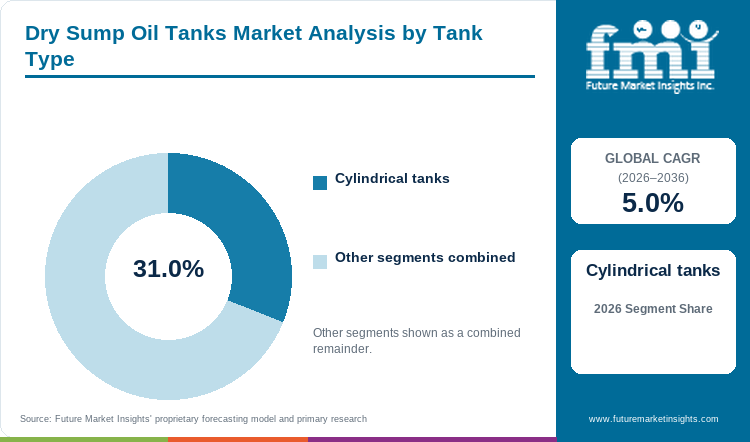
Cylindrical tanks hold oil in a tall, narrow space. In June 2026, Moroso described the external tank as a core part of dry-sump oil control. Engine oil filters and return lines use the same area. A round tank also gives builders one steady mounting diameter.
- Based on tank type, cylindrical tanks are projected to account for 31.0% in 2026, supported by compact mounting and controlled oil return.
- Custom tanks remain useful when suspension, exhaust, or body parts block space for a round tank.
Why does aluminum hold the largest material share?
Aluminum keeps tank weight low and is easy to weld around ports and mounts. In December 2025, Performance Racing Industry documented aluminum oil-control hardware from Canton Racing Products. Automotive seals and gaskets protect removable joints. Builders can reposition fittings without choosing a heavier tank.
- By material, aluminum is estimated to hold 56.0% in 2026, influenced by low weight and easy fabrication.
- Stainless steel and titanium serve jobs that accept more weight or cost for added strength or heat resistance.
How does motorsport shape the end use category?
Motorsport places the oil system under repeated high-g loads. In March 2026, FFSA reported 850 events and nearly 52,000 licenses. That activity keeps race preparation and parts replacement active. Automotive pumps work in the same oil circuit. A tank becomes more important because low oil pressure can damage an engine.
- In 2026, motorsport is expected to lead end use with 47.0% share, attributable to severe oil-control and space needs.
- Performance road cars also use dry-sump tanks when track use creates the same oil-control risk.
What supports the 5-10 L capacity category?
The 5-10 L band gives builders enough oil without using too much chassis space. In June 2026, Moroso described the external tank as a core part of dry-sump oil control. Automotive hoses and assemblies also need space in the engine bay. Builders match tank size to heat load, oil return and service access.
- By capacity, 5-10 L is forecast to represent 39.0% in 2026, supported by a balance between oil reserve and available space.
- Smaller tanks suit tight builds. Larger tanks serve endurance racing or engines with higher heat loads.
What drives the performance aftermarket sales channel?
Engine swaps and dry-sump conversions often rely on specialist parts channels. These sellers help match tanks, fittings, pumps and filters before installation. In June 2026, SCCA published the Runoffs technical schedule for Road America. National club racing keeps race preparation active. Buyers also compare replacement oil filters during rebuilds. Specialist sellers win orders by solving fit problems before parts reach the shop.
- Performance aftermarket is projected to hold 38.0% of sales channel revenue in 2026, driven by rebuilds and conversion work.
- Direct sales become more important when a build needs custom ports or a special tank shape.
What are the drivers, restraints and opportunities in the Dry Sump Oil Tanks Market?
Competition duty keeps oil-control demand active, system integration slows fitment and serviceable reservoir designs can remove installation work.
- Driver: Repeated high-g running and engine changes increase the need for steady external oil storage.
- Restraint: Tank height, return plumbing, vent routing and pickup geometry must work with the full dry-sump system.
- Opportunity: Built-in venting, modular mounts and easier cleaning can reduce parts, fitting work and service time.
Race teams choose the tank as part of the oil system because low oil pressure can destroy an engine. In June 2025, Performance Racing Industry reported more than 318,000 U.S. motorsports jobs and USD 69.2 billion in annual economic impact. That national activity keeps race cars, engines and service shops busy. Teams often replace oil and fuel filters during the same rebuild cycle. Builders are more likely to order a tank when they can confirm oil volume, return flow and air removal. Repeat orders depend on steady oil delivery, clear fit data and parts that do not add extra work in the engine bay.
Packaging is the main barrier because the right capacity does not guarantee a tank will fit. Engine builders check tank height, port position, return size, vent lines and service access before approval. In February 2025, Peterson Fluid Systems introduced a Gen V LT R4 pump mount with CAD files for system layout. The release lets builders check the layout earlier. Nearby automotive heat exchangers may use space needed by the tank and lines. Late interference can force new brackets or hose routes. Suppliers reduce this risk with clear dimensions, CAD data and port options that builders can check before fabrication.
Tank suppliers can reduce service work with built-in baffling, easy drains and simple mounts. OBP Motorsport’s 2025 catalog documents aluminum dry-sump tanks that are baffled and leak tested before sale. These features keep oil control inside a tank that is easier to service. Makers can add removable sections and easy-to-reach drains for cleaning and inspection. Capacity and line size must still match the engine program. A serviceable tank can justify a higher price because teams inspect the oil system many times during a season. Clear mounting points also make removal and refitting easier without changing nearby plumbing.
Which country CAGRs are profiled in the Dry Sump Oil Tanks Market?
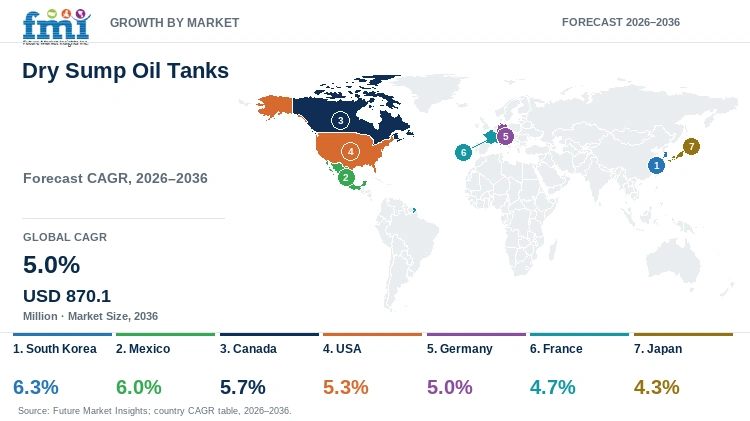
| Country | CAGR |
|---|---|
| South Korea | 6.3% |
| Mexico | 6.0% |
| Canada | 5.7% |
| USA | 5.3% |
| Germany | 5.0% |
| France | 4.7% |
| Japan | 4.3% |
How do country-level CAGRs compare in the Dry Sump Oil Tanks Market?
South Korea, Mexico and Canada form the upper growth group. The USA and Germany stay near 5.0%, while France and Japan grow more slowly. The 2.0-point spread compares forecast pace, not current revenue.
- Korea’s smaller specialist channel makes distributor training more important for teams and workshops.
- Mexico gains from local parts stock between events in its national racing series.
- Canadian buyers use North American supply, but long distances can slow delivery of special parts.
- The USA combines stocked aftermarket parts with custom engineering for many racing applications.
- German teams need detailed drawings before fabrication because race cars often have very tight packaging.
- French endurance programs value tanks that are easy to inspect and service during long events.
- Japanese teams place strong value on clear application data before they install a new tank.
Similar CAGRs still produce different selling conditions by country. The full report provides country-level CAGR analysis across North America, Latin America, Western Europe, Eastern Europe, East Asia, South Asia and Pacific and the Middle East and Africa.
Country-wise Analysis
- U.S. engine builders serve race teams, club racers and performance shops that buy stock and custom tanks. By 2036, the USA is projected to grow at 5.3% CAGR, supported by its broad national racing base. In June 2025, Performance Racing Industry reported more than 318,000 U.S. motorsports jobs and USD 69.2 billion in annual economic impact. That scale keeps engine service and rebuild work active. Racing classes use different chassis and engine packages, so tank sizes and port layouts vary. Suppliers can shorten ordering with common diameters, configurable ports and clear drawings. These features also support repeat orders when teams rebuild engines or change classes.
- German race teams place strong weight on formal licensing and vehicle-specific engineering. Dry sump oil tank demand in Germany is forecast to rise at 5.0% CAGR through 2036, shaped by careful system fit. In April 2026, DMSB expanded its digital license and Motorsport ID process for national competition. The system keeps license records clear for teams and officials. Tight engine bays still limit the use of standard tanks. Teams need tank height, port position and hose routes to match the car before fabrication begins. Suppliers can offer compact tanks, clear drawings and CAD files so builders can check hose routing before metal work starts.
- Japanese race teams favor stable parts and clear application data. Japan is estimated to post 4.3% CAGR over the forecast period, linked to a mature competition base rather than rapid channel growth. In March 2026, JAF reported 70,773 motorsport licenses for 2025. That national base keeps service and replacement work active. Teams also use set service routines, so a new tank must install without extra rework. Suppliers can protect repeat orders by keeping tank dimensions and port locations steady. Local distributors also need common fittings in stock. Fast access to those parts helps teams finish planned service work between race events.
- Korean motorsport uses national team registration and event approval. Adoption of dry sump oil tanks in South Korea is estimated to expand at 6.3% CAGR through 2036, supported by organized team activity. In March 2026, KARA opened accredited-team registration under its national competition framework. The structure gives newer teams a clear route into sanctioned events and technical rules. The installed base is still smaller than in mature racing countries, so stock for every tank layout is limited. Suppliers can reduce engineering work with standard tank packages and clear plumbing guides. Distributor training also helps teams choose fittings and vent routes before installation.
- Canadian racers combine domestic competition with easy access to North American performance brands. By 2036, Canada is projected to grow at 5.7% CAGR, supported by national racing and cross-border supply. In March 2025, GDS ASN Canada published the Canadian Karting Championship program for the national season. National events keep race preparation active beyond one local club. Long travel distances can still slow delivery of nonstandard parts. Suppliers with regional stock can cut lead times for common mounts and fittings. Clear technical support also helps shops finish custom hose routes before a race weekend. That service can turn one-off builds into repeat orders.
- France supports a deep race service base through national clubs, organizers, officials and track programs. Dry sump oil tank sales in France are forecast to expand at 4.7% CAGR by 2036, reinforced by repeated race preparation. In March 2026, FFSA reported 850 events and nearly 52,000 licenses. The national calendar keeps inspection and service work active. Endurance racing also places more weight on fast maintenance than short events. Teams need tanks that are easy to drain, inspect and reinstall. Suppliers can compete with serviceable tank designs and clear fitment documents. Local fabricators also need quick access to replacement fittings during long race weekends.
- Mexico’s national race series visits several tracks. Mexico is estimated to post 6.0% CAGR over the forecast period, aided by repeated race preparation and a growing parts channel. In January 2026, FEMADAC announced a nine-date Súper Copa Roshfrans national calendar. The schedule keeps workshops working on race cars during the season. Parts access remains uneven for specialized oil systems. Suppliers can improve repeat orders by pairing durable tanks with local stock and clear plumbing guides. Distributors can also keep common fittings and mounts near major racing regions. Better local access reduces downtime when teams service cars between events and prepare for the next race.
Who are the notable companies in the Dry Sump Oil Tanks Market?
Armstrong Race Engineering (ARE Dry Sump Systems), Peterson Fluid Systems, Dailey Engineering, Aviaid, OBP Motorsport, Moroso, Canton Racing Products, Barnes Systems, Setrab and Think Automotive (Mocal) are active within the defined dry sump oil tank and closely integrated dry-sump system boundary.
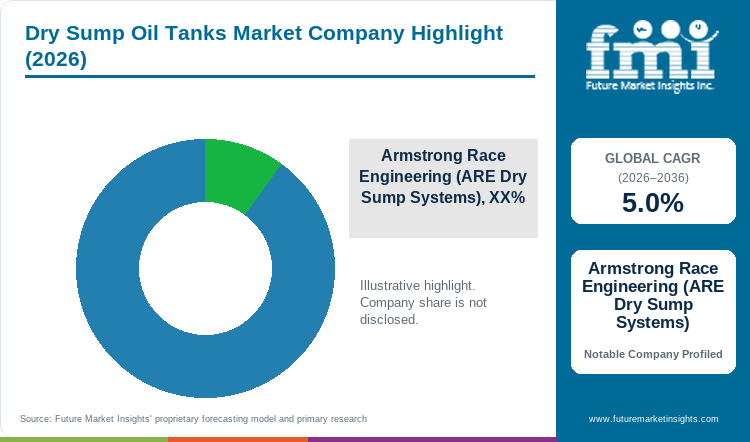
Dedicated dry-sump engineers compete with catalog oil-control and thermal-management suppliers. Armstrong Race Engineering, Peterson Fluid Systems, Dailey Engineering, Aviaid and Barnes Systems focus on complete systems or custom engineering. Moroso, Canton and OBP focus on catalog oil-control hardware. Mocal and Setrab supply parts that help manage engine lubricants under high load.
- Full-system and custom dry-sump engineering: Armstrong Race Engineering (ARE Dry Sump Systems), Peterson Fluid Systems, Dailey Engineering, Aviaid and Barnes Systems.
- Catalog performance oil control: Moroso, Canton Racing Products and OBP Motorsport.
- Reservoir and thermal-management specialists: Think Automotive (Mocal) and Setrab.
Competitive Benchmarking: Dry Sump Oil Tanks Market
| Company | Tank Configuration Breadth | Dry-Sump System Integration | Application Support | Geographic Reach |
|---|---|---|---|---|
| Armstrong Race Engineering (ARE Dry Sump Systems) | High | High | High | North America; international motorsport |
| Peterson Fluid Systems | High | High | High | North America; international dealers |
| Dailey Engineering | Low | High | High | North America; international racing |
| Aviaid | Medium | High | Medium | North America and Australia |
| OBP Motorsport | High | Medium | Medium | United Kingdom; worldwide distributors |
| Moroso | High | High | High | North America; international aftermarket |
| Canton Racing Products | Medium | Medium | High | North America; export availability |
| Barnes Systems | Low | High | High | North America; marine and racing |
| Setrab | Low | Medium | High | Europe; global thermal management |
| Think Automotive (Mocal) | High | Medium | High | United Kingdom; international supply |
Scoring basis: High means broad documented capability, Medium means narrower verified coverage and Low means limited evidence. Ratings assess tank breadth, dry-sump integration and application support rather than company size.
Key Developments in the Dry Sump Oil Tanks Market
- In March 2026, Moroso introduced billet breather tanks with internal baffling and configurable -AN fittings for remote oil-control plumbing.
- In June 2025, Setrab started production of a coolant-to-oil heat exchanger for an Italian high-performance vehicle manufacturer.
- In February 2025, Peterson Fluid Systems introduced a Gen V LT R4 dry-sump pump mount with CAD files for layout work.
Key Players in the Dry Sump Oil Tanks Market
Full-system dry-sump engineering
- Armstrong Race Engineering (ARE Dry Sump Systems)
- Peterson Fluid Systems
- Dailey Engineering
- Aviaid
- Barnes Systems
Catalog oil-control suppliers
- Moroso
- Canton Racing Products
- OBP Motorsport
Specialist fabrication and thermal-management suppliers
- Think Automotive (Mocal)
- Setrab
Dry Sump Oil Tanks Market - Report Scope
| Coverage field | Report scope |
|---|---|
| Market breakdown | By tank type, material, end use, capacity, sales channel and region. |
| Quantitative Units | USD million. |
| Market Definition | External oil reservoirs used in dry-sump lubrication systems for racing, performance, aviation, marine and specialty engine applications are included. Adjacent pumps, pans, filters and coolers are excluded from market value. |
| Regions Covered | North America, Latin America, Western Europe, Eastern Europe, East Asia, South Asia and Pacific and Middle East and Africa. |
| Countries Covered | South Korea, Mexico, Canada, USA, Germany, France, Japan and 20+ countries included in the full report. |
| Key Companies Profiled | Armstrong Race Engineering (ARE Dry Sump Systems), Peterson Fluid Systems, Dailey Engineering, Aviaid, OBP Motorsport, Moroso, Canton Racing Products, Barnes Systems, Setrab and Think Automotive (Mocal). |
| Forecast Period | 2026 to 2036. |
| Approach | Primary and secondary research with market triangulation. |
Dry Sump Oil Tanks Market - Research Methodology
| Method | Approach |
|---|---|
| Primary Research | FMI analysts gathered input from manufacturers, service providers, technology developers, distributors, end users, procurement teams and subject-matter experts. Interviews examined purchasing decisions, product or service evaluation, adoption barriers, approval requirements, pricing considerations and expectations for technical or commercial support. Respondents were also asked what evidence is required before a trial, pilot, or initial order develops into regular purchasing. |
| Desk Research | Desk research covered government statistics, regulatory publications, trade data, industry associations, technical literature, standards, company filings, product information and official corporate announcements. Sources were reviewed for relevance, publication date, geographic coverage and consistency with the defined market scope. Claims relating to performance, applications, approvals, capacity, investment and commercial activity were retained only when supported by credible public evidence. |
| Market Sizing and Forecasting | The market model combined the baseline value with historical performance, segment structure, pricing and volume indicators, adoption levels, company participation and country-level demand conditions. Forecast assumptions considered economic activity, investment trends, regulatory developments, technology adoption, purchasing cycles, supply availability and barriers to wider market use. Segment and regional estimates were reconciled before the final market total was calculated. |
| Data Validation | Estimates were checked against multiple independent indicators, including public data, company activity, trade patterns, industry developments and findings from primary interviews. Validation also tested whether products, services, applications and company revenues fell within the defined market boundaries. Adjacent categories, unsupported claims, overlapping revenues and activities without direct market relevance were excluded to reduce double counting and maintain consistency across segments and countries. |
Dry Sump Oil Tanks Market by Segments
Dry Sump Oil Tanks Market segmented by Tank Type:
- Cylindrical tanks
- Rectangular or square tanks
- Integrated breather tanks
- Custom tanks
Dry Sump Oil Tanks Market segmented by Material:
- Aluminum
- Stainless steel
- Titanium
- Composites
Dry Sump Oil Tanks Market segmented by End Use:
- Motorsport
- Performance road vehicles
- Aviation
- Marine
- Industrial or specialty engines
Dry Sump Oil Tanks Market segmented by Capacity:
- Below 5 L
- 5-10 L
- Above 10 L
Dry Sump Oil Tanks Market segmented by Sales Channel:
- Performance aftermarket
- Motorsport suppliers
- Direct manufacturer sales
- Engine builders or integrators
Dry Sump Oil Tanks Market by Region:
- North America
- United States
- Canada
- Latin America
- Brazil
- Mexico
- Chile
- Rest of Latin America
- Western Europe
- Germany
- United Kingdom
- Italy
- Spain
- France
- Nordics
- Benelux
- Rest of Western Europe
- Eastern Europe
- Russia
- Poland
- Hungary
- Balkan and Baltic States
- Rest of Eastern Europe
- East Asia
- China
- Japan
- South Korea
- South Asia and Pacific
- India
- ASEAN
- Australia and New Zealand
- Rest of South Asia and Pacific
- Middle East and Africa
- Kingdom of Saudi Arabia
- Other GCC Countries
- Türkiye
- South Africa
- Other African Union Countries
- Rest of Middle East and Africa
Research Sources and Bibliography
- Moroso Performance Products. (2026, June 1). Dry Sump Oil Systems Explained: Better Oil Control, More Power, More Reliability.
- Japan Automobile Federation. (2026, March). Motorsports promotion activities.
- Performance Racing Industry. (2025, December). New products: Canton Racing Products GM LS front sump baffled pan for Nissan 350Z.
- Fédération Française du Sport Automobile. (2026, March 24). 2026 FFSA highlights.
- Performance Racing Industry. (2025, June 18). New report highlights U.S. motorsports’ USD 69.2 billion annual economic impact and 318,000 jobs.
- Peterson Fluid Systems. (2025, February). New Product Release for February 2025.
- Moroso Performance Products. (2026, March 18). New Moroso billet breather tanks.
- Federación Mexicana de Automovilismo Deportivo. (2026, January). 2026 Súper Copa Roshfrans calendar announced.
- Deutscher Motor Sport Bund. (2026, April 9). Overview of digital licenses and Motorsport ID.
- Korea Automobile Racing Association. (2026, March 9). 2026 KARA accredited team registration notice.
- GDS ASN Canada FIA. (2025, March 24). 2025 Canadian Karting Championship.
- Fédération Française du Sport Automobile. (2025, December 16). FFSA 2026 licenses.
- Sports Car Club of America. (2026, June 1). SCCA unveils preliminary supplemental regulations and schedules for 2026 Runoffs at Road America.
- OBP Motorsport. (2025). Motorsport product catalogue: dry sump tanks.
- Think Automotive Ltd. (2026). Mocal dry sump tanks.
- Setrab. (2025, June 5). Setrab starts production of coolant-to-oil heat exchanger for Italian high-performance car manufacturer.
- Australian Business Register. (2025, January). Aviaid Oil Systems business name registration under Omega Manufacturing Group Pty Ltd.
- Dirt Empire Magazine. (2025, November-December). Barnes Systems dry- and wet-sump racing pump configurations.
This bibliography is provided for reader reference and is not exhaustive. The full report contains the complete reference list and detailed citations
This Report Answers
- How large is the dry sump oil tanks market in 2026 and 2036?
- What operating conditions require an external oil reservoir?
- Why do cylindrical tanks hold 31.0% of tank type revenue?
- Why does aluminum hold 56.0% of material revenue?
- Why does motorsport hold 47.0% of end-use demand?
- Why does the performance aftermarket hold 38.0% of channel revenue?
- How do country conditions change reservoir fitment and technical support?
- Which companies supply dry-sump tanks and integrated oil-control systems?
Frequently Asked Questions
How big is the dry sump oil tanks market in 2026?
The dry sump oil tanks market is valued at USD 534.2 million in 2026 and is projected to reach USD 870.1 million by 2036. Race-engine rebuilds keep demand steady for reliable external oil storage.
What is the CAGR of the dry sump oil tanks market from 2026 to 2036?
The dry sump oil tanks market is projected to grow at 5.0% CAGR between 2026 and 2036. Racing use and repeated system rebuilds support demand for steady oil delivery.
Which tank type leads the dry sump oil tanks market in 2026?
The cylindrical segment is projected to hold 31.0% of tank type revenue in 2026. Its shape supports compact mounting and controlled oil return in race vehicles.
Which material segment leads the dry sump oil tanks market in 2026?
The aluminum segment is estimated to hold 56.0% of material revenue in 2026. Fabricators use aluminum to reduce weight while keeping welding and port placement practical.
Which companies are active in the dry sump oil tanks market?
Key companies in the dry sump oil tanks market include Armstrong Race Engineering, Peterson Fluid Systems, Dailey Engineering, Aviaid, OBP Motorsport, Moroso, Canton Racing Products, Barnes Systems, Setrab and Think Automotive. They compete on system integration, tank formats and application support.
Preview the report firsthand - request a free sample
Get SampleGet the brochure for pricing and purchase details.
Get PDFTable of Content
- Key Takeaways
- Market Size and CAGR
- Top Growth Driver
- Fastest Growing Segment
- Leading Region
- Key Companies
- Emerging Opportunities
- Executive Summary
- Global Market Outlook
- Demand-side Trends
- Supply-side Trends
- Technology Roadmap Analysis
- Analysis and Recommendations
- Analyst Perspective (What is happening? Why now? What should investors know?)
- Key Questions Answered
- How large is the market?
- What is the CAGR?
- What are key trends?
- Which region dominates?
- Who are the leaders?
- Market Overview
- Market Coverage / Taxonomy
- Market Definition / Scope / Limitations
- Research Methodology
- Chapter Orientation
- Analytical Lens and Working Hypotheses
- Market Structure, Signals, and Trend Drivers
- Benchmarking and Cross-market Comparability
- Market Sizing, Forecasting, and Opportunity Mapping
- Research Design and Evidence Framework
- Desk Research Programme (Secondary Evidence)
- Expert Input and Fieldwork (Primary Evidence)
- Tooling, Models, and Reference Databases
- Data Engineering and Model Build
- Quality Assurance and Audit Trail
- Market Background
- Market Dynamics (Drivers, Restraints, Opportunity, Trends)
- Scenario Forecast (Optimistic, Likely, Conservative)
- Impact Analysis
- AI Impact
- Sustainability Impact
- Regulatory Impact
- Technology Impact
- Consumer / Buyer Analysis
- Purchase Drivers
- Adoption Barriers
- Buyer Journey
- Opportunity Map Analysis
- Product Life Cycle Analysis
- Supply Chain Analysis
- Investment Feasibility Matrix
- Value Chain Analysis
- PESTLE and Porter's Analysis
- Regulatory Landscape
- Regional Parent Market Outlook
- Production and Consumption Statistics
- Import and Export Statistics
- Global Market Analysis and Forecast, 2021 to 2036
- Historical Market Size Value (USD Million) Analysis, 2021 to 2025
- Current and Future Market Size Value (USD Million) Projections, 2026 to 2036
- Y-o-Y Growth Trend Analysis
- Absolute $ Opportunity Analysis
- Global Market Pricing Analysis, 2021 to 2036
- Global Market Analysis and Forecast, By Tank Type, 2021 to 2036
- Introduction / Key Findings
- Historical Market Size Value (USD Million) Analysis By Tank Type, 2021 to 2025
- Current and Future Market Size Value (USD Million) Analysis and Forecast By Tank Type, 2026 to 2036
- Cylindrical tanks
- Rectangular or square tanks
- Integrated breather tanks
- Custom tanks
- Y-o-Y Growth Trend Analysis By Tank Type, 2021 to 2025
- Absolute $ Opportunity Analysis By Tank Type, 2026 to 2036
- Global Market Analysis and Forecast, By Material, 2021 to 2036
- Introduction / Key Findings
- Historical Market Size Value (USD Million) Analysis By Material, 2021 to 2025
- Current and Future Market Size Value (USD Million) Analysis and Forecast By Material, 2026 to 2036
- Aluminum
- Stainless steel
- Titanium
- Composites
- Y-o-Y Growth Trend Analysis By Material, 2021 to 2025
- Absolute $ Opportunity Analysis By Material, 2026 to 2036
- Global Market Analysis and Forecast, By End Use, 2021 to 2036
- Introduction / Key Findings
- Historical Market Size Value (USD Million) Analysis By End Use, 2021 to 2025
- Current and Future Market Size Value (USD Million) Analysis and Forecast By End Use, 2026 to 2036
- Motorsport
- Performance road vehicles
- Aviation
- Marine
- Industrial or specialty engines
- Y-o-Y Growth Trend Analysis By End Use, 2021 to 2025
- Absolute $ Opportunity Analysis By End Use, 2026 to 2036
- Global Market Analysis and Forecast, By Capacity, 2021 to 2036
- Introduction / Key Findings
- Historical Market Size Value (USD Million) Analysis By Capacity, 2021 to 2025
- Current and Future Market Size Value (USD Million) Analysis and Forecast By Capacity, 2026 to 2036
- Below 5 L
- 5-10 L
- Above 10 L
- Y-o-Y Growth Trend Analysis By Capacity, 2021 to 2025
- Absolute $ Opportunity Analysis By Capacity, 2026 to 2036
- Global Market Analysis and Forecast, By Sales Channel, 2021 to 2036
- Introduction / Key Findings
- Historical Market Size Value (USD Million) Analysis By Sales Channel, 2021 to 2025
- Current and Future Market Size Value (USD Million) Analysis and Forecast By Sales Channel, 2026 to 2036
- Performance aftermarket
- Motorsport suppliers
- Direct manufacturer sales
- Engine builders or integrators
- Y-o-Y Growth Trend Analysis By Sales Channel, 2021 to 2025
- Absolute $ Opportunity Analysis By Sales Channel, 2026 to 2036
- Global Market Analysis and Forecast, By Region, 2021 to 2036
- Introduction
- Historical Market Size Value (USD Million) Analysis By Region, 2021 to 2025
- Current Market Size Value (USD Million) Analysis and Forecast By Region, 2026 to 2036
- North America
- Latin America
- Western Europe
- Eastern Europe
- East Asia
- South Asia and Pacific
- Middle East and Africa
- Market Attractiveness Analysis By Region
- North America Market Analysis and Forecast, By Country, 2021 to 2036
- Historical Market Size Value (USD Million) Trend Analysis By Market Taxonomy, 2021 to 2025
- Market Size Value (USD Million) Forecast By Market Taxonomy, 2026 to 2036
- By Country
- United States
- Canada
- By Tank Type
- By Material
- By End Use
- By Capacity
- By Sales Channel
- By Country
- Market Attractiveness Analysis
- By Country
- By Tank Type
- By Material
- By End Use
- By Capacity
- By Sales Channel
- Key Takeaways
- Latin America Market Analysis and Forecast, By Country
- Historical Market Size Value (USD Million) Trend Analysis By Market Taxonomy, 2021 to 2025
- Market Size Value (USD Million) Forecast By Market Taxonomy, 2026 to 2036
- By Country
- Brazil
- Mexico
- Chile
- Rest of Latin America
- By Tank Type
- By Material
- By End Use
- By Capacity
- By Sales Channel
- By Country
- Market Attractiveness Analysis
- By Country
- By Tank Type
- By Material
- By End Use
- By Capacity
- By Sales Channel
- Key Takeaways
- Western Europe Market Analysis and Forecast, By Country
- Historical Market Size Value (USD Million) Trend Analysis By Market Taxonomy, 2021 to 2025
- Market Size Value (USD Million) Forecast By Market Taxonomy, 2026 to 2036
- By Country
- Germany
- United Kingdom
- Italy
- Spain
- France
- Nordics
- Benelux
- Rest of Western Europe
- By Tank Type
- By Material
- By End Use
- By Capacity
- By Sales Channel
- By Country
- Market Attractiveness Analysis
- By Country
- By Tank Type
- By Material
- By End Use
- By Capacity
- By Sales Channel
- Key Takeaways
- Eastern Europe Market Analysis and Forecast, By Country
- Historical Market Size Value (USD Million) Trend Analysis By Market Taxonomy, 2021 to 2025
- Market Size Value (USD Million) Forecast By Market Taxonomy, 2026 to 2036
- By Country
- Russia
- Poland
- Hungary
- Balkan and Baltic States
- Rest of Eastern Europe
- By Tank Type
- By Material
- By End Use
- By Capacity
- By Sales Channel
- By Country
- Market Attractiveness Analysis
- By Country
- By Tank Type
- By Material
- By End Use
- By Capacity
- By Sales Channel
- Key Takeaways
- East Asia Market Analysis and Forecast, By Country
- Historical Market Size Value (USD Million) Trend Analysis By Market Taxonomy, 2021 to 2025
- Market Size Value (USD Million) Forecast By Market Taxonomy, 2026 to 2036
- By Country
- China
- Japan
- South Korea
- By Tank Type
- By Material
- By End Use
- By Capacity
- By Sales Channel
- By Country
- Market Attractiveness Analysis
- By Country
- By Tank Type
- By Material
- By End Use
- By Capacity
- By Sales Channel
- Key Takeaways
- South Asia and Pacific Market Analysis and Forecast, By Country
- Historical Market Size Value (USD Million) Trend Analysis By Market Taxonomy, 2021 to 2025
- Market Size Value (USD Million) Forecast By Market Taxonomy, 2026 to 2036
- By Country
- India
- ASEAN
- Australia and New Zealand
- Rest of South Asia and Pacific
- By Tank Type
- By Material
- By End Use
- By Capacity
- By Sales Channel
- By Country
- Market Attractiveness Analysis
- By Country
- By Tank Type
- By Material
- By End Use
- By Capacity
- By Sales Channel
- Key Takeaways
- Middle East and Africa Market Analysis and Forecast, By Country
- Historical Market Size Value (USD Million) Trend Analysis By Market Taxonomy, 2021 to 2025
- Market Size Value (USD Million) Forecast By Market Taxonomy, 2026 to 2036
- By Country
- Kingdom of Saudi Arabia
- Other GCC Countries
- Türkiye
- South Africa
- Other African Union Countries
- Rest of Middle East and Africa
- By Tank Type
- By Material
- By End Use
- By Capacity
- By Sales Channel
- By Country
- Market Attractiveness Analysis
- By Country
- By Tank Type
- By Material
- By End Use
- By Capacity
- By Sales Channel
- Key Takeaways
- Key Countries Market Analysis
- United States
- Pricing Analysis
- Market Share Analysis, 2025
- By Tank Type
- By Material
- By End Use
- By Capacity
- By Sales Channel
- Canada
- Pricing Analysis
- Market Share Analysis, 2025
- By Tank Type
- By Material
- By End Use
- By Capacity
- By Sales Channel
- Mexico
- Pricing Analysis
- Market Share Analysis, 2025
- By Tank Type
- By Material
- By End Use
- By Capacity
- By Sales Channel
- Brazil
- Pricing Analysis
- Market Share Analysis, 2025
- By Tank Type
- By Material
- By End Use
- By Capacity
- By Sales Channel
- Chile
- Pricing Analysis
- Market Share Analysis, 2025
- By Tank Type
- By Material
- By End Use
- By Capacity
- By Sales Channel
- Germany
- Pricing Analysis
- Market Share Analysis, 2025
- By Tank Type
- By Material
- By End Use
- By Capacity
- By Sales Channel
- United Kingdom
- Pricing Analysis
- Market Share Analysis, 2025
- By Tank Type
- By Material
- By End Use
- By Capacity
- By Sales Channel
- Italy
- Pricing Analysis
- Market Share Analysis, 2025
- By Tank Type
- By Material
- By End Use
- By Capacity
- By Sales Channel
- Spain
- Pricing Analysis
- Market Share Analysis, 2025
- By Tank Type
- By Material
- By End Use
- By Capacity
- By Sales Channel
- France
- Pricing Analysis
- Market Share Analysis, 2025
- By Tank Type
- By Material
- By End Use
- By Capacity
- By Sales Channel
- India
- Pricing Analysis
- Market Share Analysis, 2025
- By Tank Type
- By Material
- By End Use
- By Capacity
- By Sales Channel
- ASEAN
- Pricing Analysis
- Market Share Analysis, 2025
- By Tank Type
- By Material
- By End Use
- By Capacity
- By Sales Channel
- Australia and New Zealand
- Pricing Analysis
- Market Share Analysis, 2025
- By Tank Type
- By Material
- By End Use
- By Capacity
- By Sales Channel
- China
- Pricing Analysis
- Market Share Analysis, 2025
- By Tank Type
- By Material
- By End Use
- By Capacity
- By Sales Channel
- Japan
- Pricing Analysis
- Market Share Analysis, 2025
- By Tank Type
- By Material
- By End Use
- By Capacity
- By Sales Channel
- South Korea
- Pricing Analysis
- Market Share Analysis, 2025
- By Tank Type
- By Material
- By End Use
- By Capacity
- By Sales Channel
- Russia
- Pricing Analysis
- Market Share Analysis, 2025
- By Tank Type
- By Material
- By End Use
- By Capacity
- By Sales Channel
- Poland
- Pricing Analysis
- Market Share Analysis, 2025
- By Tank Type
- By Material
- By End Use
- By Capacity
- By Sales Channel
- Hungary
- Pricing Analysis
- Market Share Analysis, 2025
- By Tank Type
- By Material
- By End Use
- By Capacity
- By Sales Channel
- Kingdom of Saudi Arabia
- Pricing Analysis
- Market Share Analysis, 2025
- By Tank Type
- By Material
- By End Use
- By Capacity
- By Sales Channel
- Türkiye
- Pricing Analysis
- Market Share Analysis, 2025
- By Tank Type
- By Material
- By End Use
- By Capacity
- By Sales Channel
- South Africa
- Pricing Analysis
- Market Share Analysis, 2025
- By Tank Type
- By Material
- By End Use
- By Capacity
- By Sales Channel
- United States
- Market Structure Analysis
- Competition Dashboard
- Competition Benchmarking
- Market Share Analysis of Top Players
- By Regional
- By Tank Type
- By Material
- By End Use
- By Capacity
- By Sales Channel
- Emerging Startups
- Innovation Benchmarking
- Competition Analysis
- Competition Deep Dive
- Armstrong Race Engineering (ARE Dry Sump Systems)
- Overview
- Product Portfolio
- Profitability by Market Segments
- Sales Footprint
- Strategy Overview
- Marketing Strategy
- Product Strategy
- Channel Strategy
- Peterson Fluid Systems
- Dailey Engineering
- Aviaid
- OBP Motorsport
- Moroso
- Canton Racing Products
- Barnes Systems
- Setrab
- Think Automotive (Mocal)
- Armstrong Race Engineering (ARE Dry Sump Systems)
- Case Studies
- Success Stories
- Recent Developments
- Competition Deep Dive
- Assumptions & Acronyms Used


