

- Market Size (2026)
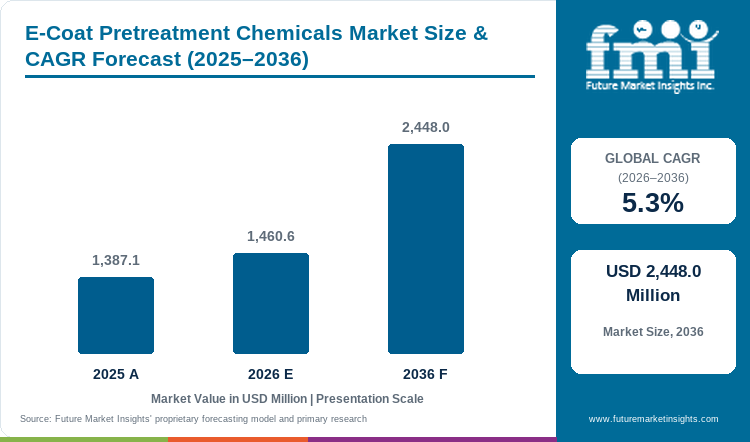
- USD 1460.6 Mn
- Forecast (2036)
- USD 2448.0 Mn
- CAGR (2026 to 2036)
- 5.3%
How big is E-Coat Pretreatment Chemicals Market in 2026?
USD 1,460.6 million in 2026 and USD 2,448.0 million by 2036 at a 5.3% CAGR.
E-coat surface-prep chemical sales are expected to reach USD 1,460.6 million in 2026, rising from USD 1,387.1 million in 2025. The market is projected to reach USD 2,448.0 million by 2036 at a 5.3% CAGR. Paint shops manage surface prep as one cleaning and conversion system. Bath condition can affect adhesion before the e-coat step begins. PPG describes phosphate surface prep as the first e-coat process step. Mixed-metal bodies also require one approved bath to work across more combinations of metal.
National rules change how paint shops manage conversion chemicals in each country. The U.S. Environmental Protection Agency treats phosphating as a metal-finishing operation and reports about 44,000 facilities with process wastewater discharges. Germany's Annex 40 covers metal processing and painting. Mexico's NOM-052 treats spent phosphating solutions as hazardous waste during bath changes. Paint shops must balance rust control with wastewater handling and steady production.
Key Takeaways
- Mixed-metal vehicle programs need surface prep that controls rust on steel and zinc-coated steel while also treating aluminum.
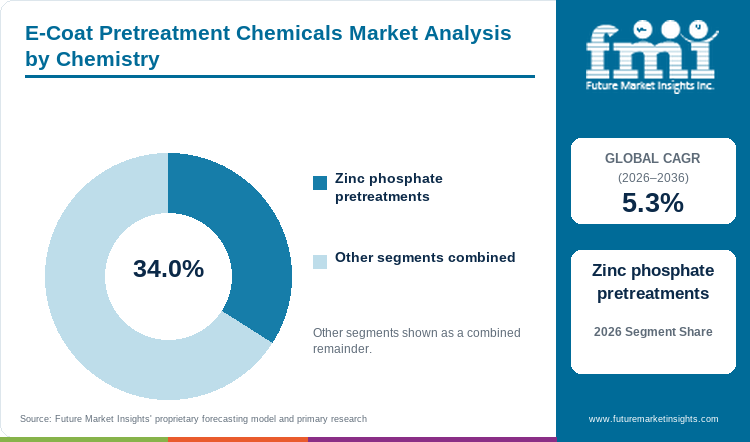
- Zinc phosphate pretreatments are expected to hold 34.0% of chemistry in 2026 because approved specifications make plants less willing to switch.
- In 2026, steel is expected to account for 38.0% of substrate demand because many vehicle and equipment lines still use it.
- Vehicle OEMs are projected to hold 47.0% of end use in 2026 because large paint shops need ongoing rust checks.
- Long approval work slows switching because a new bath must protect adhesion and meet wastewater rules without stopping production.
- Key players include Henkel, PPG, Chemetall / Surventis, Nippon Paint Surf Chemicals, and Nihon Parkerizing. Other suppliers include DuBois Chemicals, Quaker Houghton, Atotech / MKS, SurTec, and Chemische Werke Kluthe.
Analyst Perspective
"How can a paint shop use less energy without raising corrosion risk? The bath must still meet corrosion limits. Lower-temperature chemistry can cut utility use without adding more process variation."
- Nikhil Kaitwade, Principal Consultant, Future Market Insights
How is the e-coat pretreatment chemicals market segmented?
The e-coat pretreatment chemicals market is segmented by chemistry, substrate, end use, process stage, sales channel, and Region.
Chemistry includes zinc phosphate, zirconium, titanium, silane, and cleaner-conditioner packages used before e-coat application. Substrate includes steel, galvanized steel, aluminum, mixed-metal bodies, and light alloys. End use covers vehicle OEMs, parts suppliers, and industrial equipment. Process stage includes cleaning, activation, conversion coating, rinsing, and bath maintenance. Sales channel covers chemical suppliers, direct OEM contracts, system integrators, and distributors.
Why do zinc phosphate pretreatments retain the leading position within chemistry?
Many vehicle surface-prep specs still use zinc phosphate because its film helps paint bond and resist rust. Surface treatment chemicals also clean metal and form the layer used before paint. Plant teams know these bath-control steps well. That makes routine zinc phosphate refills easier to manage.
- In chemistry, zinc phosphate pretreatments are projected to account for 34.0% in 2026. Plants already approve this route for rust control and paint bond.
- Plants may accept more energy use when a bath already meets warranty needs. The approved phosphate window also lowers the risk of a change.
Why does steel lead the substrate category?
Steel remains common in body frames and chassis parts. Plants also use it in appliances and factory machines. The use of automotive lightweight materials adds aluminum and other metals to vehicle lines. Steel still stays in many mixed-metal paint shops. Surface prep must treat each metal without too much etching or an uneven treatment layer.
- In 2026, steel is expected to account for 38.0% of substrate demand. Many vehicle and equipment lines already use steel.
- The bath must protect steel without harming aluminum or zinc-coated surfaces. This need to treat several metals limits the choices for plant teams.
How do automotive OEMs anchor end use demand?
Vehicle OEM paint shops coat large body parts under strict rust and finish rules. Surface prep gets the metal ready for the e-coat step. Later automotive paints and coatings build the finish layers. A model change can alter leftover lubricant or the mix of metals. The plant may then need to test the bath again.
- By end use, vehicle OEMs are forecast to represent 47.0% in 2026. Large paint shops use a lot of these products and need constant process checks.
- Paint-shop engineers prefer bath packages that stay stable during planned model changes and recorded rust tests.
Why does conversion coating lead the process stage category?
The conversion layer forms a working film between clean metal and the e-coat primer. It helps paint stick and resist rust. Later corrosion protection coatings add more service life. Cleaning and activation get the metal ready for this step. Rinsing and bath care help protect the result.
- The conversion layer is set to account for 33.0% of the process-stage category in 2026. It directly helps paint bond and rust control.
- A weak spot in this layer may stay hidden until a rust test finds it under the e-coat film.
Why do automotive chemical suppliers lead the sales channel category?
Vehicle chemical suppliers sell concentrates and help plants fill each bath. They also test the bath and fix line issues. Their work differs from industrial cleaning chemicals because surface prep affects the later paint layer. On-site support helps plants stay inside an approved bath range during tests.
- Vehicle chemical suppliers are projected to hold 41.0% of sales channel demand in 2026. Routine bath checks and line support help sustain this share.
- Direct OEM contracts still matter. These contracts often use the same lab and field teams for approval and routine supply.
What are the drivers, restraints, and opportunities in the e-coat pretreatment chemicals market?
Mixed-metal retooling expands qualification demand, production risk slows chemistry switching, and lower-temperature systems create retrofit openings.
- Driver: Vehicle-platform changes require one surface-prep system to protect several metals without weakening the e-coat interface.
- Restraint: Plants must complete rust testing and wastewater checks before changing bath chemistry. They also need shutdown planning for high-volume lines.
- Opportunity: Low-temperature and phosphate-free packages can reduce utility use or sludge if they keep the approved rust window.
Mixed-metal vehicle programs make surface prep a plant-engineering task instead of a basic supply purchase. PPG shows ZIRCOBOND for current lines. PPG states that its zirconium bath cuts sludge by at least 80 percent compared with zinc-phosphate systems. Less sludge gives plants a reason to review the treatment step while keeping later coating needs the same. Advanced surface treatment chemicals must work across several metals and still protect against rust. Paint-shop teams need panel results and stable bath data before they change an approved process. New metal mixes or efficiency goals can trigger more surface-prep tests.
Plants face more than a bath test when they switch surface prep. A new bath can change wastewater duties and coating-control needs. The U.S. EPA lists phosphating under its Metal Finishing Effluent Guidelines. It also reports about 44,000 metal-finishing facilities that discharge process wastewater. Wastewater treatment chemicals still add cost during a bath change. Paint-shop teams must test each metal mix and the later e-coat result before routine line use. A planned shutdown also adds cost because the plant must time the treatment change with the full line.
Plants can cut process work without rebuilding the full surface-prep line. Atotech lists Interlox 5707 as a phosphate-free system for several metals. It works at ambient temperature and supports later e-coat or powder coating. That range lets current lines test lower energy use and less sludge. Automotive adhesives and sealants create more material contact points in body assembly and paint work. Suppliers can pair thin-film conversion treatment with dose control and a clear wastewater change plan. Brownfield plants can compare resource savings with rust and paint-bond results in the same line trial.
Which country CAGRs are profiled in the e-coat pretreatment chemicals market?
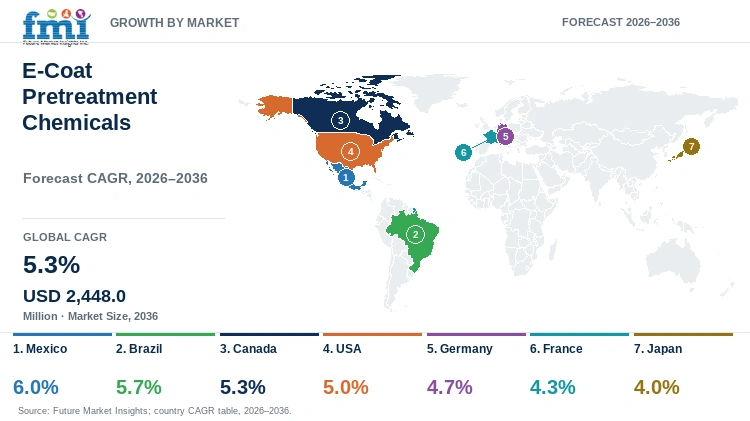
| Country | CAGR |
|---|---|
| Mexico | 6.0% |
| Brazil | 5.7% |
| Canada | 5.3% |
| USA | 5.0% |
| Germany | 4.7% |
| France | 4.3% |
| Japan | 4.0% |
How do country-level CAGRs compare in the e-coat pretreatment chemicals market?
Country CAGRs range from 4.0% to 6.0%. These rates compare forecast growth speed and do not show current revenue size.
- In Mexico, hazardous-waste regulations place spent phosphating-bath solutions under controlled handling and disposal requirements.
- Brazil’s environmental framework classifies surface-treatment activities among operations requiring heightened pollution-management oversight.
- In Canada, regulations governing conversion-coating sludge influence waste-management practices across metal-finishing operations.
- The USA’s metal-finishing wastewater requirements directly shape compliance obligations for phosphating facilities.
- Germany’s wastewater framework places metal-treatment and related coating operations under structured environmental controls.
- In France, phosphating activities are explicitly recognized within the national industrial-classification system.
- Japan’s environmental regulations cover designated acid- and alkali-based surface-treatment facilities, including phosphating applications.
The full report provides country-level CAGR analysis for North America and Latin America. It also covers Western Europe and Eastern Europe. Coverage extends to East Asia and South Asia and Pacific. The report also covers Middle East and Africa.
Country-wise Analysis
- Mexico's e-coat surface-prep chemicals demand is forecast to rise at 6.0% CAGR through 2036. Metal-finishing plants also manage spent bath chemicals under national hazardous-waste rules. Mexico's official normalization portal lists NOM-052-SEMARNAT-2005 as in force. The rule treats spent phosphating-bath solutions from metal-finishing work as hazardous waste. Pretreatment coatings must protect against rust and limit waste problems when a bath is replaced. Plants must plan line cleanup and disposal before they change the bath. Local plant support can lower risk by fitting tests into planned shutdowns. It also gives teams a clear way to handle spent chemicals after the switch. That plan helps the line restart with fewer open waste questions.
- Brazil's e-coat surface-prep chemicals outlook is expected to advance at 5.7% CAGR through 2036. Surface-treatment teams also work under a federal list for activities that may cause pollution. Ibama lists surface treatment under Category 3-11 of the federal technical registry. The listing keeps waste rules tied to bath choices during plant upgrades. Vehicle and factory metal lines still need routine cleaning and treatment as work programs change. Suppliers can pair low-sludge products with field support to help plants adopt them. They also need to match local water use and waste practices. Clear work steps can help a plant upgrade its line without adding needless delays during the bath change.
- Canada's e-coat surface-prep chemicals demand is expected to expand at 5.3% CAGR through 2036. North American vehicle programs and production specs support this outlook. Canada's Cross-border Movement regulations list F019 sludge from chemical conversion coating of aluminum. The rules also note a zirconium-phosphating exception for can washing. That difference makes the exact bath type important before a plant changes its treatment route. Plant teams must review wastewater controls and disposal needs at the same time. Cross-border programs favor suppliers that record bath contents before a line change. Clear waste guidance helps plants restart routine work with fewer rule questions after a planned shutdown.
- The USA is expected to post 5.0% CAGR through 2036 as plants replace chemicals and update installed lines. U.S. paint shops also follow wastewater rules that cover phosphating and other metal-finishing discharges. The EPA reports about 44,000 facilities that do metal-finishing work and discharge process wastewater. Plant teams review rust results with water treatment and permit needs during a bath change. Panel tests and bath data can lower doubt before a planned shutdown. Teams must also check how the new bath works with the later e-coat step. A clear shutdown plan helps the plant make the change as part of the full paint line instead of as a separate task.
- Germany's e-coat surface-prep chemicals demand is forecast to rise at 4.7% CAGR through 2036. Vehicle plants have a large base of paint shops and must handle changes in body metals and vehicle programs. Germany's Waste Water Ordinance Annex 40 covers wastewater from metal processing and related painting work. Factory surface prep has different needs from automotive refinish coatings. The plant must keep surface prep in step with nonstop e-coat and high-volume body work. Proven energy savings can make a retrofit bath worth testing. The new route still needs to control rust and work with current bath checks. Plants often prefer changes that save resources without forcing a large paint-shop rebuild.
- France's e-coat surface-prep chemicals sector is projected to record 4.3% CAGR through 2036. French plants review surface prep under an industrial rule that directly covers chemical conversion. Classification 2565 covers chemical surface conversion and specifically includes phosphating. The national rule keeps waste controls tied to bath choices during plant reviews. Vehicle makers may test lower-temperature or multi-metal routes to cut process work. Suppliers can support these retrofits with systems that keep rust control inside the approved range. The bath must also work in the current paint shop. Vehicle warranty needs and plant uptime still shape approval. A practical retrofit can cut process work without forcing a wider line change.
- Japan's e-coat surface-prep chemicals demand is expected to expand at 4.0% CAGR through 2036. Vehicle plants place strong value on repeatable control from surface prep through e-coat. Japan's Ministry of the Environment lists acid or alkali surface-treatment facilities as specified sources under water-pollution rules. The framework also covers electroplating facilities. Plant teams keep clear bath records when they change a process. A new bath needs sound test results and stable control limits before approval. Cost savings alone may not justify replacing a proven route. Suppliers can support adoption by showing that the new bath controls rust and works with planned paint-shop changes. The route must also fit current control steps.
Who are the notable companies in the e-coat pretreatment chemicals market?
Henkel; PPG; Chemetall / Surventis; Nippon Paint Surf Chemicals; Nihon Parkerizing; DuBois Chemicals; Quaker Houghton; Atotech / MKS; SurTec; Chemische Werke Kluthe
Companies compete on rust control across several metals and on plant support. Service teams must keep each bath inside an approved range. Integrated coating groups link surface prep with later e-coat steps. Specialist suppliers compete through treatment products and plant support.
- Henkel and PPG plus Chemetall / Surventis and Nippon Paint Surf Chemicals operate integrated vehicle surface prep platforms with Nihon Parkerizing.
- DuBois Chemicals and Quaker Houghton plus Atotech / MKS and SurTec operate specialized conversion platforms with Chemische Werke Kluthe.
Competitive Benchmarking: E-Coat Pretreatment Chemicals Market
| Company | Multi-metal pretreatment | Low-impact platform | E-coat interface | Geographic reach |
|---|---|---|---|---|
| Henkel | High | High | High | Global |
| PPG | High | Medium | High | Global |
| Chemetall / Surventis | High | High | High | Global |
| Nippon Paint Surf Chemicals | High | High | High | Multi-region |
| Nihon Parkerizing | High | High | High | Global |
| DuBois Chemicals | High | High | High | North America |
| Quaker Houghton | High | High | Medium | Global |
| Atotech / MKS | High | High | High | Global |
| SurTec | High | High | High | Global |
| Chemische Werke Kluthe | Medium | High | High | Multi-region |
High means direct public proof supports the criterion. Medium means the company has a narrower recorded route. Low means public proof shows one route with limited breadth. The ratings use current company records and do not measure overall corporate strength.
Key Developments in the E-Coat Pretreatment Chemicals Market
- In August 2026, Surventis launched two Chemetall testing lines for surface prep and anodizing in Blackman Township.
- In April 2026, Chemische Werke Kluthe documented production-condition tests of surface prep and paint systems for adhesion and rust performance.
- In February 2026, Henkel launched BONDERITE C-AD 20202 for low-temperature dip degreasing before phosphating and other conversion treatments.
Key Players in the E-Coat Pretreatment Chemicals Market
Integrated coating and pretreatment platforms
- Henkel
- PPG
- Chemetall / Surventis
- Nippon Paint Surf Chemicals
- Nihon Parkerizing
Specialized conversion-chemistry platforms
- DuBois Chemicals
- Quaker Houghton
- Atotech / MKS
- SurTec
- Chemische Werke Kluthe
E-Coat Pretreatment Chemicals Market - Report Scope
| Coverage field | Report scope |
|---|---|
| Market breakdown | By chemistry, substrate, end use, process stage, sales channel, and Region. |
| Quantitative units | USD million. |
| Market definition | Commercial cleaners, activators, conversion coatings, rinses or seals, and bath-maintenance chemistry used before or around e-coat application. |
| Regions covered | North America, Latin America, Western Europe, Eastern Europe, East Asia, South Asia and Pacific, and Middle East and Africa. |
| Countries covered | Mexico, Brazil, Canada, USA, Germany, France, Japan, and 20+ countries in the full report. |
| Key companies profiled | Henkel, PPG, Chemetall / Surventis, Nippon Paint Surf Chemicals, Nihon Parkerizing, DuBois Chemicals, Quaker Houghton, Atotech / MKS, SurTec, and Chemische Werke Kluthe. |
| Forecast period | 2026 to 2036. |
| Approach | Primary and secondary research with market triangulation. |
E-Coat Pretreatment Chemicals Market - Research Methodology
| Method | Approach |
|---|---|
| Primary Research | FMI analysts gathered input from manufacturers, service providers, technology developers, distributors, end users, procurement teams, and subject-matter experts. Interviews examined purchasing decisions, product or service evaluation, adoption barriers, approval requirements, pricing considerations, and expectations for technical or commercial support. Respondents were also asked what evidence is required before a trial, pilot, or initial order develops into regular purchasing. |
| Desk Research | Desk research covered government statistics, regulatory publications, trade data, industry associations, technical literature, standards, company filings, product information, and official corporate announcements. Sources were reviewed for relevance, publication date, geographic coverage, and consistency with the defined market scope. Claims relating to performance, applications, approvals, capacity, investment, and commercial activity were retained only when supported by credible public evidence. |
| Market Sizing and Forecasting | The market model combined the baseline value with historical performance, segment structure, pricing and volume indicators, adoption levels, company participation, and country-level demand conditions. Forecast assumptions considered economic activity, investment trends, regulatory developments, technology adoption, purchasing cycles, supply availability, and barriers to wider market use. Segment and regional estimates were reconciled before the final market total was calculated. |
| Data Validation | Estimates were checked against multiple independent indicators, including public data, company activity, trade patterns, industry developments, and findings from primary interviews. Validation also tested whether products, services, applications, and company revenues fell within the defined market boundaries. Adjacent categories, unsupported claims, overlapping revenues, and activities without direct market relevance were excluded to reduce double counting and maintain consistency across segments and countries. |
E-Coat Pretreatment Chemicals Market by Segments
E-Coat Pretreatment Chemicals Market segmented by Chemistry:
- Zinc phosphate pretreatments
- Zirconium pretreatments
- Titanium pretreatments
- Silane pretreatments
- Cleaner-conditioner packages
E-Coat Pretreatment Chemicals Market segmented by Substrate:
- Steel
- Galvanized steel
- Aluminum
- Mixed-metal bodies
- Magnesium / light alloys
E-Coat Pretreatment Chemicals Market segmented by End Use:
- Automotive OEMs
- Auto parts suppliers
- Appliance coating
- Industrial equipment
- Commercial vehicles
E-Coat Pretreatment Chemicals Market segmented by Process Stage:
- Cleaning
- Activation
- Conversion coating
- Rinse / seal
- Bath maintenance
E-Coat Pretreatment Chemicals Market segmented by Sales Channel:
- Automotive chemical suppliers
- OEM paint shop contracts
- System integrators
- Distributors
E-Coat Pretreatment Chemicals Market by Region
- North America
- United States
- Canada
- Latin America
- Brazil
- Mexico
- Argentina
- Chile
- Western Europe
- Germany
- France
- United Kingdom
- Italy
- Spain
- Benelux
- Nordics
- Eastern Europe
- Poland
- Czech Republic
- Romania
- Hungary
- East Asia
- China
- Japan
- South Korea
- South Asia and Pacific
- India
- ASEAN
- Australia and New Zealand
- Middle East and Africa
- GCC Countries
- South Africa
- Türkiye
- Israel
Research Sources and Bibliography
- U.S. Environmental Protection Agency. (2026, March 17). Metal Finishing Effluent Guidelines.
- Henkel. (2026, February 18). Henkel launches BONDERITE C-AD 20202: Energy-efficient dip degreasing for the most demanding cleaning requirements.
- BASF. (2026, May 6). Chemetall strengthens footprint in Asia Pacific with new application laboratory in Vietnam.
- Nippon Paint Holdings Co., Ltd. (2026, July 23). Notice regarding reorganization among consolidated subsidiaries in the Japan Group.
- Nippon Paint Holdings Co., Ltd. (n.d.). Surface treatments.
- Federal Ministry of Justice and Federal Office of Justice. (n.d.). Waste Water Ordinance (AbwV), Annex 40: Metal processing and treatment.
- Department of Justice Canada. (2026, August 20). Cross-border Movement of Hazardous Waste and Hazardous Recyclable Material Regulations, Schedule 12.
- Légifrance. (n.d.). Classification 2565: Metal coating and chemical or electrolytic surface treatment.
- Instituto Brasileiro do Meio Ambiente e dos Recursos Naturais Renováveis. (2023, July 7). CTF/APP category 3-11: Surface treatment.
- Secretaría de Economía. (n.d.). NOM-052-SEMARNAT-2005.
- Secretaría de Medio Ambiente y Recursos Naturales. (2006, June 23). NORMA Oficial Mexicana NOM-052-SEMARNAT-2005, Que establece las características, el procedimiento de identificación, clasificación y los listados de los residuos peligrosos.
- Ministry of the Environment, Government of Japan. (n.d.). Water Pollution Control framework and specified surface-treatment facilities.
- PPG. (n.d.). Industrial e-coating process: Pretreatment requirements.
- PPG. (2026, April 20). PPG introduces end-to-end protective coatings solutions and application services for data centers.
- PPG. (2026, June 25). PPG ENVIRO-PRIME EPIC electrocoat named Innovative Coating of the Year at Ringier Technology Innovation Awards.
- Henkel. (2026, September 16). Henkel launches BONDERITE E-CO GUARD system: Stable pretreatment operations with multi-channel process control.
- Henkel. (2026, September 17). ALUMINIUM 2026: Henkel showcases solutions for resource-efficient pretreatment and finishing.
- Chemetall. (n.d.). Oxsilan advanced multi-metal pretreatment technology.
- Surventis. (2026, July 1). Surventis launches as an independent global leader in automotive coatings and surface treatment.
- Surventis. (2026, August 27). Surventis expands surface treatment capabilities in North America with new testing lines in Blackman Township.
- Nihon Parkerizing Co., Ltd. (n.d.). Automotive surface-treatment technology and paint-base conversion coatings.
- Nihon Parkerizing Co., Ltd. (n.d.). Processing Services.
- DuBois Chemicals. (n.d.). DuraTEC zirconium phosphate-free pretreatment portfolio.
- A2LA. (2026, February 20). Scope of Accreditation to ISO/IEC 17025:2017 - DuBois Application Engineering Department Laboratory.
- Quaker Houghton. (n.d.). Surface finishing conversion coatings and remanufacturing solutions.
- Quaker Houghton. (2026, April 30). Quaker Houghton Announces First Quarter 2026 Results.
- Atotech. (n.d.). Interlox 5707 phosphate-free paint pretreatment for multiple metals.
- Atotech. (2026, March 5). Modern Cleaners: Boosting Efficiency and Sustainability in Industrial Cleaning.
- SurTec. (n.d.). SurTec 609 EC phosphate replacement for multi-metal pretreatment.
- SurTec. (2026, March 18). CHEMEON and SurTec form strategic alliance in global surface technology market.
- Chemische Werke Kluthe GmbH. (n.d.). Downloads: Pretreatment and E-Coat process chemicals.
- Chemische Werke Kluthe GmbH. (2026, March 31). Application-Focused Processes in the Tech Center.
- Chemische Werke Kluthe GmbH. (2026, April 7). Paints in Practice.
- PPG. (n.d.). Industrial pretreatment products.
- Henkel Adhesive Technologies. (n.d.). Paint shop solutions for the vehicle body.
This bibliography is provided for reader reference and is not exhaustive. The full report contains the complete reference list and detailed citations
This Report Answers
- How large is the market in 2026 and 2036?
- What supports the 5.3% CAGR?
- Which segments lead in 2026?
- Why does conversion layer lead?
- How do used water controls affect switching?
- How do country outlooks differ?
- How do low-temperature systems change retrofits?
- Which companies compete in surface prep?
Frequently Asked Questions
How big is the e-coat pretreatment chemicals market in 2026?
The market is worth USD 1,460.6 million in 2026. It is projected to reach USD 2,448.0 million by 2036. Mixed-metal vehicle programs keep demand tied to good rust control. Wastewater rules also make plant teams review surface prep before they approve a line change.
What is the forecast CAGR for the e-coat pretreatment chemicals market?
The market is projected to grow at 5.3% CAGR through 2036. Vehicle retooling and lower-temperature systems support demand. Long bath tests slow switching because plants must confirm rust control and process checks before they change a line.
Which chemistry leads the e-coat pretreatment chemicals market in 2026?
Zinc phosphate pretreatments are expected to hold 34.0% of the chemistry category in 2026. Many vehicle and durable-goods lines already use approved zinc phosphate specs. That history lowers switching risk during plant reviews and keeps the route qualified for rust control.
Which end use leads the e-coat pretreatment chemicals market in 2026?
Vehicle OEMs are projected to hold 47.0% of end use in 2026. Large paint shops use high volumes of surface-prep products. They also need steady bath checks and proven rust control when vehicle models or metal mixes change.
Which companies are active in the e-coat pretreatment chemicals market?
The market profiles ten companies. The profile includes Henkel and PPG with Chemetall / Surventis. It also includes Nippon Paint Surf Chemicals and other specialists. These suppliers compete through treatment chemistry and plant support. Their teams help customers test and approve surface prep before routine line use.
Preview the report firsthand - request a free sample
Get SampleGet the brochure for pricing and purchase details.
Get PDFTable of Content
- Key Takeaways
- Market Size and CAGR
- Top Growth Driver
- Fastest Growing Segment
- Leading Region
- Key Companies
- Emerging Opportunities
- Executive Summary
- Global Market Outlook
- Demand-side Trends
- Supply-side Trends
- Technology Roadmap Analysis
- Analysis and Recommendations
- Analyst Perspective (What is happening? Why now? What should investors know?)
- Key Questions Answered
- How large is the market?
- What is the CAGR?
- What are key trends?
- Which region dominates?
- Who are the leaders?
- Market Overview
- Market Coverage / Taxonomy
- Market Definition / Scope / Limitations
- Research Methodology
- Chapter Orientation
- Analytical Lens and Working Hypotheses
- Market Structure, Signals, and Trend Drivers
- Benchmarking and Cross-market Comparability
- Market Sizing, Forecasting, and Opportunity Mapping
- Research Design and Evidence Framework
- Desk Research Programme (Secondary Evidence)
- Expert Input and Fieldwork (Primary Evidence)
- Tooling, Models, and Reference Databases
- Data Engineering and Model Build
- Quality Assurance and Audit Trail
- Market Background
- Market Dynamics (Drivers, Restraints, Opportunity, Trends)
- Scenario Forecast (Optimistic, Likely, Conservative)
- Impact Analysis
- AI Impact
- Sustainability Impact
- Regulatory Impact
- Technology Impact
- Consumer / Buyer Analysis
- Purchase Drivers
- Adoption Barriers
- Buyer Journey
- Opportunity Map Analysis
- Product Life Cycle Analysis
- Supply Chain Analysis
- Investment Feasibility Matrix
- Value Chain Analysis
- PESTLE and Porter's Analysis
- Regulatory Landscape
- Regional Parent Market Outlook
- Production and Consumption Statistics
- Import and Export Statistics
- Global Market Analysis and Forecast, 2021 to 2036
- Historical Market Size Value (USD Million) Analysis, 2021 to 2025
- Current and Future Market Size Value (USD Million) Projections, 2026 to 2036
- Y-o-Y Growth Trend Analysis
- Absolute $ Opportunity Analysis
- Global Market Pricing Analysis, 2021 to 2036
- Global Market Analysis and Forecast, By Chemistry, 2021 to 2036
- Introduction / Key Findings
- Historical Market Size Value (USD Million) Analysis By Chemistry, 2021 to 2025
- Current and Future Market Size Value (USD Million) Analysis and Forecast By Chemistry, 2026 to 2036
- Zinc phosphate pretreatments
- Zirconium pretreatments
- Titanium pretreatments
- Silane pretreatments
- Cleaner-conditioner packages
- Y-o-Y Growth Trend Analysis By Chemistry, 2021 to 2025
- Absolute $ Opportunity Analysis By Chemistry, 2026 to 2036
- Global Market Analysis and Forecast, By Substrate, 2021 to 2036
- Introduction / Key Findings
- Historical Market Size Value (USD Million) Analysis By Substrate, 2021 to 2025
- Current and Future Market Size Value (USD Million) Analysis and Forecast By Substrate, 2026 to 2036
- Steel
- Galvanized steel
- Aluminum
- Mixed-metal bodies
- Magnesium / light alloys
- Y-o-Y Growth Trend Analysis By Substrate, 2021 to 2025
- Absolute $ Opportunity Analysis By Substrate, 2026 to 2036
- Global Market Analysis and Forecast, By End Use, 2021 to 2036
- Introduction / Key Findings
- Historical Market Size Value (USD Million) Analysis By End Use, 2021 to 2025
- Current and Future Market Size Value (USD Million) Analysis and Forecast By End Use, 2026 to 2036
- Automotive OEMs
- Auto parts suppliers
- Appliance coating
- Industrial equipment
- Commercial vehicles
- Y-o-Y Growth Trend Analysis By End Use, 2021 to 2025
- Absolute $ Opportunity Analysis By End Use, 2026 to 2036
- Global Market Analysis and Forecast, By Process Stage, 2021 to 2036
- Introduction / Key Findings
- Historical Market Size Value (USD Million) Analysis By Process Stage, 2021 to 2025
- Current and Future Market Size Value (USD Million) Analysis and Forecast By Process Stage, 2026 to 2036
- Cleaning
- Activation
- Conversion coating
- Rinse / seal
- Bath maintenance
- Y-o-Y Growth Trend Analysis By Process Stage, 2021 to 2025
- Absolute $ Opportunity Analysis By Process Stage, 2026 to 2036
- Global Market Analysis and Forecast, By Sales Channel, 2021 to 2036
- Introduction / Key Findings
- Historical Market Size Value (USD Million) Analysis By Sales Channel, 2021 to 2025
- Current and Future Market Size Value (USD Million) Analysis and Forecast By Sales Channel, 2026 to 2036
- Automotive chemical suppliers
- OEM paint shop contracts
- System integrators
- Distributors
- Y-o-Y Growth Trend Analysis By Sales Channel, 2021 to 2025
- Absolute $ Opportunity Analysis By Sales Channel, 2026 to 2036
- Global Market Analysis and Forecast, By Region, 2021 to 2036
- Introduction
- Historical Market Size Value (USD Million) Analysis By Region, 2021 to 2025
- Current Market Size Value (USD Million) Analysis and Forecast By Region, 2026 to 2036
- North America
- Latin America
- Western Europe
- Eastern Europe
- East Asia
- South Asia and Pacific
- Middle East and Africa
- Market Attractiveness Analysis By Region
- North America Market Analysis and Forecast, By Country, 2021 to 2036
- Historical Market Size Value (USD Million) Trend Analysis By Market Taxonomy, 2021 to 2025
- Market Size Value (USD Million) Forecast By Market Taxonomy, 2026 to 2036
- By Country
- United States
- Canada
- By Chemistry
- By Substrate
- By End Use
- By Process Stage
- By Sales Channel
- By Country
- Market Attractiveness Analysis
- By Country
- By Chemistry
- By Substrate
- By End Use
- By Process Stage
- By Sales Channel
- Key Takeaways
- Latin America Market Analysis and Forecast, By Country
- Historical Market Size Value (USD Million) Trend Analysis By Market Taxonomy, 2021 to 2025
- Market Size Value (USD Million) Forecast By Market Taxonomy, 2026 to 2036
- By Country
- Brazil
- Mexico
- Argentina
- Chile
- By Chemistry
- By Substrate
- By End Use
- By Process Stage
- By Sales Channel
- By Country
- Market Attractiveness Analysis
- By Country
- By Chemistry
- By Substrate
- By End Use
- By Process Stage
- By Sales Channel
- Key Takeaways
- Western Europe Market Analysis and Forecast, By Country
- Historical Market Size Value (USD Million) Trend Analysis By Market Taxonomy, 2021 to 2025
- Market Size Value (USD Million) Forecast By Market Taxonomy, 2026 to 2036
- By Country
- Germany
- France
- United Kingdom
- Italy
- Spain
- Benelux
- Nordics
- By Chemistry
- By Substrate
- By End Use
- By Process Stage
- By Sales Channel
- By Country
- Market Attractiveness Analysis
- By Country
- By Chemistry
- By Substrate
- By End Use
- By Process Stage
- By Sales Channel
- Key Takeaways
- Eastern Europe Market Analysis and Forecast, By Country
- Historical Market Size Value (USD Million) Trend Analysis By Market Taxonomy, 2021 to 2025
- Market Size Value (USD Million) Forecast By Market Taxonomy, 2026 to 2036
- By Country
- Poland
- Czech Republic
- Romania
- Hungary
- By Chemistry
- By Substrate
- By End Use
- By Process Stage
- By Sales Channel
- By Country
- Market Attractiveness Analysis
- By Country
- By Chemistry
- By Substrate
- By End Use
- By Process Stage
- By Sales Channel
- Key Takeaways
- East Asia Market Analysis and Forecast, By Country
- Historical Market Size Value (USD Million) Trend Analysis By Market Taxonomy, 2021 to 2025
- Market Size Value (USD Million) Forecast By Market Taxonomy, 2026 to 2036
- By Country
- China
- Japan
- South Korea
- By Chemistry
- By Substrate
- By End Use
- By Process Stage
- By Sales Channel
- By Country
- Market Attractiveness Analysis
- By Country
- By Chemistry
- By Substrate
- By End Use
- By Process Stage
- By Sales Channel
- Key Takeaways
- South Asia and Pacific Market Analysis and Forecast, By Country
- Historical Market Size Value (USD Million) Trend Analysis By Market Taxonomy, 2021 to 2025
- Market Size Value (USD Million) Forecast By Market Taxonomy, 2026 to 2036
- By Country
- India
- ASEAN
- Australia and New Zealand
- By Chemistry
- By Substrate
- By End Use
- By Process Stage
- By Sales Channel
- By Country
- Market Attractiveness Analysis
- By Country
- By Chemistry
- By Substrate
- By End Use
- By Process Stage
- By Sales Channel
- Key Takeaways
- Middle East and Africa Market Analysis and Forecast, By Country
- Historical Market Size Value (USD Million) Trend Analysis By Market Taxonomy, 2021 to 2025
- Market Size Value (USD Million) Forecast By Market Taxonomy, 2026 to 2036
- By Country
- GCC Countries
- South Africa
- Türkiye
- Israel
- By Chemistry
- By Substrate
- By End Use
- By Process Stage
- By Sales Channel
- By Country
- Market Attractiveness Analysis
- By Country
- By Chemistry
- By Substrate
- By End Use
- By Process Stage
- By Sales Channel
- Key Takeaways
- Key Countries Market Analysis
- United States
- Pricing Analysis
- Market Share Analysis, 2025
- By Chemistry
- By Substrate
- By End Use
- By Process Stage
- By Sales Channel
- Canada
- Pricing Analysis
- Market Share Analysis, 2025
- By Chemistry
- By Substrate
- By End Use
- By Process Stage
- By Sales Channel
- Mexico
- Pricing Analysis
- Market Share Analysis, 2025
- By Chemistry
- By Substrate
- By End Use
- By Process Stage
- By Sales Channel
- Brazil
- Pricing Analysis
- Market Share Analysis, 2025
- By Chemistry
- By Substrate
- By End Use
- By Process Stage
- By Sales Channel
- Chile
- Pricing Analysis
- Market Share Analysis, 2025
- By Chemistry
- By Substrate
- By End Use
- By Process Stage
- By Sales Channel
- Germany
- Pricing Analysis
- Market Share Analysis, 2025
- By Chemistry
- By Substrate
- By End Use
- By Process Stage
- By Sales Channel
- United Kingdom
- Pricing Analysis
- Market Share Analysis, 2025
- By Chemistry
- By Substrate
- By End Use
- By Process Stage
- By Sales Channel
- Italy
- Pricing Analysis
- Market Share Analysis, 2025
- By Chemistry
- By Substrate
- By End Use
- By Process Stage
- By Sales Channel
- Spain
- Pricing Analysis
- Market Share Analysis, 2025
- By Chemistry
- By Substrate
- By End Use
- By Process Stage
- By Sales Channel
- France
- Pricing Analysis
- Market Share Analysis, 2025
- By Chemistry
- By Substrate
- By End Use
- By Process Stage
- By Sales Channel
- India
- Pricing Analysis
- Market Share Analysis, 2025
- By Chemistry
- By Substrate
- By End Use
- By Process Stage
- By Sales Channel
- ASEAN
- Pricing Analysis
- Market Share Analysis, 2025
- By Chemistry
- By Substrate
- By End Use
- By Process Stage
- By Sales Channel
- Australia and New Zealand
- Pricing Analysis
- Market Share Analysis, 2025
- By Chemistry
- By Substrate
- By End Use
- By Process Stage
- By Sales Channel
- China
- Pricing Analysis
- Market Share Analysis, 2025
- By Chemistry
- By Substrate
- By End Use
- By Process Stage
- By Sales Channel
- Japan
- Pricing Analysis
- Market Share Analysis, 2025
- By Chemistry
- By Substrate
- By End Use
- By Process Stage
- By Sales Channel
- South Korea
- Pricing Analysis
- Market Share Analysis, 2025
- By Chemistry
- By Substrate
- By End Use
- By Process Stage
- By Sales Channel
- Poland
- Pricing Analysis
- Market Share Analysis, 2025
- By Chemistry
- By Substrate
- By End Use
- By Process Stage
- By Sales Channel
- Hungary
- Pricing Analysis
- Market Share Analysis, 2025
- By Chemistry
- By Substrate
- By End Use
- By Process Stage
- By Sales Channel
- Türkiye
- Pricing Analysis
- Market Share Analysis, 2025
- By Chemistry
- By Substrate
- By End Use
- By Process Stage
- By Sales Channel
- South Africa
- Pricing Analysis
- Market Share Analysis, 2025
- By Chemistry
- By Substrate
- By End Use
- By Process Stage
- By Sales Channel
- United States
- Market Structure Analysis
- Competition Dashboard
- Competition Benchmarking
- Market Share Analysis of Top Players
- By Regional
- By Chemistry
- By Substrate
- By End Use
- By Process Stage
- By Sales Channel
- Emerging Startups
- Innovation Benchmarking
- Competition Analysis
- Competition Deep Dive
- Henkel
- Overview
- Product Portfolio
- Profitability by Market Segments
- Sales Footprint
- Strategy Overview
- Marketing Strategy
- Product Strategy
- Channel Strategy
- PPG
- Chemetall / Surventis
- Nippon Paint Surf Chemicals
- Nihon Parkerizing
- DuBois Chemicals
- Quaker Houghton
- Atotech / MKS
- SurTec
- Chemische Werke Kluthe
- Henkel
- Case Studies
- Success Stories
- Recent Developments
- Competition Deep Dive
- Assumptions & Acronyms Used


