

- Market Size (2026)
- USD 74.8 Mn
- Forecast (2036)
- USD 347.4 Mn
- CAGR (2026 to 2036)
- 16.6%
How big is Electronic Wedge Brakes Market in 2026?
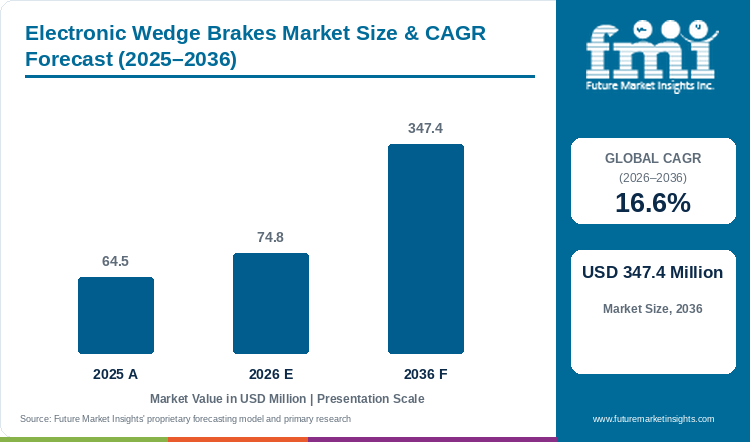
Having recorded a market size of USD 64.5 million in 2025 and moving to USD 74.8 million in 2026, the global electronic wedge brakes market is projected to scale up to USD 347.4 million by the end of 2036, maintaining a 16.6% CAGR.
Pressure on electric vehicle manufacturers to remove hydraulic brake-fluid assembly bottlenecks and cut wheel-end actuator weight is the primary factor driving the adoption of electronic wedge brakes. Conventional ball-screw dry calipers require heavy high-torque motors to stop three-tonne battery trucks, whereas self-reinforcing wedge geometry uses rotor rotation to multiply clamping force with a smaller motor. For instance, a September 2026 critical review of 100 electromechanical braking sources in MDPI Vehicles evaluated 59 peer-reviewed studies and 26 patent families, confirming that self-energizing wedge amplification substantially lowers motor torque demand while requiring active pad-friction control [1]. Because OEM safety teams refuse to risk mechanical wedge lockup during panic stops, Cross-Roller Dual-Motor Self-Reinforcing Wedge is expected to command 59.4% of the self-energizing wedge kinematics segment in 2026 across x-by-wire systems. Global electronic wedge brakes market value is estimated to rise from USD 64.5 million in 2025 to USD 74.8 million in 2026 and are forecast to reach USD 347.4 million by 2036, expanding at a 16.6% CAGR to generate USD 272.6 million in added annual market value. However, sudden friction-coefficient spikes at the pad-disc interface during wet or heat-soaked braking still restrain four-corner adoption in price-sensitive compact cars.
Key Market Trends & Insights
- By self-energizing wedge kinematics: Cross-Roller Dual-Motor Self-Reinforcing Wedge is projected to capture 59.4% in 2026 because dual-motor counter-torque paths guarantee active pad release across high-load wheel corners.
- By vehicle voltage supply: 48V Zonal Dry Brake-by-Wire Architecture is estimated to command 66.8% in 2026 by cutting resistive power losses by 75% during peak dynamic clamping maneuvers.
- By axle deployment strategy: Rear-Axle Dry Wedge + Front Hydraulic/EMB Hybrid is expected to hold 62.0% in 2026 owing to simplified electric parking-brake integration and staged regulatory sign-off.
- By vehicle category: Heavy Electric SUVs & Pickups (>2,500 kg GVW) is forecast to generate 54.5% in 2026 since high gross vehicle mass directly benefits from self-reinforcing mechanical gain.
Regional Highlights
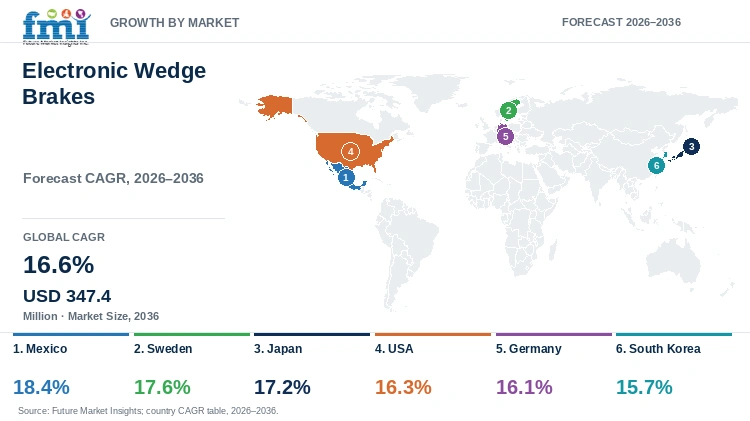
- Top national expansion: Mexico is projected to lead national expansion at an 18.4% CAGR through 2036 under nearshored dry caliper assembly plants supplying North America electric pickup platforms.
- Broader country progression: Sweden is expected to expand at 17.6% CAGR ahead of Japan at 17.2% and the USA at 16.3%, while Germany and South Korea are forecast to advance at 16.1% and 15.7% yearly paces.
Market Size & Forecast
Table 1: Market Size and Forecast for the Electronic Wedge Brakes Market (USD million and CAGR percentage), 2025 to 2036
| Metric | Value |
|---|---|
| 2025 Market Size | USD 64.5 million |
| Estimated Market Size in 2026 | USD 74.8 million |
| Projected Market Size by 2036 | USD 347.4 million |
| CAGR, 2026 to 2036 | 16.6% |
| Added Revenue, 2026 to 2036 | USD 272.6 million |
Regulatory clearance for purely electrical braking transmission is the main catalyst converting OEM prototype budgets into commercial supply contracts between 2026 and 2036. Until recently, vehicle type-approval rules required a physical hydraulic backup circuit, which forced automakers to delay fluid-free corner actuators. In October 2025, for instance, the UNECE Working Party on Automated/Autonomous and Connected Vehicles (GRVA) and CITA established Electrical Transmission Braking System (ETBS) periodic technical inspection protocols under UN Regulation No. 13 and UN Regulation No. 13-H (PTI 41-03) [2]. This regulatory clarity enables OEM purchasing teams to nominate self-energizing wedge calipers inside regenerative brake-by-wire systems without bearing open-ended homologation risk.
Vehicle-Parc and Caliper-Actuator Requirement Sizing
Table 2: Vehicle-Parc and Caliper-Actuator Requirement Sizing for the Electronic Wedge Brakes Market (USD million and operational ranges), 2025 to 2036
| Metric | 2025 | 2026 | 2036 |
|---|---|---|---|
| Market size (USD million) | 64.5 | 74.8 | 347.4 |
| Equipped vehicle production (thousand units) | 148.0 to 165.0 | 172.0 to 192.0 | 860.0 to 940.0 |
| Shipped wedge caliper units (thousand units) | 340.0 to 380.0 | 395.0 to 440.0 | 2,150.0 to 2,380.0 |
| Average OEM revenue per vehicle shipset (USD) | 390.0 to 435.0 | 390.0 to 435.0 | 370.0 to 405.0 |
Operational note: Equipped vehicle and caliper unit ranges reconcile 2-corner rear-axle hybrid installations and 4-corner full dry architectures across heavy electric SUV and autonomous shuttle production schedules.
Expansion of equipped vehicle volumes from 172.0 thousand units in 2026 to 860.0 thousand units by 2036 depends on how effectively dry wedge actuators improve battery range recovery. Faster wheel-end torque response allows chassis software to maximize regenerative deceleration before friction pads touch the rotor. Automakers are therefore bundling rear wedge calipers with electric vehicle e-axles so recuperation and friction braking operate through a single zonal controller.
Per-Vehicle & Corner-Module Spending Indicators
Table 3: Per-Vehicle and Corner-Module Spending Indicators for the Electronic Wedge Brakes Market (USD and percentages), 2025 to 2036
| Metric | 2025 | 2026 | 2036 |
|---|---|---|---|
| Global BEV & L4 shuttle output (million units) | 14.2 | 16.5 | 42.0 |
| Wedge brake spend per 1,000 EVs produced (USD) | 4,542.3 | 4,533.3 | 8,271.4 |
| Average ASP per wedge caliper corner (USD) | 170.0 to 190.0 | 170.0 to 190.0 | 146.0 to 162.0 |
| OEM series-production contract share (%) | 88.0% to 91.0% | 89.0% to 92.0% | 93.0% to 96.0% |
Table 4: OEM Platform & Corner-Actuator Spending Indicators for the Electronic Wedge Brakes Market (USD and percentages), 2026
| Metric | Value | Institutional Reference Basis |
|---|---|---|
| Market size, 2026 | USD 74.8 million | 2026 global revenue baseline |
| Active OEM dry brake-by-wire vehicle programs | 34 platforms | Global EV pickup, SUV & L4 robotaxi platform tracker |
| Average annual wedge procurement per platform | USD 2.2 million | Annualized Tier-1 corner-actuator supply value |
| Heavy electric SUV & pickup allocation, 2026 | USD 40.8 million | 54.5% vehicle category segment share |
Reductions in average selling prices from USD 180 per corner in 2026 toward USD 154 by 2036 is essential for Tier-1 suppliers seeking mass-market platform nominations. High caliper cost currently stems from embedding physical load-cell sensors inside high-temperature brake housings. Suppliers that replace physical load cells with motor-current estimation algorithms and link them with automotive steering systems win multi-platform software-defined vehicle contracts.
Analyst Perspective
"Self-energizing wedge kinematics solve the peak amperage and motor-mass penalty that previously restricted dry electromechanical brakes on three-tonne electric trucks. Suppliers that pair cross-roller dual-motor redundancy with sensorless contact-point estimation will capture multi-year corner-module nominations across 48V zonal vehicle architectures."
- Nikhil Kaitwade, Principal Consultant, Future Market Insights.
How is the electronic wedge brakes market segmented?
The electronic wedge brakes market is segmented by self-energizing wedge kinematics, vehicle voltage supply, axle deployment strategy, and vehicle category. In 2026, Cross-Roller Dual-Motor Self-Reinforcing Wedge is projected at 59.4%, 48V Zonal Dry Brake-by-Wire Architecture at 66.8%, Rear-Axle Dry Wedge + Front Hydraulic/EMB Hybrid at 62.0%, and Heavy Electric SUVs & Pickups (>2,500 kg GVW) at 54.5%.
By self-energizing wedge kinematics: Cross-Roller Dual-Motor Self-Reinforcing Wedge and Single-Motor Ball-Ramp / Planetary Wedge Caliper.
By vehicle voltage supply: 48V Zonal Dry Brake-by-Wire Architecture and 12V Redundant Dual-Battery Architecture.
By axle deployment strategy: Rear-Axle Dry Wedge + Front Hydraulic/EMB Hybrid and 4-Corner Full Dry Wedge Brake-by-Wire.
By vehicle category: Heavy Electric SUVs & Pickups (>2,500 kg GVW) as well as Autonomous Level 4 Robotaxis & Shuttles and Light Commercial Electric Delivery Vans.
Why does Cross-Roller Dual-Motor Self-Reinforcing Wedge lead the self-energizing wedge kinematics category?
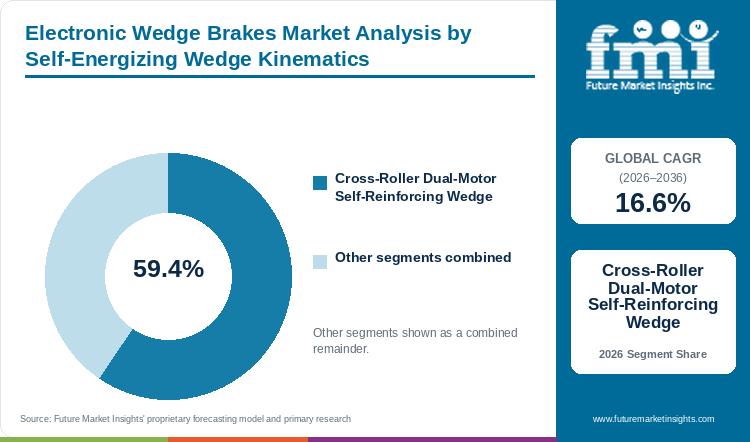
Cross-Roller Dual-Motor Self-Reinforcing Wedge is projected to capture 59.4% of the self-energizing wedge kinematics category in 2026 through dual-motor anti-jamming actuation.
Table 5: Self-Energizing Wedge Kinematics Share for the Electronic Wedge Brakes Market (percentage share), 2026
| Self-Energizing Wedge Kinematics | Share (2026) |
|---|---|
| Cross-Roller Dual-Motor Self-Reinforcing Wedge | 59.4% |
| Other Segments Combined | 40.6%* |
| Total | 100.0% |
*Calculated as the balance remaining after deducting the leading segment's reported share from 100.0%.
Table 6: Self-Energizing Wedge Kinematics Leadership and Market Growth for the Electronic Wedge Brakes Market (segment and CAGR percentage), 2026 to 2036
| Metric | Value |
|---|---|
| Global CAGR (2026 to 2036) | 16.6% |
| Leading Segment | Cross-Roller Dual-Motor Self-Reinforcing Wedge |
Strict ISO 26262 ASIL-D fail-operational safety mandates explain why OEM chassis teams strongly prefer cross-roller dual-motor mechanisms over single-motor ball-ramp designs. If a single-motor wedge actuator loses power while the brake pad friction coefficient spikes, the caliper can jam against the rotor and lock the wheel. Two counter-acting brushless motors on hardened cross-roller bearings allow one motor to actively retract the wedge even if the other winding fails, which is accelerating adoption in automotive integrated corner modules.
- Cross-Roller Dual-Motor Self-Reinforcing Wedge is projected to secure 59.4% of self-energizing wedge kinematics revenue in 2026 by guaranteeing active pad release under split-friction braking.
- For instance, a March 2026 thermoelastic modeling study by Galvanini et al. in MDPI Vehicles demonstrated that self-energizing carbon-carbon wedge brake stability depends directly on controlling localized contact temperatures and wedge angle geometry [3].
Why does 48V Zonal Dry Brake-by-Wire Architecture define the largest vehicle voltage supply segment?
48V Zonal Dry Brake-by-Wire Architecture is estimated to command 66.8% of the vehicle voltage supply segment in 2026 to cut corner-harness weight and resistive heat.
Peak current draw during rapid ABS modulation is the decisive variable pushing automakers away from 12V brake power toward 48V zonal architectures. Four dry calipers on a 12V bus require thick copper cables and exposes wheel-end MOSFET switches to thermal derating during repeated downhill stops. A shift to a 48V power supply cuts transient amperage by fourfold and reduces wiring harness mass across autonomous shuttles and public transit pods.
- Within the vehicle voltage supply category, 48V Zonal Dry Brake-by-Wire Architecture is estimated to hold 66.8% in 2026 because higher bus voltage prevents inverter overheating during emergency stops.
- In fact, a May 2026 review by Zhu et al. in MDPI Energies analyzing brake energy recovery control strategies confirmed that fast electromechanical actuator response and stable power bus regulation are essential to coordinate friction clamping with regenerative motor torque [4].
What keeps Rear-Axle Dry Wedge + Front Hydraulic/EMB Hybrid ahead by axle deployment strategy?
Rear-Axle Dry Wedge + Front Hydraulic/EMB Hybrid is expected to hold 62.0% of axle deployment strategy demand in 2026 owing to staged homologation and integrated parking lock.
High engineering validation costs for four-corner dry braking compel mainstream automakers to adopt a staged rear-axle hybrid deployment strategy first. Front wheels carry up to 70% of dynamic braking load, so retaining familiar front hydraulic calipers while fitting dry wedge units on the rear axle lowers homologation expense. At the same time, rear dry wedge units delete rear fluid piping and integrate electric parking-brake locking across automotive brake system components.
- Rear-Axle Dry Wedge + Front Hydraulic/EMB Hybrid commands an expected 62.0% of axle deployment strategy sales in 2026 since hybrid rollouts cut first-generation ISO 26262 verification cost.
- To illustrate this demand pattern, ZF Friedrichshafen AG documented on its By-Wire Technology portal in October 2026 production orders covering nearly 5 million vehicles for hybrid brake-by-wire systems pairing rear electromechanical calipers with front hydraulic actuation [5].
Why does Heavy Electric SUVs & Pickups (>2,500 kg GVW) lead the vehicle category segment?
Heavy Electric SUVs & Pickups (>2,500 kg GVW) is forecast to represent 54.5% of the vehicle category segment in 2026 under high gross-vehicle-weight stopping requirements.
Severe kinetic energy loads on battery-electric pickups and full-size SUVs exceeding 2,500 kilograms gross vehicle weight make heavy electric trucks the primary revenue driver for electronic wedge brakes. Standard ball-screw electromechanical calipers struggle to deliver 50 kilonewtons of clamping force on heavy trucks without oversized actuators that intrude into wheel-rim clearance. Self-energizing wedge amplification solves this packaging bottleneck by multiplying clamping force mechanically, which attracts high-volume pickup and SUV platform nominations.
- In 2026, Heavy Electric SUVs & Pickups (>2,500 kg GVW) is forecast to account for 54.5% of vehicle category demand owing to electric utility truck launches in North America and Asia.
- For example, in May 2026, Brembo N.V. confirmed in its Q1 2026 financial release that its SENSIFY intelligent braking platform entered series production across 100% of vehicles in a global automaker program [6].
What are the drivers, restraints, and opportunities in the electronic wedge brakes market?
In the electronic wedge brakes market, 48V zonal skateboard architectures and UNECE R13-H brake-by-wire homologation expand adoption whereas nonlinear pad-friction jamming risks restrain four-corner rollout and sensorless clamping-force observers create high-margin software opportunities.
- Driver: Deletion of hydraulic fluid lines and vacuum boosters across skateboard EV platforms accelerates OEM nomination of dry self-energizing wedge calipers.
- Restraint: Tribological friction spikes at the pad-disc interface and high dual-redundant power electronics costs slow full four-corner adoption in compact cars.
- Opportunity: Replacement of costly caliper load cells with motor-current virtual force estimators and automatic clearance calibration unlocks volume Tier-1 contracts.
Growth Analysis and Future Potential: Qualitative Demand Catalysts
Stricter mandatory automatic emergency braking stopping-distance rules are compelling automakers to replace slow hydraulic master cylinders with fast dry electronic wedge actuators. Dry wedge calipers reach full clamping force within 70 to 90 milliseconds compared with 250 milliseconds for conventional vacuum-boosted hydraulic brakes, cutting highway emergency stopping distances by up to 4.5 meters. In January 2025, the U.S. National Highway Traffic Safety Administration (NHTSA) published its FMVSS No. 127 rule notice (90 FR 8179) governing mandatory automatic emergency braking systems for light vehicles [7]. To capture OEM demand resulting from these safety standards, Nexteer Automotive launched its modular Electro-Mechanical Brake (EMB) system in April 2025 for software-defined Motion-by-Wire chassis control [8]. Commercial fleet builders developing level 4 autonomous highway trucking platforms are also adopting dry wedge actuators to eliminate factory brake-fluid bleeding.
Risk Assessment of the Electronic Wedge Brakes Market: Operational and Engineering Friction
Unpredictable shifts in brake-lining friction coefficients during wet weather or high-temperature mountain descents remain the chief restraint hindering electronic wedge brake adoption. When pad friction rises toward the tangent of the wedge inclination angle, a single-motor wedge caliper risks mechanical self-locking and unintended wheel lockup. In December 2025, a fault-tolerant control study by Kwon in MDPI Actuators demonstrated that four-wheel independent electromechanical brake actuators require robust time-delay control weighted to lateral velocity and yaw rate to prevent lane departure during severe asymmetric actuator faults [9]. Because of this safety liability, OEM qualification engineers require dual-channel power inverters and stable linings from automotive brake friction products suppliers before approving four-corner dry braking.
Commercial Opportunity Analysis: Architecture Differentiation and Value-Add Formats
Removal of physical piezoelectric load sensors from high-temperature caliper housings represents the largest margin-expansion opportunity for Tier-1 braking manufacturers. Dedicated force sensors add USD 18 to USD 25 per wheel corner to the bill of materials and suffer signal drift after repeated thermal cycles above 400 degrees Celsius. In January 2025, Park and co-authors published an experimental validation in MDPI Electronics proving that a Kalman-filter friction torque fusion observer estimates electromechanical brake clamping force within 5% error without physical load cells [10]. Suppliers embedding these virtual force estimators inside automotive brake systems lower per-corner hardware costs and win high-volume EV platform tenders.
Electronic Wedge Brakes Market by Country (2026 to 2036)
Mexico is projected to lead electronic wedge brakes expansion across major automotive manufacturing countries at an 18.4% CAGR through 2036, while South Korea is estimated to advance at a 15.7% yearly pace. Commercial performance across North America, Western Europe, and East Asia tracks UNECE R13-H Electrical Transmission Braking System type-approval milestones and localized 48V caliper machining capacity.
Table 7: Country CAGR and Primary Growth Levers for the Electronic Wedge Brakes Market (CAGR percentage and operational drivers), 2026 to 2036
| Country | CAGR (2026 to 2036) | Primary Growth Lever |
|---|---|---|
| Mexico | 18.4% | Nearshored Nuevo Leon and Coahuila caliper plants supplying North America electric pickups |
| Sweden | 17.6% | Heavy commercial EV truck and autonomous haulage dry braking programs at Volvo and Scania |
| Japan | 17.2% | Software-defined vehicle corner-actuator integration by Advics, Akebono, and Astemo |
| USA | 16.3% | FMVSS 127 automatic emergency braking rules and heavy electric pickup production |
| Germany | 16.1% | 48V zonal architecture rollouts and UNECE R13-H ETBS homologation across premium EVs |
| South Korea | 15.7% | E-GMP and next-generation platform EMB deployment led by HL Mando and Hyundai Motor Group |
Source: Future Market Insights analysis
Mexico Electronic Wedge Brakes Market Outlook (2026 to 2036)
Regional value-content thresholds under the USMCA trade agreement are compelling global braking suppliers to localize electromechanical caliper assembly in Mexico for duty-free shipment to North America electric pickup plants. For instance, following its USD 207 million Escobedo caliper plant expansion in Nuevo Leon, Brembo N.V. reported EUR 983 million in Q2 2026 group revenue in July 2026 on rising North America intelligent braking orders [11]. Demand for electronic wedge brakes in Mexico is projected to expand at an 18.4% CAGR through 2036 owing to these nearshored pickup and commercial van supply contracts in Monterrey and Saltillo. However, local absence of vacuum-degassed bearing steel mills forces caliper plants in Mexico to import precision cross-roller races from Europe and Japan, which exposes supplier margins to currency swings.
Key takeaway: In Mexico, USMCA regional content rules and Nuevo Leon caliper plant expansions are projected to anchor export-oriented dry wedge brake manufacturing.
Sweden Electronic Wedge Brakes Market Outlook (2026 to 2036)
Between 2026 and 2036, electronic wedge brakes turnover in Sweden is forecast to register a 17.6% annual growth rate driven by battery-electric heavy truck and autonomous mining haulage programs. Heavy commercial vehicle OEMs in Sweden require sub-90-millisecond wheel-end braking response to prevent trailer jackknifing across 64-tonne electric timber and freight combinations on split-friction winter roads. To support this transition, Scania Group updated its active road-safety and electronic braking architecture specifications for commercial fleets in September 2026 [12]. Even so, severe sub-zero road-salt corrosion across Nordic winters challenges actuator durability and forces suppliers in Sweden to qualify costly hermetically sealed metallic bellows.
Key takeaway: In Sweden, heavy electric truck electrification and winter split-friction stability requirements are forecast to accelerate commercial wedge caliper adoption.
Japan Electronic Wedge Brakes Market Outlook (2026 to 2036)
The need for extra interior cabin space inside compact urban electric vehicles is pushing automakers in Japan to integrate dry wedge brakes directly into steer-by-wire corner modules. In June 2025 Astemo Ltd. showcased its intelligent software-defined vehicle braking and integrated motion control technologies at the Automotive Summit 2025 to address compact EV packaging [13]. Revenue in the Japan electronic wedge brakes market is anticipated to climb at a 17.2% CAGR through 2036 because domestic OEMs are standardizing unified corner actuators across next-generation urban EVs. On the other hand, strict cabin noise thresholds below 35 decibels during low-speed creep stops require suppliers in Japan such as Advics and Akebono to add active harmonic current damping.
Key takeaway: In Japan, software-defined corner-module integration and strict cabin NVH standards are anticipated to guide compact dry wedge caliper procurement.
USA Electronic Wedge Brakes Market Outlook (2026 to 2036)
High curb weights across three-tonne battery-electric pickup trucks and federal high-speed emergency stopping rules are the primary variables expanding electronic wedge brake adoption in the USA. Commercial expenditure on electronic wedge brakes in the USA is expected to advance at a 16.3% yearly clip through 2036 under federal FMVSS No. 127 stopping-distance rules and electric utility truck production. To serve these domestic truck programs, HL Mando Corporation has expanded electromechanical caliper engineering and manufacturing in Opelika, Alabama while maintaining disclosed investor relations financial targets for North America by-wire contracts [14]. Nevertheless, strict litigation exposure surrounding autonomous robotaxi and light-truck safety in the USA forces OEMs to demand dual-redundant 48V/12V battery backups.
Key takeaway: In the USA, heavy electric pickup production and Level 4 robotaxi safety redundancy are expected to sustain high-value wedge caliper contracts.
Germany Electronic Wedge Brakes Market Outlook (2026 to 2036)
Early standardization of 48V zonal electrical architectures and UNECE Regulation No. 13-H type-approval protocols positions Germany as the engineering anchor for dry brake-by-wire systems in Europe. In July 2026, ZF Friedrichshafen AG reported improved first-half 2026 operating performance and confirmed full-year revenue guidance above EUR 38 billion as by-wire chassis deliveries ramped up [15]. In Germany, electronic wedge brakes sales are predicted to progress at a 16.1% CAGR over the 2026 to 2036 forecast window, supported by 48V zonal architecture rollouts across Munich and Stuttgart electric sedan platforms. However, capital expenditure discipline across automakers in Germany keeps near-term volume concentrated in rear-axle dry hybrid systems rather than costlier four-corner dry fitments.
Key takeaway: In Germany, UNECE R13-H type-approval leadership and 48V zonal chassis platforms are predicted to anchor OEM series production of dry wedge calipers.
South Korea Electronic Wedge Brakes Market Outlook (2026 to 2036)
Direct vertical integration between domestic electric vehicle platforms and Tier-1 chassis electronics suppliers accelerates commercialization of dry wedge calipers in South Korea. HL Mando Corporation continues to scale dry electromechanical brake calipers and patented pad contact-point detection algorithms across its R&D centers in Pangyo and Hwaseong [16]. Through 2036, electronic wedge brakes demand in South Korea is estimated to rise at a 15.7% annual pace on the back of software-defined electric vehicle platform upgrades and domestic dry caliper production. At the same time, foreign import tariffs on finished vehicles compel suppliers in South Korea to shift final caliper assembly closer to USA and Europe plants.
Key takeaway: In South Korea, vertically integrated chassis electronics R&D and sensorless pad-contact algorithms are estimated to drive domestic EV platform adoption.
Full report country CAGRs cover: North America; Latin America; Western Europe; Eastern Europe; East Asia; South Asia and Pacific; Middle East and Africa.
Who are the notable companies in the electronic wedge brakes market?
ZF Friedrichshafen AG, Continental AG (AUMOVIO SE), HL Mando Corporation, Brembo N.V., Nexteer Automotive Group Limited, Schaeffler AG, and Knorr-Bremse AG are the notable companies in the electronic wedge brakes market.
Competition in the electronic wedge brakes industry centers on how suppliers bundle mechanical wedge hardware with fail-operational braking software. Full-system chassis integrators supply pedal-feel simulators and zonal domain controllers paired with rear or four-corner dry wedge calipers. Meanwhile, motion-control and bearing manufacturers provide cross-roller wedge mechanisms and virtual clamping-force estimators to OEMs that write their own vehicle dynamics software.
- Full-System Dry Brake-by-Wire Integrators: ZF Friedrichshafen AG, Continental AG (AUMOVIO SE), and Brembo N.V. supply complete hybrid and four-corner dry brake-by-wire systems to global passenger and light-truck OEMs.
- Electromechanical Actuator & Motion Specialists: HL Mando Corporation and Nexteer Automotive Group Limited as well as Schaeffler AG engineer electromechanical wheel-end calipers and virtual clamping-force software.
- Commercial Vehicle Electromechanical Braking Platforms: Knorr-Bremse AG develops heavy-duty electromechanical and pneumatic-wedge braking modules for electric commercial trucks and rail vehicles.
Competitive Benchmarking: Electronic Wedge Brakes Market
Table 8: Competitive Benchmarking for the Electronic Wedge Brakes Market (qualitative capability ratings), 2026
| Company | Self-Energizing Wedge Kinematics | 48V Zonal & ASIL-D Control | OEM Series-Production Contracts | Geographic Reach |
|---|---|---|---|---|
| ZF Friedrichshafen AG | High | High | High | High |
| Continental AG (AUMOVIO SE) | High | High | High | High |
| HL Mando Corporation | High | High | High | Medium |
| Brembo N.V. | Medium | High | High | High |
| Nexteer Automotive Group Limited | Medium | High | Medium | High |
| Schaeffler AG | High | Medium | Medium | High |
| Knorr-Bremse AG | High | High | Medium | High |
Scoring basis: Capability tiers evaluate documented patent and prototype breadth in self-energizing wedge and cross-roller mechanisms as well as 48V ASIL-D dual-channel inverter integration and disclosed OEM series-production contracts across Europe and North America.
Key Developments in the Electronic Wedge Brakes Market
- Brembo N.V. confirmed in May 2026 that its SENSIFY intelligent braking platform entered series production across 100% of vehicles in a global automaker program [6], while Nexteer Automotive introduced its market-ready Electro-Mechanical Brake (EMB) system at Auto China in April 2026 after completing winter validation with more than 20 OEMs [17].
- AUMOVIO SE (spun off from Continental AG's Automotive group sector) published its updated semi-dry and dry brake-by-wire product roadmap in January 2026 covering global EV platforms [18].
- Schaeffler AG reported EUR 23.5 billion in FY2025 group revenue in March 2026 following the Vitesco Technologies merger [19] and released preliminary nine-month 2026 financial results in October 2026 highlighting electromechanical chassis actuator commercialization [21].
- Knorr-Bremse AG delivered strong second-quarter financial results in July 2025 and launched its Growth Beyond strategy covering electromechanical commercial braking systems [20].
Key Players in the Electronic Wedge Brakes Market
Full-System Dry Brake-by-Wire Integrators
- ZF Friedrichshafen AG
- Continental AG (AUMOVIO SE)
- Brembo N.V.
Electromechanical Actuator & Motion Specialists
- HL Mando Corporation
- Nexteer Automotive Group Limited
- Schaeffler AG
Commercial Vehicle Electromechanical Braking Platforms
- Knorr-Bremse AG
Electronic Wedge Brakes Market - Report Scope
Table 9: Report Scope for the Electronic Wedge Brakes Market (coverage fields and definitions), 2026 to 2036
| Coverage field | Report scope |
|---|---|
| Market breakdown | Self-Energizing Wedge Kinematics; Vehicle Voltage Supply; Axle Deployment Strategy; Vehicle Category |
| Quantitative Units | USD Million |
| Market Definition | Includes commercial OEM and Tier-1 supplier revenue from dry electromechanical wedge brake calipers, cross-roller and ball-ramp self-energizing wedge actuators, and integrated wheel-end wedge control electronics. Category Scope Note: Excludes conventional hydraulic disc calipers, vacuum brake boosters, pneumatic air-wedge drum brakes, and standalone non-wedge ball-screw electric parking brakes. |
| Regions Covered | North America; Latin America; Western Europe; Eastern Europe; East Asia; South Asia and Pacific; Middle East and Africa |
| Countries Covered | Mexico, Sweden, Japan, USA, Germany, South Korea, and additional countries in the full report |
| Key Companies Covered | ZF Friedrichshafen AG, Continental AG (AUMOVIO SE), HL Mando Corporation, Brembo N.V., Nexteer Automotive Group Limited, Schaeffler AG, Knorr-Bremse AG |
| Forecast Period | 2026 to 2036 |
| Approach | Primary and secondary research with top-down and bottom-up market triangulation. |
Electronic Wedge Brakes Market - Research Methodology
Table 10: Research Methodology for the Electronic Wedge Brakes Market (research methods and approach), 2026 edition
| Method | Approach |
|---|---|
| Primary Research | Structured interviews with OEM chassis architecture directors, Tier-1 brake-by-wire chief engineers, ISO 26262 functional-safety assessors, and 48V zonal harness procurement leads to validate corner-module pricing and rear-vs-four-corner rollout schedules. |
| Secondary Research | Analysis of UNECE GRVA Regulation No. 13 and 13-H ETBS working documents, NHTSA FMVSS No. 127 Federal Register filings, MDPI Vehicles and Actuators peer-reviewed EMB studies, and corporate annual reports. |
| Market Sizing and Forecasting | Top-down global X-by-Wire and dry EMB capital budgets reconciled against bottom-up vehicle platform nominations and per-corner wedge caliper ASPs from 2026 to 2036. |
| Country Forecasting Model | Econometric country projections weight battery-electric pickup and SUV assembly volumes, 48V zonal platform adoption rates, and regional brake-caliper manufacturing investments across six national automotive hubs. |
| Operational Benchmark Traceability | Vehicle-parc and corner-actuator indicators in Tables 2, 3, and 4 trace to MDPI Vehicles 100-source critical review datasets, MDPI Energies brake recovery benchmarks, and disclosed ZF and Brembo series-production contracts. |
| Data Triangulation and Validation | Demand estimates are cross-checked against Tier-1 braking division order intakes and OEM platform SOP schedules without double counting conventional hydraulic master cylinders or electrohydraulic one-box boosters. |
Electronic Wedge Brakes Market by Segments
Electronic Wedge Brakes Market segmented by Self-Energizing Wedge Kinematics:
- Cross-Roller Dual-Motor Self-Reinforcing Wedge
- Single-Motor Ball-Ramp / Planetary Wedge Caliper
Electronic Wedge Brakes Market segmented by Vehicle Voltage Supply:
- 48V Zonal Dry Brake-by-Wire Architecture
- 12V Redundant Dual-Battery Architecture
Electronic Wedge Brakes Market segmented by Axle Deployment Strategy:
- Rear-Axle Dry Wedge + Front Hydraulic/EMB Hybrid
- 4-Corner Full Dry Wedge Brake-by-Wire
Electronic Wedge Brakes Market segmented by Vehicle Category:
- Heavy Electric SUVs & Pickups (>2,500 kg GVW)
- Autonomous Level 4 Robotaxis & Shuttles
- Light Commercial Electric Delivery Vans
Electronic Wedge Brakes Market by Region
- North America
- USA
- Canada
- Latin America
- Brazil
- Mexico
- Argentina
- Chile
- Western Europe
- Germany
- France
- UK
- Italy
- Spain
- Benelux
- Sweden & Nordics
- Eastern Europe
- Poland
- Czech Republic
- Romania
- Hungary
- East Asia
- China
- Japan
- South Korea
- South Asia and Pacific
- India
- ASEAN
- Australia and New Zealand
- Middle East and Africa
- GCC Countries
- South Africa
- Türkiye
- Israel
Research Sources and Bibliography
- [1] Ulian, T. M., Achitei, G., Sachelarie, D., & Ianus, G. (2026, September 25). Critical Review of Electro-Mechanical Braking Systems (EMB). MDPI Vehicles, 8(10), 237.
- [2] United Nations Economic Commission for Europe (UNECE) GRVA & CITA. (2025, October 15). Electrical Transmission Braking System (ETBS) UN REG 13 & 13-H PTI 41-03. UNECE Wiki.
- [3] Galvanini, G., Gobbi, M., Mastinu, G., Cantoni, C., & Passoni, R. (2026, March 9). Thermoelastic Modeling of Self-Energizing Carbon-Carbon (C/C) Wedge Brakes for High-Performance Race Vehicles. MDPI Vehicles, 8(3), 54.
- [4] Zhu, J., Liu, H., Xing, B., Chen, J., & Fan, A. (2026, May 7). A Review of Control Strategies for Brake Energy Recovery Systems. MDPI Energies, 19(10), 2275.
- [5] ZF Friedrichshafen AG. (2026, October 8). By-Wire Technology - ZF. ZF Friedrichshafen AG.
- [6] Brembo N.V. (2026, May 7). Brembo Q1 2026 Results | Brembo EN. Brembo Corporate Website.
- [7] National Highway Traffic Safety Administration (NHTSA). (2025, January 27). Federal Motor Vehicle Safety Standards; Automatic Emergency Braking Systems for Light Vehicles. Federal Register, 90 FR 8179.
- [8] Nexteer Automotive. (2025, April 15). Nexteer Launches Brake-by-Wire System - Nexteer. Nexteer Automotive News Releases.
- [9] Kwon, O.-S. (2025, December 17). Fault Tolerant Robust Control of Four-Wheel Independent Electro-Mechanical Brake Actuators Using Time Delay Control with Relative Weighting to Lateral Velocity and Yaw Rate. MDPI Actuators, 14(12), 616.
- [10] Park, G., Kim, S., & Kim, J. (2025, January 16). Clamping Force Estimation for Electro-Mechanical Brake Based on Friction Torque Fusion Approach. MDPI Electronics, 14(2), 348.
- [11] Brembo N.V. (2026, July 28). Investors: press releases | Brembo Corporate website EN. Brembo N.V.
- [12] Scania CV AB. (2026, September 15). Road safety | Scania Group. Scania Corporate Website.
- [13] Astemo, Ltd. (2025, June 11). Astemo sponsors Automotive Summit 2025, showcasing intelligent advanced mobility technologies for SDV age. Astemo, Ltd. News Releases.
- [14] HL Mando Corporation. (2026, June 9). Financial Information | HL Mando. HL Mando Investor Relations.
- [15] ZF Friedrichshafen AG. (2026, July 30). ZF Continues Performance Improvement Trajectory - ZF. ZF Press Center.
- [16] HL Mando Corporation. (2026, October 22). HL Mando Official Website. HL Mando Corp.
- [17] Nexteer Automotive. (2026, April 21). Nexteer Introduces Market-Ready EMB at Auto China 2026, Advancing Comprehensive Motion Control Solutions - Nexteer. Nexteer Automotive News Releases.
- [18] AUMOVIO SE. (2026, January 15). Brake system roadmap | AUMOVIO. AUMOVIO Solutions.
- [19] Schaeffler AG. (2026, March 3). Schaeffler reports solid results for 2025 | Press Releases | Schaeffler Group. Schaeffler Group.
- [20] Knorr-Bremse AG. (2025, July 31). Knorr-Bremse delivers strong second-quarter results and launches “Growth Beyond” strategy. Knorr-Bremse Newsroom.
- [21] Schaeffler AG. (2026, October 13). Schaeffler releases preliminary numbers for first nine months of 2026 | Press Releases | Schaeffler Group. Schaeffler Group.
This bibliography is provided for reader reference and is not exhaustive. The full report contains the complete reference list and detailed citations.
This Report Answers
- How large is the electronic wedge brakes market in 2026 and what is forecast for 2036?
- Which 48V zonal and brake-by-wire homologation pressures support demand for electronic wedge brakes?
- Why does Cross-Roller Dual-Motor Self-Reinforcing Wedge lead the self-energizing wedge kinematics category?
- Why does 48V Zonal Dry Brake-by-Wire Architecture lead the vehicle voltage supply category globally?
- How do growth rates differ across Mexico and Sweden as well as Japan and the USA?
- Which leading companies supply dry electromechanical wedge calipers and by-wire systems today?
- What limits four-corner adoption or supplier switching in the electronic wedge brakes market?
- What should OEM chassis buyers evaluate before nominating an electronic wedge brake supplier?
Frequently Asked Questions
How big is the electronic wedge brakes market in 2026, and what is forecast for 2036?
Global electronic wedge brakes turnover is estimated to reach USD 74.8 million in 2026 from USD 64.5 million in 2025. Revenue is forecast to hit USD 347.4 million by 2036 as electric pickup and SUV platforms adopt fluid-free corner actuators.
What is the CAGR for the electronic wedge brakes market from 2026 to 2036?
The electronic wedge brakes market is projected to record a 16.6% compound annual growth rate between 2026 and 2036, creating USD 272.6 million in added annual revenue across passenger and commercial EV platforms.
Which self-energizing wedge kinematics segment leads the electronic wedge brakes market?
Cross-Roller Dual-Motor Self-Reinforcing Wedge is projected to capture 59.4% of self-energizing wedge kinematics demand in 2026 because counter-acting dual motors prevent mechanical pad-disc jamming.
Which vehicle voltage supply segment leads the electronic wedge brakes market?
48V Zonal Dry Brake-by-Wire Architecture is estimated to command 66.8% of the vehicle voltage supply category in 2026 to reduce peak amperage and corner wiring harness weight.
Which country has a notable growth outlook during the assessment period?
Mexico is projected to lead national expansion at an 18.4% CAGR through 2036 under Nuevo Leon and Coahuila caliper plant expansions supplying North America electric truck assembly.
Who are the key players in the market?
ZF Friedrichshafen AG, Continental AG (AUMOVIO SE), and HL Mando Corporation lead commercial supply across global OEM chassis programs. Brembo N.V. and Nexteer Automotive Group Limited as well as Schaeffler AG and Knorr-Bremse AG also hold key positions.
Preview the report firsthand - request a free sample
Get SampleGet the brochure for pricing and purchase details.
Get PDFTable of Content
- Key Takeaways
- Market Size and CAGR
- Top Growth Driver
- Fastest Growing Segment
- Leading Region
- Key Companies
- Emerging Opportunities
- Executive Summary
- Global Market Outlook
- Demand-side Trends
- Supply-side Trends
- Technology Roadmap Analysis
- Analysis and Recommendations
- Analyst Perspective (What is happening? Why now? What should investors know?)
- Key Questions Answered
- How large is the market?
- What is the CAGR?
- What are key trends?
- Which region dominates?
- Who are the leaders?
- Market Overview
- Market Coverage / Taxonomy
- Market Definition / Scope / Limitations
- Research Methodology
- Chapter Orientation
- Analytical Lens and Working Hypotheses
- Market Structure, Signals, and Trend Drivers
- Benchmarking and Cross-market Comparability
- Market Sizing, Forecasting, and Opportunity Mapping
- Research Design and Evidence Framework
- Desk Research Programme (Secondary Evidence)
- Expert Input and Fieldwork (Primary Evidence)
- Tooling, Models, and Reference Databases
- Data Engineering and Model Build
- Quality Assurance and Audit Trail
- Market Background
- Market Dynamics (Drivers, Restraints, Opportunity, Trends)
- Scenario Forecast (Optimistic, Likely, Conservative)
- Impact Analysis
- AI Impact
- Sustainability Impact
- Regulatory Impact
- Technology Impact
- Consumer / Buyer Analysis
- Purchase Drivers
- Adoption Barriers
- Buyer Journey
- Opportunity Map Analysis
- Product Life Cycle Analysis
- Supply Chain Analysis
- Investment Feasibility Matrix
- Value Chain Analysis
- PESTLE and Porter's Analysis
- Regulatory Landscape
- Regional Parent Market Outlook
- Production and Consumption Statistics
- Import and Export Statistics
- Global Market Analysis and Forecast, 2021 to 2036
- Historical Market Size Value (USD Million) Analysis, 2021 to 2025
- Current and Future Market Size Value (USD Million) Projections, 2026 to 2036
- Y-o-Y Growth Trend Analysis
- Absolute $ Opportunity Analysis
- Global Market Pricing Analysis, 2021 to 2036
- Global Market Analysis and Forecast, By Self-Energizing Wedge Kinematics, 2021 to 2036
- Introduction / Key Findings
- Historical Market Size Value (USD Million) Analysis By Self-Energizing Wedge Kinematics, 2021 to 2025
- Current and Future Market Size Value (USD Million) Analysis and Forecast By Self-Energizing Wedge Kinematics, 2026 to 2036
- Cross-Roller Dual-Motor Self-Reinforcing Wedge
- Single-Motor Ball-Ramp / Planetary Wedge Caliper
- Y-o-Y Growth Trend Analysis By Self-Energizing Wedge Kinematics, 2021 to 2025
- Absolute $ Opportunity Analysis By Self-Energizing Wedge Kinematics, 2026 to 2036
- Global Market Analysis and Forecast, By Vehicle Voltage Supply, 2021 to 2036
- Introduction / Key Findings
- Historical Market Size Value (USD Million) Analysis By Vehicle Voltage Supply, 2021 to 2025
- Current and Future Market Size Value (USD Million) Analysis and Forecast By Vehicle Voltage Supply, 2026 to 2036
- 48V Zonal Dry Brake-by-Wire Architecture
- 12V Redundant Dual-Battery Architecture
- Y-o-Y Growth Trend Analysis By Vehicle Voltage Supply, 2021 to 2025
- Absolute $ Opportunity Analysis By Vehicle Voltage Supply, 2026 to 2036
- Global Market Analysis and Forecast, By Axle Deployment Strategy, 2021 to 2036
- Introduction / Key Findings
- Historical Market Size Value (USD Million) Analysis By Axle Deployment Strategy, 2021 to 2025
- Current and Future Market Size Value (USD Million) Analysis and Forecast By Axle Deployment Strategy, 2026 to 2036
- Rear-Axle Dry Wedge + Front Hydraulic/EMB Hybrid
- 4-Corner Full Dry Wedge Brake-by-Wire
- Y-o-Y Growth Trend Analysis By Axle Deployment Strategy, 2021 to 2025
- Absolute $ Opportunity Analysis By Axle Deployment Strategy, 2026 to 2036
- Global Market Analysis and Forecast, By Vehicle Category, 2021 to 2036
- Introduction / Key Findings
- Historical Market Size Value (USD Million) Analysis By Vehicle Category, 2021 to 2025
- Current and Future Market Size Value (USD Million) Analysis and Forecast By Vehicle Category, 2026 to 2036
- Heavy Electric SUVs & Pickups (>2,500 kg GVW)
- Autonomous Level 4 Robotaxis & Shuttles
- Light Commercial Electric Delivery Vans
- Y-o-Y Growth Trend Analysis By Vehicle Category, 2021 to 2025
- Absolute $ Opportunity Analysis By Vehicle Category, 2026 to 2036
- Global Market Analysis and Forecast, By Region, 2021 to 2036
- Introduction
- Historical Market Size Value (USD Million) Analysis By Region, 2021 to 2025
- Current Market Size Value (USD Million) Analysis and Forecast By Region, 2026 to 2036
- North America
- Latin America
- Western Europe
- Eastern Europe
- East Asia
- South Asia and Pacific
- Middle East and Africa
- Market Attractiveness Analysis By Region
- North America Market Analysis and Forecast, By Country, 2021 to 2036
- Historical Market Size Value (USD Million) Trend Analysis By Market Taxonomy, 2021 to 2025
- Market Size Value (USD Million) Forecast By Market Taxonomy, 2026 to 2036
- By Country
- USA
- Canada
- By Self-Energizing Wedge Kinematics
- By Vehicle Voltage Supply
- By Axle Deployment Strategy
- By Vehicle Category
- By Country
- Market Attractiveness Analysis
- By Country
- By Self-Energizing Wedge Kinematics
- By Vehicle Voltage Supply
- By Axle Deployment Strategy
- By Vehicle Category
- Key Takeaways
- Latin America Market Analysis and Forecast, By Country
- Historical Market Size Value (USD Million) Trend Analysis By Market Taxonomy, 2021 to 2025
- Market Size Value (USD Million) Forecast By Market Taxonomy, 2026 to 2036
- By Country
- Brazil
- Mexico
- Argentina
- Chile
- By Self-Energizing Wedge Kinematics
- By Vehicle Voltage Supply
- By Axle Deployment Strategy
- By Vehicle Category
- By Country
- Market Attractiveness Analysis
- By Country
- By Self-Energizing Wedge Kinematics
- By Vehicle Voltage Supply
- By Axle Deployment Strategy
- By Vehicle Category
- Key Takeaways
- Western Europe Market Analysis and Forecast, By Country
- Historical Market Size Value (USD Million) Trend Analysis By Market Taxonomy, 2021 to 2025
- Market Size Value (USD Million) Forecast By Market Taxonomy, 2026 to 2036
- By Country
- Germany
- France
- UK
- Italy
- Spain
- Benelux
- Sweden & Nordics
- By Self-Energizing Wedge Kinematics
- By Vehicle Voltage Supply
- By Axle Deployment Strategy
- By Vehicle Category
- By Country
- Market Attractiveness Analysis
- By Country
- By Self-Energizing Wedge Kinematics
- By Vehicle Voltage Supply
- By Axle Deployment Strategy
- By Vehicle Category
- Key Takeaways
- Eastern Europe Market Analysis and Forecast, By Country
- Historical Market Size Value (USD Million) Trend Analysis By Market Taxonomy, 2021 to 2025
- Market Size Value (USD Million) Forecast By Market Taxonomy, 2026 to 2036
- By Country
- Poland
- Czech Republic
- Romania
- Hungary
- By Self-Energizing Wedge Kinematics
- By Vehicle Voltage Supply
- By Axle Deployment Strategy
- By Vehicle Category
- By Country
- Market Attractiveness Analysis
- By Country
- By Self-Energizing Wedge Kinematics
- By Vehicle Voltage Supply
- By Axle Deployment Strategy
- By Vehicle Category
- Key Takeaways
- East Asia Market Analysis and Forecast, By Country
- Historical Market Size Value (USD Million) Trend Analysis By Market Taxonomy, 2021 to 2025
- Market Size Value (USD Million) Forecast By Market Taxonomy, 2026 to 2036
- By Country
- China
- Japan
- South Korea
- By Self-Energizing Wedge Kinematics
- By Vehicle Voltage Supply
- By Axle Deployment Strategy
- By Vehicle Category
- By Country
- Market Attractiveness Analysis
- By Country
- By Self-Energizing Wedge Kinematics
- By Vehicle Voltage Supply
- By Axle Deployment Strategy
- By Vehicle Category
- Key Takeaways
- South Asia and Pacific Market Analysis and Forecast, By Country
- Historical Market Size Value (USD Million) Trend Analysis By Market Taxonomy, 2021 to 2025
- Market Size Value (USD Million) Forecast By Market Taxonomy, 2026 to 2036
- By Country
- India
- ASEAN
- Australia and New Zealand
- By Self-Energizing Wedge Kinematics
- By Vehicle Voltage Supply
- By Axle Deployment Strategy
- By Vehicle Category
- By Country
- Market Attractiveness Analysis
- By Country
- By Self-Energizing Wedge Kinematics
- By Vehicle Voltage Supply
- By Axle Deployment Strategy
- By Vehicle Category
- Key Takeaways
- Middle East and Africa Market Analysis and Forecast, By Country
- Historical Market Size Value (USD Million) Trend Analysis By Market Taxonomy, 2021 to 2025
- Market Size Value (USD Million) Forecast By Market Taxonomy, 2026 to 2036
- By Country
- GCC Countries
- South Africa
- Türkiye
- Israel
- By Self-Energizing Wedge Kinematics
- By Vehicle Voltage Supply
- By Axle Deployment Strategy
- By Vehicle Category
- By Country
- Market Attractiveness Analysis
- By Country
- By Self-Energizing Wedge Kinematics
- By Vehicle Voltage Supply
- By Axle Deployment Strategy
- By Vehicle Category
- Key Takeaways
- Key Countries Market Analysis
- USA
- Pricing Analysis
- Market Share Analysis, 2025
- By Self-Energizing Wedge Kinematics
- By Vehicle Voltage Supply
- By Axle Deployment Strategy
- By Vehicle Category
- Canada
- Pricing Analysis
- Market Share Analysis, 2025
- By Self-Energizing Wedge Kinematics
- By Vehicle Voltage Supply
- By Axle Deployment Strategy
- By Vehicle Category
- Mexico
- Pricing Analysis
- Market Share Analysis, 2025
- By Self-Energizing Wedge Kinematics
- By Vehicle Voltage Supply
- By Axle Deployment Strategy
- By Vehicle Category
- Brazil
- Pricing Analysis
- Market Share Analysis, 2025
- By Self-Energizing Wedge Kinematics
- By Vehicle Voltage Supply
- By Axle Deployment Strategy
- By Vehicle Category
- Chile
- Pricing Analysis
- Market Share Analysis, 2025
- By Self-Energizing Wedge Kinematics
- By Vehicle Voltage Supply
- By Axle Deployment Strategy
- By Vehicle Category
- Germany
- Pricing Analysis
- Market Share Analysis, 2025
- By Self-Energizing Wedge Kinematics
- By Vehicle Voltage Supply
- By Axle Deployment Strategy
- By Vehicle Category
- UK
- Pricing Analysis
- Market Share Analysis, 2025
- By Self-Energizing Wedge Kinematics
- By Vehicle Voltage Supply
- By Axle Deployment Strategy
- By Vehicle Category
- Italy
- Pricing Analysis
- Market Share Analysis, 2025
- By Self-Energizing Wedge Kinematics
- By Vehicle Voltage Supply
- By Axle Deployment Strategy
- By Vehicle Category
- Spain
- Pricing Analysis
- Market Share Analysis, 2025
- By Self-Energizing Wedge Kinematics
- By Vehicle Voltage Supply
- By Axle Deployment Strategy
- By Vehicle Category
- France
- Pricing Analysis
- Market Share Analysis, 2025
- By Self-Energizing Wedge Kinematics
- By Vehicle Voltage Supply
- By Axle Deployment Strategy
- By Vehicle Category
- India
- Pricing Analysis
- Market Share Analysis, 2025
- By Self-Energizing Wedge Kinematics
- By Vehicle Voltage Supply
- By Axle Deployment Strategy
- By Vehicle Category
- ASEAN
- Pricing Analysis
- Market Share Analysis, 2025
- By Self-Energizing Wedge Kinematics
- By Vehicle Voltage Supply
- By Axle Deployment Strategy
- By Vehicle Category
- Australia and New Zealand
- Pricing Analysis
- Market Share Analysis, 2025
- By Self-Energizing Wedge Kinematics
- By Vehicle Voltage Supply
- By Axle Deployment Strategy
- By Vehicle Category
- China
- Pricing Analysis
- Market Share Analysis, 2025
- By Self-Energizing Wedge Kinematics
- By Vehicle Voltage Supply
- By Axle Deployment Strategy
- By Vehicle Category
- Japan
- Pricing Analysis
- Market Share Analysis, 2025
- By Self-Energizing Wedge Kinematics
- By Vehicle Voltage Supply
- By Axle Deployment Strategy
- By Vehicle Category
- South Korea
- Pricing Analysis
- Market Share Analysis, 2025
- By Self-Energizing Wedge Kinematics
- By Vehicle Voltage Supply
- By Axle Deployment Strategy
- By Vehicle Category
- Poland
- Pricing Analysis
- Market Share Analysis, 2025
- By Self-Energizing Wedge Kinematics
- By Vehicle Voltage Supply
- By Axle Deployment Strategy
- By Vehicle Category
- Hungary
- Pricing Analysis
- Market Share Analysis, 2025
- By Self-Energizing Wedge Kinematics
- By Vehicle Voltage Supply
- By Axle Deployment Strategy
- By Vehicle Category
- Türkiye
- Pricing Analysis
- Market Share Analysis, 2025
- By Self-Energizing Wedge Kinematics
- By Vehicle Voltage Supply
- By Axle Deployment Strategy
- By Vehicle Category
- South Africa
- Pricing Analysis
- Market Share Analysis, 2025
- By Self-Energizing Wedge Kinematics
- By Vehicle Voltage Supply
- By Axle Deployment Strategy
- By Vehicle Category
- Sweden
- Pricing Analysis
- Market Share Analysis, 2025
- By Self-Energizing Wedge Kinematics
- By Vehicle Voltage Supply
- By Axle Deployment Strategy
- By Vehicle Category
- USA
- Market Structure Analysis
- Competition Dashboard
- Competition Benchmarking
- Market Share Analysis of Top Players
- By Regional
- By Self-Energizing Wedge Kinematics
- By Vehicle Voltage Supply
- By Axle Deployment Strategy
- By Vehicle Category
- Emerging Startups
- Innovation Benchmarking
- Competition Analysis
- Competition Deep Dive
- ZF Friedrichshafen AG
- Overview
- Product Portfolio
- Profitability by Market Segments
- Sales Footprint
- Strategy Overview
- Marketing Strategy
- Product Strategy
- Channel Strategy
- Continental AG (AUMOVIO SE)
- HL Mando Corporation
- Brembo N.V.
- Nexteer Automotive Group Limited
- Schaeffler AG
- Knorr-Bremse AG
- ZF Friedrichshafen AG
- Case Studies
- Success Stories
- Recent Developments
- Competition Deep Dive
- Assumptions & Acronyms Used


