

- Market Size (2026)
- USD 37.7 Bn
- Forecast (2036)
- USD 179.6 Bn
- CAGR (2026 to 2036)
- 16.9%
Fleet Management Market Size, Market Forecast and Outlook By FMI
Fleet management market was valued at USD 32.2 billion in 2025 and is projected to reach USD 37.7 billion in 2026. Industry is forecast to reach USD 179.6 billion by 2036 at 16.9% CAGR. Direct sales are expected to account for 75.0% share of distribution channel in 2026. Hardware is projected to hold 51.3% share of component in 2026.
Summary of the Fleet Management Market
- Demand and Growth Drivers
- Freight operators are increasing fleet software adoption as paper-based compliance records become harder to manage across cross-border transport lanes.
- EV fleet rollout is raising the need for route and charging analytics within the same operating dashboard.
- Safety-focused fleets are shifting toward AI dashcams as buyers compare driver alerts and coaching signals against basic video recording.
- Product and Segment View
- Solutions are forecast to account for 64.0% share in 2026 as fleet operators prioritize tracking and compliance tools over standalone services.
- Cloud-based deployment is projected to capture 58.0% share in 2026 since multi-location fleets need remote access and faster software updates.
- Transportation and logistics are expected to hold 36.0% share in 2026 due to higher route density and stronger need for vehicle utilization monitoring.
- Geography and Competitive Outlook
- India is projected to record 17.8% CAGR by 2036 as tolling data and logistics digitization widen the addressable fleet pool.
- China is expected to expand at 16.4% CAGR by 2036 due to high freight activity and domestic platform scale.
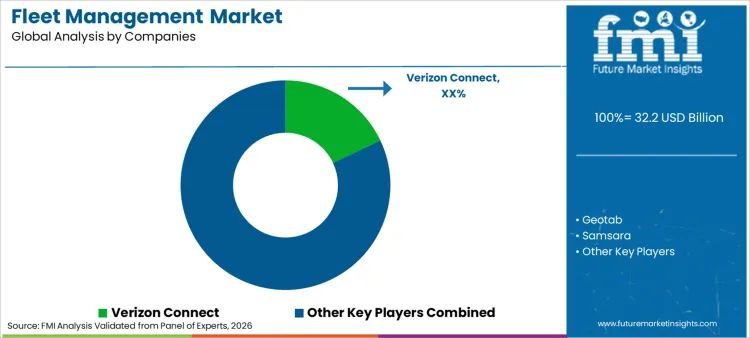
- Companies such as Verizon Connect and Geotab shape platform competition through connected vehicle data and enterprise account depth.
- Analyst Opinion
- Nikhil Kaitwade, Principal Consultant for Automotive at FMI, observes, “Fleet management is moving from vehicle tracking into daily cost control. Buyers now seek systems able to reduce service delays and prove driver safety across large mixed fleets. Suppliers connecting devices and compliance records are likely to shape the next phase of fleet digitization.”
- Fleet Management Market Value Analysis
- Fleet management platforms are shifting from basic vehicle tracking into connected systems able to manage compliance and asset uptime.
- Operator spending is tied to fuel control and vehicle utilization as fleets seek lower idle time across daily routes.
- Software providers are linking telematics with driver behavior data as safety programs move beyond incident recording.
- Demand is supported by logistics and service fleets seeking cloud dashboards combining routing and regulatory records.
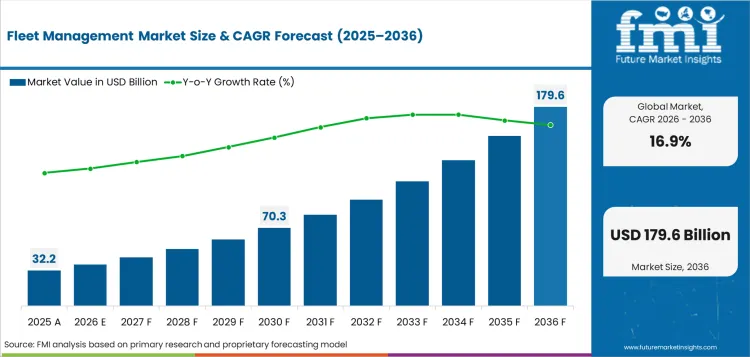
Key Takeaways
| Metric | Value |
|---|---|
| Market Size (2025) | USD 32.2 Billion |
| Market Size (2036) | USD 179.6 Billion |
| CAGR (2026–2036) | 16.9% |
| Incremental Opportunity (2026–2036) | USD 141.9 Billion |
| Leading Distribution Channel (2026) | Direct Sales |
| Direct Sales Share (2026) | 75.0% |
| Leading Component (2026) | Hardware |
| Hardware Share (2026) | 51.3% |
| Fastest-Growing Country | India |
| India CAGR | 17.8% |
| 2nd Fastest-Growing Country | China |
| China CAGR | 16.4% |
Paper freight records and preventable driving events are becoming harder to manage through disconnected tools. Freight compliance is moving toward platform-grade data exchange as the European Commission stated in January 2025 that eFTI-certified IT platforms can share standardized freight data from July 2027. Operators handling cross-border freight need systems able to keep regulatory data usable for authorities and business partners. EV fleet management is becoming a daily control function. Geotab stated in March 2025, sustainability solution deployment rose 39% during 2024 and connected EVs grew 63%. Buyers are looking for range and route data in the same fleet dashboard. Safety procurement is shifting in the same direction. Motive stated in January 2026, AI Dashcam Plus delivers three times more AI processing power and runs more than 30 AI models simultaneously. Camera vendors gain stronger positioning when they convert video from incident evidence into driver alerts and coaching signals.
Fleet Management Market Definition
Fleet management covers hardware and software used to monitor, route and maintain commercial vehicle groups. Scope includes GPS tracking devices, onboard devices and support services for daily fleet control. Revenue covers systems sold to fleet owners and transport operators for vehicle visibility and cost control. Services tied to setup and data handling are included if billed as part of fleet control systems.
Fleet Management Market Inclusions
Market scope includes vehicle tracking systems used across trucks and buses in commercial fleet operations. Railcars and aircraft support fleets are included if commercial fleet control revenue is identifiable. Component coverage includes hardware and software for collecting data and turning it into fleet decisions. Service revenue is included if tied directly to fleet system use. Application coverage includes tracking and geofencing for fleets requiring route proof and security alerts. Diagnostics, driver behavior and fuel control are handled as separate buyer needs. Distribution coverage includes direct sales and indirect sales for enterprise and channel-based fleet buyers. Online channels are included for subscription-based access aimed at smaller and digitally served fleet buyers.
Fleet Management Market Exclusions
Scope excludes private consumer navigation devices sold without fleet control features for commercial operators. Passenger infotainment and standalone insurance telematics are excluded unless sold as fleet tools to commercial operators. Vehicle leasing revenue is excluded from the market value to keep software and device revenue separate. Fuel cards and maintenance workshops are excluded unless software revenue is separately identifiable inside supplier contracts.
Fleet Management Market Research Methodology
- Primary Research: FMI analysts reviewed fleet platform features alongside buyer workflows and supplier positioning across transport and service fleets.
- Desk Research: Public transport data, vehicle regulation sources and official company releases supported the demand view.
- Market sizing and forecasting: Forecast values used supplied anchors, vehicle stock checks and segment-level share estimates.
- Data validation: Checks compared freight activity and commercial vehicle records and supplier product launches across major countries.
Why is the Fleet Management Market Growing?
- Commercial fleets are using telematics to connect vehicle location with compliance records and maintenance alerts.
- Operators are adding AI safety tools as camera data becomes useful for driver coaching and incident review.
- Route control adoption is rising as delivery fleets seek lower fuel waste and stronger customer time visibility.
Freight-heavy economies are giving fleet systems a larger operating role across routing and service control. Bureau of Transportation Statistics reported in March 2026, trucks moved USD 1.0 trillion of freight with Canada and Mexico during 2025. Cross-border freight creates repeated handoffs and delivery windows that manual tracking cannot manage reliably. Platform suppliers gain by connecting route status with driver logs and maintenance alerts. Buyers gain clearer proof of vehicle use and service delay exposure across repeated freight movements.
Digital tolling is creating another data layer for fleet cost control across road freight operations. India’s Ministry of Road Transport and Highways reported through PIB in January 2026 that 11.86 crore FASTags had been issued till December 2025. FASTag adoption gives operators a wider trail for route checks and toll cost review across paid road networks. Video safety platforms extend the same record into driver behavior and incident proof for safety managers. Fleet buyers expect one system to join location and safety data for daily operations.
Market Segmentation Analysis
- Hardware is projected to capture 51.3% share in 2026 because devices and sensors remain necessary before software can read vehicle data.
- Vehicle maintenance and diagnostics are forecast to account for 42.0% share in 2026, led by downtime control becoming a direct cost issue.
- On-premise systems are projected to account for 48.0% share in 2026 among large fleets with stricter data control needs.
- GPS-based systems are forecast to account for 42.0% share in 2026 as global positioning systems remain core to fleet visibility.
- Direct sales are projected to account for 75.0% share in 2026 as large buyers require account support and integration planning.
Market segmentation is structured around five primary groups: component, deployment model, vehicle type, end use, and fleet size. Component captures whether demand is for solutions or related services. Deployment model reflects cloud and on-premise preferences. Vehicle type and fleet size indicate operating scale, while end use highlights adoption differences across logistics, public transport, and service fleets.
Insights into Fleet Management Market by Deployment Model
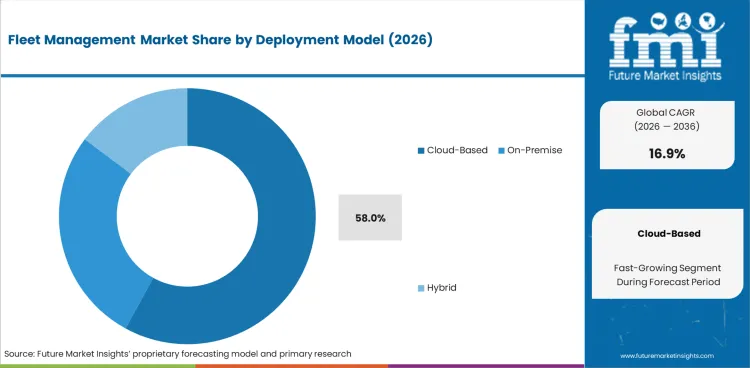
- Cloud-based deployment is forecast to capture 58.0% share in 2026 since multi-location fleets need remote access and faster software updates.
- On-premise deployment remains important for operators able to manage sensitive route data through internal IT controls.
Insights into Fleet Management Market by Fleet Size
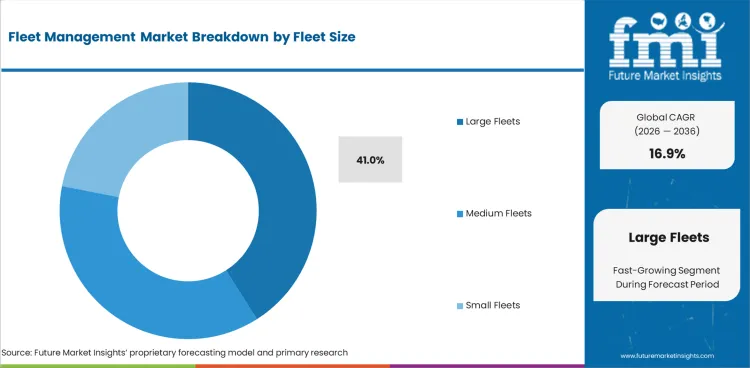
- Large fleets lead adoption with a share of 41% in 2026 as they prioritize compliance visibility and enterprise integrations across multi-location operations.
- Medium fleets adopt cloud dashboards to standardize dispatch and maintenance planning without building internal IT teams.
- Small fleets increasingly choose subscription bundles when upfront device cost and training time remain the main adoption barriers.
Insights into Fleet Management Market by End Use
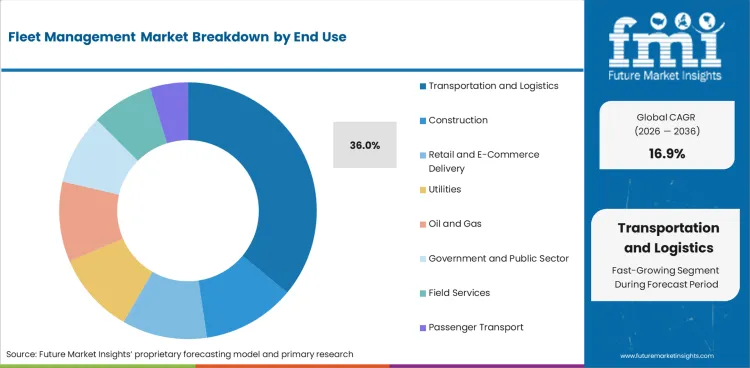
- Transportation and logistics are expected to hold 36.0% share in 2026 due to higher route density and stronger vehicle utilization needs.
- Construction and field services are adopting fleet systems as equipment movement and technician dispatch require tighter scheduling control.
Fleet Management Market Drivers, Restraints and Opportunities
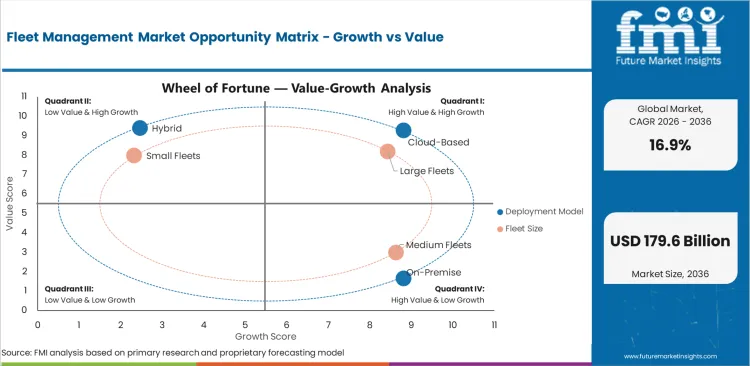
- Electronic driver records and toll data are making fleet platforms part of everyday compliance work.
- Upfront hardware cost can delay adoption in smaller fleets running vehicles with thin operating margins.
- AI safety cameras create opportunity as operators seek proof of coaching and incident handling.
Regulated data capture is expected to remain a core driver as fleet owners need defensible records for drivers and route activity. FMCSA states that an electronic logging device synchronizes with a vehicle engine to record a driver’s off-duty and on-duty time. It transfers hours-of-service data to a safety official for review. Engine-linked records reduce manual disputes and make compliance buying more practical for road freight operators. India’s Press Information Bureau reported in January 2026 that 11.86 crore FASTags had been issued till December 2025. Digital tolling adds another data layer for route checks and cost control across paid road networks. Geotab stated that Ace is available directly in the MyGeotab platform and uses fleet data such as predictive maintenance, trip data and GPS tracking. Suppliers gain when platforms turn compliance and safety records into simpler daily workflows for fleet managers.
Installed Base and Replacement Cycle Analysis
Europe’s aging commercial vehicle base is expected to support fleet management adoption as operators extend asset life before full replacement. ACEA stated in January 2025, EU roads had about 30.1 million vans and 6 million trucks in 2023. ACEA reported average truck age at 14.1 years and electrically chargeable truck share at 0.1%. Older trucks and vans keep maintenance risk high for freight and service fleets. Fleet operators are likely to use telematics and utilization data to decide which vehicles remain in service. Replacement planning will support platforms able to connect mileage and vehicle availability inside one operating view.
Production Capacity and Supplier Footprint Analysis
Supplier footprint in the fleet management market is better measured through platform scale and integration reach than factory capacity. Samsara stated in September 2025 that Q2 FY2026 ARR reached USD 1.640 billion and revenue reached USD 391.5 million. The company reported 2,771 customers with ARR above USD 100,000 and more than 350 partner integrations. Large fleets are expected to favor suppliers able to process high-volume vehicle data across safety and compliance workflows. Platform depth will play a larger role during vendor selection as fleet buyers move away from isolated tracking tools and toward connected operating systems.
Analysis of Fleet Management Market by Key Countries
.webp "Top Country Growth Comparison Fleet Management Market Cagr (2026 2036)")
| Country | CAGR |
|---|---|
| India | 17.8% |
| China | 16.4% |
| United Kingdom | 15.5% |
| United States | 15.2% |
| Germany | 14.9% |
| France | 14.8% |
| Japan | 13.7% |
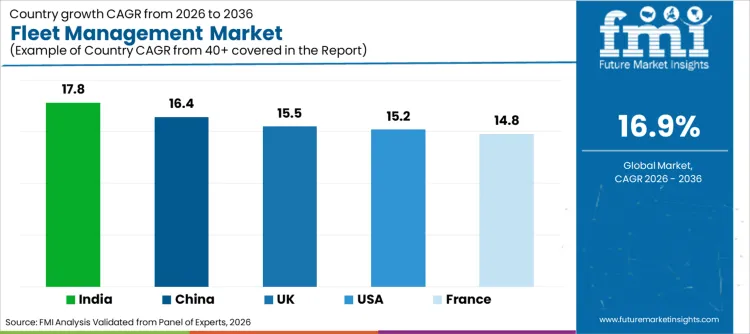
Source: Future Market Insights, 2026.
Fleet Management Market CAGR Analysis by Country
- India is projected to record 17.8% CAGR by 2036 due to digital tolling adoption and stronger freight visibility needs.
- China is expected to expand at 16.4% CAGR by 2036 as e-commerce logistics and connected commercial vehicle use support wider adoption.
- United Kingdom is forecast to grow at 15.5% CAGR by 2036, led by van fleet monitoring and tighter urban delivery control.
- United States is expected to advance at 15.2% CAGR by 2036 since ELD compliance and mature telematics use support freight fleet adoption.
- Germany is projected to rise at 14.9% CAGR, France at 14.8% CAGR, and Japan at 13.7% CAGR by 2036 through emissions planning and route efficiency needs.
Country performance differs by freight intensity and digital transport readiness. India and China track above the global pace due to expanding road logistics and stronger digital operating records. United Kingdom and United States remain close to the upper range as compliance and urban delivery visibility support platform adoption. Germany, France and Japan show measured expansion as operators focus on emissions planning, maintenance analytics and service reliability.
Demand Outlook for Fleet Management Market in the United States
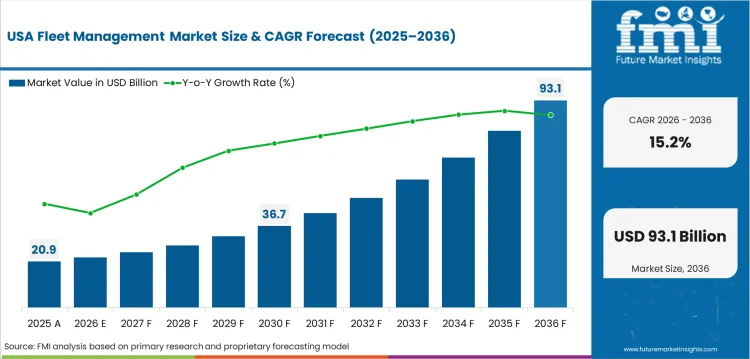
The sector in the United States is projected to record a 15.2% CAGR by 2036, as freight carriers combine compliance records with routing and service data. Federal Motor Carrier Safety Administration reported in September 2025, 2022 registrations included 11.08 million single-unit trucks and 3.25 million combination trucks. A large vehicle pool makes fleet software useful for service tracking and driver records. Enterprise buyers will favor vendors with uptime support and strong account coverage.
- Cross-border carriers can use tracking tools to manage handoffs across customs and carrier networks.
- Safety teams can use AI dashcams to document incidents and improve driver coaching programs.
- Maintenance managers can connect engine alerts with service planning for fewer unexpected vehicle stoppages.
Opportunity Analysis of Fleet Management Market in France
Demand in France is expected to expand at 14.8% CAGR by 2036, led by domestic freight carriers adding digital control across road fleets. France’s statistical office for sustainable development reported in April 2026, French heavy goods vehicles moved 168.2 billion tonne-km domestically in 2024. France’s freight scale supports routing and driver performance systems across national logistics operations. Suppliers with French-language support and EU compliance knowledge should gain preference among local buyers.
- Road haulers can use telematics to improve delivery proof and reduce disputes with shippers.
- Cold-chain operators can pair vehicle tracking with temperature alerts to protect regulated cargo.
- Public transport fleets can use connected systems to track vehicle availability and service punctuality.
Demand Analysis of Fleet Management Market in the United Kingdom
The industry in the United Kingdom is forecast to grow at 15.5% CAGR by 2036 since road freight remains central to domestic movement. Department for Transport reported in December 2025, road carried 168 billion tonne-km and represented 82% of domestic freight movement in 2024. High road reliance makes fleet visibility important for cost control and service timing. Buyers will value systems combining tachograph and maintenance records.
- Van fleets can use mobile tracking tools to improve delivery visibility across dense customer routes.
- Fleet owners can combine mobile tracking solutions with driver apps for daily dispatch and proof of service.
- Zero-emission light commercial vehicle growth will increase the need for battery and charging data across fleet systems.
Sales Analysis of Fleet Management Market in China
Sales in China are expected to advance at 16.4% CAGR by 2036 due to freight activity and domestic digital freight platforms supporting connected vehicle use. National Bureau of Statistics of China reported in February 2025, freight traffic reached 57.8 billion tons in 2024. Large transport volume gives telematics suppliers a broad customer pool. Domestic fleets will prioritize high-volume systems able to handle dense route data and driver safety records.
- Long-haul operators can use GPS routing to improve vehicle utilization over high-volume freight lanes.
- Domestic platform vendors can expand faster by connecting APAC automotive telematics with e-commerce and parcel networks.
- Electric commercial fleets can add fleet battery health tools as charging schedules become part of daily route planning.
Growth Outlook for Fleet Management Market in India
Demand in India is projected to rise at 17.8% CAGR by 2036, as tolling and fleet digitization reshape freight operations. Press Information Bureau reported in March 2026, National Highways Authority of India signed an agreement with vehicle aggregators to improve FASTag grievance reporting. Better toll data increases buyer interest in route costs and trip accountability. Fleet systems will gain adoption faster among operators seeking lower leakage and clearer vehicle use records.
- Truck owners can use route and toll data to compare planned trips with actual movement patterns.
- Logistics platforms can use telematics to improve driver assignment and vehicle availability across regional routes.
- Small fleet operators will need lower-cost packages before adoption extends beyond organized logistics groups.
Future Outlook for Fleet Management Market in Germany
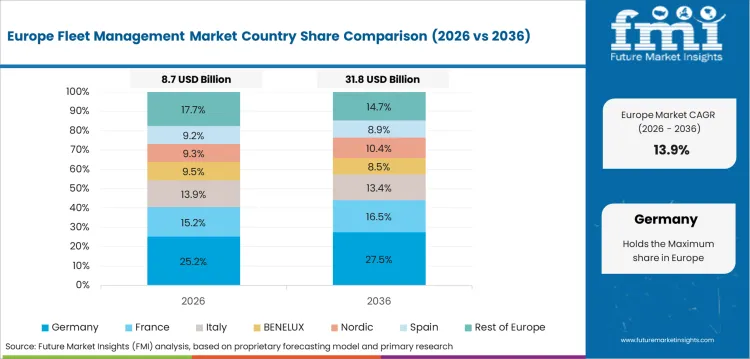
The sector in Germany is forecast at 14.9% CAGR by 2036 since road freight operators prepare for cleaner heavy transport and tighter cost control. Federal Statistical Office reported in May 2026, road freight transport handled 2.8 billion tonnes in 2024. Germany planned a truck fast-charging network covering around 350 locations in September 2024. Fleet platforms will need to connect vehicle tracking with charging and maintenance data.
- Heavy truck fleets can use telematics to plan charging stops and reduce schedule risk.
- Freight operators can pair heavy-duty truck fleet control units with diagnostics to improve workshop planning.
- Shippers will favor carriers able to provide clear delivery data and lower-emission vehicle reporting.
Demand Outlook for Fleet Management Market in Japan
The market in Japan is expected to post 13.7% CAGR by 2036 as logistics groups modernize amid driver shortages and commercial vehicle renewal. Japan Automobile Manufacturers Association reported in September 2025, truck production reached 995,000 units in 2024. Domestic truck manufacturing gives suppliers a route into factory-linked telematics and service partnerships. Adoption should favor platforms supporting reliability and simple driver workflows.
- Truck producers can pair automotive OEM telematics with service programs for better warranty and uptime data.
- Urban delivery fleets can use in-vehicle connectivity to improve route reporting without adding separate manual checks.
- Aging driver availability will support systems reducing paperwork and make daily trip records easier to manage.
Competitive Landscape and Strategic Positioning
- Platform providers are better placed if hardware and software work together across mixed vehicle fleets.
- AI camera suppliers compete by proving fewer safety events and faster driver feedback cycles.
- OEM-linked providers gain account access through factory hardware and embedded vehicle data paths.
- Regional channel partners win with field setup support and faster response for mid-sized fleets.
The fleet management market is becoming increasingly competitive as platforms evolve from standalone tracking tools into integrated, data-driven ecosystems. Companies such as Verizon Connect and Samsara are focusing on broad platform coverage and enterprise customer reach. Motive has sharpened competition with AI dashcam hardware and vehicle inspection tools. Geotab reported roughly 5 million connected vehicles under subscription in August 2025. Platform scale gives leading vendors more data depth for benchmarks and product tuning. Buyers compare vendors on uptime, service coverage and user simplicity.
Platform Science completed its acquisition of Trimble’s transportation telematics business in February 2025. Platform Science’s transaction indicates how OEM-linked access and software integration have become stronger competitive filters. Teletrac Navman and Azuga add video safety depth through AI cameras. Webfleet supports European fleets through routing and maintenance tools. Competitive strength will depend on connecting in-vehicle connectivity with daily fleet decisions. Fleet software update validation test platform will remain important as vehicles receive more remote updates.
Key Companies in the Fleet Management Market
Competition is clearer by role as platform software and safety analytics differ across suppliers.
- Global Platform Providers: Verizon Connect and Geotab serve large fleets through broad dashboards. Samsara and Motive support the same buyer group with safety tools.
- Transportation System Firms: Platform Science and Trimble Transportation support freight customers through routing. Omnitracs adds compliance features for carrier operations.
- Video Safety Specialists: Teletrac Navman and Azuga compete through cameras. Webfleet adds driver coaching and risk alert tools.
- Regional and Channel Players: Fleet Complete and Mix Telematics support fleets requiring flexible implementation and local sales coverage.
- Electric Fleet Support: Geotab, Webfleet and Fleet Complete are expanding tools for charging and vehicle energy monitoring.
Competitive Benchmarking: Fleet Management Market
| Company | Real-Time Fleet Data Depth | AI Safety Capability | OEM Integration Strength | Geographic Footprint |
|---|---|---|---|---|
| Verizon Connect | High | Strong | Medium | Global with strong North American enterprise reach |
| Geotab | High | Strong | Strong | Global with broad connected vehicle scale |
| Samsara | High | Strong | Medium | North America and Europe centered with fast platform adoption |
| Motive | High | Strong | Medium | United States centered with AI hardware focus |
| Teletrac Navman | Medium | Strong | Medium | North America, Europe and Oceania presence |
| Omnitracs | Medium | Medium | Medium | North America centered freight management reach |
| Trimble Transportation | Medium | Medium | Strong | Transportation software reach through Platform Science |
| Fleet Complete | Medium | Medium | Medium | North America and partner-channel strength |
| Azuga | Medium | Strong | Low | North America centered video and tracking focus |
| Mix Telematics | Medium | Medium | Medium | Global with strength in regulated and remote fleets |
Source: Future Market Insights competitive analysis, 2026. Ratings reflect relative positioning based on real-time data depth, AI safety tools and OEM integration strength.
Key Developments in Fleet Management Market
- In February 2025, Platform Science completed the acquisition of Trimble’s global transportation telematics business.
- In September 2025, Geotab launched GO Focus Plus with AI-based in-cab verbal alerts. The large pilot reported 90% lower tailgating and 95% lower phone use.
- In April 2026, Samsara and International Motors expanded pre-delivery installation support for connected fleet equipment.
Key Players in the Fleet Management Market
Major Global Players
- Verizon Connect
- Geotab
- Samsara
- Motive
- Teletrac Navman
- Omnitracs
- Trimble Transportation
Specialist and Regional Players
- Fleet Complete
- Azuga
- Mix Telematics
- Webfleet
- Platform Science
Report Scope and Coverage
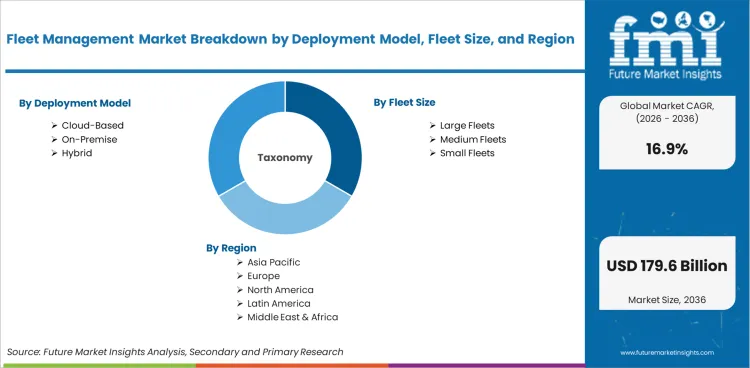
Fleet Management Market Segmented by Component, Deployment Model, Vehicle Type, Fleet Size, End Use, and Region.
| Parameter | Details |
|---|---|
| Quantitative Units | USD 37.7 billion to USD 179.6 billion, at 16.9% CAGR |
| Market Definition | Hardware and software used to monitor commercial vehicle groups. Services are included if tied to system use |
| Component |
|
| Deployment Model |
|
| End Use |
|
| Fleet Size |
|
| Regions Covered | North America, Latin America, Western Europe, Eastern Europe, East Asia, South Asia and Pacific, Middle East and Africa |
| Countries Covered | United States, France, United Kingdom, China, India, Germany, Japan and 30+ countries |
| Key Companies Profiled | Verizon Connect, Geotab, Samsara, Motive, Teletrac Navman, Omnitracs, Trimble Transportation, Fleet Complete, Azuga, Mix Telematics |
| Forecast Period | 2026 to 2036 |
| Approach | Hybrid top-down and bottom-up sizing using supplied values. Fleet activity checks and supplier evidence supported validation |
Source: Future Market Insights, 2026.
Fleet Management Market by Segments
Fleet Management Market Segmented by Component:
- Hardware
- Solutions
- Services
Fleet Management Market Segmented by Deployment Model:
- Cloud-Based
- On-Premise
- Hybrid
Fleet Management Market Segmented by Vehicle Type:
- Light Commercial Vehicles
- Medium Commercial Vehicles
- Heavy Commercial Vehicles
- Passenger Fleet Vehicles
Fleet Management Market Segmented by Fleet Size:
- Small Fleets
- Medium Fleets
- Large Fleets
Fleet Management Market Segmented by End Use:
- Transportation and Logistics
- Construction
- Retail and E-Commerce Delivery
- Utilities
- Oil and Gas
- Government and Public Sector
- Field Services
- Passenger Transport
Research Sources and Bibliography
- European Commission, Directorate-General for Mobility and Transport. (2025, January 9). Towards paperless freight transport: EU takes a step forward with eFTI Regulation implementation.
- U.S. Environmental Protection Agency. (2024, March 29). Final rule: Greenhouse gas emissions standards for heavy-duty vehicles - Phase 3.
- Geotab. (2025, March 26). Geotab releases 2024 sustainability and impact report: Profitable sustainability.
- Motive. (2026, January 8). Motive launches AI Dashcam Plus, powering a new era of edge AI safety for physical operations.
- Samsara Inc. (2025, September 4). Samsara announces customer and platform growth milestones with Q2 FY26 results.
- European Automobile Manufacturers’ Association. (2025, January 29). Report - Vehicles on European roads 2025.
- Azuga. (2025, April 28). Azuga unveils next-gen AI-powered SafetyCam to redefine fleet safety.
- Bureau of Transportation Statistics. (2026, March 13). Transborder freight data annual report: 2025.
- Federal Motor Carrier Safety Administration. (2025, September 3). 2024 pocket guide to large truck and bus statistics.
- Federal Motor Carrier Safety Administration. (2026, May 7). FMCSA removes Safe ELD and MYLOGS ELD from list of registered electronic logging devices.
- Federal Statistical Office of Germany. (2026, May 8). Truck toll mileage index in April 2026: -0.7% on the previous month.
- Geotab. (2025, June 2). Geotab unveils Ace: The first fully integrated trusted generative AI copilot in the industry.
- Geotab. (2025, September 15). Geotab’s new AI dash cam slashes risky driving behaviours by up to 95% with in-cab verbal alerts.
- Japan Automobile Manufacturers Association. (2025, September). The motor industry of Japan 2025.
- National Bureau of Statistics of China. (2026, February 28). Statistical communiqué of the People’s Republic of China on the 2025 national economic and social development.
- National Centre for Charging Infrastructure. (2024, September 16). Wissing: Tender to be launched in September.
- Trimble Inc. (2025, February 10). Platform Science completes acquisition of Trimble’s global transportation telematics business units.
- Press Information Bureau. (2026, January 29). Collection and FASTag adoption.
- Press Information Bureau. (2026, March 10). NHAI signs MoU with commercial vehicle aggregator platforms to simplify FASTag grievance reporting.
- Samsara Inc. (2025, June 24). Samsara announces new safety and AI-powered technology to transform physical operations.
- Samsara Inc. (2025, September 23). Samsara unveils major expansion of AI-powered safety platform.
- Samsara Inc. (2026, April 9). Samsara expands pre-delivery installation program with International Motors partnership.
- Service des données et études statistiques. (2026, April). Transport routier de marchandises - Édition 2026.
- Teletrac Navman. (2025, July 22). Teletrac Navman debuts Multi IQ.
- United Kingdom Department for Transport. (2025, December 17). Transport statistics Great Britain: 2025.
- Webfleet. (2025, October 29). Webfleet and Questar launch pioneering AI-powered predictive maintenance solution.
Bibliography uses government sources, official company evidence and non-commercial industry bodies relevant to fleet management demand signals.
This Report Answers
- What is the current and future size of the fleet management market?
- How fast is the fleet management market expected to expand between 2026 and 2036?
- Which component is expected to account for the leading fleet management share in 2026?
- Which application is projected to account for the leading fleet management share in 2026?
- Why are vehicle maintenance and diagnostics important for fleet management demand?
- How do GPS-based systems support fleet management adoption?
- Which countries are projected to record faster expansion during the forecast period?
- Who are the main companies active in fleet management and telematics supply?
- How does FMI define the fleet management market scope?
- How does FMI estimate and validate the fleet management forecast?
Frequently Asked Questions
What is the global market demand for fleet management in 2026?
In 2026, the fleet management market is expected to cross USD 37.7 billion as fleets digitize routing and safety workflows.India is projected to record 17.8% CAGR by 2036 as toll digitization and organized logistics use expand.
How big will the fleet management market be in 2036?
By 2036, the fleet management industry is anticipated to reach USD 179.6 billion as connected operations become standard across commercial fleets.
How much is demand for fleet management expected to expand between 2026 and 2036?
Between 2026 and 2036, the fleet management sector is projected to expand at 16.9% CAGR as digital fleet control widens.
Which component is expected to lead the fleet management market by 2026?
Hardware is projected to represent 51.3% share in 2026 since tracking units and sensors create the first vehicle data layer.
Which application is expected to lead fleet management demand in 2026?
Vehicle maintenance and diagnostics are projected to account for 42.0% share in 2026 as fleets focus on fewer unplanned repairs.
Which country is forecast to grow fastest in the fleet management market?
India is projected to record 17.8% CAGR by 2036 as toll digitization and organized logistics use expand.
What does the fleet management market include?
Scope includes hardware and software used for vehicle tracking and diagnostics. Driver monitoring, fuel control and fleet administration complete the core coverage.
How does FMI estimate the fleet management market forecast?
FMI uses supplied values, vehicle activity checks and supplier evidence to validate forecast size and segment shares.
Why are GPS based systems important in fleet management?
GPS-based systems provide location data needed for route visibility, trip proof and dispatch control across mixed vehicle fleets.
Who uses fleet management systems?
Main users include logistics firms and public transport operators. Construction fleets, mining fleets and service vehicle owners complete the user group.
Preview the report firsthand - request a free sample
Get SampleGet the brochure for pricing and purchase details.
Get PDFTable of Content
- Key Takeaways
- Market Size and CAGR
- Top Growth Driver
- Fastest Growing Segment
- Leading Region
- Key Companies
- Emerging Opportunities
- Executive Summary
- Global Market Outlook
- Demand-side Trends
- Supply-side Trends
- Technology Roadmap Analysis
- Analysis and Recommendations
- Analyst Perspective (What is happening? Why now? What should investors know?)
- Key Questions Answered
- How large is the market?
- What is the CAGR?
- What are key trends?
- Which region dominates?
- Who are the leaders?
- Market Overview
- Market Coverage / Taxonomy
- Market Definition / Scope / Limitations
- Research Methodology
- Chapter Orientation
- Analytical Lens and Working Hypotheses
- Market Structure, Signals, and Trend Drivers
- Benchmarking and Cross-market Comparability
- Market Sizing, Forecasting, and Opportunity Mapping
- Research Design and Evidence Framework
- Desk Research Programme (Secondary Evidence)
- Expert Input and Fieldwork (Primary Evidence)
- Tooling, Models, and Reference Databases
- Data Engineering and Model Build
- Quality Assurance and Audit Trail
- Market Background
- Market Dynamics (Drivers, Restraints, Opportunity, Trends)
- Scenario Forecast (Optimistic, Likely, Conservative)
- Impact Analysis
- AI Impact
- Sustainability Impact
- Regulatory Impact
- Technology Impact
- Consumer / Buyer Analysis
- Purchase Drivers
- Adoption Barriers
- Buyer Journey
- Opportunity Map Analysis
- Product Life Cycle Analysis
- Supply Chain Analysis
- Investment Feasibility Matrix
- Value Chain Analysis
- PESTLE and Porter's Analysis
- Regulatory Landscape
- Regional Parent Market Outlook
- Production and Consumption Statistics
- Import and Export Statistics
- Global Market Analysis and Forecast, 2021 to 2036
- Historical Market Size Value (USD Billion) Analysis, 2021 to 2025
- Current and Future Market Size Value (USD Billion) Projections, 2026 to 2036
- Y-o-Y Growth Trend Analysis
- Absolute $ Opportunity Analysis
- Global Market Pricing Analysis, 2021 to 2036
- Global Market Analysis and Forecast, By Deployment Model, 2021 to 2036
- Introduction / Key Findings
- Historical Market Size Value (USD Billion) Analysis By Deployment Model, 2021 to 2025
- Current and Future Market Size Value (USD Billion) Analysis and Forecast By Deployment Model, 2026 to 2036
- Cloud-Based
- On-Premise
- Hybrid
- Cloud-Based
- Y-o-Y Growth Trend Analysis By Deployment Model, 2021 to 2025
- Absolute $ Opportunity Analysis By Deployment Model, 2026 to 2036
- Global Market Analysis and Forecast, By Fleet Size, 2021 to 2036
- Introduction / Key Findings
- Historical Market Size Value (USD Billion) Analysis By Fleet Size, 2021 to 2025
- Current and Future Market Size Value (USD Billion) Analysis and Forecast By Fleet Size, 2026 to 2036
- Large Fleets
- Medium Fleets
- Small Fleets
- Large Fleets
- Y-o-Y Growth Trend Analysis By Fleet Size, 2021 to 2025
- Absolute $ Opportunity Analysis By Fleet Size, 2026 to 2036
- Global Market Analysis and Forecast, By End Use, 2021 to 2036
- Introduction / Key Findings
- Historical Market Size Value (USD Billion) Analysis By End Use, 2021 to 2025
- Current and Future Market Size Value (USD Billion) Analysis and Forecast By End Use, 2026 to 2036
- Transportation and Logistics
- Construction
- Retail and E-Commerce Delivery
- Utilities
- Oil and Gas
- Government and Public Sector
- Field Services
- Passenger Transport
- Transportation and Logistics
- Y-o-Y Growth Trend Analysis By End Use, 2021 to 2025
- Absolute $ Opportunity Analysis By End Use, 2026 to 2036
- Global Market Analysis and Forecast, By Vehicle Type, 2021 to 2036
- Introduction / Key Findings
- Historical Market Size Value (USD Billion) Analysis By Vehicle Type, 2021 to 2025
- Current and Future Market Size Value (USD Billion) Analysis and Forecast By Vehicle Type, 2026 to 2036
- Light Commercial Vehicles
- Medium Commercial Vehicles
- Heavy Commercial Vehicles
- Passenger Fleet Vehicles
- Light Commercial Vehicles
- Y-o-Y Growth Trend Analysis By Vehicle Type, 2021 to 2025
- Absolute $ Opportunity Analysis By Vehicle Type, 2026 to 2036
- Global Market Analysis and Forecast, By Component, 2021 to 2036
- Introduction / Key Findings
- Historical Market Size Value (USD Billion) Analysis By Component, 2021 to 2025
- Current and Future Market Size Value (USD Billion) Analysis and Forecast By Component, 2026 to 2036
- Hardware
- Solutions
- Services
- Hardware
- Y-o-Y Growth Trend Analysis By Component, 2021 to 2025
- Absolute $ Opportunity Analysis By Component, 2026 to 2036
- Global Market Analysis and Forecast, By Region, 2021 to 2036
- Introduction
- Historical Market Size Value (USD Billion) Analysis By Region, 2021 to 2025
- Current Market Size Value (USD Billion) Analysis and Forecast By Region, 2026 to 2036
- North America
- Latin America
- Western Europe
- Eastern Europe
- East Asia
- South Asia and Pacific
- Middle East & Africa
- Market Attractiveness Analysis By Region
- North America Market Analysis and Forecast, By Country, 2021 to 2036
- Historical Market Size Value (USD Billion) Trend Analysis By Market Taxonomy, 2021 to 2025
- Market Size Value (USD Billion) Forecast By Market Taxonomy, 2026 to 2036
- By Country
- USA
- Canada
- By Deployment Model
- By Fleet Size
- By End Use
- By Vehicle Type
- By Component
- By Country
- Market Attractiveness Analysis
- By Country
- By Deployment Model
- By Fleet Size
- By End Use
- By Vehicle Type
- By Component
- Key Takeaways
- Latin America Market Analysis and Forecast, By Country
- Historical Market Size Value (USD Billion) Trend Analysis By Market Taxonomy, 2021 to 2025
- Market Size Value (USD Billion) Forecast By Market Taxonomy, 2026 to 2036
- By Country
- Brazil
- Mexico
- Chile
- Rest of Latin America
- By Deployment Model
- By Fleet Size
- By End Use
- By Vehicle Type
- By Component
- By Country
- Market Attractiveness Analysis
- By Country
- By Deployment Model
- By Fleet Size
- By End Use
- By Vehicle Type
- By Component
- Key Takeaways
- Western Europe Market Analysis and Forecast, By Country
- Historical Market Size Value (USD Billion) Trend Analysis By Market Taxonomy, 2021 to 2025
- Market Size Value (USD Billion) Forecast By Market Taxonomy, 2026 to 2036
- By Country
- Germany
- UK
- Italy
- Spain
- France
- Nordic
- BENELUX
- Rest of Western Europe
- By Deployment Model
- By Fleet Size
- By End Use
- By Vehicle Type
- By Component
- By Country
- Market Attractiveness Analysis
- By Country
- By Deployment Model
- By Fleet Size
- By End Use
- By Vehicle Type
- By Component
- Key Takeaways
- Eastern Europe Market Analysis and Forecast, By Country
- Historical Market Size Value (USD Billion) Trend Analysis By Market Taxonomy, 2021 to 2025
- Market Size Value (USD Billion) Forecast By Market Taxonomy, 2026 to 2036
- By Country
- Russia
- Poland
- Hungary
- Balkan & Baltic
- Rest of Eastern Europe
- By Deployment Model
- By Fleet Size
- By End Use
- By Vehicle Type
- By Component
- By Country
- Market Attractiveness Analysis
- By Country
- By Deployment Model
- By Fleet Size
- By End Use
- By Vehicle Type
- By Component
- Key Takeaways
- East Asia Market Analysis and Forecast, By Country
- Historical Market Size Value (USD Billion) Trend Analysis By Market Taxonomy, 2021 to 2025
- Market Size Value (USD Billion) Forecast By Market Taxonomy, 2026 to 2036
- By Country
- China
- Japan
- South Korea
- By Deployment Model
- By Fleet Size
- By End Use
- By Vehicle Type
- By Component
- By Country
- Market Attractiveness Analysis
- By Country
- By Deployment Model
- By Fleet Size
- By End Use
- By Vehicle Type
- By Component
- Key Takeaways
- South Asia and Pacific Market Analysis and Forecast, By Country
- Historical Market Size Value (USD Billion) Trend Analysis By Market Taxonomy, 2021 to 2025
- Market Size Value (USD Billion) Forecast By Market Taxonomy, 2026 to 2036
- By Country
- India
- ASEAN
- Australia & New Zealand
- Rest of South Asia and Pacific
- By Deployment Model
- By Fleet Size
- By End Use
- By Vehicle Type
- By Component
- By Country
- Market Attractiveness Analysis
- By Country
- By Deployment Model
- By Fleet Size
- By End Use
- By Vehicle Type
- By Component
- Key Takeaways
- Middle East & Africa Market Analysis and Forecast, By Country
- Historical Market Size Value (USD Billion) Trend Analysis By Market Taxonomy, 2021 to 2025
- Market Size Value (USD Billion) Forecast By Market Taxonomy, 2026 to 2036
- By Country
- Kingdom of Saudi Arabia
- Other GCC Countries
- Türkiye
- South Africa
- Other African Union
- Rest of Middle East & Africa
- By Deployment Model
- By Fleet Size
- By End Use
- By Vehicle Type
- By Component
- By Country
- Market Attractiveness Analysis
- By Country
- By Deployment Model
- By Fleet Size
- By End Use
- By Vehicle Type
- By Component
- Key Takeaways
- Key Countries Market Analysis
- USA
- Pricing Analysis
- Market Share Analysis, 2025
- By Deployment Model
- By Fleet Size
- By End Use
- By Vehicle Type
- By Component
- Canada
- Pricing Analysis
- Market Share Analysis, 2025
- By Deployment Model
- By Fleet Size
- By End Use
- By Vehicle Type
- By Component
- Mexico
- Pricing Analysis
- Market Share Analysis, 2025
- By Deployment Model
- By Fleet Size
- By End Use
- By Vehicle Type
- By Component
- Brazil
- Pricing Analysis
- Market Share Analysis, 2025
- By Deployment Model
- By Fleet Size
- By End Use
- By Vehicle Type
- By Component
- Chile
- Pricing Analysis
- Market Share Analysis, 2025
- By Deployment Model
- By Fleet Size
- By End Use
- By Vehicle Type
- By Component
- Germany
- Pricing Analysis
- Market Share Analysis, 2025
- By Deployment Model
- By Fleet Size
- By End Use
- By Vehicle Type
- By Component
- UK
- Pricing Analysis
- Market Share Analysis, 2025
- By Deployment Model
- By Fleet Size
- By End Use
- By Vehicle Type
- By Component
- Italy
- Pricing Analysis
- Market Share Analysis, 2025
- By Deployment Model
- By Fleet Size
- By End Use
- By Vehicle Type
- By Component
- Spain
- Pricing Analysis
- Market Share Analysis, 2025
- By Deployment Model
- By Fleet Size
- By End Use
- By Vehicle Type
- By Component
- France
- Pricing Analysis
- Market Share Analysis, 2025
- By Deployment Model
- By Fleet Size
- By End Use
- By Vehicle Type
- By Component
- India
- Pricing Analysis
- Market Share Analysis, 2025
- By Deployment Model
- By Fleet Size
- By End Use
- By Vehicle Type
- By Component
- ASEAN
- Pricing Analysis
- Market Share Analysis, 2025
- By Deployment Model
- By Fleet Size
- By End Use
- By Vehicle Type
- By Component
- Australia & New Zealand
- Pricing Analysis
- Market Share Analysis, 2025
- By Deployment Model
- By Fleet Size
- By End Use
- By Vehicle Type
- By Component
- China
- Pricing Analysis
- Market Share Analysis, 2025
- By Deployment Model
- By Fleet Size
- By End Use
- By Vehicle Type
- By Component
- Japan
- Pricing Analysis
- Market Share Analysis, 2025
- By Deployment Model
- By Fleet Size
- By End Use
- By Vehicle Type
- By Component
- South Korea
- Pricing Analysis
- Market Share Analysis, 2025
- By Deployment Model
- By Fleet Size
- By End Use
- By Vehicle Type
- By Component
- Russia
- Pricing Analysis
- Market Share Analysis, 2025
- By Deployment Model
- By Fleet Size
- By End Use
- By Vehicle Type
- By Component
- Poland
- Pricing Analysis
- Market Share Analysis, 2025
- By Deployment Model
- By Fleet Size
- By End Use
- By Vehicle Type
- By Component
- Hungary
- Pricing Analysis
- Market Share Analysis, 2025
- By Deployment Model
- By Fleet Size
- By End Use
- By Vehicle Type
- By Component
- Kingdom of Saudi Arabia
- Pricing Analysis
- Market Share Analysis, 2025
- By Deployment Model
- By Fleet Size
- By End Use
- By Vehicle Type
- By Component
- Türkiye
- Pricing Analysis
- Market Share Analysis, 2025
- By Deployment Model
- By Fleet Size
- By End Use
- By Vehicle Type
- By Component
- South Africa
- Pricing Analysis
- Market Share Analysis, 2025
- By Deployment Model
- By Fleet Size
- By End Use
- By Vehicle Type
- By Component
- USA
- Market Structure Analysis
- Competition Dashboard
- Competition Benchmarking
- Market Share Analysis of Top Players
- By Regional
- By Deployment Model
- By Fleet Size
- By End Use
- By Vehicle Type
- By Component
- Emerging Startups
- Innovation Benchmarking
- Competition Analysis
- Competition Deep Dive
- Verizon Connect
- Overview
- Product Portfolio
- Profitability by Market Segments
- Sales Footprint
- Strategy Overview
- Marketing Strategy
- Product Strategy
- Channel Strategy
- Geotab
- Samsara
- Motive
- Teletrac Navman
- Omnitracs
- Trimble Transportation
- Verizon Connect
- Case Studies
- Success Stories
- Recent Developments
- Competition Deep Dive
- Assumptions & Acronyms Used


